ARTIN THE KURD.
Reading edition
BY G. B. BURGIN.
I.
am not afraid of you," said the Rev. William P. Marsh. "You know very well that I am an American missionary and that you dare not touch me."
Karin the son of Artog looked somewhat ruefully at Oglou the son of Kizzil. "The infidel dog speaks truth," said he. "We must be careful, or the Vali's soldiers will hear of it, and it will take much bakshish to free us. What shall we do with him?"
Before Oglou the son of Kizzil could reply, the Rev. William P. Marsh took a small Bible from his pocket. "The subject of my discourse," he remarked, tucking a horse-blanket over his feet to keep off the cold, and comfortably resting his back against the side of the mountain—"the subject of my discourse this evening will be on the sinfulness of taking what does not belong to us. I shall be enabled to put more vigor into my remarks from the fact that you have robbed me of all my money, have likewise stolen my horse and saddle-bags. As I came to this country just to look after your miserable souls, it's pretty mean of you. However, we will now consider the subject in its primary aspects; thence we will touch upon original sin; and after that I propose to present for your prayerful consideration the subject of Kurdish sin, which seems to be a pretty big variety in itself."
He deliberately turned over the leaves of his well-thumbed Bible in search of an appropriate text for these two ruffians who had waylaid and robbed him within five miles of Kharput. Karin the son of Artog looked irresolutely at Oglou the son of Kizzil.
"It would be simpler to cut this missionary pig's throat," he suggested, stroking his long mustache. "Perhaps the Vali would be only too glad to get rid of him."
"I should like to; I have not killed any one for a week," rejoined Oglou the son of Kizzil, with much fervor. "But—" He hesitated.
The missionary did not understand Kurdish, and spoke in Armenian. "It would be more becoming," he remarked, "for you to sit down and listen to me without interruption. You may never have such another chance."
The quick eyes of Karin the son of Artog caught a glimmer of arms in the plain below them. All around the mountain pass was flecked with snow. "Proclaimed by all the trumpets of the sky," fresh masses began to fall. Their own village was a good many miles away. This mad hodga would continue to preach until he talked them to death. The Turkish zaptiehs, winding slowly up from the plain below, might ask inconvenient questions and appropriate all the plunder.
"After all, it is only four liras," suggested Oglou the son of Kizzil. "If we cut his throat, the zaptiehs will come after us, and our horses are done up. Better tell him we repent and give him back the money."
"When Allah, the All Great, has given us this money," sententiously said Karin the son of Artog, "it is showing ourselves thankless to throw it aside. But—perhaps it is as well. We can always catch him again when there aren't any zaptiehs about. Let us repent and get away before we are caught by these sons of burnt mothers, the zaptiehs."
Hence it was the Rev. William P. Marsh felt that his efforts at conversion had been suddenly blessed. "Maybe I was a bit hard on you," he said, affably, as the two Kurds helped him into the saddle. "If ever you show yourselves in Kharput, just come and see me and let me know how you're getting on. I don't want either of you to backslide after this act of grace, for I know how badly you must feel at giving back this money. I could see just now that nothing but the fear of the Lord prevented you from cutting my throat. If that stops you from cutting your neighbors' throats in your usual hasty fashion, you'll be very glad you tried to rob me by the way, and were brought to repentance. Now here's this Bible of mine, beautifully printed in Armenian. Maybe some one could read it to you when you feel inclined to go out and plunder your neighbors after the fashion of these parts. If you like to have it just say so, and I'll make you a present of it."
"Some day we will bring it back to you, Effendi," obsequiously said Karin the son of Artog, as the two picturesque-looking villains helped the infirm old missionary into the saddle. "Where is your house?"
"By the big college; you can't mistake it," said the old missionary, cheerfully. "Just ask for me, and you shall have a square meal first and some square truth afterwards. But I must get on." He jogged his patient old horse with one spurless heel, and shuffled away in the direction of Kharput, lifting up his voice in a hymn of praise as he disappeared in the gathering night.
Karin the son of Artog and Oglou the son of Kizzil watched the receding old man with a grin. "Four liras!" said the one. "Four liras!" echoed the other. "Now for the zaptiehs." The two cronies turned in the direction of the approaching force, but it was not to be seen.
"They've turned off, and are not coming up the mountain at all," mournfully suggested Karin the son of Artog.
"Oh, if we had only known, sons of dead asses that we are!" wrathfully replied Oglou the son of Kizzil.
"We would have cut his throat and kept the money," they added, simultaneously.
But the good old missionary jogged up the steep incline to Kharput, feeling that he had not lived in vain, and that the mission report for that year of grace, 1880, would contain the first authentic instance of the sudden conversion to Christianity of two Kurd desperadoes.
"Allah is with him" (an Eastern equivalent for stating that a man is mad), said Karin the son of Artog, leaping on his wiry pony and digging his shovel-shaped stirrups into its hairy sides.
"We must have been mad too," suggested Oglou the son of Kizzil, as he galloped down the mountain-side after his friend, "to give him back four liras when I would have cut his throat for a medjidieh!"
II.
HE MADE A VICIOUS THRUST AT HIS FRIEND'S HEART.
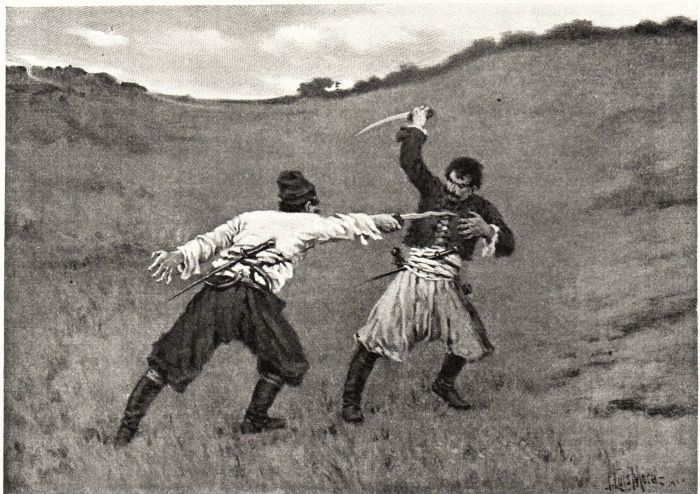
A few days later Karin the son of Artog had a slight difference of opinion with Oglou the son of Kizzil. No one knew how the quarrel originated, but it ended in Karin the son of Artog drawing an extremely sharp and crooked sword and rushing upon Oglou the son of Kizzil with the indecorous observation that he would slice out his liver. Although Karin the son of Artog was theoretically acquainted with the position of the human liver he had no practical knowledge of the fact, and, consequently, made a vicious thrust at his old friend's heart. Fortunately for Oglou the son of Kizzil, the point of the sword caught in the cover of the old missionary's Bible, and whilst Karin the son of Artog futilely endeavored to get it out again, Oglou the son of Kizzil, with the neat and effective back-stroke which was his one vanity, cut off the head of Karin the son of Artog. Oglou the son of Kizzil had placed the Bible over his heart as an amulet; hence, this providential instance of its powers more than ever convinced him of its utility as a charm to ward off misfortune. However this may have been, it could not protect the son of Kizzil from the somewhat inopportune attentions of his late friend's clan. The relations, with that blind haste which generally distinguishes the actions of relatives, promptly assumed that Oglou the son of Kizzil had been the aggressor, and demanded "blood-money." Here again arose another difference of opinion. Oglou the son of Kizzil, whilst willing to testify to the admirable qualities of his late friend Karin the son of Artog, felt inclined to rate those qualities at a lower market value than seemed becoming to the dead man's friends. Three liras and a pony seemed to Oglou the son of Kizzil an adequate tribute to the virtues of the defunct warrior. He was willing, as a concession to sentiment, to throw in a praying-carpet with the pony, but was not prepared to do more. As a tribute to old friendship, however, he would marry the widow and take over the household. To this ultimatum the widow, through the medium of a white-haired old chief, her father, replied that Oglou the son of Kizzil had insulted her by supposing that she could ever have married a man whose "blood-money" would scarcely suffice for the funeral expenses, and that it would be well, in view of the circumstances, for Oglou the son of Kizzil to put his house in order and bid farewell to a world which he had too long disgraced by his presence.
With feminine unfairness, the widow of Karin the son of Artog did not give Oglou the son of Kizzil a start, for his relations were scattered about on different plundering expeditions, and were much too busy to attend to their kinsman's sudden call for aid. One morning, that darkest hour before the dawn in which ill deeds are done, Oglou the son of Kizzil was awakened by a smell of burning thatch.
"Ugh!" he grunted, feeling to see whether his yataghan was in order. "She's set her relations on to me. I should like to marry that woman. I wonder how many of them are outside."
Whilst he was still pondering, a bullet came through the wall of the hut, and scattered little pellets of mud all round. This seemed to Oglou the son of Kizzil a hint that it was about time for him to be off. With characteristic forethought he had tethered his pony in the hut. Picking up his small one-year-old son, the joy of his heart and the pride of his eyes, Oglou the son of Kizzil mounted his pony, rushed through the crazy door, tumbling against a crowd of Kurds who were waiting to receive him, and the next moment was madly galloping through the darkness in the direction of Kharput.
Recovering from their momentary panic, the relations of Karin the son of Artog charged after their former friend, headed by the widow, who, lance in hand and mounted en cavalier, resolved to revenge the slights which her pride had suffered. But Oglou the son of Kizzil had a good pony, the shovel edges of his stirrups were sharp enough to rake even that much-enduring animal's hide, and he sped up the mountain, guiding the animal with his knees, holding his little son on the saddle before him with one hand, and brandishing his yataghan with the other, as if he were slicing an imaginary foe with the same famous stroke which had killed Karin the son of Artog.
But the way was long, the ascent steep, and the one-year-old Artin, so rudely awakened from slumber, began to cry.
"Hush, little warrior," said his father, tenderly. "Little sheep's heart, be still."
As they toiled up the steep mountain path, the wiry pony going at each sudden rise in the broken ground with an impetuous rush, the clatter of falling stones served as a guide to the pursuers, and they came on, headed by the widow, brandishing her husband's lance.
"I shall have to turn and fight them presently," said Oglou to his son. "They'll never let me alone now."
Suddenly he gave a wild yell, and mercilessly prodded the pony.
"The house next the college! That is the place. Inshallah, I shall have time to get there and back to the top of the pass before they catch up with me. But unless I can get back in time I'm done for. It all depends upon the pony."
In answer to this appeal the gallant little beast bounded up the precipitous path like a wild goat. The piercing shriek of the widow died away, and the loud breathing of the pony, as he neared the top of the pass alone, broke the stillness. Once on the level ground, Oglou the son of Kizzil gave a peculiar cry, and the pony skimmed along, his belly almost touching the earth.
Hastily taking off his thick lamb-skin coat, Oglou the son of Kizzil wrapped it round the child, tied the missionary's Bible to his breast, sprang from his pony, hammered vigorously on the door of a little house next the college, and left the boy there. When the Rev. William P. Marsh opened the window, Oglou the son of Kizzil was already moving away.
"What does the rascal mean by having religious doubts at this hour of the morning," grumbled the good missionary, preparing to shut down the window. "Perhaps he has brought back the Bible I gave him."
Little Artin, snugly wrapped up in the lamb-skin, rolled off the door-step and began to howl. "When a baby howls," thought the good missionary, "the best thing is to call one's wife." He awoke his better half and explained the circumstances to her. "What would you advise me to do?" he inquired, as she sat up in bed.
"Fetch the child, and bring it up to our warm bed," she said, promptly. "Fancy wasting all this time, and on such a bitter night."
As Oglou the son of Kizzil reached the top of the pass, the gray dawn began to break. Only one of his pursuers was in sight; whereupon, Oglou the son of Kizzil urged the tired pony forward, took a firmer grip of his yataghan, and prepared to demolish his plucky adversary.
"Stop," shouted the widow of Karin the son of Artog. "I've changed my mind; a live donkey is better than a dead lion. Kill your son, and I will marry you. You shall be the head of our tribe."
"You are stronger than Rustam, fairer than a gazelle," said Oglou the son of Kizzil. "Inshallah, but it is kismet. My son dropped over the precipice as I rode along."
And they went back together.
III.
Sixteen years later Oglou the son of Kizzil, much stouter and a little dirtier than of yore, cautiously rose from his couch without awakening his spouse, slipped out from the hut, and rode swiftly away through the darkness towards Kharput. Oglou the son of Kizzil was much troubled, for his interests lay in different directions. The little boy Artin had grown up to be a fine stalwart lad, with a strong vocation for the ministry, and an equally strong affection for the old cutthroat, who dare not openly acknowledge his son. Three or four times a year the Kurd galloped up to Kharput, whistled beneath his son's window, and the two would ride away together, the lad longing for the wild life of his father's folk, and yet restrained by his knowledge that he would one day be called to minister to them.
On this particular night Oglou the son of Kizzil was much perturbed. "These Armenian pigs will all be slaughtered to-morrow like sheep," he said. "It is the Sultan's will. We begin early in the morning, and the looting is to last for three days. But if the old hodga hears of it, he will go to the Vali, and the Vali will know that he has been betrayed."
Then young Artin thought for a moment. "Is there no way of stopping the massacre?" he asked. "You know people think I am an Armenian."
Oglou the son of Kizzil shrugged his shoulders. "There will be much plunder. We shall walk our horses through blood," he said, as if that settled the matter.
"And what shall I do?" inquired Artin.
"If the hodgas (schoolmasters) keep within their houses they will be safe; but we shall kill all their servants, and not leave an Armenian alive in the place, the dogs."
Artin knew that it would be useless to argue with the old robber, his father. "I suppose I had better get away with Mr. Marsh, or else take refuge with the British Consul at Sivas? He is staying with Mr. Marsh, but leaves to-morrow."
"It is the will of Allah that these dogs should die the death," said the Kurd, with pious resignation for other people's sufferings. "Joy of my heart, get away early in the morning, or you might be hurt when we attack the place. If we didn't obey orders we should have the troops let loose on us; and even my wife is afraid of that."
He embraced Artin fondly, shook his shaggy hair, and galloped swiftly away, leaving the young man in a brown study. Artin went back to the college, roused up every slumbering pupil, and hunted among the Consul's travelling things for one particular article. When Mr. Marsh came down to breakfast, three hours later, there were fifteen thousand Armenians huddled together within the Mission walls.
"What does this all mean?" asked the English Consul, as he entered the breakfast-room. "I can hear firing in the town."
"The Sultan has ordered a massacre of all the Armenians to be found here," said Artin, quietly. "The Kurds are beginning now."
"I'll go to the Vali," cried Mr. Marsh, starting up in horror.
"It is no good," said Artin, with a touch of fatalism. "What will be, will be. I have done all I could. We have several thousands here already."
"But these cutthroat scoundrels will soon break into the college grounds," said the Consul. "Why didn't you warn people to fly, if you knew what was coming?"
"It was too late. There was only one thing to be done."
"And that was—?"
"To collect as many as the place would hold."
"Of course you will interfere to protect these poor people," suggested Mr. Marsh to the Consul.
"I have no instructions," said the Consul. "My action might bring about a war between Turkey and England."
"But if you do not, you will have the blood of thousands of innocent people on your soul;" and the good missionary paced the room in his agitation. "Then you must act!"
"The Consul has already interfered," said Artin.
"What do you mean?" testily asked the Consul.
"The English flag is flying from the top of the college," said Artin. "I took it out of your baggage and put it up. Now, for the honor of your country, you can't haul it down again."
The Consul's face cleared. "It's a fearful responsibility you've forced on me."
Accompanied by Mr. Marsh and Artin, he went into the court-yard. The Kurds were already beginning to batter in the gates.
The gates soon came down with a crash, the Turkish regulars outside looking on with an amused grin, and licking their lips at the thought of what was to follow.
But the English Consul strode out through the gates. He was unarmed, and his life hung on a thread. Then a Turkish officer came forward. "Effendi, this is no business of yours. You had better leave."
The Consul pointed to the British flag flying from the college tower. "Whilst that flag is flying here," he said, proudly, "this is English ground. Now enter if you dare."
After a hurried consultation with the Turkish officer the disappointed Kurds drew off, and rode into the town to continue their butchery.
"I did all I could directly I knew what was going on," said Artin the Kurd, to Mr. Marsh the American.
The missionary put his hand affectionately on the lad's shoulder. "To think," he mused—"to think that one small Bible should have been the means of saving the lives of all this multitude of people! If your father hadn't carried that Bible, his enemy's sword would have pierced his heart, and he would never have brought you here. Now we must try to feed the women and children until this slaughter ceases."
But Oglou the son of Kizzil, in the very act of shearing off an Armenian's head with his characteristic back stroke, sighed as if all the savor of slaughter had gone out of him. "Alas that I should raise up seed for the wife of mine enemy, and my own son rides not at his father's bridle-hand!"