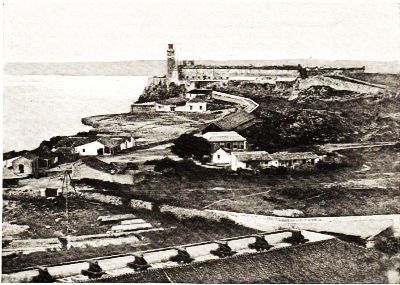
MORRO CASTLE.
Reading edition
BY T. R. DAWLEY, JR.
After Columbus discovered Cuba the island seems to have been forgotten by the Spaniards, who bent all their efforts to explore and colonize the neighboring island of Haiti, to which they gave the name of Hispaniola, meaning pertaining to Spain or "Spanish land." Although the rising promontory of Cape Mayzi could be discerned on a clear day from the coast of Hispaniola, it was not until nearly twenty years after Columbus had made his memorable discovery that Diego, his son, determined to conquer and settle the island of Cuba. Diego Columbus was then Governor of Hispaniola, and under his orders Captain Valazquez disembarked with 300 men on the eastern coast of Cuba and founded the city of Baracoa. Then the Spaniards crawled around to the south and founded Santiago, which they made their capital, and then followed in quick succession the cities of Trinidad, Bayamo, Puerto Principe, Sancti Spiritus, and Remedios.
In 1515 the colonists founded a city near the present site of Batabanó, to which they gave the name of Habana, but the marshy land of the southern coast proved a very undesirable place for such a city as they intended to build. Proceeding to the north about thirty miles, they crossed the island and came to a beautiful little bay, surrounded by hills on one side and a stretch of flat land on the other. The bay resembled a huge bowl, with only just one narrow outlet into the sea where the two points of land almost met—the ridge of rock on one side and the flat land on the other. A more delightful nook for a city could not have been hit upon, so the new city of Havana was transplanted from its original site on the south coast to the shore of the bowl-like bay on the north.
A SPANISH TRIAL IN MORRO CASTLE.
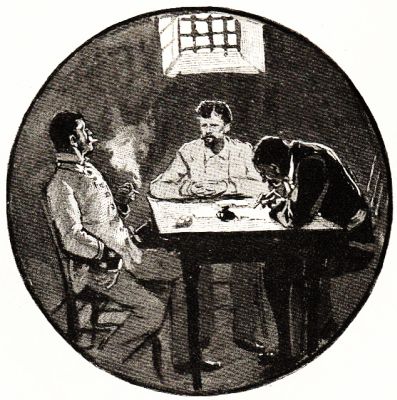
Captain Velazquez was enthusiastic over his new city, and cutting loose from the Governor of Hispaniola he set up a government of his own. He made rapid strides in subjugating the peaceful inhabitants, whom he allowed to be treated with great cruelty, and Habana soon rose to be a city of importance. To protect it from any probable invasion from the sea, a fort was built on each of the points of land which nearly met, forming the narrow entrance to the bay. The one constructed on the city side of the bay was called La Punta. Upon the rocks on the opposite side was built the famous El Morro, which, in the Spanish language, is called a castle.
In 1762 the English sailed into the bay in spite of these forts, and took possession of Havana, which they held for nearly a year. After the English went away the Spanish government ordered the forts to be rebuilt, and neither money nor labor was spared to make them impregnable. By the construction of the forts an immense amount of money was put into circulation, which necessarily contributed to the development of many industries.
As the traveller approaches Havana to-day the old castle walls are the most curious thing which greets him, for within those walls has originated many a story of suffering, cruelty, and barbarism. As you gaze upon those walls a ship's officer may stand by your side and tell you, as he points to the towering light-house, a sad story of how the builder of that light—an Englishman, I believe he was—so pleased his Spanish masters that they, jealous that he might impart the secret of his work to his countrymen or build for them another such light, confined him in one of the dungeons and put out his eyes.
When I sailed by that huge fortress for the first time, and a fellow-passenger jokingly pointed out a little square window which he designated as opening into my future cell, I did not think how near his prophecy would be realized. But El Morro is not designed to hold criminals. By criminals I mean men who have sinned against their fellow-beings, men who have robbed and murdered—in fact, have not lived up to the golden rule to do unto others as they would have others do unto them. But men, and even boys, who are suspected of not being in favor of Spain's rule in the island of Cuba, these are called political prisoners, and Morro awaits them. And so I became a political prisoner too. And not till I was finally bound by the arms and marched before soldiers, who held me by a rope as though I was some sort of domesticated animal, did I remember that little window in Morro's walls, and wonder if that really was going to be the prison-barred window from which I could watch the ships bound home. But no; they put me in a cell with sixteen Cubans, who one and all greeted me as though I were a friend come to bring them news and consolation. I did see the other side of that little window, however, and that was when they took me before the judge and gave me a trial.
MORRO CASTLE.
The Spanish have a queer way of trying folks, according to our notion. They do not take you into a big court-room full of people, where there is a judge and a jury and a prosecuting attorney, and where your accusers are brought before you and made to tell all they know, and if they tell something they don't know, you have the right to question them and prove that they are not telling the truth. But they send you into a little room, where a prosecuting officer examines you all by himself, and a soldier writes down what you say. And then your trial becomes something like a simple sum in arithmetic. Some one must swear that you have done wrong, and then if you get one witness besides yourself who swears that you did not commit the wrong, then your two statements count against the government's one, and so it goes. If the government produces six witnesses you must produce seven; and then again the officer who takes you into the little room is very powerful, for a great deal depends upon just how he makes out the papers in your case, and he has a hand very susceptible to Spanish gold. So it becomes very easy for a suspect to get off (if he is given a trial), and the government knows this; so instead of giving their political prisoners a trial, unless they are sure of convicting them, they keep them shut up in Morro Castle. They gave me a trial because our government at Washington demanded it, and as by their simple methods they were unable to find out what I had been doing, they were obliged to let me go.