A DAY WITH SAND-PIPER SNIPE, ESQ.
Reading edition
BY DUDLEY D. F. PARKER
There is no pleasanter way of spending a day than snipe-shooting, and there are many reasons why it is so popular. The birds are to be found almost anywhere where water and sedge-grass abound, though the best shooting-grounds are the salt-meadow-bordered bays on the coast. When a bird is shot there is small danger of losing it as compared to that in upland or thicket shooting, and a dog is not a necessity, as all wing-shots are generally made over water or short grass, where the bird can easily be recovered. Most boys are not so fortunate as to possess a good dog, and as very fine snipe-shooting can be had without one, it is especially fitted for them. The bird when "flushed" anywhere near the water will fly out over it.
THE BEACH SNIPE.
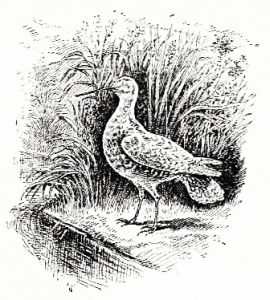
The bird that will be especially referred to in this paper will be the ordinary little beach snipe that is so common everywhere, though what remarks apply to him will, with very slight exceptions, apply to all of the snipe family.
The sand-piper always flies on a dead level, about a foot above the water, unless the flock is flying high to escape some obstruction. He propels himself with a jerky motion of the wings, a stroke, and then an instant's soaring, at a pretty fair rate of speed. The "yellow leg," a larger variety, on the contrary, flies quite high, and sometimes in the formations adopted by the wild-duck. They can always be recognized by their peculiar whistling call. The predominating colors of the snipe family are gray and white, though some few have a touch of brown on the back plumage. There is also a slight variation in the length and shape of the bill, though the character is about the same in all. The legs of the snipe are long and a greenish-yellow in color; those of the "yellow leg" being almost a bright yellow. The sand-piper is a very rapid walker, or perhaps, more properly, runner, and this remarkable facility should always be borne in mind when a bird is only "winged." When not frightened they usually travel in a very irregular course along a beach, but when frightened they will make as straight a line as the best sprinter. These little birds are very good swimmers and divers, remaining under water for a long time, propelling themselves with great rapidity by the use of their wings.
Sand-piper Snipe is a very sociable little fellow, and travels with lots of company, though the snipe are split up into small flocks during the latter part of June, July, and the first part of August, when they are breeding, usually beginning to flock again about the middle of August. No true sportsman will shoot during this season. Aside from that, it is against the game laws; the old birds are not fit to eat, and there are in the latter part of the breeding season large numbers of small flocks of young birds who are too small to be of any use, and are so tame that it is possible to decimate a whole flock by a single barrel as they are bunched on the beach. This is not the aim of the sportsman.
A word about the game laws. You should always respect them. They were made for your and all sportsmen's benefit, and not as a means of annoyance. If you kill the birds whilst breeding, or destroy the young, there will soon be little left in the country to shoot.
There are three times to find the snipe at rest: in the early morning, shortly after sunrise; at low tide, when the ground usually under water is exposed, so they can pick up the sand insects and feed on the sea-grasses that the high-water has brought up; and in the evening, when the flocks are coming to rest for the night. The early morning and low-water are the best times, as the birds will be found along the water's edge feeding, whilst in the evening they usually retire some distance inland on the meadows, and after they are settled in the grass for the night it is pretty hard to get them up again. There is sometimes a pretty fair show of finding the birds on the beach feeding just before sundown. It must be remembered, however, that the strength and direction of the wind have much to do with the number of snipe. The above is in fair weather, and now for the ideal "snipe weather."
If you live on the Jersey coast, or any of the neighboring ones, and wake up one September morning with a good southeaster, which has been blowing since the previous evening, rattling around your windows, accompanied by drizzle, get up and put on your shooting "togs," oil your gun well, and prepare for a good day's sport. The birds do not like to fly in a high wind, and will almost always come up into the coast bays and rivers to feed on the overflowed meadows that such storms produce.
It is a rather difficult thing to determine on what kind of ground you will find snipe; some days they will be found in great abundance in one locality, and the day after hardly a bird will be seen. The weather has something to do with this, and by a careful study of it some idea may be gained as to where to find the birds, though this will not always prove reliable.
When the wind in a storm is not too high, the birds usually remain on the sea-beach, but when it is violent you will run a pretty fair chance of finding them inland. During the southeaster mentioned, if the wind is rather high and there is a heavy tide, Sand-piper likes nothing better than to spend the day paddling around on the flooded salt-meadows, picking up the little worms and bugs that have been soaked out of their homes in the grass and soil. Here you will find him in large flocks, travelling by short flights from one end of the meadow to the other, showing very little disposition to move on. But above all his happiness seems wholly complete if he can find a meadow on which the grass has been cut and not collected in mows at the time of the overflow. The floating grass affords a refuge for all the washed-out bug inhabitants of the meadow, and the snipe make the most of the rare treat offered. This kind of meadow-shooting is very pleasant, as the birds will not fly far when "flushed," and it is possible to follow a flock all around the meadow, securing several shots before it takes flight for good. The sedge islands at the mouths of rivers and bays are great feeding-grounds when the wind is not so high, and tide not sufficient to flood the fields.
Sometimes on the day after a storm pretty good shooting can be had on the meadows that have been overflowed. The soil is usually of a clayey character, and the water does not drain off in the lower places very rapidly, forming puddles and patches of slimy mud around which the birds like to feed. They are usually found on the sea-beach just before or after a storm.
The favorite haunts of snipe in fine weather, at low water, are the little sand or mud beaches bordering the sedge islands and meadows, and in the inlets along the water-front.
There are three methods of shooting snipe: tramping the beach, crawling up on them by boat, and by using decoys.
TRAMPING FOR SNIPE.
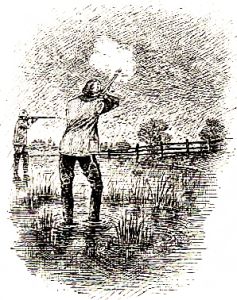
Tramping the beach or following up on land requires the smallest outfit of any, all that is necessary being the gun and your equipments. It is best to wear rubber boots, unless you intend to shoot along hard beaches or dry meadows. This tramping of the meadows will afford rather good sport when they are flooded, and although you may not get as many birds as by decoying, the action it necessitates adds much to the pleasure. However, if the birds are plentiful and inclined to move about, I should advise the use of a blind and decoys.
Let us suppose we are going out at low water to look out for the birds on the beaches. You have arrived at the scene of action and loaded your gun. Put it in the hollow of either arm; if there are two shooting, carry the guns in opposite arms. In walking along the water you should not walk on the beach, if there is one, but about fifteen or twenty feet back, going up to the beach at frequent intervals to study it for a distance ahead. By this means the birds behind the sedge-grass will not be able to see you until you are quite near. If when studying the beach ahead you do not see any birds, you should make a careful note of the likely places behind which snipe may be, and use corresponding care when approaching them. The snipe do not take to wing until you get quite near, and there is little danger of frightening your birds by these short examinations. You have been walking along the shore in the described manner for some time, and in one of the above examinations you locate some birds, let us say two hundred feet off. Crouch down in the grass and make a study of the lay of the beach where the snipe are, noting with care the positions of any high tufts of grass, bushes, or anything by which you can locate the place without seeing the beach, and it is best to select two between which the game is. Now strike inland some fifty feet, more if level meadow, and move up parallel to the beach until opposite the marks noticed. When directly in back of where you think the birds ought to be, work up to the beach, cocking your gun, and holding it in a position for instant use. You will probably get within twenty or thirty feet of the edge of the grass, when the shrill whistles of the snipe will let you know the birds are off. It is then only a question of your skill as to whether you bag some. In approaching this way, the birds will usually fly directly off-shore and away from you for a distance, thus affording the best kind of a shot. Taking the birds by surprise, you can afford to let them get steadied in flight before shooting. Do not shoot as the bird first starts off, as his twisting will destroy the aim; but let him get settled, cover him with the muzzle of your gun, following him with it for an instant until your hand is steady, and then pull the trigger.
Perhaps it should be mentioned here that if the wind is at all heavy you will never find the birds on a lee shore; always look for them on the windward. If the snipe is "flushed" on the meadow, or any other place where he has the choice of direction, he will always rise against the wind; so if you approach up wind you will get mostly driving shots, but if down wind good shots will be presented.
SHOOTING FROM A SNEAK-BOAT.
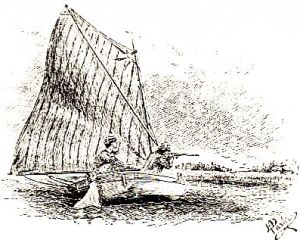
Following the birds by boat is sometimes very effective. Perhaps before coming to the shooting proper we should consider the boat. The best kind of boat for this work, where there is a great deal of running up on beaches, is a sneak-box (description of shooting-boat in Harper's Round Table No. 818). The long bow overhang makes it easy to land without running the boat hard aground. We will consider the sailing first. No special equipment is required, but if you are going out alone a yoke-line attachment will be necessary for steering (see sketch). By this device you can steer the boat from any part of the cockpit by simply catching hold of the line at the nearest place, and pulling either way you wish.
If alone, it is best to sit pretty well aft, as you are less liable to be bothered by the sail, but if there are two in the boat, one shooting and the other sailing, the man with the gun should sit as far forward as convenient, and on the side next to the shore. If the sail happens to be on the shore side, if possible sit on the forward deck so as to be able to shoot ahead of the mast; if not, you will have to shoot under the sail or in whatever manner a shot offers.
ROWING AFTER SNIPE.
The pleasure of the expedition may be greatly marred by mismanagement of the boat. There are no particularly new problems in sailing presented, but there are several points that must be borne in mind. Above all, the boat must not race alongshore, but should only drift along about thirty or forty feet off, because, when going at only a fair speed, objects on shore pass so rapidly as to make all accurate shooting impossible; and, also, a boat travelling even slowly in shallow water will kick up such large waves, that these, breaking on the beach, will frighten all the birds within hearing.
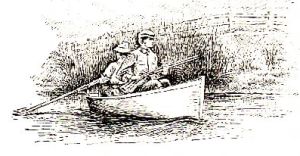
There is one peculiarity of snipe that perhaps ought to be mentioned. When the flock is feeding on small beaches broken up by patches of grass extending down to the waters edge, the birds, if approached on the water in a direction parallel to the beach, will run along it until they are all bunched at the grass before taking wing. This affords a good shot, and you can usually bag several. If you prefer to row after the birds, select a two-oared light flat-bottomed boat, and sit in the front row seat, the person pulling occupying the rear. Sometimes the boat is propelled with a pole used over the stern. There is one indispensable article in shooting snipe from a boat—a crab-net. By this, the dead and wounded birds can easily be picked up.
DECOYING SNIPE.
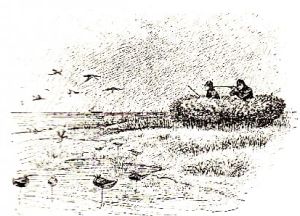
Decoying, though requiring quite an extensive outfit, under proper conditions, will yield fine results. The blind is of first consideration, much depending on its location. Before building it you should try to determine where the birds are flying the day in question, though the following general locations may be of help in the selection: a neck of land separating two streams or arms of a river; a sedge island; or a flooded meadow. In choosing the site try to find a spot where natural conditions give as much cover as possible, as behind weeds or tall grass, and try not to alter the appearance in the construction. If you intend to shoot on a meadow, place the blind at a convenient distance from some spot where you notice the birds feed. If on a beach, try and place it so as to get a raking shot. In the meadow-blind, if you have been able to find a convenient clump of weeds, cut down the extra ones so as you will have a thin circle around you, or as near so as possible, and line the inside with hay or anything procurable, filling up the thin places in the barrier of live weeds with those you cut down. If no clump can be found, look over the meadow until you find some stiff-stemmed weeds, and cut them quite near the roots. Carry these to the selected spot, and construct the blind by sticking the ends in the ground, and finish as before. The beach-blind may be constructed like this, or a hiding-place can be made in the sedge-grass.
DIAGRAMS OF SHELLS, DECOYS, AND STEERING-GEAR.
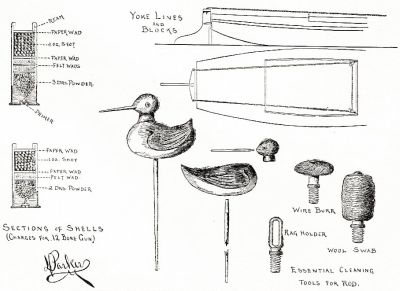
The decoys are an essential part of the outfit. They can be made at home, and should be at least twice life size. Their construction may be understood from the sketch. In painting them, try to lay the colors in the same relations as in the live bird.
Suppose we have constructed our blind near a beach, and set our decoys, some twelve or fifteen, fairly bunched. A flock is seen approaching. They see our decoys, and head in, apparently just skimming the water. Let them land, if they will; if not, fire as they wheel off. They will most likely land, and if clear of the decoys use the right barrel, reserving the left (usually choked) for when they fly off. You have most likely bagged some birds, but do not attempt to recover them now, for a flock will often return if any birds are lost. If there are any dead birds on the water, you had better keep an eye on them, as the crabs are fond of dead snipe.
A few words here about the gun. The dangers of mishandling have been gone over so often that it is unnecessary to repeat them. A boy is perfectly safe with a gun if he will bear in mind the old and perhaps rather ambiguous saying, "A gun is always loaded." A gun should not be allowed to stand for anytime with the remains of previous discharges in the barrels, as the acid contained in the powder will pit them. It is best to follow the rule of swabbing it clean after a day's sport; first, perhaps, if very dirty, with the wire burr, and polishing with soft rags. Sometimes the barrels become so much coated that they cannot be cleansed by these means, and it will be necessary to wash them out with water. If this is the case, be sure to remove every trace of moisture afterwards. Always keep every part of the gun well coated with oil, and never forget to oil the barrels after swabbing them clean, bearing in mind also that the heat of the discharge will dry the oil off the outside.
A great deal might be said about shells, but it is not essential here. Machine-loaded shells with suitable charges for snipe can be bought for about $1.40 a hundred, and will answer all purposes very well. There is room for discussion as to the proper charge. I should say 2¾ or 3 drams of powder and 1 ounce of either No. 8 or No. 9 shot is a good load for a 12-bore gun. The smaller shot is best for flock shooting. In the sketch is represented a section of a shell showing the position and kind of wads, and there is also shown a light home-loaded shell to kill crippled birds. Many sportsmen load their own shells, but this takes much time and trouble, and the saving is not as great as would be supposed, unless expensive powders are used. The boy learning to shoot should by all means buy his ammunition, at least for such a time, until he will know exactly what he is doing when loading his own shells.