ARTIFICIAL ICE.
Reading edition
AN ICE "CAN."
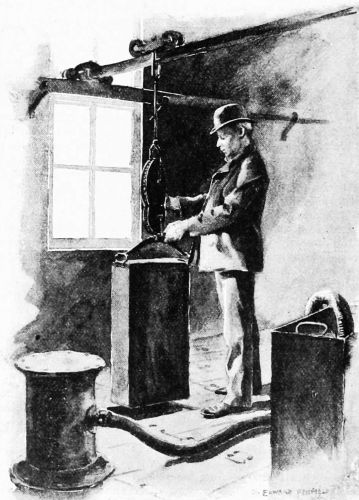
Sign-boards bearing the legend "Boston ice" over the doors of cellars and other places where ice was kept for sale have long been a familiar sight in the South. During the last twelve years, however, nearly every Southern town of importance has established its own factory for making ice, and the process has become so perfect and cheap that the artificial ice competes with the natural article shipped from the New England States.
The cost of transportation, handling, and enormous waste by melting serves to make "Boston ice" a costly luxury to the Southern consumer. This has stimulated the invention of improved methods of making artificial ice.
On his first visit to an ice factory, one who is not familiar with ice-making machinery will be surprised to see large steam-engines and boilers, with great piles of coal, and will wonder how the use of fire and steam can assist in producing cold; but a little understanding of the chemistry of the process will enable him to perceive the need of such machinery.
All objects contain a certain amount of heat. The capacity for retaining this heat varies in different substances. Liquids retain more than solids, and gases more than liquids. If gases be compressed, their heat-retaining capacity will be reduced in proportion. Nearly all of the known gases may be compressed until they assume the liquid form. Gas made from ammonia when subjected to a pressure of about one hundred and fifty pounds to the square inch, becomes a liquid. Should the pressure be now removed, the liquid ammonia will instantly rush into gas again, and in doing so tries to absorb the heat which has been squeezed out of it.
If this expansion into gas be allowed to take place in pipes sunk in brine, it will draw all the heat out of the brine, and cause the brine to become cold enough to freeze fresh water in cans suspended in it, and convert the fresh water in the cans into solid ice.
A BLOCK OF MANUFACTURED ICE.
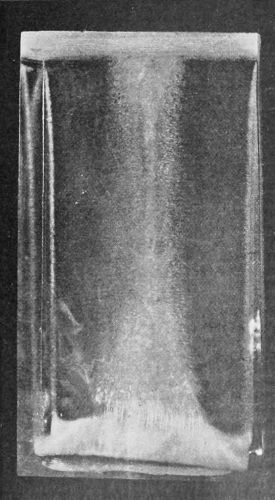
In the factories which freeze the water in cans there is provided a very large brine-chamber or vat, so deep that the cans may be immersed in it nearly to their tops. The cans are about four feet deep, and are made of galvanized iron. They are filled with pure water, and let down into the brine through openings in the top of the vat. Between the rows of water-cans are tiers of iron pipes running back and forth through the brine, and throughout these pipes the expansion of gas takes place, cooling the brine to ten degrees below zero. Ice soon begins to form on the inside and bottom of the cans under the influence of this intense cold. It becomes thicker and thicker, until it is finally a solid mass of clear crystal ice, usually with a small core of opaque or snowy ice, exactly through the centre.
As fast as their contents are frozen the cans are removed by a special lifting apparatus, and dipped for a minute into hot water to loosen the block from the can. Then it slides out easily, and is stored away for use.
There are other factories conducted on a somewhat different plan from the foregoing, in which the ice is made to form on iron plates, in cakes weighing several tons each.
In such factories the brine-chamber is in the shape of double partition walls of iron plates, about four inches apart. The partition divides a deep wooden water-tank into two equal rooms, and in the narrow space between the iron plates the brine and pipes for the ammonia gas are placed. The rooms are filled with pure water, which is in contact with the brine-chamber on one side. Ice soon begins to form on the iron side plates, precisely in the same way as on a pond or river, except that the sheet of ice is vertical instead of horizontal. Only about half of the water in the rooms is allowed to freeze.
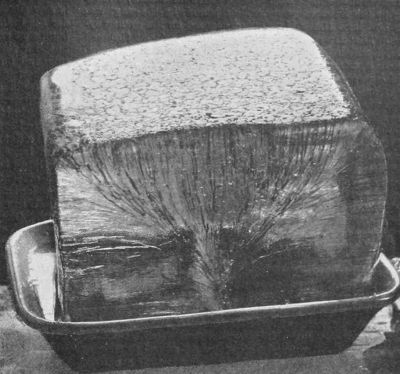
When the cakes of ice are considered to be of sufficient thickness, the cold brine is pumped out of its compartment into another tank, and its place is filled with water of ordinary temperature. This soon thaws the ice cakes loose from the plates, and allows the mass of ice to be lifted out by hoisting machinery. The ice is then passed on to the sawing-machine, which divides it into blocks weighing about two hundred pounds each. The only essential difference in the two systems described lies in the fact that in the can method all the water is frozen, and if there be any impurity in the water the ice will contain it. In the plate method the ice is formed entirely from one side of the cake, and only about one-half of the water is allowed to congeal into solid ice. Since water, in freezing, tends to purify itself in the way in which the natural ice of ponds and rivers purifies itself, the plate method more nearly resembles the natural way, and the ice shows its characteristic structure.
A BLOCK THAT STOOD SOME TIME IN THE SUN.
After having performed its work in cooling the brine, the expanded gas is drawn from the pipes by means of powerful steam-pumps, and it is then compressed into a coil of iron pipes kept immersed in a tank of cold running water. This compression of the expanded gas requires very heavy machinery, and the operation develops much heat, which is absorbed by the running water. In other words, the expanding gas having absorbed much heat from the brine, and having been made cold by this means, must be deprived of the heat thus gained by compression again into a coil surrounded by running water, which takes away the heat as soon as it is developed by compression.
Being now restored to the liquid form, the gas is ready to go on another round, and may be used again and again. The only loss of gas sustained is from leaky joints in the pipes.
It is a curious sight to see these pipes and pumps, even in the hottest weather, all coated with a thick layer of snow-white frost, so thick that it may be scraped off with the hands and squeezed into a snowball. The brine-pumps soon lose their characteristic shape, and are scarcely recognizable, looking more like a fantastic snow-drift than a piece of iron machinery.
Sometimes we see fine fruit or a bouquet of handsome flowers which had been so placed in the water as to become frozen in the centre of a large block of crystal ice. Such objects form beautiful ornaments while they last.
Many people believe that coal is really at the foundation of cheap ice, and that it will presently be cheaper to use coal to make ice than to use it in transporting ice to the place where it is wanted. Artificial ice is already produced in considerable quantities in districts where natural ice is also cut for the market.