STAMPS
Reading edition
10 stamps and large list FREE!
L. Dover & Co., 1469 Hodiamant, St. Louis, Mo.

Catching and Mounting Butterflies.
Will you kindly tell me how to catch, how to kill without pain, how to mount, and on what to mount butterflies?
Zell Steever. "The Cairo," Washington, D. C.
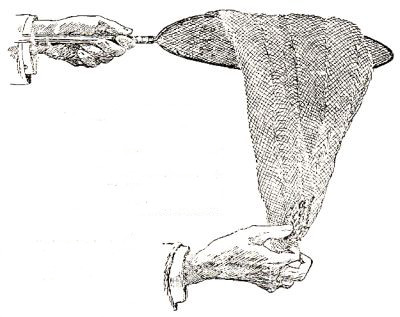
To properly catch butterflies for a collection do not use your hat or your fingers. Provide a net as shown in the illustration. Bend a light wire so as to form a hoop ten inches across, and fasten the two ends into a section of a fishing-rod or other light pole about four feet long. Over this hoop stretch netting as shown. Immediately the fly is in the net turn the hoop over, that it may not escape. If it be of large size, catch it at the base of the wings by your thumb and finger. Press hard enough to kill, but not to crush the body. If of small size, or if it does not hold its wings above its back, put your killing-bottle inside the net, drive the fly inside it, and let the poison do the rest. This killing-bottle is of glass, with a large mouth, and has a cork that projects sufficiently to be easily handled. Into the bottle put a piece of cyanide of potassium as big as a chestnut, and pour over it, to depth enough to cover it, plaster of Paris, letting the latter harden.
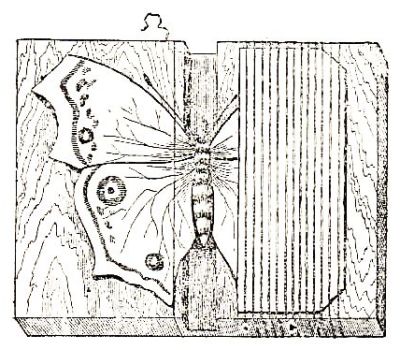
To mount butterflies prepare a setting-board as shown in the illustration. Put the body into the groove, as here shown, and then, using a fine needle, spread the wings well, the front wings being quite well forward, and the hind wings well away from the body. Get the antennæ in position, and put two pins crossed under the abdomen so it does not fall. Put over the wings pieces of stiff cardboard, as in the cut, and bind them down with the string. Let them be on the setting-boards one week after you think them thoroughly dry. If insects become too dry to spread they can be softened by putting them, for a few hours, into a closed jar in which there is wet sand.
There are various ways of arranging a permanent butterfly collection, but the best way is to provide a light box, two inches deep and 20x24 inches square. Have the bottom of cork, and over the top put a cover with glass in it. Cover the cork bottom with white paper. Insects should be arranged as they are classified in science, each with a label below the insect giving scientific name, date and place of capture, and with both sexes present. With each ought to be placed the other stages of its life, if possible: egg, caterpillar, pupa, and cocoon, if it makes one. Some prefer to set insects on pins arranged to show their color to the best advantage, but this is not so good a plan from a scientific point of view. Designs might be a crown, a star, a wasp, or a butterfly, using beetles, wasps, and dragon-flies to vary colors.
Storing and Transferring Wheat.
In this city are stored vast quantities of wheat. This wheat has to be kept somewhere between crops, so to speak. Formerly it was stored in great wooden structures called elevators. You have seen such buildings, of course. But there were two serious objections to wooden buildings for keeping grain. One was that rats, weevils, and worms easily got through the wood. The other was the danger from fire, and the consequently increased cost of insurance.
In Toledo the experiment was first tried of erecting immense steel tanks for storing grain. These tanks would not burn, and rats could not dig through them. Furthermore, they can be made air-tight, and hence they preserve the grain.
A short distance from here, on the line of the Lake Shore and Michigan Southern Railway, a new method has just been tried for putting wheat into and getting it out of these tanks. The grain is transferred by a system of tubes, through which are strong air-currents, and the wheat is carried by the air just as a chip is carried along by a stream of water. These air-tight tanks make the flour you eat better than formerly, and the tubes for transferring the wheat lessen its cost.
Frank F. Clark. Toledo, O.
Answers to Kinks.
No. 14.—Pope Gregory IX. Found by using capitals.
No. 15.—Spear, pear, ear, ar.
No. 16.—Hot-ten-tot. An-a-gram, Mush-room.
No. 17.
Turtle, cod, salmon, duck, goose, onion, pea, olive, tongue, orange, plum, strawberry, sugar, milk, cold water.
No. 18.
1, General Sher (Shire) man. 2, U. S. Grant. 3, B. Franklin. 4, Chauncey Depew (chance, seedy, pew). 5, Salmon Portland Chase. 6, P. T. Barnum (pea, tea, bar, numb). 7, Patrick Henry (pat, rick, hen, rye). 8, Abraham Lincoln (a, bray, ham, lin, con). 9, G. Washington (gee, washing, ton). 10, James A. Garfield. 11, Noah Porter. 12, Phil Sheridan (fill, sherry, den). 13, Daniel Webster (Dan, yell, web, star). 14, Benjamin Harrison. 15, Henry Ward Beecher (hen, reward, beech, err). 16, Oliver Wendell Holmes (olive, are, double u, homes.) 17, Thomas Edison. 18, J. Russell Lowell (jay, russ, cell, low, well). 19, Kit Carson. 20, Captain Kidd (cap, tun, kid).
Questions and Answers.
"Can you tell a New York city boy, who is interested in architecture, where he can get a chance, without expense, to read the illustrated architectural papers or magazines as they come out? Can you suggest the names of those which are best suited to help a boy ambitious to become familiar with this study?" You can read all the periodicals and books on this subject contained in the Astor and Cooper Institute libraries free of expense. Consult the Architectural News, which you will find on the Institute table; also Gunton's Magazine—advertisements as well as contents. Lewis J. Mather: No pins of the Order are in stock just now. Notice will be given on this page when a new stock is ready. "Would-be-Marine" should read the article by Admiral Gherardi in Harper's Round Table for June 30 last. He can procure it through any dealer or direct from the publishers for five cents. In it he is told in great detail how to enter the navy, the requirements, pay, and chances of promotion.
Will "H. K. M.", an autograph-collector, send us his or her full name and address? A Knight in France writes: "Will any Western Knight or Lady write to Sir Victor Cartier, 3 Rue Beauregard, Troyes, Aube, France, how farmers are making their own oatmeal, and about sweet-corn culture? He shall answer them any question concerning France. Sir Victor would like, too, to trade French stamps with people living in Africa, South America, China, Australia." Josephus Cinquemont: Ask your newsdealer for Harper's Round Table, which is Harper's Young People under a different name. You give no address. To insure a reply it is always best to send your address. Evon Foucht, 105 Bank Street, Dayton, O., is interested in magic, and wants correspondents who have ideas to trade with him. He is informed, in answer to his question, that the St. George and the Greek crosses are one and the same in form—as nearly as the types will allow us, this +. Look in Webster for a picture of the Greek cross. The St. George is not given there.
Frank W. Dougherty, 1751 North Thirty-first Street, Philadelphia, is a "Shut in," aged thirteen, who has had to keep his room for three years. He is what the daily papers call a baseball "rooter," and is saving up colored pictures of ball-players. Can you send him some for his collection? Henry F. Schermerhorn: It is better to apply for a patent through an experienced attorney than to attend to the matter yourself. Models are no longer required.
AN UNEXPECTED RESULT.
A party of American college graduates on a trip around the world were spending a few days in one of the smaller cities of India. Near by was a temple, in the grounds of which were always to be found a number of fakirs and jugglers and performers of wonderful tricks. One evening the Americans were joking with one of these miracle-workers, and succeeded in making him believe that they considered there was nothing wonderful about his performances. One of the Americans who had a knack of doing sleight-of-hand tricks, and who had cultivated his ability somewhat by entertaining his college mates with various feats of dexterity before he graduated, thought it would be a good joke to challenge the fakir to a competition. The juggler accepted, and called his assistants about him. It was decided that the American should perform the first trick; and he confided to his friends that he would make the fakir believe he had swallowed a lighted cigarette. Knowing how well he could perform this feat of sleight-of-hand, his companions smiled confidently. The American youth rolled up his sleeves and pulled from his pocket a cigarette, which he passed around among the Hindoos. He then took a match from his pocket and scraped it on the heel of his shoe.
To the amazement of all the American travellers the natives uttered howls of dismay, and gathered up their goods and fled. Nothing could persuade them to come back again, and the Americans were considerably at a loss to know what had caused their fright. They learned a few days later from a low-caste Hindoo that the fakir and his friends had been scared almost out of their wits by the lighting of the match. "They are willing to do tricks with human beings," said the man, "but they have great fear of one who can pick up a small stick from the ground, and with it draw fire from his foot. The fakirs fear no man, but they would have the Prophet protect them from devils."
A SLOW TRAIN.
Southern railroads have a reputation for slow travel, and in some cases it is well merited. A Western travelling-man, making a trip on these lines, suffered a great deal of annoyance from this particular failing, but up to the time of the following incident he had enjoyed himself immensely guying the conductors, trainmen, or any persons having to do with the roads, about their rapid transit.
He was travelling one afternoon on an exceptionally slow train, which came to a stop every now and then without any apparent cause. After expressing himself very audibly to the passengers he resigned himself to the inevitable, and dozed off into short naps, which were interrupted by the sundry jerks of the train, at which he complained. The passengers showed their annoyance at these complaints by angry looks. The conductor had excused the engineer in every possible way. The last apology had been that cattle obstructed the track. The train had started again, and had proceeded about ten minutes, when it halted with a jerk. Up waked the impatient traveller, and petulantly remarked:
"Dear, dear! I suppose, conductor, this worse than slow train has struck another herd of cattle?"
"Struck another one?—not much," replied the conductor; "we've simply caught up again with the first herd we ran into, that's all."
The traveller subsided, and the conductor was left in peace.
NO HIRING ABOUT THE MATTER.
Probably one of the neatest bits of sharp bargaining ever enacted took place not long ago between an apparently ignorant German with an abundance of wealth and a sharp dealer in horses. The German wanted a day's outing, and decided that a long drive would suffice for his wants, and applied to the horse-dealer for the hire of his best horse and trap. The dealer, not knowing the applicant, demurred at supplying his wants. The German, determined to have his ride, finally pulled out a huge roll of bills, and offered to buy the horse and rig, provided the dealer would buy them back at the same price. This surprised the dealer, but not wishing to offend the owner of so much ready money and possibly a good future customer, he agreed to the deal.
The German departed with the horse and rig, and at the end of the day returned them in good condition, expressing his satisfaction at the pleasure the drive had afforded him. The dealer, according to the agreement, paid him back the money, and the German started to leave the place.
"I beg your pardon, sir," exclaimed the dealer, "but you have forgotten to pay for the hire, you know."
"Pay for the hire? Why, my dear sir," coolly replied the German, "I fail to see that. If you will exercise your memory a trifle you will agree that I have been driving my own horse and trap all day, and, now you have bought them back, they are yours. There was no hiring about the matter. Good-day, sir." And he left the astonished dealer to reflect.

The popular wash silk waists can be made as fresh as new by washing in a suds of Ivory Soap. The gloss is restored by ironing when almost perfectly dry. Use no starch.
The Procter & Gamble Co, Cin'ti.