TWO LEAVES FROM PUNCH.
Reading edition
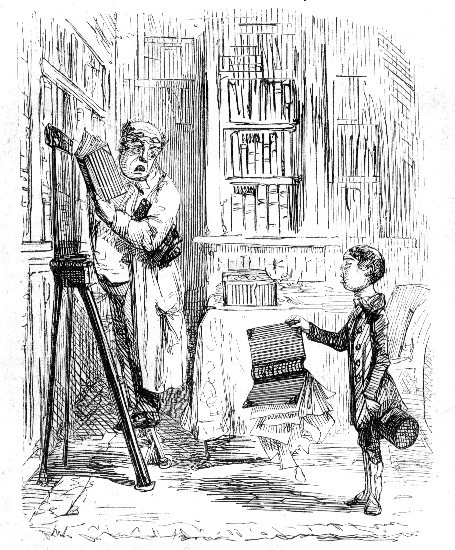
ENCOURAGEMENT TO BOOK-LENDERS. "If you please, Sir, Master's sent back the First Volume, and he says will you be so good as to let him 'ave the Second?"
DIPLOMACY AND GASTRONOMY.
It is a very generally received opinion that gammon is the basis of diplomacy; but the fact is, that it is impossible to conduct international negotiations on the foundation of that humble and economical fare, even when rendered more palatable by the addition of spinach. Mr. Rives, it is said, has written a letter to Mr. Webster, complaining that the American Embassadorship can not be done at Paris under £9000 a year, and adds that
"According to Mr. Pakenham, good dinners are half the battle of diplomacy, and the most favorable treaties are gained by liberal feeding."
This aphorism suggests important reflections.
A main point to be attended to in the formation of a diplomatic corps is the commissariat; and the force must be well armed with knives and forks, in addition to being supplied with plate armor.
The trenches in diplomatic warfare must be manned by regular trenchermen.
Rivals in diplomacy must be cut out by actual carving; and in order to dish them, recourse must be had to real dishes.
If one diplomatist wishes to turn the tables on another, it is requisite that he and his suite should keep the better tables.
The politeness of diplomatic intercourse should be qualified, in some measure, with sauce, and its gravity tempered with gravy.
Treating, in diplomacy, is best managed by giving "a spread."
Bold diplomatists are those "who greatly daring, dine."
The most liberal foreign policy is that of giving grand banquets.
A plenipotentiary should have unlimited powers of cramming.
An embassador has been defined to be, "a man sent abroad to lie for the sake of the commonwealth;" but the definition must be enlarged to express the fact, that he is also a person deputed to a foreign country to eat and drink for the interest of his native land.
The most important diplomatic functions are those of digestion.
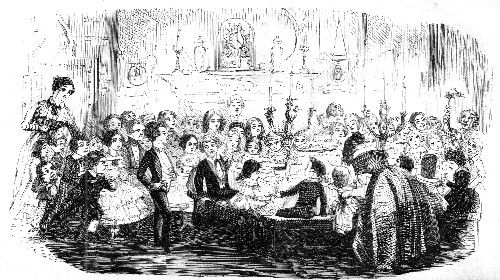
SUPPER AT A JUVENILE PARTY. Alfred. "I say, Frank, arn't you going to have some Supper?" Frank. "A—Not at present. I shall wait till the Women leave the room."
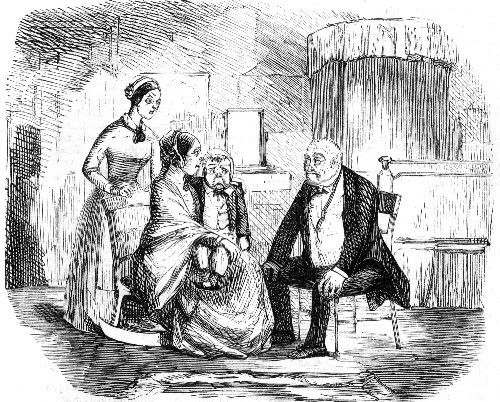
ONE OF THE JUVENILES AFTER THE PARTY. Doctor. "Ahem! Well! and what's the matter with my young friend, Adolphus?" Mother. "Why, doctor, he was at a Juvenile Party last night, and I'm afraid he's eaten something that does'n't agree with him, poor dear!"
CONVERSATION-BOOKS FOR 1851.
It is said that Publishers are getting up a series of Conversation-Books for the use of foreigners, visiting the Great Exhibition. But the spoken and written language of London are so different that it is feared these books will be of little use. Mr. PUNCH furnishes the following corrections of the two most important chapters, by the diligent study of which it is hoped that visitors may be enabled to ride and dine.
TO CONVERSE WITH A CABMAN.
What the Book said.What the Man said.
Do you wish, Sir, to ride in my cabriolet?C'b? (from every driver on the rank, and as many fingers held up as there are Cabmen.)
Where do you wish, Sir, that I should drive you?Vere to? (and a look.)
I wish to go to the Exposition.
Thank you, Sir. I will drive you thither without delay.Vere? (not understanding the foreigner's English.)
What is your fare?
I have driven you two miles. My legal fare for driving you that distance is one shilling and four-pence.Two bob and a tanner.
As you have driven fast, there is one shilling and sixpence.
Thank you, Sir, I am very much obliged to you.Vot's this? (and a look of contemptuous curiosity at the coin presented.)
I shall be happy to drive you in future.Vel, if hever I drives a scaly furrinrr again, I'm blessed!
Good morning to you, Sir.Ollo! You ain't a-goin' hoff in this 'ere way.
You have paid me handsomely.Oh—you calls yourself a gentleman!
TO CONVERSE WITH A WAITER.
Waiter, what have you for dinner?
You can have what you choose to order, Sir.Din'r, Sir!—Yezzir!
Here is the bill of fare, Sir.S'p, f'sh, ch'ps, st'ks, cutl't, Sir! r'nd o' b'f, Sir!—nice cut, Sir!—sad'l mt'n, Sir!—Yezzir!
—John, att'nd to the gnl'm.—Yezzir!—Jem, mon'y—com'n, Sir!—'Ere, Sir!—Yezzir!
Waiter, how much have I to pay?
Here, Sir, is your bill.Money! (calling.)
Permit me to ask you what you have had to eat, Sir?Now, Sir? (and an interrogative look.)
I have had a beef-steak, with boiled potatoes; I have also had a fried sole, and some bread, with Cheshire cheese, and a pint of porter.St'k, Sir? Yezzir! shill'n, Sir! 'taters, Sir? Yezzir! twop'nce, that's one-and-three, and bread a penny, one-and-three and two is one-and-five, and sole, you said, Sir? Yezzir! that's one shilling: one-and-eight and five, thirteen, that's two-and-six; and cheese?
Sir, the price of all that is two shillings.Yezzir! two-and-eight and four, that's three shill'n; and porter is four; three, four, eight, ten, fifteen—four-and-two. Thank you, Sir! Waiter, Sir? Thank you, Sir. Good afternoon, Sir.
TO FIND ROOM IN A CROWDED OMNIBUS.
Conductor.—Would any gentleman mind going outside, to oblige a lady?
Unfortunate Gentleman (tightly wedged in at the back).—I should be very happy, but I only came, yesterday, out of the Fever Hospital.
[Omnibus clears in a minute!
A FILE TO SMOOTH ASPERITIES.
The Sheffield Times describes an extraordinary file, which is to be sent from Sheffield to the Great Exhibition. This remarkable file is adorned with designs as numerous as those on the original shield of Achilles, all cut and beaten out with hammer and chisel. How much more sensible and friendly to show distinguished foreigners files of this sort, than to exhibit to them files of soldiers!
THE LOWEST DEPTH OF MEANNESS.
A FARCE, FOUNDED ON FACT.
Mr. and Mrs. Skinflint are discovered in a Parlor in a Fashionable Square. The Wife is busy sewing. The Husband is occupied running his eye, well drilled in all matters of domestic economy, over the housekeeping account of the previous week.
Mr. Skinflint.—You've been very extravagant in my absence, my dear.
Mrs. Skinflint.—It's the same story every week, John.
Mr. Skinflint.—But, nonsense, Madam, I tell you, you have. For instance, you had a Crab for supper last night.
Mrs. Skinflint (startled).—How do you know that? It's not down in the book.
Mr. Skinflint (triumphantly).—No—but I found the shell in the dust-bin!!!!
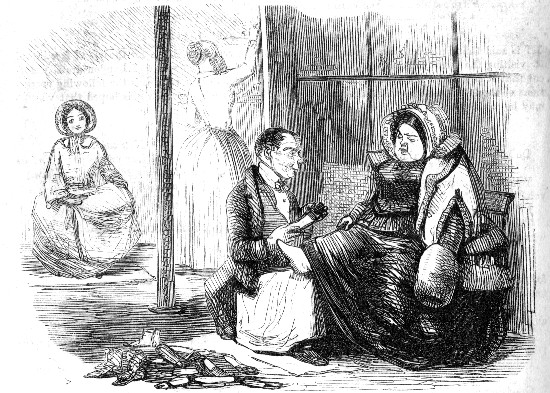
A LITTLE BIT OF HUMBUG. Shoemaker. "I think, Mum, we had better make you a pair. You see, Mum, yours is such a remarkable long and narrer Foot!"