SCENES IN EGYPT.
Reading edition
The Egyptian Pyramids.—How many illustrious travelers in all ages have sat and gazed upon the scene around! and how endless are the speculations in which they have indulged! "The epochs, the builders, and the objects of the pyramids," says Gliddon, "had, for two thousand years, been dreams, fallacies, or mysteries." To begin at the beginning, some have supposed them to be antediluvian; others, that they were built by the children of Noah to escape from a second flood—by Nimrod, by the Pali of Hindostan, and even the ancient Irish. It was a favorite theory until very lately, that they were the work of the captive Israelites. The Arabians attributed them to the Jins or Genii; others to a race of Titans. Some have supposed them to have been the granaries built by Joseph; others, intended for his tomb, or those of the Pharaoh drowned in the Red Sea, or of the bull Apis. Yeates thinks they soon followed the Tower of Babel, and both had the same common design; while, according to others, they were built with the spoils of Solomon's temple and the riches of the queen of Sheba. They have been regarded as temples of Venus, as reservoirs for purifying the waters of the Nile, as erected for astronomical or mathematical purposes, or intended to protect the valley of the Nile from the encroachments of the sands of the desert (this notable theory, too, is quite recent); in short, for every conceivable and inconceivable purpose that could be imagined by superstitious awe, by erudition groping without data in the dark, or reasoning upon the scanty and suspicious evidence of Grecian writers. At length, after a silence of thousands of years, the discoveries of Champollion have enabled the monuments to tell their own tale; their mystery has been, in great measure, unraveled, and the names of their founders ascertained. The explorations of Colonel Vyse, Perring, and recently of Lepsius, have brought to light the remains of no less than sixty-nine pyramids, extending in a line from Abouroash to Dashoor. These, by the discovery of the names of their founders, are proved to have been a succession of royal mausolea, forming the most sublime Necropolis in the world. The size of each different pyramid is supposed to bear relation to the length of the reign of its builder, being commenced with the delving of a tomb in the rock for him at his accession, over which a fresh layer of stones was added every year until his decease, when the monument was finished and closed up. Taking the number of these Memiphite sovereigns and the average length of their reigns, the gradual construction of the pyramids would, therefore, it is presumed, extend over a period, in round numbers, of some sixteen hundred years! Imagination is left to conceive the antecedent period required for the slow formation of the alluvial valley of the Nile until it became fit for human habitation, whether it was first peopled by an indigenous race, or by an Asiatic immigration, already bringing with them from their Asiatic birth-place the elements of civilization, or whether they grew up on the spot, and the long, long ages that might have elapsed, and the progress that must have been made, before monuments so wonderful could have been erected.
THE PYRAMIDS.
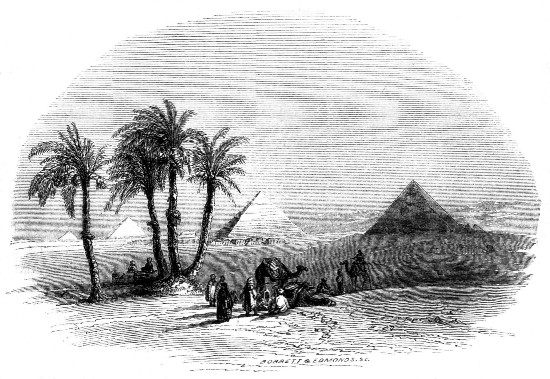
Such is the latest theory, we believe, of the construction and import of the pyramids.
The entrance to the great pyramid is about forty feet from the ground. At the entrance, the stones follow the inclination of the passage: there are a few foot-holes to aid you in descending the slippery blocks. Stooping down at the entrance of the low passage, four feet high, we began the sloping descent into the interior. This first passage continues on a slope, down to a subterranean room; but at the distance of 106 feet, a block of granite closes it; and an upper passage ascends from this point at an angle of 27°. Climbing by a few steps into the second passage, you ascend to the entrance of the great gallery. From this point a horizontal passage leads into what is called the Queen's Chamber, which is small, and roofed by long blocks, resting against each other, and forming an angle: its height to this point is about twenty feet. There is a niche in the east end, where the Arabs have broken the stones in search for treasure; and Sir G. Wilkinson thinks, that "if the pit where the king's body was deposited does exist in any of these rooms, it should be looked for beneath this niche." He remarks besides, that this chamber stands under the apex of the pyramid. At the base of the great gallery, to which we now return, is the mouth of what is called the well, a narrow funnel-shaped passage, leading down to the chamber at the base of the edifice, hollowed in the rock, and if the theory of Dr. Lepsius is correct, originally containing the body of the founder. The long ascending slope of the great gallery, six feet wide, is formed by successive courses of masonry overlaying each other, and thus narrowing the passage toward the top.
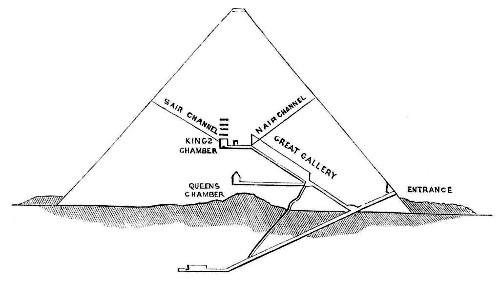
Advancing 158 feet up this impressive avenue, we come to a horizontal passage, where four granite portcullises, descending through grooves, once opposed additional obstacles to the rash curiosity or avarice which might tempt any to invade the eternal silence of the sepulchral chamber, which they besides concealed, but the cunning of the spoiler has been there of old, the device was vain, and you are now enabled to enter this, the principal apartment in the pyramid, and called the King's Chamber, entirely constructed of red granite, as is also the sarcophagus, the lid and contents of which had been removed. This is entirely plain, and without hieroglyphics; the more singular, as it seems to be ascertained that they were then in use. The sarcophagus rests upon an enormous granite block, which may, as suggested by Mrs. Poole, in her minute account of the interior, have been placed to mark the entrance to a deep vault or pit beneath. There are some small holes in the walls of the chamber, the purpose of which was for ventilation, as at length discovered by Col. Howard Vyse.
Above the King's Chamber, and only to be reached by a narrow passage, ascending at the south-east corner of the great gallery, having notches in which pieces of wood were formerly inserted, and from the top of that, along another passage, is the small chamber discovered by Mr. Davison; its height is only three feet six inches; above it are four other similar niches, discovered by Colonel Howard Vyse, the topmost of which is angular. Wilkinson supposes that the sole purpose of these chambers is to relieve the pressure on the King's Chamber, and here was discovered the cartouche containing the name of the founder, Suphis, identical with that found upon the tablets in Wady Maghara, in the desert of Mount Sinai.
The second pyramid, generally attributed, though without hieroglyphical confirmation, to Cephrenes, is more ancient and ruder in its masonry than that of Cheops. Standing on higher ground, it has from some points an appearance of greater height than that of the great pyramid, and its dimensions are hardly less stupendous. It is distinguished by having a portion of the smooth casing yet remaining, with which all the pyramids were once covered, and it is a great feat to climb up this dangerous, slippery surface to the summit. Yet there are plenty of Arabs who for a trifling beckshish will dash "down Cheops and up Cephrenes" with incredible celerity. Its interior arrangements differ from those of the great pyramid, in that in accordance with Lepsius's theory, the sarcophagus of the builder is sunk in the floor, and not placed in the centre of the edifice. The glory of opening this pyramid is due to the enterprising Belzoni.
The third pyramid is of much smaller dimensions than the two others, but beautifully constructed. It was the work, as is proved by the discovery of his name, of Mycerinus or Mencheres, whose wooden coffin in the British Museum, very simple, and unornamented, as well as the desiccated body, supposed to be that of the monarch himself, has probably attracted the notice of our readers. This pyramid is double, i. e., eased over with a distinct covering. Besides these principal ones, there are still standing other and smaller pyramids, more or less entire, grouped about these larger ones, and forming a portion of this stupendous Necropolis of Memphis.
The Great Hall At Karnak.—We had spent so much time in the examination of Luxor, and of the other portions of Karnak, that the evening was advanced when we arrived at the Great Hall. The shadows were creeping solemnly through the intricate recesses of its forest of columns, but the red light rested for a while upon their beautiful flower-shaped capitals, the paintings upon which, scarred and worn as they are by the accidents of 3000 years, still display, under a strong light, much of their original vividness. It is a perfect wilderness of ruin, almost outrunning the wildest imagination or the most fantastic dream. We paced slowly down the central avenue. The bases of the columns are buried among the fallen fragments of the roof and a mass of superincumbent earth; from his hiding-place, amidst which the jackal began to steal forth, and wake the echoes of the ruins with his blood-curdling shriek; while the shadowy bat flitted, spirit-like, from dusky pillar to pillar. From the centre of the hall, whichever way we looked through the deepening gloom, there seemed no end to the labyrinthine ruins. Obelisks and columns, some erect in their pristine beauty, others fallen across, and hurled together in hideous confusion, forming wild arcades of ruin; enormous masses of prostrate walls and propylæa, seemed to have required either to construct or to destroy them the power of a fabled race of giants. Pillars, obelisks, and walls of this immense hall, were covered with the forms of monarchs who reigned, and of the gods who were once worshiped within it. Involuntarily the mind goes back, in gazing on them, to the period of its original splendor, when Rameses in triumph returned from his oriental conquests—pictures the pile in all its completeness, the hall of a hundred and thirty columns with its superb roof, glittering in all the vivid beauty of its paintings, thronged with monarchs, and priests, and worshipers, and devoted to splendid and gorgeous ceremonies.
GREAT HALL AT KARNAK.
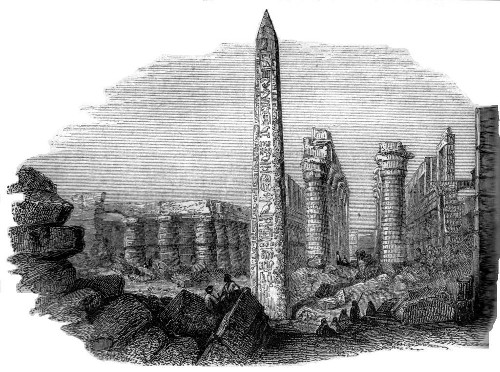
Next morning, after an early breakfast, I was again among the ruins of the Great Hall, which I had but imperfectly surveyed the previous evening. I give its dimensions from Wilkinson, with a description of the rest of the temple. "It measures 170 feet by 329, supported by a central avenue of twelve massive columns, 66 feet high (without the pedestal and abacus) and 12 in diameter, besides a hundred and twenty-two of smaller, or rather less gigantic dimensions, 41 feet 9 inches in height, and 27 feet 6 inches in circumference, distributed in seven lines on either side of the former. The twelve central columns were originally fourteen, but the two northernmost have been inclosed within the front towers or popylæa, apparently in the time of Osirei himself, the founder of the hall. The two at the other end were also partly built into the projecting wall of the doorway, as appears from their rough sides, which were left uneven for that purpose. Attached to this are two other towers, closing the inner extremity of the hall, beyond which are two obelisks, one still standing on its original site, the other having been thrown down and broken by human violence. Similar but smaller propylæa succeed to this court, of which they form the inner side." This is the spot which I have selected for a retrospective view of the Great Hall, the obelisk still standing, but the propylæa in the fore-ground a mass of utter ruin. Still following the intricate plan of the great temple through the ruined propylæa in the fore-ground, we reach another court with two obelisks of larger dimensions, the one now standing being 92 feet high and 8 square, surrounded by a peristyle, if I may be allowed the expression, of Osiride figures. Passing between two dilapidated propylæa, you enter another smaller area, ornamented in a similar manner, and succeeded by a vestibule, in front of the granite gateways that form the façade of the court before the sanctuary. This last is also of red granite, divided into two apartments, and surrounded by numerous chambers of small dimensions, varying from 29 feet by 16, to 16 feet by 8. The walls of this small sanctuary, standing on the site of a more ancient one, are highly polished, sculptured, and painted, and the ceiling of stars on a blue ground, the whole exquisitely finished. The entire height of the hall, i. e., the central portion, is not less than 80 feet, the propylæa still higher.
The imagination is no doubt bewildered in following these numerous details, and yet much is left undescribed and even unnoticed, and the eye, even of the visitor, more than satisfied with seeing, will return to the prominent objects, those alone, of which he can expect to retain a vivid recollection. The Great Hall will attract his attention above every thing else.