Volume 5 / Book 12 — Autumn Fashions.
Reading edition
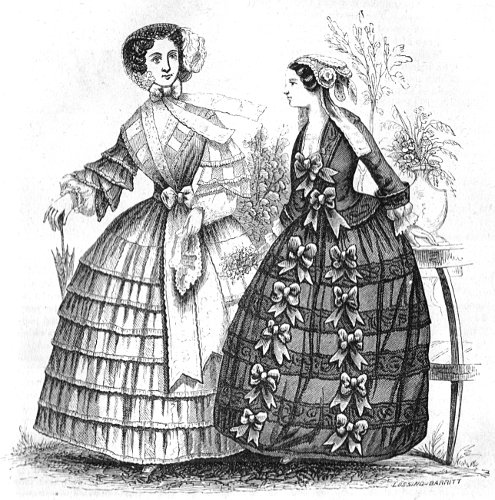
Figures 1 and 2.—Walking and Home Toilet.
Our report for October varies but little from that of September, style and texture being similar. In the above engraving we give representations of very elegant modes of toilet for the promenade and the parlor. The figure with the bonnet shows a promenade toilet. Bonnet of lisse crape and tulle puffed. It is covered with white lace, reaching beyond the edge of the brim, falling in front, after what is called the Mary Stuart style. The brim inside is trimmed on the one hand with a tuft of roses mixed up with narrow white blondes; and on the other it has a feather of graduated shades, which is placed outside and then turns over the edge and comes inside near the cheek; strings of white gauze ribbon.
Barege dress, trimmed with taffeta ribbons and fringes bordering the trimmings. Body lapping over, the right on the left, having a flat lapel parallel to the edge. The body is gathered at the waist, on the shoulders, and at the bottom of the back. A No. 22 ribbon forms a waistband, and ties on the left side at the bottom of the lapels. This ribbon matches that used for the trimming of the dress. The sleeve is composed of four frills one over the other. The skirt, which is very full, has seven graduated flounces. All are bordered with a narrow fringe. The lapel of the body, the frills of the sleeves, and flounces of the skirts are ornamented with ribbons; those on the body are No. 9, those on the skirt No. 12. On the lapels and sleeves the No. 9 ribbons are placed at intervals of three inches. On the flounces the No. 12 ribbons, 2¾ inches wide, are placed further apart. The white lace which replaces the habit-shirt follows the outline of the body. The under-sleeve is composed of a large bouillonné of thin muslin, tight at the wrist, but falling full over it in the shape of a bell. Two rows of lace fall on the hand.
The other figure represents a Home Toilet. Taffeta redingote with moire bands; the moire trimmings are edged on each side with a taffeta biais, rather under half an inch wide, and which stands in relief. The joining of the biais and the moire is concealed by a braid about the width of a lace. A moire band with its edges trimmed with biais follows the outline of the body. Three inches wide at top, it narrows to half the width at the waist, and is then continued about 2½ inches wide on the lappet. The skirt is trimmed with five moire bands with biais at their edges. These bands are of graduated width; the top one is 8 inches from the waist, and two inches wide. The interval between each one and the next is 4 inches; the lowest band, which is 4 inches wide, is placed 2 inches from the bottom of the skirt. On the body there are two rows of moire and three on each band of the skirt. These gradually diverge toward the bottom. These last form a width of apron of 32 inches. (The posture of this figure masks the right side of the skirt, and consequently only the middle row and that on the left side are to be seen.) The sleeves, half wide, are terminated by a cuff turned up with moire and a biais on the edge. A row of white lace follows the outline of the body. We see the chemisette composed of a row of lace, an insertion, and round plaits from top to bottom of thin muslin. A muslin bouillon plaits. All the fullness is thrown behind, beginning at the side trimming. The sleeve is open behind, ornamented with buttons, and then edged with guipure. A cardinal collar of Venice guipure falls on the neck. The under sleeves are composed of two rows of white guipure following the outline of the sleeve.
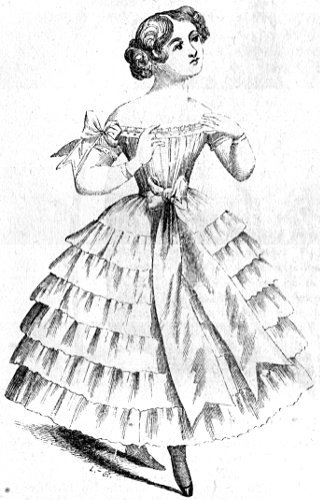
Figure 3.—Girl's Toilet.
Fig. 3 represents a pretty toilet for a girl from nine to eleven years of age. Hair parted down the middle and rolled in plaits at the sides. Frock of white muslin. Short sleeves, body low. Six small-pointed flounces on the skirt. A wide pink silk ribbon passed under the sleeve, is tied at the top in a large bow, so that the sleeve is drawn together in it, and leaves the shoulder visible. A plain band runs along the top of the body, which is plaited lengthwise, in very small plaits.
Fig. 4 represents a graceful cap for the parlor. It is made of guipure, ornamented with apple blossoms, and having wide pale-green silk ribbon bows and streamers.
This is a pleasant season for traveling, after the equinoctial storms have passed by. Appropriate dresses are very desirable. None is more so than the foulard dress of a dark color, with branches of foliage and large bouquets of flowers. The same may be said of valencia and poplin de laine, either with Albanese stripes on a plain ground, or a large plaid pattern. A traveling dress should be made like a morning gown, but not exactly; for strings are put in underneath, both before and behind, for the purpose of drawing it, so as to form a pretty plaited body when they are pulled tight. Over the gathers either a ribbon or a band with a buckle must be added. The body may be either low or high, with a small collar having two rows of cambric plaited very fine, or with a jaconet collar having open plaits, or again with a Charles V. collar, made of frieze well starched and lustred. The under sleeves should be always in harmony with the collar.
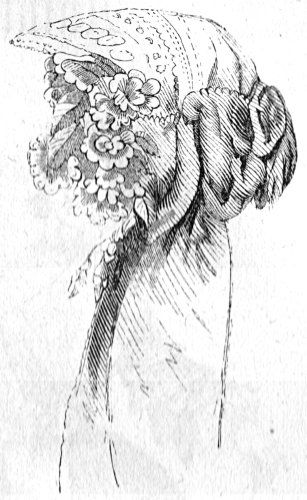
Figure 4.—Cap.
The bonnet is made half of straw, half of taffeta. The brim is straw veined with black or mixed with aloes, and the crown has a soft top of ruffled taffeta, with a bow of ribbon. On this capote, it is indispensable to put a Cambrai lace vail, that lace being at once substantial, light, and rich in pattern.
As to the feet they are provided with boots of bronze leather, and having low heels and button-holes in vandykes.
The gloves are Swedish leather, dark color, as for instance Russia leather, iron-gray, maroon, or olive.
The traveling corset, called the nonchalante, is an article every way worthy of the name. From its extreme elasticity and clever combination it yields to every motion of the body, and supports it without the least compression or inconvenience. This corset is therefore extremely agreeable for travels.
As a general rule, round waists are daily gaining ground; but you must not confound round waists with short waists: for the former, the dressmaker ought, on the contrary, to endeavor to make the sides as long as possible, and merely suppress the point in front.
Vests are still worn, but only to accompany linen and lace waistcoats. The under-sleeves are always wide and floating; the wrists are ornamented with ribbon bracelets matching the colors of the dress.
Boots and shoes are both in very good wear. The shoe is more suitable for the carriage than for walking. Boots of bronze leather, and of a soft light color, are much sought after by the more elegant ladies. These boots have low heels, and are fastened with enamel buttons of the same color as the material of the boots.