"Happy Jack" (continued 2)
Reading edition
“The ship was cast away on the west coast of Ireland, and nearly all on board perished. I had secured about me the case, which still contained the parchment, the title-deeds of a large property, and a few jewels.
“I, with a few survivors, reached the shore. I was afraid to go back to England to deliver the case to the person to whom it was addressed, and so, making my way to Cork, where I found a ship bound for America, I went on board her.
“Jack, I have been knocking about ever since, my conscience never at rest, and yet not having the courage to face any danger I might incur, and make the only reparation in my power to those who, if still alive, I have deprived of their property. Now, notwithstanding what you say, there’s something tells me that I have not long to live. I never had such a notion in my head before, but there it is now, and I cannot get rid of it. You are young and strong, and I want you to promise me, if you get home, to do what I ought to have done long ago. I will give you the case when we go below. Take it to the lawyer to whom it is addressed, and tell him all I have told you, and how it came into your possession, he’ll believe you, I am sure, and though the money and most of the jewels are gone, the remainder will, I hope, be of value to the rightful owners.”
I of course promised old Tom that I would do as he wished, at the same time I tried to persuade him to banish the forebodings which haunted him, from his mind. “That’s more than I can do, Jack,” he said, “I shouldn’t mind the thoughts of death so much, if I could find the means of undoing all the ill I have done in the world—that’s what tries me now.” Unhappily neither I nor any one on board could tell the poor fellow that there is but one way by which sins can be washed away. I did indeed suggest that he should try and borrow a Bible from one of the gentlemen in the cabin, if they had one among them, for there was not one for’ard nor in the captain’s or officers’ berths.
When our watch was over, old Tom sat down on his chest, waiting till the rest of the watch had turned in and gone to sleep. He then cautiously opened his chest, and exhibited within, under his clothes, a small box, strongly bound with silver, and the metal case he had spoken of. “Here, Jack,” he said, “I make you my heir, and give you the key of my chest: I’ll tell the men to-morrow that I have done so, and let the captain and mates know it also, that there may be no dispute about the matter.” I thanked old Tom, assuring him, at the same time, that I hoped not to benefit by his kindness.
In about three weeks we reached the mouth of the Columbia river. A strong gale from the westward had been blowing for several days, and as we came off the river a tremendous surf was seen breaking across the bar at its mouth. “I hope the captain won’t attempt to take the vessel in,” observed old Tom to me. “I have been in once while the sea was not so heavy by half as it is now, and our ship was nearly castaway.” Still we stood on. Presently, however, the captain seemed to think better of it, and indifferent as he was to the lives of others, he apparently did not wish to lose his own, and the brig into the bargain. She was accordingly hauled to the wind, and we again stood off. It was only, however, to heave-to, when he ordered a boat to be lowered. He then directed the first mate to take four hands to go in her and sound the bar. The mate expostulated, and declared that the lives of all would be sacrificed in the attempt. “You are a coward, and are afraid,” exclaimed the captain, stamping with rage. “Take old Tom and ‘Happy Jack,’ and two others,” he called out their names. “No man shall justly say I am a coward,” answered the mate; “I’ll go, but I’ll take none but volunteers. My death and theirs will rest on your head, Captain Pyke.”
“I’ll not go if the boy is sent,” exclaimed old Tom; “but I am ready to go if another man takes his place.”
“Let me go, Tom,” I said; “if you and the mate go I am ready to accompany you.”
“No, Jack, I’ll do no such thing,” answered my friend. “You stay on board. Unless others step forward the boat won’t go at all. The bar is not in a fit state for the vessel to cross, much less an open boat.” The captain, however, seemed determined to go into the river, and now ordered another man to go instead of me. “I’ll make you pay for this another day,” he cried out, looking at me. I saw the mate shaking hands with several on board before he stepped into the boat. “Remember the case, Jack,” said old Tom as he passed me, giving me a gripe by the hand. “You have got the key, lad.”
The boat shoved off and pulled towards the bar. I watched her very anxiously; now she rose to the top of a roller, now she was hidden by the following one. Every instant I expected her to disappear altogether. I couldn’t help thinking of what old Tom had said to me. Some time passed, when the captain ordered the helm to be put up, and the brig was headed towards the bar. He had been looking with his glass, and declared he had seen the mate’s signal to stand in. The wind by this time had moderated. The brig was only under her topsails and mainsail, and I began to wonder at the mate’s apprehensions. We had not stood on long when I saw the boat to the northward of us, much nearer the breakers than we were. She seemed to be carried by beyond the control of those in her. A strong current had caught hold of her. Presently she passed, not a pistol shot from us. The three men were shouting and shrieking for aid; old Tom was in the bows, sitting perfectly still; I could even distinguish the countenance of the mate, as he turned it with a reproachful glance, so it seemed to me, towards the captain. Beyond her appeared a high wall of hissing, foaming breakers, towards which she was driving. The captain seemed scarcely to notice the unfortunate men; indeed his attention was occupied with attending to the brig, our position being extremely critical. I couldn’t take my eyes off the boat. Would she be able even yet to stem the current and get back into smooth water? Suddenly, however, it seemed as if the wall of foaming breakers came right down upon her, and she disappeared amidst them. A cry of horror escaped me. “We may be no better off ere long,” I heard one of the men exclaim. He had scarcely spoken when the brig struck, and the foaming waters leaped up on either side, as if about to break on board. Another sea came roaring on, and she again moved forward. Again and again the brig struck, and at last seemed fixed.
Darkness was coming on, the foaming waters roared around us, frequently breaking on board, and we had to hold on to escape being washed away. The hatches had been battened down, or the vessel would have filled. She must have been a strong craft, or she could not have held together. The passengers behaved like brave men, though they evidently thought that it was the captain’s obstinacy which had brought them into their present perilous position.
Hour after hour passed by, with no object discernible beyond the foaming waters surging round us. The men declared that they could hear the shrieks and cries of our shipmates. The captain swore at them as fools for saying so, declaring that their voices must long since have been silenced by the breakers. Every instant it seemed that the brig must go to pieces, and that we should be carried away to share their fate. Suddenly, however, I felt the brig move. The topsails were let fall and sheeted home, and we once more glided forward. In another hour we were safely at anchor in a sheltered bay within the mouth of the river.
The next morning several natives came off to us in their canoes. They were red-skinned painted savages, but appeared inclined to be friendly. By means of Mr Duncan, who understood something of their language, they were told of the accident which had happened to the boat, and they undertook to search along the shore, in the possibility of any of the crew having escaped, and been washed on to the beach. On hearing of this my hopes of seeing old Tom again somewhat revived, though I scarcely believed it possible that any boat getting into those fearful breakers could have survived. Mr Duncan and two of the other gentlemen agreed to accompany the savages.
In the evening the boat which had taken them on shore was seen coming off. I anxiously watched her. Besides those who had gone away, I distinguished one other person, he turned his face towards the vessel as the boat approached, and, to my delight, I saw that he was old Tom. “And so you have escaped, have you?” said the captain, as he stepped on board. “Yes, sir, but the others have gone where some others among us will be before long,” answered Tom, gloomily, “and those who sent them there will have to render an account of their deeds.”
“What do you mean?” exclaimed the captain. “I leave that to others to answer,” said Tom, walking forward.
He told me that the boat, on entering the surf, was immediately capsized, and that all hands were washed out of her. That he had managed to cling on with one man, and that when they got through the surf they had righted the boat, and picking up two of the oars, after bailing her out, had succeeded in paddling, aided by the current, some distance to the northward. On attempting to land the boat was again capsized. He had swam on shore, but the other poor fellow was drowned, and he himself was almost exhausted when met by the party who brought him back. “You see, Tom,” I observed, “your prognostications have not come true, and you may still live to get back to old England again.”
“Oh no, Jack, though I have escaped this once, I am very sure my days are numbered,” he answered; do all I could, I was unable to drive this idea out of his head.
The crew were so indignant at the boat having been sent away, declaring that the captain wished to get rid of the mate and old Tom, that I felt sure another slight act of tyranny would produce a mutiny. While the gentlemen remained on board this was less likely to happen, but they were about to leave us, and take up their residence on shore.
Some time was occupied in landing their goods and stores, and then we found that we were to proceed to the northward, on a trading voyage with the Indians, and that Mr Duncan was to accompany us. We had also received on board an Indian, who had long resided with the whites, and who was to act as our interpreter.
A fair wind carried us over the bar, and, steering to the northward, we continued on for several days, till we brought up in a deep bay, on the shore of which was situated a large native village. Large numbers of the Indians came off in their canoes, with furs to exchange for cutlery, cotton goods, looking-glasses, beads, and other ornaments. Many of them were fine looking, independent fellows, but veritable savages, dressed in skins, their heads adorned, after their fashion, with feathers, shells, and the teeth of different animals. The captain treated them with great contempt, shouting at them, and ordering them here and there, as if they were beings infinitely inferior to himself. I saw them frequently turn angry glances at him, but they did not otherwise exhibit any annoyance. One day, however, he had a dispute with one of their chiefs about a matter of barter, when, losing his temper, he struck the savage and knocked him over on the deck. The Indian, recovering himself, cast a fierce glance at him, then, folding his arms, walked away, uttering some words to his companions, which we did not understand.
The next day, Mr Duncan, who had gone on shore, returned on board hurriedly, with the interpreter, and warned the captain that the Indians intended to take vengeance for the insult their chief had received. The captain laughed, declaring that he did not fear what ten times the number of savages who as yet had come on board, would venture to do. “They are daring fellows, though, Captain Pyke, and treacherous, and cunning in the extreme,” observed Mr Duncan. “Take my advice and keep them out of the ship. We have already done a fair trade here, and the natives have not many more skins to dispose of.”
“I am not to be frightened as other people are,” answered the captain, scornfully. “If they have no skins they will not bring them, and if they have, I am not the man to be forgetful of the interests of the Company, by refusing to trade.”
This was said on deck in the hearing of the crew. “I’ll tell you what, Jack,” observed old. Tom to me, “the captain will repent not following Mr Duncan’s advice. If the Indians come on board, keep by me—we shall have to tight for our lives. I know these I people. When they appear most friendly, they are often meditating mischief.”
That very evening several canoes came off, and in them was the chief whom the captain had knocked down. He seemed perfectly friendly, smiling and shaking hands with the captain as if he had entirely forgotten the insult he had received.
When the savages took their departure, they were apparently on the best of terms with us all.
Chapter Six.
The brig blown up.
The next morning we were preparing to put to sea, when two large canoes came off, each carrying about twenty men. As they exhibited a considerable number of furs, the captain allowed them to come on board, and trade commenced as usual. In the meantime, three other canoes came off with a similar number of men, and a larger quantity of furs of the most valuable descriptions. They also were allowed to come up the side like the rest.
“Jack, I don’t like the look of things,” said old Tom.
“Do you observe that the savages are wearing cloaks such as they have not appeared in before. Just come down for’ard with me.”
I followed Tom below. “Here,” he said, “fasten this case under your jacket. If the savages attack us, we will jump into the boat astern; they will be too much intent on plunder to follow us, and we will make our escape out to sea. I propose to do this for your sake. As for me, I would as lief remain and fight it out. I have mentioned my suspicions to several of the men, and advised them to have an eye on the handspikes; with them we may keep the savages at bay till we can make good our retreat.”
I asked him why he did not warn the captain. “Because he is mad, and would only laugh at me,” he answered, “Mr Duncan and the interpreter have already done so, and they are as well aware as I am that mischief is brewing.”
On going on deck, we saw the captain speaking to the Indians, and ordering them to return to their canoes. They appeared as if they were going to obey him, when suddenly, each man drawing a weapon from beneath his cloak uttered a fearful yell, and leaped at the officers and us. The captain, with only a jack-knife in his hand, defended himself bravely, killing four of his savage assailants.
Led by old Tom, I, with three or four other men, fought our way aft to join the officers, intending, should we be overpowered, to leap, as we had proposed, into the boat. I saw poor Mr Duncan struck down and hove into a canoe alongside. The captain was apparently trying to reach the cabin, probably to get his fire-arms, when he fell, struck by a hatchet on the head.
“Follow me,” cried Tom. “We may reach the boat through the cabin windows.” As he said this, he sprang down the companion-hatch, I and two others following him. The remainder of our number were overtaken by the savages before they could reach it. The last, Andrew Pearson, our boatswain, contrived to secure the hatch. This gave us time to get hold of the fire-arms fastened against the bulkheads, and to load and place them ready for use on the table. There were at least a dozen muskets, and as many brace of pistols. Had these been in our hands on deck, we should probably have driven the savages overboard, or they would have been deterred from making the attack. With them, we might now defend our lives against vastly superior numbers.
The scuffle on deck was still going on, the yells of the savages rising above the stifled groans and cries of our unfortunate shipmates. They soon ceased, and then arose a shout of triumph from our enemies, and we knew that we were the only survivors. But we too were in a desperate plight. Tom was severely wounded, and the boatswain and the other man had received several gashes. I, indeed, thanks to the way in which Tom had defended me, was the only person unhurt.
“Green, do you look after the hatchway,” said Pearson to the other man who had escaped. “Tom, do you and Jack show your muskets through the stern windows, I have some work to do. The savages think they have us in a trap, but they are mistaken.” He opened, as he spoke, a hatch which led to the magazine, and I saw him uncoiling a long line of match, one end of which he placed in the magazine, while he led the other along the cabin to the stern-port. Meantime, the savages had all clambered on board, and were shrieking and shouting in the most fearful manner, crowding down into the hold, as we could judge by the sounds which reached us, and handing up the rich treasures they found there.
“No time to be lost,” said Pearson, hauling up the boat. He went to the locker, and collected all the provisions he could find. “Jump in, Tom and Jack,” he said. “Now for the fire-arms.” He handed them in, and told us to place them along the thwarts, ready for use. “Now, Green,” he said in a low voice, “jump in.” We three were now in the boat, which was hidden under the counter from those on deck. He struck a light, and placed it to the slow match, and, having ascertained that it was burning, slipped after us into the boat, in which the mast was fortunately stepped.
“Jack, do you take the helm, and steer directly for the mouth of the harbour,” he said, cutting the painter and seizing an oar. Tom and Green did the same, and pulled away lustily. We had already got several fathoms from the vessel before we were perceived. The sail had been placed ready for hoisting. It was run up and sheeted home. The savages were about to jump into one of the canoes, and chase us, but three muskets pointed towards them made them hesitate. We were rapidly slipping away from the doomed brig. We could see the savages dancing and leaping on deck, their shouts and yells coming over the water towards us.
“They will dance to another tune soon,” muttered Pearson between his teeth.
He and the other two had again taken to the oars. Even now a flight of arrows might have reached us, but fortunately the savages had not brought their bows with them, and probably that was the chief reason why they had not ventured to pursue us. They well knew that several of their number would have been shot down with our bullets had they made the attempt. Still we could see some of the chiefs apparently trying to persuade their warriors to follow us, and we knew that though we might fight till all our ammunition was expended, we should at last be overwhelmed by numbers.
Our chance of ultimate escape seemed small indeed. “They will not come,” said Pearson. “See!” We had got half-a-mile or more from the brig, when a deep thundering sound reached our ears. It seemed as if the whole vessel was lifted out of the water, while up into the air shot her mainmast and spars, and fragments of her deck and bulwarks, and other pieces of timber, mingled with countless human bodies, with limbs torn off and mangled in a fearful manner. At the same time the canoes with those who had escaped were paddling with frantic energy towards the shore, probably believing that the Great Spirit had sent forth one of his emissaries to punish them for their treachery to the white people. We concluded that some such idea as this was entertained by them, as we saw no canoes coming off in pursuit of us.
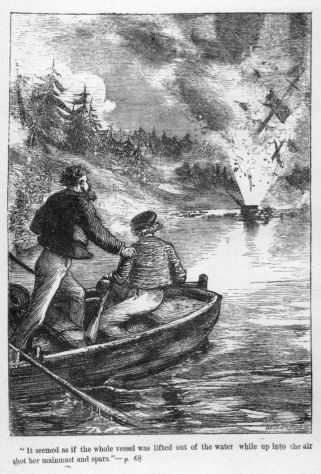
Rowing and sailing, we continued to make our way out to the open ocean. It was blowing fresh but, the wind coming off-shore, the sea was tolerably calm, and we agreed that at all events it was better to undergo the dangers of a long voyage in an open boat than trust ourselves in the power of the revengeful savages. We had reached the mouth of the harbour, and could still see the village far off on its shore, when, to our dismay, we found the sea breeze setting in. We had accordingly to haul our wind, though we still hoped to weather the headland which formed its southern point, and get an offing.
Tom all this time had uttered no complaint, though I saw the blood flowing down his side. The boatswain and Green had, with my help, bound up their wounds. I wanted Tom to let me assist him. “No,” he said; “it’s of no use. If you were to swathe me up, I could not pull. It will be time enough for that when we get round the headland.” He was evidently getting weaker, and at last the boatswain persuaded him to lay in his oar, and try to stop the blood. The wounds were in his back and neck, inflicted by the savages as he fought his way onward to the cabin. I bound our handkerchiefs round him as well as I could; but it was evident that he was not fit for rowing, and that the only chance of the blood stopping was for him to remain perfectly quiet.
During the last tack we made I fancied, as I looked up the harbour, that I saw the canoes coming out. I told the boatswain. “We will give them a warm reception, if they come near us,” he answered.
I felt greatly relieved when we at last weathered the point, and were now able to stand along shore, though we couldn’t get the offing which was desirable.
Night was coming on. The weather looked threatening, and our prospects of ultimately escaping were small.
At last we got so near the surf that the boatswain determined to put the boat about and stand out to sea. Although the other tack might bring us almost in front of the harbour’s mouth, it was the safest course to avoid being cast on shore.
The night came on very dark, but the wind was moderate, and there was not much sea. Still the weather was excessively cold, and my companions suffered greatly from their wounds. Tom had been placed in the stern-sheets near me. Though he said less, he suffered more than the rest, and I could every now and then hear low groans escaping from his bosom. At last I heard him calling me. “Jack,” he whispered, “what I told you is coming true. I am going; I feel death creeping over me. Remember the case. Do all you know I ought to have done. I have been a great sinner; but you once said there is a way by which all sins can be blotted out. I believe in that way. Jack, give me your hand. It’s darker than ever; and I am cold, very cold.” He pressed my hand, and I heard him murmuring to himself. It might have been a prayer, but his words were indistinct; I could not understand what he said. I kept steering with one hand, looking up at the sails, and casting a glance now and then at him, while the other two men pulled away to keep the boat to windward. Presently I felt his fingers relax; an icy chill came from his hand. I knew too well that my friend was dead. It was some time before I could bring myself to tell the boatswain what had happened. “Poor fellow! But it may be the lot of all of us before another day is over,” he said; “yet, as men, we will struggle to the last.”
The night passed on, and we still persevered in endeavouring to obtain an offing, though so indistinct was the land that we could not tell whereabouts we were. What was our dismay, when morning broke, to find that we were directly off the mouth of the harbour, and at such a distance that the keen eyes of the savages on the hills around might easily perceive our sail. We at once put the boat about, hoping to get again to the south’ard before we were discovered. “It’s too late,” cried Green; “I see the canoes coming.”
“We must fight them, then,” said the daring boatswain, calmly. “We don’t just expect mercy at their hands after the treat we gave them,” and he laughed at the fearful act he had committed. Still I thought what could we three, in a small boat, with our dozen muskets, do against a whole fleet of fierce savages.
We could now see the canoes coming out of the harbour. The sea was smooth, and they would without fail venture after us. Our only chance of escape seemed in a sudden gale springing up, but of that there was little probability. I was turning my eyes anxiously towards the offing in hopes of seeing signs of a stronger breeze coming, when I caught sight of a sail. I pointed her out to the boatswain. “She is a large vessel,” he exclaimed, “and standing this way.”
“Perhaps the savages will be more than ever anxious to catch us, for fear we should persuade the people on board yonder ship to punish them for what they have done,” I observed. “They will catch us if they can,” answered Pearson; “but they will have to pay a good price yet if they make the attempt,” and he cast his eyes at the muskets which lay ready loaded. The canoes were drawing nearer and nearer, and we could now distinguish the figures of the plumed warriors as they stood up in the bows. The boat at the same time was slipping pretty quickly through the water. “The breeze is freshening,” I observed; “we may escape them yet.”
“I don’t much care if we do or do not,” said Pearson; “I should like to knock over a few of these boasting fellows; we may hit them long before they can get near enough to hurt us.” I for my part did not wish to see more of the savages killed, for they had only followed the instinct of their untutored natures, and we had already inflicted a terrible punishment on them in return. In a few minutes the breeze came down even stronger than before, and greatly to my satisfaction, the canoes appeared to be scarcely gaining on us, even if they did so at all. I continued to give a glance every now and then at the ship, for I was afraid after all she might alter her course, and stand away from us.
At length, to my joy, I saw the savages in the canoes cease paddling. They apparently were afraid of venturing farther out into the ocean, or saw that it would be hopeless to attempt overtaking us. For some minutes they waited, as if holding a consultation, and then round they paddled and made their way back into the harbour.
“Just like them,” exclaimed Pearson. “Those cowardly red-skins will never fight unless they can take their enemies at an advantage.”
We had to make several tacks towards the ship, and then when we got near enough for the sound of our muskets to reach her, we fired several as a signal. They were at length, we concluded, heard on board. She kept away towards us. She drew nearer. We saw that she was a whaler, with the English colours flying at the peak. She rounded to, and we went alongside. “What has happened?” exclaimed several voices, as old Tom’s body was seen lying in the stern-sheets. A few words told our tale. I was able to climb up the side, but Pearson and Green were so stiff from their wounds that they had to be helped up. They were far more hurt indeed than they had supposed, especially Pearson; but his dauntless spirit had hitherto kept him up. Our boat was hoisted on board, and old Tom’s body was taken out and laid on deck. We were treated with great kindness, and the captain, greatly to my satisfaction, volunteered to give old Tom Christian burial. He had, as we supposed, intended to go into the harbour to obtain wood and water, and to trade with the natives; but when he heard of what had occurred he resolved to steer for a port farther south, and he told me that he was very grateful to us for giving him warning of the danger which he otherwise would have run.
In the evening I saw my poor friend lashed up in a hammock, and committed to his ocean grave.
All night long I was dreaming of him and of the dreadful scenes I had witnessed.
The ship was the Juno. Her commander, Captain Knox, was a very different sort of person to my late captain; and from his kind manner, and the way he spoke to the officers and men, he seemed truly to act the part of a father to his crew. The ship had been out a year and a half, and it was expected she would remain another year in the Pacific.
Though I was anxious to get home, yet when the captain asked me to enter on board, I was very glad to do so. Pearson continued to suffer fearfully from his wounds. Whether the deed he had done preyed on his mind, I cannot say; but a high fever coming on, he used to rave about the savages, and the way he had blown them up. At the moment he committed the deed I daresay he had persuaded himself that he was only performing a justifiable act of vengeance. The day before we entered the harbour to which we were bound he died, and poor Green did not long survive him, so that I alone was left of all the crew of the ill-fated Fox.
Chapter Seven.
A strange discovery.
The captain of the Juno took every precaution to prevent her being surprised by the Indians. Boarding nettings were triced up round the ship every night, and the watch on deck had arms ready at hand. None of the natives were allowed to come on board, and only two or three canoes were permitted alongside at a time. We judged by their manner, though they were willing enough to trade, that they had already heard of what had occurred to the northward.
Having got our wood and water on board, we again put to sea, cruising in various parts of the ocean known to be frequented by whales. A bright look-out was kept for their spouts as the monsters rose to the surface to breathe. The instant a spout was seen all was life and animation on board; the boats were lowered, generally two or three at a time, and away they pulled to be ready to attack the whale as it again rose to the surface. I remember, the first time I saw one of the monsters struck, I shouted and jumped about the deck as eagerly as if I myself were engaged in the work. Now I saw the lines flying out of the boat at a rapid rate, as the animal sounded; now the men in the boats hauled it in again, as the whale rose once more to the surface; now they pulled on, and two more deadly harpoons were plunged into its sides, with several spears; now they backed to avoid the lashing strokes of its powerful tail; now the creature was seen to be in its death-flurry, tumbling about and turning over and over in its agony. At length it lay an inert mass on the surface, and the boats came back, towing it in triumph. Next there was the work of “cutting in,” or taking off the blubber which surrounded it; the huge body being turned round and round during the operation, as the men stood on it cutting off with their sharp spades huge strips, which were hoisted with tackles on deck. Last of all came the “trying out,” when the blubber, cut into pieces, was thrown into huge caldrons on deck, with a fire beneath them; the crisp pieces, from which the oil had been extracted, serving as fuel. It was a curious scene when night came on, and fires blazed up along the deck, surrounded by the crew, begrimed with oil and smoke, looking like beings of another world engaged in some fearful incantation.
This scene was repeated over and over again. We visited several islands in the Pacific. At some, where Christian missionaries had been at work, the inhabitants showed by their conduct that they were worthy of confidence; but at others the captain deemed it necessary to be constantly on his guard, lest they might attempt to cut off the crew and take possession of the ship, as we heard had frequently occurred.
At length, to my delight and that of all the crew, the last cask we had on board was filled with oil, and with a deeply-laden ship we commenced our homeward voyage. We encountered a heavy gale going round the Horn, but the old Juno weathered it bravely, though, as she strained a good deal, we had afterwards to keep the pumps going for an hour or so during each watch. We, however, made our way at a fair rate northward, and once more crossed the line.
It may seem surprising that I had not hitherto examined the metal case which old Tom had committed to my charge. The box itself I had resolved not to open. I did not suppose that I should be induced to act as he had done, but yet I thought it wiser not to run the risk of temptation. We for several days lay becalmed, and one evening, while the crew were lying about the decks overcome with the heat, I stowed myself away for’ard, at a distance from the rest, and drew the paper out of the case. Great was my surprise to find that it was addressed to my own father. It contained a reference to the parchment in the box, and gave a list both of the jewels, the notes, and gold. The writer spoke of his wife and infant son, and charged my father, should any accident happen to him, to act as their guardian and friend as well as their legal adviser. The letter was signed “Clement Leslie.”
“This is strange,” I thought. “Then there can be no doubt that little Clem is the very child old Tom saw placed in his nurse’s arms on the raft, and his poor mother must have been washed away when the ship went down. Those Indian nurses, I have often heard, will sacrifice their own lives for the sake of preserving the children committed to their charge, and Clem’s nurse must have held him fast in her arms, in spite of the buffeting of the waves and the tossing of the raft during that dreadful night when the Indiaman went down; and if she had any food, I dare say she gave it to him rather than eat it herself. But, poor fellow, what may have happened to him since we parted.”
I now felt more anxious than ever to reach home, and longed for the breeze to spring up which might carry us forward through the calm latitudes. It came at last, and the Juno again made rapid progress homeward. We were bound up the Irish Channel to Liverpool; when, however, we got within about a week’s sail of the chops of the Channel, it came on to blow very hard. The leaks increased, and we were now compelled to keep the pumps going during nearly the whole of each watch. The weather was very thick, too, and no observations could be taken. The crew were almost worn out; yet there was no time for rest. The gale was blowing from the south-west, and the sea running very high, when in the middle watch the look-out shouted the startling cry of “Land! on the starboard bow.” The yards were at once braced sharply up, and soon afterwards the captain ordered the ship to be put about. We were carrying almost more canvas than she could bear, but yet it would not then do to shorten sail. Just as the ship was in stays, a tremendous squall struck her, and in an instant the three masts went by the board.
There we lay on a lee shore, without a possibility of getting off it. The order was at once given to range the cables, that immediately the water was sufficiently shallow to allow of it we might anchor.
I will not describe that dreadful night. Onward the ship drove towards the unknown shore. We had too much reason to dread that it was the western coast of Ireland, fringed by reefs and rugged rocks. As we drove on it grew more and more fearfully distinct. We fired guns of distress, in the faint hope that assistance might be sent to us; but no answering signal came. Too soon the roar of the surf reached our ears, and it became fearfully probable that the ship and her rich cargo, with all on board, would become the prey of the waves. I secured the precious box and case as usual, determined, if I could save my own life, to preserve them. The lead was continually hove, and at last the captain ordered the anchors to be let go. They held the ship but for a few minutes; then a tremendous sea struck her, and sweeping over her deck, they parted, and again onward she drove. A few minutes more only elapsed before she struck the rocks, and the crashing and rending sounds of her timbers warned us that before long she would be dashed into a thousand fragments. The sea was breaking furiously over the wreck, and now one, now another of the crew was washed away. I was clinging with others to a part of the bulwarks, when I felt them loosening beneath us. Another sea came, and we were borne forward towards the shore. For an instant I was beneath the boiling surf; when I rose again my companions were gone, and in a few seconds I found myself dashed against a rock. I clung to it for my life, then scrambled on, my only thought being to get away from the raging waters. I succeeded at length in scrambling out of their reach, and lay down on a dry ledge to rest. I must have dropped to sleep or fainted from fatigue. When I came to myself, the sun was up, and I heard voices below me. The tide had fallen, and numbers of country people were scrambling along the rocks, and picking up whatever was thrown on shore. I managed to get on my feet and wave to them. Several came up to me, and the tones of their voices showed me at once that they were Irish.
Out of the whole crew, I was the only person who had been saved, and I was very doubtful how I might be treated. However, I wronged them. It was a matter of dispute among several who should take charge of me; and at length a young woman, whose cottage was not far off, carried me up to it. She and her husband gave me the best of everything they had; that is to say, as many potatoes and as much buttermilk and bacon as I could swallow. I was so eager to get home that, after a night’s rest, I told them I wished to start on my journey. I was, I knew, on the west of Ireland, and I hoped that, if I could manage to get to Cork, I might from thence find means of crossing to England. Though my host had no money to give me, he agreed to drive me twenty miles on the way, promising to find a friend who would pass me on; and his wife pressed on me a change of linen, and a few other articles in a bundle. With these I started on my long journey.
I was not disappointed, for when I told my story I was fully believed, and I often got help where I least expected it.
At length I reached Cork, where I found a vessel just sailing for Liverpool. The captain agreed to give me a free passage, and at last I safely landed on the shores of old England. I must confess that I had more difficulty after this in making my way homeward, and by the time I reached the neighbourhood of my father’s house my outer clothing, at all events, was pretty well worn to rags and tatters.
Chapter Eight.
I reach home and think I have had enough of the sea.
It was the early summer when one evening I came in sight of my home. The windows and doors were open. Without hesitation I walked up the steps, forgetting the effect which my sudden appearance might produce on my family. One of my youngest sisters was in the passage. I beckoned to her. “What do you want?” she asked; “you must not stop here; go away.”
“What! don’t you know me?” I asked. “No,” she answered; “who are you?”
“Jack—your brother Jack,” I answered. On this she ran off into the drawing-room, and I heard her exclaim, “There’s a great big beggar boy, and he says he is Jack—our brother Jack.”
“Oh no, that cannot be!” I heard one of my other sisters reply. “Poor Jack was drowned long ago in the Naiad.”
“No, he was not,” I couldn’t help exclaiming; and without more ado I ran forward.
My appearance created no small commotion among three or four young ladies who were seated in the room. “Go away; how dare you venture in here?” exclaimed one or two of them.
“Will you not believe me?” I cried. “I am Jack, I assure you, and I hope soon to convince you of the fact.”
“It is Jack, I know it is!” exclaimed one of them, jumping up and coming forward. I knew her in an instant to be Grace Goldie, though grown almost into a young woman. “It is Jack, I am sure it is,” she added, taking my hand and leading me forward. “Oh, how strange that you do not know him!”
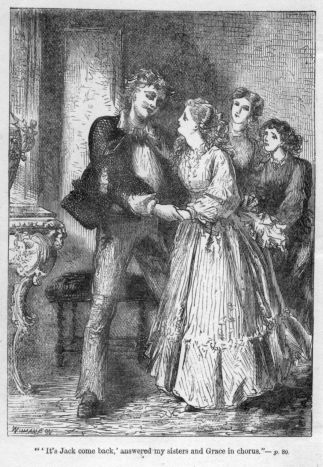
My sisters now came about me, examining me with surprised looks. “How strange, Grace,” said one; “surely you must be mistaken?”
“No, I am sure I am not,” answered Grace, looking into my face, and putting back the hair from my forehead; “Are you not Jack?”
“Yes, I believe I am,” I answered, “though if you did not say so I should begin to doubt the fact, since Ann, and Mary, and Jane, do not seem to know me.”
“Well, I do believe it is Jack,” cried Jane, coming up and taking my other hand, though I was so dirty that she did not, I fancy, like to kiss me. “So he is—he must be!” cried the others; and now, in spite of my tattered dress, their sisterly affection got the better of all other considerations, and they threw their arms about me like kind girls as they really were, and I returned their salutes, in which Grace Goldie came in for a share, with long unaccustomed tears in my eyes. Just then a shriek of astonishment was heard, and there stood Aunt Martha at the door. “Who have you got there?” she exclaimed. “It’s Jack come back,” answered my sisters and Grace in chorus. “Jack come back! impossible!” cried out Aunt Martha, in what I thought sounded a tone of dismay. “Yes, I am Jack, I assure you,” I said, going up to her; “and I hope to be your very dutiful and affectionate nephew, whatever you may once have thought me;” and I took her hand and raised it to my lips. “If you are Jack I am glad to see you,” she said, her feelings softening; “and it will at all events be a comfort to your poor mother to know that you are not drowned.”
“My mother! where is she?” I asked. “I trust she is not ill.”
“Yes, she is, I am sorry to say, and up-stairs in bed,” replied my aunt; “but I’ll go and break the news to her, lest the sound of all this hubbub should reach her ears, and make her inquire what is the matter.”
I had now time to ask about the rest of my family. My father was out, but was soon expected home, and in the meantime, while Aunt Martha had gone to tell my mother, by my sisters’ advice I went into the bedroom of one of my brothers, and washed, and dressed myself in his clothes. By the time Aunt Martha came to look for me I was in a more presentable condition than when I entered the house.
I need not dwell on my interview with my mother. She had no doubts about my identity, but drawing me to her, kissed me again and again, as most mothers would do, I suspect, under similar circumstances. She was unwilling to let me go, but at length Aunt Martha, suggesting that I might be hungry, a fact that I could not deny, as I was almost ravenous, I quickly joined the merry party round the tea-table, when I astonished them not a little by the number of slices of ham and bread which I shortly devoured. My father soon arrived. He was not much given to sentiment, but he wrung my hand warmly, and his mind was evidently greatly relieved on finding that his plan for breaking me of my desire for a sea life had not ended by consigning me to a watery grave. He was considerably astonished, and evidently highly pleased, when I put into his hands the box and case which old Tom had given into my care; and I told him how I had fallen in, on board the Naiad, with the boy I fully believed to be Mr Clement Leslie’s heir.
“This is indeed strange,” he muttered, “very strange, and we must do our best to find him out Jack. It’s a handsome estate, and it will be a pity if the young fellow is not alive to enjoy it. I must set Simon Munch to work at once.”
“Perhaps if the Russian frigate has returned home, we may learn from her officers what has become of him,” I suggested. “We will think the matter over. Would you like a trip to Russia, Jack?”
“Above all things, sir,” I answered. “I could start to-morrow if it were necessary;” though I confess I felt very unwilling to run away again so soon from home, especially as my mother was so ill. Perhaps, also, Grace Goldie entered somewhat into my considerations.
Next morning while we were at breakfast, and my father was looking over the newspaper, he exclaimed, “We are in luck, Jack! Did you not say that the name of the Russian frigate which picked you up was the Alexander? I see that she has just arrived at Spithead, from China and the Western Pacific. If so, there is not a moment to be lost, for she will probably be off again in a few days. You must start at once. Get your sisters to pack up such of your brother’s things as will fit you, and I’ll order a post-chaise to the door immediately.”
“I shall be ready, sir, directly I have swallowed another egg or two, and a few more slices of toast,” I answered. “Munch must go with you, that there may be no mistake about the matter,” said my father. “He will be of great assistance.”
All seemed like a dream. In a quarter of an hour I was rattling away as fast as a couple of posters could go, along the road to London. I sat in a dignified and luxurious manner, feeling myself a person of no little consequence—remembering that, at the same hour on the previous day, I had been trudging along the road ragged and hungry, with some doubt as to the reception I was to meet with at home. My tongue was kept going all the time, for Munch wished to hear all about my adventures. “Well, Master Jack, I am glad to have you back,” he said. “To tell the truth, my conscience was a little uncomfortable at the part I had taken in shipping you off on board the collier, though I might have known,”—he cast a quizzical look at me—“that those are never drowned who are—”
“Born to end their lives comfortably in bed,” I added, interrupting him. “You needn’t finish the sentence in the way you were about to do; I was never much of a favourite of yours, Mr Munch, I know.”
“I hope we shall be better friends in future, Master Jack,” he remarked. “You used, you know, to try my temper not a little sometimes.”
As the old clerk was accustomed to long and sudden journeys, we stopped nowhere, except for a few minutes to get refreshments, till we rattled up to the George Inn at Portsmouth.
Much to our satisfaction, we heard from the waiter that the Russian frigate was still at Spithead, and as the weather was fine, we hurried down the High Street, intending at once to engage a wherry and go off to her. As we reached the point a man-of-war’s boat pulled up, and several officers stepped on shore. “That is not the English uniform,” observed Munch; “perhaps they have come from the Russian frigate.” He was right, I was sure, for I thought that I recognised the countenances of several I had known on board the Alexander. Among them was a tall, slight young man, dressed as a sub-lieutenant. I looked at him earnestly, scanning his features. It might be Clement, yet I should not under other circumstances have thought it possible. The young man stopped, observing the way I was regarding him, and I began to doubt that he could be Clement, as he did not appear to know me. I could bear the uncertainty no longer, so, walking up to him, I said, “I am Happy Jack! Don’t you know me?” His whole countenance lighted up. With a cry of pleasure he seized both my hands, gazing earnestly in my face. “Jack, my dear fellow, Jack!” he exclaimed. “You alive, and here! Happy you may be, but not so happy as I am to see you. I mourned you as lost, for I could not hope that you had escaped a second time.” His surprise was great indeed when I told him I came especially to search for him, and we at once agreed to repair to the “George,” that I might give him the important information I had to afford, and settle, with the aid of Mr Munch, what course it would be advisable for him to pursue.
He was overwhelmed, as may be supposed, with astonishment and thankfulness when I told him of the wonderful way in which I had become possessed of the title-deeds and jewels, which would, I hoped, establish his claims to a fair estate.
This matter occupied some time. “With regard to quitting the ship,” he observed, “there will, I trust, be no difficulty. I am but a supernumerary on board, and as I could not regularly enter the service till the frigate returned to Russia, the captain will be able to give me my discharge when I explain the circumstances in which I am placed.”
Having settled our plans, Mr Munch and I went on board with Clement. The captain at once agreed to what Clement wished, though he expressed his regret at losing him. My friend the doctor recognised me, and treated me, as did several of the other officers, with much kindness and politeness. I was, however, too anxious to get Clement home to accept their courtesy, and the next morning we were again on the road northward.
Clement had studied hard while on board the Russian frigate, and had become a polished and gentlemanly young man, in every way qualified for the position he was destined to hold. He was made not a little of by my family, and though at one time I felt a touch of jealousy at the preference I fancied he showed to Grace Goldie, he soon relieved my fears by telling me that he hoped to become the husband of one of my sisters.
My father, after a considerable amount of labour, proved his identity with the son of Mr Clement Leslie, who perished with his wife at sea, and established his claims to the property.
I had had quite enough of a “life on the ocean wave,” and though I had no great fancy for working all day at a desk, I agreed to enter my father’s office and tackle to in earnest, my incentive to labour, I confess, being the hope of one day becoming the husband of Grace Goldie. We married, and I have every reason still to call myself “Happy Jack.”
Chapter Nine.
The “San Fiorenzo” and her Captain.
Narrated by Admiral M—.
There was not a happier ship in the service, when I joined her towards the end of the year 1794, than the gallant San Fiorenzo, Captain Sir Harry Burrard Neale, and those were not days when ships were reckoned little paradises afloat, even by enthusiastic misses or sanguine young midshipmen. They were generally quite the other thing.
The crews of many ships found it that other thing, and the officers, of course, found it so likewise. If the men are not contented, the officers must be uncomfortable; and, at the same time, I will say, from my experience, that when a ship gained the title of a hell-afloat, it was always in consequence of the officers not knowing their duty, or not doing it. Pride, arrogance, and an utter disregard for the feelings of those beneath them in rank, was too prevalent among the officers of the service, and was the secret of the calamitous events which occasionally happened about that time.
My noble commander was not such an one as those of whom I have spoken. There were some like him, but not many his equals. I may truly say of him “that he belonged to the race of admirals of which the navy of Old England has a right to be proud; that he was a perfect seaman, and a perfect gentleman.”
“He was one of the most humane, brave, and zealous commanders that ever trod a deck, to whom every man under him looked up as a father.” I was with him for many, very many years—from my boyish days to manhood,—and I may safely say that I never saw him in a passion, or even out of temper, though I have seen him indignant; and never more so than when merit—the merit of the junior officers of the service—has been overlooked or disregarded. I never heard him utter an oath, and I believe firmly that he never allowed one to escape his lips. I will say of him what I dare say of few men, that, in the whole course of his life, he was never guilty of an act unworthy of the character of a Christian and a gentleman. I was with him when his career was run—when, living in private on his own estate, the brave old sailor, who had ever kept himself unspotted from the world, spent his days in “visiting the fatherless and widows in their affliction”—walking from cottage to cottage, with his basket of provisions or medicines, or books, where the first were not required.
Genuine were the tears shed on his grave, and hearty was the response as the following band gave forth the air of “The Fine Old English Gentleman, all of the Olden Time!”
And now, on the borders of his estate, visible afar over the Solent Sea, there stands a monument, raised by his sovereign and by those who knew and loved him well, all eager to add their testimony to his worth. But yet he lives in the heart of many a seaman, and will live while one remains who served under his command. But, avast! whither am I driving? My feelings have carried me away.
Note: The “Solent Sea” is the name of the channel between the Isle of Wight and the mainland.
After what I have said, it is not surprising that the San Fiorenzo should have been a happy ship. Her captain made her so. From the highest to the lowest, all trusted him; all knew that he had their interest at heart—all loved him. The San Fiorenzo might have been a happy ship under an inferior commander—that is possible; but I doubt very much whether her crew would have done what they did do under any officer not possessed of those high qualities for which Sir Harry was so eminently distinguished. The San Fiorenzo was highly honoured, for she was the favourite ship, or rather, Sir Harry was the favourite captain of His Majesty George the Third, who, let people say what they will of him, was truly the sailors’ friend, and wished to be his subjects’ friend, as far as he had the power. Sir Harry was a favourite, not because he was a flatterer, but because the King knew him to be an honest man.
George the Third, as is well known, was very fond of spending the summer months at Weymouth, whence he could easily put to sea in his yacht, or on board a man-of-war, placed at his disposal. He seemed never to tire of sailing, especially with Sir Harry.
Whist was the constant game in the royal cabins. Sir Harry, who did everything as well as he could, though far from a good player, often beat the King, who was an indifferent one. Lord A—, a practised courtier, was, on the contrary, a remarkably good one, and generally beat Sir Harry. When, however, Lord A— played with the King, His Majesty always came off victorious. The King used to pretend to be exceedingly puzzled.
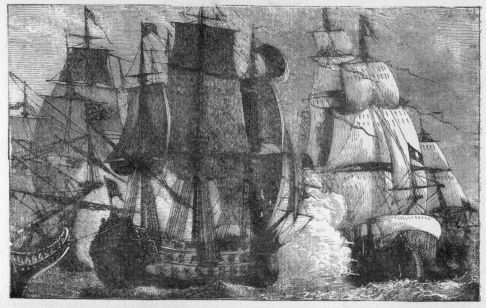
“It’s very odd—very odd. I beat Lord A—, Lord A— beats Sir Harry, and Sir Harry beats me. How can it be—how can it be?”
The King was always anxious to stand out to sea, so as to lose sight of land. This, however, was too dangerous an amusement to allow him. Sir Harry’s plan was to put the ship’s head off-shore, and to make all sail. This satisfied the King, who was then easily persuaded to go below to luncheon, dinner, or tea, or to indulge in his favourite game. Sail was soon again quietly shortened, and the ship headed in for the shore. Sometimes the King seemed rather surprised that we should have made the land again so soon; but whether or not he suspected a trick, I cannot say. His only remark was, “All right, Sir Harry; you are always right.”
It was impossible for a monarch to be more condescending and affable than was the good old King to all on board. He used to go among the men, and talk to them in the most familiar way, inquiring about their adventures and family histories, and evidently showing a sympathy with their feelings and ideas. Did they love the old King? Ay, there was not a man of them who would not gladly have died for him. It was the same with the midshipmen and officers. He used to delight in calling up us youngsters, and would chat with us as familiarly as would any private gentleman. He showed his real disposition, when able thus to cast aside the cares of state, and to give way to the kindly feelings of his heart. I say again, in that respect the King and his captain were worthy of each other. The following anecdote will prove it:—
We had gone to Portsmouth, leaving the King at Weymouth, and were returning through the Needles, when, as we got off Poole harbour, a small boat, with three people in her, was seen a little on the starboard bow. One man was rowing, the other two persons were beckoning, evidently towards the ship. As we drew near, we saw, through our glasses, that the two people were an old man and woman, and, as we appeared to be passing them, their gestures became more and more vehement. Many captains would have laughed, or taken no notice of the old people. Not so Sir Harry—he had a feeling for everyone. Ordering the ship to be hove-to, he allowed the boat to come alongside.
“Oh, captain, is our ain bairn Davie on board?” shouted the old people, in chorus.
Sir Harry, with the benignant smile his countenance so often wore, directed that they might be assisted up the side.
“Who is it you want, good people?” he asked, as soon as their feet were safely planted on the deck, where they stood, gazing round with astonished countenances.
“Our ain son, Davie—David Campbell, sir,” was again the reply.
“Is there any man of that name on board?” inquired Sir Harry. “Let him be called aft.”
A stout lad soon made his appearance, and was immediately pressed in the old people’s arms. This son was a truant, long absent from his home. At length, grown weary at delay, quitting their abode near Edinburgh, they had travelled south, inquiring at every port for their lost son, and only that morning had they arrived by waggon at Poole, believing that it was a port where men-of-war were to be found. A boatman, for the sake of a freight, had persuaded them to come off with him, pointing out the ship which was then coming out through the Needles.
Sir Harry was so pleased with the perseverance and affection which the old couple had exhibited, that he took them on to Weymouth, when the story was told to the King. His Majesty had them presented to him, and he and Queen Charlotte paid them all sorts of attention, and at length, after they had spent some weeks with their son, dismissed them, highly gratified, to their home in the North.
Queen Charlotte was as good a woman as ever lived, and, in her way, was as kind and affable as was the King. She had a quaint humour about her, too, which frequently exhibited itself, in spite of the somewhat painful formality of the usual court circle. As an example—Sir Harry had had a present of bottled green peas made to him the previous year, and, looking on them as a great rarity, he had kept them to be placed on the table before his royal guests. As he knew more about ploughing the ocean than ploughing the land, and affairs nautical than horticultural, it did not occur to him that fresh green peas were to be obtained on shore. The bottled green peas were therefore proudly produced on the first opportunity.
“Your Majesty,” said Sir Harry, as the Queen was served, “those green peas have been kept a whole year.”
The Queen made no reply till she had eaten a few, and sent several flying off from the prongs of her fork. Then, nodding with a smile, she quietly said, “So I did tink.”
To the end of his days, Sir Harry used to laugh over the story, adding, “Sure enough, they were very green; but as hard as swan-shot.”
But I undertook to narrate a circumstance which exhibited Sir Harry Burrard Neale’s character in its true colours. I need not enter into an account of that painful event, the Mutiny of the British Fleet. It broke out first at Spithead, on the 15th April, 1797, on board Lord Bridport’s flag-ship, the Royal George; the crews of the other ships of the fleet following the example thus set them. The men, there can be no doubt, had very considerable grievances of which to complain; nor can it be well explained how, in those days, they could by legal means have had them redressed. One thing only is certain, mutiny was not the proper way of proceeding. We were at Spithead, and not an officer in the fleet knew what was about to occur, when, on the 14th, two of our men desired to speak with the captain, and then gave him the astounding intelligence that the ships’ companies of the whole fleet had bound themselves to make certain important demands, and which, if not granted, that they would refuse to put to sea. The two men—they were quartermasters—moreover, stated that they had themselves been chosen delegates to represent the ship’s company of the San Fiorenzo, by the rest of the fleet, but that they could assure him that all the men would prove true and loyal, and would obey their officers as far as was consistent with prudence.
Sir Harry thanked them, assuring them, in return, that he would trust them thoroughly. He, however, scarcely believed at that time the extent to which the mischief had gone. The next day evidence was given of the wide spread of the disaffection. Affairs day after day grew worse and worse; and although some of the superior officers acted with great judgment and moderation, others very nearly drove matters to the greatest extremity.
Meantime, the delegates of the San Fiorenzo attended the meetings of the mutineers, and, though at the imminent risk of their lives, regularly brought Sir Harry information of all that occurred. He transmitted it to the Admiralty, and it was chiefly through his representations and advice that conciliatory measures were adopted by the Government. Nearly all the just demands of the seamen having been granted, they returned to their duty, and it was supposed that the mutiny was at an end. Just before this, the Princess Royal had married the Duke of Wirtemberg, and the San Fiorenzo had been appointed to carry Her Royal Highness over to Cuxhaven. We could not, however, move without permission from the delegates. This was granted. Our upper-deck guns were stowed below, and the larger portion of the upper-deck fitted with cabins. In this condition, when arriving at Sheerness, we found to our surprise that the red flag was still flying on board the guardship, the Sandwich. Supposing that her crew had not been informed of what had taken place at Spithead, Sir Harry sent our delegates on board her, that they might explain the real state of affairs. The disgust of our men was very great when they were informed that fresh demands had been made by the crews of the North Sea fleet, of so frivolous a nature that it was not probable they would be granted. Our men, in spite of the character of delegates, which had been forced on them, could not help showing their indignation, and expressing themselves in no very courteous terms. This showed the mutineers that they were not over-zealous in their cause, and our people were warned that, should they prove treacherous, they and their ship would be sent to the bottom.
On returning on board, they informed Sir Harry of all that had occurred. Our delegates, at his suggestion, immediately communicated with those of the Clyde, an old fellow-cruiser, commanded by Captain Cunningham. That officer, on account of his justice, humanity, and bravery, enjoyed, as did Sir Harry, the confidence of his ship’s company. An arrangement was therefore made between the captains and their crews that, should the mutineers persevere in their misconduct, they would take the ships out from amidst the fleet, fighting our way, if necessary, and run for protection under cover of the forts at Sheerness. Every preparation was made. We waited till the last moment. The mutineers showed no disposition to return to their duty. The Clyde was the in-shore ship; she was therefore to move first. We watched her with intense interest, while we remained still as death. Not one of our officers appeared on deck, and but few of the men, though numerous eager eyes were gazing through the ports. The Clyde had springs on her cables, we knew, but as yet not a movement was perceptible. Suddenly her seamen swarmed on the yards, the topsails were let fall and sheeted home. She canted the right way. Hurrah! all sail was made. Away she went; and, before one of the mutinous fleet could go in chase, she was under the protection of the guns on shore. It was now our turn; but we had not a moment to lose, as the tide was on the turn to ebb, when we should have had it against us. What was our vexation, therefore, when the order was given to get under weigh, to find that the pilot, either from fear, incompetency, or treachery, had declared that he could not take charge of the ship! Sir Harry would have taken her out himself; but the delay was fatal to his purpose, and before we could have moved, boats from the other ships were seen approaching the San Fiorenzo. They contained the delegates from the fleet, who, as they came up the side, began, with furious looks, to abuse our men for not having fired into the Clyde, and prevented her escaping. High words ensued, and so enraged did our men become at being abused because they did not fire on friends and countrymen, that one of the quartermasters, John Aynsley by name, came aft to the first lieutenant, and entreated that they might be allowed “to heave the blackguards overboard.”
Note. The plan was proposed and executed by the late Mr W. Bardo, pilot, then a mate in the navy. He returned to the San Fiorenzo, and piloted her as he had the Clyde, when her own pilot refused to take charge.
A nod from him would have sealed the fate of the delegates. I thought then, (and I am not certain that I was wrong) that we might at that moment have seized the whole of the scoundrels, and carried them off prisoners to Sheerness. It would have been too great a risk to have run them up to the yard-arm, or hove them overboard, as our men wished, lest their followers might have retaliated on the officers in their power.
No man was more careful of human life than Sir Harry, and it was a plan to which he would never have consented. The delegates, therefore, carried things with a high hand, and, convinced that our crew were loyal to their king and country, they ordered us to take up a berth between the Inflexible and Director, to unbend our sails, and to send our powder on board the Sandwich, at the masthead of which ship the flag of the so-called Admiral Parker was then flying. That man, Richard Parker, had been shipmate with a considerable number of the crew of the San Fiorenzo, as acting lieutenant, but had been dismissed his ship for drunkenness, and having lost all hope of promotion, had entered before the mast.
Our people had, therefore, a great contempt for him, and said that he was no sailor, and that his conduct had ever been unlike that of an officer and a gentleman. Such a man, knowing that he acted with a rope round his neck, was of course the advocate of the most desperate measures. Everything that took place was communicated immediately to Sir Harry, who advised the men to pretend compliance, and, much to our relief, the other delegates took their departure. As soon as they were gone, Sir Harry told the ship’s company that, provided they would agree to stand by him, he would take the ship into Sheerness, as before intended. The men expressed their readiness to incur every possible risk to effect that purpose. The almost unarmed condition of the ship at the time must be remembered. The men set zealously to work to prepare for the enterprise. Springs were got on our cables. All was ready. The flood had made. The object was to cast in-shore. The men were at their stations. We were heaving on the spring—it broke at the most critical moment, and we cast outward. There was no help for it. Nothing could prevent us from running right in among the two ships of the mutinous fleet which I have mentioned, and which lay with their guns double shotted, and the men at quarters, with the lanyards in their hands, ready to fire at us. Our destruction seemed certain; but not for a moment did our captain lose his presence of mind. Calm as ever, he ordered the quartermaster Aynsley to appear on deck as if in command, while the officers concealed themselves in different parts of the ship, he standing where he could issue his orders and watch what was taking place. All was sheeted home in a moment, and we stood in between the two line-of-battle ships, the Director and Inflexible. The ship, by this time, had got good way on her. It appeared that we were about to take up the berth into which we had been ordered, when Sir Harry directed that all the sheets should suddenly be let fly. This took the mutineers so completely by surprise, that not a gun was then fired at us. Sir Harry next ordered the helm to be put “hard-a-port,” which caused the ship to shoot ahead of the Inflexible—we were once more outside our enemies. Springing immediately on deck, he took the command, crying out, in his encouraging tone, “Well done, my lads—well done!”
A loud murmur of applause and satisfaction was heard fore and aft; but we had no time for a cheer.
“Now clear away the bulkheads, and mount the guns,” he added.
Every man flew with a hearty will to obey his orders. And need there was; for scarcely were the words out of his mouth than the whole fleet of thirty-two sail opened their fire on us. The shot flew like hail around us, and thick as hail, ploughing up the water as they leaped along it, chasing each other across the surface on every side of the ship. We could have expected nothing else than to be sunk instantly, had we had time for consideration; but, as it was, wonderfully few struck our hull, while not a shroud was cut away, nor was a man hurt. The huge Director, close to us, might have sent us to the bottom with a broadside, but not a shot from her, that we could see, came aboard us.
“They have not the heart to fire at us, the blackguards!” observed one of the men near me.
“It may be that, Bill; but, to my mind, they’re struck all of a heap at seeing the brave way our captain did that,” answered another. “If we’d had the guns mounted he’d have fired smack into them. We send our powder aboard that pirate Parker’s ship! we unbend our sails to please such a sneaking scoundrel as he!”
“It’s just this, that the misguided chaps are slaves against their will, and they haven’t become bad enough yet to fire on their countrymen, and maybe old friends and shipmates,” said a third.
Such were the opinions generally expressed on board. It was reported afterwards that the Director fired blank cartridges, and this may have been the case, but I think more probably that her people were first struck with astonishment at our manoeuvre, and then, with admiration at the bravery displayed, purposely fired wide of us. As, however, we were frequently struck, some shots by traitorous hands must have been aimed at us from her, or from some of the other ships. In little more than two hours the bulkheads were cleared away from the cabin door, to the break of the quarter-deck, (the whole space having, as I before said, been fitted up with cabins for the suite of Her Royal Highness). The guns on both sides were got up from the hold and mounted, and we were ready for action. As soon as the task was accomplished, the men came aft in a body, and entreated, should any ships be sent after us by the mutineers, that they might be allowed to fight to the last, and go down with our colours flying, rather than yield, and return to the fleet at the Nore.
Sir Harry readily promised not to disappoint their wishes.
We stood on, but as yet no sign was perceptible of chase being made after us. It was possible, we thought, that no ship’s company could be induced to weigh in pursuit. They well knew that we should prove a tough bargain, had any single ship come up with us. Should we prove victorious, every man might have been hung as a pirate. As to Parker, he dared not leave his fleet, as he ventured to call it.
Our master, although a good navigator, did not feel himself justified in taking charge of the ship, within the boundaries of a Branch pilot, and we were therefore on the look-out for a pilot vessel, when a lugger was discovered on the lee-bow, and we were on the point of bearing down to her, when we made out first a ship or two, then several sail, and lastly, a whole fleet, which we guessed must be the North Sea Fleet standing for the Nore. We were steering for them, to give the admiral notice of what had occurred, when the red flag was discovered flying on board them also. They had, as it appeared, left their station in a state of mutiny, having placed the admiral and all the officers under arrest. To avoid them altogether was impossible, and before long a frigate bore down to us. Should our real character be discovered, we must be captured by an overwhelming force. Still Sir Harry remained calm and self-possessed as ever. As the frigate approached, he ordered all the officers below, and giving the speaking-trumpet to Stanley, the quartermaster, told him to reply as he might direct. The frigate hailed and inquired what we were about. “Looking out to stop ships with provisions, that we may supply the fleet,” was the answer. The people of the frigate, satisfied with this reply, proceeded to rejoin the fleet, while we, glad to escape further questioning, made sail in chase of the lugger. She was a fast craft, and led us a chase of four hours before we captured her. She proved to be the Castor and Pollux privateer of sixteen guns. Having taken out the prisoners, and put a prize crew on board, we were proceeding to Portsmouth, when the lugger, being to windward, spoke a brig, which had left that place the day before, and from her gained the information that the mutiny had again broken out at Spithead. Under these circumstances, Sir Harry thought it prudent to anchor under Dungeness until he could communicate with the Admiralty. This we did; but it was a time of great anxiety, for the mutineers might consider it important to capture us, to hold Sir Harry and his officers as hostages, and to wreak their vengeance on our men. We got springs on the cable, and the ship ready for action. During the middle watch a ship was made out bearing down towards us; she was high out of the water, and was pronounced by many to be a line-of-battle ship. Sir Harry was on deck in an instant—the private signal was made—would it be answered? Yes; but there was no security in this, as, should the ship’s company have mutinied, they would naturally have possessed themselves of it. The drum beat to quarters, the fighting lanterns were up, their light streaming through our ports. Our men earnestly repeated their request to be allowed to sink rather than surrender to the mutineers. No sight of the sort could be finer, as the brave fellows stood stripped to the waist, dauntless and resolute, not about to fight with a common foe, but one that would prove cruel and revengeful in the extreme. The wind was extremely light, and the stranger closed very slowly. The suspense was awful. In a short time we might be engaged in a deadly struggle with a vastly superior foe, and deadly all determined that it should be. Nearer and nearer the stranger drew; at length our captain hailed. The answer came: “The Huzzar! Lord Garlais! from the West Indies.” She anchored close to us, and we exchanged visits. Her people, ignorant of the mutiny, could not understand the necessity of the precaution we had taken. They were so struck, when made acquainted with what had occurred, at the bravery and determination of our ship’s company, that they immediately swore they would stick by us, and that, should any ship be sent to take us back to the Nore, they would share our fate, whatever that might be. I am sure that they would have proved as good as their word, but daylight came, and no enemy appeared. We lay here for some time, that Sir Harry might ascertain what was occurring on shore. He found that most active and energetic measures were being taken to repress the mutiny, and in a few days we heard that the ship’s company of the Sandwich had taken her into Sheerness, and allowed their late leader, Parker, to be arrested by a guard of soldiers, sent on board for that purpose by Admiral Buckner. We sailed for Plymouth, and another ship was appointed to have the honour of taking over the Princess Royal.
I must say a word or two about that mutiny. I am convinced that the proportion of disaffected men was comparatively small. The seamen had grievances, but those would have been redressed without their proceeding to the extremities into which they plunged, led by a few disappointed and desperate men like Parker. Had greater energy been shown from the first, during some of the opportunities which occurred, the whole affair might have been concluded in a more dignified manner, at a much earlier date. I will instance one occasion. Having one day got leave from the delegates of our ship, while we lay off Sheerness, to go on shore, I landed at the dockyard. I found, as I passed through it, that I was followed by the whole body of delegates, walking two-and-two in procession, Parker and Davis leading, arm-in-arm. Just as we got outside the gates, the Lancashire Fencibles appeared, coming to strengthen the garrison. As soon as the seamen got near the soldiers, they began to abuse them in so scurrilous a manner, that the officer in command halted his men, and seeing the admiral and superintendent, close to whom I at the time was standing opposite the gates, he came, and, complaining of the insults offered to himself and men, asked permission to surround and capture them. So eager did I feel, that I involuntarily exclaimed, “Yes! yes! now’s the time!” The admiral, on hearing me, turned sharply round, and demanded how I dared to speak in that way? “Because there they all are, sir, and we may have them in a bunch!” I replied, pointing to Parker, Davis, and the rest. The admiral told me that I did not know what I was saying; but I did, and I have no cause to suppose that I was wrong. When the truly loyal and heroic conduct of our ship’s company became known, it was intended to raise a sum in every seaport town in England to present to them. From some reason, however, the Government put a stop to it, and the only subscription received was from Ludlow in Shropshire, from whence the authorities sent 500 pounds to Sir Harry Neale, which he distributed to the ship’s company on the quarter-deck.
Chapter Ten.
Orlo and Era.
A Tale of the African Slave Trade.
There exists an extensive district on the west coast of Africa, about forty miles to the north of the far-famed river Niger, known as the Yoruba country. Sixty years ago it was one of the most thickly populated and flourishing parts of equatorial Africa, the inhabitants having also attained to a considerable amount of civilisation, and made fair progress in many industrial arts.
Then came those dreadful wars, carried on by the more powerful and cruel chiefs, for the purpose of making slaves to sell to the white traders, who carried them away to toil in the plantations of North and South America and Cuba, and the prosperity of the once happy people of Yoruba was brought to an end. The savage rulers of Dahomey and Lagos now became notorious for the barbarities they inflicted on the unoffending tribes in their neighbourhood. The Yoruba country was the chief scene of their hunting expeditions. Towns and villages were attacked and burned; the able-bodied men and young women and children were carried off into slavery; the aged were ruthlessly murdered, fields and plantations were laid waste, and a howling wilderness was left behind. At length the scattered remnants of the population who had escaped from slavery and death assembled together in a spot among rocks, especially strong by nature, where they hoped to be able to make a stand against their persecutors. Here they built a town, to which they gave the name of Abbeokuta, or the place among the rocks. It increased rapidly in population and extent, for numerous were the unfortunates in search of a home, and rest, and peace.
Lagos, one of the chief strongholds of the slave-dealers, which the Yorubans most had to fear, has since been taken possession of by the British, and has been declared an English colony or settlement; but Dahomey, governed by its bloodthirsty monarch, with his army of six thousand Amazons and five thousand male warriors, still exists as a terrible scourge to the surrounding territories.
On the confines of the Yoruba country existed a beautiful village which had hitherto escaped the ravages of the relentless slave-hunting foe. It was situated on the banks of a rapid stream, which gave freshness to the air, and fertility to the neighbouring plantations. Palms, dates, and other trees of tropical growth, overshadowed the leaf-thatched cottages, in which truly peace and plenty might be said to reign. Although true happiness cannot exist where Christianity is not, and where the fear of the fetish and the malign influence of the spirit of evil rules supreme over the mind, the people were contented, and probably as happy as are any of the countless numbers of the still benighted children of Africa. Rumours of wars and slave-hunts reached them, but they had so long escaped the inflictions others had suffered, that they flattered themselves they should escape altogether. So little accustomed are the negro race to look to the future, contented with the pleasures of the passing moment, that as they did not actually see the danger, they allowed no anticipation of evil to mar their happiness. The hearts of the dark-skinned children of that burning clime are as susceptible of the tender sentiments of love and friendship as many of those boasting a higher degree of civilisation, and a complexion of a fairer hue. No couple, indeed, could have been more warmly attached than were young Orlo and Era, who had lately become man and wife, and taken up their abode in the village. They were industrious and happy, and from morning till night their voices might be heard singing as they went about their daily work. Orlo employed himself principally in collecting the various products of the country to sell to the traders who occasionally visited the district,—palm oil, and gold dust from the neighbouring rivulet, and elephants’ tusks, and skins which he took in the chase.
At length Era gave birth to a child, a little boy, which proved a great addition to their happiness, and drew still closer the bonds of their affection. Indeed no people can be fonder of their children than are the negroes of Africa.
Soon after little Sobo was born Orlo set off on a hunting expedition with several other villagers, telling Era that he must get her some fresh soft skins for their child’s bed, and that he must be more industrious than ever, as he had a family to provide for.
Era entreated him not to be long away.
“Two or three days will see me back, laden with the spoils of the chase,” was his answer, in a cheerful tone.
Era’s heart sank within her—why, she could not tell. With anxious eyes she watched him and his companions as, with bows, and arrows, and lances in hand, they disappeared among the trees.
Seldom had Orlo and his party been more successful. More than one lion, several antelopes, and numerous monkeys were killed. Even a huge elephant was conquered by their skill and cunning. The skins of the animals slaughtered were hidden in safe places, to be taken up on their return. Excited by their success they proceeded even farther than they intended. Night surprised them, and collecting together they formed a camp, with fires blazing in the centre to keep off the savage beasts roaming around.
Their supper having been discussed, they were merrily laughing and talking over their adventures when they were startled by some terrific shouts and cries close to them. They grasped their arms, but before a bow could be drawn a body of warriors rushed in on them with clubs and swords, knocking over or cutting down all who stood at bay or attempted resistance. Some endeavoured to escape, but they were completely surrounded. Several were killed by their savage assailants, and their bodies were left where they fell. The greater number were secured with their arms bound tightly behind them, and they found themselves captives to the troops of the King of Dahomey, towards whose capital they were marched away in triumph. They had heard enough of the fate which had befallen so many of their countrymen to know that they must never more expect to taste the sweets of liberty; but they were scarcely aware of the horrible cruelty to which the will of the tyrant King of Dahomey might compel some of them to submit. Bitter, too, was the anguish which poor Orlo suffered when he felt that he should for ever be separated from his beloved Era.
The journey was long and tedious, and the captives’ feet were torn by the thorns and cut by the hard rocks over which they had to pass; but whenever they lagged behind they were urged on by the long spears of their relentless captors. Arrived at the capital, they were astonished at its extent and the number of its inhabitants, and, more than all, by the vast army they saw drawn up for the inspection of the king. They had little opportunity of seeing much, for they were soon conducted into a large low building, where they were secured by iron shackles, back to back, to a long beam, scarcely able to move.
After remaining here for several days Orlo and others were separated from their companions and carried to a building on one side of the great square of the city, where all public ceremonies were performed. Dreadful shrieks assailed their ears both by day and night. They heard they were uttered by the human victims offered up by the savage king to the spirits of his departed ancestors.
They were not long left in doubt as to what was to be their fate. They also were to be destroyed in the same manner. Some of their number on hearing this sank into a state of apathy, others loudly bemoaned their cruel lot, and others plotted how they might escape, but Orlo could think only of his beloved Era, and the anxiety and anguish his absence would have caused her.
At length Orlo and nine others were taken out and told they were to enjoy the high privilege of being sacrificed in presence of their king. They were now dressed in white garments, and tall red caps were put on their heads. Their arms and legs were then bound securely, and they were placed in a sitting posture in small canoe-shaped troughs, and thus in a long procession were carried around the square amid the cruel shouts of the savage populace. At length they reached a high platform or slope in the centre of the square, on which sat the king, under the shade of a vast umbrella, surrounded by his courtiers and chiefs. Below the platform were collected a vast mob of savages, their hideous countenances looking up with fierce delight at the terrible drama which was to be enacted. Among the crowd stood several men of gigantic stature, even more savage-looking than the rest, armed with huge knotted clubs. These they knew instinctively were their intended executioners. Not one of them attempted to plead for mercy; that they knew were vain. Their eyes glanced hopelessly round, now on the assembled throng below, now on the groups collected on the platform, not expecting to meet a look of compassion turned towards them. But yes, among one group they see a man of strange appearance. His skin is white, and by his fine dress, glittering with gold, they believe him to be a great chief. He advances towards the king, whom, with eager look, he addresses in a strange language. What he says they cannot tell, till another man of their own colour speaks, and then they know that he is pleading for their lives; not only pleading, but offering a large ransom if they be given up to him. How anxiously they listen for the reply! The king will not hear of it. The spirit of his father complains that he has been neglected; that his nation must have become degenerate; that they have ceased to conquer, since so few captives have been sent to bear him company in the world of shades. Again the strange white chief speaks, and offers higher bribes. Curious that he should take so much trouble about some poor black captives they think. What can be his object? What can influence him?