Chapter XXIV · THE LAST YEARS: 1540-1543
Reading edition
Holbein’s work at Whitehall—His residence in the parish of St. Andrew Undershaft—In high favour at court—Payments of his salary—Possible visit to Basel—Portraits and miniatures of Catherine Howard—Portraits of the Duke of Norfolk—The Earl of Surrey—Unknown men at Berlin and Vienna—Unknown Englishman at the Hague—Earl of Southampton—Unknown man, aged 54, at Berlin—Unknown English lady at Vienna—Simon George—Dr. John Chamber—Sir William and Lady Butts—Unknown Englishman at Basel—Young English lady in the collection of Count Lanckoronski—Lady Rich—Holbein’s self-portraits—A newly-discovered one at Basel—Portraits, now lost, etched by Hollar—The Duke of Buckingham’s Collection.
Though there is no actual evidence in support of the statement of the older writers that Holbein, after he entered the royal service, had the use of a permanent studio in Whitehall Palace, granted to him by the King, there is every possibility that such was the case. “One of the earliest of the famous non-royal residents in Whitehall Palace,” says Dr. Edgar Sheppard, “was the artist Holbein. He had been presented to Henry VIII by Sir Thomas More, and the King assigned him a permanent suite of apartments in Whitehall, and commissioned him to paint the interior of the new Palace, for which work he received two hundred florins per annum.”[396] While the great wall-painting in the Privy Chamber was in progress, it would be necessary for him to have a room for his own use within the building, for the storage of the materials required for the work, and it is not impossible that he was permitted to retain the room as his own, perhaps one of those over the so-called “Holbein’s Gate,” for the short remainder of his life, more particularly as his practice was almost entirely confined to the court, so that a studio in Whitehall would best suit the convenience both of the painter and his sitters.[397] That he had a “permanent suite of apartments” there, as Dr. Sheppard states, is much less probable. This would indicate residence, whereas it is known 186that during his last years he occupied a house in the east of London.
It is doubtful, too, whether Holbein carried out any important decorative work in the Palace beyond the famous wall-painting already described.[398] According to a curious entry in Pepys’ Diary, under the date August 28, 1668, which is not easy to understand, the room known as the Matted Gallery had a painted ceiling of Holbein’s handiwork. The passage runs as follows: “With much difficulty, by candle-light, walked over the matted gallery, as it is now with the mats and boards all taken up, so that we walked over the rafters. But strange to see how hard matter the plaister of Paris is, that is there taken up, as hard as stone! And pity to see Holben’s work in the ceiling blotted on, and only whited over!” The exact sense of the concluding words is not very clear, but Pepys appears to mean that the ceiling had been formerly painted by Holbein, and that, having become damaged in course of time, it had recently been given a coat of whitewash. The ceiling was probably decorated with coloured plaster-work in relief, and though Holbein may have supplied the design, and may even have been responsible for the painting, it is much more likely that the plaster-work itself was done by some Italian, such as Nicolas Beilin of Modena, who had carried out similar undertakings at Fontainebleau.
“DANCE OF DEATH” AT WHITEHALL
The legend that Holbein also painted a “Dance of Death,” composed of life-size figures, upon the walls of one of the rooms in Whitehall, is probably pure fiction, or, at least, there is much less to be said in its favour than for Pepys’ attribution of the ceiling in the Matted Gallery to the painter. The writer who first gave currency to the story was Francis Douce, in his “Dance of Death,” published in 1833. According to his statement, “very soon after the calamitous fire at Whitehall in 1697,[399] which consumed nearly the whole of that palace, a person, calling himself T. Nieuhoff Piccard, probably belonging to 187the household of William III, and a man who appears to have been an amateur artist,”[400] made etchings after nineteen of the cuts in the Lyon “Dance of Death.” Impressions of these etchings, accompanied with manuscript dedications, are said to have been presented by this Piccard to his friends and patrons, and among others to a Mynheer Heymans, and to the “high, noble, and well-born Lord William Denting, Lord of Rhoon, Pendreght,” &c. In these addresses Piccard speaks of a “wall-painting” of the “Dance” by Holbein which he himself had seen in Whitehall. In the dedication to Heymans he says:
“Sir,—The costly palace of Whitehall, erected by Cardinal Wolsey, and the residence of King Henry VIII, contains, among other performances of art, a Dance of Death, painted by Holbein in its galleries, which, through an unfortunate conflagration, has been reduced to ashes.”
In the dedication to “Lord William Benting” Piccard is more precise:
“Sir,—In the course of my constant love and pursuit of works of art, it has been my good fortune to meet with that scarce little work of Hans Holbein neatly engraved on wood, and which he himself had painted as large as life in fresco on the walls of Whitehall.”
As far as can be ascertained, there is not the slightest truth in this legend. Nothing is known as to the identity of Heymans, but Lord William Benting was evidently William Bentinck (1704-1774), of Rhoon and Pendrecht in Holland, and Terrington St. Clements, Norfolk, third son of Hans William Bentinck, first Earl of Portland, and a Count of the Holy Roman Empire. Douce, who gave undeserved authority to this story, made no attempt to trace the history of the manuscript “addresses” which accompanied the etchings, and though he saw them, does not say to whom they then belonged, or even in what language they were written. They may be safely set down as forgeries, as far as any wall-paintings of the “Dance of Death” by Holbein are concerned. Piccard, whoever he may have been, is the sole authority for the existence of these mythical works, which are not mentioned by Van Mander or Sandrart, or by any of the foreign travellers who visited this country in their descriptions of Whitehall, though the wall-painting of Henry VIII 188with his wife and parents in the same palace is more than once spoken of in such records in terms of high praise. Both Pepys and Evelyn are equally silent on the subject, though the latter mentions the “Dance of Death” woodcuts, and ascribes them to Holbein by name. “We have seen,” he says, “some few things cut in wood by the incomparable Hans Holbein the Dane, but they are rare and exceedingly difficult to come by; as his Licentiousnesse of the Friers and Nuns; Erasmus; Moriae Encomium; the Trial and Crucifixion of Christ; The Daunce Macchabree; the Mortis Imago, which he painted in great in the Church at Basil, and afterwards graved with no lesse art.”[401] What he says is by no means free from mistakes, but as, in speaking of a visit paid to Whitehall in 1656, he describes the condition of the large wall-painting of the two kings Henry VII and Henry VIII, and their consorts, it is not probable that he would have failed to mention any other important wall-paintings in the palace had they existed. Douce thought he had discovered a corroboration of Piccard’s story in an entry in Van der Doort’s catalogue of Charles I’s collection, which runs: “A little piece, where Death with a green garland about his head, stretching both his arms to apprehend a Pilate in the habit of one of the spiritual Prince-Electors of Germany. Copied by Isaac Oliver from Holbein”; but this, no doubt, was painted from the woodcut of the Elector in the Lyon “Dance of Death,” and not from a large wall-painting.
As already stated, though Holbein may have had a workroom within the precincts of Whitehall, his permanent home in London was elsewhere. The public records show that in 1541 he was living in the parish of St. Andrew Undershaft, in Aldgate Ward. How long he had been there is not known, but possibly for the greater part of his second sojourn in England. This information is contained in a subsidy roll for the City of London, dated 24th October, 33 Hen. VIII (1541). Among the “straungers” taxed were:
“Barnadyne Buttessey, xxx. li. xxx. s.
Hanns Holbene in fee, xxx. li. iij. li.”
Why Holbein was obliged to pay twice the amount charged to Buttessey on an equal assessment of £30 a year is explained by the fact that in these subsidies it was usual to tax “lands, fees, and annuities,” at 189double the rate of goods. “In the royal accounts,” says Sir Augustus W. Franks, “the payments to Holbein are sometimes noticed as wages, sometimes as an annuity; while other payments of a similar kind, although fees or annuities, are included under the general term “wages,” and evidently looked upon as synonymous terms for the salaries paid by the King to various members of his household. In any case, the salary of Holbein, the painter, rendered him liable to be rated, as a foreigner, at the high amount above-mentioned.”[402] There can be no doubt that this Holbein of the subsidy roll was the artist. The amount of his fee, £30, corresponds with the salary he received from the royal purse, while Holbein’s will gives his place of residence as the parish of St. Andrew Undershaft.
HOLBEIN’S RESIDENCE IN LONDON
According to a story told by Walpole, Holbein once resided in a house on London Bridge. He says: “The father of Lord Treasurer Oxford passing over London Bridge, was caught in a shower, and stepping into a goldsmith’s shop for shelter, he found there a picture of Holbein (who had lived in that house) and his family. He offered the goldsmith 100l. for it, who consented to let him have it, but desired first to show it to some persons. Immediately after happened the fire of London, and the picture was destroyed.”[403] This story is apparently a mere legend, and there is no evidence to support it; nor is it very probable that an important painting by Holbein would have remained in the same small house for more than one hundred and twenty years. Dallaway, in his notes to Walpole, includes in a supplementary list of works by Holbein in England a small picture of Holbein, his wife, four boys, and a girl, at Mereworth Castle, Kent, which he suggests may be either a repetition or the original picture of the London Bridge story; but in the first place, Holbein never had a family of four sons, and, secondly, the picture bears no traces of Holbein’s manner. He quotes Gilpin’s description of it: “As a whole, it has no effect; but the heads are excellent. They are not painted in the common flat style of Holbein, but with a round, firm, glowing pencil, and yet exact imitation of nature is preserved—the boys are very innocent, beautiful characters.” If some such “family” picture existed in London at that time, it is much more likely to have been a copy or a replica of the genuine family group in the Basel Gallery.
190The favour with which Holbein was now regarded at court is shown by the frequency with which he received a year’s or half a year’s salary in advance, a mark of royal condescension which was most unusual. Thus under “September Ao xxxi” (1539) is the following entry: “Item paide by the Kingis highnesse commaundement certefied by my lorde privyseales lettres to Hans Holbenne, paynter, in the advauncement of his hole yeres wagis beforehande, aftre the rate of xxx li. by yere, which yeres advauncement is to be accompted from this present Michaelmas, and shall ende ultimo Septembris next commynge, the somme of xxx li.”[404] Notwithstanding this payment in advance, it appears, as already pointed out,[405] from the four following quarterly entries in the accounts having reference to Holbein, from Michaelmas 1539 to Midsummer 1540, that he continued to receive his salary of £7, 10s. each quarter as usual.[406] If these entries are to be depended upon, he clearly received his money twice over, either by accident, owing to carelessness in the keeping of the King’s accounts, or of set purpose as a further reward for his services.
HIS WORK ABOUT THE COURT
In September 1540 he received an advance of half a year: “September, Ao xxxii—Item paide to Hans Holbyn, the Kingis paynter, in advauncement of his wagis for one half yere beforehande, the same half yere accompted and reconned fromme Michaelmas last paste, the somme of xv li.” This time, however, he did not receive his salary twice over, for in the two following entries, at Michaelmas and Christmas, 1540, the accounts merely state: “Item, for Hans Holbyn, paynter, wages, nihil, quia prius per warrantum.” In the following March 1541 he again obtained a half-year’s advance: “March, Ao xxxii: Item paied to Hans Holben, the Kingis painter, in advauncement of his half yeres wages before hande, after the rate of xxx li. by yere, which half yere is accompted to beginne primo Aprilis Ao xxxij. domini Regis nunc, and shall ende ultimo Septembris then next ensuynge, the somme of xv li.” The two remaining entries of which we have record, at Lady Day and Midsummer following, are as follows: “Item for Hans Holben, paynter, wages, nil, quia praemanibus”; and “Item for Hans Holbyn, paynter, nihil, quia prius.” The volume of accounts closes with the payments for this quarter, and no details of the royal expenditure during the next two years and a half exist, so that there is no record of the salary Holbein received for the remaining years of his life. In a later volume of Tuke’s accounts, as treasurer of the household, extending from October, 35 Hen. VIII (1543) to November, 36 Hen. VIII (1544), the first quarterly payments are for Christmas 1543, and Holbein’s name does not occur in them, as he had then been dead for about two months. It is rather strange, however, that it does not appear among the Christmas payments with “Nihil quia mortuus” after it, as this was the usual procedure in case of death. This omission, however, may have been due to the fact that he had once again received his salary beforehand.
191The remaining years of Holbein’s life must have been busy ones, judging from the number of preliminary studies for portraits of the men and women of Henry’s court which exist in the Windsor Collection and in many of the great European museums. These drawings are all undated, and cover the whole period of his English career, but there are so many of them that his time must have been always fully occupied. It is strange, therefore, that so few of his finished portraits can be ascribed with any certainty to the year 1540. Although it was by no means his invariable custom to put the date on his paintings, yet this was his more usual practice, and there is no known picture by him which is inscribed 1540, though there are a few dated 1541 and 1542. Several portraits of the Howard family can be given with some certainty to the earlier year, but beyond this nothing has been so far discovered. It may be suggested, as some explanation of this, that Holbein paid another visit to Basel during the last quarter of 1540, as the two years’ leave of absence granted him by the Town Council came to an end in the middle of October. The Council, who had been paying his wife the promised yearly pension of forty gulden, expected him to make Basel his permanent residence on the completion of this further extension of leave. The terms of their agreement with him were fairly generous, and it is not to be supposed that the painter would risk losing his rights of citizenship and the stoppage of the pension to his wife through a total disregard of the Council’s wish. It seems possible, therefore, that he went over to Switzerland in order to make personal application for a further and longer leave of absence in England than the agreement of 1538 permitted. Unlike many of the foreign artists and artificers then resident in this country, 192he never became a naturalised British subject, and this, no doubt, was due to the fact that he was determined to end his days as a citizen of Basel, and regarded his residence here as merely a temporary one, and England as a profitable field which, as time passed, would become worked out. He could not, of course, foresee that he was to be suddenly cut down when a comparatively young man and still in the full maturity of his powers. At Michaelmas in the year in question he received half a year’s salary in advance, so that it was impossible for him to leave England permanently for some time to come.
In the summer of 1540 Holbein lost another of his English patrons. Henry formally divorced Anne of Cleves on the 12th of July, and on the 28th of the same month Thomas Cromwell, then Earl of Essex, who had been a good friend to the painter, was beheaded for high treason, after a period of eight years during which his influence with both King and Parliament had been paramount. During the same month Henry privately married Catherine, daughter of Lord Edmund Howard, a cousin of Anne Boleyn, and niece of Thomas, third Duke of Norfolk. By this marriage the Howards, and through them the Catholic party, regained that ascendancy in the councils of the King which had received a severe check at the fall of Anne Boleyn; and at least three members of this family were painted by Holbein. The new Queen was publicly acknowledged on August 8 at Hampton Court Palace.
MINIATURES OF CATHERINE HOWARD
Although it was to be supposed that Henry would employ Holbein to paint the portrait of his new queen, until quite recently the only known likeness of her from his brush was the miniature portrait in the royal collection at Windsor Castle, and the replica of it belonging to the Duke of Buccleuch. In 1909, however, the discovery was made by Mr. Lionel Cust of a genuine and very beautiful portrait of this Queen. In the Windsor miniature (Pl. 31 (4)),[407] which shows her in a similar position to the one in the newly-discovered picture, she is represented nearly to the waist, turned to the left, her hands folded in front of her, the left over the right. Her hair and eyes are brown, and she wears a circular hood of the then fashionable French pattern, with a fall of black velvet. Her square-cut bodice is of dark cloth of gold, 193with sleeves of grey-green silk embroidered with gold, and white ruffles with black embroidery. Round her neck, over the white cambric filling of the dress, falls an elaborate necklace of pearls, rubies, and sapphires. The background, which is bright blue, has no inscription. It is painted on the back of a playing card, the eight of diamonds, and is 2⅓ inches in diameter. The hands, and the lower part of the arms, are badly painted, and appear to be a later addition.
Nothing is known of its history, or as to the date of its acquisition, but it did not belong to the Crown in Tudor or Stuart days. Dr. Ganz describes it as badly over-painted, and possibly only a copy. Doubts have been thrown from time to time on its right to be called a portrait of Catherine Howard. Mr. Ernest Law considers the attribution to be “very problematical indeed,” and states that it “does not at all accord with the Holbein drawing inscribed as ‘Queen Katherine Howard.’”[408] In this he follows earlier writers. Nichols says that though the position and head-dress of the drawing agree with the miniature, “the features do not appear to correspond.”[409] It is difficult, however, to agree with them in this, for a careful comparison of the two makes it quite evident that they represent the same lady. The version belonging to the Duke of Buccleuch is almost identical with the Windsor miniature, but is a better work and slightly smaller, being only two inches in diameter. It was last publicly exhibited at the Burlington Fine Arts Club, in 1909.[410] It was formerly in the collection of the Earl of Arundel, and when there was etched by Hollar in 1646. It was afterwards owned by Jonathan Richardson the younger (1694-1771), and subsequently by Horace Walpole. Walpole describes it as: “Catherine Howard, a miniature, damaged, it was Richardson’s, who bought it out of the Arundelian collection. It is engraved among the Illustrious Heads [of Houbraken]; and by Hollar, who called it Mary, Queen of France, wife of Charles Brandon, Duke of Suffolk.”[411] In this he is wrong, for no name is attached to 194it in Hollar’s etching, and it was first identified as Catherine Howard by Mr. Cust. In his Description of Strawberry Hill, however, Walpole calls it merely “a lady painted by Holbein,” and says that it is “probably Mary Tudor, Queen of France, sister of Henry VIII, but among the Illustrious Heads called Catherine Howard.” According to Granger, it was Vertue who first named it Mary, Queen of France. The Duke of Buccleuch also possesses a small oil painting on panel, 5⅜ in. × 4½ in., which was likewise at the Burlington Fine Arts Club (Case C, 24). It is inscribed, by a hand later than that of the painter of the portrait, “Catherine Howard Henry VIII.” According to Scharf, this is “apparently a French work, and, indeed, thoroughly so in personal characteristics.”[412] It is in the style of Clouet, and the compilers of the Burlington Fine Arts Club catalogue suggest that it may represent Anne de Pisseleu, Duchesse d’Estampes.
The Windsor drawing[413] bears no inscription, and the sitter is turned to the right, as in Hollar’s engraving, instead of to the left, but otherwise it shows the same type of features, smooth auburn hair, and French cap or hood, as in the miniature. The dress, however, in Holbein’s usual fashion, is merely indicated with a few lines, showing a plain bodice cut square, filled in with white cambric, with a diamond-shaped opening revealing neck and bosom. It agrees in the same way with the newly-discovered portrait, of which, though reversed, it is evidently one of the preliminary studies. The identity with Catherine Howard is further proved, as Mr. Lionel Cust points out, by the family resemblance, plainly visible, in certain of the features, such as the over-accentuated lower jaw, to the portraits of her uncle, the Duke of Norfolk, and of his son, the ill-fated Earl of Surrey.
PORTRAIT OF CATHERINE HOWARD
In 1898 the Trustees of the National Portrait Gallery acquired a portrait of Catherine Howard[414] at the sale of the Cholmondeley pictures at Condover Hall, Shropshire, which closely follows the Windsor drawing, although in the reverse position. The excellence of the painting of the hands, and of the details of the dress and jewels, led at first to the supposition that it might be a genuine work by Holbein 195which had undergone some damage and restoration, but closer examination proved that it was merely a careful contemporary school copy, or repetition of some lost original. It is inscribed “Etatis svæ 21,” which corresponds with the known facts of Catherine Howard’s life. In the summer of 1909 the original picture of which it is a copy was submitted to Mr. Cust, who recognised it at once as not only a portrait of Catherine Howard, but as most possibly a genuine work of the great master, which proved to be the case on the removal of much dirty varnish and some repaints.[415] It came from a private collection in the west of England, where it had formed part of a series of historical portraits which had been in the possession of the same family for several generations, and had been regarded at one time as a portrait of Eleanor Brandon, Countess of Cumberland, and at another as Princess Mary Tudor. It is now in Canada, in the collection of Mr. James H. Dunn.
Henry’s fifth Queen is shown seated, at a little more than half length, turned to the left. The hands are in the same position as in the miniature, though the fingers are more closely interlaced. Her hair is auburn, parted in the middle, and the eyes are blue-grey. She wears, too, a costume of a similar fashion, though of different materials. The circular French hood, with its heavy band of gold ornament and black fall, appears to be the same, but the dress is of black satin, with a square black velvet yoke across the bosom, open at the neck and turned back to show the white lining. A band or piping of gold ornament elaborately pierced, with pairs of gold tags at intervals, runs along the outer seam of the sleeves from shoulder to wrist, and the white ruffles are embroidered all over with a floral design in black. The ornaments she wears are of exceptional interest, as they afford actual evidence that Holbein not only painted portraits of royal ladies, but also designed their jewellery. Round her neck is a small necklace, set with pearls and diamonds, less heavy and elaborate than the one represented in the miniatures, and of greater beauty and delicacy of design, to which a large pendant jewel is attached. At her breast is a brooch from which hangs a circular jewel or medallion of chased gold work, with a large oblong diamond in the centre, on which is represented the story of Lot’s wife and the flight from Sodom. This 196jewel was designed for Catherine by Holbein. It corresponds exactly, as Mr. Cust points out, with a most characteristic study, a small roundel placed within an octagon, among the wonderful series of Holbein’s original drawings for jewellery in the Print Room of the British Museum,[416] and thus gives particular interest to a portrait which in all ways forms a very important addition to the master’s work, both on account of the brilliance of its execution and of its value as an historical document. Suspended from a chain round her waist hangs a still larger circular jewel, only the upper part of which is seen. That portion of the subject which is visible represents two angels with hands raised in adoration on either side of a crowned and bearded figure, most possibly the Almighty. The background of the portrait is a plain one, of Holbein’s favourite blue, across which is inscribed, as in the National Portrait Gallery copy, “Etatis svæ 21,” on either side of the head. It is on an oak panel 29 inches high by 20 inches wide. It must have been painted between August 1540, the date of her marriage, and November 1541, when she was deprived of her dignity as Queen, and forbidden to wear jewels; most probably in the latter year, according to Mr. Cust, which would correspond with her accepted age at the time of her marriage. Its importance and its genuineness have been accepted by such leading authorities as Dr. Bode, Dr. Friedländer, Dr. Paul Ganz, and Sir Sidney Colvin.
Catherine Howard’s reign as Queen of England was a short one. There is no need to describe her tragic fate in detail. Before the close of the year 1541 it was discovered that not only had she had two lovers, one of them her cousin Francis Dereham, before her marriage, but that she had also been unfaithful to the King almost from the beginning of her married life, her paramour being one of her gentlemen, Thomas Culpeper. The Queen and her accomplice, Lady Rochford, were confined in Syon House, pending a parliamentary inquiry. Dereham and Culpeper were tried at Guildhall in December, pleaded guilty, and were hanged at Tyburn twelve days afterwards; and in February 1542, Catherine and Lady Rochford were condemned to death, and were beheaded on the 13th of the month, on the same spot on which the Queen’s cousin, Anne Boleyn, had suffered the same penalty for the same crime.
197This fresh tragedy in his life greatly aged the King, as can be seen in the portraits of him painted about this period, usually attributed to Lucas Hornebolt. A month after the execution, Marillac wrote to Francis I, on March 17, 1542, that Henry was “already very stout and daily growing heavier, much resembling his maternal grandfather, King Edward, being about his age, in loving rest and fleeing trouble. He seems very old and grey since the mishap (malheur) of this last queen, and will not yet hear of taking another, although he is ordinarily in company of ladies, and his ministers beg and urge him to marry again.”[417]
PORTRAIT OF THOMAS HOWARD
The portrait of Thomas Howard, third Duke of Norfolk, uncle by marriage to Henry VIII, was painted at about the same time as that of Catherine Howard. The inscriptions on the fine original version by Holbein in Windsor Castle (Pl. 25),[418] and the excellent contemporary copy in Arundel Castle, both state that it was taken in his sixty-sixth year, and as he is said to have been born in 1473, this gives the date of the picture as 1539 or early in 1540. He is shown standing, at half-length, slightly turned to the left. He is wearing a doublet of dusky red silk, edged with brown fur, and a white collar embroidered with black silk. His outer robe of dark velvet has a deep collar and border of ermine, and on his head is a plain, flat black hat, without a badge, over a black skull-cap which covers the ears. In his left hand he holds the long white wand of his office of Lord High Treasurer, and in his right the shorter gold baton, tipped with black, which he carried as hereditary Earl Marshal of England. Across the shoulders hangs the magnificent and richly-jewelled collar of the Order of the Garter with the pendant George, which is painted with all Holbein’s wonderful mastery in the clear rendering of minute ornament. The face, clean-shaven, and of a brown complexion, displays remarkable subtlety in the delineation of a proud and cruel nature. The cold, unflinching eyes, the thin, compressed lips with their faint, ironic smile, and the bony hands clasping the staves, reveal the sitter’s true character as it has come down to us in the pages of history, pride of race, cruelty almost remorseless in its pursuit of power, and inflexibility of purpose both in personal aggrandisement and in the service of his royal master.
198The background is green, and across the top of the panel runs the inscription: “Thomas · Dvke · off · Norfolk · Marshall · and Tresvrer off · Inglonde the · lxvi yere · of · his · age.” It is now almost illegible, through the passage of time and over-painting, but can be deciphered by the aid of the exactly similar inscription on the Arundel picture. This, as already stated, gives the date of the portrait as about 1540. The inscription, however, is not contemporary, but was probably added some hundred years later, in the reign of Charles I, when the picture was in the collection of the Earl of Arundel. It was finely etched by Vorsterman when in the Earl’s possession, in 1630, though without the inscription, but beneath the plate is engraved: “Hans Holbein pinxit. Visitur in Ædibus Arondelianis Londini.” This does not necessarily prove that the inscription on the panel did not exist at that date, as Vorsterman may have omitted it as disfiguring. That it was certainly there fifteen years later is proved by a coloured drawing on vellum by Philip Fruytiers, the Antwerp painter, dated 1645, a copy of a study by Van Dyck representing a large group of Thomas Howard, Earl of Arundel, his wife, and family. On the wall in the background Van Dyck had inserted, and Fruytiers has copied, on the one side, this very portrait of the Duke of Norfolk by Holbein, in which the inscription across the top of it in gold letters can be plainly seen, and on the other side the portrait of his son, the Earl of Surrey, also evidently a work by Holbein, though the original painting is now lost, which is inscribed: “Henry Howard Erle of Suhry anno ætatis svæ 25.” This water-colour drawing, which is signed “An. Vandyke inv. Ph. Fruytiers fecit 1645,” is in the collection of the Duke of Sutherland, and there is a small copy of it in oils on copper at Norfolk House, which also shows the inscription. It was engraved by Vertue in 1743. The original sketch or composition by Van Dyck has been lost.
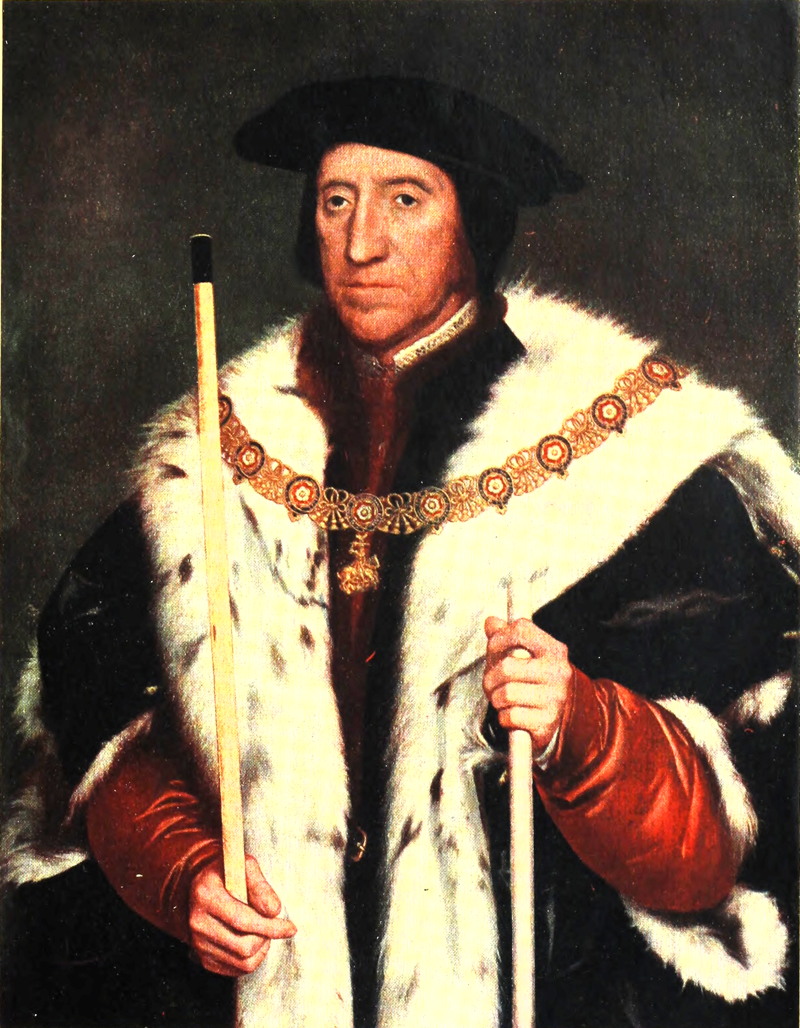
Vol. II., Plate 25 THOMAS HOWARD, DUKE OF NORFOLK Windsor Castle
PORTRAIT OF THOMAS HOWARD
It is supposed that the Windsor version is the one which was in the Arundel Collection, but its subsequent history is uncertain. That collection was divided in 1686, and the share which fell to the Duke of Norfolk may possibly have contained this portrait of his ancestor.[419] 199The Duke’s pictures were sold in 1692, and nothing further is to be heard of this portrait until it is mentioned by Walpole as being then (1762) in Leicester House, at that time the dower-house of the Dowager Princess of Wales, widow of Frederick, Prince of Wales.[420] “There can be no doubt,” says Mr. Ernest Law, “that the picture passed, on the death of the Princess in 1772, into the possession of the Crown with the rest of the collection which had been formed by Prince Frederick.”[421] It is not known from whom that Prince acquired it, but many of his pictures were purchased for him on the Continent by his agent, Bagnols, and it is not unlikely that Woltmann’s surmise is correct, and that it is to be identified with the portrait of the Duke which appeared in the catalogue of an anonymous sale of pictures at Amsterdam on April 23, 1732, as “Een zeer konstig uitmuntent stuk door Hans Holbeen, zynde de Hartog van Nortfolk nooit zoo goet gezien,” which must have been a fine work, as it fetched the relatively high price of 1120 florins.[422] It is quite possible, therefore, that the portrait was one of those sold by Lord Stafford in Amsterdam in 1654, immediately after the death of the Countess of Arundel, and that it was never in the possession of the Duke of Norfolk, but remained in that town until 1732.
The copy at Arundel Castle, about which still less is known, is so good that it is only when it is placed side by side with the Windsor version, as it was in the Tudor Exhibition in 1890, that the latter is seen to be by far the finer work of the two. The Arundel picture is slightly the smaller, and was last exhibited at the Burlington Fine Arts Club in 1909 (No. 49). There is a second version of this portrait in the Norfolk collection, at Norfolk House, in which various alterations have been made in the position and the dress, and a more elaborate background has been added. It is a work of comparatively little merit, and appears to have been painted during the seventeenth century by some inferior artist.
At the time he sat to Holbein the Duke was at the height of his power. He had been the bitter enemy of both Wolsey and Cromwell, and had assisted to bring about the downfall of both, and had arrested the latter with his own hands. After Cromwell’s execution he became the most powerful of Henry’s subjects, and reached his highest summit 200of greatness. His influence over the King, however, waned after the fall of his niece, Catherine Howard, when he was supplanted by his enemies, the Earl of Hertford and the Seymours. In 1546 he was attainted, together with his son, the Earl of Surrey, for high treason, and only escaped the latter’s fate by the death of the King on the day the warrant for his execution was made out. He remained in the Tower throughout the reign of Edward VI, but was released on the accession of Queen Mary in 1553, and his titles and estates were restored to him, but he only lived to enjoy them for a year.
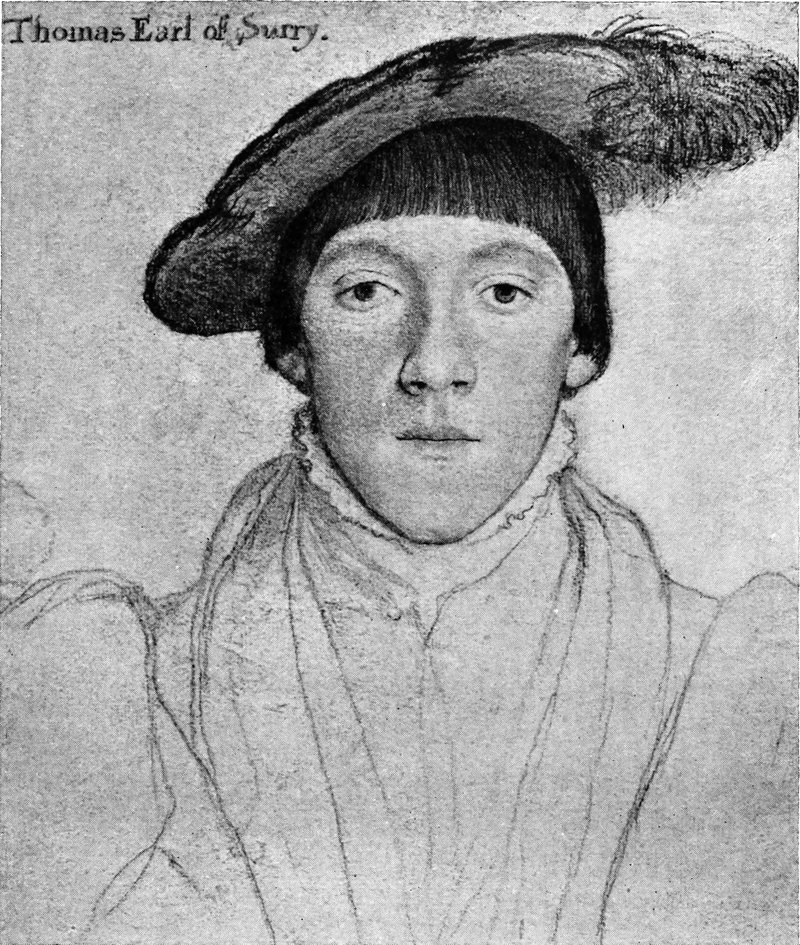
Vol. II., Plate 26 HENRY HOWARD, EARL OF SURREY Wrongly inscribed “Thomas Howard” Drawing in black and coloured chalks Windsor Castle
PORTRAITS OF HENRY HOWARD
That Holbein painted his son, Henry, Earl of Surrey, is proved by the small portrait on the wall in Fruytiers’ version of Van Dyck’s picture of the Arundel family. The inscription on this miniature copy gives his age as twenty-five; and as he was born about 1517, Holbein must have painted him about 1541. He is represented with reddish hair and beard, and brown eyes, the head slightly turned to the right, and wears a black cap with a feather, and a black mantle from the folds of which the right hand appears. There is a small drawing in the Windsor Collection wrongly inscribed “Tho. Howard E. of Surrey,”[423] which bears some likeness to the Earl in the Fruytiers drawing, and is supposed to represent Henry Howard. It is badly rubbed, and has suffered from retouching and certain coarse alterations, and has the slightly-wavering touch which marks the so-called “Melanchthon” in the same collection. It is apparently the original study for the portrait which was engraved by Hollar when it was in the Arundel Collection.[424] There are two other heads at Windsor also named Thomas Howard, Earl of Surrey, but the attribution cannot be correct, as Surrey’s son, Thomas, was a small boy of only six or seven at the time of Holbein’s death. Whether the drawings represent the poet himself is also doubtful. One of them, inscribed “Thomas Earl of Surry” (Pl. 26),[425] in which he is shown full-face, clean-shaven, with hair cut straight across the forehead and partly covering the ears, and wearing a black cap with scalloped edges and an ostrich feather, is one of the finest drawings in the whole collection, conspicuous for the delicacy of the modelling and the freedom and expressiveness 201of the draughtsmanship. The face is one of considerable charm, which is not to be seen in the third drawing,[426] inscribed “Tho. Earle of Surry,” perhaps a little later in date, in which the head is turned slightly to the left, and the hair entirely covered with the black skull-cap he wears beneath the feathered bonnet. The dress is only slightly indicated, and is rubbed, and a circular medallion suspended from a broad ribbon hangs on his breast. A portrait of his wife is also to be found among the Windsor heads,[427] full-face, wearing the angular English head-dress with black fall, and a round jewelled ornament hanging from a chain round her neck, and a second medallion on her breast. The dress which, like the ornaments, is badly rubbed, was of rose-coloured velvet, according to a note in Holbein’s handwriting. The portrait for which this drawing was the study, like that of her husband, cannot now be traced. The two full-length portraits of Henry Howard, dated 1546, at Arundel Castle and at Knole respectively, are usually ascribed to the Netherlandish painter Guillim or Gillam Stretes, on account of Strype’s statement, already quoted,[428] that in 1551 the Privy Council ordered a picture “of the late Earl of Surrey, attainted,” to be fetched away from “the said Guillim’s house.” The Duke of Norfolk’s version of the portrait[429] has a very elaborate architectural setting, coarsely painted in stone colour, and apparently of a somewhat later date than the rest of the picture, while the one belonging to Lord Sackville at Knole shows the figure only, and is looked upon by some authorities as the original. The attribution of these two pictures to Stretes is extremely doubtful. The Arundel portrait, in particular, suggests the hand of an Italian, and the name of Nicolas Beilin of Modena may be tentatively suggested. One of them was in the collection of Thomas Howard, Earl of Arundel, where it was attributed to Holbein. It is described in the inventory of 1655 as “il ritratto del Conte de Surry grande del naturale.”
Only three dated works of the year 1541 remain; the two fine portraits of men in the Berlin and Vienna Galleries, and the miniature of Charles Brandon, the younger son of the Duke of Suffolk. The Berlin 202panel,[430] (No. 586 C), is inscribed at the top, in gold, on either side of the cap, “ANNO 1541,” and lower down, in smaller letters, level with the sitter’s ears: “ETATIS : SVÆ : 37.” The coat of arms, enamelled in red and white, on the gold ring on his left hand, indicates that in all probability this young man was a member of the Dutch family of Vos van Steenwijk, though the writer has failed to trace the name, or any indication of a sojourn in or visit to England on the part of its bearer, in the Calendars of the English State Papers. It is a half-length portrait, considerably less than life-size, head and body turned to the right, but both eyes shown. The eyes are grey, and the finely painted beard and moustache are a reddish brown. In his clasped hands he holds a pair of brown gloves. He wears a black silk under-dress and a surcoat of black or very dark brown, with the collar turned over to show the lining of black watered silk, and his flat cap of the same colour has a turned-down brim. He is gazing to the spectator’s right with a far-away and slightly melancholy look in his eyes, which are wonderfully painted, as is the beautiful and expressive left hand. It comes from the Von Sybel, Elberfeld, Merlo of Cologne, and Suermondt collections, having been purchased from the last-named owner in 1874.
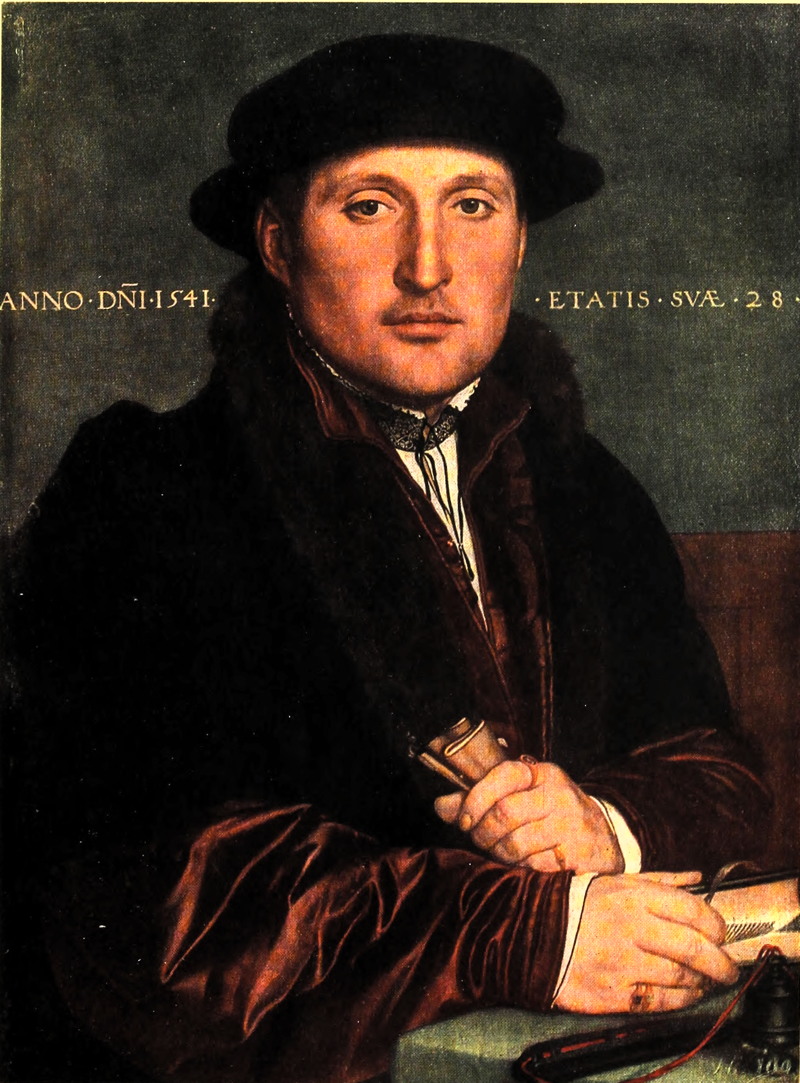
Vol. II., Plate 27 PORTRAIT OF AN UNKNOWN YOUNG MAN 1541 Imperial Gallery, Vienna
PORTRAIT OF A MAN WITH A FALCON.
The picture of an unknown man, aged twenty-eight, at Vienna[431] (No. 1479) (Pl. 27), is still finer in expression, and, indeed, is one of the most brilliant portraits of Holbein’s later years. It is one of his customary half-length figures, less than life-size, seated at a table, the body turned to the right, and the face looking out at the spectator. His doublet is of purple-brown silk, and over it he wears the usual black cloak with a deep collar and lining of brown fur, and black cap with a brim. The collar of his white shirt is beautifully embroidered with black Spanish work and tied with black laces. His grey gloves are held in his left hand, and his right rests on the olive-green cloth of the table, the forefinger being thrust within the pages of a gilt-edged book, near which is placed an inkstand with a red cord. On one of his rings is an intaglio. The clean-shaven face, showing blue on chin and upper lip, is of a ruddy brown complexion, and the hair, which does not cover the ears, is almost concealed by the hat. The unknown 203sitter, who appears to be an Englishman, is comely in features, and the eyes have a far-seeing, visionary expression, which Holbein has rendered with extraordinary vividness and subtlety of drawing. The upper part of the background consists of a blue-grey wall, with wooden panelling, or the back of a long wooden seat, below, and the panel is inscribed on either side of the head: “ANNO · DNI · 1541 · ETATIS · SVÆ · 28.” It was in the collection of the Archduke Leopold William in the seventeenth century. There is an old copy of this picture in the Palermo Gallery (Woltmann, 223).
To the year 1542 belongs the small portrait of an unknown Englishman in the Hague Gallery (No. 277) (Pl. 28),[432] which, again, is brilliant in execution, the details painted with the minutest care, but with a touch both delicate and free from all hardness, and unusual richness of colour. The head is full-face, the body turned slightly to the left. His closely cropped hair is chestnut in colour, turning to red at the ends of his moustache and short pointed beard. It is almost the only portrait by Holbein in which the sitter is shown without a hat. He wears a dress of black velvet and watered silk with a pattern, slashed with red silk at the shoulder and wrist. On his left hand, which is gloved, stands his falcon, a large bell on its claw. His right hand, in which he holds the bird’s hood, is ungloved, with a gold ring set with a stone on the little finger. The light falls from the right, and the shadow on the left side of the face is more strongly marked than in most of Holbein’s portraits. The modelling is fine, the face full of strong character, and, as usual, the hands are most expressively painted, the whole presentment being most vivid and life-like. The background is a plain blue-grey, of much the same tone as that in the portrait of 1541 at Vienna. Across the panel is inscribed, on either side of the head, the date 1542, and lower down “ANNO · ETATIS · SVÆ · XXVIII.” Little is known about the history of this picture, except that it was at one time in the royal collections of England, and that it was taken to Holland by William III, and was included in the list of works of art reclaimed by Queen Anne after that King’s death.[433] Like the portrait of Cheseman, however, it remained abroad. It is inscribed on the back “The manner of Holbein,” and in old catalogues was absurdly described as a portrait of Sir Thomas More.
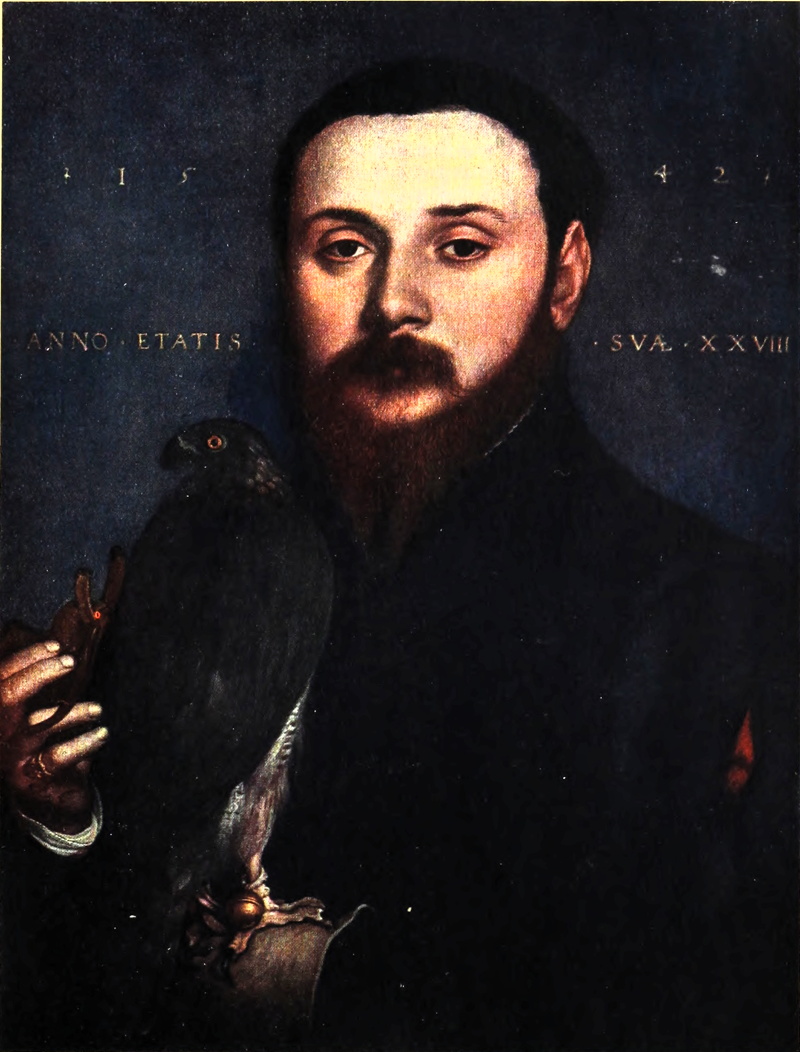
Vol. II., Plate 28 PORTRAIT OF AN UNKNOWN MAN WITH A FALCON 1542 Royal Picture Gallery, Mauritshuis, The Hague
UNDATED PORTRAITS OF LAST YEARS
204It is probable that during this year Holbein painted Sir William Fitzwilliam, created Earl of Southampton in 1538, who died at Newcastle in 1543. There is a fine drawing of the head in the Windsor Collection,[434] turned three-quarters to the right, wearing a black cap with a medallion, and ear-flaps, or a coif, tied under the chin; slight whiskers are indicated on the cheek-bones. It is a face of strong individuality, with a big nose, finely and boldly drawn, the dress only roughly indicated. There is a full-length portrait of the Earl, 6 ft. × 3 ft. 3 in., in the Fitzwilliam Museum, Cambridge (No. ii. 164),[435] which is described in the catalogue as probably a copy of the original picture by Holbein which, in 1793, was destroyed by fire at Cowdray House, the estate purchased by the Earl in 1528. He is represented standing to the right, and wearing a black cap tied under the chin as in the Windsor drawing, a long black cloak with fur collar reaching to the knees, dark hose and shoes, and the collar and jewel of the Garter round his neck. He grasps a gold-headed staff in both hands, and stands on a terrace with a low parapet and a pavement of black and red tiles, overlooking a distant landscape consisting of wooded country and a land-locked harbour or estuary of a river with ships. His coat of arms is in the top left-hand corner, and in the right an inscription giving his titles and offices, as Lord Privy Seal and Chancellor of the Duchy of Lancaster, and the date 1542. The supposition that this picture is a copy after a lost original by Holbein is probably correct; it is quite in his manner, though in workmanship it in no way reaches to his mastery, the landscape background in particular showing an indecisive touch quite unlike his firm handling. A copy of the head, evidently taken from this picture, a small panel, 13⅛ in. × 9¾ in., was lent to the Burlington Fine Arts Club Exhibition, 1909 (No. 34),[436] by the Duke of Devonshire, which is inscribed across the brown background, in an eighteenth-century hand, “Sir Thomas Moore.” The compilers of the Burlington Club catalogue do not accept the Cambridge portrait on which it is based as a copy after Holbein, but as an original work, and clearly by the same hand as the Earl of Surrey at Knole, the full-length of a young man in Hampton Court Palace, and 205the Sir Thomas Gresham in Mercers’ Hall, with which the name of Guillim Stretes has been connected, though on somewhat flimsy foundations.[437] The Windsor head, however, is in such close accord with the Fitzwilliam Museum picture that it seems reasonable to suppose that the latter was based on it, or, rather, upon some painting of Holbein’s for which it formed the preliminary study. There were two portraits of the Earl in the Arundel Collection, both attributed to Holbein.[438]
In 1542 John Leland’s “Naeniae” on the death of Sir Thomas Wyat was published, with the small circular woodcut of the poet after a drawing by Holbein, which has been already described;[439] but otherwise the only dated portrait of this year is the one of the young man with the falcon at the Hague, though there are several which must have been painted shortly before his death. Those of Dr. John Chamber and Sir William Butts and his wife must have been produced in 1542 or the earlier half of 1543, while others, such as the “Elderly Man” at Berlin, the small portrait of an English lady at Vienna, and the Simon George at Frankfurt, may be attributed with some certainty to the last seven or eight years of Holbein’s life. It is probable, too, that he painted at about this time another portrait of the Prince of Wales. No such painting now exists, but the full-faced head with a cap in the Windsor Collection[440] represents Edward as a boy of about five or six years of age, and certainly older than in the Hanover picture, while in the profile head with cap and feather in the same collection of drawings,[441] which forms the basis of numerous portraits in the National Portrait Gallery and elsewhere, the boy seems even older, though he was only six at the time of Holbein’s death.
The portrait of an Unknown Man, aged fifty-four, in the Berlin Gallery (No. 586 I) (Pl. 29 (1)),[442] is another work of great power in its suggestion of life-like portraiture, and of high technical excellence. He 206is shown to the waist, slightly turned to the right. The face is a dignified one, with a long nose, and a slight droop in the right eyelid, and a look of melancholy absorption about his dark grey eyes. The hair and long beard are black, the latter with numerous grey hairs finely indicated with all Holbein’s customary minute care. The hands are thrust out of sight within the sleeves. His doublet, of which only the lower part of the sleeves is visible, is of ruby-red silk or satin, over which is a black or dark-brown coat with bands of black velvet, and lined with a patterned watered silk. The black cap has gold tags. The plain background is a greyish-blue, and on either side of the head is inscribed in gold lettering, “ÆTATIS · SVÆ · 54.” On the back of the panel are the letters “W.E.P.L.C.,” apparently in a sixteenth-century hand, probably the mark of some early English collector. The same letters appear on the back of the portrait of Robert Cheseman at the Hague, and on the portrait of a young man by Joos van Cleve in Berlin (No. 633 A), which was formerly in the Marlborough Collection, where it was at one time attributed to Holbein. Nothing of the early history of the portrait under discussion is known. It belonged at one time to Sir J. E. Millais, and was lent by him to the Holbein Exhibition in Dresden in 1871, where it was acknowledged by the leading German critics to be a splendid example of the master’s later English period. It was purchased at the Millais sale, in 1897, for 3000 guineas for the Kaiser Friedrich Museum. There is a poor and lifeless copy of the head of this portrait in the collection of Mr. John G. Johnson, of Philadelphia.[443] The panel is a pastiche, for the copyist has attached the head of the Millais portrait to the body of the Unknown Young Man aged twenty-eight in the Vienna Gallery. In the copy of the head the hat is without the gold tags, the beard is slightly shorter, and the sitter appears to be somewhat younger. In that of the body the dress, hands, the rings, gloves, and book follow the Vienna picture closely, but the copyist has removed the two rings on the little finger of the right hand to the more usual ring-finger. Mr. C. Ricketts regards it as “almost certainly modern. In draughtsmanship it is without subtlety, the nostril is preposterous, the under lip like a muffin.”[444] Mr. F. J. Mather considers it to be old, and of fair quality.
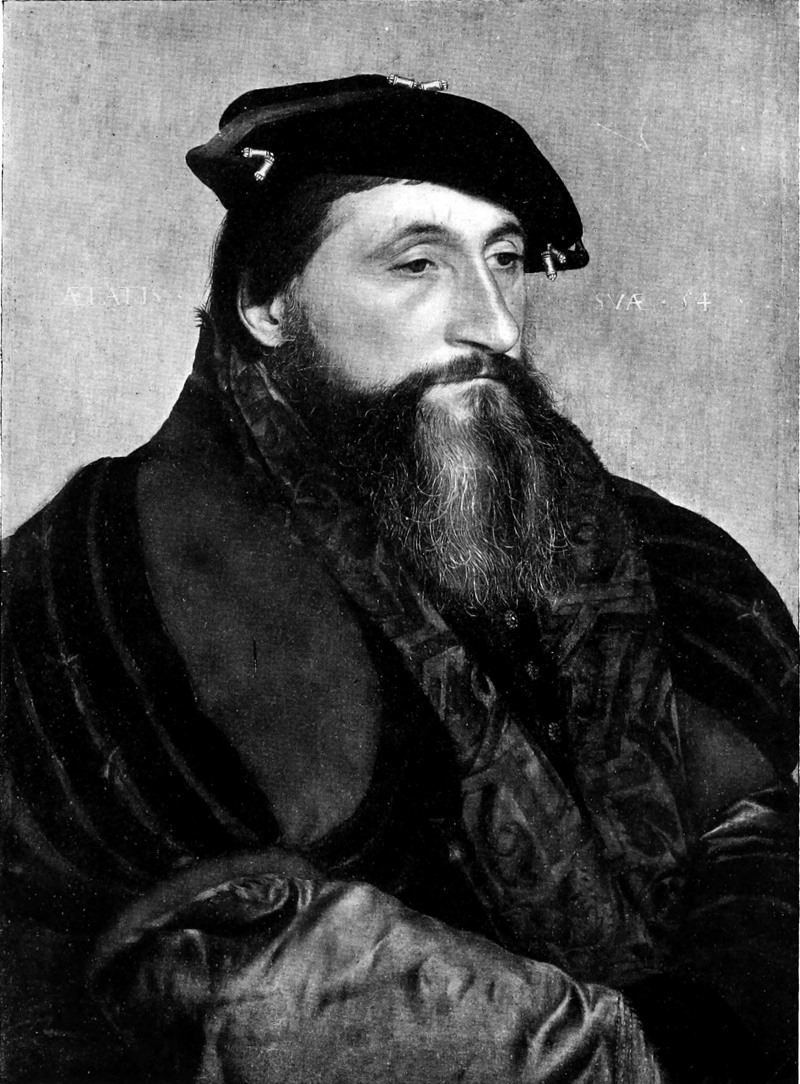
Vol. II., Plate 29a PORTRAIT OF AN UNKNOWN ELDERLY MAN Kaiser Friedrich Museum, Berlin
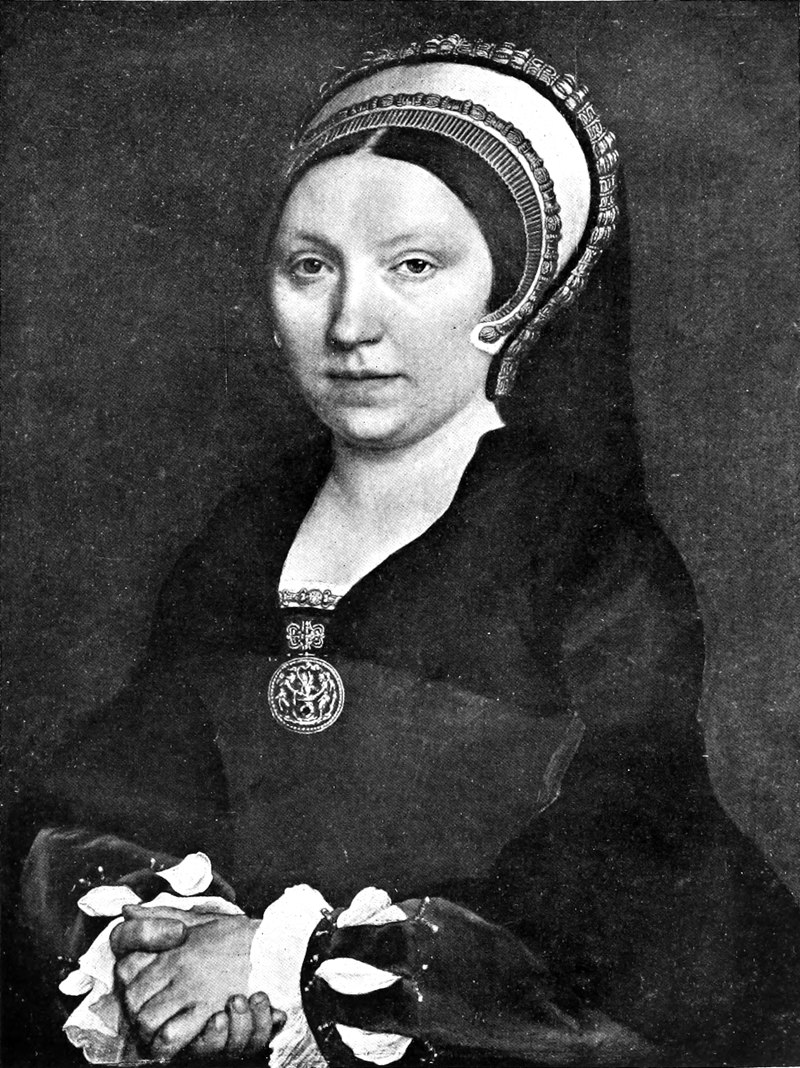
Vol. II., Plate 29b PORTRAIT OF AN UNKNOWN ENGLISH LADY Imperial Gallery, Vienna
207“It is pretty surely of Holbein’s century, and of better quality than the reproduction indicates.”[445]
PORTRAIT OF SIMON GEORGE
The portrait of an unknown English lady in the Imperial Gallery, Vienna (No. 1483) (Pl. 29 (2)),[446] is almost miniature in size, and is characterised by the most delicate brush-work and great charm and richness of colour. She is shown to the waist, full-face, the body turned slightly to the left, and her hands clasped in front of her. The dress is of dark brown or puce, with the yoke and central hanging part of the sleeves of black velvet. The sleeves from the elbow are of red velvet slashed with white at the wrists. She wears a French head-dress of white and gold, with black fall, closely resembling the one in the portrait of Catherine Howard. The hair is a dark reddish brown. At her breast is suspended a circular gold ornament upon which is represented figures sacrificing at an altar, possibly of Holbein’s designing. The background is a deep grey-blue, surrounded by a frame imitating stonework. It has no inscription.
Another small work of much beauty and delicacy of workmanship, and charm of expression, is the portrait of Simon George, of Quocote, in Cornwall, in the Städel Institut in Frankfurt (No. 71),[447] a profile portrait to the left, showing the head and shoulders only, and the right hand, in which the sitter holds a carnation. He has dark, closely-cropped hair and pointed beard, with a black cap over the right ear, elaborately ornamented with a white feather, many gold tags, an oval medallion with a representation of Leda and the Swan, and a small bunch of enamelled pansies. His dress is a rich one, and the open collar of the shirt is covered with black embroidery of a floral pattern of conventional design. The background is of greenish blue, and some letters of a two-lined inscription, of later date than the painting, mutilated by the reduction of the panel, which appears to have been originally round, can still be traced, including the letters NOB and part of the painter’s signature, “IOHA : H.” It was acquired in 1870 from the Brentano-Birckenstock sale. The original study for the head is in the Windsor Collection,[448] and shows the same slight frown 208wrinkling the forehead as in the picture. The hairs of the moustache are very carefully drawn, but the beard only shows a few days’ growth. It is inscribed at the bottom, in cursive writing, “S. George of Cornwall.”
The portrait of Dr. John Chamber or Chambre in the Imperial Gallery, Vienna (No. 1480) (Pl. 30),[449] is one of Holbein’s most powerful portraits of old men, the deeply-lined, clean-shaven face being full of individuality. He is shown to the waist, turned three-quarters to the right, in a plain black doctor’s cap, which covers the hair and hides all but the lobe of the ears, and a black gown with brown fur collar; and he holds a pair of grey gloves in his hands. The background is a very dark blue, and is inscribed, on either side of the head, “ÆTATIS SVE 88.” The date of John Chamber’s birth has not been traced, but the portrait was probably painted in 1541 or 1542, when Holbein was engaged upon the big “Barber-Surgeons” picture, in which Chamber is introduced in much the same position as in the Vienna portrait. He died at an advanced age, well over ninety, in 1549. He was one of the King’s physicians, and his name was the first on the roll of six doctors who in 1518 received letters patent from the Crown giving them the privilege of admitting other physicians to practise medicine in London, which was the original foundation of the Royal College of Physicians. Chamber was joint author with Dr. Butts and two others of a manuscript “Pharmacopœia” for the use of Henry VIII. As Court physician he attended Anne Boleyn at Greenwich Palace at the birth of the Princess Elizabeth, and it was he who reported to the Privy Council the critical condition of Jane Seymour when Edward VI was born. He married Joan Wardell in 1545, when he was nearly ninety, and their son was christened in the following year, both he and his wife dying within a few weeks of one another in 1549. His career, however, was more remarkable for the many religious preferments he gained, than for his medical skill. Born in Northumberland, he became a priest in early life, and was a Fellow, and afterwards Warden, of Merton College, Oxford. In 1502 he went to Italy and graduated in physic in Padua. On his return to England he succeeded Linacre as the King’s chief physician. In 1522 he was Canon of Windsor, in 1536 Dean of the 209Collegiate Church of St. Stephen, and later on Archdeacon of Meath. A very excellent copy of this portrait is in the possession of Merton College, Oxford, and was included in the Oxford Exhibition of Historical Portraits in 1904 (No. 27). It is inscribed on the back: “Dr. Chamber, phisician of King Henry VIII, copied from Hanns Holbein’s original by H. Reinhart. The original, once belonging to the collection of King Charles I, was, together with several other pictures of the same master, after the execution of this Monarch, sold and became the property of Archduke Leopold, Stadtholder of the Low Countries, from whence by legacy it passed into the Gallery of the Emperors of Austria (Ob. 1549).” The original portrait, however, does not appear at any time to have been included in the collection of Charles I, but it formed part of the wonderful series of works by Holbein got together by Thomas Howard, Earl of Arundel. In the Dictionary of National Biography the date of his birth is given as 1470, while the Oxford catalogue suggests the date 1469, but neither can be correct, or otherwise the date of the Vienna picture would be 1557 or 1558, fourteen years or so after Holbein’s death. If the age of the sitter, eighty-eight, as given on the panel, is correct, and it is accepted that the portrait was painted about 1542, Chamber must have been born about 1454. The Merton College copy was exhibited at the Royal Academy Winter Exhibition, 1901-2 (No. 155), as a work of the school of Holbein. In 1894 the Royal College of Physicians became possessed of a miniature portrait of Chamber, painted on the back of the ten of clubs, and said to be by Isaac Oliver. This is a careful copy of the Vienna picture, and has a long Latin inscription, giving Chamber’s titles, and the date of his death, round the frame. The original, when in the Arundel Collection, was engraved by Hollar (Parthey, 1372), with the inscription “D. Chambers Anno Ætatis Svæ 88. Holbein pinxit.” In the Arundel inventory it is described as “Doctore John Chambers.” It is possibly one of the pictures which remained on the Continent after the death of the Countess of Arundel in 1654.
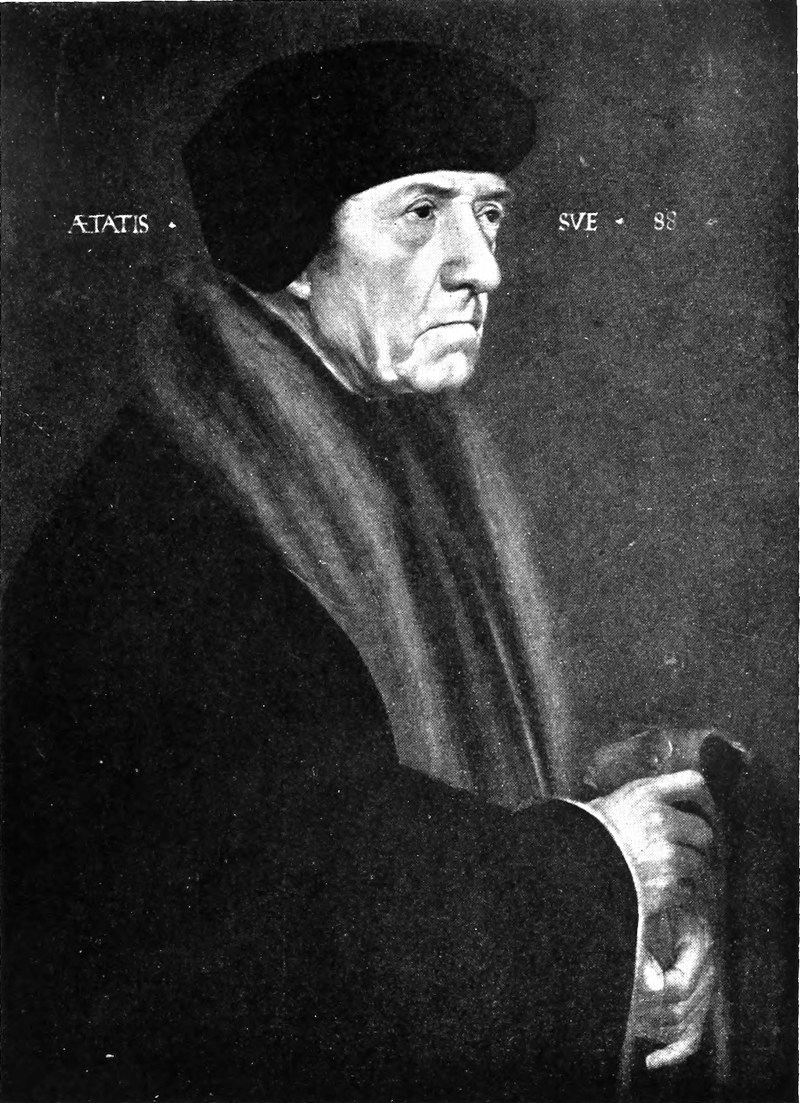
Vol. II., Plate 30 DR. JOHN CHAMBER Imperial Gallery, Vienna
PORTRAIT OF DR. JOHN CHAMBER
The portraits of Sir William and Lady Butts,[450] which have suffered, more particularly the former, from coarse repainting, are probably of about the same date as the Dr. Chamber, for Butts is also one of the prominent figures in the “Barber-Surgeons” group. The portrait 210of the husband has an inscription which has been repainted by an ignorant copyist, and now reads “ANNO ATATS SVE LIX.” Unfortunately, as in the case of Chamber, the year of Butts’ birth is not known, so that the exact date of the portrait cannot be proved. It is given in the National Portrait Gallery Catalogue as 1485 (?). His tombstone at Fulham bears only the date of his death, 1545. The portraits show the heads and shoulders only. Sir William is represented in profile to the right, in black cap and furred gown, and a heavy gold chain upon his shoulders. His face is clean-shaven, and his grey hair almost covers the ears. Lady Butts is painted almost full-face, but turned slightly to the left. She wears the angular English head-dress with black fall, a plain dress with fur-trimmed mantle, and a large enamelled rose at her breast. Above her head is inscribed “ANNO ÆTATIS SVE LVII.” Both portraits were in the National Portrait Exhibition, 1866, lent by Mr. W. H. Pole-Carew, and are now in the collection of Mrs. John Gardner, Fenway Court, Boston, U.S.A. They are about 18 in. × 14 in., and the green backgrounds and inscriptions of both pictures have been badly repainted. There is a good copy or replica of Sir William in the National Portrait Gallery[451] (No. 210), and copies of both husband and wife, apparently seventeenth-century work, in the collection of Mr. F. A. Newdegate-Newdigate, at Arbury, Warwickshire. There is no head of Butts among the Windsor drawings, but that collection contains a masterly one of his wife,[452] in which the lines of the face are very strongly marked. She was a daughter of John Bacon of Cambridgeshire. The portrait of their third son, Edmund Butts, of Thornham, Norfolk, who died at the age of thirty in 1549, is in the National Gallery (No. 1496), and is regarded as a work of that little-known English painter John Bettes. This portrait is dated 1545, and the age of the sitter is given as twenty-six, and on a card on the back is the inscription “faict par Johan Bettes Anglois.”[453]
In the exhibition held at the Burlington Fine Arts Club in 1909, Prince Frederick Duleep Singh lent a portrait (No. 30), also dated 1545, said to represent Edmund Butts, and attributed by the owner to Bettes. The armorial bearings on this picture indicate a member of the Butts 211family, but the person represented is certainly not the same as in the National Gallery portrait, nor do the two appear to be the work of the same painter.
PORTRAIT OF SIR WILLIAM BUTTS
Dr. Butts was in receipt of a salary of £100 a year from the King, and was the favourite physician about the Court. He was a native of Norfolk, and educated at Cambridge. Many prescriptions in his handwriting are preserved in the British Museum. He appears as one of the characters in Shakespeare’s Henry VIII (Act v. sc. 2), and his name occurs in a number of contemporary letters. Thus, in 1537, the Earl of Shrewsbury wrote thanking Cromwell “for asking the King to licence Dr. Buttes to come to him”;[454] and on October 6, 1542, the Earl of Southampton wrote to Wriothesley from York, when upon the expedition against Scotland: “Recommend me to Butts, and thank him for his pills. I would not have foregone them at this time for all the good I have.”[455] In spite of the pills, however, the Earl died at Newcastle nine days later.
A small half-length portrait of an Unknown Man in the Basel Collection (No. 327),[456] belongs to the later period of Holbein’s English residence. He is turned three-quarters to the left, and wears the customary dark fur-lined surcoat and black cap, and dark purple sleeves, and holds his gloves and a paper, upon which the inscription is now illegible, in his clasped hands. The beard, moustache, and hair are dark. This picture, which was purchased in Basel in 1862, has been more than once restored, so that Holbein’s handiwork has suffered considerably. Another small picture which is also now in a damaged state is the portrait of a young English lady in the collection of Count Lanckoronski in Vienna,[457] which was regarded by Woltmann as probably by Holbein, but when exhibited in the Dresden Exhibition of 1871 was declared by the critics to be a genuine work. It is similar in style to the small portrait of a Lady in the Vienna Gallery, and of about the same date. She is shown at half-length, turned a little to the spectator’s right, with clasped hands, and wearing a dark dress with red puffings and gold tags from shoulder to wrist, and a French hood with bands of gold ornaments and a black fall. Round her neck is a gold chain with a 212pendant with seven flat stones, a second gold chain, and a large brooch fastened at her breast with a cameo of a double head, a young man’s shown full-face, attached to one of a lady in profile. Across the plain green background, on either side of her head, is inscribed “Anno etatis svæ xvii.” In appearance she is stolid and unattractive, but this may be partly due to the present state of the picture.
There remains one other portrait of a lady of about this date—that of Lady Rich,[458] which until 1912 had been for many years in the possession of the Moseley family at Buildwas Park, Shropshire. The sitter is represented to the waist, slightly turned to the right, and wears the English diamond-shaped hood with black fall, and a black dress with a gold medallion decorated with the figures of a man and woman by a corpse, which, according to Wornum, are “exquisitely put in.”[459] According to the same writer, it is “a fine expressive portrait, with a thin rich carnation.” It is painted on wood, 17 in. by 13 in., and has suffered some retouching. The face is a most determined one, as can be seen from the fine preliminary drawing in the Windsor Castle Collection.[460] Lady Rich was the daughter and heiress of William Jenks or Gynkes, a rich London grocer, and she married, in 1535, Lord Chancellor Rich, of notorious memory, who helped to ruin many of the prominent men of his day, such as More and Fisher. In the seventeenth century the portrait became the property of the Rev. Herbert Croft, Bishop of Hereford, whose granddaughter, Elizabeth Croft, married Acton Moseley, of Staffordshire. In 1792 the portrait, with some other pictures, was bequeathed by Sir Archer Croft to his cousin, Mr. Walter Michael Moseley. The latter’s descendant, Captain H. R. Moseley, parted with the picture in 1912, and it is now in an American collection.[461] It was last exhibited at the National Portrait Exhibition at South Kensington in 1866 as a portrait of “Queen Katherine of Arragon.” There is also a drawing of her husband, Richard Rich,[462] at Windsor, and Holbein must almost certainly have painted his portrait, but all traces of it have been lost. A version of it was among the pictures destroyed by fire at Knepp Castle in 1904.
HOLBEIN’S SELF-PORTRAITS
Among the very last works from Holbein’s hand must have been 213the various miniature portraits of himself, dated 1543, described in the next chapter.[463] The self-portrait in the Uffizi Gallery, Florence,[464] which is evidently founded on one of them, or on one of the small oil-paintings, now lost, has few pretensions, in the writer’s opinion, to be regarded as an original work, though it is, of course, possible that beneath the brush-work of some later and inferior painter there may be an original work by Holbein now practically obliterated. It is only right, however, to point out that Dr. Ganz considers it to be an original though damaged drawing, and other writers are in agreement with him. It is in coloured crayons on a gold ground, and the comparatively modern inscription with the date 1543 has been painted over an earlier one, which can be still traced below. Dr. Ganz suggests that it is probably one of the two portraits which Van Mander saw in Amsterdam in 1604.
Of far greater interest is the recently-discovered portrait, first published in 1912 by Dr. Ganz,[465] which he considers to be a genuine self-portrait by Holbein, hitherto unknown. The likeness both to the numerous miniatures and to the Uffizi portrait is so great that the attribution is most certainly the correct one. It is in all ways much more attractive than the last-named work, and has far greater vitality and a more subtle expression of character. It is a drawing of the head and shoulders only, turned slightly to the spectator’s right, and the painter is wearing a dark fur-lined cloak and black cap. Part of the left hand only is shown. It is a coloured-crayon drawing touched with water-colour, on white paper which has been covered with a flesh-coloured ground. The paper has a Zürich water-mark, and was only manufactured between 1536-1540, so that the date of the drawing can be fixed with some accuracy, and was very probably done in Basel during Holbein’s short visit home in the autumn of 1538. It has, unfortunately, suffered considerable damage, and here and there has been touched up with Indian-ink. On the top right-hand comer of the blue background is inscribed, in a later hand, “H. H. 15 ...” It was purchased in England in the summer of 1910, and is now in Basel in the collection of Dr. Rudolph Geigy-Schlumberger.[466]
214Several portraits by Holbein, which so far have not been traced, were etched by Hollar when they were in the Arundel Collection, and these prints, in the absence of the originals, form invaluable records for the use of students. Some few of them, however, though Hollar has placed Holbein’s name on them, cannot have been painted by him, as, for instance, the portrait of Thomas Chaloner,[467] which is dated 1548. All the more important of them are reproduced by Dr. Ganz in his Holbein (1912),[468] and several have been already described in these pages. Among those remaining there is one of an unknown bearded man in a black cap,[469] and two of unnamed boys.[470] The second of these boys, whose head is turned three-quarters to the left, appears, from the details of the dress he is wearing, to be a Swiss. Holbein’s original silver-point study for the portrait from which the etching was taken is in the Louvre, and is dated 1520. The connection between the two was first pointed out by Dr. Ganz.[471] The circular portrait of Sir Anthony Denny is inscribed “ANNO 1541 ÆTATIS SVÆ 29.”[472] The original painting, a small roundel, descended, according to Mr. W. Barclay Squire, to the Howards of Greystoke Castle, and is now in the collection of Mr. J. Pierpont Morgan, junr. There is an old copy of it at Longford Castle.[473] The large print of an elderly, grey-bearded man, with fur coat, and cap with a feather,[474] is usually said to represent Charles Brandon, Duke of Suffolk, but though it bears considerable likeness to the authentic portraits of him, the attribution is doubtful. There are several portraits of English ladies among Hollar’s work. Of one, in which the sitter is turned to the right, and is wearing a round head-dress surmounted by a flat black cap with a large feather,[475] there is no study known, but for two others, which Hollar has reproduced as small roundels, the preliminary drawings are to be found in the Windsor Collection, one of them of an unknown lady, full-face, wearing the angular head-dress,[476] and 215the other the drawing inscribed “The Lady Mary after Queen.”[477] The profile portrait of a lady, which has been considered by some writers to represent Anne of Cleves,[478] does not appear to be after an original by Holbein, though Hollar has placed his name on it. It is possible, though not very probable, that some of these circular etchings were based on the drawings, and not on finished pictures.
DUKE OF BUCKINGHAM’S COLLECTION
Holbein’s practice during his last English period seems to have been devoted almost entirely to portraiture, so that an entry in an inventory of the Duke of Buckingham’s pictures at York House, made in 1635,[479] is of exceptional interest, as it shows that he did occasionally paint subjects other than portraits. It runs as follows: “Hans Holbin.—Jupiter and Jo in Water Coulers.” This picture, of which all traces are lost, was hanging in the Vaulted Room. The Duke possessed a number of other works by or attributed to Holbein, but unfortunately the entries in the inventory are so tantalisingly vague that it is impossible to gather much information about them, though two of them seem to have been portraits of Steelyard merchants. They included “Erasmus Rotterodamm after Holbin”; “A Dutchman Sealing a Letter” (possibly the John of Antwerp now at Windsor);[480] “A Rare piece, being a Dutchman”; “A Queen”; “An other Lady”; “A little picture in Linnen”; and “A little picture of Holbin himself,” which was probably one of the miniatures. With the exception of the last-named, all are described as by “Holbin” or “Hans Holbin.”
THE “DANCING PICTURE”
Another subject-picture by Holbein is mentioned by Evelyn in his Diary, but so vaguely that it is impossible to guess what it could have been. He says, under the date May 8, 1654: “I also call’d at Mr. Ducie’s, who has indeede a rare collection of the best masters, and one of the largest stories of H. Holbein.” This, however, may have been some picture similar to “The Battle of Spurs” at Hampton Court, attributed to Holbein in Evelyn’s day, and not a genuine work of the master. His judgment was not always infallible, as he speaks of the 216well-known “Dancing Picture,”[481] which he saw at the Duke of Norfolk’s at Weybridge (23rd August 1678) as “that incomparable painting of Holbein’s.”
217