BOOK ILLUSTRATIONS AND ORNAMENTAL WOODCUTS.
Reading edition
Holbein’s versatility as an artist is nowhere shown more convincingly than in the illustrations he made for printed books, and the series of woodcuts which were published from his designs during the last decade of his life. His title-pages, initial letters, chapter headings, and ornamental borders, for Froben and other printers, display a rich invention, greatly in advance of most similar work of that period. In some of them the artist’s sureness of hand and firmness of drawing have been sadly blunted by the incapacity of the woodcutter. In others, however, he was very happily associated with a cutter of real genius, Hans Lützelburger, who had both the skill and intuition to carry out the master’s intentions with marvellous and sympathetic accuracy. One of the most celebrated of his title-pages is that known as The Table of Cebes, representing, by means of countless little figures, the soul’s journey through life.
But Holbein’s fame as a designer of woodcuts, which had spread throughout Europe before the end of the sixteenth century, was based
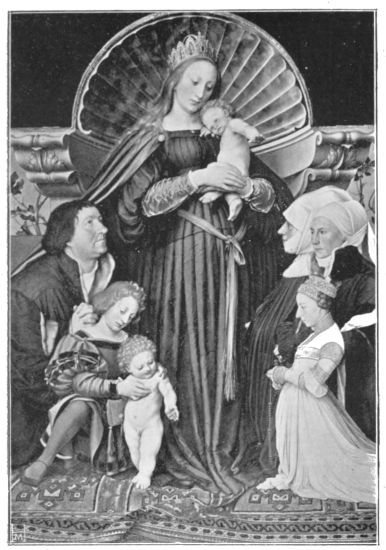
Hanfstängl photo.] [Darmstadt THE MEYER MADONNA.
upon two celebrated series of designs, The Dance of Death and his Old Testament Illustrations, in which his gifts as an illustrator are most clearly shown. The Dance of Death, with its forty little pictures, at once became popular, and editions followed one after the other, with additional illustrations. The subject was a very favourite one throughout mediæval Europe, and in Holbein it reaches its highest development. It is a series of short pictorial sermons, in which the artist points out to the reader how slight and how uncertain is his hold upon life, and how in the presence of death both Prince and peasant are equal. In the satire with which Holbein has treated clerics of all degrees we learn something of the way in which the Reformation influenced him. Each little picture is a masterpiece of art, in which is depicted, with grim humour, death’s unexpected approach, sparing neither King nor Pontiff, Queen nor courtesan, knight nor beggar, old age nor childhood. In each one the feeling for fine dramatic situation is admirable, the whole being indicated in a few sure lines of masterly draughtsmanship. Detailed accounts of each of the subjects will be found in Dr. Woltmann’s “Holbein and His Time,” and in Chatto and Jackson’s “History of Wood Engraving,” while Ruskin’s “Ariadne Florentina” should be read for a very sympathetic and beautiful analysis of their intellectual side, their spiritual meaning, and Holbein’s marvellous power of design for such work.
In the same year, 1538, his illustrations to the Old Testament, ninety-one in all, were also published by the brothers Trechsel. They did not accompany an edition of the Bible, but were issued as a book of pictures, with appropriate letter-press. They are less known than The Dance of Death woodcuts, and in them the artist has put a curb on his fertile imagination, and confines himself to telling the sacred stories with great simplicity and directness, while nothing essential to the full understanding of the story is omitted.
In addition to these more important woodcuts, Holbein also designed several series of ornamental alphabets, one of them a dance of death, another with peasants at their merrymakings, and a third with children at their games.
DESIGNS FOR GOLDSMITHS AND OTHER CRAFTSMEN.
No form of art came amiss to this versatile genius. He made hundreds of designs for jewellers and metal-workers, many of which, happily, have been preserved, the greater part of them being now in the Basle and British Museums. These include designs for rings, brooches, pendants, medallions, buttons, badges, jewelled monograms, hand-mirrors, decorative bands to be engraved upon metal, dagger handles and sheaths, and every kind of personal ornament, and a number of larger objects, such as cups, bowls, clocks, and similar pieces. In these, again, his most inventive powers of design, based upon Renaissance lines, combined with a very skilful adaptation for decorative purposes of the human figure, place him in the forefront of sixteenth-century designers. His most important piece of goldsmith’s work of which we know was a gold cup of beautiful Renaissance design, known as the Jane Seymour Cup, the original drawing for which is in the British Museum, and a second one in the University Galleries at Oxford. It was undoubtedly made as a gift from the King to the Queen, and bears their initials, together with Jane Seymour’s motto, “Bound to obey and serve.” Benvenuto Cellini never accomplished anything finer in cinquecento ornament than this. In the beauty of his design, with its more restrained taste, Holbein equalled the famous Italian craftsman. Another beautiful design for a clock, in which the nude figures of boys are admirably introduced, was completed for Sir Anthony Denny, who presented it to the King on the New Year’s Day immediately following the artist’s death.
In his younger days, when in Basle, he made many admirable designs for stained and painted glass windows, some with sacred subjects, already mentioned, others with armorial bearings, and in several the figures of armed soldiers, with their picturesque costumes, are introduced with excellent effect.
Among the many drawings by him which have been preserved there are several examples of architecture, of which the most important is a drawing of a large fireplace and chimney-piece, decorated with the Royal Arms and of very elaborate Renaissance design (British Museum), but whether it was actually carried out is uncertain. Several architectural works have been attributed to him, such as the old Whitehall Gateway, now demolished, the so-called “Holbein Porch” and lodge at Wilton, the carved capitals in the More Chapel at Chelsea, and a ceiling in Whitehall, mentioned very vaguely by Samuel Pepys. It is almost certain that he had nothing whatever to do with these, although his fertility in the invention of architectural details for the backgrounds of his pictures and woodcuts was so great that possibly he wanted only an opportunity to attempt more serious architectural work, as was the custom of many Italian artists, who built as well as painted.
PORTRAIT PAINTING.
It was, however, as a portrait painter that Holbein’s genius reached its highest manifestations. In portraiture he stands side by side with the greatest. That so considerable a part of his time was given up to this branch of art was no doubt owing to environment, although his stupendous gifts in this direction were born in him, and were bound to come to the front. The Reformation in Switzerland brought his paintings of altar-pieces to an abrupt conclusion, and in England he found no demand for sacred art, but, on the other hand, a splendid field for portrait painting, of which he availed himself to the utmost; and he has left a series of lifelike representations of the illustrious men and women of Henry VIII.’s reign of more value, both historically and as absolutely faithful representations of the people depicted, than even the similar series painted by Van Dyck at the Court of Charles I., or by Reynolds and Gainsborough under George II. and George III., and even wider in its range of subjects than Velasquez accomplished in Philip’s service. The magical brush of the artist has pictured for us, with a living realism, many members of the royal House of Tudor, high prelates of the Church, leading statesmen, soldiers and sailors, men of learning and of science, leaders of fashion, country gentlemen and their wives, German and English merchants, foreign diplomatists, and plain citizens.
One of the greatest artistic treasures in this country is the series of drawings of heads at Windsor Castle, the preliminary studies Holbein made before painting his portraits, and, slight as many of them are, themselves most vivid portraits, in which, with wonderful swiftness yet sureness of touch, he has given us not only an accurate likeness, but also the character which lies behind the face-mask, allowing us to look into the inmost thoughts of each sitter, and so to fathom the invisible by the aid of his acute penetration, which is of far higher value than mere accurate delineation of features, and is the crowning quality of all really great portraiture.
In all his completed portraits he spared no pains over the painting of accessories and details, and in some of them he carried this to as fine a finish as any Dutchman or Fleming ever accomplished. What could be finer than the various objects scattered about the office of the Steelyard merchant, Georg Gisze (Berlin), or the ornaments and embroideries, silks, satins, and furs of the dresses in such portraits as those of Archbishop Wareham (Louvre), Jane Seymour (Vienna), Anne of Cleves (Louvre), Charles de Solier, Comte de Morette (Dresden), The Ambassadors (National Gallery), or the Duke of Norfolk (Windsor)? Yet the fine execution of all this elaborate detail is soon overlooked, and attention is fixed solely upon the portrait itself, in which, without any apparent effort on the part of the artist, the very man stands out before us exactly as he looked when in the flesh, with no flattering or softening of harsh features, and with his character, and the thoughts which he imagined were hidden from the painter, laid bare for our inspection.
Holbein produces this effect of truth and this revelation of character by what appear to be the simplest methods, which yet are in reality most subtle and most profound. He puts but little of himself into his portraits, and almost everything of his sitter. No great subtleties of light and shade are brought in to aid the artistic result; and even colour, delightful and harmonious in a high degree as Holbein’s colour always is, is not allowed to usurp the attention from the purpose of the work, the complete realization of both the outward and inner man. What at the first glance seems almost an unnatural flatness in his painting of a face displays upon examination the most delicate and accurate modelling of form. His keenness of observation was extraordinary. He constantly noted the slight difference in the shape of two sides of a face, and that a man’s eyes were not always of the same size, characteristics which even the best artists have sometimes failed to see. His painting of hair and of beards displays a marvellous fidelity to nature, and his drawing of hands, and the expression he puts into them, is extraordinary. In the painting of eyes, too, and mouth he is most expressive. The hands of Erasmus in the Louvre and at Longford Castle, of Wareham and Anne of Cleves in the Louvre, are instances of this; and the eyes of Southwell (Uffizi), and of Cheseman (Hague), and both eyes, hands, and mouth of the Duchess of Milan (National Gallery).
He is seen at his best as a portrait painter in the Duchess of Milan (see illustration, and p. 54); Count Morette; Jacob Meyer and his family in the Madonna picture at Darmstadt (see illustration, and p. 44); Erasmus at Longford Castle (see illustration, and p. 50) and in the Louvre; Georg Gisze (see illustration, and p. 51); the portrait of an unknown man with a long beard, formerly belonging to Sir J. E. Millais, at Berlin; the portraits of three unknown young men, all dated 1541, at Vienna, the Hague, and Berlin; The Ambassadors; The Two Godsalves at Dresden; his own wife and children at Basle; and the Anne of Cleves, Robert Cheseman (see illustration, and p. 56), and Richard Southwell already mentioned; while among his earliest portraits those of Bonifacius Amerbach, and Jacob Meyer and His Wife on one panel, both in Basle, should be carefully studied. A number of others might be mentioned, but these are sufficient to establish his right to the title of a great master.
Holbein’s method of work seems to have remained the same throughout his life. It was his custom to make a preliminary study of the head on paper, fixing with unerring accuracy the features of the sitter, and making notes as to the colour or the details of the ornaments to be introduced at the side of the drawing, and for the rest relying almost entirely upon his memory, which must have been singularly retentive. In this way he could accomplish much without fatiguing his patrons with a number of sittings. Occasionally, by the use of colour and more careful and elaborate drawing, he carried such preliminary studies much further, until they were finished portraits in themselves. Others, again, are only hasty outlines, but displaying the hand of a master. They were executed in charcoal and black and red chalk, the eyes, hair, and hand being often drawn in their proper colours. Some are strengthened in the outlines with the brush and Indian ink, while in others the whole face has been modelled with the brush with the greatest delicacy. In some cases he fixed the preliminary drawing upon a panel, and then painted the finished portrait over it.
Unlike that of Dürer, the one other really great German painter, Holbein’s art bears no traces of mediævalism, either in form, in method, or in thought. He was in every way a child of the Renaissance, and so was essentially modern, as we understand the term to-day. For this reason the forms in which he expresses himself require no explanation or preliminary training for their full comprehension, but are immediately intelligible to us. The great Franconian, Albert Dürer, was steeped in the spirit of mediævalism, a dreamer of dreams, full of philosophical theories and spiritual speculation, and his work fired with a passion which Holbein’s lacked; whereas the great Swabian was before all things a serene painter, lacking strong artistic passions. He loved Nature simply and for herself, and had the keenest vision for her manifold beauties down to the minutest details, and was filled with the delight of life and joy of the world around him, without troubling himself greatly about theological questions. That he was at heart on the side of the Reformation is shown in many of his woodcut illustrations, but his share in the controversy is marked by none of the violence which characterized the eager partisans on either side.
Sir Frederic Leighton, speaking of these two painters in his address to the Royal Academy students in 1893, notes the most striking differences between them in a few admirable sentences. He says of Holbein: “As a draughtsman he displayed a flow, a fulness of form, and an almost classic restraint which are wanting in the work of Dürer, and are, indeed, not found elsewhere in German art. As a colourist he had a keen sense of the values of tone relations, a sense in which Dürer again was lacking; not so Teutonic in every way as the Nuremberg master, he formed a link between the Italian and German races. A less powerful personality than Dürer, he was a far superior painter. Proud may that country be indeed that counts two names so great in art.”
It is an almost impossible task to sum up in a short paragraph the leading characteristics of Holbein’s art. In his great decorative wall-paintings he rivalled many of the best Italian painters of the Renaissance. In the depth of expression in his portraits, and his power of rendering character and grasping the hidden thoughts of his sitter, he is worthy of a place by Leonardo da Vinci. In his religious paintings he reached at least once, in The Meyer Madonna, the level upon which Raphael stood, and had his surroundings been different he would have attained signal success as a painter of sacred compositions. He attempted no great subtleties of chiaroscuro, nor sought to rival his Italian contemporaries in the magnificence of their colour; but his colour is always most harmonious, and both in design and style he was great.
In his most important designs for metal-workers he is equal to Benvenuto, that most inspired and artistic of swashbucklers, and with more restraint in the handling of his theme, but no less invention. With the exception of Dürer, no artist of the cinquecento produced such admirable designs for woodcuts and book illustrations. In his preliminary drawings for his portraits the insight, the ease of draughtsmanship, the force united with the greatest delicacy, and the freedom from all traces of mannerism, unite to make them—as seen at Windsor, Basle, Berlin, and elsewhere—one of the most complete and valuable series of documents of the history of the first half of the sixteenth century we possess to-day. Possibly the greatest side of his genius is to be found in his penetrative power into the very souls of his sitters, and the revelation of true character which was the consequence of it. This keen insight, aided by a manipulative skill of a very rare quality, combined to make him one of the great masters of the world. Ruskin’s judgment of him, when comparing him with Sir Joshua Reynolds, may be fitly quoted in conclusion. He says: “The work of Holbein is true and thorough, accomplished in the highest, as the most literal, sense, with a calm entireness of unaffected resolution which sacrifices nothing, forgets nothing, and fears nothing. Holbein is complete; what he sees, he sees with his whole soul; what he paints, he paints with his whole might.”