Part 2 — Appendix. A Division Front in Trench Warfare.
Reading edition
EXPLANATION OF PLATE I.
The following may be considered a standard scheme of distribution of troops, for trench warfare, in a fully developed trench system.
An infantry division is composed of two brigades, each brigade of two regiments, each regiment of three battalions. Each brigade thus has six battalions, each battalion numbering 1026 officers and men, normally divided into four companies.
One battalion occupies about 1000 yards in ordinary trench warfare. As reliefs must be frequent, three battalions of each brigade will be on duty, while the other three are in rest-billets, at least two miles back of the trenches.
Two of the battalions on duty occupy the trenches, the third is stationed about a mile back, in reserve.
A brigade can therefore hold about 2000 yards of trenches: two battalions in front line trenches, one battalion in reserve, and three battalions in rest billets.
Hence a division (two brigades) will hold a front of about 4000 yards.
Within each 1000 yards front, the distribution may be as follows:
Three platoons of Companies A, B, and C occupy the dugouts of the cover trench and of the support trench and post sentinels by roster in the fire trench.
Platoon No. 4 of each company occupy the dugouts of the reserve trench, together with the entire Company D.
Platoons and companies then relieve one another according to roster, a platoon of each company and an entire company, in turn, enjoying comparative rest in the reserve trench even during the stay of the battalion in the trenches.
EXPLANATION OF PLATE II.
The following is a description of the back areas of a divisional sector in which there has been no great changes since 1915. There are still several hundred miles of such sectors.
The line at the top marks the beginning of the trench-system described in Plate I. being the entrance to the communication trenches.
Road a, b, with the river c, d, run at the bottom of a small valley surrounded by hills of about 80 ft. elevation. A branch of the river runs from c. to e. and a railroad beside it, along road h, i, and crossing road j, k. A good size village is at D, a smaller one at C, hamlets at A and B. The latter are about one mile back of the trenches, village C. about two miles and village D. between three and four.
Hamlets A and B have probably been heavily bombarded at the time line was established and have been evacuated by the civilians. Village C. has received shells, but, if there has been no big attack in the sector, is in fair shape and some of the inhabitants remain. Village D. may also have suffered from shells but probably most of the inhabitants remain. Such villages may be clusters of farms or of cottages, depending upon the region. If village is made up of cottages, farm houses will be found along the roads at frequent intervals. The fields are likely to be under cultivation almost as far as road k, l.
Villages A, B, C are used to billet the battalion in reserve of each brigade. Village D. and the nearest villages further back are used as rest-billets by the battalions of the brigades who will relieve those in the trenches.
Near or in villages A, B and C or near hill E and G are located the transports of the infantry battalions in the trenches. Supplies are sent daily to the trenches from this headquarters of the quartermaster and transport officer.
Somewhere along road k, l, or about hills E and G are hidden in gun pits the batteries of field artillery attached to the division. The men live in dugouts alongside. The camps for the horses, wagons and supply headquarters of these batteries are hidden in the woods or on the further slopes of hills E, F, G.
In village D are very likely located the Brigades' headquarters and such services as the Field Ambulance and the Divisional Supply Departments. The Y. M. C. A. recreation centers, divisional theatre, football fields, army canteens etc., are also located in village D or just back of it. If the houses in the villages do not provide enough billets, huts and tents are erected. Otherwise the officers are billeted in the houses of the inhabitants and the men in the barns.
The Divisional Headquarters, the Ammunition Column, the Artillery Brigade Headquarters, the Engineers, the Ammunition Dumps, etc., are strung out in the villages and along the roads just back of village D. The heavier artillery is also posted back of this line.
In sectors that have been the scenes of offensives the several elements remain in the same relation, but as the villages have been obliterated, shelters must be provided. [The Editor.]
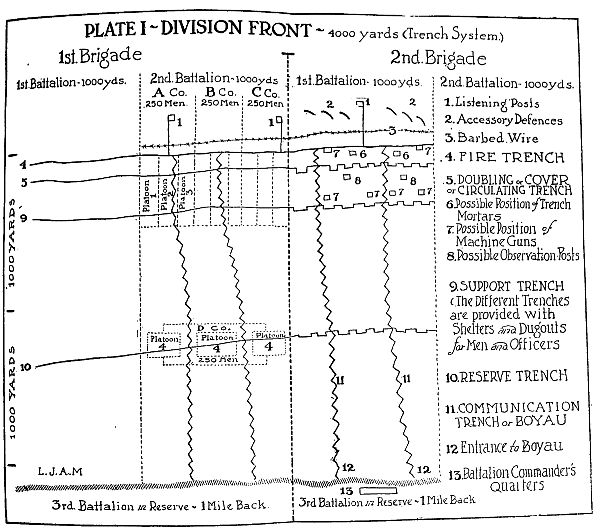
PLATE I—DIVISION FRONT—4000 yards (Trench System)
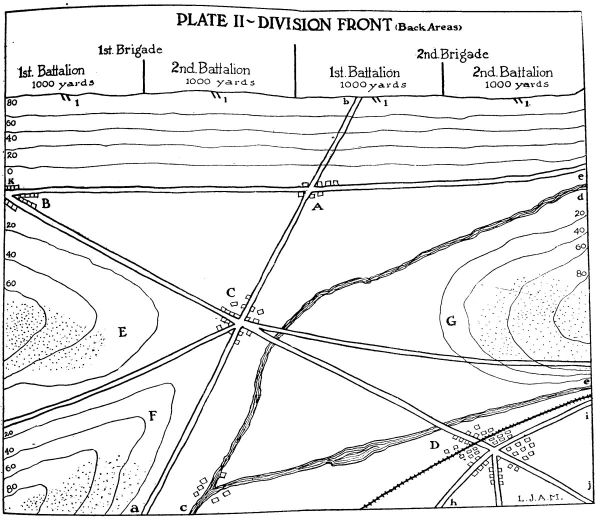
PLATE II—DIVISION FRONT (Back Areas)