Chapter VI · THE “GENERAL MORPHOLOGY” (continued 2)
Joseph McCabe translation
On the whole this systematic introduction to the second volume would have sufficed of itself to secure for Haeckel a prominent position in the history of zoology and botany. He himself was chiefly proud of the fact that it was the first natural-philosophical system on the new lines to meet the rigorous demands of academic science, and indeed to revolutionise academic science. This enhances his complete triumph in the last two books of the volume. First man is introduced, with absolute clearness and decisiveness, into the system of evolved natural beings, as crown of the animal world, but subject to the same laws as the animal: a vertebrate, a mammal, whose nearest relatives are the anthropoid apes. Thus at last the “system of nature” was complete. It embodied the unity of nature. It formed the framework of facts for a unified natural philosophy, Monism. The monon, the “one,” embracing all things, that included nature in itself and itself in nature, became the last scientific definition of what people called “God.”
Thus the volume, which had begun the system of nature with the monera, closes with a chapter on the Monistic God—“the God in nature.” The conception of God in human fashion is rejected. Man is merely a vertebrate, a mammal, adapted in his whole structure to our little planet. A supreme 236Being to whom we ascribe omnipresence could not possibly be confined within the narrow limits of this vertebrate and mammal organisation. When we try to do so we fall into unshapely conceptions that are wholly unworthy of the most exalted of all words, ideas, and beings. It is in this connection that Haeckel uses for the first time the phrase “gaseous vertebrate,” that has so often been quoted and attacked since. He means to say that we are driven to such debasing and senseless definitions if we do not recognise in God the essence of the whole system of things; if we form our idea of him arbitrarily on any particular property of things within the system. We must beware—as he expressly says—of such confused and unworthy comparisons.
“Our philosophy,” Haeckel continues, “knows only one God, and this Almighty God dominates the whole of nature without exception. We see his activity in all phenomena without exception. The whole of the inorganic world is subject to him just as much as the organic. If a body falls fifteen feet in the first second in empty space, if three atoms of oxygen unite with one atom of sulphur to form sulphuric acid, if the angle that is formed by the contiguous surfaces of a column of rock-crystal is always 120 degrees, these phenomena are just as truly the direct action of God as the flowering of the plant, the movement of the animal, or the thought of man. We all exist ‘by the grace of God,’ the stone as well as the water, the radiolarian as well as the pine, the gorilla as well as the 237Emperor of China. No other conception of God except this that sees his spirit and force in all natural phenomena is worthy of his all-enfolding greatness; only when we trace all forces and all movements, all the forms and properties of matter, to God, as the sustainer of all things, do we reach the human idea and reverence for him that really corresponds to his infinite greatness. In him we live, and move, and have our being. Thus does natural philosophy become a theology. The cult of nature passes into that service of God of which Goethe says: ‘Assuredly there is no nobler reverence for God than that springs up in our heart from conversation with nature.’ God is almighty: he is the sole sustainer and cause of all things. In other words, God is the universal law of causality. God is absolutely perfect; he cannot act in any other than a perfectly good manner; he cannot therefore act arbitrarily or freely—God is necessity. God is the sum of all force, and therefore of all matter. Every conception of God that separates him from matter, and opposes to him a sum of forces that are not of a divine nature, leads to amphitheism (or ditheism) and on to polytheism. In showing the unity of the whole of nature, Monism points out that only one God exists, and that this God reveals himself in all the phenomena of nature. In grounding all the phenomena of organic or inorganic nature on the universal law of causality, and exhibiting them as the outcome of ‘efficient causes,’ Monism proves that God is the necessary cause of all things and the law itself. In 238recognising none but divine forces in nature, in proclaiming all natural laws to be divine, Monism rises to the greatest and most lofty conception of which man, the most perfect of all things, is capable, the conception of the unity of God and nature.”
The book closes with these words and a quotation from Goethe. It had opened with a quotation from Goethe. Goethe runs through the whole of the two energetic volumes like an old and venerable anthem. The stalwart fighter not only traces his whole Monistic philosophy to Goethe: not only owes to him the very idea of morphology. In front of the second and more strictly Darwinistic volume he has a dedication “to the founders of the theory of evolution,” and between Darwin and Lamarck we find the name of Goethe. It was Haeckel’s firm conviction that Goethe not only believed in the unity of God and nature, but literally in the natural evolution of the various species of animals and plants from each other. In this conviction, which claims Goethe explicitly for Darwin, he has never been shaken, although his own friends and convinced evolutionists (Oscar Schmidt, for instance) have often opposed him on the point.
Much has been written since the days of the General Morphology both for and against this Goethe-Darwin theory, but I cannot see that we have got much further with it. I still find that a candid study of some of Goethe’s smaller writings, such as the History of my Botanical 239Studies, the criticism of D’Alton’s Sloths and Pachyderms (which is very important), and several others, compels us to think that Goethe really believed, in a strikingly Darwinian way, in a slow transformation and evolution of animal and plant species in virtue of purely natural laws; and that he always laid great stress on this idea of his as an original notion, far in advance of the professional science of his time. We not only have several clear passages, but the whole point of his argument really rests on this idea. Hence, apart altogether from the pedantry that tries to make a cabalistic mystery out of Goethe’s works, and always reads B for A and C for B, it does seem that there was truth in Haeckel’s first view of the matter, in spite of all the ink that has been shed over it and the vast amount of word-splitting exegesis. Darwinism has, in a certain sense, its German side, even apart from all that Haeckel has done for it.
This was the book, then, that the deeply afflicted author wrung from himself as his “testament.” It was written and printed with unprecedented speed. When the first copies were issued, the author had a feeling that he had nearly “done for himself.” He could not sleep. The state of his nerves gave great concern to his friends, who were watching him most anxiously. With a stolid fatalism, as if nothing mattered now, he yielded to their pressing advice, and decided to travel for a time. Far away on the blue Atlantic, 240at the gate to all the glories of the tropics, there is an island, Teneriffe, that was counted one of “the isles of the blest” in the old Roman days. A huge volcano rises from it, and on its flanks we find all the zones of the geography of plants, as in a model collection. Humboldt has given us a splendid description of it, as the first station of his voyage to the tropics. “The man who has some feeling for the beauty of Nature,” he says, “will find a more powerful restorative than climate on this lovely island. No place in the world seems to me better calculated to banish sorrow and restore peace to an embittered soul.” Haeckel went there.
It was not an expensive journey, but it came as a fresh greeting from Nature. It was a new ocean after the long studies on the Mediterranean. What might it not afford in the way of medusæ and other zoological prizes when the general beauty of the landscape, that had enchanted Humboldt, had been fully enjoyed. With a mingling of his overflowing passion for Nature, and the gloomy fatalism that told him this would be his “last voyage” after his “last book,” he asked permission to leave Jena in the autumn of 1866, when the printing of the Morphology was completed, and set out. It was no more to be his last voyage than the Morphology to be his last testament. Although still subdued with resignation in his inner life, he came home in the spring of 1867 with a new elasticity of body and mind, restored by the influence of the palms and bananas 241and spurge, and braced for the great struggle of his life that was now to begin in earnest.
The voyage had really two aims. To see the volcano above a palm-clad coast, with the Atlantic Ocean bringing its medusæ; and to work for Darwin.
A personal connection between the two had already been formed as a matter of course. Darwin, almost confined for years to his isolated home at Down owing to his constant ill-health, had received a copy of the Radiolaria, and the correspondence had begun. The work had as yet met with little encouragement from the ranks of exact scientists. It cannot have been a matter of indifference to Darwin personally that so distinguished a work, a real model of professional research, had come over to him. Proofs of the Morphology were sent over to Down before the book was ready for publication. Darwin read German with difficulty, but in this case he was stimulated to make an unusual effort. At last Haeckel himself made his appearance at the master’s home. It seemed as though he had to visit him in person to receive his blessing. It was, at all events, a happy moment in the history of Darwinism when the two men first met whose names will be inseparable in literature.
This was in October, 1866; Darwin had sent his carriage to bring Haeckel from the station. A sunny autumn morning smiled on the homely and beautiful English landscape with its bright woods and golden broom and red erica and evergreen oaks. 242Haeckel has described their first meeting. “When the carriage drew up before Darwin’s house, with its ivy and its shadowy elms, the great scientist stepped out of the shade of the creeper-covered porch to meet me. He had a tall and venerable appearance, with the broad shoulders of an Atlas that bore a world of thought: a Jove-like forehead, as we see in Goethe, with a lofty and broad vault, deeply furrowed by the plough of intellectual work. The tender and friendly eyes were overshadowed by the great roof of the prominent brows. The gentle mouth was framed in a long, silvery white beard. The noble expression of the whole face, the easy and soft voice, the slow and careful pronunciation, the natural and simple tenor of his conversation, took my heart by storm in the first hour that we talked together, just as his great work had taken my intelligence by storm at the first reading. I seemed to have before me a venerable sage of ancient Greece, a Socrates or an Aristotle.”
They were delighted to meet each other, for they were like natures, in their best qualities. Darwin had more passion in him than he ever expressed, and behind all Haeckel’s impetuosity there was the naïve and yielding temper of the child. He poured out his anger against the stubborn and bewigged professors who still held out against the luminous truth of the theory of evolution. Darwin put his hand on his shoulder, smiled, and said they were rather to be pitied than blamed, and that they could not keep back 243permanently the stream of truth. At heart, however, he was delighted with his fiery pupil. They were to fight their battle shoulder to shoulder for seventeen years. During all those years there was never the slightest disturbance of their friendship. Darwin knew well what an auxiliary he had in Haeckel. It is true that he wrote him a wonderful letter occasionally, in which he used the right of a senior to warn Haeckel not to deal so violently with his opponents. Violence only had the effect of making onlookers side with the party you attacked. We must be careful not to be too hasty in setting things up as positive truths, as we see every day people starting from the same premises and coming to opposite conclusions. But he was generally at one with Haeckel, and had the good spirit to acknowledge it openly. When Haeckel’s History of Creation raised up the most extreme parties, and started the cry that a distinction must be drawn at once between Darwin’s real scientific ideas and Haeckel’s desperate excursions into natural philosophy, Darwin said, in the Descent of Man, which he had begun much earlier, but did not publish for some time, that he would never have written his book if he had then known Haeckel’s History of Creation. Haeckel had anticipated so much that he wished to say. And when Virchow attacked Haeckel in 1877, Darwin spoke very severely of the opponents who would make the eternal freedom to teach the truth dependent on the accidental conditions of 244a modern State. Haeckel visited him twice at Down. On February 12, 1882, he sent Darwin his congratulations on his seventy-third birthday from the summit of Adam’s Peak in Ceylon. This was his last greeting. Darwin died two months afterwards. There was a touch of romance in this last communication of the two great warriors. On the summit of the mountain, almost as sharp as a needle, and 2,500 yards above the Indian Ocean, a tiny temple of Buddha hangs like a stork’s nest suspended by chains. Buddha is believed to have left his footprints on the rocks here. The Mohammedan tradition, however, says it was done by Adam as he stood on one foot and bemoaned the loss of Paradise. In front of this holy trace, a depression in the rock about a foot long, Haeckel made a speech to his travelling companions, and they broke the neck of a bottle of Rhine wine to Darwin’s health. It is no little stretch of humanity’s pilgrimage, from Adam to Buddha and on to Darwin.
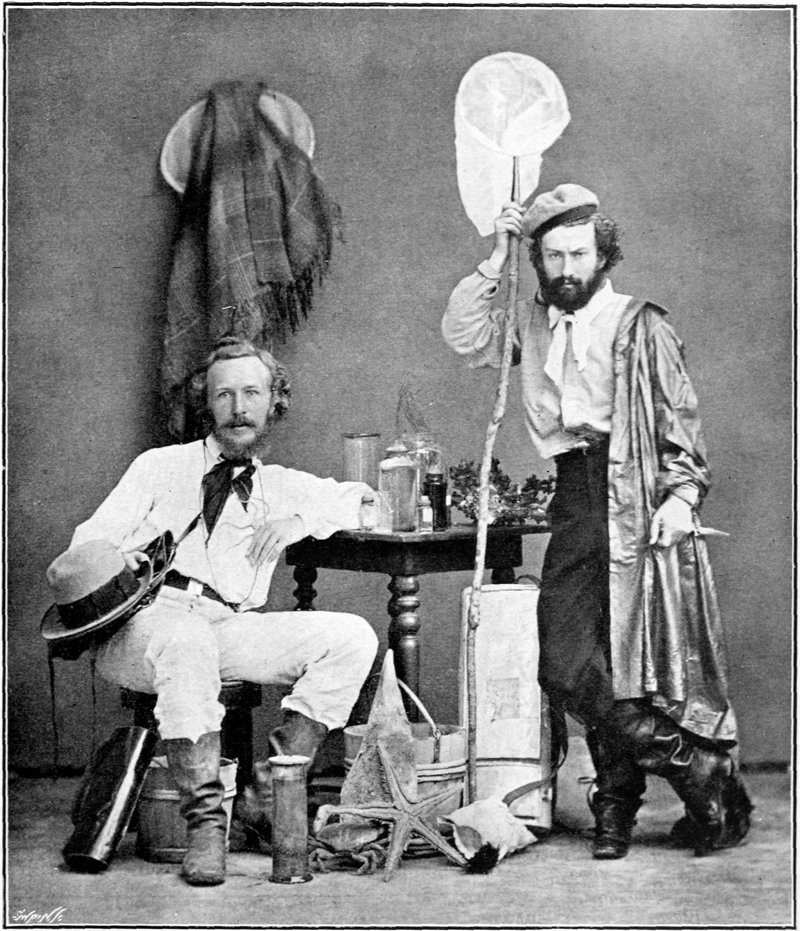
Ernst Haeckel and his assistant Miklucho-Maclay at Lanzarote, in the Canaries, 1867.
In October, 1866, Haeckel had a companion in a teacher from Bonn, Richard Greeff (afterwards professor of zoology at Marburg). They took ship from London to Lisbon, where they were long detained for quarantine, though the annoyance was somewhat relieved by the discovery of an interesting medusa in the brackish water of the Tagus. They then went to Madeira and Teneriffe, not right into the tropics, but where they might get a breath of it, as it were. Two of Haeckel’s pupils, who both became well known afterwards, 245Miklucho-Maclay and Fol, were with them. Greeff has given a full account of the journey in a whole volume (published at Bonn, 1868), and Haeckel has written of it in two articles, one of which (in the fifth volume of the Zeitschrift der Gesellschaft für Erdkunde, Berlin, 1870) is a perfect masterpiece of narrative and description of scenery. After a long search they chose as the best station for studying marine animals, especially the medusæ, the little island of Lanzarote, instead of one of the chief islands. Here they fished and drew, in the manner taught by Johannes Müller, for three months, from December, 1866, to February, 1867. It is not exactly an ideal place. “Imagine yourself dumped down on the moor!” Haeckel said afterwards in his description of it. A piece of arid land that looked like a strip of the Sahara in the middle of the ocean. There is hardly any water, and the vegetation is correspondingly meagre. Across the middle of the island stretches a chain of volcanic craters, and old lava-fields run down from them as far as the coast. Everything of zoological interest in the place was to be found in the sea. There they found abundance. As in Messina, certain local currents drove the rich animal plancton together until there were literally rivers or streets of tiny animals. One had only to dip in one’s nets and glasses, and bring up whole shoals with every drop of water.
Haeckel had come chiefly to study the medusæ. But this led him on much further to a great 246zoological problem. In his General Morphology he had expounded his brilliant ideas on the subject of individuality, and now he encountered in the flesh one of the greatest marvels of animal individuality. He had shown how the higher individual is always made up of a community, a kind of state, of lower individuals. In the simplest instance there are the cells. Each of them is an individual. Millions of these individuals, banded together with division of labour for great collective operations, make up the human frame, and therefore the human “individual.” In the same way others form a beetle, a snail, or a single medusa. Sometimes, however, these higher individuals enter in turn into social combinations to form still higher communities. Human beings form social commonwealths, with division of labour among the individuals. Bees and ants form their communities in the same way. But in the latter cases the texture of the community seems to be much looser than in the preceding one. It is not so easy for the imagination to grasp a human commonwealth or a colony of bees as a real “over-individual.” It is, therefore, extremely instructive to find that at least one animal community of this kind is of so firm a texture that even on the most superficial examination it is recognised at once as an individual. This is found in one of the groups of the medusæ, the siphonophores, or social medusæ.
A number of single medusæ, each of which 247corresponds to what we regard as the individual man, combine and form a new body, a social individual. As citizens of this new state they have introduced the most rigid division of labour. One medusa does nothing but eat, and it thus provides nourishment for the rest, as they are all joined in one body. Another accomplishes the swimming movement; another has been converted entirely into a reproductive organ. In a word, the whole has become a “unity” once more, equipped with its various organs like any large body. Sometimes thousands of separate medusæ enter into the structure of one of these wonders of the deep. And as each of the medusæ is generally a very pretty, flower-like creature, the social groups with their charming colours look like floating garlands of flowers made of transparent and tinted crystal. Their beauty would soon fix Haeckel’s attention, but their bearing on his theory of individuality would give them an even greater value. For several years he had searched most attentively in the animal world for these “over-individuals” of the highest class. In the morphology he had had to be content with an old illustration of something of the kind, the star-fish. It was supposed to be a combination of vermalians. In this case the hypothesis has broken down, though there was a good deal to be said for it at first, and it was abandoned by him afterwards. But now, when he saw enormous numbers of siphonophores in the animal streams at Lanzarote, he entered upon a decisive study of 248the meaning of these real “social animals.” A social medusa has so great an appearance of unity that those who discovered it first did not believe it was a community, but a very complicated individual medusa. Vogt (1847) and Leuckart (1851) had denied this, and declared it to be a social group. But the controversy was still going on, as there was much difference of opinion as to the meaning of “social” and “state.” Haeckel now succeeded at Lanzarote in tracing for the first time the development of one of these siphonophores from the ovum. He was able to show that from the ovum only a single simple medusa is developed. This, then, becomes the parent of the community; it produces the rest of the members, not by a new sexual generation, but by budding out from itself, until the whole garland of connected individuals is ready to constitute the new over-individual, or the community. These luminous investigations were published three years afterwards (1869) in a work that was crowned by the Utrecht Society of Art and Science (The Embryology of the Siphonophoræ, with fourteen plates, published at Utrecht). But Haeckel returned time after time in later years to this group of animals with such great philosophic and zoological interest. When he had put before him in the eighties the whole of the siphonophores brought home by the splendid Challenger expedition, he combined the material with the results of his own studies in a fine work, which was included (in English) in the publications of the Challenger 249series at London, as the 28th volume of the Zoology of the Challenger, 1888. The voluminous work is illustrated with fifty masterly plates, some of them coloured, by Haeckel himself. The most important part of the text was also published in German at Jena, with the title, System of the Siphonophoræ. There is a good popular account of the siphonophore question in his lecture on “The Division of Labour in Nature and in Human Life” (1869). A few of these beautiful forms are also given on coloured plates in his illustrated work, Art-forms in Nature. Every thoughtful man ought, whatever his position is as regards Haeckel’s ideas, to glance at this material that he has so vigorously and clearly presented.
While he was conducting this research into the embryonic development of the siphonophores, Haeckel made certain experiments on phenomena that have lately been made the subject of a special “experimental mechanical embryology” by some of his pupils, particularly Professor Roux, of Halle. He cut up siphonophore ova into several pieces at the commencement of their development, and saw an incomplete social medusa develop from each fragment.
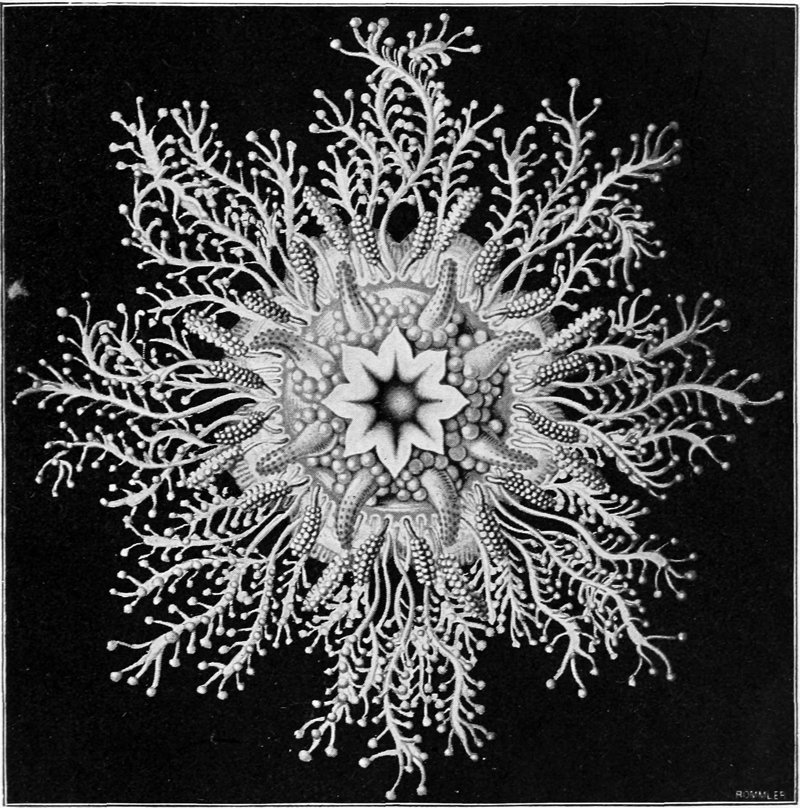
A Siphonophore (Disconalia gastroblasta.)
Thus the journey, like the earlier one to Messina, brought the indefatigable student into touch once more with a “philosophical animal.” This alone would have made it well worth the trouble. How many more of the kind the future might still have in reserve for him! In the quiet 250months at Puerto del Arrecise, on Lanzarote, he was gradually restored to his spiritual balance. Nature had taken much from him, but she offered him an inexhaustible return. His elasticity and vigour of frame had been restored before he left Teneriffe. In a twenty-two hours’ tour, only interrupted by two hours’ sleep, he had climbed to the highest summit of the Peak, in such an unfavourable season (in the November snow) that the native guides would not go any further in the end; all those who were with him except one stopped short a little way from the top. The short rest at the summit (4,128 yards above the sea-level, on the icy edge of the crater) was greatly enjoyed by him. He could see over a distance of 5,700 square miles, as much as one-fourth of the whole of Spain. “The extraordinary range and height of the horizon gives one a vague idea of the infinity of space. The deep unbroken silence and the consciousness that we have left all animal and vegetal life far behind, produce a profound feeling of solitude. One feels oneself, with a certain pride, master of the situation that has been secured with so much trouble and risk. But the next moment one feels what we really are—momentary waves in the infinite ocean of life, transitory combinations of a comparatively small number of organic cells, which, in the last resort, owe their origin and significance to the peculiar chemical properties of carbon. How small and mean at such moments do we find the little play of human passions that unfolds itself far below in 251the haunts of civilisation! How great and exalted in comparison does free Nature seem, as it unrolls before us, in one vast picture, the whole majesty and splendour of its creative power!” Thus he himself describes the moment. Something of that feeling of exalted solitude entered into his life. He stood firm and undazed—come what might.
252