Chapter IX · THE RIFLE. (continued 2)
Reading edition
The French Government are making great efforts to improve their military system, in imparting to every soldier as much information relative to his weapons and the best method of using them, as is compatible with his limited education. Their institution of a normal-school for the instruction of the whole army in all that relates to guns, shooting, and natural “trigonometry,” is proof of this. A detachment from every infantry regiment in the service arrives at “Vincennes” early in the spring, and the men undergo a complete course of instruction during the whole of the summer and autumn months, or until by ability they acquire all that is to be taught. The first and a very essential part of the duty is to teach them to judge of distance; for this purpose a soldier takes a target, and runs straight ahead as far as he pleases. Having planted it, each man is called upon to judge the distance, which is recorded in a report of the day. This exercise is carried on to a great extent, until each becomes well able to judge correctly; then commences the instruction in shooting, each soldier using an elevation according to the distance he calculates he is from the target; and this is practised at all distances, from 500 to 1,000 paces. The greatest degree of perfection attained by the instructed is rewarded, by promotion or otherwise; and such skill in shooting is displayed by these various detachments as would truly astonish our military officers.
The accomplishment of a school of instruction for teachers of rifle shooting to the British army is now an established fact; the results, most flattering to the projectors, more than verifying their anticipations. The degree of perfection attained by some before leaving Hythe is so extraordinary, that I will leave the reality to be imagined or witnessed; and it will well repay the journey. The standing order lately issued, awarding substantial benefits to the adept in shooting, is sure to bear its fruits, and is only the first step to many others of no less importance.
Double rifled carbines can be constructed of so light a weight that their exclusive use for cavalry purposes is not far distant, 51⁄2 pounds being sufficient weight to ensure perfect safety. A carbine of this description, from 18 to 20 inches in the barrel, could give a practical range of from 600 to 700 yards, with an extreme range of 1,000 to 1,100. A cavalry soldier armed with two of these would be equal to four of the present day, for they would be no greater encumbrance than the late carbine used by the Guards, which approaches 10 lbs. in weight; and a pair of double carbines could easily be carried at the saddle bow, their length being no obstacle.
Revolvers have not yet been, and I fear they never can be, made sufficiently durable to become a useful cavalry appendage. The fact may be concealed, but it is true, nevertheless, that their fragile nature, independently of their great cost, will always confine their use to an exclusive few: indeed, revolving and breech-loading weapons are among the doubtful class of arms, not fully developed as yet, even if they ever can be.
The adoption of double carbines will eventually throw all other small arms for cavalry purposes into the back ground; a range of 1,000 yards with a toy 51⁄2 lbs. in weight is one of the greatest wonders of this wonderful age, showing the astonishing change which has been effected in gunnery: for a deadly power now exists in the most Lilliputian toy as well as in the Brobdignagian monster; and that, too, at immense distances. In proof of this, I will just quote a letter from that gallant officer, Lieutenant William A. Kerr, Southern Mahratta Irregular Horse.
“Camp, Bejapore, May 29th, 1858.
“Sir,
“I have received the Enfield carbine, and am much pleased with it in every respect. It cannot, I consider, be improved on, and is by far the best weapon for the mounted service I have ever handled. It is but due to you that I should mention, that your work, as put into the carbine, is far beyond what I expected at the money. I hope to be in a position, at no very distant date, to give you a heavy commission, and will certainly recommend you in every way I can. I have knocked over a deer at 400 yards with the carbine, and make very good practice up to 800 yards, by firing with two drachms of fine rifle powder. I have given it, and Prince’s breech-loader, a fair trial; the latter cannot be compared to the former; it has not the same range, power of projection, or of shooting; it moreover fouls in the proportion of at least 3 to 1 more. Had I had such carbines at Kolapore, I would have destroyed the 27th Native Infantry in an hour.
“I am, sir, yours, &c., “William A. Kerr.”
The weight of this single carbine is only 51⁄4 lbs., and it is 20 inches in the barrel. The great power of shooting would justify a reduction of length to 15 inches, thus reducing the weight to a little over 41⁄4 lbs.; and yet this carbine would be more certain in its effects at 600 yards, than old Brown Bess at 150. The complaint that carbines are found to be an encumbrance in the service is no longer valid: they may be made to form merely a portion of the saddle with the same facility of handling as a pistol, and with a hundredfold greater accuracy of range.
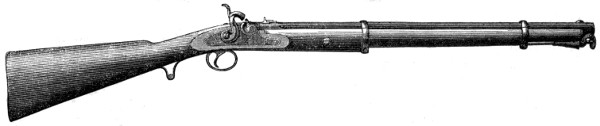
Mr. Greener’s Model Carbine, 22 inches long in the barrel, .577 bore, 51⁄4 lbs. weight.
The hybrid affair, adopted by the Government, of a pistol made to serve as a carbine by the introduction of a loose butt, is of doubtful utility: if valuable as a carbine, it will never be used as a pistol; hence it had been much better to make it a carbine at once, thus rendering it at the same time more durable and less costly: even a double carbine might be constructed at about twice the price paid for the socket joint alone. But there is still a want in the Government establishment of “designers” of ability; all that has been effected by way of improvement has been done by feeling the way: a kind of progressional experiment, with a total absence of mind to grasp good ideas, and to hold them fast. The arms used by the corps of Guides who have distinguished themselves so much in India are now seven years old, and they will bear comparison with the best arms our Government are only just now producing: in fact, the irregular cavalry in India have always been armed with weapons in advance of those of the Government troops; and the explanation of this is very suggestive, they provide arms for themselves, and are more alive than the Government officials to the importance of having good ones.
The adoption of greased cartridges in India by some irregular corps, took place in carbines supplied by me eight or nine years ago; and the origin of the idea was this:—
The principal objection urged against the adoption of the rifle, is that of loading. I know not how quickly it is possible to load a musket; but with cartridges properly made, I think I could load and fire a rifle four times in a minute. But then it will be said, at the conclusion of so many shots, the rifle gets so foul, that it will be difficult to get the ball down. Not difficult at all. Have your cartridges made with a saturated cover, to surround the ball, and fit properly the grooves of the rifle.
It would clean the barrel so much, as to allow forty shots to be fired with as much ease as you now fire twenty. Or let a steel-wire brush be attached to the rifle; and by screwing it to the end of the rod, you can, by two or three times rubbing up and down, remove any accumulation of dirt from the powder. If, however, the covering I have mentioned were used with a weighty rod to the rifle, there would be no occasion for cleaning, short of fifty shots.
Experience leaves no room for doubt that a few grooves are better than many, in all expansive-principled rifles: the nearer the approach to a smooth surface the better, and the three divisions of grooves and projections adopted by the British Government is the best to meet all requirements. They will shoot as well as poly-grooved rifles; and if three grooves give the same result, more are unnecessary and useless. The advantage of the atmosphere acting to keep the bullet steady by its current down the grooving on the bullet seems to meet with no confirmation; improved shooting accruing by the grooves being reduced, as in the case of the gathering-grooved rifle experiments. In all cases of wild animal shooting at short distances with small charges, the many grooves will be an advantage: the same as those formerly adopted, and which are shown in the cut.
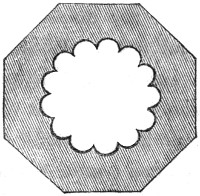
Expansive bullets may be effectually used; but in varying charges, incidental to game shooting, the same form of cavity in the bullet as is observed in the Enfield would not act, therefore a large cavity would be preferable to enable the less charge to act in expanding the lead into the grooving.
For other purposes than war, rifles will continue to be constructed on the poly-groove principle, and with spherical bullets. The perfect destruction of various animals is dependent generally on two causes: the penetration into the body, and the shock to the system during that act of penetration. No doubt exists that a spherical bullet would combine these two qualities best. The 25 bore, the 32 and 50 hexagonal bore would be, practically speaking, useless for the killing of elephants, tigers, &c. The effectual and instant killing of seals on ice is an illustration: failing to kill a seal dead, he will to a certainty reach his hole in the ice, and disappear, to the shooter’s serious disappointment. Small bore elongated bullets were very rapidly adopted, and as rapidly abandoned. “They did not kill dead;” the spherical bullet did this better. It would be wise to pause and consider whether a good military rifle is a good game-shooting rifle or not: whether the hole in the beast be wide enough. I am inclined to think the reduction to a bore of 25 too small for this purpose. In military muskets of smooth bore, the elongated bullet is not applicable: very little benefit is gained in using them in a smooth bore; and, although the original invention contemplated this, experience decided otherwise. The spherical bullet being thus indispensable, it follows that one size should be adopted which combines the greatest number of favourable points. Many years ago I made numberless experiments to ascertain this fact, and had it demonstrated beyond all doubt to be a bore of 18 and a bullet of 19; the difference in size admitting of the paper of the cartridge with a moderate degree of tightness. The ultimate range of such a musket with three drachms of gunpowder, would be equal to the range of the Enfield; but, of course, without one-tenth its accuracy. Yet for close quarters, line-firing, or quickness of loading, the musket will hold its place for centuries to come; and that this opinion is entertained by many officers, is proved by the fact that our Government is at this moment issuing contracts for 100,000 plain-bored muskets: 17 bore, 3 feet 3 inches long in the barrel. The near approximation of bore to my standard is suggestive of the influence my writings have had after many years, as the following extract from my book of 1842 shows:—
“Military rifles should never be shorter than three feet—say three feet three inches, with half-turn of spiral—the length of the musket. They should not be larger in the bore than a ball eighteen to the pound, as at that length a force, calculated to throw an extreme distance, might be generated. Whatever may be the arguments for heavy substances, they do not avail here, as it is impossible to throw them either with velocity or accuracy; for there never can be certainty, where so much elevation is required. The size of ball we have mentioned, can be thrown with great certainty, as far, if not farther, than any soldier in her Majesty’s service can accurately survey a single object. For the purpose of annoying a dense body of men, such as a square column, such a rifle would be an invaluable gun; as the muskets now made will not throw a ball one-half the distance. As to the actual range of a rifle of this bore and length, I should think it would reach, effectively, the distance of 1,500 yards.”
The experimental or competitive trials by the Royal Engineers at Chatham to prove the superiority of the elliptical bored rifle over the Enfield, is another of those occasional clap-traps with which the public are amused. The ordinary reader would judge and set it down for an established fact that the elliptical rifle was, as has generally been represented, an invention purely Lancasterian, gun and bullet; while the real facts are quite contrary: true, the barrel is rifled, slightly elliptical, and having “an increasing spiral;” but the ammunition is that of the Enfield—the “‘Greenerian’ expansive bullet with the centre of gravity in the head.” The bullet that Lancaster adopted, as well known, had a leaden plug. I quote from the report of the select committee:—
“The plug bullet used by Mr. Lancaster does not appear suitable for military service, for when the plug is driven into the bullet by the ignition of the powder, it generally nips the paper of the cartridge between itself and the base of the bullet, and carries a portion of it away, as may be seen by the specimens sent to the committee; upon the amount of paper so carried away by the ball depends the accuracy or inaccuracy of its flight; and the plugs do not in all cases remain firmly attached to the bullet.”
What then are these trials conducted to prove? It cannot be the superiority of Lancaster’s bullet; for he has abandoned that, “and uses the Enfield.” Is it the rifling?—if so, let us see what the same committee say of that:—
“The chief peculiarity of this rifle consists in the inner surface of the barrel being smooth, instead of cut into grooves, as in most rifled barrels. As a substitute for grooves, the interior of the barrel is cut into the form of an ellipse, whose major axis exceeds the minor by ·005 of an inch. The ball is rifled by being forced (when expanded by the explosion of the gunpowder) into the major axis of the ellipse, which thus fulfils the office of grooves in conducting the ball into the required degree of spiral motion.
“As Mr. Lancaster has adopted the American plan of a ‘gaining-twist,’ or ‘increasing spiral,’ and applied it to his smooth-bored barrels with elongated projectiles, it may be as well to consider the merits of this system.
“The advantages are supposed to be:
“1st. Increased accuracy.
“2nd. Less recoil.
“3rd. An absence of the tendency a ball has, when starting with a rapid spiral, to twist the rifle over sideways to the right or left, according to the inclination of the grooves.
“4th. A diminution of the tendency a ball has to ‘strip’ when first started.
“1st. The alleged increased accuracy has been by some attributed to the supposition that the revolutions of the bullet round its own axis increase in rapidity while passing through the air, in consequence of having acquired that motion when passing through the barrel, under the influence of the grooves; but it is difficult to imagine how a leaden bullet can carry within itself, after leaving the muzzle, any power of increasing its own rotatory or progressive motion.
“2nd. That there should be less recoil is natural, as the bullet meets with less opposition when first started from a state of rest; but the amount of recoil in all rifles now made for expanding projectiles is quite inconsiderable, and not worth noticing.
“3rd. The tendency of a bullet to twist the rifle on one side is now avoided by reducing the spirality of the grooves. Instead of being one turn in three or four feet as formerly, it is now one turn in six feet six inches, and sometimes only one turn in eight or nine feet.
“4th. The advocates of this system maintain that a bullet is less likely to ‘strip,’ or pass out of the barrel without rifling itself, when conducted gradually into the required degree of spirality. But the question is, whether in a well-constructed rifle, the bullet does strip? and if not, then a gaining-twist is unnecessary and objectionable, as it offers to the ball’s progress a continually increasing opposition, while the ball itself is subjected to a continually increasing urging force from the inflamed gunpowder in the barrel, so that, as the velocity of the ball increases, so also does the resistance to its escape. A projectile is set in motion gradually, and is (or should be, if the quality and quantity of the powder, and the barrel, have a right proportion to each other) at its greatest velocity just before leaving the muzzle; consequently the tendency of a ball would be to yield to the increasing force of the powder and pass straight out of the barrel without following the grooves; and this more especially in a smooth bore, which has no clearly defined edges to hold and guide the ball to its proper degree of spirality, but where the lead may be compressed along the smooth surface so as to pass straight along the barrel.”
So much for the gaining twist; it requires no further argument. The oval bore is not an invention of Mr. Lancaster: it is older than Captain Beaufoy’s book, “Scloppetaria,” published in 1808, for in it you will find a description how to rifle a smooth bore; and he gives drawings of the tools to do it with.
If these statements are facts—and I defy them being gainsaid—what connection has this gentleman with it at all? for what purpose is it pompously announced that the Lancaster elliptical bored rifle shoots superior to the Enfield, when there is not such a thing? The superior shooting of one man over another is more than sufficient explanation. The highly unscientific theory of putting a bullet into excessive spiral motion at the instant it has acquired a maximum of velocity is untenable, admitting of no lucid explanation. The Enfield rifle has evidently many enemies, who do not hesitate in injuring her reputation, nor hesitate about the means of doing it. All elliptical bores are but the two-grooved rifle in disguise: an idea fast exploding.
The truth of my opinion about the two-grooved or Brunswick rifle, introduced into the service in 1840, is now proved. Many of my readers will recollect that in my books of 1842 and 1846 I termed this “an abortion of science:” it has since died with that cognomen; though it was puffed up, as my readers will remember, by many high authorities, and amongst the rest by Dr. Ure, who said nearly as much for it as is now advanced in favour of the hexagonal rifle. On referring to the report of the Select Committee on Small Arms, published in 1852, I find the following account of it:—
“At all distances above 400 yards the shooting was so wild as to be unrecorded. The Brunswick rifle has shown itself to be much inferior in point of range to every other arm hitherto noticed.
“The loading of this rifle is so difficult that it is wonderful how the rifle regiments have continued to use it so long—the force required to ram down the ball being so great as to render any man’s hand unsteady for accurate shooting. Comment is unnecessary.”
The Prussian needle gun, too, has departed this life: another instance of the absurdity of adopting plans containing in themselves the reverse of scientific principles; for it may safely be accepted as an axiom that success at the present day can only arise to mechanical constructions which are based on those immutable foundations of mechanical science in accordance with great Nature’s laws.
That the principles of the expansive or “Greenerian” rifles are fast gaining the approbation of all scientific men qualified by their pursuits to judge, is evident from the fact that Birmingham has contributed, within the last twelve months, a considerable number of workmen to construct Enfield rifles in all the principal States of Europe. France, and Russia especially, are expending large amounts in manufacturing this arm; so that it is no stretch of imagination to suppose that in a few years the equilibrium of arms will be again established, all nations being armed with equally good weapons, to contrast with the contemptible ones of bygone times.
Before separating for the recess, a question was asked from the officials by an honourable member in the House of Commons:—“When a report would be given in as to the relative merits of the Enfield and Whitworth rifles as military weapons?” The answer given was evidently intended to mystify; for, from the most intimate inquiries I have made, I find that no experiments whatever are in progress. The last took place at Woolwich, in October, 1857, and terminated so very unsatisfactorily, that Mr. Whitworth wished to make some alterations in his rifles, in order to overcome the difficulties presented. Up to the present time the authorities inform me that no other rifles have been sent in for further trial.
The defects demonstrated in these experiments were precisely those pointed out in this chapter. On reversing their positions, “hard bullets v. soft,” the penetration of the Enfield was found to be equal to that of the Whitworth; the same number of elm deals being perforated. This proves what may be done by “mechanical dodges,” and how intimately acquainted those in charge of “gunnery experiments” ought to be with all its ramifications, or they, too, may be hoodwinked.
The difficulty of loading was here more strongly exemplified than at Hythe. The deposit from the “Government gunpowder” became so tenacious in the “hexagonal grooves,” that after a certain number of shots, loading became a very difficult matter indeed; so much so, that Mr. Whitworth considerately provided a very superior description of gunpowder, with which the hexagonal rifle worked a little better. The recoil, too, was of that severe kind as to leave strong recollections of its force on the minds of the reluctant operative shooters employed to carry out the experiment. The entire result may be summed up, in the mildest term, as “unsatisfactory.” The concealment of this result may be probably a considerate act on the part of the late Government; the parts acted by some of the members of it must be strong in the recollection of others; and letting down quietly this very highly inflated “wind-bag,” when it showed symptoms of collapse, was doubtless a judicious act.