PALEONTOLOGY
Reading edition
During the Permian Period the area that is now Palo Duro Canyon State Park, was a nearly-flat land surface along the edge of a restricted sea. The scarcity of fossils in the Quartermaster Formation indicates that plant and animal life was sparse. The environment was probably unsuited for plant life. It is thought that groundwater near the surface evaporated, leaving large amounts of salt as a residue. Since plants could not grow, animals would not have frequented the area either.
15
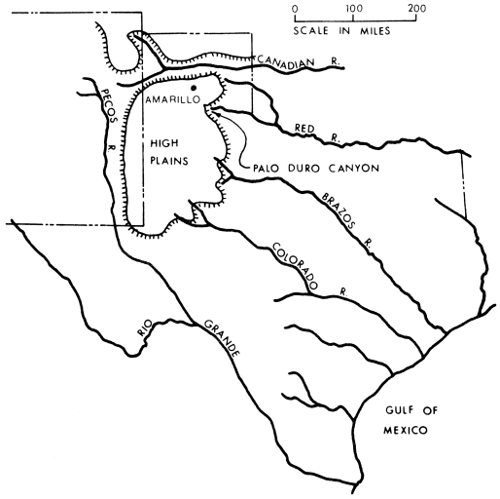
Figure 6. Headward erosion by the Pecos, Colorado, Brazos, Red and Canadian Rivers isolate the High Plains by the end of the Pleistocene (10,000 years ago) and cut Palo Duro Canyon.
16
Fossils and rocks of the Tecovas Formation indicate that the sediments were deposited in a swamp and stream environment (Figure 7). As time went on and the land continued rising, the climate became drier and some of the earlier life forms disappeared.
Remains of Metoposaurus (‘Buettneria’), the last of a long line of giant amphibians, are found here. These animals lived in large ponds. Metoposaurus buried themselves in the bottom of a pond and waited for fish to pass. With the aid of a third eye in the middle of its head, the animal could direct its huge mouth to its prey. Metoposaurus was so bulky that it is thought that it did not leave the water because its weak legs could not support its weight on land.
Living in shallower areas of the swamp were a group of semiaquatic reptiles known as phytosaurs. Phytosaurs looked very much like giant crocodiles with a nostril on the top of their heads, which permitted them to lie submerged just below the surface of the water. They probably fed on fish and smaller reptiles. Phytosaurs reached a length of 50 feet.
A heavily armored aetosaur, Desmatosuchus also lived in the Park area during the Triassic. They attained a length of about 10 feet. These reptiles probably were herbivorous (plant eating). A unique feature of Desmatosuchus was a fringe of backward-pointing horns around their necks. These possibly served to protect them from the carnivorous (meat eating) phytosaurs.
17
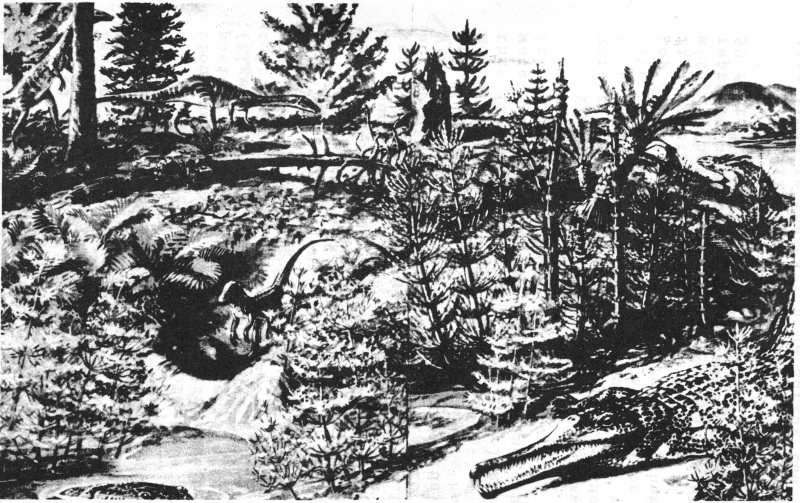
Figure 7. Life of Late Triassic time, showing restorations of the animals and plants that are now found as fossils in the Chinle beds of New Mexico and Arizona. In the water is the gigantic labyrinthodont amphibian, Eupelor, an animal some six feet or more in length. Lying on the bank is the crocodile-like thecodont reptile, Phytosaurus, large individuals of which may be twenty or thirty feet long. Behind the phytosaur, in the distance, is the armored thecodont, Desmatosuchus, ten feet long, and in the foreground is the small, bipedal thecodont, Hesperosuchus. In the left background are two individuals of the early saurischian dinosaur, Coelophysis, reptiles about ten feet in length. These animals lived in a tropical environment of moderate topography, crossed by many sluggish rivers and dotted with lakes. Numerous volcanoes rose above the general level of the land. Large, araucarian trees were abundant, stout scouring rushes or horsetails ten or fifteen feet high were everywhere, and the ground was covered with abundant ferns.
18
Also found in the Tecovas and Trujillo formations are fossil lung-fish teeth. Lung-fish are a type of fish that can breathe air, enabling them to move from pond to pond. Footprints of a chicken-sized dinosaur have also been found. The Middle Triassic flora was dominated by giant palm-like trees. Also found are remains of a few large ferns and horsetails. As the climate became drier and the swamps began to disappear, coniferous (evergreen) trees such as Araucarioxylon became plentiful. These trees can be found in the canyon today as petrified wood.
The Ogallala in the park contains very few fossils. A giant tortoise was found near the bend where the road begins to descend into the canyon. Fossil seeds may be seen in the exposure of the Ogallala near the Coronado Lodge.
More extensive Late Pliocene fossil beds are exposed south of the park in Cita Canyon. These beds are younger than the Ogallala and are stream and basin deposits. The fauna and flora found here suggest a broad, flat, grassy plain much like the present landscape (Figure 8). Remains of mastodons, large, elephant-like animals with long upper tusks that were used to dig up roots, are found here. Saber-tooth cats, also present, preyed upon the mastodons. The remains of these, as well as bones of camels, pony-sized horses, and sloths 10 feet high have been found in the vicinity of the canyon. Some of these animals are thought to have lived in the Panhandle a mere 10,000 years ago.
19
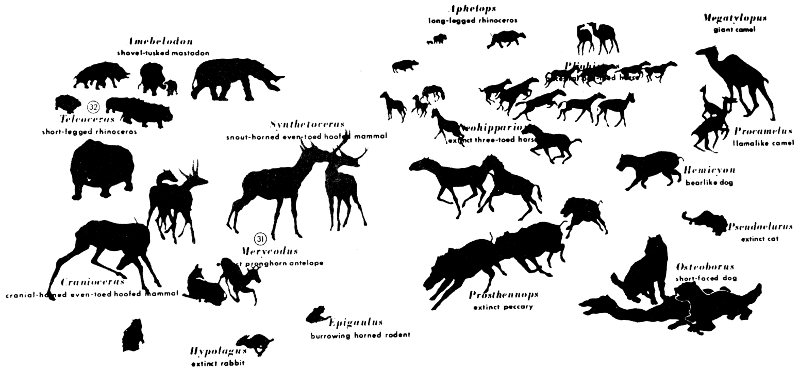
Figure 8.
Amebelodon: shovel-tusked mastodon
Teleoceras: short-legged rhinoceros
Synthetoceras: snout-horned even-toed hoofed mammal
Cranioceras: cranial-horned even-toed hoofed mammal
Merycodus: extinct pronghorn antelope
Hypolagus: extinct rabbit
Epigaulus: burrowing horned rodent
Aphelops: long-legged rhinoceros
Prosthennops: extinct peccary
Osteoborus: short-faced dog
Pseudaelurus: extinct cat
Hemicyon: bearlike dog
Procamelus: llamalike camel
Megatylopus: giant camel
Pliohippus: ancestral one-toed horse
Neohipparion: extinct three-toed horse
20
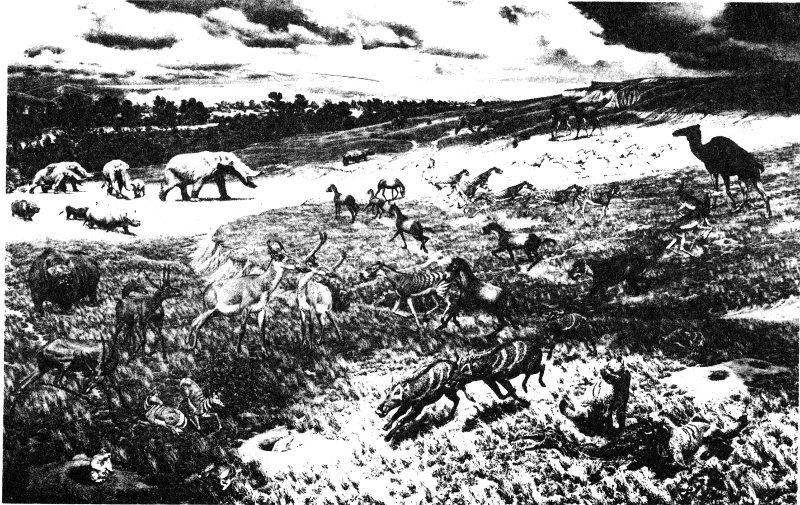
FIGURE 22.41 Pliocene Mammals. Early Pliocene life of the southern High Plains. (Mural by J. H. Matternes, courtesy U.S. National Museum.)
21
Due to limited outcrops in the Canyon proper, Pleistocene fossils are very rare. An excellent collection of fossils from Palo Duro Canyon and the Panhandle area is on display at the Panhandle-Plains Historical Museum.
Spectacular Palo Duro, “grand canyon” of the Panhandle Plains, is an exciting experience. One of the nation’s most magnificent scenic attractions, it provides delightful drives and opportunities for hiking, horseback riding and camping in season. Visit Palo Duro and enjoy it.
Diamond Shamrock
QUALITY ROCK SHOP
OVERNIGHT CAMPING LAPIDARY EQUIPMENT QUALITY AGATE & JADE, FOREIGN & DOMESTIC CUSTOM SILVER, GOLD AND TURQUOISE WORK
2 Miles West of Canyon on U.S. Highway 60 Route 1, Box 211, Canyon, Texas 79015
MAGGIE & WHITEY VOELM (806) 655-7631
Search Drilling Co.
Rotary Drilling Contractors Oil & Gas Producers
SUITE 400 WELLINGTON SQUARE OFFICE PARK 1616 S. KENTUCKY AMARILLO, TEXAS 79102 (806) 359-7645
YUCCA PETROLEUM CO.
300 Diamond Shamrock Building P.O. BOX 2585 AMARILLO, TEXAS 79105 Telephone: (806) 376-5431
Argonaut Energy Corporation
GLEN S. SODERSTROM, President LORNE E. TJERNAGEL, Exec. Vice-President R. L. PATTERSON, Vice-President of Production
1209 West 7 St. Suite 200 Amarillo, Texas 79101 806/373-6885
W.M. QUACKENBUSH
Petroleum Geologist
2315 Harmony Amarillo, Texas 79106 806-355-2931
JACK G. JONES
CONSULTING PETROLEUM GEOLOGIST
Office: AC 806/352-6891 5500 Meadow Green Dr. Post Office Box 8145 Amarillo, Texas 79109
TUTHILL & BARBEE
PETROLEUM GEOLOGISTS
S. KEITH TUTHILL BILL J. BARBEE
300 Fisk Bldg.
Amarillo, Texas PH. 373-3023
CAMBRIDGE & NAIL
PETROLEUM EXPLORATION SERVICES
803 Bank of the Southwest Bldg. AMARILLO, TEXAS 79109 806 355-9297
Geologist: THOMAS R. CAMBRIDGE Landman: A. L. NAIL
PAGE PETROLEUM LTD.
901 BANK OF THE SOUTHWEST BUILDING AMARILLO, TEXAS 79109 806-366-9586
11TH FLOOR ROYAL BANK BLDG., 335-8TH AVE. S.W. CALGARY, ALBERTA T2P 1C9 403-269-8221
ALPAR RESOURCES, INC.
Box 1046 Perryton, Texas 79070
Panhandle Geological Society
Box 2473 Amarillo, Texas Petroleum Library 5th Floor Petroleum Bldg. Field trip Guidebooks, Cross-Sections and Other Publications GEOLOGY STUDENTS INVITED AND WELCOME
DUDLEY R. STANLEY
Consulting Geologist
5500 Meadowgreen Drive Box 7586 Amarillo, Texas 79109 355-8051
PARADOX PETROLEUM CO.
P.O. BOX 10025 AMARILLO, TEXAS 79106
George Dobervich Frank Rapstine Dan Taylor
PHONE (806) 355-5562
HAWK ENERGY CORPORATION
VERNON H. ROBINETT BOB CONLEY
Suite 230 / Wellington Square Amarillo, Texas 79102 806-359-7021
JAMES F. O’CONNELL
CONSULTING GEOLOGIST
355-8051 5772 Canyon E-way P. O. Box 7006 Amarillo. Texas 79109
Texas Panhandle Sample Log Service
Plotted and described Stratigraphic Sample Logs on current and old wildcat tests drilled in the Oklahoma and Texas Panhandles and Northeastern New Mexico
1011 W. 9th Amarillo, Texas 373-8522
CHARLES B. MORGAN
CONSULTING GEOLOGIST
355-8051 5772 Canyon E-way P. O. Box 7586 Amarillo, Texas 79109
IRWIN & ASSOCIATES
GEOLOGICAL MECHANICAL CIVIL ARCHITECTURAL “COUNTY MAPS” Professional Drafting Service
BILL E. IRWIN
502 Petroleum Bldg. P. O. Box 14032 Amarillo, Texas 79101 Bus. 806-373-4611 Res. 806-622-0789
Mesa Petroleum Co.
With Compliments Mesa Petroleum Co. One Mesa Square Amarillo, Texas
BAKER & TAYLOR DRILLING COMPANY
—Combining the finest in drilling equipment and skill to better serve the oil industry—
Offering summer employment to W.T.S.U. students this year—as in the last twenty-five years.
Discover the world around you at West Texas State University
When you look toward the future, include a good education in your plans. West Texas State University will help you learn about your world and prepare you for the future.
West Texas State University Canyon, Texas