III—HISTORY OF THE TAPESTRY.
Reading edition
THE “Bayeux Tapestry” has had an adventurous career since its first mention in the Inventory of Bayeux Cathedral in 1476, when it was hung round the nave during the season of the Feast of Relics. It is even possible that its adventures may have begun before this, if the assumption of an early date be correct, for the cathedral was burnt to the ground in 1106.
However that may be, in 1562 the town was sacked by Calvinists: but, fortunately, the Tapestry was handed over to the civil authority to guard, and it escaped destruction, though a tapestry “de grande valeur” that used to hang in the choir perished during the troubles. When these disturbances were over, it was once more in the hands of the ecclesiastical authorities, hung in the nave on appointed days, and forgotten for close on 200 years.
In the year 1724 an archæologist, M. Launcelot, read a paper before the French Academy on this subject. He had, however, only seen a drawing of a portion of the whole, and was only able to conjecture that the original was a fresco or an embroidery. He was strongly of the opinion that the original was made in the time of the Conqueror or his immediate successors. Better results, however, attended the efforts of Père Montfaucon, a Benedictine of St. Maur, who ran the original to earth after much search. It was published in engraving on a reduced scale in his second volume of “Monuments de la Monarchie Française (1730).” Kept in the repositories of the cathedral and only exhibited on feast days, the Tapestry survived in peace the early days of the Revolution, but when the Revolutionaries were going out to scatter their foreign enemies it was turned to account and made to cover an army waggon. It had been laid in position and was on the point of being taken off to the front, when M. le Forestier, the Commissioner of Police, seized on it and hid it in his study. In 1794 it was again about to be cut to pieces, when it was rescued by a self-appointed committee for guarding works of art in the neighbourhood.
The Tapestry was not unknown to Napoleon, and in 1803 it was sent to Paris and exhibited in the Musée Napoléon, doubtless with the intention of stirring the enthusiasm of the French into emulating the illustrious deeds portrayed. It was, however, returned to Bayeux in 1804 and deposited in the Library, with permission to be hung in the cathedral, fifteen days a year, a concession to the Church party that was never put into effect. It was exhibited in the Hôtel de Ville in 1830, and is now to be seen in a room built for it in the Public Library in 1842.
In 1871 on the near approach of the Prussians, the Tapestry was hastily taken down and hidden secretly away. When danger was passed it was returned to its former position. The Bayeux authorities, however, refuse to divulge the secret of its hiding-place, feeling that should adverse circumstances again arise it would be advisable that there should again be this secret spot in which to stow away the Tapestry.
The Bayeux Tapestry has since the 18th century received notice from English archæologists; in 1746, Stukeley, author of the Palæographica Britannica, mentions it as “the noblest monument in the world, relating to our old English history.” He was followed by a learned antiquarian, Dr. Ducarel, who stated that it was hung round the nave of the cathedral on St. John’s Day, and continued there for eight days more. Two distinguished historians, Lord Lyttelton and David Hume, also discussed the Tapestry, the former being the first to doubt its contemporary date, thereby anticipating some modern criticism.
In the early years of the 19th century criticism of the Tapestry became more serious, the years 1816-1820 being very important in this respect. The views of Messrs. Stothard, Amyot, Hudson Gurney and others can be read in volumes XVIII. and XIX. of Archæologia.
In 1816 Mr. Charles Stothard was sent by the Society of Antiquaries to Bayeux to make a drawing of the Tapestry, and he brought home two small fragments with him.[6] Within two years he had completed his copy of the Tapestry, which is to be seen reproduced in Vol. VI. of the Vetusta Monumenta. Freeman, in Appendix A., Vol. III. (2nd edition), devotes a long passage to the subject and states his belief in its being made in England, an opinion which has not been generally shared.
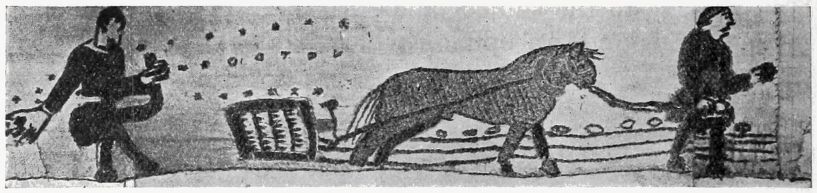
Fig. 3. Harrowing (see p. 27).