PETROLEUM (15)
Reading edition
PETROLEUM (crude oil) is classed as a mineral resource although it is a liquid hydrocarbon and not technically a mineral or rock. It is, however, found in the pores and fractures of rocks. The color of crude oil ranges from yellow through green and brown to black.
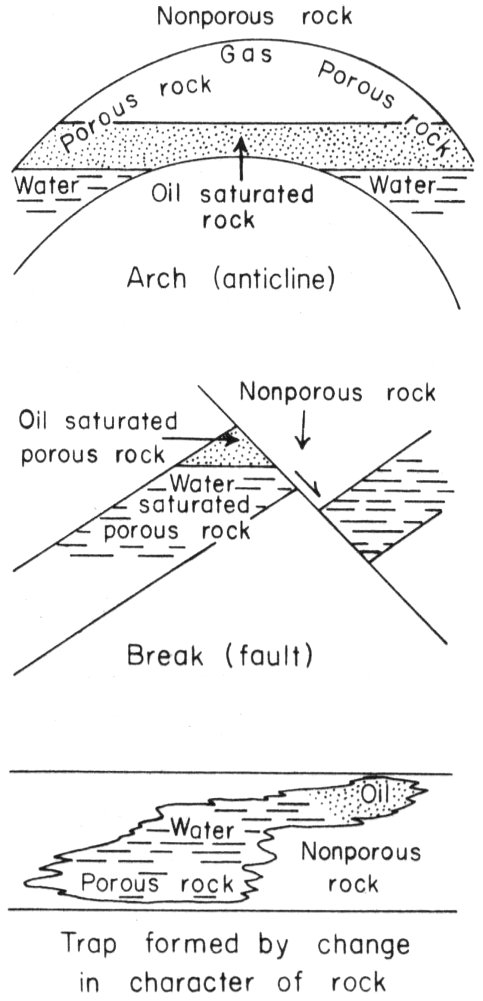
Arch (anticline)
Gas
Porous rock
Nonporous rock
Oil saturated rock
Water
Break (fault)
Nonporous rock
Oil saturated porous rock
Water saturated porous rock
Trap formed by change in character of rock
Water
Nonporous rock
Porous rock
Petroleum had its origin in the plants and animals buried in ancient sediments. The organic matter changed slowly into the complex mixture of hydrogen and carbon compounds that is petroleum.
Because gas is lighter than oil, and oil in turn lighter than water, gas and oil move upward in a porous rock containing all three. Gas moves to the highest position with oil next below and water in the lowest part of the rock. Oil pools exist where geologic barriers have stopped the movement of gas and oil.
Arches (upward folds or anticlines), breaks (faults), and lateral changes from porous to nonporous rock are geologic features that serve to localize oil pools within the reservoir rock.
Petroleum is obtained by drilling wells into the reservoir rock. Gas that is free or dissolved in the petroleum expands as pressure is released when the well is drilled and drives the oil to the well. Water in the reservoir rock also acts as a driving force. When this natural pressure is no longer effective, other methods (secondary recovery) are used to recover the oil remaining in the reservoir.
Porous sandstones and limestones are the oil-bearing rocks. Illinois also has deposits of oil shale from which petroleum may be produced in the future.
Thousands of products are derived from petroleum, including gasoline, kerosene, naphtha, lubricating oils and waxes, medicinal oils, salves, heavy fuels, road oils, tar, and asphalt.
17