GRETTIR THE OUTLAW (continued 2)
Reading edition
But when Biorn heard this proposal, he shouted out that he would not suffer the matter to be so compromised; he was not ashamed of his words. Thorgils drew Grettir aside, and said to him that his kinsman was a badly-behaved, brutal fellow, but that he hoped Grettir would not take up the quarrel in his house; and Grettir promised him solemnly that he would not attempt to take revenge for the rudeness of Biorn so long as they were both inmates of his house.
"As for what may happen between you later," said Thorgils, "I wash my hands of responsibility. If Biorn is offensive to those who have never hurt him, he must take the consequences."
So matters remained; only that Biorn, presuming on his position, became daily more arrogant, intolerable, and abusive, so that Grettir had to exercise daily self-restraint to keep his hands off him. And glad he was when spring came, that he might get away to another part of Norway.
As for Biorn, he went in the summer to England in a ship that belonged to Thorgils, trading there for Thorgils and for himself. Consequently, all that summer he and Grettir did not meet.
CHAPTER IX.
THE SLAYING OF BIORN.
The Meeting on the Island—Biorn's Death—Thorfin Comes to Grettir's Aid—Grettir's Life in Danger—Hiarandi's Revenge—A Doomed Man
Grettir left Thorgils very good friends, and he went with some merchants to the north, but when the summer was over he came back south, and arrived at a little island in the entrance of the Drontheim firth. His intention was to see Earl Sweyn, and perhaps take service under him; but if so, things fell out other than he had reckoned. For, as he was in this island, there came in a large merchant vessel from England, and Grettir and those with him at once went to see the shipmen, and among them was Biorn. The ship was, in fact, that of Thorgils, and it was laden with commodities bought in England, or obtained by exchange for the wool, and furs, and women's embroidery sent out in the spring by Thorgils.
Directly Biorn saw Grettir he turned red, and pretended not to recognize him; but Grettir went to him at once and said:
"Now has come the time when we two can settle our differences."
"Oh," said Biorn, "that is soon done. I don't object to paying a trifle."
"The time for paying is over," said Grettir. "Thorgils offered an indemnity for your insolence, and you refused to consent to it."
Then Biorn saw that there was no help for him but that he must fight. So he girded him for the conflict, and he and Grettir went down on the sand, and they fought.
The fight did not last long. Grettir's sword cut him that he fell and died.
When the news reached Thorgils, he got ready, and came by boat as fast as he could to see the earl at Drontheim. He found the earl very angry, but he said to him:
"I am a kinsman of the fallen man, and I know that he treated Grettir with intolerable insolence, and that he refused every compromise. Then remember what a benefit has been done to the country by Grettir, who ridded it of the Red Rovers, Thorir wi' the Paunch and Ogmund the Bad."
Thorfin also came to Drontheim when he heard of the straits into which Grettir had come through killing Biorn. The earl called a council on the matter, and said he would not come to a decision till he had heard what Biorn's brother Hiarandi had to say on the matter. Hiarandi was a violent man, and he was very wroth. He would hear of no patching up of the matter, and he vowed he would not, as he expressed it, "bring his brother into his purse." As already said, it was customary when a man had been killed to offer a sum of money to the next of kin, and if he accepted the money the quarrel was at an end. When we now speak of "pocketing an injury," reference is made to this same ancient usage, by which every offence was estimated at so much money, and if the wronged man took money for the offence committed against him, he was said to pocket it. When the earl went into the matter, and heard how Grettir had been wronged and outraged by Biorn, he gave his decision that Grettir had not acted contrary to law, and that Biorn had justly forfeited his life. Thorfin offered the sum of money which the earl considered was sufficient to atone to the relations for the death of Biorn, but Hiarandi refused absolutely to touch it.
Then Thorfin knew that Grettir's life was in danger, for Hiarandi would certainly try to take it; so he begged his kinsman Arinbiorn to go about with Grettir, and keep on the look-out against the mischief that threatened.
Now it fell out one day that Grettir and Arinbiorn were walking down a street in Drontheim when their way led before a narrow lane opening into it. They did not see any danger in the way, and were unaware of this lane. But just as they had passed it a man jumped out from behind, in the shadow, swinging an axe, and he struck at Grettir between the shoulder-blades. Fortunately, Arinbiorn had looked round at the lane, and he saw the man leap out, so he suddenly dragged Grettir forward with such a jerk that Grettir fell on his knee. This saved his life, for the axe came on his shoulder-blade, made a gash that cut to his armpit, and then the axe buried itself in the roadway. Instantly Grettir started to his feet, turned round, and with his short sword smote in the very nick of time as the man, who was Hiarandi, was pulling up his axe to cut at Grettir again. Grettir's sword fell on his upper arm near the shoulder, and cut it off. Then out rushed some servants of Hiarandi on Arinbiorn and Grettir, who set their backs against a house-wall and defended themselves with such valour that they killed or put to flight all who had assailed them.
Now, this had been a base and cowardly attempt on the life of Grettir, and Hiarandi richly deserved his fate. But the earl was exceedingly angry when he heard the news, and he called a council together. Thorfin and Grettir attended, and the earl angrily charged Grettir with having committed great violence, and being the cause of the death of Hiarandi and some of his servants.
Grettir acknowledged this; but showed his wound, and stated how he had been attacked from behind; how his life had been saved by the promptitude of Arinbiorn, and how he had but defended himself against enemies who sought his life.
"I wish you had been killed," said the earl, "and then there would have been an end to these disorders."
"You would not have a man not raise his hands to save his head?" said Grettir.
"I see one thing," exclaimed the earl. "Ill luck attends you, and you are doomed to commit violences wherever you are."
The end of it was that Earl Sweyn said he would not have Grettir to live in Norway any longer, lest he should be the cause of fresh troubles. But he remained over the third winter, and next spring sailed for Iceland, the time of his outlawing being ended.
CHAPTER X.
OF GRETTIR'S RETURN.
Iceland Once More—Life's Bitter Lessons—Grettir Pays Audun a Visit—Some Icelandic Terms—Byres and Sels—A Chief's Hall—The Return of Audun—Grettir's Second Wrestle with Audun—Bard Interposes—The Cousins Reconciled
When Grettir came back to Biarg, he found his father so old and infirm as to be no more able to stir abroad, and Atli managed the farm for him along with Illugi, Grettir's youngest brother, now grown up to be a big boy. Grettir was now aged eighteen, but he looked and was a man. Illugi was about fifteen, a gentle, pleasant boy. He and the kindly, careful Atli were as unlike Grettir as well could be; they avoided quarrels, they had a civil word for every one, and took pains to make themselves agreeable, whether to guests in their house, or when staying anywhere, to their hosts. Grettir never troubled himself to be courteous or to be obliging to anyone. Now that he was back from Norway he was rather disposed to think much of himself as a man more brave and audacious than his fellows, for, had he not killed twelve rovers, broken into a barrow, slain a bear, and been the death of one man in a duel, and another who had attempted to assassinate him? Atli did not much like his manner, and cautioned him not to be overbearing whilst at home, lest he should involve himself in fresh troubles. But words were wasted on Grettir. He was not the fellow to listen to advice, but one of those men who must learn the bitter lessons of life by personal experience. It is so with men always. Some, who are thoughtful, see what God's law is which is impressed on all society, and listen to what others have found out as the lessons taught them by their lives, so they are able to go out equipped against the trials and difficulties of life. But others will neither look nor listen, and such have to go through every sort of adversity, till they have learned the great truths of social life, and perhaps they only acquire them when it is too late to put them in practice.
It is with laws and courtesies of life as with the three R's. A man will fare badly who cannot read, write, and cipher. If he learns these accomplishments as a child, he does well; he is furnished for the struggle of life, and starts on the same footing as other men; but if as a child he is morose and indifferent, and refuses to learn, then all through his life he is met with difficulties, owing to his ignorance, and he finds that he must learn to read, write, and do sums; and he has to acquire these in after years with much less ease than he might have learnt as a child, and after he has lost many chances of getting on which might have been seized, had he known these things before.
Grettir's temper on his return may be judged by one incident that happened almost directly. He had not forgotten his struggle on the ice with his cousin Audun, and he was resolved to have another trial of strength with him. So he had not been home many days before he rode over the hill to Audunstead in his best harness, and with a beautiful saddle on his horse that had been given him by Thorfin. The time was that of hay, and he saw the field round Audun's farm full of rich grass, ready to be cut. He took the bridle off his horse and turned it into Audun's meadow. This was not out of thoughtlessness, but out of insolence, and was intended to exasperate Audun. In Iceland grass grows very little, and only fit to be cut for hay round the farms in what is called the tun, where it is richly dressed with stable-dung. Consequently hay is very scarce and very precious. The grass never grows much longer than one's fingers, and so even in the tun it is not plentiful. He knocked at the door of the farm and asked for his cousin, and was told that Audun had gone to the highland sel to fetch curds, and would be back later. The sel was a farm on the highland, only occupied in summer, when the cattle were driven to the moors and hills to feed on the grass there, and to save that in the lowlands against winter.
Here a word or two must be said about Icelandic names of places and people. When Iceland was colonized, those who first settled in the land and built farms, called the places after their own names in a great many cases; they called them so-and-so's stead, or so-and-so's by or farm. A by is the Scotch byre, and in Icelandic is bœr, pronounced exactly like the Scotch word. Wherever, in the north and east of England, Norse settlers came, there we find names of places ending in the same way, and we know that these were farms and dwellings of old Norse settlers. Thus in Northumberland, Yorkshire, and Lincolnshire, are plenty of Norse place-names. Near Thirsk is Thirkelby or Thorkel's-byre, near Ripon is Enderby or Andrew's-byre. Not only so, but where there are high hills there we find also sels, that is summer-farms, like the Alps to which the cattle are driven in Switzerland. Next as to the names of people. What is a little puzzling to remember is the number of persons whose names begin with Thor. Thor, the god of thunder, was regarded with the highest reverence by the Icelanders; they thought of him even more than they did of Odin, the chief god of all, who had one eye, and his one fiery eye was the sun. Thor was called the Redbeard, and the aurora borealis was thought to be his waving red-beard in the sky. The thunderbolt they regarded as his hammer. To show their respect for him, children were named after him: Thor-grim means Thor's wrath; Thor-kel, Thor's kettle, in which the sacrificial meat was cooked in offering to Thor; Thor-gil was Thor's boy or servant; Thor-hall was Thor's flint spear-head, and so on. The Northumbrian king, St. Osmund, takes his name from the Hand of God, and the name is the same as Asmund, the father of Grettir. Oswald means the elect of the god; in Icelandic the name would be Aswald.
When Grettir found that Audun was from home, he went into the hall and lay down on the bench nearest the door. The hall was dark.
The halls of the Icelandic chiefs were like bodies of churches, and were divided into a nave with side aisles; and were lighted by windows in a clere-story that were covered with the skin of the lining of a sheep's stomach, to let in light and keep out cold, because they had no glass. In the side aisles were the beds of those who lived in the house, some with doors and shutters, which could be fastened from within; and a man in danger of his life would so sleep. He would go to bed, and then close himself in and lock the shutters, that no one could get at him when he was asleep. The fires and benches and tables were in the nave, or middle of the great hall. Over the partitions for the beds were hung shields and swords and spears, and on grand occasions hangings were put up all along the sides, hiding the beds and berths in the side aisles. The arrangement in an Icelandic house at the present day is much the same, only on a very much reduced scale. The people live and eat and sleep in the same room, like the saloon-cabin of a ship, with the berths round the walls.
Audun arrived in the afternoon with a horse that carried curds in skins on its back; that is to say, skins were made into bottles, as is still common in Palestine. When he saw that a horse with a saddle on it was wandering about in his meadow, trampling down the grass and eating it, he was very vexed; and throwing one bottle of curd over his back, and hanging another in front on his breast to counterbalance it, he ran into the house to ask who had done this.
The hall was dusky, and Audun's eyes were accustomed to the bright summer-light. As he entered Grettir put out his foot; Audun did not see it, and stumbled over it, fell on the skin of curds and burst it. Then he jumped up, very angry, and asked who had played him this scurvy trick. Grettir named himself, and said he had come over about that matter of the wrestle on the ice. Audun, still very irate, all at once stooped, picked up the burst skin, and dashed it in Grettir's face, smothering him with curds. Then he threw down the other curd-bottle, and began to wrestle with Grettir. They swung up and down the hall, kicking over the benches, now upon the floor, then on the stone-paved fire-hearth in the midst; then they crashed against the walls and pillars of the bed-chambers, and as they did so the shields and weapons hung over them clashed like bells. Some frightened servant-maids came in, and ran out again in alarm, calling for aid.
Audun felt now that Grettir had outgrown him in strength, but he would not give in; then they slipped on the curd and both fell, parted for a moment, rose, and flew at each other once more. Again, up and down, banging, stumbling, writhing in each other's arms, twisting legs round each other, to try to trip each other up, and ever Grettir bearing Audun backwards, but never wholly mastering him. Audun could not trust his cousin, for though they were akin, and though he had not really done him an injury, there was no telling to what a pitch Grettir's blood might mount and blind him; so as they wrestled, Audun took care to twist the short sword out of Grettir's belt and throw it away. As, to do this, he had to disengage his hand from Grettir's shoulder, he lost an advantage. Grettir managed to trip him, and throw him flat on his back.
At that moment, fortunately, a man, big, wearing a red kirtle, and in full harness, entered the hall and asked what was the meaning of the noise and fight? As he did not receive an immediate answer, he came to the rescue of Audun, and drew Grettir from him.
"We are only in play with each other," said Grettir.
"Rather rough play," said the man, "and likely to end in tears rather than laughter."
"Who are you that interfere?" asked Grettir.
"My name is Bard."
Then Audun scrambled to his feet.
"What is the reason of this rough play?" asked Bard.
Then Grettir answered, by singing:
"Prithee, Audun, will you say
How, upon the ice one day,
You to throttle did essay?
Now, for that I this have done,
On Audun honour I have won;
Curds and wrestle make good fun."
"Oh, I see," said Bard; "fighting out an old grudge. I have nothing to say against that. Now, shake hands, and be loving cousins again."
Audun held out his hand, and Grettir agreed to let the matter end thus. But he was dissatisfied, and ever after bore Bard a grudge. However, he never again wrestled with Audun, and remained on good terms with him.
CHAPTER XI.
THE HORSE-FIGHT.
Atli's Roan—The Coming Fight—Unfair Play—Grettir Retaliation—Smouldering Fire
One of the rude and cruel sports that amused the Icelanders in summer time was horse-fighting. A smooth piece of turf was chosen, and was staked round. Into this inclosure two or sometimes more horses were introduced, and a man attended each, who urged on his own horse, armed with a goad. By means of these goads the horses were stung to madness, and attacked each other, biting each other savagely. Now, Atli had a beautiful roan, with a black mane, which he and his old father were very proud of. Lower down the valley, near the sea, was a farm called Mais, in which lived a bonder named Kormak, and his brother; they had in their house a man called Odd the Foundling, a sly, captious fellow, who, like Grettir, made verses; but his verses were not generally thought to be so good as those of Grettir. On the opposite side of the river is a hot-spring; it is still hot, but not so hot as it was in those days, when it boiled up and poured forth a cloud of steam, and ran in a scalding rill down to the river. There was a convenient level place near the river for a horse-fight, and it stood above the water on one side rather steeply, so that it needed only fencing on three sides. Kormak had a brown horse that fought well, and it was resolved that autumn to have a fight between the horse of Kormak and the roan of Atli. Odd was to goad on Kormak's brown, and Grettir offered himself to his brother to run with the roan. Atli did not much like the proposal, as he feared Grettir's temper; but he could not well decline his offer, so he said, "I will consent, brother; only I pray you, be peaceable, for we have to do with overbearing men, and it will be very unfortunate if a broil should come of this."
"If they begin, I shall not run away," said Grettir.
"Not if they begin; but be very careful not to provoke a quarrel."
"Quarrels come and are not made," said Grettir.
"That I do not hold," answered Atli.
The day of the horse-fight arrived, and the horses were led to the place of contest. They had been fed up and groomed for the occasion, and each had a band round his middle of colour, by which he who went with the horse could hold, and the goad of each was tied with a tuft of feathers at the head, stained the same colour as the belt about the horse.
The two horses were introduced within the inclosure, and were soon goaded into anger, and began to plunge, and snort, and snap at each other. The by-standers outside the railing cheered and shouted, and the horses seemed to understand that they were to do their best; so they pranced about each other, struck at each other, and tried to get round each other so as to bite the flank. At one moment the roan bit the side of the brown, and held. Odd ran his goad into the horse of Grettir to make it let go;—this was against the rules; he did it to save his own horse from a terrible wound. Grettir saw what he did, but he said nothing. Now the horses bore towards the river, and were rearing and plunging close to the edge, and the two men had much ado to hold on. Then Odd took the opportunity when Grettir's back was turned to drive at him with his goad between the shoulders, where was the great scar still red, and only just fully healed, that he had received from the axe of Hiarandi. It was a cruel blow, and this also was against all rule of fair play.
At that moment the roan reared, and instantly Grettir ran under him, and struck Odd with such a blow that he reeled back towards the water edge, and in so doing dragged the brown horse he was holding over the edge, and both went down into the water together. The river was very full with the melted snows, and Odd was brought ashore with difficulty. It was found that three of his ribs were broken; but whether with the blow dealt by Grettir, or by his fall on the rock, or by the hoof of the horse as it fell and struggled in the river, cannot be said; but the party of Kormak, of course, charged Grettir with having broken Odd's ribs with his stick, and they flew to arms, and threatened the party from Biarg. However, the people of the nearest vales and firths interfered, and no bloodshed ensued. But the men of Mais and of Biarg separated bearing each other much ill-will, each charging the other with having broken the laws of the sport.
Atli did not say what he felt, he was greatly annoyed; but Grettir was less careful of his words, he said that the matter was by no means ended, and that he hoped there would be a meeting between the men of Mais and the men of Biarg, and then—it would not be a fight of horses, but of men; not a biting of horses, but of sharp blades.
CHAPTER XII.
OF THE FIGHT AT THE NECK.
The Desolate Moor—Grettir challenges Kormak—Oxmain comes on the Scene—Slow-coach taunts Grettir—Grettir's Vexation
The next fiord on the west of that into which the river that flowed past Biarg poured was called the Ramsfirth, and at the head of it lived Grettir's married sister.
In the following summer, that is in 1014, Grettir paid his sister a visit; he had with him two servant-men from Biarg, and he spent three days and nights at his sister's. Whilst there, news reached him that Kormak, who had been away from Mais for a week or two, was on his road home, and who was now staying at a house called Tongue. Grettir at once made ready to depart, and his brother-in-law sent two men with him, for it was not safe that Grettir should have only two churls with him, as there was ill blood between him and Kormak about that affair of the horse-fight.
A high, long shoulder of desolate moor lies between the Ramsfirth and the Westriver-dale, in which is a confluent of the river that flows past Biarg. This shoulder rises to the north into a great hump, called Burfell, and on the saddle is a little lake. A very fine view is obtained from this shoulder of moor over the northern immense bay of Hunafloi, towards the glaciers and mountains of that curious excrescence of land that lies on the north-west of Iceland. I know exactly the road taken by Grettir on this occasion, for I have ridden over it. Along the top of this shoulder the rocks are scraped by glaciers, that must at one time have occupied the whole centre of the island, and have slowly slidden down into the firths on all sides. Here, what is curious is, that the rocks are furrowed, just as if carved with a graving tool, in lines from south to north, showing the direction from which the glaciers slipped down. Now, on the slope of this bit of upland is a great stone poised on a point, which I have seen. Grettir came to this stone, and spent a long time in trying to upset it. It is called Grettir's-heave to this day. The men who were with him rather wondered at him why he wasted time over this, instead of pushing on. But his sharp eye had noticed the party of Kormak leaving Tongue, and he was bent on an encounter. He thought that if Odd had seen him going over the hill he would make a lampoon about him running away from his sister's house the moment he heard that danger was threatening. So he determined to tarry till Kormak came up and fight him. He had not long to wait, for presently over the top of the hill came Kormak with Odd and some others. Grettir at once rode to meet them, and said, "Now we have our weapons on both sides, let us fight like men of good birth, and not with sticks as churls."
Then Kormak turned to his men and bade them accept the challenge and fight.
Accordingly they ran at one another and fought. Grettir bade his two serving-men stand behind his back and defend that, and he, sweeping his longsword from left to right, went forward against Kormak. Thus they fought for a while, and some were wounded on both sides.
Now it so happened that at a rich farm in the Ramsfirth-dale lived a well-to-do, and very strong man, called Thorbiorn—that is, Thor's Bear—nicknamed Oxmain. He had ridden that day over Burfell-heath, with a party, and was now returning. As he came along he heard shouts and the clashing of arms, so he quickened his pace, and presently came in sight of the fighters. He at once ordered his men to dash in between the combatants. But by this time the passions of those engaged were so furious that they would not be separated. Grettir sweeping his long-sword about him strode forward, and the men of Kormak fell back before him. Down went two of those who were with Kormak, and one servant of Atli, Grettir's brother, was killed.
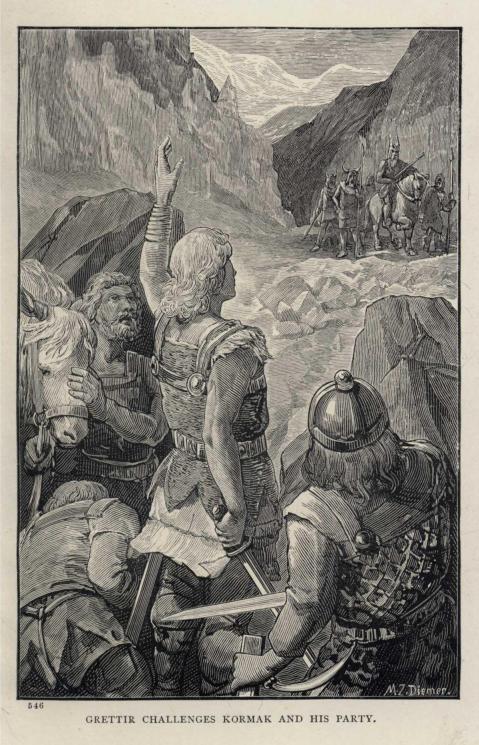
GRETTIR CHALLENGES KORMAK AND HIS PARTY.
Then Thorbiorn Oxmain raised his great voice and roared out, that he and his party would take sides against the first man who dealt another blow. Grettir saw that it would hardly do if Thorbiorn Oxmain brought all his force against him, so he gave up the battle; but they did not part till every one of those engaged was wounded, and two were killed on one side, and one on the other. Grettir was ill pleased that the affray had ended in this manner, and he felt resentment against Oxmain for his interference. Unfortunately, Oxmain's brother, who went by the name of the Slow-coach, made fun of the matter, and laughed about Grettir sneaking away from the fight directly he saw that he was getting the worst of it. Whatever he said was reported at Biarg, and, as may well be imagined, did not improve Grettir's temper, or liking for Oxmain and Slow-coach. Nothing further occurred between him and Kormak, probably he and Kormak were content with the trial of strength that had taken place, and were disinclined to renew a profitless contest.
Atli took no notice of the loss of his house-churl; he desired peace, and not a stirring afresh of the fires of discord. To his peaceable behaviour it was doubtless due that the quarrel with Kormak came to an end. But the vexation felt by Grettir against Oxmain for his meddlesomeness, and against Slow-coach for his gibes, rankled in his breast.
CHAPTER XIII.
HOW GRETTIR AND AUDUN MADE FRIENDS.
Audun's Pedigree—His relation to Grettir—Grettir's-heaves—In Willowdale—The Place called Tongue—A very strange Tale
Grettir remained through the autumn at Biarg, after the skirmish at the Neck, till September, and then he thought he would ride away east and see Audun again, with whom he had had that little ruffle that was almost a quarrel, and which was fortunately interrupted by the entrance of Bard. Audun was a cousin, though not a near one, and Grettir had no desire that any bad blood should exist between kinsfolk. Audun belonged to what was called the Madpate family; for it had had in it at least two who had been so odd in their ways that folk said they were not quite right in their minds. The relationship will easily be understood by a look at the pedigree. It will be remembered that old Onund Treefoot, who had settled in Iceland, had to wife secondly Thordis, an Icelandic woman, and his son by her was Thorgrim Grizzlepate, and this Thorgrim bought the estate and house of Biarg about the year 935. Onund Treefoot died in or about 920, and then his widow Thordis married again a man called Audun Skokull, and they had a son who was called Asgeir, who settled in Willowdale, and either went off his head or proved so queer in his ways that folks called him Madpate. This Madpate married and had a son Audun, and a daughter Thurid who married away west into a very good family; and she had a son called Thorstein Kuggson, of whom we shall hear more presently. Audun of Willowdale's son was Madpate the Second, and the lad Audun who wrestled with Grettir and burst the bottle of curds was the son of this Madpate the Second. Consequently the relationship to Grettir was through Grettir's great-grandmother, and Audun belonged to a generation younger than that of Grettir, because Grettir was the son of Asmund's old age. Moreover, Asmund's father Thorgrim had married somewhat late in life, whereas all the Madpate family had dashed into marriage at a very early age. Thus it came about that Grettir's great-grandmother was Audun's great-great-grandmother, and that, nevertheless, Audun was somewhat older than Grettir.
Grettir rode straight up over the hill behind his house. Now this hill like the Neck, already described, is rather curious, for on it are a number of rocks that have been deposited by glaciers, and not only so, but they have been dragged along by ice, scratching the rocks over which they were driven forward, and so these beds of rock are rubbed and scored with lines made by the stones forced over them by ice. Above Biarg there is one large stone that has scratched a deep furrow in the bed of rock and then has stopped at the end of the furrow it had itself scored. This remarkable phenomenon tells us of a time when the whole of the centre of Iceland was covered with glaciers, like the centre of Greenland now. These glaciers slided down the slopes of the hills, and were thrust along to the sea, where they broke off and floated away as icebergs.
Nowadays folk in Iceland do not understand these odd stones perched in queer places, which were deposited by the ancient glaciers, and they call them Grettir-taks or Grettir's-heaves. So the farmer at Biarg told me that the curious stone at the end of the furrow in the bed of rock on top of the hill was a Grettir-tak; it had been rubbed along the rock and left where it stands by Grettir. But I knew better. I knew that it was put there by an ancient glacier ages before Grettir was born, and before Iceland was discovered by the Norsemen. I have no doubt that in Grettir's time this stone was said to have been put there by some troll. Afterwards, when people ceased to believe in trolls, they said it was put there by Grettir.
Grettir's ride led him by a pretty little blue lake that lies folded in between high hills and has a stream flowing from it into a very large lake near Hop. But he did not follow the stream down; he crossed another hill, not very steep and high, and reached his cousin's house at Audun stead in Willowdale. Now this valley took its name from the woods of willows that grew in it when first settled, but at the present day none remain; all have in course of time been burnt for fuel, and except for scanty grass the Willowdale is very dreary-looking. We may be sure that Iceland presented a much more smiling and green appearance eight hundred or a thousand years ago than it does at present.
When Grettir came to Willowdale, Audun received him in a friendly manner, and Grettir made him a present of a handsome axe he had. He remained with him some little while, and they talked over old tales of Onund Treefoot and his doings, and every shadow of rivalry and anger disappeared, so that they parted at length in the best of tempers and as true and affectionate cousins.
Audun would have desired to keep Grettir there longer, but Grettir would not stay. He desired to get on to the head of Waterdale, where lived an uncle of his called Jokull, his mother's brother, at a place called Tongue.
So he rode away over the moor, and reached Tongue. Here a stream comes rushing through a gorge in a series of waterfalls, and meets another stream that comes down a valley called the Valley of Shadows further east.
Tongue is so called because it lies on a grassy slope exactly in the tongue of land between these two streams. There is now a good farm there and a church, and there I stayed a few days. At the back of Tongue the hill rises rapidly to a fell called Tongue-heath. This hill was covered with snow when Grettir arrived. This uncle Jokull was glad to see him.
He was a rough and violent man, very big and strong; and it was clear to everyone that his nephew took after his mother's family more than his father's, for there was a strong likeness both in build and face and in character between Jokull and Grettir.
He received Grettir heartily in his rough, blunt way, and bade him stay there as long as he liked. Jokull had been a seafaring man, and had made much by his merchant trips. He would probably have been a richer and more respected man had he not been so violent and overbearing and ready to pick quarrels.
Now Grettir had not been at Tongue three days before he heard a very strange tale. Jokull's mouth was full of it, and with good reason, for the events had taken place not an hour's ride distant. It was a tale about the nearest farm in the Valley of Shadows, a farm called Thorhall's-stead, which was reported to be haunted; and so serious had affairs become there that no servants would remain, and the farmer and his family had been driven from house and home by the hauntings last winter, and had come and lodged with Jokull at Tongue, and he had entertained them for some two or three months. Now this was not a case of mere fancy and fantastic fear. It was something very real and very marvellous. But it is a long story, and must be consigned to another chapter.
CHAPTER XIV.
THE VALE OF SHADOWS.
A Turning-point in Grettir's Life—The Farm in the Valley—The haunted Sheep-walks—A strange-looking Fellow—"Here is my Hand"—Glam keeps Faith—Glam is missing—Following the Red Track—The Ghost of Glam—Glam's Successor—Thorgaut is Missing—From Bad to Worse—Fate of the old Serving-man—Thorhall's Perplexity—Grettir offers Aid
We have come now to an incident which formed a turning-point in Grettir's life. It is a very mysterious and inexplicable story, not one that can be put aside as we have that of his fight in the tomb with Karr the Old. This is a story even more gruesome. It relates to an event that so shook Grettir's nerves that he never after could endure to be alone in the dark, and would risk all kinds of dangers to escape solitude. How much of truth lies under this strange narrative we cannot now say, but that something really did take place is certain from the effect it had on Grettir ever after.
The richest valley for grass in all this quarter of Iceland, and the most peopled, is the Waterdale. On the east rises a mountain ridge of precipitous basaltic cliffs, down which leap waterfalls from the snows above. The river that flows through this valley is fed by two main streams that unite at the farm called Tongue. The stream on the east rises a long way inland in a mass of lava, and flows through a valley so narrow and so gloomy that it goes by the name of the Valley of Shadows. The high ranges of moor and waste to the south shut off the southern sun, and the lofty banks of mountain to east and west so close it in that it gets no sun morning or evening.
A little way up this valley—not far, and not where it is most gloomy—are now the scanty ruins of a farm called Thorhall's-stead. Above this the valley so contracts and the hills are so steep that it is only with great difficulty that a horse can be led along. This I know very well; for in crossing an avalanche slide my horse and I were almost precipitated into the torrent below. Further up the valley stands a tongue of high land with a waterfall on one side and the ravine on the other, and here at one time some robbers had their fortress who were the terror of the neighbourhood. No trace of their fortress remains at present, but it was to find this place that I explored the valley.
In the farm that is now but a heap of ruins lived a bonder named Thorhall and his wife. He was not a man of much consideration in the district, for he was planted on cold, poor land, and his wealth was but small. Moreover, he had no servants; and the reason was that his sheep-walks were haunted.
Not a herdsman would remain with him. He offered high wages, he threatened, he entreated, all in vain. One shepherd after another left his service, and things came to such a pass that he determined to have the advice of the law-man or chief judge at the next annual assize.
He saddled his horses and rode to Thingvalla. Skapti was the name of the judge then, a man with a long head, and deemed the best of men for giving counsel. Thorhall told him his trouble.
"I can help you," said Skapti. "There is a shepherd who has been with me, a rude, strange man, but afraid of neither man nor hobgoblin, and strong as a bull; but he is not very clear in his intellect."
"That does not matter," said Thorhall, "so long as he can mind sheep."
"You may trust him for that," said Skapti. "He is a Swede, and his name is Glam."
Towards the end of the assize two gray horses belonging to Thorhall slipped their hobbles and strayed; so, as he had no serving-man, he went after them himself, and on his way met a strange-looking fellow, driving before him an ass laden with faggots. The man was tall and stalwart; his face attracted Torhall's attention, for the eyes were ashen gray and staring. The powerful jaw was furnished with white protruding teeth, and about his low brow hung bunches of coarse wolf-gray hair.
"Pray, what are you called?" asked Thorhall, for he suspected that this was the man Skapti had spoken about.
"Glam, at your service."
"Do you like your present duties—wood-cutting?" asked the farmer.
"No, I do not. I am properly a shepherd."
"Then, will you come with me? Skapti has spoken of you and offered you to me."
"What are the drawbacks to your service?" asked Glam cautiously.
"None, save that my sheep-walks are haunted."
"Oh! is that all? Ghosts won't scare me. Here is my hand. I will come to you before winter."
They separated, and soon after the farmer found his horses; they had got into a little wood, and were nibbling the willow tops. He went home, having thanked Skapti.
Summer passed, then autumn, and nothing further was heard of Glam. The winter storms began to bluster up the valley from the cold Polar Sea, driving the flying snowflakes and heaping them in drifts at every turn of the vale. Ice formed in the shallows of the river, and the streams which in summer trickled down the sides were now turned to icicles. I was there the very end of June, and then the whole of the mountain flank to the west was covered with frozen streams spread like a net of icicle over the black and red striped bare rock.
One gusty night a violent blow at the door startled all in the farm. In another moment Glam, tall and wild, stood in the hall glowering out of his gray staring eyes, his hair matted with frost, his teeth rattling and snapping with cold, his face blood-red in the glare of the fire that glowed in the centre of the hall.
He was well received by Thorhall, but the housewife did not like the man's looks, and did not welcome him with much heartiness. Time passed, and the shepherd was on the moors every day with the flock; his loud and deep-toned voice was often borne down on the wind as he shouted to the sheep, driving them to fold. His presence always produced a chill in the house, and when he spoke it sent a thrill through the women, who did not like him.
Christmas-eve was raw and windy; masses of gray vapour rolled up from the Arctic Ocean, and hung in piles about the mountain tops. Now and then a scud of frozen fog, covering bar and beam with feathery hoar-frost, swept up the glen. As the day declined snow began to fall in large flakes.
When the wind lulled there could be heard the shout of Glam high up on the hillside. Darkness closed in, and with the darkness the snow fell thicker. There was a church then at Thorhall's farm; there is none there now, since the valley has been abandoned from its cold and ill name.
The lights were kindled in the church, and every snowflake as it sailed down past the open door burned like a golden feather in the light.
When the service was over, and the farmer and his party returned to the house, Glam had not come home. This was strange; as he could not live abroad in the cold, and the sheep would also require shelter. Thorhall was uneasy and proposed a search, but no one would go with him; and no wonder, it was not a night for a dog to be out in, and the tracks would all be buried in snow. So the family sat up all night listening, trembling and anxious.
Day broke at last faintly in the south over the great white masses of mountains. Now a party was formed to search for the missing man. A sharp climb brought them to the top of the moor above Tongue. Here and there a sheep was found shivering under a rock or half buried in a snowdrift, but of Glam—not a sign.
Presently the whole party was called together about a spot on the hilltop where the snow was trampled and kicked about, and it was clear that some desperate struggle had taken place there. There the snow was also dabbled with frozen blood. A red track led further up the mountain side, and the searchers were following it when a boy uttered a shriek of fear. In looking behind a rock he had come on the corpse of the shepherd lying on its back with the arms extended. The body was taken up and carried to the edge of the gorge, and was there buried under a pile of stones, heaped over it to the height of about six feet. How Glam had died, by whom killed, no one knew, nor could they make a guess.
Two nights after this one of the thralls who had gone for the cows burst into the hall with a face blank from terror; he staggered to a seat and fainted. On recovering his senses, in a broken voice he assured those who were round him that he had seen Glam walking past him, with huge strides, as he left the stable door. The shepherd had turned his head and looked at him fixedly from his great gray staring eyes. On the following day a stable lad was found in a fit under a wall, and he never after recovered his senses. It was thought he must have seen something that had scared him. Next, some of the women, declared that they had seen Glam looking in on them through a window of the dairy. In the dusk Thorhall himself met the dead man, who stood and glowered at him, but made no attempt to injure his master, and uttered not a word. The haunting did not end thus. Nightly a heavy tread was heard round the house, and a hand groping along the walls, and sometimes a hand came in at the windows, a great coarse hand, that in the red light from the fire seemed as though steeped in blood.
When the spring came round the disturbances lessened, and as the sun obtained full power, ceased altogether.
During the course of the summer a Norwegian vessel came into the fiord; Thorhall went on board and found there a man named Thorgaut, who had come out in search of work. Thorhall engaged him as a shepherd, but not without honestly telling him his trouble, and what there was uncanny about his sheep-walks, and how Glam had fared. The man did not regard this, he laughed, and promised to be with Thorhall at the appointed season.
Accordingly he arrived in autumn, and he soon established himself as a favourite in the house; he romped with the children, helped his fellow-servants, and was as much liked as his predecessor had been detested. He was such a merry careless fellow that he did not think anything of the risks that lay before him, and joked about them.
When winter set in strange sights and sounds began to alarm the folk at the farm, but Thorgaut was not troubled; he slept too soundly at night to be disturbed by the heavy tread round the house.
On the day before Yule, as was his wont, Thorgaut drove out the sheep to pasture. Thorhall was uneasy. He said to him: "I pray you be careful, and do not go near the barrow under which Glam was laid."
"Don't fear for me," laughed Thorgaut, "I shall be back in time for supper, and shall attend you to church."
Night settled in, but no Thorgaut arrived. There was little mirth at table when the supper was brought in. All were anxious and fearful.
The wind was cold and wetting. Blocks of ice were driving about in the bay, grinding against each other, and the sound could be heard far up the valley. Aloft, the aurora flames were lighting up the heavens with an arch of fire. Again this Christmas night the dwellers in the farm sat up and did not go to bed, waiting for the return of Thorgaut, but he did not arrive.
Next morning he was sought, and was found lying dead across the barrow of Glam, with his spine and one leg and one arm broken. He was brought home and laid in the churchyard.
Matters now rapidly became worse. Outbuildings were broken into of a night, and their woodwork was rent and shattered; the house door was violently shaken, and great pieces of it were torn away; the gables of the house were also pulled furiously to and fro.
Now it fell out that one morning the only man who remained in the service of the family went out early. Not another servant dared to remain in the place, and this man remained because he had been with Thorhall and with his father, and he could not make up his mind to desert his master in his need. About an hour after he had gone out Thorhall's wife took her milking cans and went to the cow-house that she might milk the cows, as she had now not a maid in the house, and had to do everything herself. On reaching the door of the cow-house she heard a terrible sound from within, the bellowing of the cattle, and the deep bell-notes of an unearthly voice. She was so frightened that she dropped her pails and ran back to the house and called her husband. Thorhall was in bed, but he rose instantly, caught up a weapon, and hastened to the cow-house.
On opening the door he found all the cattle loose and goring each other. Slung across the stone that separated their stalls was the old serving-man, perfectly dead, with his back broken. He had, apparently, been tossed by the cows, and had fallen on this stone backwards.
Neither Thorhall nor his wife explained his death in this way; they thought that Glam must have been there, have driven the cattle wild, and that just as he had broken the back of Thorgaut, so had he now broken that of the poor old serving-man.
It was impossible for the bonder to remain longer in that place; he and his wife therefore removed down to Tongue, which lies at the junction of the two rivers, and there things were quiet. There he was hospitably received by Jokull. Thorhall was able to persuade some of his runaway servants to come back to him, but no man all that winter would go near the moor where was the barrow of the shepherd Glam.
Not till the summer returned, and the sun had dispelled the darkness, did Thorhall venture back to the Vale of Shadows. In the meanwhile his daughter's health had given way under the repeated alarms of the winter; she became paler every day; with the autumn flowers she faded, and was laid in the churchyard before the first snowflakes fell. What was Thorhall to do through the winter? He knew that it was not possible for him to secure servants if he remained on his own farm; besides, he did not know what loss might come to his stock. Then, he could not spend the whole winter at Tongue, for that was another bonder's house, and though the farmer there had kindly received him and entertained him for three months the winter before, he could not ask him to give him houseroom to himself, his cattle, and servants for a whole long winter.
So he was in the greatest possible perplexity what to do. Help came to him from an unexpected quarter.
Grettir had heard the story of the hauntings, and he rode to Thorhall's farm and asked if he might be accommodated there for the night. He said that it was his great desire to encounter Glam.
Thorhall was surprised, but not exactly pleased, for he thought that the family at Biarg would attribute the wrong to him were anything to happen to Grettir.
Grettir put his horse into the stable, and retired for the night to one of the beds in the hall and slept soundly.
CHAPTER XV.
HOW GRETTIR FOUGHT WITH GLAM.
Grettir awaits Glam—The Sound of Feet—Glam breaks into the Hall—A Strange Figure—Grettir seizes Glam—Grettir's Last Chance—Glam's Curse—The End of Glam—Was it True?
Next morning Grettir went with Thorhall to the stable for his horse. The strong wooden door was shivered and driven in. They stepped across it; Grettir called to his horse, but there was no responsive whinny. Grettir dashed into the stall and found his horse dead; its neck was broken.
"Now," said Thorhall, "I will give you a horse in exchange for that you have lost. You had better ride home to Biarg at once."
"Not at all. My horse has been killed, and I must avenge it." So Grettir remained.
Night set in. Grettir ate a hearty supper, and was right merry. But not so Thorhall, who had his misgivings. At bed-time the latter crept into a locked bedstead beside the hall; but Grettir said he would not go into a bed, he would lie by the fire in the hall. So he wrapped himself up in a long fur cloak and flung himself on a bench, with his feet against the posts of the high seat. The fur cloak was over his head, and he kept an opening through which he could look out.
There was a fire burning on the hearth, a smouldering heap of glowing embers, and by the red light Grettir looked up at the rafters of the blackened roof. The smoke escaped by a louvre in the middle. The wind whistled mournfully. The windows high up were covered with parchment, and admitted now and then a sickly yellow glare from the full moon, which, however, shone in through the smoke hole, silvering the rising smoke. A dog began to bark, then bay at the moon. Then the cat, which had been sitting demurely watching the fire, stood up with raised back and bristling tail, and darted behind some chests. The hall-door was in a sad plight. It had been so torn by Glam that it had to be patched up with wattles. Soothingly the river prattled over its shingly bed as it swept round the knoll on which stood the farm. Grettir heard the breathing of the sleeping women in the adjoining chamber, and the sigh of the housewife as she turned in her bed.
Then suddenly he heard something that shook all the sleep out of him, had any been stealing over his eyes. He heard a heavy tread, beneath which the snow crackled. Every footfall went straight to Grettir's heart. A crash on the turf overhead. The strange visitant had scrambled on the roof, and was walking over that. The roofs of the houses in Iceland are of turf. For a moment the chimney gap was completely darkened—the monster was looking down it—the flash of the red fire illumined the horrible face with its lack-lustre eyes. Then the moon shone in again, and the heavy tramp of Glam was heard as he walked to the other end of the hall. A thud—he had leaped down.
Then Grettir heard his steps passing to the back of the house, then the snapping of wood showed that Glam was destroying some of the outhouse doors. Presently the tread was heard again approaching the house, and this time the main entrance. Grettir thought he could distinguish a pair of great hands thrust in over the broken door. In another moment he heard a loud snap—a long plank had been torn out of place, and the light of the moon shone in where the gap had been made. Then Glam began to unrip the wattles.
There was a cross-beam to the door, acting as bolt. Against the gray light Grettir saw a huge black arm thrust in trying to remove the bar. It was done, and then all the broken door was driven in and went down on the floor in shivers. Now Grettir could see a tall dark figure, almost naked, with wild locks of hair about the head standing in the doorway. That was but for a minute, and then Glam came in stealthily; he entered the hall and was illumined by the firelight. The figure Grettir now saw was unlike anything he had seen before. A few rags hung from the shoulders and waist, the long wolf-gray hair was matted. The eyes were staring and strange. Grettir could hear Thorhall within his locked bed trembling and breathing fast.
Presently Glam's eyes rested on the shaggy bundle by the high seat. He stepped towards it, and Grettir felt him groping about him. Then Glam laid hold of one end of the fur cloak and began to pull at it. The cloak did not come away. Another jerk. Grettir kept his feet firmly pressed against the posts, so that the fur was not pulled away. Glam seemed puzzled; he went to the other end of the bundle and began to pull at that. Grettir held to the bench, so that he was not moved himself, but the fur cloak was torn in half, and the strange visitant staggered back holding the portion in his hand wonderingly before his eyes. Before he could recover from his surprise, Grettir started to his feet, bent his body, flung his arms round Glam, and driving his head into the breast of the visitor, tried to bend him backward and so snap his spine. This was in vain, the cold hands grasped Grettir's arms and tore them from their hold. Grettir clasped them again about his body, and then Glam threw his also round Grettir, and they began to wrestle. Grettir saw that Glam was trying to drag him to the door, and he was sure that if he were got outside he would be at a disadvantage, and Glam would break his back. He therefore made a desperate effort not to be drawn forth. He clung to benches and posts, but the posts gave way, and the benches were torn from their places.
At each moment he was being dragged nearer to the door. Sharply twisting himself loose, Grettir flung his arms round a beam of the roof, for the hall was low. He was dragged off his feet at once. Glam clenched him about the waist, and tore at him to get him loose. Every tendon in Grettir's breast was strained; still he held on. The nails of Glam cut into his side like knives, then his hands gave way. He could endure the strain no longer, and Glam drew him towards the doorway, in so doing trampling over the broken fragments of the door, and the wattles that lay about. Grettir knew that the last chance was come for saving himself. Here, in the hall, he could hold to posts and beams, and so make some resistance; but outside he would have nothing to cling to, and strong though he was, his strength did not equal that of his opponent.
Now the door-posts were of stone, and the beam that had served as bolt went across the door, slid into a hollow on one side cut in the door-post, and was pulled across and fitted into another hollow in the other post. As the wrestlers neared the opening, Grettir planted both his feet against the stone posts, one against each, and put his arms round Glam. He had the enemy now at an advantage; but then, he merely held him, and could not hold him so for ever. He called to Thorhall, but Thorhall was too greatly frightened to leave his place of refuge.
"Now," thought Grettir, "if I can but break his back!" Then drawing Glam to him by the middle, he put his head beneath the chin of his opponent and forced back the head. If he could only drive the head far enough back he would break his neck.
At that moment one or both of the door-posts gave way; down crashed the gable-trees, ripping beams and rafters from their places, frozen clods of turf rattled from the roof and thumped into the snow.
Glam fell on his back outside the door, and Grettir on top of him. The moon was, as I said before, at her full; large white clouds chased each other across the sky. Grettir's strength was failing him, his hands quivered in the snow, and he knew that he could not support himself from dropping flat on the mysterious and dreadful visitant, eye to eye, lip to lip.
Then Glam said: "You have done ill matching yourself with me; now know that never shall you be stronger than you are to-day, and that, to your dying day, whenever you are in the dark you will see my eyes staring at you, so that for very horror you will not dare to be alone."
At this moment Grettir saw his short sword in the snow, it had slipped from his belt as he fell. He put out his hand at once, clutched the handle, and with a blow cut off Glam's head, and at once laid it beside his thigh.
Thorhall came out at this juncture, his face blanched; but when he saw how the fray had ended, he joyfully assisted Grettir to roll the dead man to the top of a pile of faggots that had been collected for winter fuel. Fire was applied, and soon far down the Waterdale the flames of the pyre startled folks, and made them wonder what new horror was being enacted in the Vale of Shadows.
Next day the charred bones were conveyed a long way—some hours' ride—into the great desert in the interior, and in one of the most lonely spots there a cairn or pile of stones was heaped over them. I have seen this mound, which is still pointed out as that under which the redoubted Glam lies.
And now we may well ask, what truth is there in the story? That there is a basis of truth can hardly be denied. The facts have been embellished, worked up, but not invented. The only probable explanation of the story is this.
As already said, further up the valley, in a spot difficult to be reached, stood the old fortress of some robbers, with many caves in the sandstone about it very convenient for shelter. Now, it is not improbable that some madman may have taken refuge in this safe retreat, and may have come out at night in search of food, and carried off the sheep of Thorhall. It may be that Glam caught him attempting to steal a sheep, and fought with him, and was killed, and that in like manner Thorgaut was killed. Then when people saw a great wild man wandering about they thought it was Glam, whereas it was the man who had haunted the region before Glam came there, and had killed Glam. This is the simplest and easiest explanation of this wild and fearful tale.
CHAPTER XVI.
HOW GRETTIR SAILED TO NORWAY.
Olaf the Saint—Slowcoach with the Nimble Tongue—Slowcoach insults Grettir—Ill Words—Death of Slowcoach—In Search of Luck
Early in the spring of the year 1015, news reached Iceland of a change of rulers in Norway. Olaf Harald's son, commonly known as Olaf the Saint, had come to be King of Norway; Earl Sweyn had been defeated in battle and driven out of the country. Now Grettir was remotely connected with the king, that is to say, his father's grandfather was brother to the grandfather of Asta, Olaf's mother. The cousinship was somewhat distant; but in those days folk held to their kin more than they do now. Grettir thought that a good chance had opened to him for doing well in Norway, so he resolved to leave Iceland, and enter the service of his relative, the king. There was a ship bound for Norway lying in Eyjafiord, and Grettir engaged a berth in her, and made ready for the voyage.
Now his father Asmund was very old and feeble, and was well nigh bedridden. He had given over the entire management of the farm to his eldest son Atli, and to young Illugi, who was a few years younger than Grettir. Atli was everywhere liked, he was such a prudent, peaceable, and kindly man.
Grettir's ill-luck still followed him; for, as it chanced, Thorbiorn, the Slowcoach, the relation of Thorbiorn Oxmain, had resolved to go to Norway also, and in the same ship. Now the Slowcoach may have been overslow in his movements, but he was overnimble with his tongue, and he was strongly advised either not to go in the same boat with Grettir, or, if he did, to mind his words.
Such advice was thrown away on the Slowcoach, who, instead of practising caution, in order to show himself off, began to brag of his strength, and to say scurvy things of Grettir, which were duly reported by tale-bearers to Grettir. Consequently, when Grettir arrived in the Eyjafiord with his goods, he was not very amiably disposed towards the Slowcoach. However Atli had impressed on him the necessity of controlling himself, and Grettir was resolved not to quarrel with the man unless he could not help it.
At the side of the shore, those who were about to sail had run up booths and cabins for themselves and their stores. Many of those going in the boat were chapmen, and they took with them goods with which to traffic in Norway.
Just as the vessel was ready, and about to sail next day, Slowcoach arrived, slow as usual, and after every one else was ready, and their goods on board. As it was the last evening on shore, all the merchants and seamen were sitting about their booths, when Thorbiorn Slowcoach arrived, and rode along the lane between the wooden cabins. The men shouted to him to know if he had any news to tell them.
Thorbiorn's eye caught that of Grettir, who was sitting on a bench, and he answered, "I don't hear any news, except that the old idiot Asmund of Biarg is dead."
This was not true; the old man was not dead, but very ill. Some of those who heard him said, "That is sad news indeed, for he was a worthy and honourable old man, and he could ill be spared."
"I don't know that," said Thorbiorn with a scornful laugh.
"But how did he die? What did he die of?"
"Die of?" repeated the Slowcoach loud enough to be heard by Grettir. "Smothered like a dog in the poky little kennel they call their hall at Biarg. As for any loss in him, it is news to me that the world is not well rid of dotards."
"These are ill words," said those who heard him. "No good man will speak slightingly of old and blameless chiefs. Besides, such words as these Grettir will not endure."
"Grettir!" scoffed Thorbiorn. "Before I face him I must see him use his weapons better than he did last summer, when engaged with Kormak. Then I put my elbow between them, and Grettir was but too ready to accept the interference. I never saw a man before so shake in his shoes."
Thereat Grettir stood up, and controlling himself, said, "If I have any faculty of foresight, Slowcoach, I see that you will not be smothered with smoke like a dog. You should have done other than speak foul words of very aged men. Gray hairs deserve respect."
"I don't think more of your foresight than I do of the wisdom of your old fool of a father," said Thorbiorn.
The end was that they fought. The insult was too gross to be endured, and Grettir felt it incumbent on him to strike for his father's honour. The fight did not last long; the Slowcoach was slow in his fighting, slow of hand, only not slow of tongue, and Grettir's sharp sword wounded him to death.
Slowcoach was buried in the nearest churchyard; and the chapmen gave Grettir credit for having restrained himself as long as possible, and allowed that, according to the ideas of the time, he was justified in fighting and killing the Slowcoach for his spiteful and strife-provoking words. But Grettir was not pleased, he regretted the contest, because he knew that it left occasion of strife behind, which might occasion Atli trouble. Thorbiorn Oxmain would, lie feared, be sure to take up the quarrel, and then Atli would have to pay a heavy fine in silver to atone for the death.
The vessel set sail, and reached the south of Norway. There Grettir took ship in a trading keel, to go north to Drontheim, because he heard that the king was there, and his heart beat high with hopes that Olaf would acknowledge him as a cousin, and would take him into his body-guard, and treat him with honour; and that so, though he had had ill-luck in Iceland, good luck might attend him in Norway.
CHAPTER XVII.
THE HOSTEL BURNING.
Aground in the Fiord—The Light over the Water—Grettir Swims Across—The Fight for Fire—The Burned Hostel—At Drontheim
There lived a man named Thorir at Garth in Iceland who had spent the summer in Norway when Olaf returned from England, and he had stood in great favour with the king. He had two sons, and at this time both were well-grown men.
Thorir left Norway for Iceland, where he broke up his ship, not intending again to go a seafaring. But when he heard the tidings that Olaf was king over the whole of Norway, then he deemed it would be well for his sons to go there and pay their respects to the king, and remind him of his old friendship for their father.
On reaching Norway much about the same time as had Grettir, they took a long rowing-boat, and skirted the coast on their way north to Drontheim. They preceded Grettir by a few days. On reaching a fine fiord, in which there was shelter from the gales that began to bluster violently with the approach of winter, the sons of Thorir ran in their boat, and as there was a large wooden hostelry there built for the shelter of weather-bound travellers, they took refuge in it, and spent their days in hunting and their nights in revelry.
Now it so fell out that Grettir's merchant ship came into this same fiord one evening and ran aground on the opposite shore to that on which was the hostel. The night was bitterly cold; storms of snow drove over the country, whitening the mountains. The men from the ship were worn out and numbed with cold, and they had no means of kindling a fire. Then, all at once, they saw a light spring up on the opposite side of the firth, twinkling cheerfully between the trees. This was a sight to make them more eager for a fire, and they began to wish that some one of their number would swim across and bring over a light.
"In the good old times there must have been men who would have thought nothing of swimming across the streak of water at night," said Grettir.
"No comfort to us to know that," said one of the crew. "It does not concern us what may have been in the past, we are shivering in the present. Why do you not get us fire?"
Grettir hesitated. The night was very like that on which he had fought with Glam: the same full moon, with snow-laden clouds rolling over its face for a while obscuring it, and then the full glare falling over the face of earth again; and, unaccountably, a sense of doubt and depression had come over him, as though that evil adversary were now about to revenge his downfall upon him. He looked round suddenly, for he thought that the fearful eyes were staring at him from out of the black shadows of the fir-wood.
The rest of the crew united in urging him, and at length, reluctantly, Grettir yielded. He flung his clothes off, and prepared himself to swim. He had on him a fur cape, and a pair of wadmal breeches. He took up an iron pot, and jumped into the sea and swam safely across.
On reaching the further shore, he shook the water off him, but before long his trousers froze like boards, and the water formed in icicles about the cape. Grettir ascended through the pine-wood towards the light, and on reaching the hostel from which it proceeded, walked in without speaking to anyone, and striding up to the fire, stooped and began to scrape the red-hot embers into his iron pot. The hall was full of revellers, and these revellers were the sons of Thorir and their boat's crew. They were already more than half intoxicated, and when they saw a wild-looking man enter the hall, half naked and hung with icicles, they thought he must be a troll or mountain-spirit.
At once every one caught up the first weapon to hand, and rushed to the attack. Grettir defended himself with a fire-brand plucked from the hearth; the sons of Thorir stumbled over the fire, and the embers were strewn about over the floor that was covered with fresh straw.
In a few moments the hall was filled with flame and smoke, and Grettir took advantage of the confusion to effect his escape. He ran down to the shore, plunged into the sea and swam across.
He found his companions waiting for him behind a rock, with a pile of dry wood which they had collected during his absence. The cinders were blown upon, and twigs applied, till a blaze was produced, and before long the whole party sat rubbing their almost frozen hands over a cheerful fire.
Next morning the merchants recognized the fiord, and, remembering that a hostel stood on the further side, they crossed the water to see it, when—what was their dismay to find of it only a heap of smoking embers! From under some of the charred timber were thrust scorched human limbs. The chapmen, in alarm and horror, turned upon Grettir and charged him with having maliciously burned the house with all its inmates.
"See, now," said Grettir, "I had a thought that this expedition would not bring luck. I would I had not taken the trouble to get fire for such a set of thankless churls."
The ship's crew raked out the embers, pulled aside the smoking rafters, in their search for the bodies. Some of these were not so disfigured but that they could recognize them. Moreover, they knew the ship that lay at anchor under the lee, hard by, and they saw that Grettir had brought the sons of Thorir to an untimely end. The indignation of the merchants became so vehement, and their fear so great that they might be implicated in the matter, that they drove Grettir from their company, and refused to receive him into their vessel for the remainder of their voyage. Grettir, in sullen wrath, would say no word of self-defence; he had to make his way on foot to Drontheim, where he resolved to lay the whole matter before the king.
The vessel reached Drontheim before him, and the news of the hostel burning roused universal indignation against Grettir.
CHAPTER XVIII.
THE ORDEAL BY FIRE.
Grettir tells his Story—Preparing for the Ordeal—The Procession—Attacked by the Mob—The King Intervenes—Wicked or Unlucky
One day, as King Olaf sat in audience in his great hall, Grettir strode in, and going before his seat, greeted the king. Olaf looked at him and said:
"Are you Grettir the Strong?"
He answered: "That is my name, and I have come hither, kinsman, to get a fair hearing, and to clear myself of the charge of having burned men maliciously. Of that I am guiltless."
King Olaf replied: "I heartily trust that what you say is true, and that you will be able to rid yourself of a charge so bad."
Grettir replied that he was ready to do whatsoever the king desired, in order to prove his innocence.
Then said the king to him, "Tell me the whole story, that I may be able to judge."
Grettir answered by relating the circumstances. He had simply taken fire from the hearth, when he was fallen upon by those who were drinking, and who were too tipsy to understand his explanation. He went away with the red-hot embers, and did not set fire to anything, but the drunken men kicked the glowing coals about amidst the straw.
The king remained silent some moments, and then he said: "There are no witnesses either on your behalf or against you. No man was by who is not dead. God and his angels alone know whether you speak the truth or not, therefore I must refer you to the judgment of God."
"What must I do?" asked Grettir.
"You will have to go through the ordeal of fire," said the king.
"What is that?" asked the young man.
"You must lift bars of red-hot iron, and walk with bare feet on ploughshares heated red in a furnace."
"And what if I am burnt?"
"Then will you be adjudged guilty."
Grettir shrugged his shoulders: "If it must be so, let it be at once; but whether I be burnt or not, I declare that I am clear of all intent to hurt those men."
"You cannot undergo the ordeal now," said the king. "You would be burned to a certainty. You must go through preparation first."
"What preparation?"
"A week of fasting and prayer," was the reply.
Then Grettir was taken away and put in ward, and fed with bread and water for a week, and the bishop visited him and taught him to pray that if he were innocent, God would reveal his innocence by enabling him to pass unscathed through the ordeal.
The day came, and Drontheim was thronged with people from all the country round, to see the Icelander of whom such tales were told. A procession was formed; first went the king's body-guard followed by the king himself, wearing his crown, then came the bishop, the choir, and the clergy, and last of all Grettir, his wild red hair flying loose in the breeze, his arms folded, and his eyes wandering over the sea of heads that filled the square before the cathedral doors. The crowd pressed in closer and closer. Opinions differed as to whether he were guilty or not. Among the mob was a young man of dark complexion, who made a great noise, shouldering his way to the front, and shouting.
"Look at the fellow!" he exclaimed. "This is the man who, in cold blood, burnt down a house over helpless men, and now he is to be given u chance of escape."
"But he says he is guiltless," argued one in the crowd.
"Guiltless!" exclaimed the youth. "If one of us had done the deed, should we have been trifled with? The king wants him for his body-guard, because he is so strong."
"He should be given a chance of clearing himself," said one who stood near.
"Yes—of course—because he is a kinsman of the king. So the irons have been painted red, to look as if hot. I know how the trick is done. But he shall not escape me."
Thereupon the young man sprang at Grettir and drove his nails into his face so that they drew blood; at the same time he poured forth against him a stream of insulting names.
This was more than the Icelander could bear; he caught the young man, as a cat catches a mouse, held him aloft, shook him, and then threw him away, when he fell on the ground and was stunned. It was feared he might be killed. This act gave occasion to a general uproar; the mob wanted to lay hands on Grettir; some threw stones, others assaulted him with sticks; but he, planting his back against the church wall, turned up his sleeves, guarded off the blows, shouting to his assailants to come on. Not a man came within his reach but was sent reeling back or was felled to the ground. In the meantime the king and the bishop were in the choir waiting. The red-hot ploughshares which had been laid on the pavement were gradually cooling, but no Grettir appeared.
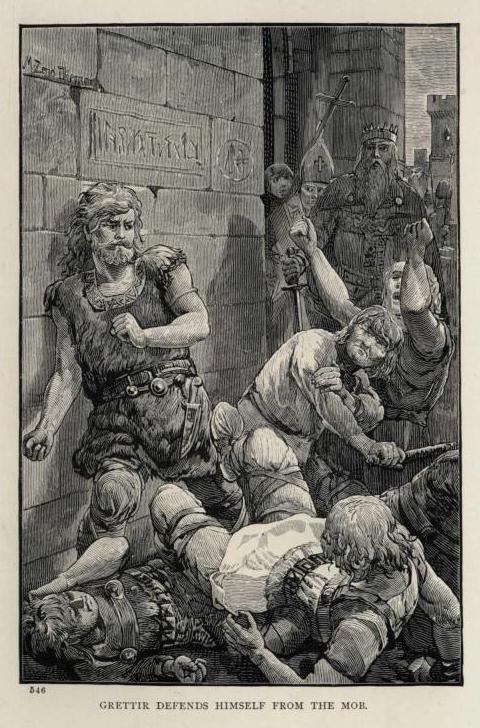
GRETTIR DEFENDS HIMSELF FROM THE MOB.
At last the sounds of the uproar reached the king's ear, and he sent out to know the occasion. His messenger returned a moment after to report that the Icelander was fighting the whole town and had knocked down and well nigh killed several persons. The king thereupon sprang from his throne, hastened down the nave, and came out of the great western door when the conflict was at its height.
"Oh, sire," exclaimed Grettir, "see how I can fight the rascals!" and at the word he knocked a man over at the king's feet.
With difficulty the tumult was arrested, and Grettir separated from the combatants; and then he wanted to go with the king and try the ordeal of fire.
"Not so," answered Olaf, "you have already incurred sin. It is possible that some of those you have knocked down may never recover, so that their blood will lie at your door."
"What is to be done?" asked Grettir.
The king considered.
"I see you are a very wicked or at all events a very unlucky man. When you were here before you were the occasion of several deaths. I do not desire to keep you in Norway, but as winter has set in you may tarry here till next spring, and then you shall be outlawed and return to Iceland."
CHAPTER XIX.
THE WINTER IN NORWAY.
At Einar's Farm—The Bearsarks—A Visit from Snœkoll—The Bearsark's Demand—Grettir Temporizes—The Bearsark has a Fit—Death of Snœkoll—Dromund's History—Grettir's Arms—A Pair of Tongs
King Olaf had decided that Grettir must leave Norway and return to Iceland. If he was not a guilty man he was a most unfortunate one. Now, the Norse race, whether in Denmark, Norway, Sweden, or Iceland, believed in luck. They said that certain men were born to ill-luck, and such men they avoided, because they feared lest the ill-luck that clung to them might attach itself to, and involve those who came in contact with them.
It was not possible for Grettir to return that year to Iceland, for all the ships bound for his native land had sailed before winter set in, so King Olaf agreed to allow him to remain in the kingdom through the winter, but bound him to depart on the first opportunity next year.
Somewhat sad at heart with disappointment, and with the impression that perhaps Olaf the king was right, and that ill-luck really did weigh on him, Grettir left the court, and went at Yule to the house of a bonder or yeoman called Einar, and remained with him awhile. The farm was in a lonely place in a fiord opening back to the snowy mountains. Einar was a kindly man, hospitable, and he did his best to make Grettir's stay with him pleasant. He had a daughter, a fair, beautiful girl, with blue eyes, and hair like amber silk, and her name was Gyrid. Perhaps the beautiful Gyrid was one attraction to Grettir, but if so he never spoke what was on his heart, because he knew it would be useless. He was an unlucky man; he had made himself a name, indeed, as one of great daring, but he had won for himself neither home, nor riches, nor favour.
Now it fell out that at this time there were some savage ruffians in the country who were called Bearsarks. They were outlaws in most cases, and they lived in secret dens in the dense forests, whence they issued and swooped down on the farms, and there challenged the bonders to fight with them, or to give up to them whatever they needed. These ruffians wore bear-skins drawn over their bodies, and they thrust their heads through the jaws of the beasts, so that they presented a hideous and frightening appearance. Then they worked themselves into paroxysms of rage, when they were like madmen; they rolled their eyes, they roared and howled like wild beasts, and foam formed on their mouths and dropped on the ground. They were wont also, when these fits came on them, to bite the edges of their shields, and with their fangs they were known to have dinted the metal quite deep. Some folks even said they had bitten pieces out of solid shields. It was usually supposed that these Bearsarks were possessed by evil spirits, and it is probable that in many cases they were really mad—mad through having given way to their violent passions, till they knew no law, and thought to carry everything before them by their violence. It was even at one time thought by the superstitious that they could change their shapes, and run about at will in the forms of bears or wolves; but this idea grew out of the fact of their clothing themselves in bear or wolf skins, and drawing the skull of the beast over their heads as a rude helmet, and looking out through the open jaws that thus formed a visor.
One day, just after Yule, to the terror and dismay of Einar, one of the most redoubtable of these Bearsarks, a fellow called Snœkoll, came thundering up to his door on a huge black horse, followed by three or four others on foot, all clothed in skins; but Snœkoll, instead of wearing the bear's skin over his head, had on a helmet with great tusks of a boar protruding from it, and a boar's head drawn over the metal.
It is worth remark that the crests worn later by knights, and which we have still on our plate and on harness, are derived from similar adornments to helmets. Some warriors put wings of eagles on their head-pieces, others put the paws of bears or representations of lions. These were badges of their prowess, or marks whereby they might be known.
Snœkoll struck the door of the farmhouse with his spear, and roared to the owner to come forth. At once Einar and Grettir issued from the hall, and Einar in great trepidation asked the Bearsark what he wanted.
"What do I want?" shouted Snœkoll. "I want one of two things. Either that you give me up your beautiful daughter to be my wife, and with her five-score bags of silver, or else that you fight me here. If you kill me, then luck is yours. If I kill you, then I shall carry off your daughter and all that you possess."
Einar turned to Grettir and asked him in a whisper what he was to do. He himself was an old man whose fighting days were over, and he had no chance against this savage.
Grettir answered that he had better consult his honour and the happiness of Gyrid, and not give way to a bully. The Bearsark sat on his horse rolling his eyes from one to another. He had a great iron-rimmed shield before him.
Then he bellowed forth: "Come! I am not going to wait here whilst you consider matters. Make your selection of the two alternatives at once. What is that great lout at your side whispering? Does he want to play a little game of who is master along with me?"
"For my part," said Grettir, "the farmer and I are about in equal predicament; he is too old to fight, and I am unskilled in arms."
"I see! I see!" roared Snœkoll. "You are both trembling in your shoes. Wait till my fit is on me, and then you will shake indeed."
"Let us see how you look in your Bearsark fit," said Grettir.
Then Snœkoll waxed wroth, and worked himself up into one of the fits of madness. There can be no doubt that in some cases this was all bluster and sham. But in many cases these fellows really roused themselves into perfect frenzies of madness in which they did not know what they did.
Now Snœkoll began to bellow like a bull, and to roll his eyes, and he put the edge of the great shield in his mouth and bit at it, and blew foam from his lips that rolled down the face of the shield. Grettir fixed his eyes steadily on him, and put his hands into his pockets. Snœkoll rocked himself on his horse, and his companions began also to bellow, and stir themselves up into madness. Grettir, with his eye fixed steadily on the ruffian, drew little by little nearer to him; but as he had no weapon, and held his hands confined, Snœkoll, if he did observe him, disregarded him. When Grettir stood close beside him and looked up at the red glaring eyes, the foaming lips of Snœkoll, and heard his howls and the crunching of his great teeth against the strong oak and iron of the shield, he suddenly laughed, lifted his foot, caught the bottom of the shield a sudden kick upwards, and the shield with the violence of the upward shock broke Snœkoll's jaw. Instantly the Bearsark stopped his bellows, let fall the shield, and before he could draw his sword Grettir caught his helmet by the great boar tusks, gave them a twist, and rolled Snœkoll down off his horse on the ground, knelt on him, and with the ruffian's own sword dealt him his death-blow.
When the others saw the fall of their chief they ceased their antics, turned and ran away to hide in the woods.
The bonder, Einar, thanked Grettir for his assistance, and the lovely Gyrid gave him also her grateful acknowledgments and a sweet smile; but Grettir knew that a portionless unlucky man like himself could not aspire to her hand, and feeling that he was daily becoming more attached to her, he deemed it right at once to leave, and he went away to a place called Tunsberg, where lived his half-brother, Thorstein Dromund.
Now, to understand the relationship of Dromund to Grettir, you must know that his father, Asmund, had been twice married. He had been in Norway when a young man with a merchant ship, and he had also gone with his wares to England and France, and had gained great wealth; and as he had many relations in Norway he was well received there in winter, when he came back from his merchant trips. On one of these occasions he had met a damsel called Ranveig, whose father and mother were dead. She was of good birth, and was wealthy. Asmund asked for her hand and married her, and settled on the lands that belonged to her in Norway. They had a son called Thorstein, who, because he was rather slow of speech and manner, was nicknamed Dromund; but as we meet with other Thorsteins in this story, to prevent confusion we will speak of him as Dromund.
After a while Asmund's wife Ranveig died, and then her relatives insisted on taking away all her lands and possessions and keeping them in trust for little Dromund. Asmund did not care to quarrel with them, so he left Dromund with his late wife's relatives and went home to Iceland, where, after a few years, he married Asdis, and by her became the father of Atli, Grettir, and Illugi, and of two daughters, one of whom he named after his first wife.
Dromund grew up in Norway on his estates at Tunsberg, and became a man of wealth and renown, a quiet man, but one who held his own, and was generally respected.
Now Grettir went to him, and his half-brother received him very affectionately, and insisted on his remaining with him all the rest of the winter till it was time for him to sail to Iceland.
One little incident is mentioned concerning that time that deserves to be recorded.
Grettir slept in the same apartment as did his brother.
One morning Dromund awoke early, and he saw how that Grettir's arms were out of bed, and he wondered at their size.
Presently Grettir awoke, and then Dromund said to him: "Grettir, I have been amused with looking at your bare arms. What muscles you have got! I never saw the like."
"I need strong muscles to do what I have to do."
"True enough, brother," said Dromund. "But I could wish there were a little more luck as well as muscle attached to those bones."
"Let me look at your arms," said Grettir.
Then Dromund put his arms out of bed, and when he saw them Grettir burst out laughing, for they were so thin and scraggy.
"Upon my word, brother, I never saw such a wretched pair of tongs in my life," he said.
"They may be a pair of tongs, old boy," answered Dromund, "but they are tongs that shall ever be extended to help you when in need. And," added Dromund in a lower tone, "if it should ever befall you that your ill-luck should overmaster you, and you not die in your bed; then, Grettir, I promise you, if I am alive, that I shall not let this pair of tongs rest till, with them, I have avenged you."
No more is related of their talk together. The spring wore on, and in summer Grettir took ship.
The brothers parted with much affection, and they never again saw each other's face.
CHAPTER XX.
OF WHAT BEFELL AT BIARG.