2 Gymnastics and Military Training
Reading edition
THE various athletic exercises, which are here for convenience classed together under the word ‘gymnastics,’ fall into three main classes, depending respectively on strength of body, of leg, and of arm. To the first class belong boxing and wrestling, to the second running and jumping, to the third throwing the diskos and the javelin. The last five of these six sports—boxing being excluded—formed the Pentathlon, a combined competition of five events arranged to suit the all-round military athlete, for whom Greek athletic training at its best was especially designed. In such a competition the foot-race probably came first and the wrestling last; the three middle events—the field events, as we should call them, jumping, throwing the javelin, and hurling the diskos—being those that were particularly identified with the five-sport system which aimed at producing, not a specialized athlete, but a man who combined strength with agility and skill. Victory in the Pentathlon depended, not on success in all events, but on a system of marks; victory in three of the competitions was sufficient in itself, but if no competitor won three times, and two competitors tied with two victories each, it is highly probable that account was taken of second and third places.
Of the separate exercises, wrestling perhaps was the favourite. It was the oldest of all sports, and to the Greeks one of the most important. To them it was both a science and an art. Theseus, its inventor, was, according to the myth, taught the rules by Athena herself. Victory alone was not sufficient; the winner must win gracefully and according to the precepts of the schools. It was from wrestling that the palæstra took its name, and the Greek language is full of metaphors and expressions borrowed from the technical phraseology of the ring. The contests between Heracles and Antæus, and between Atalanta and Peleus, are two of the best known and most frequently depicted episodes of the heroic saga, and wrestling was one of the sports in which women were allowed by some States—by Sparta and Chios, for example—to take part, competing even against men. Instruction was given in the school; there were separate rules for men and boys, and the different movements, grips, and throws were taught on a system of progressive difficulty; textbooks were used, and fragments of such a manual have recently been found on an Egyptian papyrus. There were two principal styles, the upright wrestling, in which the object was to throw one’s opponent to the ground, three falls being necessary for victory, and the ground wrestling, in which the struggle was continued even after a fall until one of the combatants yielded. The first style, however, was the only one regarded as strictly legitimate, the second being merely part of the pankration. The attitude of a Greek before coming to grips was very similar to that of modern wrestlers, and is beautifully illustrated in the pair of boy statues from Naples which may be seen in the Embankment gardens. Standing square to one another, they endeavoured to get a hold from the front or the side. The defence was often a grip on the opponent’s wrist, which might lead to the offensive if his elbow could also be seized and the throw we call ‘the flying mare’ be then executed. Of front body-holds, the most effective was gained by catching the waist with both hands and then lifting the opponent off his feet, such a hold as Heracles used against Antæus. Of side-throws the best known was ‘the heave,’ usually ascribed to Theseus, where one hand was passed round the opponent’s back and the other hand slipped underneath him. Another favourite hold was by the neck—a strong neck was essential for a wrestler—and when this was secured a sudden turn of the body would lead to the throw that we call a ‘cross-buttock.’ In all wrestling tripping played an important part, and there are a very large number of technical terms in Greek for the different trips that are
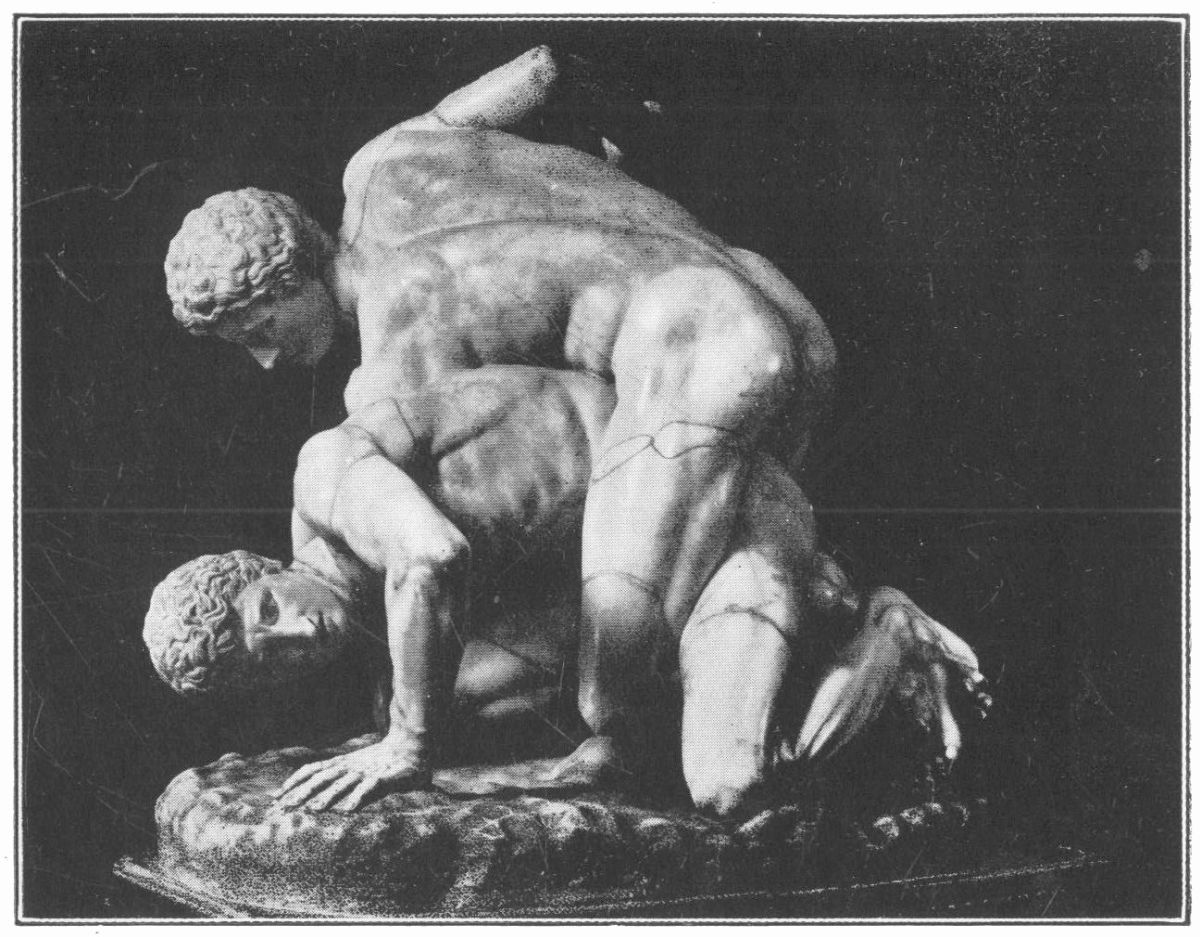
THE WRESTLERS (Uffizi Gallery, Florence)
employed. Every district in Greece had a style of its own, and these diversities of method helped to keep active an interest in wrestling and to preserve it from the disease of professionalism, so that even when other sports had been ruined the wrestling ring still remained a useful and a popular institution.
It is this popularity in actual life that accounts for the frequency of descriptions of wrestling matches in Greek literature. Two of them at least are worth quoting; the first from the Iliad, Book XXIII, the contest between Ajax and Odysseus at the funeral games of Patroclus:
He said; and straight uprose the giant form Of Ajax Telamon: with him uprose Ulysses, skilled in every crafty wile. Girt with the belt, within the ring they stood, And each, with stalwart grasp, laid hold on each; As stand two rafters of a lofty house, Each propping each, by skilful architect Designed the tempest’s fury to withstand. Creaked their backbones beneath the tug and strain Of those strong arms; their sweat poured down like rain; And bloody weals of livid purple hue Their sides and shoulders streaked, as sternly they For victory and the well-wrought tripod strove. Nor could Ulysses Ajax overthrow, Nor Ajax bring Ulysses to the ground, So stubbornly he stood; but when the Greeks Were weary of the long protracted strife, Thus to Ulysses mighty Ajax spoke: ‘Ulysses sage, Laertes’ godlike son, Or lift thou me, or I will thee uplift: The issue of our struggle rests with Jove.’ He said, and raised Ulysses from the ground; Nor he his ancient craft remembered not, But locked his leg around, and striking sharp Upon the hollow of the knee, the joint Gave way; the giant Ajax backwards fell, Ulysses on his breast; the people saw, And marvelled. Then in turn Ulysses strove Ajax to lift; a little way he moved, But failed to lift him fairly from the ground; Yet crooked his knee, that both together fell, And side by side, defiled with dust, they lay. (Homer: Iliad, XXIII, 820-851, Derby’s translation.)
The second description is separated from Homer by some twelve centuries, but it is equally vigorous. In the tenth book of The Æthiopian History of Heliodorus, the hero Theagenes, as his last trial before winning his beloved Chariclea, is matched against a stalwart Æthiopian, and in Underdowne’s quaint Elizabethan version the passage thus appears:
‘Then hee tooke dust, and cast it upon his armes and shoulders, and stretched foorth his hands, and tooke some footing, and bent his legges a little, and stouped lowe, at a word all partes of his body were ready, so that he stoode, and with great desire awayted for the advantage at the close. The Æthiopian seeing this laughed irefully, and triumphed scornefully upon him: and ranne suddenly upon him, and with his elbowe hit Theagenes in the necke, as sore as if he had stricken him with a leaver, and then drewe backe, and laughed againe at his owne foolish conceite. But Theagenes like a man alway from his cradle brought up in wrastling, and throughly instructed in Mercuries arte, thought it good to geve place at first, and take some triall of his adversaries strength, and not to withstand so rude a violence, but with arte to delude the same. Therefore he stouped lower, and made semblance as though he had beene very sorrowfull, and layde his other side to receive his other blowe. And when the Æthiopian came upon him againe, he made as though hee would have fallen flat upon his face; but as soon as the Æthiopian began to despise him, and was incouraged well, and came unadvisedly the third time, and lyfted up his arme againe to take holde of him, putting his right arme under his left side, by lifting up his hande he overthrew him in a heape, and casting himselfe under his arme pittes gryped his gorbelly with much a doo, and forced him with his heeles to fall on his knees, and then leapt on his backe, and clasping his feete about his privie parts made him stretch out his legges, wherewith he did stay up himselfe, and pulled his armes over his head behinde him, and laide his bellie flatte upon the earth.’
Boxing also, like wrestling, always retained its attractiveness, and in its ancient form offers some varieties from the modern mode. There were three stages in its history, depending largely upon the instruments of fighting used. Down to the beginning of the fourth century b.c. it was customary to wind soft strips of leather—meilichai—round the hands and arms, which served, like our light gloves, to protect the knuckles and so increased the power of attack, but did not in themselves add to the severity of the blow. Early in the fourth century the meilichai were superseded by gloves—sphairai—made of hard pieces of leather with projecting and cutting edges, real weapons of offence, like our knuckle-dusters. From these the Roman cæstus was developed, where the glove was weighted with pieces of iron and metal spikes placed in position over the knuckles.
In Greek boxing there was no ring and therefore little close fighting, there were no rounds and therefore the pace was slow, for rushing tactics marked the untrained man; lastly, there was no classification by weight; the heavier the man the greater his chance of success, so that a meat diet for boxers was almost compulsory, and boxing became practically the monopoly of the heavy-weights. As thongs or gloves were always used on the hands, wrestling was impossible, and in later times at least the defence was all-important. It seems fairly well established that body-hitting was not practised, and in the Hellenistic age a fight was usually decided by a knock-out blow on the jaw. But in the best period the Greek boxer used both his hands freely, was active on his feet, and had a considerable variety of attack. The introduction of heavy gloves vitiated the art, and boxers began to rely merely on their weight and defensive powers.
Of all these stages we have plentiful evidence both in art and literature, for boxing and its preliminaries are among the favourite subjects of vase painters, while in poetry, beside the account of the fight between Odysseus and the beggar Irus in the Odyssey and between Entellus and Dares in the Æneid, we have a really enthusiastic and expert description by Theocritus of the great struggle between Amycus and Polydeuces. The battle is as vividly described as the epic contest in the Dell between Lavengro and the Flaming Tinman, and the poet, by making it a fight between the old school of scientific activity and the new method of stolid strength, ingeniously enlists our sympathies from the first upon the side of skill against brute force.
‘Then Amycus came on furiously, making play with both hands; but Pollux smote him on the point of the chin as he charged, maddening him the more, and the giant confused the fighting, laying on with all his might, and going in with head down.... But the son of Zeus stepped now this side, now that, and hit him with both fists in turn, and checked his onslaught, for all his monstrous strength. Like a drunken man he reeled beneath the hero’s blows, and spat out the red blood, while all the princes shouted together, as they marked the ugly bruises about his mouth and jaws, and saw his eyes half closed by puffy flesh. Next Pollux began to tease him, feinting on every side, and at last, seeing that he was now quite bewildered, he got in a smashing blow just above the middle of the nose beneath the eyebrows, and laid the bone of his forehead bare. Stretched on his back the giant fell amid the flowers; but he rose again, and the fighting went on fiercely. They mauled each other hard, laying on with the weighted thongs; but the giant was always busy with his fists on the other’s chest and outside his neck, while Pollux, the invincible, kept on smashing his opponent’s face with cruel blows.’ (Theocritus: Idyll, XXII, 87-111.)
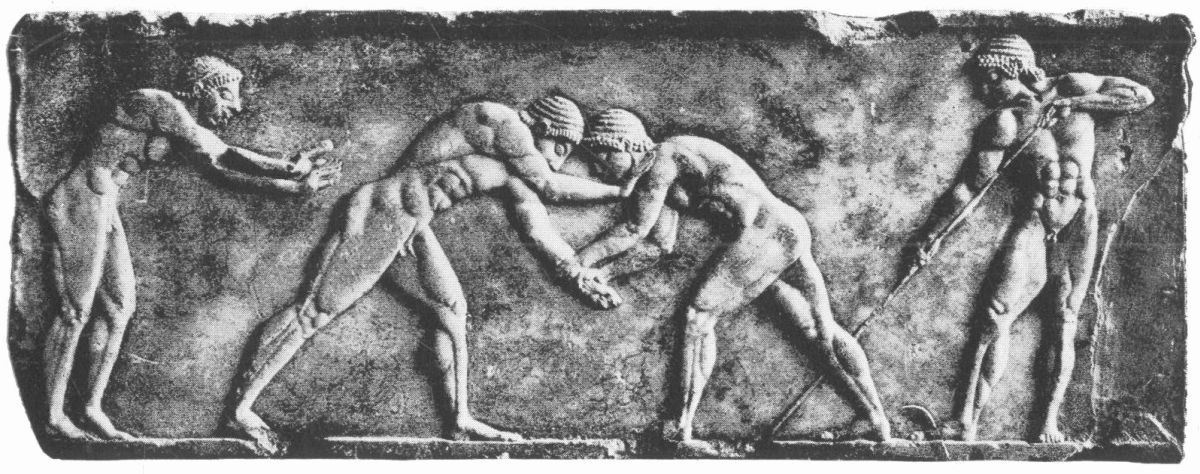
A WRESTLING CONTEST (Athens)
Boxing and wrestling were combined in the pankration and allied with many other devices, such as kicking, strangling, twisting, etc.; it was a versatile performance, the joint invention of Heracles and Theseus, and considered both by Pindar and Philostratus as ‘the fairest of all contests.’ There was an element of danger, but it was no more brutal than is the almost similar method of jujitsu; moreover, strict rules were enforced by umpires who closely watched the combatants. Biting and gouging were strictly forbidden, although frequently attempted, as for example by Alcibiades. ‘You bite like a woman,’ cried his opponent. ‘No,’ said the young Athenian, ‘like a lion.’ Of gouging we have a picture on a cup in the British Museum, where one figure has inserted his finger into his opponent’s eye, while the umpire hurries forward with uplifted rod. But nearly every manœuvre of hands, feet, and body was permissible. You might catch your opponent by his foot and throw him backwards; you might seize his heel or ankle, and then, if you could, twist his foot out of its socket; you might kick him violently in the stomach; you might plant your foot against the other man’s waist and throw him over your shoulder; you might even stand on your own head, if that position seemed expedient. All these tricks were used in the standing position, but the issue of the combat was usually decided on the ground. There you might twist arm or hand, break fingers, and strangle. All neck holds were allowed, but the favourite method of strangling was known as the ‘ladder grip,’ in which you mounted your opponent’s back and wound your legs round his stomach and your arms round his neck. Ground wrestling was indeed the distinctive feature of the pankration, and the well-known group in the Uffizi Palace at Florence represents one of the last stages in such a contest.
Of running and jumping little need be said, for it is very possible that in neither sport had the Greeks much to teach modern athletes. They were a short-legged people, and although they may have had some advantages in long-distance races they probably would be much inferior to our specialized sprint runners: length of leg must tell, and as in horse-racing ‘a good big ’un’ is better than ‘a good little ’un,’ so in a short-distance race length of stride ensures victory. But running was very popular in Greece, and of the eight events in the early Olympic games no less than four were foot-races, three for men—at 200 yards, 400 yards, and three miles—and one for boys. The running course—the stade—was a straight 200 yards; for the diaulos of 400 yards the runners turned at a post and came back to the starting-point. The start was marked by two parallel lines, for a Greek runner began in a somewhat cramped position, with the feet close together. The runners ran naked, their bodies carefully oiled, and for each man there was a post at the starting and at the finishing point to which he ran; there were no dividing strings, nor was there any tape. Vase paintings of runners are very frequent and plainly show the difference of style between the sprinter and the long-distance man; in the early vases a short, thickset type is common, in the later the thin sprinter is preferred. The most famous names are those of long-distance runners—e.g. Pheidippides and Ladas, whose statue by Myron was even more admired than the same master’s Diskobolos,—and in these races the Cretans and Arcadians especially excelled, while the Athenians were better at short distances. Beside races proper there were various running contests; for example, the race in armour, which was introduced at Olympia towards the close of the sixth century and was the final event of the games, the competitors running in full panoply of shield, helmet, and greaves. Other similar events were the Oschophoria, where youths ran in women’s clothes, and the Lampadophoria, in which a lighted torch was carried by single runners or by teams. These latter were very popular at Athens, and they illustrate the difference between the ancient and modern view of running. They were not serious and specialized enough for a modern athletic meeting, where everything is a matter of record and a fifth of a second is of vital importance.
Jumping, also, was comparatively simple and restricted in its scope. Of high jumping and pole jumping the Greeks had none, for athletics were always practical, and as there were no hedges in Greece for soldiers to jump over it was unnecessary to practise high jumping in the school. Their long jump differed from ours in that it was always performed with the help of jumping weights—halteres—things much like our dumb-bells and used in a very similar fashion. With these implements a class of pupils would practise together to the music of the flute. Both standing and running jumps were performed from a take-off into a pit—skamma—and jumps of over twenty feet were common; the fifty-five feet ascribed to Phayllus is an impossible exaggeration.
But if in running and jumping we have little to learn, it is very different in regard to the ‘field events,’ the throwing of the javelin and the diskos. Here the Greek system of body poise and muscular development gave their athletes an enormous advantage and enabled them easily to perform movements which to our modern bodies seem almost impossible. Both exercises were especially popular at Athens, and were there regarded as part of gymnastics rather than athletics: i.e. they were designed, not as
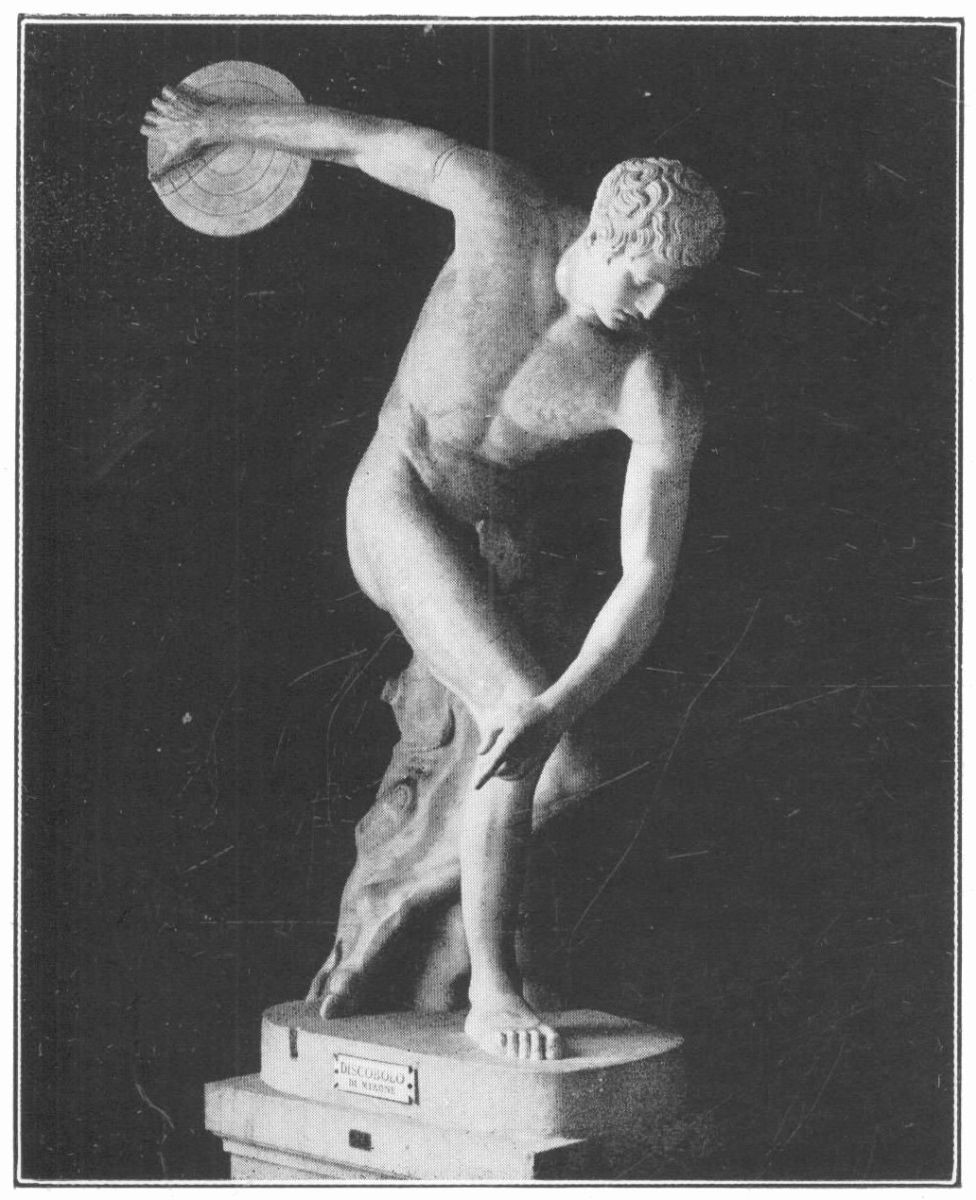
THE DISKOBOLOS OF MYRON
competitive sports, but as means to improve bodily efficiency.
The javelin was a light stick of wood, usually pointless. Distance throwing was far more usual than throwing at a mark, and for this purpose a thong—amentum—was used, fastened near the centre of the javelin shaft. Such a thong practically quadruples the range of throw, but the process needs long practice and is of course highly artificial in comparison with the natural use of the spear in hunting or in war. Greek athletics had a definite purpose, and we may be sure that it was not the actual throw but the movements necessary for the throw that gave its value to the exercise. These movements, the short, quick steps before the cast and the sharp turn of the body to the right, are illustrated frequently on the vases; the throw itself is seldom represented, and then with very poor results. The diskos was a flat and fairly heavy circle of bronze. It was thrown from behind a line and in a restricted space, a throw of 100 feet being exceptionally good.
II
Such is a brief account of the gymnastic sports and exercises which formed so important a part of a Greek’s everyday round. Each one of them had its own special value in developing the strength of some particular part of the body, and taken together they formed a complete and adequate training for what was to an ancient citizen the chief business of life—war.
To us, whose civilization is based on the habits of peace and to whom war means the negation of all the humanities, it may seem illogical to think of fighting as a business. But it was not so in Greece. Warfare was the art of life, so far surpassing all the other arts that it was regarded not so much as an accidental state but rather as a vital function, as necessary to existence as breathing, sleeping, eating, and drinking. It would accept what help the other arts could give: athletics made a soldier nimble and supple; medicine kept him in health; the music of the flute was useful in marching; the lyric poet and the dramatist could foster and elevate the martial spirit; but all these were subservient to the one engrossing purpose. Men fought to live and lived to fight.
For the Greeks it was war, not peace, that seemed the natural state of an organized community. War was part of their civilization: they liked fighting and they fought like gentlemen. The Romans, on the other hand, had no love for fighting in itself and fought without much regard to the rules of the game. And yet the Romans were more successful in the conduct of war, for, as our English general says, Courage, Common Sense and Cunning are the essentials of victory, and if by courage we mean endurance all three were Roman rather than Greek qualities. The Romans were always anxious to win and get finished with it, and for this purpose they were willing to fight on year after year in order that at last they might inflict a crushing defeat on the enemy and then return home to their flesh-pots. The Greeks were satisfied with one indecisive success and never tried to annihilate their opponents; for then the sport would have come to an end. To the Romans, in spite of their many campaigns, war was an unpleasant interruption of their usual way of life; to the Greeks, it was simply an exciting but somewhat dangerous diversion, which was, however, an integral part of the citizen’s service to the state.
The Greek attitude may be easily understood if we consider their history. They were never, like the Romans, a pastoral or agricultural community. Their culture was cradled on the battle-field and the more intense the fighting the more intense the literary and artistic effort of the nation. The constant stress of battle wore the race out eventually, but it never hurt their civilization. From the earliest days peace was unknown in the land. The raids of sea pirates, the forced migrations of peoples, tribal wars, trade wars, dynastic wars: such is the history of Greece in its first, middle, and concluding stages. If war is a curse that can only bring evil, then the Greeks were the most unhappy of nations, for the noise of battle was seldom hushed, and instead of declaring war they thought themselves fortunate if occasionally they could declare peace.
This constant presence of the martial spirit is visible in all that remains to us of their art and literature. Upon the silver ware of Mycenæ we see the Minoans fighting naked, crouching with bow and arrow behind their shields. The statues from Ægina are all of men arrayed for battle with lance, shield, and sword. Even Pallas Athene, the goddess of wisdom and the household arts, is usually represented wearing the panoply of war, and the decorations of her temple are mostly pictures of battle or of preparation for the fray, the combats between Centaurs and Lapithæ and the marshalling of the mounted soldiers for her solemn procession. Painters, like sculptors, found their chief subjects in war, either in the ancient combats of the epic lays or in the actual life of the parade-ground and the guard-room. The Attic vases of the sixth and fifth centuries, the best example we possess of truly popular art, repeat the warrior motif almost to satiety, and they did so because the potter knew that of this subject at least his clients would never be weary.
It is the same in Greek literature, from first to last. In the Homeric poems fighting is the normal business of man. There are fairy-lands, the poet can imagine, where fighting is not the common rule of life, the land of the lotus-eaters, the orchards of the Phæacians, the island realms of Circe and Calypso: but these are all uncanny magic places where decent everyday rules do not hold good. In Homer it is a man’s function to fight, by sea and land, in a chariot or on foot, to use spear and sword, to attack and plunder, or to defend himself from the enemy’s raids. So also with the lyric poets of the next era, from Archilochus downwards; they are men of battle first and men of letters afterwards, squires of the War god, as Archilochus cries:
‘My spear is bread, white kneaded bread, My spear’s Ismarian wine, My spear is food and drink and bed, With it the world is mine.’
We get the same refrain in Hybrias the Cretan, the verses known to English musicians by Campbell’s translation:
‘My wealth’s a burly spear and brand And a right good shield of hides untanned Which on my arm I buckle. With these I plough, I reap, I sow, With these I make the sweet vintage flow And all around me truckle. But your wights that take no pride to wield A massy spear and well made shield, Nor joy to draw the sword, Oh I bring those heartless hapless drones Down in a trice on their marrow bones To call me king and lord.’
‘King and lord’—they are the only words that the lyrists have for the soldier, and the elegiac poets repeat the idea in the more serious fashion appropriate to their poetical form. Tyrtæus, for example, the lame schoolmaster lent by Athens to Sparta, in those poems which the Spartans regarded as one of the chief causes of their military success, emphasizes the supreme importance of martial valour:
‘I would never remember a man nor hold him of any account because of his speed of foot, or skill in wrestling, his bigness, or his strength, his beauty, or his wealth. He might be more kingly than Pelops, more eloquent than Adrastus; but all his fame would avail him naught unless he were a man of mettle in fight. This is the supreme virtue, the best sport, the highest prize that a young man can win.’
Tyrtæus, as we see in his verses, regarded the art of poetry as ancillary to the art of war, and the greatest of the Athenian dramatists shared his views. The real gravamen of Æschylus’ attack upon Euripides in the Frogs is that the latter did not sufficiently exalt the martial spirit among a nation, of whom the old poet says:
‘Their life was in shafts of ash and of elm, in bright plumes fluttering wide, In lance and greaves and corslet and helm and heart of seven bulls hide.’
Prose literature gives us the same evidence as poetry. Thucydides and Xenophon look upon history chiefly as a succession of battles and campaigns. Of the social history of their time they tell us scarcely anything, but they will dilate with the most intense interest on the smallest details of a skirmish. To them, as to most of their contemporaries, war was the one thing that mattered, the great business and the great sport of life, and our historians have only in comparatively recent times escaped from their point of view.
It is probable indeed that many of those Athenians, whom we think of only as men of letters, were viewed by their contemporaries in rather a different light. Æschylus was perhaps better known as one of the heroes of Salamis than as a dramatist. Sophocles was an admiral in charge of the Athenian fleet the year after the performance of the Antigone, and the anecdote that his military position was due to his literary skill is probably a literary invention. Thucydides had been appointed to the command of the Athenian troops in Thrace long before he set to work on his history. The stubborn courage of Socrates was proved upon the field of Delium, and Euripides, that keenest critic of the war spirit, served his forty years in the Athenian army when fighting was at its fiercest. We generally imagine Pericles and Nicias as being civilian ministers, men holding the same sort of position as Pitt and Walpole: in reality through most of their lives they were soldiers on active service, and Cleon, who was almost a professional politician, was ready and willing at a moment’s notice to take command of a difficult and dangerous military expedition and, what is more, had enough technical knowledge to bring it to a successful termination.
As every Athenian citizen was a soldier serving under equal conditions, there was no military caste and no military discipline as we know it. The cavalry, once the preserve of the richer classes, was in the fifth century b.c. confined to decorative peace functions. The higher officers of the army were elected by their fellows, walked in the ranks, and had no distinguishing badges.
The Athenian, who supplied his own elaborate equipment and was trained to a particular kind of fighting, refused to become part of a military machine. A general was forced to adapt his tactics to the temper of his men, and the personal element entered very largely into all questions of army organization. The accoutrement of the hoplite was the deciding factor in strategy and tactics, and the character of fifth-century fighting can only be realized by considering first the weapons with which the citizen soldier was armed and the fashion in which he was accustomed to use them.
If a citizen were to play his part properly in the great war game, long and constant bodily training was necessary. At Sparta, the complete type of a militarist state, everything was made subservient to physical fitness, and even at Athens the claims of the body came before the claims of the mind, so that when Socrates wanted patients for his dialectic he had to go to the gymnasia to find them. And this was reasonable, for only a man in perfect condition could fight under the conditions imposed upon a Greek heavy-armed soldier. The mere weight of a hoplite’s accoutrement would astonish a modern infantryman. His defensive armour consisted of four pieces: helmet, cuirass, greaves, and shield; and even the first of these, especially if it were of the Corinthian type, was a considerable burden and involved a severe strain on the neck muscles. It was very heavy, twice as heavy as any of the mediæval helmets that we possess, was made usually of thick iron and completely covered the head and neck. Holes were left for eyes and mouth, the nose was protected by a vertical strip of metal, and a lining of felt or leather was sewn inside to save the skin from abrasion. After the fifth century, it is true, the Corinthian type began to go out of use, and the Attic shape became more common. This was considerably lighter and in appearance resembled a metal cap with extra pieces protecting neck, cheeks and nose, which could be detached at will. It was graceful both in its proportions and its adornment: a crest, and often a triple crest, was usually worn with it, the three plumes being carried in elaborately modelled supports.
The cuirass in its first form consisted of two bronze plates, roughly carved to fit the body and fastened on the sides and shoulders. The bottom edge was turned up to leave the hips free and the lower parts of the body were thus dangerously exposed. Moreover, the rigid metal seriously hampered all movement, and this type was generally superseded by the cuirass proper, a garment worn much in the fashion of a modern corset, but made of leather plated with bronze and buckled down upon the breast by means of shoulder straps. The bronze plating was mostly in the form of round scales sewn on to the leather with wire and overlapping so as to present three thicknesses of metal.
The greaves were thin sheets of bronze shaped to fit the leg, which they clasped and held by their own elasticity. They were often adorned with embossed work and the fittings were sometimes of tin or ivory. Their length varied; some went only to the knee, others covered part of the thigh and an ankle pad was worn to keep the bottom edge from chafing the foot. They were a protection against minor hurts, scratches, bruises, etc., rather than a defence against spear thrusts, but their general adoption is synchronous with the disappearance of the oblong covering shield in favour of the smaller oval, carried on the left arm.
The Homeric shield, ‘great as a tower,’ and large enough to cover a man from head to foot, had in the fifth century gone completely out of use. In art we have no representation that corresponds to the descriptions in the Iliad, and the heroes whose combats are pictured on the Attic vases are armed either with a round shield which protects their body only, or else with the oval shield about three feet long which after 500 b.c. had become the normal type in Greece. These shields bore usually the blazon of their owner and often served to identify his body: man and shield were inseparable and the fighter who threw his shield away revealed himself as destitute of knightly honour. The character of the blazonry varied as much as our heraldic designs. Sometimes it was decorative and depended on individual caprice; Capaneus, in Æschylus’ play, carries as his device a naked man with a torch; beneath, the words ‘I will burn your city’; Alcibiades had merely a little Cupid with a toy thunderbolt. In other cases it was the city or a god who supplied the design: for example, the Mantinean hoplites had on their shields a trident, the symbol of their state god, Poseidon; the Thebans, a sphinx in memory of Œdipus; while others were merely marked with an initial letter, the Argives with an A., the Sikyonians with the Doric San. These devices were on the outer surface: the inside of the shield was supplied with a leather or metal strap across its middle through which the left arm was passed, and one or two grips of cord or leather at the side and end to give a firm hold; for this shield was a heavy implement, very different from the light buckler, with which the cavalry and the skirmishers were armed, and it required strong and well-trained muscles to wield it effectively in the stress of battle.
The race in armour, therefore, often called simply ‘The Shield,’ was not only one of the most popular of gymnastic contests, but also had a very practical value; although as a concession to human weakness the runners were usually allowed to divest themselves of cuirass and greaves. The picturesqueness of the race appealed especially to the vase-painters, and we have many pictures of it, the best perhaps being those on a red figured cup in the Museum at Berlin. On one side is a group of three runners, the right-hand one bending ready to start, the left-hand one turning the half-way post, and the central one hastening back on the home stretch. On the other side are three runners one behind the other, while in the interior of the vase is a single figure looking back, in rather unsportsmanlike fashion, as he runs.
So far for a hoplite’s body armour; but he had also to carry his weapons of offence, his sword and his spear. The first was of many different shapes and has many different names in Greek, but all its varieties belong to three main types.
In the first, dating from the earliest age, the blades are short and heavy, made in one piece with the hilt. The guard is usually straight, the pommel a round knob, the space between being filled with bone or ivory to form a grip. This pattern, really a survival from the Bronze Age, was transferred to the iron sword and is occasionally found even in the classical period.
But the ordinary Greek sword of the fifth century is of quite a different shape. The hilt is round and the long thin blade swells from the hilt towards the point, showing that it was meant for cutting rather than thrusting. Flat scabbards, often highly ornamented with the precious metals, were used and occasionally the spear would be discarded for single combat and two swords employed, one in the hand, the other hanging ready in its sheath, as we see it in the well-known vase painting of the combat between Achilles and Memnon. This was the usual infantry sword, but there was another cutlass shape, the ‘machaira,’ which was especially suited to the cavalry soldier. Here the blade curved and the whole weapon was heavier, with knife-like cutting edges. The hilt was usually bent—often in the shape of a bird’s head—and gave a secure grip, so that it was possible to deal heavy blows from above.
The spear, however, rather than the sword, remained always the chief item in a Greek soldier’s equipment, for the Mediterranean peoples, unlike the northerners, have always preferred the thrust to the cut. In Greek poetry the word for spear is used indifferently for any weapon and includes sword, while on the drill-ground the commands—‘To the spear,’ ‘To the shield’—corresponded to our ‘Right’ and ‘Left Turn.’ In shape there seems to have been but little variation. The iron head was sometimes formed like a spike, with three or four blades tapering to a point, but more commonly it was of the flat dagger type, with a raised central rib and two cutting edges. The shaft, usually of stout ashen wood, was about six feet long and the weapon was chiefly used for thrusting at close quarters. Occasionally it was thrown from a distance, but for this purpose the light cavalry lance of cornel wood was more suitable. The spear, used like a pike, was too heavy for any but close fighting, and there was a constant tendency to increase its length and weight until the Macedonian sarissa reached an average of twelve feet and required both hands for its effective use.
Such was the accoutrement of the Greek citizen soldier, and the character of his arms fixed the character of his fighting. It was not stupidity and lack of judgment that led the Greeks to fight in the way that Mardonius the Persian thought so foolish, but rather the fact that a Greek fighting man was almost useless on rough ground. ‘These Greeks,’ the old general told his young master, ‘when they have declared war upon one another choose out the best and most level piece of ground they can find, and there go down and fight so that the winners get off with the maximum of loss: as to the beaten side I need not say anything; they are completely wiped out. Speaking all the same language they ought to settle their differences by any method rather than battle. But if in spite of everything war becomes inevitable, then each side ought to discover its strongest points and try to take advantage of them.’ The passage is interesting, for it shows that total inability to comprehend the psychology of any nation but one’s own, which is one of the most pathetic things in history. Mardonius was among the wisest of the Persians, but he could not understand that to the Greeks war was not merely a business, but also the highest form of sport, and that it may be carried on under rules of honourable conduct which rob it of most of its worst features. In the great age, from causes partly physical, partly moral, a Greek battle was fought on a system as formal and well defined as the precepts of mediæval chivalry. The herald was an important figure; due proclamation had to be made to the enemy; there was a definite acknowledgment of defeat; and an elaborate ceremonial of triumph and trophy. The battle once over, no bad blood was left: it was a fair fight with equal weapons on the plain, and no attempt was made to annihilate the enemy or to annex his territory. The losses in killed and wounded were by no means as heavy as Mardonius believed, for these were not big battalions directed by invisible generals, but citizen soldiers who were sensible enough to know when they were beaten. The procedure was fixed. The army marched out from the city at dawn until it found itself face to face with the enemy on the traditional battle ground, one of those alluvial plains, comparatively rare in Greece, upon which the city depended for its supply of corn, the prize of victory being indeed the ground on which the fighting took place. Then the generals on either side would address their men with some final words of exhortation (there was a special style of rhetoric held appropriate for such occasions) and the two armies would advance to the attack.
With waving plumes and glittering spears, the sun striking upon the gold ornaments of breastplate and sword-belt, the hoplites pushed forward, slowly at first but quickening their step as they approached the enemy, and at last the two lines, moving now at the double, would meet with a crash in the shock of battle. Then came the moment for which the Greek’s whole life was one long preparation: swaying, struggling, heaving, with every muscle tense and every limb engaged, the opposing masses strove to hurl one another back. All the tricks of the wrestling school and the boxing match were designed for use in this hour, and even courage was of little avail unless it was supported by that perfection of physical fitness which the ancient Greeks alone of all nations attained. Success in an ancient battle depended upon the quality of the men engaged, and the men derived little aid from external sources: cavalry, engineers and artillery played no part. The issue was decided by the final shock of two bodies of heavy armed infantry relying on solidity and weight, and momentum in the attack was all important, for the ranks once broken could seldom be reformed. Long training in the drill ground must have been necessary for the orderly advance of formations so dense as these (the average depth of men in the fifth century seems to have been about eight, but at Delium in 421 the Bœtians massed their men in files of twenty-five), and however good the marching there was a constant tendency for the front line to slant as each man edged under his right hand neighbour’s shield. A Greek hoplite like a modern Rugby forward depended upon his formation, and without a comrade on either side of him, and ranks of men behind or in front, he felt himself lost. His formation broken, the natural impulse was to retire, and a withdrawal to the city walls was the usual result of defeat. Once behind his ramparts the citizen soldier was safe, for in the fifth century sieges were costly, tedious, and usually indecisive. Open fighting was the cardinal rule: cunning surprises and unforeseen attacks were as difficult for an Athenian hoplite as they were for an English knight. Both, when encased in their armour, were conspicuous figures incapable of any very nimble movements, and needing an attendant squire to take charge of their war panoply. With both physical conditions led to a moral code of ‘noblesse oblige,’ and for a time war became almost a gentlemanly diversion. In neither case it is true did these conditions last long: the moral degeneration caused by the Peloponnesian War destroyed the one, and the physical changes brought about by the invention of gunpowder put an end to the other.
Ancient as distinguished from modern warfare really ends with the fifth century b.c., for the next age brought a revolution to Greece. War ceased to be an art and became a science. The end of the Peloponnesian War coincided with the spread of the Sophistic spirit; warfare was subjected to the same sort of investigation and criticism as the other departments of life; and specialization, with all its advantages and disadvantages, began.
The later years of the Peloponnesian War had shown the importance of cavalry and its proper functions in the attack and support of infantry; but the first great change came when Iphicrates the Athenian discovered that a hoplite force was not invincible by light armed troops, if these latter were properly handled. His defeat of a detachment of Spartan heavy armed infantry was in itself an insignificant event, but it created a revolution in military tactics comparable to that brought about by the success of the English archers over the French knights at Creçy. Up till that time the hoplite in popular estimation held much the same position as a battleship does in modern sea warfare; it was considered as hopeless for peltasts to engage hoplites as it would be for a light cruiser to attack a Dreadnought.
With the fall of the citizen soldier came the rise of the mercenary and the professional fighting man. A Greek force ceased to be a homogeneous unit and split up into the component elements of a modern army. ‘The light armed men are the hands, the horse the feet, the infantry the breast, and the general the head’; such was the saying of Iphicrates; and the Theban tacticians, notably Epaminondas, followed him in combining cavalry and light infantry with the heavy armed phalanx. Philip of Macedon improved upon his Theban teacher’s example and soon a standing army was established which disregarded all the old traditions of chivalry. The Greeks had their first warning in the ruthless destruction of Olynthus and the two systems met in final conflict at Chæronea. The professional soldier won, and by the end of the fourth century the ancient ideals had disappeared.
But it is well still to remember them. The system of orderly combat in the open remains the best for developing the manly virtues; and any nation that relies over-much on the mechanical and the unseen in war will inevitably fall away from those standards of conduct which we in our half humorous, half depreciatory way call sportsmanlike, and to which the Greeks gave the truer name of ‘Aidôs,’ the quality alike of the sportsman and the gentleman. Aidôs is ‘ruth,’ and the man who has no aidôs in him will be ready to employ all means to achieve his aims, and in the end perhaps will even delight in ruthlessness for its own sake.