Front matter
Reading edition
E-text prepared by Juliet Sutherland, David E. Brown, and the Online Distributed Proofreading Team (http://www.pgdp.net)

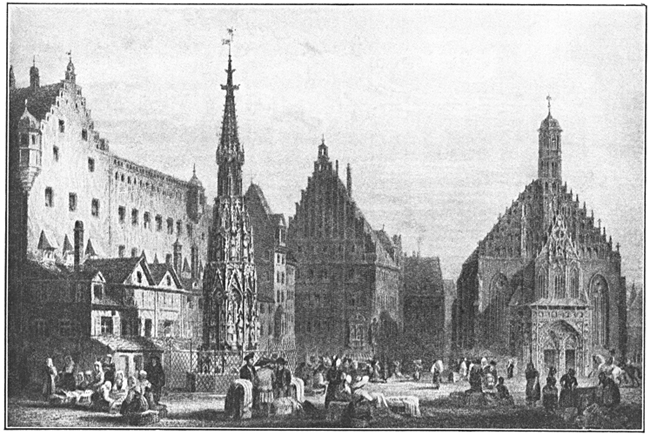
THE MARKET PLACE IN NUREMBURG
EVERYCHILD'S SERIES
GREAT OPERA STORIES
TAKEN FROM ORIGINAL SOURCES IN OLD GERMAN
BY
MILLICENT S. BENDER
ILLUSTRATED
New York THE MACMILLAN COMPANY 1935
All rights reserved
Copyright, 1912, By THE MACMILLAN COMPANY.
Set up and electrotyped. Published September, 1912. Reprinted March, 1913; June, 1915; January, September, 1916; November, 1917 July, 1931; November, 1935.
Printed in the United States of America
CONTENTS
PAGE
Children of Kings1
Haensel and Gretel35
The Master Singers57
Lohengrin, the Knight of the Swan 101
The Flying Dutchman137
Tannhäuser, the Minstrel Knight156
GREAT OPERA STORIES
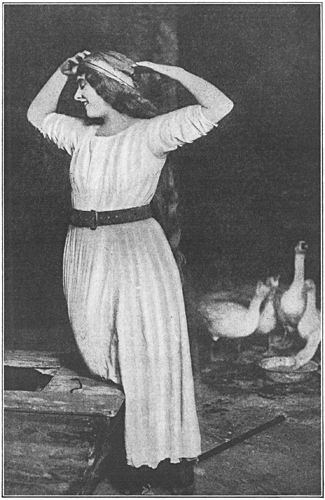
CHILDREN OF KINGS
I
Once upon a time, in a lonely glade between high mountains far, far above the World of Men, there stood a hut. It was a miserable, tumbledown, little hut, and the mosses of many summers clung to its sloping roof. It had a bent stovepipe where its chimney should have been, a slanting board in place of a doorstep, and just one, poor, little, broken window.
Yet it was not its forlorn appearance alone that made the hut hide behind the shadows of the grim forest, far away from the sight of man. It had more, much more than that to be ashamed of. For a hideous Witch lived there,—and with her, a Goosegirl.
They lived alone, those two,—the Goosegirl, with the joy of youth in her heart; and the Witch, unmindful of joy or youth, thinking only of magic and evil and hate. While the Goosegirl had been growing from babyhood to girlhood, from girlhood to womanhood, dreaming and wondering and wishing,—she knew not what,—the Witch had been trying to make her as ugly and as wicked as herself. But try as she would, the heart of the Goosegirl was so pure that evil could find no spot in it to lodge. As for her face, each passing year left it lovelier than the last. The sunshine was no brighter than her yellow hair, the sky no bluer than her clear blue eyes. The lone lily before the hut envied the whiteness of her skin, and the birch tree in the woods, the slenderness of her form.
Now it chanced upon a sunny afternoon in summer that the Goosegirl lay on her back in the long grass before the hut. Now and then she tossed a handful of corn to her quacking geese or played with a wreath of wild daisies. But her thoughts were far away. Her eyes were full of the wonder of things,—of the sun that shone, the brook that laughed, the flowers that bloomed, the birds that sang, and the blue sky over all. And her dreams were full of the World of Men, which she had never seen and to which she longed to go. Something within her whispered that happiness was to be found there, and the Goosegirl desired happiness above all things. And she desired kindness and love, too, although she had never heard of them, and did not know what they were.
As far back as she could remember, ever since she was a tiny little child, the Goosegirl had lived in the wretched hut. And the hideous Witch had been her only companion. The Goosegirl wondered whether all the people in the World of Men had such gruesome bodies, such ugly faces, such evil ways, as the Witch. She had never seen any one else, so she could not tell. For fear of the Witch no one had ever come that way. Winter and summer, summer and winter, it had always been the same.
The Goosegirl's dreams were suddenly interrupted by the hoarse voice of the Witch.
"Where are you, good-for-naught?" came from the doorway. "Idle, I'll be bound, when there's work to be done!"
The Goosegirl turned her eyes toward the figure of the Witch, and, familiar as it was, for the thousandth time she shuddered with disgust. The crooked back, the burning eyes peering out from under the tangled hair, the rags, the ugliness,—oh, must she always stay? She arose slowly and walked toward the door. With hands outstretched she begged the hideous creature to set her free and to let her go down to the World of Men to seek for happiness.
"I will never become a Witch," she implored. "Oh, please let me go."
The Witch's crooked mouth widened into a horrible smile. One yellow tooth stuck out.
"Not make a Witch of you, indeed! Wait and see! I'll bend your proud back!" Then brandishing her cane, she muttered savagely:
"Get to work. There's bread to knead!"
The frightened Goosegirl ran for bowl and flour, and set to work. Meanwhile the Witch took out some dark powders. She mumbled strange words over them, and while the Goosegirl, with busy hands but unseeing eyes, kneaded and kneaded and kneaded, the Witch poured the powders into the dough. Poor Goosegirl! Her bread was soon finished, but it was a foul-smelling bread, and it contained enough poison to kill a dozen men.
Soon afterward the Witch, chuckling fiendishly, took up her basket and hobbled away to the grim forest. But the Goosegirl, full of horror for the deed she had been made to do, sat motionless, staring straight ahead. Would her life never, never change? With a sigh she called to her geese and wandered back to her place in the grass. Ah, that there should be so much evil in such a beautiful world! She looked at the dancing shadows of the fluttering leaves. They were beautiful. There was beauty in the thin, blue line of smoke as it climbed lazily upward from the broken chimney. Two turtledoves cooed above her head. The sunlight shimmered upon the wings of the buzzing bumblebees and made them shine like gold. All, all was beautiful. Were people the only ugly things? The Goosegirl gazed toward the World of Men far, far below, and wondered.
Presently her fingers, wandering idly over the grass, found the wreath of daisies. Idly she placed it upon her head.
"Look at me, geese!" she cried. "Look at me! Am I ugly, too?"
With the geese at her heels, she ran swiftly toward the pool and peered earnestly into its clear depths. Her hair hung in long golden strands on each side of her face, her eyes shone like stars, her cheeks were flushed.
"Ah!" she exclaimed happily. "I am beautiful! Geese dear, I am beautiful, very beautiful!" And she gazed and gazed again.
Suddenly a song broke the silence. The Goosegirl started. For it was a song of youth and joy, the like of which she had never heard before in all her life.
Then, down from the mountains, out of the woods, straight to that lonely glade, came a youth, a ragged youth, but a noble youth, with a sword at his side, a bundle on his back, and a smile on his lips. His bearing was so proud, he looked so straight ahead, with eyes both fearless and true, that the Goosegirl held her breath as he halted before her.
"Hey, pretty Queen of the Geese," he said. "How goes the world with you? Have you no greeting for me?"
The Goosegirl continued to stare, saying nothing, her eyes wide with wonder. Finally she found her voice, and in a whisper just loud enough for him to hear, ventured timidly:
"Are you a man?"
"From top to toe!" exclaimed the youth, and laughed. How he laughed! He threw back his head, his white teeth gleamed, and the distant hills rang with the joyous sound. Even the Goosegirl was forced to smile at her own ignorance.
Such merriment soon made them the best of friends, and before long, seated side by side in the grass, the youth told the Goosegirl whence he had come and whither he was roving.
A King's Son was he, of noble name and fortune. High up among the mountains stood his father's castle, and there, amid the luxuries of the court, he had been reared. But when he had grown old enough to wander, the luxury had palled, the court life had fettered his free spirit. "Up and away!" cried a summons from within his heart. And so, while no one watched, he had stolen forth, with naught but a sword by his side, a bundle on his back, and a song on his lips. And he had wandered over the mountains, through the valleys, up and down, in and out, in search of adventure.
The Goosegirl heard the marvelous tale to the end. Then in faltering tones, but with shining eyes, she said slowly:
"Oh, that I might go with you!"
The youth smiled scornfully.
"King's Son and beggar maid!" exclaimed he, shaking his head. But as he looked into her face he stopped short.
The nobility of her expression, her simple beauty, drew him nearer. Ah! this was no beggar maid. There was something regal in the pose of that golden head, the glance of those clear blue eyes. What a companion she would make for now and forevermore! He forgot the rags, he forgot the geese, he forgot the hut.
"Have you courage?" he asked, gazing at her searchingly.
In answer she placed her hand in his. So he took off her wreath of white daisies and placed it within his jacket, close to his heart. And he opened his bundle and drew forth a golden crown, which he placed upon her head. Then crying:
"Up and away!" he led her to the edge of the grim wood.
At that instant, however, the sky began to darken with rushing clouds. Broad flashes of lightning blazed forth, thunder rolled, and the wind blew furiously through the trees. The geese flapped their wings in terror and gathered about the Goosegirl. She stood still, staring before her in fear. She was turned to stone. She could not move. Her feet were fixed to the ground.
"What makes you stand so still and stare?" cried the King's Son.
"Oh, I am afraid!" answered the Goosegirl. "I cannot go! I am bewitched!"
"Fear is but shame," declared the King's Son, angrily. "You have lied to me. You are not fit to wander with a King's Son. You are only a beggar maid, after all."
Then, overpowered by his wrath, he made ready to go, adding:
"Farewell. You shall never see me any more. No, never again, unless a star from heaven falls into the lily yonder." And pointing to the lone lily by the door of the hut, he rushed into the grim forest and was lost to sight.
II
The Goosegirl, saddened, disheartened, hid her golden crown and dragged herself wearily into the hut. The hideous Witch, returning with her venomous load, soon followed. And evening came. All was still. But for the thin column of smoke rising from the stovepipe one would not have known that any life was there.
Just as the golden edge of the moon peeped over the eastern mountain a loud song burst upon the air. And a moment later a Fiddler, clad in leather jacket and boots, appeared, emerging from the grim wood. He strode forth boldly as befitted an honest man who had nothing to fear. Seeing the miserable, tumbledown hut with its smoking chimney, he stopped.
"Ah, ha!" cried he. "Here's the journey's end." Then, looking back into the woods and waving his cap, he shouted at the top of his voice:
"Come on, Master Wood-cutter. Come on, Master Broom-maker. Here's the Witch's den. Come on!"
And Master Wood-cutter and Master Broom-maker came on. But how they came! They slunk out of the woods in fear and trembling, teeth chattering, knees shaking, eyes bulging. They took but one look at the tumbledown hut and then made for the nearest tree, behind which they cowered, shivering from head to toe.
"Not so loud! Not so loud! Master Fiddler, please. She may hear you," they protested.
"Ha-ha-ha! Ha-ha-ha!" laughed the Fiddler. "Don't you want her to hear you? What did you come for, then, pray tell me?"
And so he half dragged, half pushed, the two cowardly braggarts toward the Witch's door.
"You may knock first," said the polite Broom-maker through his chattering teeth to the Wood-cutter.
"No, indeed. You may have the honor," responded the Wood-cutter, and his knees knocked together as he bowed.
Since there was no way out of it, the Broom-maker moved toward the door. He tapped once with the knuckle of his forefinger, gently, like a little mouse. Then in a wee, small voice, he said:
"Good wife, won't you buy a broom?"
No answer came from within the hut.
Emboldened by the silence, Master Wood-cutter joined his comrade at the door of the hut. Then he, too, rapped a little bit, just like a penny hammer.
"Most honored wise-woman!" he whispered.
But no answer came. All was as still as before.
"There's no one at home," said both at once. And they strutted boldly to and fro, grinning from ear to ear.
"Stand aside!" said the Fiddler.
He pushed them away and strode toward the door. With his clenched fist he banged once, twice, thrice. And he lifted his voice. My, what a voice it was! The very woods rang with the sound of it.
"Witch! Hag! Foul woman!" he shouted. "Open the door!"
There was a moment's silence. But presently the door creaked on its rusty hinges, and there stood the Witch, in all her ugliness, leaning upon a cane.
The Wood-cutter and the Broom-maker gave her one glance and then, stricken with terror, they fled as fast as their legs could carry them to the first tree. There they waited, trembling and quaking, to see what the dread creature would do. They would not venture out, no, not they. They had wives and children to care for, and it was no business for men of their kind. No, indeed!
Meanwhile the Witch was croaking in her awful voice:
"Who comes here to my hut in the woods? Hey, fellows, what do you want?"
"What do I want?" mocked the Fiddler, who had bravely stood his ground. Looking at her calmly, he dropped on one knee, with a comical smile:
"Ah, fair dame, those red, red eyes and that one yellow tooth of yours have made me sick with love and longing. Listen to my suit, I pray."
The Witch looked at him in surprise as he rose to his feet. Could it be that he was not afraid of her? He looked her straight in the eyes, fearless and brave. So she scowled. He smiled. She shook her cane. He laughed. Well! Well! Her magic was powerless against a man like that. Let him tell his tale and be gone.
So it came to pass that the Fiddler called the Wood-cutter and the Broom-maker and bade them state their business. But they bobbed and scraped and hemmed and hawed and chattered and giggled so long that the Fiddler had to come to the rescue.
The King of the World of Men had died, and since the King's Son had run away and could not be found, there was no one to rule the town of Hellabrun. So the people had sent the Wood-cutter and the Broom-maker to ask the Wise-Witch what was to be done. They wanted a ruler straightway and did not know where to find one.
The Witch pondered long, frowning savagely. Then she told the Wood-cutter and the Broom-maker to go back and tell the people that the first person who knocked at the town gate at noon on the morrow would be worthy to wear the crown.
Pleased with this prophecy the Wood-cutter and the Broom-maker hurried away through the grim forest toward the town of Hellabrun in the World of Men.
But the Fiddler did not go. He had caught a glimpse of a golden head and a pair of blue eyes at the window; and the sight of one so fair in such a hut told him that there was work for him to do here.
"Why do you stay?" snarled the Witch. The Fiddler gave her a sharp glance.
"I'm setting a snare for the little golden bird that you keep in the hut."
The Witch started. She clenched her fist wrathfully, but her eyes fell before his steady glance.
"Let out the golden bird," sang the Fiddler, cheerily, "or I will go in, I will go in."
The Witch looked this way and that. She could not meet his eyes. Muttering savagely, she hobbled toward the door. A moment later she dragged forth the trembling Goosegirl.
The Fiddler was amazed. Such beauty! Such pride! She was fit to sit upon a throne!
"Who are you, maiden?" he asked. "And how came you here?"
Slowly and sadly the words fell from the Goosegirl's lips. She knew not who she was. The Witch had told her to call her "Grandmother." More than that she could not say.
The Fiddler's eyes traveled from the Goosegirl to the hideous Witch and back again. This fair maid kin to that foul creature! No, no, it was not possible.
As if divining his thought, the Witch wagged her head maliciously and sneered:
"No, she is no kin of mine. But worse, far worse. You may know all. A hangman's daughter is she; that's it, a hangman's daughter."
"It is not true," shouted the Fiddler. Then turning to the weeping Goosegirl, he cried:
"Believe her not. Look at your hands, girl, your white, white hands, and your hair, your golden hair. There's nobility in your face. Believe in yourself, and you will sit beside the King's Son on a throne. Be not afraid. Pray, girl, pray!"
The Goosegirl fell upon her knees and lifted her eyes to heaven. Her voice rose from the depths of her being and cried out to the mother and father whom she had never seen. Her golden hair covered her like a mantle, her face was radiant. Still kneeling, she held her crown of gold toward heaven and prayed to God for help, for guidance, for strength. And as she prayed, a shining star shot from heaven, downward, downward, straight into the lone lily by the door of the hut.
The Goosegirl uttered a cry of joy. Putting the crown upon her head, she arose, exclaiming:
"I'm free! I'm free! I'm free!"
Then, followed by her geese and the Fiddler, she rushed into the grim wood toward the World of Men.
III
When morning dawned and the grim wood with all its terrors lay behind the King's Son, he came at last to the town of Hellabrun in the World of Men. Weary and footsore, faint from hunger and thirst, yet dauntless still, he stopped before an inn near the town gate and begged for work.
"I would earn an honest penny," he said, "to buy my daily bread. Have you any work for me?"
The innkeeper, who was a rough, ill-natured fellow, smiled with contempt as he looked upon the white hands and noble face of the youth before him. So he declared gruffly:
"All I need is a swineherd!"
"A swineherd!" The voice of the King's Son echoed the loathsome word, while a look of disgust overspread his face. But only for a moment; then, quick as thought, came the vision of the Goosegirl, so sweet and fair despite her humble calling. "All work is noble to those that are of noble mind," thought he. His hand stole to his heart and touched the wreath of white daisies there.
"I will be your swineherd," he answered sturdily.
Then he seated himself beneath a tree to await the orders of the innkeeper.
Now it happened to be a day of great excitement in Hellabrun, and as the morning wore away, a chattering, restless crowd of people—men, women, and even little children—assembled in the market place. With eager eyes they scanned the two soldiers who, armed with long spears, stood on guard before the closed and barred town gate.
There were lean men and fat men; men in rich clothes and men in rags. There were tinkers and tailors, soldiers and sailors, and their wives and their sweethearts. Here were wise doctors in black gowns, there gray-bearded counselors leaning upon canes. Wee babes in arms crowed and laughed, boys romped, girls danced. And all awaited the noontide hour and the coming of their King.
"Will he ride upon a snow-white charger?" asked one.
"Nay, he will be carried aloft, seated upon a golden throne," replied another.
"His robes will be of richest velvet," said a third.
"And a jeweled crown will be upon his head," said a fourth.
"Perhaps a beautiful queen with ropes of pearls about her neck will sit upon the throne at his side," ventured a fifth.
"Tell us again what the Wise-Witch promised," called one from the crowd to the Wood-cutter and the Broom-maker, who were strutting proudly to and fro.
Nothing loath, Master Broom-maker and Master Wood-cutter pushed their way to the front of the admiring crowd. Then they stood with heads high, chests stuck out, feet wide apart and arms waving, and told their story for the fiftieth time. And since with each telling the story had grown and grown, it was a marvelous tale, indeed.
They told of the grim forest and the many dangers through which they had passed before they arrived at the Witch's den.
"The woods were full of lions and tigers," said the Wood-cutter.
"But I felled every one with one mighty blow of my broom," said the Broom-maker.
"And an ogre with fiery eyes sat behind each tree; and a dragon snorting steam held guard before the den of the Witch. But we feared them not. We slew them all. We went so boldly forward that the Witch quaked and hid herself in fear when she saw us coming."
"'Tis not truth that you speak," cried out a young voice, and the crowd fell back amazed at the sight of the King's Son. Who was this ragged fellow who dared to interrupt the thrilling story? Down with him! And they beat him with their sticks and pelted him with stones and called him names. But just as they were about to drive him from the market place the town clock struck the hour.
A sudden hush fell upon the crowd. The people stood still. With eager, expectant faces turned toward the gate they waited, while the bell pealed forth its twelve long notes. Ding-dong! Ding-dong! Ding-dong!
It was noon!
The guards pulled out the long bolts. An excited murmur came from the crowd. Then all was still, as still as before. The guards turned the huge knobs. The door swung on its hinges, and there stood—a Goosegirl and her flock of geese. Her feet were bare. Her dress was tattered and torn. But her shining hair covered her like a mantle, and a golden crown was upon her head. Her cheeks were red. Her eyes, glowing as from an inner light, sought among the sea of faces, and found that of the King's Son alone. Then, with arms outstretched, she walked slowly toward him, crying softly:
"I have come to be your Queen."
Queen! The breathless crowd stared in amazement one moment longer. Then the amazement gave way to laughter, the laughter to anger, the anger to fury.
"Ha-ha-ha! This is no queen!" they shouted angrily. "We have been fooled. This is only a Goosegirl. Strike her! Beat her!"
The King's Son enfolded the Goosegirl in his arms.
"Stop!" he cried to the mob. "I am a King's Son, and she is my Queen."
"Listen to the ragged fellow!" shouted the people. "He says he is a King's Son! Ha-ha-ha! Stone them! Hit them! A Swineherd! A Goosegirl! Drive them out! Out! Out!"
And so the King's Son and the Goosegirl were driven away from the town of Hellabrun, and the angry people returned in disappointment to their homes. Only one little pure-hearted girl lingered at the town gate and gazed with eyes of faith after the fleeing pair. When she could see them no longer, she fell upon the ground and wept and wept.
"Why do you cry, little girl?" she was asked.
"Oh, that was the King," she sobbed—"the King and his bride."
IV
During all the long summer days the King's Son and the Goosegirl wandered over hill and dale, through field and forest, far away from the World of Men. And the King's Son shielded the Goosegirl with his love and brought her berries to eat and the skins of wild animals to rest upon, and was gentle, oh, very gentle! And the Goosegirl made the King's Son glad with the sight of her beauty and the sound of her light-hearted laughter. And they were happy with a happiness that surpassed all that they had ever felt or dreamed.
But then autumn came. The wind moaned piteously through the trees, driving brown leaves in whirling gusts before their eyes. Winter followed, covering the grim woods with a mantle of shining white. Their clothes were thin. Their feet were bare, and it was cold—bitter, bitter cold. So they wandered on and on, day after day, until at last, faint with hunger, sick with despair, they came, all unknowingly, to the lonely glade between the high mountains where the Witch's hut stood.
The hideous Witch was no longer there. Because they believed she had prophesied falsely, the infuriated people of Hellabrun had burned her at the stake. Only the Broom-maker and the Wood-cutter were in the miserable tumble-down hut; while out in the grim forest were the Fiddler and the one pure-hearted little girl, seeking, ever seeking, with eyes of faith for the rightful King and Queen.
With steps that faltered, and eyes half closed, the King's Son and the Goosegirl crept into the glade. Tottering feebly, hand in hand, they approached the door of the hut, and knocking, begged for shelter, for food, for drink.
The face of the Wood-cutter appeared at the window for a brief moment. Blinded by his distrust, he saw only two beggar children before the door.
"Away with you! We have naught to give," he shouted as he slammed the broken shutter.
Hopelessly, sadly, the King's Son bore the Goosegirl to the snow-covered mound beneath the linden tree. Whither could he turn to get his loved one food? Ah, foolish, foolish King's Son who would not rule, who could not beg!
The Goosegirl, clinging to him tenderly, felt his despair, saw his eyes fill with tears. Crying out that she was not ill, but was well and strong, she rose to her feet. To cheer him, she tripped lightly to and fro, singing a gay little song. Faster and faster twinkled her little feet, brighter and brighter grew her smiles. But weaker and weaker became her voice, paler and paler her face, until she fell, fainting, into the snow.
Then the King's Son rushed to her and took her in his arms. He wrapped his cloak about her and carried her back to the mound. She opened her eyes and smiled.
"King! My King!" she whispered.
Like a flash the King's Son remembered his crown. He opened the bundle and took it out.
"Do not sell your crown, O King!" murmured the Goosegirl.
"I will! I must!" replied the King's Son. "It will bring you bread."
He arose hastily, broke the shining crown into pieces, and ran toward the hut.
Rap! Rap! Rap! "Let me in!" he cried impatiently.
"Do you want to break down the door?" replied the Broom-maker, appearing at the window.
"I care not," answered the King's Son. "Here is gold. Now will you give me bread?"
Gold? The greedy eyes of the Broom-maker gave the glittering fragments one glance. Then he called the Wood-cutter. And they whispered, and they searched all through the miserable hut until they found the poisoned bread, the foul-smelling bread, which the Goosegirl had made as the Witch had directed on that bright summer day long, long ago.
With it in their hands they ran to the window. They handed it to the King's Son, and he gave them gold, his golden crown, in its stead.
The King's Son snatched the loaf and ran joyfully toward the mound and fell at the Goosegirl's feet, crying:
"I'm bringing bread, dear one! bread! Take it! Eat it!"
"Not I alone," answered the Goosegirl. "You, too."
So they broke the bread in two, and, laughing happily, they ate it eagerly. They ate it all to its bitter, bitter end. Then, clasped in each other's arms, they lay down to sleep and dreamed of rosy clouds of glory wafting them toward sunny lands of everlasting bliss; and dreaming, slept and—knew no more. And the snowflakes fell softly, silently, and covered them with a shining robe of fleeciest white.
A little later, the Fiddler and the little pure-hearted girl, followed by a troop of children, entered the glade, all seeking, still seeking with eyes of faith, for the rightful King and Queen. As they approached the snow-covered mound the snow suddenly ceased falling; and the sunset glow from the west shone down and revealed the Kingly Children asleep forevermore.
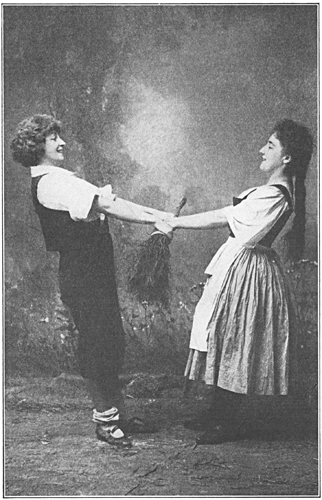
HAENSEL AND GRETEL
I
Long ago, in half-forgotten days, a little hut stood at the edge of a great forest. It was rather a meek, shamefaced little hut, for the forest was great and beautiful, and the hut was small and ugly. Still, it had a glowing fireplace inside, and a brick chimney on top, and it was somebody's home, which—after all—is the principal thing.
A broom-maker named Peter lived there with his wife Gertrude and their two children, Haensel and Gretel. The broom-maker was poor, oh, very, very poor, and that is why his home was not beautiful to see. But he was an honest, upright man who loved his family, and had he been able, I am sure, he would have housed them in a marble palace. Unfortunately, however, the broom-making business had been unusually poor that year.
Indeed, on the very day that our story begins, Peter and his wife were both away from home in quest of work, and only Haensel and Gretel were to be seen inside the hut.
Lest you should not know, it might be well to mention that Haensel was the boy. He was busily engaged—or, at least, he was supposed to be—in making brooms, while Gretel, the girl, had her knitting in hand. But it was extremely difficult to keep their thoughts or their eyes, either, upon such stupid work. Each breeze that blew in through the open window brought an invitation from the fascinatingly sunlit grassy spot before the door. Even the trees in the forest beyond beckoned to them with their tall branches.
Besides, there was another cause for rebellion on that particular afternoon. To tell the truth, the children were hungry. Moreover, since there seemed to be absolutely nothing in the house to eat, it was quite likely that they would remain hungry, which was the worst part of all.
Haensel, after the manner of boys, threw his work into the farthest corner of the room and fairly shouted:
"I just wish Mother would come home! I'm hungry, that's what I am. For a week I've eaten nothing but bread, and little of that. Oh, Gret, it would be such a treat if we had something good to eat!"
Now Gretel, as it happened, was every bit as hungry as he, but, after the manner of girls, she sought to comfort him.
"Don't be an old crosspatch," she said. "If you'll stop complaining, I'll tell you a secret. But you must smile first!"
Haensel smiled.
She went on:
"Do you see that jug over there on the table? Well—it's full of milk. Somebody left it here. And if you're good, Mother will stew rice in it when she comes home."
Haensel had heard such stories before.
"Don't believe it," said he. "It's too good to be true."
Nevertheless he went to see. And when his eyes assured him that what was in the jug really looked like milk, he was overcome with the temptation to find out whether it tasted like milk, also. First he gave a sly glance at Gretel and then down went his forefinger into the jug!
"Haensel! aren't you ashamed, you greedy boy? Out with your finger!" For Gretel had caught him in the act.
"Get back to your work in a hurry, for you know if Mother comes before we've finished, there'll be trouble."
Haensel, however, was not inclined toward work that afternoon. In fact, he was in a very rebellious mood, altogether.
"Don't let's work," suggested he. "Let's dance."
Now you must remember that Gretel was only a little girl with twinkling feet that loved to dance and a merry voice that loved to sing. So do not judge her too harshly, even though she quickly dropped her tiresome knitting.
Their wooden shoes—for they were the style in those days—clattered over the board floor; they clapped their hands, their childish voices rang out, and they had, all in all, a most beautiful time. They forgot their empty stomachs; they forgot their aching fingers. Gretel, who was clever in such things, taught Haensel some new steps. And he, less awkward than usual, learned them so quickly that Gretel praised him for his aptness. Her words made him as proud as a peacock. He seized her hands in both of his own. Round and round they whirled, faster and faster, until suddenly, losing their balance, they fell, laughing loudly, in one heap on the floor.
And then—the door opened.
"Gracious goodness!" they cried. "It's Mother!" And up they jumped in double-quick time.
Yes, it was Mother, and an angry Mother at that.
"What does this mean?" she exclaimed, "all the noise and clatter? Where is your work, you good-for-nothing children?"
The children, half penitent, wholly frightened, looked at each other. Haensel blamed Gretel, Gretel blamed Haensel.
The Mother blamed them both. She scolded, she raged, she brandished a stick, and I confess I am afraid to think of what her anger might have led her to do next. But just at that moment, in her excitement, she gave the milk jug a push, and down it went, breaking into a thousand pieces, with the precious milk running in little streams all over the floor. That was the last straw! What was there left to be cooked for supper?
The furious woman snatched a basket from a nail on the wall. She thrust it into Gretel's hand.
"Off with you both to the wood!" she cried. "And hurry up, too! Pick strawberries for supper! If the basket isn't full, you'll get a whipping. Yes, that's what you'll get." She shook her fist to make the admonition more impressive.
Scarcely had they gone, however, when the woman, completely exhausted, sat down by the table and began to weep and moan. You see, she was really not an ill-natured woman at all. Poverty had embittered her, and the mere thought that her children might be starving, caused her to lose entire control of her feelings. It had been a long, wearisome, and disappointing day, and now, even at its end, her own irritability had caused another calamity. Angry with herself, the world, and everything, she rested her head on her arms and sobbed herself to sleep.
Do you know the old verse, "It is always darkest just before dawn"? Now, if the mother had been patient only a little longer, all would have been well. But then there would have been no story to tell.
The mother was still sleeping when the father came home. He was singing joyfully, and he awoke her with a kiss.
"See," he cried happily, "my brooms are all sold. There was a festival in the town to-day, and every one must needs be clean. Such a sweeping and a dusting and a cleaning! I drove a roaring trade, I tell you. So, here's butter and eggs and ham and sausage. And tea, too. Hurry up, good wife, and get supper ready!"
The mother packed away the things. She lighted the fire. She hustled and bustled about. Suddenly the father, missing the children, inquired:
"Where are Haensel and Gretel?" He went to the door to call.
"Don't call," answered the mother. "They were naughty, and I sent them to the woods in disgrace."
"The woods!" exclaimed the father, and his voice was full of horror.
"It is growing dark," he said, "and my children are in those gloomy woods without stars or moon to guide them! Don't you know that there is enchantment in those woods? Don't you know that the Witch walks there?" His voice sank to a whisper.
"Which witch?" asked the woman, thoroughly alarmed.
"The Crust Witch, the gobbling Witch! She who rides on a broomstick at the midnight hour, when no one is abroad, over hill and vale, over moor and dale!"
"Oh! Oh! Oh! but what does she gobble?"
"Have you never heard? All day long, she stalks around, with a crinching, crunching, munching sound and lures little children with gingerbread sweet. She lures little children, the poor little things, into her oven, all red-hot; then she shuts the lid down, pop, pop!—until they're done brown."
"Oh, horror!" cried the mother, wringing her hands. "Oh, what shall we do?"
"Go seek them!" said the father.
And in another moment without hats, shawl, anything, they had run out of the hut.
II
The sunset glow lighted the forest. It bathed the stately trees in rose and gold. It shone on the cool carpet of leaves and wild flowers, and played with the garlands of bright-colored vines.
But the purple mist of twilight that hung over the distant fir-colored hill sent gray shadows down. They crept behind the hedges and bushes, warning the birds, the bees, and the flowers that night was drawing nigh.
One lingering ray of sunshine lit the mossy rock upon which Gretel sat. She was weaving a wreath of wild flowers and singing a little song, while Haensel ran hither and thither, filling his basket with red strawberries.
So, if you have imagined that they were at all unhappy, you see you were quite mistaken. Indeed, they were entirely, wonderfully, breathlessly happy. I doubt if they gave their mother's scolding a single thought. As for their home, they had quite forgotten all about it, which, for aught I know, may have been part of the enchantment. At any rate, they had never had a better time.
When Haensel's basket was full, Gretel's wreath was finished. So they played at being king and queen of the wood, and Gretel wore the wreath, and Haensel knelt in homage before her, presenting her with the basket of berries. Whereupon, as a reward, she gave him some of the ripest ones to taste. Soon tiring of this they went on to another game. A cuckoo called from a tree near by, and they imitated his call, seeking each other behind tall tree trunks. But saddest of all to tell, they ate the strawberries while they played—yes, every single one.
When they attempted to find fresh ones, they discovered that it had grown too dark. There were black shadows under the hedges and bushes now. A gray blanket of clouds was spread over the sky.
Then fear came. For they could not find their way. Gretel saw strange figures glimmering behind the birches. She saw strange faces grinning at her from every mossy tree stump. Now it was Haensel who sought to comfort her. A mist arose and shut them in. Advancing dimly through it, they spied a lantern. Haensel said it was a will-o'-the-wisp. They heard a call. He said it was the echo.
When Gretel began to whimper and cry, Haensel held her fast in his arms. But the shadows of strange things continued to nod and beckon. One shadow grew and grew and grew. It moved toward them, and both children cowered down in fear. Their eyes never left it.
Suddenly the shadow took shape, and there stood an odd little gray man. He had a long white beard. He leaned on a staff, and he carried a sack on his back. Strange to say, the moment that the children saw his calm smile and his friendly gestures they were not afraid any more. He came toward them, chanting a quiet song about restful sleep and happy dreams. Before they knew what he was about, he had sprinkled sand into their tired eyes. Then Haensel and Gretel folded their hands and sleepily whispered their evening prayer. With their arms about each other's necks they sank slowly into the soft moss and soon were fast asleep.
The little man disappeared as he had come, into the mist. But the mist became roseate. It rolled itself into a fleecy cloud, which mounted higher and higher until it touched the sky. What magic was this? It changed again into a marvelous golden stairway! And down the stairway floated beautiful guardian angels with dazzling wings and golden wands. They grouped themselves about the sleeping children, at their heads, at their feet, all about them. Waving their golden wands, they sent down showers of wonderful dreams. Oh, such gleaming, glistening, unutterable dreams!
III
Scarcely had the sun peeped over the eastern horizon than the Dew Fairy came fluttering into the woodland. Her wings were tinged with the first blush of dawn and her garments were tipped with rosy light. She carried armfuls of bluebells, and as she flitted lightly about, sweet music rippled on the air. How she smiled when she saw Haensel and Gretel asleep under the tall fir tree!
"Up, ye sleepers! Awake! Awake!" she sang. Then, sprinkling dew from the bluebells into their eyes, she vanished into the sunlit air.
Gretel rubbed her eyes sleepily and raised herself from the moss. Was she still in the beautiful greenwood? Ah, yes, she must be there. For birds were merrily chirping overhead. There were glimpses of bright blue sky between the leaf-laden branches.
"Wake up, lazy bones!" she called to Haensel.
He jumped up with a start, stretched himself, yawned once or twice, looked about. Oh, the wonderful, wonderful forest!
The sun had mounted higher in the sky. The woods were filled with a mellow radiance. The morning mists had cleared away. And, most astonishing of all, on the very hill so lately hidden by dark trees and fleecy clouds, they beheld a most entrancing sight.
A house stood there. But such a house! It was as beautiful—as beautiful,—in short, I am afraid to tell you how undescribably beautiful it was. The walls were of sweetest sugar candy, glistening like diamonds in the sun; the roof was of chocolate cake, all soft and creamy; and the gables were ornamented with raisins, like little eyes. On one side there was a strange-looking cage; on the other, a huge, strange-looking oven; and both were joined to the house by a fence made of the daintiest gingerbread figures imaginable.
"Oh," cried Haensel, "did you ever see anything so wonderful?"
"No, I never did," answered Gretel. "A princess must live in that."
They stared and stared, while their mouths watered and their fingers itched prodigiously.
Haensel wished to go boldly inside, but the mere thought of doing anything so rash frightened Gretel.
"Well, the angels led us here," reflected Haensel.
"Ye-es, that's true, they did," conceded Gretel.
"Come on. Let's just nibble a little bit," tempted Haensel.
And so, hand in hand, they hopped along, like two little mice, toward the magic house. Then they stole cautiously forward on tiptoe, until, at length, they were within reaching distance. Haensel's hand went out. He broke off a bit.
Quick as lightning came a squeaking voice from the inside:
"Nibble, nibble, mousekin, Who's nibbling at my housekin?"
Haensel started back in fear.
"'Twas only the wind," said Gretel. "Let's taste it."
They did. Since it tasted better than anything they had ever eaten before, they feasted merrily for a while, never heeding the voice of the Witch or her ugly form, either, which, a little later, appeared at the door. I have no doubt that they would be feasting yet, if the Witch had not then and there stealthily stolen upon them. With a deft movement she threw a rope about Haensel's neck and held him fast.
The children's delight turned to terror. For she was a loathsome sight to see. Bent, toothless, with unkempt hair and clawlike hands, she looked the picture of a Witch indeed.
In spite of her appearance, however, she spoke to them in a very kindly manner. She called them pretty names, told them that they were nice and plump, and that they would make excellent gingerbread. She even caressed Haensel, which made him very angry. Wriggling and squirming, he managed to loosen the rope and seizing Gretel by the hand, ran—alas! only a short distance. For the Witch, holding aloft a juniper branch, circled it in the air, repeating these strange words:
"Hocus, pocus, witch's charm, Move not, as you fear my arm!"
The children stood stock-still. They were stiff from head to toe. Fortunately, by this time they had undergone so many strange adventures that they had learned fairly well how to conduct themselves.
"Watch carefully all she does!" whispered Haensel, as the Witch led him away to the cage and gave him nuts and raisins to fatten him.
"I will," said Gretel.
Therefore, when, a few moments later, the Witch disenchanted her in order that she might prepare the table, Gretel listened attentively to the words:
"Hocus, pocus, elder bush, Rigid body, loosen hush!"
No sooner had Gretel run into the house than the Witch was seized with a fit of wild joy. She thrust more fagots into the fire, laughing wickedly when the flames flared higher and higher. She mounted her broomstick and rode about, shouting a weird song.
Gretel watched her from the doorway. That broomstick ride gave her an opportunity. She stole to the cage, and, whispering,
"Hocus, pocus, elder bush, Rigid body, loosen hush!"
she set Haensel free. But he did not move. No, not yet.
For the Witch had come back. She was rubbing her hands with glee. Her face wore an evil smile. Oh, the fine meal she would have! Haensel was not plump enough. Gretel must be eaten first. So, opening the oven door, she called Gretel and told her to look inside. But clever Gretel pretended not to understand. Would not the Witch show her how? Angry, impatient, muttering to herself, the Witch crept nearer to the oven, and when she was about to bend over it, Haensel and Gretel gave her one good, hard push from behind. She toppled over and fell in. Bang! bang! went the door. She was safe inside.
How the fire crackled and roared. A moment later there was a great crash and the oven fell to pieces. Haensel and Gretel, much terrified, started to run away, but found themselves, to their great surprise, entirely surrounded by a troop of little children.
"It's the fence," exclaimed Haensel, "the gingerbread fence!"
And so it was. The gingerbread had fallen off, and real children stood there, motionless, with closed eyes, murmuring softly:
"Oh, touch us, we pray, That we may all awake!"
"Pooh! if that's all they want!" said Gretel, proudly, and she repeated:
"Hocus, pocus, elder bush, Rigid body, loosen hush!"
Instantly life came back to the whole troop. They hurried toward Haensel and Gretel from all sides. They danced, they sang! Two boys ran to the oven and dragged out the Witch in the form of a big gingerbread cake. Then the merrymaking began in earnest. They made a big circle, and round and round it they danced. Last but not least, they ate up the candy house. At any rate, that is what they were doing when their mothers and fathers found them there that afternoon.
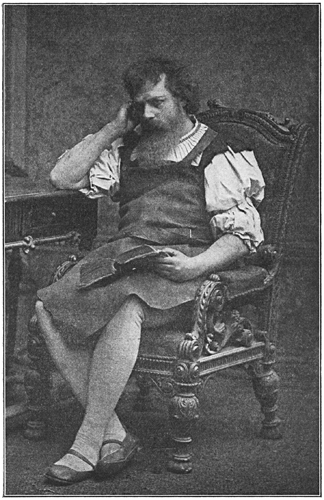
THE MASTER SINGERS
I
Across the wide sea, amid the green hop fields of southern Germany, is the old, old city of Nuremberg. Shut off from the busy world outside by its great wall of stone, it has stood unchanged through all the passing centuries. There are the same narrow, crooked streets leading to the public squares, where quaintly carved stone fountains stand. There are the same many gabled, lofty houses, with oriole windows that open outward. There are latticed doorways with plaster figures that beckon and bless and welcome. And the gray castle, the grass-grown moat, the dark, pillared church, all tell stories of the days of long ago.
In those days men dreamed dreams and sang songs as they sat on the bench or in the market place. The cobbler at his last, the baker before the oven, the silversmith by the fire, even the little apprentice, watching and learning, looked out upon a fair world and found it good. So while hands were busy, thoughts roved far and wide, and fancy wove many a song to sing by the fireside on wintry nights.
But not only by the fireside were those songs sung in the days when Nuremberg was young. The good people there prized the Art of Song too highly for that alone.
"Though a man's lot be humble," they said, "his thoughts may be rich in fancy; he may have a song to sing." So they formed a guild devoted to the cultivation of poetry and music, and the members of this guild were called Master Singers. Every man who wished to enter the guild was obliged to write some verses,—according to the rules of the guild; and to compose appropriate music for those verses,—according to the rules of the guild; and, finally, to sing them both together,—according to the rules of the guild. Then if the masters approved of his performance, he became one of the Master Singers of Nuremberg. And great was the honor conferred upon him when he reached this high estate! Many had tried, but few had been chosen. Indeed, the entire guild was composed of but twelve members. These were, for the most part, worthy men, devoted to their trades and to music. And each one had a boy apprenticed to him, to whom he taught cobbling or soap-making or baking or tailoring by day, and the Art of Song by night.
Among the Master Singers of Nuremberg none is better remembered than Hans Sachs. He was a cobbler by trade and a poet by nature, and his songs and verses have outlived his boots by many a year. It is of his part in a song festival of the Master Singers hundreds of years ago that our story has to tell.
II
It began on the day before the feast of St. John in St. Catherine's Church, which was really not the proper place for a love affair to begin at all. But what did Eva Pogner or Sir Walter von Stolzing care for that? The only thing that mattered to them was the joyous Springtime which had stolen in through the open chancel window and had warmed their hearts toward everything in the world,—but most of all toward each other.
Sir Walter stood leaning against a great stone pillar at the back of the church. He wore a blue velvet suit, his hat had a long white plume, and he was as handsome a young knight as one could ever wish to see.
Pretty Eva sat in the last pew with her maid Magdalena by her side. Her head was bent, and her eyes were upon her prayer book, as befitted a modest maiden. Still she saw Sir Walter very plainly. In fact, somehow, she caught every message that his dark eyes sent across the church. And her cheeks turned rosy, and her heart grew warmer than ever the Springtime had made it. Indeed, those glances so confused her that she lost her place in the hymn book. Magdalena noticed it and nudged her mistress sharply. So Eva sent one glance back to the fascinating young knight, just a little frightened one; and then she joined in the closing hymn. But when she lifted up her joyous young voice and made it ring high above all the rest, Sir Walter stared harder than ever.
The young knight had loved this light-hearted maiden since he had first seen her in her father's house. And his only wish was to win her for his bride. But how? Suppose she were already promised to some one else!
While these mingled thoughts of joy and doubt possessed him, a ray of sunshine crept into the dark church. It lingered on Eva's head, making a halo of her golden hair. A moment later he saw two eyes, mirroring some of the sky's own blue, dart him a shy glance. And he heard a voice so sweet that he was sure the angels themselves stood still to listen. Come what might, thought he, he would speak to her that very day.
The service was over. One by one the people filed slowly between the dark pillars, and out of the church, into the bright sunshine. Only Eva and Magdalena lingered, smiling and chatting with friends and neighbors as they walked slowly along. As they approached the pillar behind which Sir Walter stood, he stepped forward. The long, white plume of his hat swept the floor as he bowed in greeting.
"One word, my fair maid, I entreat," he began.
Strange to say, the moment Eva heard his voice she discovered that she had forgotten her handkerchief. Perhaps it was in the pew. Magdalena must return for it.
Then, with the maid safely out of hearing, Eva turned her mischievous face to Sir Walter. She was ready to listen, so he spoke. Did Eva look upon him with favor? Might he hope? Scarcely were the words out of his mouth, when Magdalena was back again, handkerchief in hand.
"Come, Eva," she said; "it is growing late."
But Eva was in no hurry, with this gallant cavalier close at hand. Perhaps he wished to tell her a beautiful story. Had Magdalena seen her scarfpin? It was gone. Was it there on the floor?
"Good Lena, go back and find it," said the artful Eva.
And Lena went back, grumbling, and searched here, there, and everywhere.
Meanwhile Sir Walter improved his opportunity. The words hurried to his lips. He begged Eva to tell him whether light and happiness, or gloom and doubt, were to be his portion.
The answering words were trembling on Eva's lips ready to be spoken. But there stood the ubiquitous Magdalena again, with the scarfpin!
"We must go home," she said. "Come. Here's your kerchief and your pin. But where's my prayer book? Oh, alackaday! I've left it in the pew!"
Back she bustled once more.
These interruptions served to make Sir Walter more impatient than ever. Would he never be able to make love in peace? He took a long breath, leaned forward, and whispered eagerly: "May I hope? Or are you promised to some one else?"
And for answer, while Eva hid her eyes for fear they would tell of her love too soon, there was Magdalena again!
"Yes, Sir Walter," said Magdalena, and she curtsied low, wishing to be most polite to this handsome young man.
"Yes, Sir Walter," she repeated. "Our Eva is betrothed."
Betrothed? Sir Walter was stunned into silence; misery spread itself like a black cloud over his face. Nor did the reply please Miss Eva, either. She quickly interrupted, saying:
"But no one knows who the bridegroom will be. No, not until to-morrow."
Sir Walter knit his brows. That was amazing! Was it a puzzle? What did it mean?
Eva and Magdalena hastened to explain. After all, it was very simple.
Out in the meadows near Nuremberg a song festival was to be held to-morrow. It was to be a great singing match. And Eva's father had promised part of his fortune, and his daughter besides, to the singer who should win the prize. Eva herself was to crown the victor with a wreath of laurel. "But," they continued, "he must be a Master Singer. No one may even try for the prize who is not a member of the guild."
"Are you not a Master Singer, Sir Walter?" inquired Eva, timidly, and it was plain that she wished with all her heart to hear him say yes.
Poor Sir Walter! Until that moment he had never heard of the Master Singers. As for the song contest, he never even knew that there was to be such a thing. What was to be done? Could no one help? Walter was in despair, and Eva, who by this time knew the man she wished to marry, was on the verge of tears.
A shaft of light streamed across the church. The door was opened, then closed with a bang. A youth ran in hastily. He noticed no one. He wore a businesslike air, as he hurried this way and that. He was David, apprentice to Hans Sachs, the shoemaker.
From the expression on Magdalena's face when she saw David, it was easy to see how matters stood! Her heart was affected, too, and David was the cause. She looked at him admiringly a moment, then gave a little cough. David started. He hastened toward her, smiling and holding out his hands. Ah! it was his own true love, Lena! But she must not detain him. He was busy. There was to be a trial meeting.
"A trial meeting!" exclaimed Magdalena, joyfully. "Just the thing!" Now the handsome knight would have a chance. She beamed happily upon David. "You must explain everything to him!" she cried, and whispered the directions eagerly.
But Mr. David was stubborn. He had no time. There was the platform to be set, the curtains to be hung, the chairs and the benches to be arranged. And it was late.
"David, dear David," coaxed Lena, with her face close to his, "if you'll help Sir Walter to become a Master Singer, I'll bring you a basket full of the best things you ever ate."
And before David had time to refuse, the clever Lena had seized Eva's hand and had hurried with her from the church.
Scarcely were they gone, than with a great shouting the jolly apprentices danced into the church. They hopped and skipped about, joking and laughing, as they made ready for the meeting. They pulled one another's hair, they played leapfrog over the chairs, they pushed, they shoved, but they worked, too, and in a twinkling the church was transformed into a meeting place. There stood the marker's platform, for all the world like a great box, with black curtains on all four sides. To the right of it were the benches for the masters, and in plain view of all was the great chair for the candidate.
Sir Walter had, all unconsciously, seated himself in the great chair. His eyes stared moodily ahead. He heard nothing, saw nothing, of all the fun about him. He was buried in deepest gloom. He had promised Eva that he would become a poet, a singer, for her sake, and he wished to do so, but where and how was he to begin? Her father would not allow her to marry any one but a Master Singer. How could he become a Master Singer in one day?
While these thoughts passed through the young knight's mind, young David stood watching. Suddenly he shouted:
"Now begin!"
Walter gave a jump.
"Eh, what?" he stuttered.
"Begin the song," said David. "That's what the marker says, and then you must sing up. Don't you know that?"
Sir Walter shook his head. He knew nothing.
"He's a stupid fellow for all his fine clothes," thought David. Then he said aloud:
"Don't you know that the marker is the man who sits in the curtained box and marks the mistakes?"
No. Sir Walter did not know that.
"Don't you know that the singer may have seven mistakes, seven,—and no more?"
Sir Walter did not know that, either.
"Well, well! And you want to become a Master Singer in one day. I've studied for years and years with Hans Sachs, my master, and I'm not a Master Singer yet. You have a lot to learn," and David gave a great sigh and scratched his head with his forefinger. Then, like the kind-hearted fellow that he was, but with half a thought fixed upon Lena's cakes, he began to explain. He explained the rules for high tones and low tones, for standing and sitting, for breathing and ending, for grace notes and middle notes, for rhyming and tuning; and the more he explained, the more perplexed poor Sir Walter became. His spirits dropped, dropped, down to his very boots. Indeed, his discouragement was so great that I fear he would have been much inclined to run away if at that moment the Master Singers had not come in.
Veit Pogner, the rich silversmith, came first. And tagging behind him, talking excitedly, and gesticulating while he talked, was the Marker of the guild, the town clerk, Sixtus Beckmesser. The rest came after. But their voices could not be heard. The town clerk was so busy telling Master Pogner that he hoped to win his daughter on the morrow, and that he would serenade her that very night, that no one else had a chance to say anything.
Imagine a short man, a fat man, a man with thin, crooked legs, a mincing gait, a head too bald, a face too red; in short, a clown of a man. That was Sixtus Beckmesser. Then think of two squinting eyes fastened upon Master Pogner's money. That was the secret of the town clerk's love for pretty Eva. He was as different from Sir Walter as night is from day, as sorrow is from joy, as falsehood is from truth. But he was determined to win in the song contest. And he had many powers, good and evil, to help him, as you shall see.
Sir Walter stepped forward, and Veit Pogner greeted him kindly. Surely so handsome a knight should be favored. Hans Sachs came forward, also. And all agreed that Sir Walter should be given an opportunity. Only Beckmesser snarled with rage, for the young knight was a formidable rival.
"Ha! ha!" croaked he to himself. "Just wait. Let him try to sing! I'll show him what singing is."
Sir Walter was bidden to seat himself in the candidate's chair. And, with a smile that was far from friendly, Sixtus Beckmesser, slate and chalk in hand, entered the Marker's box and pulled the curtains together behind him.
Then in a harsh tone he called out:—
"Now begin!"
Walter mused a moment and then began his song. The words, the music, flowed forth unbidden from his full heart. He sang of the Springtime which came into the sleeping forest, and, with thousands of heavenly voices, awakened the birds, the bees, the flowers. He sang of murmuring brooks, of rustling leaves, and of winter all forlorn, lurking in the woodlands, loath to depart.
And as he sang, groans of discouragement came from within the Marker's box. There was the sound of chalk scratches, once, twice, and again.
Walter hesitated a moment. Then he went on. He sang of the awakening of the woods to life, to happiness. His voice rose high in joyous refrain.
But a loud groan came from the Marker's box. Another scratch—another.
Walter took a long breath. He did not care. With thoughts of his fair Eva in mind, he sang on. He sang of love, which, like Springtime in the woodland, had awakened his heart. He sang of the thrill of life it brought, the happiness, the all-surpassing joy.
Suddenly the curtains were roughly pushed apart, and Beckmesser rushed out, slate in hand. It was covered on both sides with marks!
"Can no one stop him?" he cried as he jumped frantically about. "The slate is full," and he laughed exultingly.
The Masters joined in the laughter, for, it was true, Sir Walter had sung according to no rule of the guild. Only Hans Sachs and Veit Pogner, realizing the beauty and poetry of the song, tried to argue for the young knight. But their opinions were overruled. The Master Singers decreed that Sir Walter had lost his chance. He must be silent and sing no more. Sixtus Beckmesser remained triumphant, and Walter left the church while the Masters pronounced the decree,—
"Outdone and outsung."
III
The day of toil was over. Twilight came, and then the cool and quiet evening. A bright moon rode on high. It peeped in and out, between the gables, behind the church spire, and promised fair weather for the morrow.
"Midsummer Day, Midsummer Day, And the song festival so gay,—"
sang the jolly 'prentice boys, as they appeared at their masters' house doors to close the shutters for the night.
David stood on the little grass plot before his master's cottage, also. But he was not in so merry a mood. He was a serious young man with a sweetheart of his own, and he had no time for frivolity or nonsense. Let silly boys caper as they wished. So he pulled down the shutters and never noticed Magdalena, who had slipped out of Veit Pogner's great house across the street and was hastening toward him. The boys snickered and beckoned to one another in great glee. A well-laden basket was on Magdalena's arm, and even her voice had an inviting sound.
"David, dear, turn around!" she called. David hastened eagerly to her side. The boys, too, with broad grins overspreading their faces, crept forward on tiptoes to listen.
"See, David," they heard Lena say, "here's something nice for you. Take a peep inside. Doesn't that make your mouth water? But tell me first, what of Sir Walter?"
"There's nothing much to tell," answered David, quite unconcerned. "He was outsung and outdone!"
"Outsung and outdone!" gasped Magdalena. "Take your hands off of my basket. No, sir! None of my goodies for you!" and she flounced off, murmuring: "What's to be done? Oh, what's to be done?"
David stared after her. He was dumfounded. But the boys jeered and pointed their fingers at him. They had heard it all. Laughing and singing, they formed a ring, and capered about David, who became very angry, and struck out blindly right and left. But the more he raved and raged, the more they teased and tormented, until, all of a sudden, a tall figure stood before them. It was Hans Sachs, the cobbler. Annoyance was written all over his good-humored face. His honest blue eyes sent out sparks of anger. The boys hung their heads.
"What does this mean?" he cried. "To bed! To bed!" The apprentices stole shamefacedly away.
"And you"—he continued, taking the crest-fallen David by the ear, "put the new shoes on the lasts and get into the house. No song to-night, sir!" They entered the workshop.
All was still on the narrow street for a little while. Eva and her father sauntered homeward from their evening walk. They lingered for a few moments beneath the linden tree before the door, enjoying the evening air. Then they entered the house for supper. Lights glimmered in the windows. A dog barked in the distance. Peace pervaded the quiet town.
Hans Sachs appeared again at his workshop door. He flung it open and peered down the street, then he looked up at the sky. The gentle evening breeze fanned his cheeks. How refreshing it was! How pleasant it would be to work out of doors to-night! And, calling David, he ordered him to place his bench, his stool, the light, the tools outside, beneath the tree.
"You will not work in this light, Master?" queried David.
"Be quiet," retorted Hans Sachs, shortly. "Go to bed!"
"Sleep well, Master."
"Good night," answered Hans Sachs, as he sat down by the bench and took up his tools. But he did not work. The silvery moonlight cast a glamor over the town. It softened the outlines of all that he looked upon and made them vague, uncertain, beautiful. The evening breeze wafted down the sweet scent of the elder blossoms, and a delicious languor overcame him. The soul of the poet arose in the body of the cobbler, and, as if under a spell, he sat motionless, oblivious to shoes, lasts, tools, everything. The Song of Spring that the young knight had sung that afternoon began to haunt him. Faintly, elusively, it came to his mind, like the distant echo of a melody heard in a dream. Musing upon Sir Walter, who, like the birds in the woodland, had sung the song his heart had told him to sing, he did not see Eva trip lightly from her father's house. She paused before him. Hans Sachs looked up. The sweet girl, swaying back and forth like a bird on a bough, looked more like a happy thought than a physical reality.
Eva broke the silence shyly.
"Good evening, Master," she said. "Still working?"
Instantly Hans Sachs' face wore a genial smile of welcome.
"Ah, little Eva," he answered, "you have come to speak about those new shoes for to-morrow, I'll be bound."
Now, as you no doubt have already guessed, artful Miss Eva had come for no such purpose at all. To tell the truth, she had feared to ask her father aught concerning the trial meeting of the Master Singers that afternoon. For she knew it would be far easier to wheedle the story from her old friend Hans Sachs.
With a fine affectation of unconcern she began her questioning. But little did she know Hans Sachs. He, as it happened, was quite clever enough to divine her plan. He suspected that she must have some hidden reason for this sudden interest in the trial meeting. At least, he thought, it would do no harm to find out. So he spoke harshly of Sir Walter, and pretended that he had sung abominably at the trial meeting. Indeed, the Masters were quite right in rejecting him! And all the time he watched Eva's expression and laughed, oh, how he laughed, in his sleeve!
Eva flushed crimson. She flew into a temper.
"A nice lot of Masters, indeed!" She flung the words at Hans Sachs. "Little do they know of fine singing, or you either, for that matter." Then she rushed angrily away, and crossed the street to her own home.
Hans Sachs smiled tenderly. He nodded his head wisely as he gazed after her.
"Ah!" he said to himself, "that's just what I thought! That's just what I thought!"
And still shaking his head, he gathered up his tools and entered the workshop. He closed the door behind him; that is, he nearly closed the door,—nearly, not entirely, which was most fortunate, as you shall see.
Not long afterward Sir Walter von Stolzing came hastening down the street. His face was full of sorrow. All his hopes of winning Eva were gone. He would see her once more, and then bid her farewell forever.
Eva saw him coming. Running toward him, she greeted him gladly and led him to the garden seat, beneath the shade of the linden tree. And there the young knight told her of his failure. As he spoke of the narrow-minded Masters who had spurned his song, his voice grew bitter. "Ah," he continued, "all hope is gone unless you will marry me to-night." Eva assented eagerly. And so, in excited whispers, just loud enough for Hans Sachs to hear, the two lovers planned to run away.
Losing no time, Eva ran into the house and donned Magdalena's cloak. Then, bidding the maid seat herself by the window in her stead, she hurried to join Sir Walter.
Just as the two lovers made ready under cover of the darkness to dive down the narrow street, clever Hans Sachs threw his workshop door wide open, and the broad stream of bright light from his lamp flooded their path. Eva and Sir Walter fell back. They could not pass that way. The cobbler would be sure to see them. They looked in the opposite direction. No. There was the watchman, and skulking in his wake was still another figure. Who could that be? He was coming that way. Oh, this would never do. In despair the lovers rushed back to the friendly shadows beneath the linden tree.
Meanwhile Hans Sachs, who had no objection to their marriage, but who felt a great distaste for elopements, had brought out his tools, and had seated himself at his workbench once more. He, too, spied a strange figure slinking down the street toward Pogner's house. Well he knew those thin legs, that fat body, the too bald head, the too red face. It was Beckmesser, the town clerk, the Marker of the guild. He had come to serenade the fair Eva. He would show her what fine singing was. And he looked up at her window expectantly, as he tuned his lute.
At the same moment Hans Sachs, chuckling softly to himself, broke out in a loud song accompanied by an outrageous hammering upon a pair of shoes. His big voice rang out so lustily that it completely drowned the tinkle, tinkle of the town clerk's lute. Beckmesser became frantic with rage. Suppose Miss Eva should hear! Suppose she should think he was singing in that atrocious manner. A slim chance he would have to win her to-morrow! He gazed at the closed shutters Then he ran to Hans Sachs, scolding and pleading with him to be silent. What did Master Beckmesser want? And Master Sachs was most indignant. Those were his shoes that he was working upon. A man must keep at his trade. And the jolly cobbler went on hammering and singing as loudly as before.
The panic of Master Beckmesser increased. He paced angrily to and fro. He put his fingers to his ears. And if Hans Sachs had not been so big and strong, it is not hard to imagine what he would have done next.
At last when the window in Pogner's house opened wide and revealed a maiden seated there, Hans Sachs ceased. He had a plan. He consented to listen to Beckmesser's serenade if he might be permitted to mark each error by tapping on his lapstone. For there were shoes to be finished, and that was the only way.
The plan did not please Beckmesser at all, but, since he had no choice, he was forced to agree. So, by way of beginning, he strummed a prelude on his lute, and looked for favor at the figure in the window. But before he had time to get his breath Hans Sachs had struck the shoe a mighty blow and had shouted,—
"Now begin!"
Beckmesser started. Then he began to sing. But a sorry performance it was. The nervousness, the anger, the malice, had entered his voice and had made it harsh and squeaky by turns. He sang a line. It was out of tune. Down went the hammer. He scowled and began another line. It did not rhyme. The hammer fell again. And so, becoming more and more enraged, Beckmesser sang more and more falsely, so that Hans Sachs was kept busy beating a veritable tattoo upon his lapstone. Beckmesser squeaked, he bawled, he howled, and all the time Hans Sachs hammered and hammered, until both shoes were done.
This howling and hammering awakened the people in the houses all about. Shutters were pushed back, windows were opened, nightcaps appeared and sleepy voices ordered them to be silent.
David, hearing the tumult, peered out. When he saw a strange man before the window serenading a lady whom he at once perceived to be his Lena, he rushed out, cudgel in hand. He fell upon the unfortunate musician, who yelled so loudly that the whole neighborhood was aroused. The apprentices rushed out and fell upon David, and the Masters rushed out and fell upon the apprentices, and before any one knew what it was all about, everybody was hitting everybody else. The clamor and commotion grew and grew apace. People came running from all sides, and joined in the general hubbub and confusion.
Only Hans Sachs kept a cool head. Seeing that Eva and her knight were about to make use of the excitement to run away, he intercepted them. First he pushed Eva into her father's house. Then, grasping Walter by the arm, he thrust him into his own workshop and, following him, closed the door.
The street fight continued. Suddenly the sound of the watchman's horn was heard in the distance. The crowd was seized with a panic of fear. As if by magic, it dispersed. The people suddenly disappeared into the houses, down the alleys, behind doors, anywhere. The lights were extinguished. All was still.
When the sleepy watchman came to that street, he rubbed his eyes, stared about him in surprise, and then shook his head. Could he have been dreaming? He thought that he had heard a noise. Holding his torch aloft, he blew his horn and cried out:
"To my words, ye people, hearken: All your houses straight way darken! 'Tis ten o'clock, all fires put out! Let naught of evil lurk about. Praised be the Lord!"
Then he went his way. And the moon shone down upon the peaceful streets of Nuremberg.
IV
Midsummer Day dawned. Long before the town was awake, while Sir Walter still slumbered in an inner room of the cottage, Hans Sachs sat in the great armchair by the open window. The morning sunshine fell upon his head as he bent over the thick and musty volume he held in his hands. But who shall say he was reading as he turned the time-worn leaves over and over? His mind wandered far afield,—to the early days of his beloved Nuremberg, to the trades, to himself, the humble cause of last night's brawl. And the thought of the two young lovers came to him. He would like so much to help them, if he could only find a way. So absorbed was he that he scarcely noticed the youth David who came to offer him the basket of goodies, which Magdalena had given him as a token of forgiveness.
And so the moments passed. Hans Sachs resumed his reading, until at length the chamber door was opened and Sir Walter stood upon the threshold. Bidding his host good morning, he walked slowly toward him.
"Ah, good morning, Sir Knight," replied Hans Sachs, forgetful of the great book, which slid to the floor as he arose. "I hope you rested well."
"Thank you. The sleep that I had was restful," answered Sir Walter, in a dreamy and preoccupied tone. Then he exclaimed rapturously,—
"But I had a most beautiful dream!"
"A dream?" Hans Sachs was all attention. "Tell it to me!"
"I dare not. I fear it will fade away," said Sir Walter.
"Nay. It is of such dreams that poetry is made,"—and the eyes of the cobbler gleamed with an inner radiance. "Poems are but dreams made real."
Thus urged and encouraged, the young knight sang the story of his dream. And Hans Sachs was moved by the rare beauty of the poetry and music. Hastily procuring pen and ink, he bade Sir Walter sing it over again while he transcribed the words to paper. Then, as the song continued, the kind-hearted master added bits of advice in a low tone. He showed the young knight how he could keep the words and melody as beautiful as his dream, and still obey the rules of correct singing. Charging him not to forget the tune, Hans Sachs insisted that Sir Walter array himself in his richest garments and accompany him to the Song Festival.
"For," concluded he, "something may happen. Who can tell?" And so the two men entered the inner room together.
Hans Sachs was right. Something did happen, and very soon, too. Scarcely was that door closed than the one leading to the street was cautiously pushed open. And a too bald head, a too red face, and two squinting, crafty eyes peeped in. Then, assured that no one was about, a wretched figure limped after. It was Beckmesser, the town clerk, but a sore and aching Beckmesser; a Beckmesser who could neither sit, nor stand,—a miserable Beckmesser, whose disposition had not been at all improved by the cudgeling that he had received. Slowly and painfully he came forward. And since there was no one at hand, he shook his fist and scowled savagely at the bright sunshine and the soft air.
As he hopped and limped about the room, he came, by chance, to the table whereon lay the paper upon which Hans Sachs had written. He took it up, inquisitively sniffing, as he ran his eye over it. What was this? A trial song, and a love song at that? And, hearing the chamber door open, he, then and there, stuck the paper into his pocket. How Hans Sachs smiled when he saw what the crafty creature had been about!
"Very well, Master Beckmesser," said he. "Since you've already pocketed the song, and since I do not wish you to be known as a thief, I gladly give it to you."
"And you'll never tell any one that you composed it?" squeaked Beckmesser.
"No, I'll never tell any one that I composed it," and Hans Sachs turned away to hide his laughter, for he knew full well that no Master Beckmesser could learn and sing that song that day.
But the miserable Beckmesser was beside himself with joy. Such a song, composed by a master like Hans Sachs and sung by a singer like Sixtus Beckmesser, could not fail to win the prize! Rubbing his hands with glee, he hobbled and stumbled from the room.
The time for the Song Festival came at last. The worthy people of Nuremberg,—the bakers, the cobblers, the tailors, the tinkers, with their wives and their sweethearts, all clad in the brightest of holiday clothes, journeyed to the open meadow at some distance behind the town. And there a scene of jollity and merriment awaited them. Gayly decorated boats sailed to and fro, bringing more burghers from near and far. Under tents of colored bunting merry people were eating and drinking. Flags flew, bands played; there was dancing and singing, laughter and joy. And the 'prentices in all the glory of floating ribbons and many-colored flowers ran this way and that, ordering the tradespeople to the benches one moment and dancing with the prettiest girls the next.
Suddenly a shout was heard: "The Master Singers! The Master Singers!" And a hush fell over the company, as the 'prentices marched solemnly forward and cleared the way. The standard bearer came first, and following him, Veit Pogner, leading the fair Eva by the hand. She was richly dressed, and looked radiant as the morning itself. Attending her were other splendidly gowned maidens, among whom was the one that David thought the most lovely of all. Then came the Master Singers. And when the people saw their beloved Hans Sachs among the rest, they shouted and waved their hats in loyal greeting.
The Master Singers took their seats on the platform, a place of honor in their midst having been assigned to Eva and her maidens. Several 'prentices ran forward and heaped up a little mound of turf, which they beat solid and then strewed with flowers. The time for the prize singing was at hand.
"Unmarried masters, forward to win! Friend Beckmesser, it is time. Begin!"
The 'prentices conducted Beckmesser to the mound. He put up one aching leg, then the other. He stood wavering uncertainly a moment, then toppled over.
"The thing is rickety," he snarled. "Make it secure."
The boys set hastily to work, slyly snickering, while they beat the turf with their spades. And the people near at hand giggled and whispered:
"What a lover!"—"I wouldn't care for him if I were the lady."—"He's too fat."—"Look at his red face."—"Where's his hair?"
With the help of the 'prentices Beckmesser again hobbled up on the mound. Striving to set his feet securely, he looked right and left. Then he made a grand bow.
The standard bearer called out,—
"Now, begin."
And he began. He sang such a song as Nuremberg had never heard before and hoped never to hear again. Mixed with the tune of the new song was the miserable serenade he had sung the night before. As for the new words that he had tried to learn, they were gone completely. His mind was blank. So he ducked his head and took a peep at the paper, and instead of the words,
"Morning was gleaming with roseate light, The air was filled With scent distilled,"—
Beckmesser sang,—
"Yawning and steaming with roseate light, My hair was filled With scent distilled,"—
and much more besides that was far worse. The people muttered to each other. They could not understand what it was all about. The Masters stared in perplexity. Finally, as the singer became more and more confused, and sang a jumble of ridiculous and meaningless words, they all burst into a loud peal of laughter.
The sound of laughter stung Beckmesser to fury. He stumbled angrily from the mound and, shaking his fist at Hans Sachs, declared that if the song was poor, it was not his fault. Hans Sachs was to blame. He had written it. Then he threw the paper on the platform and, rushing madly through the crowd, disappeared.
The people were in confusion, the Masters were amazed. They all turned to Hans Sachs for an explanation. He picked up the paper, smoothed it out, handed it to the Masters, and said:
"No, the song is not mine. I could not hope to compose anything so beautiful."
Beautiful? The Masters were incredulous. Hans Sachs must be joking. But he went on.
"Yes, beautiful. Master Beckmesser has sung it incorrectly. The one who wrote it could render it in a manner that would prove its beauty beyond a doubt." Raising his voice, he called:
"Let the one who can sing the song step forward."
And to the great surprise of all, Sir Walter von Stolzing, clad in glittering knightly apparel, came from the crowd. He bowed courteously to the Masters, and won the hearts of all by his noble looks and his manly bearing. He stepped lightly upon the mound, mused a moment, and then began his song of the dream. And, as before, the words, the music, gushed forth from his full heart. He put all his love, all his yearning, into the melody he sang. His voice swelled upward like the rising tide. And when it reached the full, the rapture of it touched the hearts of all who listened. The song was finished. A hush fell upon the Masters and people alike. But only for a moment; soon a glad shout arose:
"Master Singer! Master Singer!"
And Sir Walter von Stolzing knew that the victory was his.
They led him to the fair Eva and placed her hand in his. While the people waved and sang, she placed a wreath of laurel upon his head. It was his beautiful dream coming true. Then the Masters hung a chain of gold around his neck, which showed that he was a member of the guild. Sir Walter thought of the treatment that he had received the day before at the trial meeting, and he was about to refuse. But Hans Sachs arose and spoke gravely of the reverence due to the Art of Song. And Walter forgot his bitterness, and thought only of his love and future happiness with Eva by his side.
And so with the people singing,
"Hail, all hail Nuremberg's beloved Hans Sachs,"
Midsummer Day and the Song Festival came to an end.
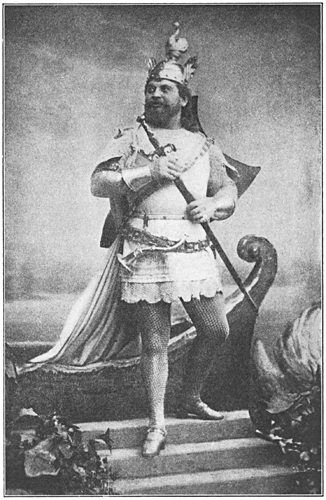
LOHENGRIN, THE KNIGHT OF THE SWAN
I
Long years ago a maiden, fair as the morning itself, wandered through a lonely greenwood in the Duchy of Brabant. She was Elsa, only daughter of the late Duke of Brabant, who had died but a short time before this story begins.
Although Elsa was the rightful owner of all the wooded lands and fertile fields for miles and miles around, she was far from happy. Although summer lay warm and fragrant over those lands, and flowers blossomed along her pathway, yet Elsa's heart was heavy within her. She was full of sorrow. For, not long before, while walking in those self-same woods, her brother Godfrey had suddenly and unaccountably disappeared from her side. Elsa had searched and searched. She had wept, she had prayed, but all in vain. No trace of him had she found anywhere. Spent with grief and anxiety, she had run to her guardian, Frederick of Telramund, and told him the story. But Frederick had repulsed her with unkind glances and cruel words. He had even accused her of doing away with her poor brother, that she might claim the entire Duchy of Brabant for herself.
This guardian, Frederick of Telramund, knew well enough that Elsa was incapable of so foul a deed. He knew that she had loved her brother Godfrey far too well to do him harm. But Frederick had coveted the rich lands and vast possessions of Brabant for many a year. And he was determined to get them now by fair means or foul. Moreover, he had married the pagan princess Ortrud, who was every whit as evil-minded and ambitious as he. Ortrud's father, a heathen prince, had once owned part of Brabant, and they were confident that, with Godfrey and Elsa out of the way, they could lay claim to the whole Duchy. How they plotted and schemed together against poor Elsa!
Do you wonder, then, that Elsa walked through the forest on that morning long ago, with downcast eyes, oblivious to all save her own sad thoughts? Her father was dead, her brother was gone, her guardian had proved false. To whom should she turn for guidance? Weary and perplexed, she sank down beneath the sheltering branches of a friendly tree near by. All was calm and still. Her tired eyes rested upon the deep blue dome of the sky, and thoughts of God, the All-Father, filled her mind. Ah, she could put her trust in Him. And a prayer for help arose from her heart. Perhaps it was the answer to her prayer, perhaps it was only a dream, but then and there Elsa saw a marvelous vision. The heavens opened, and disclosed a noble knight. Enveloped in heavenly light, this knight descended to earth, and stood before Elsa. He smiled upon her, and, like a miracle, she became tranquil and unafraid. He was so strong, so stalwart, so brave! His shining white armor glittered in the sunlight. A glistening sword hung by his side, a golden horn from his shoulder. His eyes were kind. There was comfort in his voice.
"Arise!" spoke he, "and go your way. Be of good cheer, and fear not, for when your need is sorest, I will come to defend you."
Then he vanished. Elsa was alone in the greenwood.
II
Just at this time the King of all Germany came down to Brabant. With pomp and ceremony he came, bringing rough knights from Saxony and brave nobles from Thuringia, all good men and true, to bear him company.
Henry the First was he, a wise king and a just. People called him Henry the Fowler because he was so fond of hunting. It may be, however, that it was not the hunt that he loved so much as the great out-of-doors, the wide plains, the wild forests, the winding rivers. Whenever he summoned his faithful subjects to discuss affairs of peace or war, he chose some meeting place under the blue sky, in God's temple, where men breathe deeply, think clearly, and judge rightly.
So, when at Brabant King Henry found no duke to greet him; when, instead, he heard of strife, of discord, and of strange whispers, he sat himself down beneath a giant oak on the bank of the winding river Scheldt. And the trumpeters blew a great blast, the herald proclaimed the King's presence, the trusty men who had come to bear him company stood at arms, while the Brabantians gathered from north and south, from east and west, of the Duchy to hearken to the King's word.
"I had come here, my good people," began the King, "to ask the aid of your forces in subduing the wild Hungarian foe. Full well do I know that as loyal German subjects you are ready to answer your country's call. But I find discord in your midst, strife and confusion. Therefore have I called you together to learn the causes thereof and to deal justly with the offenders, be it possible."
The people of Brabant were pleased with the King's words and looked to Frederick of Telramund to make answer. Frederick arose. Behind him stood his wife, the dark-haired princess Ortrud, ready to prompt him should he hesitate.
But false Frederick did not hesitate. His voice did not tremble, although he spoke with much show of grief. He made a low obeisance to the King and besought sympathy for the sad tale he was about to tell. He told how the dying Duke had intrusted Elsa and Godfrey to his care, how tenderly he had reared them, how devotedly he had loved them, and how sorely the mysterious disappearance of Godfrey had grieved him. And then, he continued, he had been forced to believe that Elsa had murdered her brother in order to claim the whole Duchy for herself—or mayhap—for some secret lover. Therefore he, Frederick of Telramund, and his wife Ortrud, by right of inheritance, besought the King to make them Duke and Duchess of Brabant.
"An astounding story indeed!" The free-men muttered to each other. The nobles looked at Frederick and shook their heads. "The man must be sure of his proof to make such an accusation," said they, as they turned toward the King.
King Henry sat with bowed head, in deep thought. He ran his hand over his forehead, pondered a moment, and then murmured:
"So foul a deed!"
Aloud he said:
"I would see this maid. I would look upon her face. I would hear her tale. And may God guide my judgment aright."
Hanging his shield on the giant oak behind him, King Henry swore never to wear it again until justice had been done. And all the German nobles drew their swords and thrust them, points down, into the ground, swearing never to wear them again until justice had been done. And the men of Brabant laid their swords at their feet, swearing the same. Then the herald summoned Elsa.
She came, the fair-haired Elsa, clad all in white, with her train of ladies, all in white, behind her. They paused, and she, with hands clasped and eyes cast down, advanced timidly, slowly, alone, until she stood before the King. Her golden hair, unbound, hung a cloud of glory about her. How young she was! How lovely! The rough knights gazed upon her, and their eyes filled with tears. Surely no maiden with such a face could be guilty of such a crime.