Volume 6 — LIST OF ILLUSTRATIONS (continued 5)
Reading edition
The winter of 1854-5 passed wretchedly; the physical condition of the party steadily deteriorated; failing fuel necessitated the burning of the upper woodwork of the brig; their food was reduced to ordinary marine stores, and game failed equally to the hunters of the Advance and the persistent efforts of the Etah natives on the ice-clad land and in the frozen sea. In addition scurvy attacked the crew; Hayes lost a portion of his frozen foot, and hardly a man of the crew remained fit for duty. The necessity of abandoning the brig and retreating by boat to Upernavik, Danish Greenland, was now forced upon Kane's mind. The co-operation of the natives greatly facilitated, if it did not alone render possible, the transportation of their provisions, boats, and stores to Cape Alexander. Kane says the Eskimo "brought daily supplies of birds, assisted in carrying boat stores, and invariably exhibited the kindest feelings and strictest honesty."
Bidding farewell to the natives at Cape Alexander on June 15, 1855, Cape York was passed, the land ice of Melville Bay followed, and the northern coast of Danish Greenland reached in forty-seven days. In the meantime a relief squadron under command of Lieutenant Hartstene, United States Navy, had visited Smith Sound, where the natives informed him of Kane's journey southward. Taken on board the returning flag-ship at Disco, Kane and his men reached New York, October 11, 1855.
Kane had hardly reached home when it became evident that his undermined constitution could not longer withstand the inroads of a disease which for twenty years had afflicted him. Change of climate was tried without avail, and he died at Havana, Cuba, February 16, 1857, at the early age of thirty-seven.
Between his first and second voyages Kane had become deeply interested in Margaretta Fox, one of the well-known spiritualists, who later published their correspondence under the title of "The Love Life of Dr. Kane." Their relations, it is believed, resulted in a secret marriage shortly before Kane's death.
The rare literary skill shown in the account of Kane's expedition has charmed millions of readers with its graphic account of the labors, hardships, and privations of Kane and his men. It should not, however, be considered that this expedition merits attention alone from its tales of suffering and bravery, for none other of that generation contributed so materially to a correct knowledge of the Arctic regions. In ethnology it gave the first full account of the Etah Eskimo, the northernmost inhabitants of the world; in natural history its data as to the flora and fauna of the isolated and ice-surrounded extremity of western Greenland were original, and have been to this day but scantily supplemented; in physical sciences, the magnetic, tidal, and climatic observations remained for twenty years the most important series pertaining to the Arctic regions. Kane's voyage not only extended geographically Inglefield's discoveries a hundred miles to the northward, but it also opened up a practical and safe route for Arctic exploration, which has been more fruitful of successful results than any other.
Kane was a man of generous impulses, enthusiastic ideals, and kindly heart. His chivalric nature, indomitable will, and great courage often impelled him to hazardous enterprises; but he stands out in this modern age as an unselfish character, willing to brave hardships and risk his own life on a vague possibility of rescuing Franklin and his companions.[Back to Contents]
FERDINAND DE LESSEPS[16] By Clarence Cook (1805-1894)
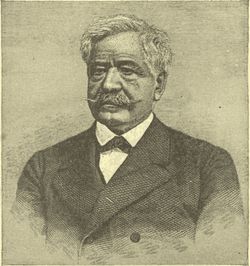
If, as Dante sings: "There is no greater grief than in a time of misery to remember happier days," there are few persons in our time who can testify more feelingly to the truth of the poet's words than Ferdinand de Lesseps. For many years he was a bright-shining, sympathetic figure among those who lead in the van of our material progress; and the accomplishment, by his initiative and energy, of the long dream of the Suez Canal, made him the hero, not of his own nation alone, but of all the civilized world; honors were heaped upon him, and acclamations greeted him on every side. His name became a household word.
A few years later, and all is changed. At the advanced age of eighty-eight, Ferdinand de Lesseps is in deep disgrace. Charged with the chief responsibility for the ruin brought about by the failure of another of his great enterprises—the Panama Canal—he has been condemned by the tribunal to pay a huge fine, and has only been saved from the shame of actual imprisonment by the knowledge of his judges that, in his feeble state of health, imprisonment would speedily be fatal. As at the ceremonies on the occasion of the opening of the Suez Canal, De Lesseps was compared to Columbus, the opener of a way to the new world, so we may see the close of the great discoverer's career reflected in the tragic ending of the splendid fortunes of De Lesseps.
Ferdinand de Lesseps was the son of a French gentleman who, fifty years since, was in the Consular service of France in Egypt. He was born at Versailles in 1805, and after receiving the usual education given to youth of his class, he was early inducted into the mysteries of diplomatic life, where his father's services and influence naturally opened a way for him. In 1833, when twenty-eight, he was made consul at Cairo, and remained at that post for over ten years, during which time he laid the foundations for that knowledge of all matters connected with Egyptian affairs which was to prove so valuable to him and to the world a few years later.
In 1842, De Lesseps was transferred from Cairo to Spain, and was made consul at Barcelona. Spain was at this time much disturbed by factional quarrels and jealousies, partly due to disputed claims to the succession to the throne, and partly to the angry rivalries of political leaders, each eager to save the country by his particular nostrum. In the dynastic struggle, Queen Christina, made regent after the death of her husband, Ferdinand VII., had been exiled to France, and General Espartero, who at first had stood for her cause, now ruled as regent in her place. In 1843, the year after the arrival of De Lesseps, the city of Barcelona, which in common with many other places had refused to support Espartero, openly revolted, and was besieged and bombarded by his forces; and in the course of the siege, which brought great misery upon the inhabitants, De Lesseps did so many humane and generous acts at great personal risk, that he was rewarded by honors from the governments of several nations whose subjects had been protected by him in his official capacity.
It was natural that after this proof of his abilities, De Lesseps should be advanced to a still higher position, and in the spring of 1848 he was made minister to Madrid. This place he held, however, only until February, 1849, for in May of that year he was sent to Rome to patch up a peace between the popular party and the French army of occupation. This proved an unfortunate venture. De Lesseps was recalled to France in disgrace, in June of the same year, for having shown too great a sympathy for the party of Mazzini, which aimed to establish a Roman Republic.
It may be conjectured that the disappointment of De Lesseps at this abrupt ending of his diplomatic career was not very great. He had not been drawn to the profession by natural inclination, but had inherited it, so to speak, from his father, as another man might inherit the profession of law or medicine, or as the son of a mechanic might inherit his father's trade. His ambition and tastes both led him in a different direction; he would play a more active, a more striking part in the affairs of his time.
During the period of his residence in Egypt, as consul for France, he must often have heard the project of a canal across the Isthmus of Suez discussed, since the course of events was every year making the necessity of the undertaking more evident. As is well known, the idea of such a canal was not a new one: Herodotus speaks of a canal designed and partly excavated by Pharaoh Necho in the seventh century before Christ, to connect the city of Bubastis, in the Delta of the Nile, with the Red Sea. As planned, the canal was to be ten feet deep with a width sufficient for two triremes to pass abreast, and it was expected that the voyage would be accomplished in four days. After the lives of 126,000 Egyptian workmen had been sacrificed to the hardships of the undertaking, Herodotus says that Necho, alarmed at the difficulties and expense, consulted the Oracle as to what was best for him to do, and received the answer: "Thou art working for barbarians." The Egyptians, like the Greeks, considered all foreigners as barbarians, and the answer simply reflected the sentiment of the people, or of their leaders, that this vast expenditure of labor, time, and money would prove to be, after all, as much for the benefit of foreigners as for themselves. The Oracle gave a voice to national and political prejudices, such as even in our own time are continually evoked to block the wheels of great enterprises. Necho, we are told, heeded the warning of the Oracle and abandoned the enterprise, but about one hundred years later, in the time of Darius Hystaspes, work on the canal was resumed and the undertaking was completed. From time to time we find mention made of the canal by later authors, but about the end of the eighth century of our era it was finally abandoned and left to be blocked up by the sand.
The project was revived by Napoleon I. at the time of his Egyptian expedition; but, on the report of his engineer, M. Lepère, now known to be mistaken, that the Red Sea level was thirty feet higher than that of the Mediterranean, nothing further was done; nor was it until so late as 1847 that it was again taken up and an attempt made to interest the maritime powers of Europe in the scheme; but nothing serious was accomplished.
In truth, the idea of a canal uniting the two seas, had up to this time been largely sentimental, if we may so express it; rather connected with vast schemes of conquest than founded on the vital needs of commercial development and the material good of the people. The commerce of the Mediterranean countries with India and the remoter East had not in those earlier times reached a point where such a costly undertaking as the Suez Canal could prove remunerative; what trade there was could be sufficiently and more cheaply accommodated by the Overland machinery of caravans, while France, Spain, and England still found the route by the Cape to answer all their purposes. In fact it was more than doubtful whether sailing-vessels, by means of which trade was then chiefly carried on, or even steamers of the build then employed, could use the canal to profit. It was believed that the advantages promised by a shorter route would be counterbalanced by the delays and dangers reckoned inseparable from the navigation of so narrow a water-way.
These objections, really of a serious nature, made it difficult to win over the business world to a practical interest in the scheme. De Lesseps had been from the start the chief mover in the enterprise, to which he had given many years of his time, and he was not a man to be discouraged by repeated failures to bring others to his own way of thinking. His long experience, besides, in the ways of diplomacy had prepared him for delays and obstructions; but the time came, at last, when his enthusiasm, his confidence in himself, and his skill in dealing with men were to bring about the realization of his hopes.
Five years, from 1849 to 1854, had been occupied by De Lesseps in negotiations with governments and bankers, but it was not until 1854 that the event occurred which insured the success of his great undertaking. In that year, Mahomet Saïd Pasha became Viceroy of Egypt, and no sooner was he seated than he sent for De Lesseps to consult with him as to the possibility of carrying out the project of the canal. In November of the same year, a commission was signed at Cairo by the Viceroy charging De Lesseps with the formation of a company to be named the United Suez Canal Company, with a capital of two hundred million francs, afterward raised to three hundred million. From this time the affairs of the canal went on with comparative smoothness, and by 1858 the money necessary for the work had been pledged; one-half the loan was placed on the continent, chiefly in Paris, the other half was taken by the Viceroy.
Actual work on the canal was begun in 1858 and such rapid progress was made that it was completed in the autumn of 1869, and opened to the commerce of the world with magnificent ceremonies, lasting for several days. Religious ceremonies, in which priests of the Catholic Church, the Greek Church, and the Moslem faith united, were followed by a naval parade representing the European powers and the United States, and the whole concluded with a brilliant series of fêtes and entertainments at Cairo. As the originator of the canal, De Lesseps, was a Frenchman, and as France had been the chief promoter of the enterprise, the place of honor at these ceremonies was naturally given to the Empress Eugénie, who went to Cairo as the representative of the French nation; while to De Lesseps, as naturally, was given the next place, a position which he filled with equal dignity and modesty, winning "golden opinions from all sorts of people."
The Suez Canal, though a vast and important undertaking, presented almost no engineering difficulties to be overcome. At Port Saïd, the Mediterranean entrance to the canal, two great piers, to serve as breakwaters, were built of artificial stone, projecting into the sea; the western, a distance of 6,940 feet, the eastern 6,020 feet, and enclosing an area of 450 acres; thus providing a safe and commodious harbor. At Suez, the Red Sea terminus of the canal, a less formidable defense was needed; but the necessary docks and buildings called for a considerable outlay.
From Port Saïd to Suez the land is almost a dead level; the few sand-dunes that break the monotonous uniformity of the isthmus nowhere reach a greater height than fifty or sixty feet. Along the middle line of the isthmus there was a series of depressions; some shallow, and others, the bottoms of which were lower than the level of the sea. Although these depressions were at all times dry, yet they were called "lakes," and as such figure on the maps, where we read the names "Lake Timsah," "The Bitter Lakes" and others. They were found to be thickly incrusted with salt on the bottom and sides, indicating that at one time they had been filled with sea-water; it is indeed must probable that the whole isthmus was at a very remote period entirely submerged. In the construction of the canal these depressions were made to play a very important part. The line of the canal was carried directly through them; the shallower were brought to a sufficient depth by dredging; the deeper were simply filled with water and required nothing more for safe navigation than an indication of the channel by buoys. Thus, in the whole length of the canal, reckoned at 88 geographical miles, there are 66 miles of actual digging; 14 miles of dredging through the lakes; and 8 miles, where neither digging nor dredging was required.
Water began to flow from the Mediterranean into the canal in February, 1869, and from the Red Sea in July of the same year; and by October, the lakes, and the canal in its whole length, were filled with water navigable by vessels of the highest class. The water-way thus obtained has a width at the surface varying from 197 feet at deep cuttings, to 225 feet at lower ground. The sides slope to a width at the bottom of 72 feet, and an average depth of 26 feet is secured along the whole course. As the water is at one level from sea to sea, the canal is without obstruction of any kind. No locks, dams, or water-gates are required, and vessels enter the canal from either end and pursue their journey without interruption or detention.
So great, however, was the eagerness of trade to take advantage of the new route, that the volume of traffic increased within a very short time after the opening of the canal to such an extent as to cause serious delays in the transit, and a number of schemes were brought forward for building other canals by which the two seas might be united. In the end, all these plans were abandoned, and it was decided to widen the canal sufficiently to enable it to meet the increased demand upon its carrying capacity. It may not be without interest to note the growth of traffic in the canal by a few figures. From 486 ships which passed through in 1870, the number rose to 3,100 in 1886; while the receipts increased from $1,031,875 in 1870, to $11,541,090 in 1886. The canal, when completed, was found to have cost twenty million pounds sterling, a sum far in advance of the original estimate, but made necessary by the addition of several important items of expenditure that were not foreseen. One of these was the substitution of paid labor for the forced labor promised by the Pasha, but which was made impossible by public clamor. The Egyptian ruler discovered that he was not living in the times of the pyramid-building Pharaohs, when men were made beasts-of-burden. Another item not provided for was the necessity of supplying the 30,000 workmen employed on the canal with fresh water. For this purpose, a branch canal had to be dug, by which water could be brought from the Nile.
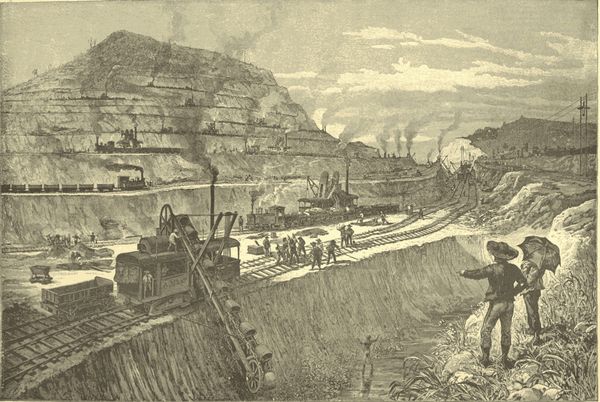
Cutting the Canal at Panama.
The enterprise thus brought to a happy ending, has already proved of great service to the world. It must be looked upon not merely as a benefit to commerce, but as one of the many powerful agents now at work binding the nations closer together. It is indissolubly connected with the name of De Lesseps, and had he been contented with the fortune and the reputation gained by his work in forwarding the canal, few names would have shone brighter in the list of those who have helped on man's material well-being. But in an evil hour he was persuaded to lend his support to the Panama Canal scheme, and along with the ruined fortunes and ruined reputations sunk in that abyss, the name and fortune of De Lesseps and his family have suffered irretrievable blight.
The Panama Canal was not first proposed in our day; the scheme is as old as the discovery of the isthmus. "The early navigators," says J. C. Rodrigues, "could not help noticing how near to each other were the two oceans, and how comparatively easy would be (they thought) the cutting of a canal through that narrow strip of land between them. The celebrated Portuguese navigator Antonio Galväo, as early as 1550, wrote an essay on the subject wherein he suggested four different lines, one of which was through the Lake of Nicaragua, and another by the Isthmus of Panama." England, in 1779, was the first to make an attempt to control the river and lake communications, but her forces sent under Nelson to begin the work were driven away by the terrible fever that has thus far been the best defence of the isthmus from attack. Various schemes were entertained by other nations, but, although the United States kept a jealous eye upon its own interests in the enterprise, it was not until the discovery of gold in California that it saw a vital reason for insisting upon its paramount claims, and the outbreak of the Civil War, with its threats of European intervention, made an easier communication with the rising States of the Pacific Coast seem an absolute necessity. But we moved slowly and with vacillating steps. We were divided in opinion as to the best route to take, as to the sort of canal that was desirable, as to the advisability of building any canal. When the war was over, the rapid increase of railroad communication with the Pacific Coast made public opinion still more indifferent to the enterprise. Meanwhile the French had started with great energy a scheme for a canal at Panama, and De Lesseps had been induced to lend his name to the scheme, and to take an active part in carrying it out. For this purpose he visited the United States and used his best diplomatic arts to induce our Government to unite with him in his plans. But he could do nothing on this side the water and returned to France to fight the battle alone. There the interest in the scheme, artificially excited by speculators and still further aided by the efforts of De Lesseps and his friends, increased to such an extent as to swamp all considerations of prudence. The name of De Lesseps, consecrated by the brilliant success of Suez, proved to be a powerful charm. Thousands and tens of thousands of people in the cities and in the country put the hard-earned savings of years into the venture; senators, deputies, men of high social rank in public life, shamelessly sold their votes and their voices to secure the moral aid and the money of the state to aid their gambling enterprise, and the newspaper press of Paris, at all times venal, betrayed for bribes the trust that was reposed in it.
Such a state of things could not last forever. The end, long prophesied, came at last; the exposure was complete, and the whole stupendous scheme of fraud was unmasked. Something might have been saved from the wreck had the canal itself been a real thing so far as it had gone, a practical enterprise, sure in time to pay its investors and serve the public. But it was found that everything connected with the construction of the canal had been grossly misrepresented; the estimates of expense; the reports of the engineering difficulties to be overcome; the dangers from the climate; the bills of mortality; everything, in short, was enveloped in a cloud of lies. So great was the shock to public confidence that followed this exposure, that for a time the Republic itself seemed in danger of overthrow. The eyes of the world were fixed upon De Lesseps and his son Charles as the chief authors of the mischief, and when the crisis was passed, and the smoke of the upheaval had passed away, the Panama Canal was seen to be a ruined enterprise, and buried deep underneath it was the once-honored name of Ferdinand De Lesseps.[Back to Contents]
GENERAL JOHN C. FRÉMONT[17] By Jane Marsh Parker (1813-1890)
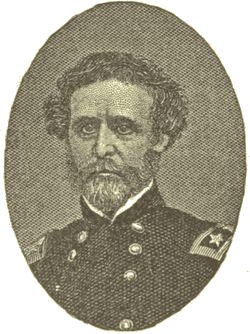
In these days of rapid transit between New York and San Francisco, of luxurious travel across desert and mountain, the story of John Charles Frémont, the Pathfinder of the great West, is of peculiar interest, a striking illustration that the history of the world is in the biography of its leaders, in the pathfinders of the unexplored.
The stormy tide of the French Revolution sent the father of John Charles Frémont to the New World about the time, presumably, when Napoleon Bonaparte was in the height of power. This M. Frémont came of a good family living near Lyons, France. A British man-of-war made prize of the ship in which he sailed for San Domingo, and he was carried prisoner to one of the British West India islands, his captivity lasting several years. Upon gaining his liberty he stopped at Norfolk, Va., to refill an empty purse as a teacher of French, and there met Anne Beverly Whiting, a leading belle of an old Virginia family, who became his wife. One of the illustrious connections of the Whitings was that with the family of George Washington. M. Frémont's marked fondness for travel and adventure was shared by his wife. They took long journeys through the wild southern country, stopping at Indian villages, often sleeping by camp-fires. On one of these expeditions, when making a halt at Savannah, Ga., John Charles, their first child, was born, January 21, 1813. M. Frémont died a few years after.
The boyhood of John Charles was spent in Charleston. It is well to remember, in a study of his life, his French blood and early southern environment. His first choice of a profession was the law. At the age of fourteen he became a student in the office of John W. Mitchell, who placed him under a private tutor, Dr. Roberton, who understood the lad thoroughly and developed his character in the right direction. Dr. Roberton seems to have first discovered what was made plain in Frémont's after-life—the makings of a poet, and the foresight of a prophet. Translating the story of the battle of Marathon in the Greek class, young Frémont catches the spirit with which it was told by Herodotus, and writes verses in protest of tyranny which are published in one of the Charleston papers. "In one year," wrote his tutor, "he had read four books of Cæsar; Cornelius Nepos; Sallust; six books of Virgil; nearly all of Horace, and two books of Livy. In Greek—all of Græca Minora, about half of the first volume of Græca Majora, and four books of the Iliad." At fifteen he enters the junior class of Charleston College. At sixteen he is confirmed in the Episcopal Church, entertaining at that time thoughts of entering the ministry. His steady progress is interrupted by his first love affair; his absorbing passion so gets the better of his common sense, that he neglects his books and classes and is expelled from college. We next find him teaching higher mathematics, acting as private tutor, and devoting his evenings to the charge of the Apprentice's Library, a school in Charleston. At twenty years of age he received the appointment of teacher of mathematics, and his long connection with the United States Army had its beginning; his post the sloop of war Natchez. He was to go on a cruise of two years and more along the coast of South America. Here was a chance for him to unfit himself for further advancement, but he improved his time upon the cruise to the utmost, and his diligent scholarship won for him the double degree of bachelor and master of arts from the college from which he had been expelled. His application for a mathematical professorship in the Navy resulted in his passing the severe examination, and in an appointment to the frigate Independence. He declined the office, however, having decided to become an engineer, to join Captain Williams's survey of the mountain passes between South Carolina and Tennessee. There was talk of a railroad between Charleston and Cincinnati in those days.
About this time a distinguished French geographer, M. Nicollet, was sent to this country by France to explore the sources of the Mississippi, "in the interests of geography." The United States were also interested in the geography of the almost unknown Northwest. M. Nicollet was appointed to make explorations for the United States, and Frémont was honored with the position of principal assistant. It was high time that something should be done in the interests of a geography made up largely from travellers' tales. That there was a great river, the Buena Ventura, running from the base of the Rocky Mountains to the Bay of San Francisco, nobody doubted, for there it was upon the map. The exploration of M. Nicollet, assisted by Frémont, awakened great interest. They were absent two years; their field, the territory between the Missouri and the upper rivers, as far north as the British line. Their report was awaited with impatience. Frémont came home to find that he had been appointed second lieutenant of the United States Topographical Engineers. As a scientific explorer his fame was established. The year following his return he spent in Washington with M. Nicollet, preparing his report for publication. Among those most deeply interested was Senator Benton, of Missouri, "Tom Benton," as he was popularly called, and "Old Bullion." Benton's hobby was the opening of a road for immigrants to the Pacific coast, as a necessary step to the acquisition of the territory held by Mexico—the California of to-day. Senator Benton's interest in the report of the young engineer, then about twenty-seven years of age, was surpassed by the young engineer's interest in the senator's daughter, Jessie, then only fifteen, an interest which ended in a betrothal contrary to the wishes of older heads, owing to Miss Benton's youth and young Frémont's connection with the army. The young engineer received an unexpected and unwelcome order, sending him to the wild frontier of Iowa at once, where the Sacs and Foxes, it was thought by Senator Benton (who had a hand in his exile), might be made to help postpone the marriage, at least. But banishment and red-skins were of no avail in breaking the engagement.
Frémont performed his duty to the letter, returned to Washington, and married Miss Benton, October 19, 1841—a "runaway match" which happily brought life-long happiness to both parties—Mrs. Frémont becoming the connecting link, to use her own words, between her father's "fixed idea of the importance of the speedy acquisition of the Pacific coast, and its actualization through the man best fitted to be the pioneer of the undertaking."
Less than a year after his marriage, in the summer of 1842, Frémont was sent by the War Department on the first of the five expeditions which gave him the name of Pathfinder.
The Mexican War was ripening fast. England had at that time financial claims upon Mexico, and Mexico was bankrupt.
How to get California was a serious question, reminding United States diplomatists of the old Quaker's advice to his son—"Get money, Joseph, get money. Get it honestly if you can—but get it." Acquisition of California by settlement was vigorously encouraged. The best routes across the mountains must be discovered and surveyed. Partial explorations of routes to Oregon and California had been made. Emigrants had crossed the Rockies and were settled in the Sacramento Valley. But the geography of the Great Basin was inaccessible to science; the best and safest routes were only guessed at. Emigration was checked by rumors of perils, alas! too true. Frémont's order to go to the frontier beyond the Mississippi, was changed at his request for something more definite—the exploration of the South Pass of the Rocky Mountains.
The first expedition was absent some six months. Frémont's Peak marks the western point of that journey.
The next order from the Government sent Frémont, in the spring of 1843, to begin exploring where he had left off in 1842; to connect his survey with that of Commodore Wilkes on the Pacific coast. Kit Carson was again his guide; many of the previous expedition enlisted, 32 men in all. Across the forks of the Kansas the route lay west of Fort Laramie, through the Medicine Butte Pass and the South Pass to the northern end of Great Salt Lake. Frémont's report of this region led the Mormons to settle at Salt Lake afterward, believing they would be in Mexican territory. The record of this expedition, like the preceding one, is a story of fearful suffering and heroic endurance. It is given in detail in Frémont's "Memoirs," and Benton's "Thirty Years in the Senate." Deep snows on the mountains, no sign of the Buena Ventura River, Indians refusing to guide such a foolhardy venture; "skeleton men leading skeleton horses;" the descent into the Sacramento Valley at last, and the arrival at Fort Vancouver, November 1843, gives but a glimpse of the heroism of this second expedition. The suffering endured in reaching the coast was as nothing to that of the return through the great valley between the Rockies and the Sierra Nevada, looking for the river they were the first to prove did not exist at all. From San Francisco back to Salt Lake, three thousand five hundred miles in eight months, not once out of the sight of snow. Geography had gained an important fact—the Colorado was the only river flowing from the Rocky Mountains on that part of the continent. For eight months not a word had been heard from the party, at the East, and then Frémont came home "thin as a shadow," and Mrs. Frémont could tell him that she might have prevented his going at all had she chosen, for an order from Washington, countermanding the expedition, had been received by her addressed to her husband, soon after his departure from St. Louis. The expedition was not too far away when the despatch came for her to get it to him, but she decided to withhold it. Because he had taken a mountain howitzer in his outfit he was ordered to stay at home. What a scientific expedition could want of a howitzer was not plain to the authorities, who seemed to think that hostile Indians knew at sight the difference between a military and a scientific party and would respect it. Mrs. Frémont tells the story in The Century for March, 1891, how she not only did not send on the despatch, but a messenger instead, bidding Frémont "Go on at once without asking why," so fearful was she a duplicate order might defeat his going at all.
General Scott was Commander in Chief of our Army in 1845. At his instance Lieutenant Frémont was made captain in the United States Army, and in the fall of that year was sent by the Government on another expedition ... this time to find the best road to the Pacific coast. Trouble with Mexico was growing fast. Our southwestern territory needed looking after; the northwestern of Mexico as well. Frémont was to follow the Arkansas River to its source in the Rocky Mountains, explore the Great Basin, the Cascades, and the Sierra Nevada, and define a route in a southern latitude for emigrants. Kit Carson was among the sixty men of this party, and several veterans of the two former expeditions. They struck out for the Sierra by the way of the Humboldt River. The war with Mexico broke out soon after their departure.
It was another story of fearful hardship—the Sacramento Valley was reached at last, and Frémont hastened to Monterey to get permission from the Mexican authorities to make a scientific exploration of the region. His request was granted, and permission given to replenish his exhausted supplies. Why the Government revoked this permission almost as soon as granted, ordering him and his men to quit the country at once or they would be sent as prisoners to Mexico, is a source of much controversy between historians of that day and this. Frémont could not retreat into the desert with his scanty outfit. A rude fort was built at once on Hawk's Peak, some thirty miles from Monterey, and the Stars and Stripes flung out, Frémont and his men ready to take the consequences of such defiance. When they withdrew, as they did in a few days, overtures from the Mexicans followed them, even a proposition from the Spanish officer that Frémont should join with him and declare the country independent of Mexico. Frémont moved northward. He had reached Tlamath Lake when overtaken by a special messenger from Washington, the bearer of a despatch which had been memorized by the messenger to prevent its falling into the hands of the Mexicans, and which Frémont interpreted to mean that it was the wish of the Cabinet that he should aid in taking and holding California, in the event of any occurrence which he thought justification for so doing. The English must not strengthen their foothold on the coast. Someone must look after the interest of the United States; he was on the ground. If a crisis came he must act without written authority, promptly and discreetly—"Get it honestly if you can—but get it." He returned at once to California, and found it in a revolutionary state. The American settlers had hoisted what was called the Bear Flag, and were eager to fight for the overthrow of the Mexican authority in California.
It is a long story, that of the conquest of California. Frémont's right to be called the Conqueror or the Emancipator is bitterly disputed by some, who claim that he attacked the Californians by irregular warfare, and so thwarted the conciliatory designs of the Government. Be that as it may, by July 5, 1846, the Bear Flag insurgents under Frémont had declared their independence of Mexico, and Frémont had been appointed Governor of California, and had hauled down the Bear Flag and raised the Stars and Stripes. A constitution had been drawn up and the territory declared to be in the possession of the United States. January, 1847, "the enemy" capitulated to Frémont. "The celerity and boldness of his movements in the conduct of the affair were only surpassed," says a contemporary, "by the moderation and clemency of his policy." "The decisive point," wrote George Bancroft, "in the establishment of the Union on a firm basis had been gained."
The seizure of California in 1846 has been called, from another outlook, "one of the least creditable affairs in the highly discreditable Mexican War," and Frémont nothing more than a filibuster seeking private ends. California had been made ours, nevertheless, and Frémont had secured the prize.
In the meantime the Mexican War had begun, and Commodore Stockton, of the U. S. Navy, was hastening to California by sea under orders to subjugate the country. General Kearney was marching westward by land under like orders. Of course there was a dispute about precedence when both were upon the ground, each asserting his right to command the other, both issuing orders and insisting upon the right to precedence. The difficulty of serving under two masters was experienced by Frémont. General Vallejo testified that he received in one day, letters from Commodore Stockton, General Kearney, and Colonel Frémont, each signing himself "Commander-in-Chief." Frémont believed he had sufficient reason for choosing to serve under Stockton, which he did. Upon Stockton's return to his squadron and Kearney's assignment to full command, Kearney brought charges against Frémont for mutiny and fraud, defeating his re-appointment as governor of the State besides. Frémont was ordered home, and it was said "that, like Columbus, he returned from the discovery and conquest of a new world, a prisoner and in disgrace." He went back to Washington under arrest. Great honors awaited him, nevertheless, his troubles only adding to his laurels. The citizens of Charleston gave him a sword, the ladies the gold-mounted belt of the same. He demanded immediate trial, which was granted, the court-martial lasting three months, his defence filling three sessions. He was pronounced guilty of mutiny, disobedience of the lawful command of a superior officer, and conduct to the prejudice of good order and military discipline—a conviction based, some said, upon technical grounds. President Polk remitted the penalty—dismissal from the army—but Frémont resigned at once, the President reluctantly accepting his resignation.
Frémont was then thirty-four years old. As the leader of three great exploring expeditions he had become not only famous, but a popular hero. He had done much for science. He had made the most accurate map of the region between the one hundred and fourth meridian and the Pacific. He had added a large collection of botanical, geological, and other specimens to the national museums. He was eager to resume explorations of routes to the Pacific, having decided to settle his family in California—upon the Mariposa estate, in the Sacramento Valley, which he had bought in 1847, before the discovery of gold, seventy square miles, for $3,000, "the only Mexican grant that covered any part of the gold regions."
Frémont's claims against the Government for expenses incurred in the conquest and defence of California, amounted to some $700,000, which was paid to him. Among those advocating the payment were Senators Benton, and Dix of New York. Twenty thousand copies of Frémont's map of Oregon and California were ordered by the Senate.
It was by no means in the rôle of a defeated man that he started out upon his fourth expedition, in the fall of 1848—when the gold fever was at its height—a venture of his own and Colonel Benton's; its object, a route to the Pacific by way of the Rio Grande. Thirty-two men were enlisted, picked men as before. It was a superb and costly outfit, no less than one hundred and twenty mules. Lacking Kit Carson for a guide, they were lost in crossing the Rocky Mountains, every mule and horse and one-third of the men perishing from cold or starvation. At last, as he wrote home, "the mules, huddled together in the deep snow, froze stiff as they stood and fell over like blocks." The freezing men recrossed the summit in retreat, some of them driven to cannibalism. Wading through the snow to the waist, the remnant reached the home of Kit Carson at Taos, N. M., where Frémont reorganized the expedition, reaching the Sacramento in the spring of 1849.
Litigation concerning his title to the Mariposa estate did not prevent Frémont from developing its mineral and agricultural resources. He engaged some twenty-eight Spaniards to work its gold mines upon shares. His prospects of boundless wealth were most flattering. The Pathfinder was now a millionaire, and in 1855 his title to Mariposa was established by the Supreme Court. Following his appointment in 1849 to run the boundary line between the United States and Mexico, the political party of the Territory seeking its admission as a free State, elected him to the United States Senate. Many honors were bestowed upon him at this time—the medal of the Royal Geographical Society of London, the Founders medal from the King of Prussia, an honorary membership of the Geographical Society of Berlin, etc.
In the California State election of 1851, Frémont stood with the Anti-Slavery party, opposed to the extension of slavery in free territories. He was defeated, and went to Europe with his family in 1852, where he was fêted by royalty generally. Mrs. Frémont, in her "Souvenirs of My Time," has given charming glimpses of this part of their life. Hearing that Congress had made appropriation for further surveys of great Western routes, Frémont hastened home in 1853, to explore by a fifth expedition, what he believed to be the most central and practicable route. This was his second private venture. He would follow the path he had lost when the guide led him astray on his fourth expedition. He would cross the Rockies at Cochetopa Pass, and that in winter.
He made the passage, but it was at the cost of frightful suffering; fifty days on frozen horse-flesh, days without even that; forty-eight hours without a morsel of food; the entire party barefooted in the snow; Frémont, in the hour of extreme peril on the storm-swept mountain-side, making his men take oath that, come what might, nothing should tempt them to cannibalism. Benton tells us how Frémont went straight to the spot where the guide had gone astray in 1848, and found safe and easy passes all the way to California, upon the straight line of 38° and 39°. Great railroads of to-day follow the line it took those starving and half-frozen men fifty days to pass in that winter of 1854. For three months nothing was heard from the party. Frémont's arrival in San Francisco was an ovation. "Europe lies between Asia and America," we read in his report; "build the road, and America lies between Europe and Asia.... The iron track to San Francisco will be the thoroughfare of the world."
The issues at stake in the presidential campaign of 1856 make that campaign the most important of any in the history of our country. "The question now to be decided," said Seward, "is whether a slave-holding class shall govern America or not." The nomination of John Charles Frémont as the candidate of the Republican party was hailed with enthusiasm at the North. The Civil War was impending. The lines between the defenders of slavery and its opponents were sharply defined. Frémont was the first nominee of the Republican party. The romance and adventure of his career, his upright life, the hero-worship of the Pacific coast, the antagonism of the South, gave the canvass a vitalizing force that his defeat by James Buchanan did not lessen, but simply changed into a new phase of strength. Frémont's popular vote was 1,341,000 against 1,838,000 for Buchanan and 874,000 for Fillmore (Know-Nothing). Frémont received 114 electoral votes, and Buchanan 174.
When the Civil War broke out, in 1861, Frémont was in Europe. He offered his services to the Government at once, and was appointed one of the four major-generals of the regular army, and given his choice of a command at the East or the West. He chose the West. "Who holds the Mississippi will hold the country by the heart," he said. His head-quarters were at St. Louis, where secession was rampant. "You must use your own judgment," wrote President Lincoln, "and do the best you can. I doubt if the States will ever come back." Frémont's policy differed from Lincoln's essentially; it lacked that patient, conciliatory spirit with the South which made it hard for many at the North to approve of the compromising policy of the Chief Executive, seeking to hold the neutral States from seceding. Frémont's hatred of the rebellion led him to deal with it just as he would have done with a mutiny on a perilous expedition. He proclaimed martial law. Rebels were to pay some penalty for rebellion—rebel newspapers were silenced—and what was the notable feature of Frémont's administration—the slaves of those in arms against the Government were declared emancipated; his emancipation proclamation antedating Lincoln's of September 22, 1862, by a little more than a year. But Frémont's policy was censured rather than approved by the country at large. Petty intrigues of officers in close relation with the Cabinet did much to defeat his plans. His fleet of gunboats was called a useless extravagance—his staff "the California Gang." His emancipation proclamation was pronounced premature and unwise by Lincoln, and revoked. Frémont again was the cause of an intense public partisanship, "Frémont's career at the West was brief," says "Patton's Concise History of the United States," "only one hundred days; but, being a man of military instincts and training, he showed in that time a sagacity which was not allowed fair practical development. In that brief time he was the first to suggest and inaugurate the following practices, then widely decried, but without which the war would not have been successfully concluded: the free use of cavalry (strongly opposed by General Scott and others); exchange of prisoners with the enemy; fortification of large cities, to allow armies to take the field; building of river gunboats for the interior operations at the West; and the emancipation of the slaves. In short, he contributed more than is generally credited to him." "To get rid of Frémont," says Major-General Sigel, "the good prospects and honor of the army were sacrificed to the jealousy of successful rivals." Frémont was relieved of his command in 1861, and shortly after appointed commander of the Mountain District of Virginia, Kentucky, and Tennessee, where he did most honorable service, Stonewall Jackson retreating before him after eight days' sharp skirmishing, ending in the battle of Cross Keys.
Upon the appointment of General Pope as Commander of the Army of Virginia, making him Frémont's superior officer, Frémont asked to be relieved; his request was granted.
A minority of the Republican party, the radical wing, opposed to the renomination of Lincoln in 1864, nominated Frémont as their candidate. He accepted, but finally withdrew. "Not to aid in the triumph of Lincoln," he said, "but to do my part toward preventing the election of the Democratic candidate." One of the Republican candidates would have to retire to save the party. Here is a subject for debating clubs: Was the interest of the country best served by Frémont's withdrawal from the canvass of 1864?
After 1864 Frémont took little part in public life. He became absorbed in his great trans-continental railroad scheme of a line from Norfolk to San Diego and San Francisco, in which he ultimately lost his large fortune. French agents, in disposing of his bonds in France, made false representations. He was prosecuted by the French Government in 1873, and sentenced by default to fine and imprisonment, although no judgment was given on the merits of the case.
The sale of his Mariposa grant brought him several millions, which he invested in railroads soon after the war, buying the properties that now constitute a large part of the Texas Pacific and other roads belonging to the Atchison and Santa Fé. In the great consolidation entailed by the foreign litigation, his confidence was abused, and he met with heavy and irreparable loss.
From 1878 to 1881 he was Governor of Arizona. His "Memoirs" appeared in 1886. The closing years of his life were spent in comparative retirement.
Not long before his sudden death in New York City July 14, 1890, at the age of seventy-seven years, he had been placed on the retired list of the United States Army with the rank of Major-General. When he passed away the Pathfinder of Africa was filling the public ear—the wedding of Stanley in Westminster Abbey was the theme of the hour.
He was buried in Kensico Cemetery, Piermont-on-the-Hudson, about thirty miles from New York City, near the country home of his prosperous days. His widow, Jessie Benton Frémont, is at this writing (1893), a resident of Los Angeles, Cal. Three children survive their father, an unmarried daughter, Elizabeth McDowell Benton, Lieutenant Frank Preston Frémont, U. S. A.; and Lieutenant John Charles Frémont, U. S. N. After his death Mrs. Frémont demanded compensation for, or restitution of the property appropriated by the United States Government for military purposes in San Francisco harbor, in 1863, and for which she has never received a dollar (1893). The settlement of this claim in her favor is anticipated by the bench generally, long as justice to her has been delayed. At present she has a pension from the Government.
Some profess to find it hard reading the character of John Charles Frémont, calling it enigmatical and baffling. Not so with those who knew him best. "His unwritten history," writes one of these, "gives the clew to his life."
That he was a man of indomitable courage none can deny; a man of lofty principle and unblemished character. An atmosphere of romance makes him the American Chevalier.
He did more than any other man to open the pathways to the Pacific coast. The bitter feeling engendered by the California conquest, and his policy in the Civil War, is not yet extinct. Partisanship has biassed the most of his biographers. The intense feeling underlying the presidential campaign of 1856 did not conduce to a fair estimate of the man, who has suffered hardly less from the intense admiration of his friends than from jealousies of rivals and foes. "I tried to do my duty," he would say in his old age, when asked to explain knotty points about the conquest.
"All that he ever did for the Government," says one who knew him well, "was uniformly repaid with injury." That is the verdict of one side of the controversy. The sifting and weighing of a mass of conflicting evidence, preceding the final verdict of permanent history, is not yet ended in Frémont's case. That the outcome will be illumination of his fame rather than obscuration, his unswerving defenders do not doubt.
"Though the Pathfinders die, the paths remain open."[Back to Contents]
DAVID LIVINGSTONE By Professor W. G. Blaikie, LL.D. (1813-1873)
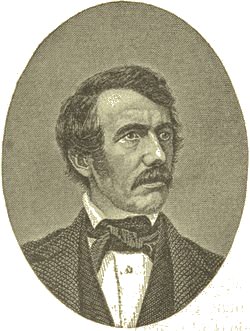
David Livingstone, missionary and traveller, was born at Blantyre, in Lanarkshire, March 19, 1813. His parents, who were in humble life, were of devout and exemplary character; his father in particular being a great reader, especially of travels and missionary intelligence, and much interested in the enterprise of the nineteenth century. At the age of ten David became a worker in a cotton-factory at Blantyre, and continued in that laborious occupation for fourteen years. His thirst for knowledge led him to read all that he could lay his hands on; he used also to attend a night-class, after the long hours of the factory, for the study of Latin. The reading of Dick's "Philosophy of a Future State" was not only the means of a profound impression on his mind, but kindled the desire to devote his life as a missionary to the service of Christ.
Deeply impressed with the advantages of medical training to a missionary, he resolved to qualify himself in medicine, as well as the other attainments looked for in a missionary. The London Missionary Society having accepted the offer of his services, he went to London to complete his studies. His first desire was to labor in China, but, war having broken out between that country and Great Britain, this wish could not be fulfilled. The Rev. Robert Moffat's visit at this time to England turned many hearts to Africa—Livingstone's among the rest; ultimately he was appointed to that field, and, having been ordained on November 20, 1840, he set sail for Africa, reaching Lattakoo or Kuruman, Moffat's settlement, on July 31, 1841.
For several years Livingstone labored as a missionary in the Bechuana country, at Mabotse, Chonuana, and Kolobeng, places that were chosen by him just because they were in the heart of heathenism. The conversion of Sechélé, chief of the Bakwains, and several of his tribe, was a great encouragement. Repulsed by the Boers in an effort to plant native missionaries in the Transvaal, he directed his steps northward, discovered Lake 'Ngami and found the country there traversed by fine rivers and inhabited by a dense population. His anxiety to benefit this region led finally to his undertaking to explore the whole country westward to the Atlantic at St. Paul de Loanda, and eastward to the Indian Ocean at Quilimane.
Livingstone had married at Mabotse, Mary, eldest daughter of the Rev. R. Moffat, and now he found it necessary to send her, with their children, to England, that he might be free for this vast and perilous undertaking. To accomplish it occupied from June 8, 1852, when he left Cape Town, to May 26, 1856, when he arrived at Quilimane. This journey was accomplished with a mere handful of followers, and a mere pittance of stores, amid sicknesses and other bodily troubles, perils, and difficulties without number. But a vast amount of valuable information was gathered respecting the country and its products, its geography and natural history, the native tribes, the regions that were favorable to health, and some great natural wonders, such as the Zambesi Falls.
Livingstone, however, found that the London Missionary Society were not willing that he should be to so large an extent an explorer, and some time after returning to Britain he resigned his office as one of their missionaries.
At home Livingstone was welcomed with extraordinary enthusiasm, receiving the acknowledgments and honors of scientific societies, universities, town councils, and other public bodies in every quarter of the country. In addition to these tokens of honor, the fifteen months spent at home were signalized by three things: the writing of his book, "Missionary Travels" (1857), which was received with the liveliest interest; his visit to Cambridge, awakening the enthusiasm of many of the students, and leading to the formation afterward of the "Universities Mission;" and his appointment by Her Majesty's Government as chief of an expedition for exploring the Zambesi and its tributaries, and the regions adjacent.
On this expedition Livingstone set out on March 10, 1858. While successful in many ways, it led to not a little disappointment. Livingstone explored the Zambesi, the Shiré, and the Rovuma; discovered Lakes Shirwa and Nyassa, and came to a decided conclusion that Lake Nyassa and its neighborhood was the best field for both commercial and missionary operations. His disappointments arose from the grievous defects of a steamer sent out to him by Government, from the death of comrades and helpers, including his wife and Bishop Mackenzie; from the abandonment of the Universities Mission; from the opposition of the Portuguese authorities; but mainly from the distressing discovery that, encouraged by Portuguese traders, the slave-trade was extending in the district, and the slave-traders using his very discoveries to facilitate their infamous traffic. At length a despatch recalling the expedition was received, July 2, 1863. Livingstone, at his own cost, had brought out a new steamer, but she could not be put on the lake. Depressed though he was, he explored the northern banks of Lake Nyassa on foot; then in his own vessel, and under his own seamanship, crossed the Indian Ocean to Bombay; and after a brief stay there, returned to Britain, reaching London on July 23, 1864.
At home Livingstone had two objects—to expose the atrocious deeds of the Portuguese slave-traders, and to find means of establishing a settlement for missions and commerce somewhere near the head of the Rovuma, or wherever a suitable locality could be found. His second book, "The Zambesi and its Tributaries" (1865), was designed to further these objects. He was again received with every demonstration of honor and regard. A proposal was made to him, on the part of the Royal Geographical Society, to return to Africa and settle a disputed question regarding the water-shed of Central Africa and the sources of the Nile. He said he would go only as a missionary, but was willing to help to solve the geographical problem.
He set out in August, 1865, via Bombay and Zanzibar. On March 19, 1866, he started from the latter place, first of all trying to find a suitable settlement, then striking westward in order to solve the geographical problem. Through the ill-behavior of some of his attendants a report of his death was circulated, but an expedition, headed by Mr. E. D. Young, R. N., ascertained that the report was false. Livingstone pressed westward amid innumerable hardships, and in 1869 discovered Lakes Meoro and Bangweolo. All the while he was doing what he could for the religious enlightenment of the natives. Obliged to return for rest to Ujiji, where he found his goods squandered, he struck westward again as far as the river Lualaba, thinking it might possibly be the Nile, but far from certain that it was not, what it proved afterward to be, the Congo. Returning after severe illness once more to Ujiji, Livingstone found there, Mr. H. M. Stanley, who had been sent to look for him by the proprietor of the New York Herald. But no consideration would induce him to return home till he had made one more effort to solve the geographical problem.
He returned to Lake Bangweolo, but fell into wretched health. His sufferings always increasing, when he reached Chitambo's village in Ilala, he was obliged to give in. On the morning of May 1, 1873, he was found by his attendants on his knees, dead. His faithful people embalmed his body as best they could, carried it amid the greatest perils to the shore, where it was put on board a British cruiser, and on April 18, 1874, it was buried in Westminster Abbey.
Among the remains brought home were his "Last Journals," brought down to within a few days of his death; these were published in 1874. Stanley suggested the name of Livingstone for the main stream of the Congo (hence the Baptist Mission on the Lower Congo was called the "Livingstone Inland Mission"), and Mr. H. H. Johnston proposed that part of the East African territory acquired by Britain in 1890—the lower drainage area of the Zambesi—should be called Livingstone Land.
The following letter, written by him to his children in 1853, during his first exploring tour, gives the character of the man, and shows his deep religious feeling:
"Sekelétu's Town, Linyanti, 2d October.—My dear Robert, Agnes, and Thomas and Oswell.—Here is another little letter for you all. I should like to see you much more than write to you, and speak with my tongue rather than with my pen, but we are far from each other—very, very far. Here are Scipone, and Meriye, and others who saw you as the first white children they ever looked at. Meriye came the other day and brought a round basket for Nannie. She made it of the leaves of the palmyra. Others put me in mind of you all by calling me Rananee, Rarobert, and there is a little Thomas in the town, and when I think of you I remember, though I am far off, Jesus, our good and gracious Jesus, is ever near both you and me, and then I pray to Him to bless you and make you good.
"He is ever near. Remember this if you feel angry or naughty. Jesus is near you, and sees you, and He is so good and kind. When He was among men, those who heard him speak said, 'Never man spake like this man,' and we now say, 'Never did man love like Him.' You see little Zouga is carried on mamma's bosom. You are taken care of by Jesus with as much care as mamma takes care of Zouga. He is always watching you and keeping you in safety. It is very bad to sin, to do any naughty things, or speak angry or naughty words before Him.
"My dear children, take Him as your Guide, your Helper, your Friend, and Saviour through life. Whatever you are troubled about, ask Him to keep you. Our God is good. We thank Him that we have such a Saviour and Friend as He is. Now you are little, but you will not always be so, hence you must learn to read, and write, and work. All clever men can both read and write, and Jesus needs clever men to do His work. Would you not like to work for Him among men? Jesus is wishing to send His gospel to all nations, and He needs clever men to do this. Would you like to serve Him? Well, you must learn now, and not get tired learning. After some time you will like learning better than playing, but you must play too in order to make your bodies strong and be able to serve Jesus.
"I am glad to hear that you go to the academy. I hope you are learning fast. Don't speak Scotch. It is not so pretty as English. Is the Tau learning to read with mamma? I hope you are all kind to mamma. I saw a poor woman in a chain with many others, up at the Barotse. She had a little child, and both she and her child were very thin. See how kind Jesus was to you. No one can put you in chains unless you become bad. If, however, you learn bad ways, beginning only by saying bad words or doing little bad things, Satan will have you in chains for sin, and you will be hurried on in his bad ways till you are put into the dreadful place which God hath prepared for him and all who are like him. Pray to Jesus to deliver you from sin, give you new hearts, and make you His children. Kiss Zouga, mamma, and each other for me.
"Your ever affectionate father."[Back to Contents]
CYRUS W. FIELD[20] By Murat Halstead (1819-1892)
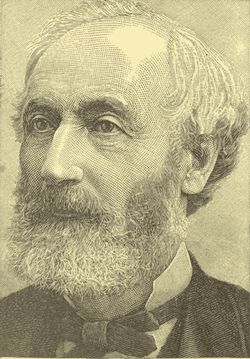
We, the people of the United States, have been celebrating with memorable pomp the discovery of our hemisphere by Christopher Columbus, and the elder nations and far-off islands have joined us in an immense festivity, honoring beyond all example of approbation an adventure that was a marvel, and an achievement that is immortal.
All the world remembers the voyage of Columbus, that, persevered in through trials and perils, ended in triumph—how he studied the stars and the charts, and out of the dreams of ages wove the fabric of fancy that grew to theory, and prophecy, and history, that there was land beyond the Atlantic; and there is no moment in human life supreme above, or of more fascinating interest than, that when, from the deck of his caravel he saw the light on the shore of the new world.
An incident worthy to be associated for ever with this, is that of Cyrus West Field, in his library, turning over a globe, after a conversation relative to extending a line of telegraph to Newfoundland, to reduce the time of the transmission of news between Europe and America; when the idea flashed into his mind that the telegraph might span the Atlantic. The next day Mr. Field wrote to Lieutenant Maury, of the National Observatory at Washington, and to Professor Morse, who invented the telegraph.
The Atlantic telegraph was as truly the conception and the accomplishment of Mr. Field, as the discovery of America was the ambition and the act of Columbus; and Chief Justice Chase was not extravagant when he said the telegraph across the ocean was "the most wonderful achievement of civilization," and entitled "its author to a distinguished rank among benefactors;" or when he added: "High upon that illustrious roll will his name be placed, and there will it remain while oceans divide and telegraphs unite mankind." John Bright said: "My friend Field, the Columbus of modern times, by his cable has moored the New World alongside the Old."
Equally lofty testimony to the splendor of his fame is that of the London Times of August 6, 1858, saying: "Since the discovery of Columbus, nothing has been done in any degree comparable to the vast enlargement which has thus been given to the sphere of human activity."
From the first vital spark that at last glows into the bloom of life, each human being is endowed with certain qualities and capacities, aptitudes, inspirations, possibilities, limitations; and if one trace the stream of blood to its remotest sources, there is no inconsistency in ancestry, and the science of humanity may be as strict within its boundaries as that of geology, or the story of fruitful trees, or the magnetic constellations.
The four famous brothers have given the Field family an almost unique celebrity in this country. They were the sons of the Rev. David Dudley Field, of Western Massachusetts, the room-mate at Yale College of Jeremiah Evarts, father of William M. Evarts. Field and Evarts entered college together in 1798, and graduated in 1802. The American Fields are the descendants of John Field, the astronomer of Ardsley, in Yorkshire, who gained a great reputation by publishing astronomical tables, and died in 1587. Ardsley, it has not passed from the general recollection, was the name of the estate on the Hudson where for so many years Mr. Cyrus W. Field made his summer home.
The family name was in the fifteenth century changed from Feld, Feild, Felde, and Fielde, into its present form; and John Field, the astronomer, was the first to introduce the Copernican system in England, and he received a patent in 1558, authorizing him to bear as a crest over his family arms, an arm issuing from clouds and supporting a globe. Dr. Richard Field, chaplain of Queen Elizabeth, was of the same family, and author of the "Book of the Church," republished in four volumes at Oxford in 1843.
It was the last day of autumn, November 30, 1819, at the Morgan Place, on a hill that sloped to the river, near Stockbridge, Mass., that Cyrus West Field was born. There were three older brothers—David Dudley, Timothy Beale, and Matthew Dickinson. The Cyrus came from a man of note in the town, named Cyrus Williams, and the West from Dr. Stephen West, the predecessor of Dr. David Dudley Field in the pulpit at Stockbridge. It is said of the child that he was of very delicate organization, so weak and frail that his body "had to be supported by a frame in which he could roll around the room till his limbs could get strength to bear him." There was, however (as his younger brother, Dr. Henry M. Field, the historian of the family, says in his vigorous English), "a nervous energy and elasticity derived from his mother," that brought him up, and "once set upon his little feet, he developed by incessant motion," and he was noted for "restless activity," a characteristic of his whole life. His frame, always slight, "became tough and wiry, capable of great effort and great endurance." Cyrus was the one of the Field boys who did not go to college. When fifteen years of age, his brother, David Dudley, who was nearly fifteen years his senior, and lived until his ninetieth year, secured a place for him in the store of A. T. Stewart. Cyrus was a thorough country boy, and his mother's boy, and did not take kindly to the city at first. Dr. Field says: "I well remember hearing my brother Matthew tell mother how Cyrus had come down to the boat on which he left the city, and wept bitterly; and mother telling him, the next time he went to New York, if his little brother felt so still, to bring him home." Mr. Field soon grew tired of being a clerk, and launched out in the manufacture and sale of paper. His capital was his brains—and in twelve years, when he was but thirty-three years old, he was in possession of a handsome fortune, and thought of retiring. This, however, was only a phase of restlessness, and he had before him nearly forty years of extraordinary activity. His great works and trials, his counting his gains and losses by millions, his glory and his sorrows, were all before him. The first of his many long journeys was to South America, with the artist Church, who painted for him the "Heart of the Andes." He ascended the Magdalena River, climbed the Andes to Bogota, crossed to Quito, and by way of Guayaquil, in Ecuador, reached the western coast, and returned home October, 1853, in time for the golden wedding of his parents. Then he set about the task of retirement from business, and was in a feverish state of energy upon that subject, and drifted into the twelve years harassing struggle, from the time when, in his house in Gramercy Park, he sat alone and turned over the globe, and thought of a telegraphic cable through the Atlantic, until the tremendous task was gloriously finished. After writing to Maury and Morse, Mr. Field called in his next-door neighbor, Peter Cooper; and next called Moses Taylor, who listened for an hour without saying a word; and brought in his most intimate friend, Marshall O. Roberts; and then Mr. Chandler White (who died the next year and was succeeded by Wilson G. Hunt). They organized "The New York, Newfoundland and London Telegraph Company," Field, Cooper, Taylor, and Roberts putting in $20,000 each, and White a smaller sum. Field and White, with David Dudley Field as legal adviser, set forth for Newfoundland to get a charter, and called it a fishing excursion. They got a land donation, and an exclusive right to land cable for fifty years. There was first to build a line of telegraph four hundred miles through the wilderness, across the huge island. The land-line work lasted three years, and each of the parties who started by putting in $20,000, put in ten times that amount, and Field much more. The first cable across the Gulf of St. Lawrence was a failure. The second one held; and at last there rolled two thousand miles of tempestuous ocean, with a bottom that was a mystery, between the verge of the American soil and the Irish coast.
Mr. Cyrus W. Field visited England as an Atlantic cable missionary, and addressed the Chambers of Commerce in the principal cities, and the members of the Government. His intense convictions and incessant enthusiasm made way. The scientific men of England were cautious but hopeful. There had been, as it happened, the year before a survey of the North Atlantic, disclosing conditions of the bottom of the sea, and they were reassuring. The Government was so far interested as to engage to furnish ships to lay the cable, and to guarantee £14,000 a year for messages sent if it proved a success—four per cent. of the expected cost; but the capital had to be raised by private enterprise, and Mr. Field visited Glasgow, Birmingham, Manchester, and Liverpool, and subscribed one-fourth of the whole sum. His persistence was continued until the money was raised; but his friends in America were not eager for the stock, and he had to pay into the treasury of the company £88,000 in gold. The complete responsibility of Mr. Field appears at every point. He was the inspiration and the moving force from first to last. The work was strange, and there were delays and details of difficulty arising at every step, that a thousand times would have been insurmountable, if it had not been for the indomitable Field, whose tenacity even exceeded his impetuosity. There were two governments to be negotiated with to furnish ships. The cable was at last ready and on board—and three hundred and sixty-five years after Columbus sailed from the shores of Spain, Field sailed from Ireland, the Lord-Lieutenant, the Earl of Carlisle, making the speech of the occasion. The first effort was to lay the cable straight from Ireland to Newfoundland, and the start was made Wednesday, August 5, 1857. Three hundred and fifty miles out the cable broke. That was failure; and Field's private fortune had suffered severely from his absence. But the next year he was again in England and another start was made—the ships going half-way and joining the cable and running both ways. The cable parted again and again, and the ships returned to England. All were in despair but Field, and he rallied once more, and another trial was made—and succeeded. The cable lasted for a few weeks and gave out. The people were wild with delight at the success, and utterly cast down and disgusted by the failure. But the proof was out; the thing could be done. Cables had been laid in the Mediterranean, and final success was in sight. A new cable was made and coiled on the Great Eastern—and when starting from Ireland and one thousand two hundred and fifty miles were out, there was a break where the ocean was two miles deep, and a year was lost. Then another cable on the Great Eastern, and in 1866 it held out all the way over. This was the year of the war between Prussia and Austria, just after the battle of Sadowa. The next thing was to find and splice the lost cable of the year before, and that was done, one of the most wonderful things that ever happened. Mr. Field told the story before the Chamber of Commerce of New York in November, 1866, saying, after the lost cable was found and spliced: "A few minutes of suspense and a flash told of the lightning current again set free—some turned their heads away and wept, others broke into cheers. Soon the wind arose and we were for thirty-six hours exposed to all the dangers of a storm on the Atlantic; yet in the fury of the gale, as I sat in the electrician's room, a flash of light came up from the deep, which, having passed to Ireland, came back to me in mid-ocean, telling that those so dear to me, whom I had left on the banks of the Hudson, were well, and following us with their prayers. This was like a whisper of God from the sea, bidding me keep heart and hope."
The Great Eastern safely landed the second cable, and the two worlds were safely forever joined. Mr. Field said he had often, in the long struggle—nearly thirteen years in the forests of Newfoundland, on ships in stormy seas—almost accused himself of madness, sacrificing everything for what might prove, after all, but a dream. He received the thanks of Congress, with a gold medal—the grand medal of the French Exposition of 1867. Honors were heaped upon him. If he had been a British subject, he would have been made a baronet. He had given twelve years without accepting remuneration for time or toil, and his hopeful, at last haggard dream, was a marvellous golden reality.
He was forty-seven years of age. He visited Egypt at the opening of the Suez Canal in 1864. He attended the millennial celebration of the settlement of Iceland in August, 1874. He made with his wife a trip around the world in 1880. He was known in all civilized lands as one of the foremost men of his time. All the people of the highest distinction in England knew and admired him as the most typical and celebrated of Americans. Mr. Gladstone, Mr. John Bright, the Duke of Argyle, Dean Stanley were his intimate friends. His house at Gramercy Park was the scene of a splendid hospitality. There gathered in his ample parlors, stored with souvenirs from every land, and in his dining-room, men and women of the highest consideration at home and abroad.
The keenness of his intelligence had increased with his unprecedented experience. His triumphs had given him confidence in his executive ability, and there was nothing too daring for him to contemplate. His bitter lessons in going to the verge of ruin, when he gave the fortune of his youth to the enterprise that he carried to success, were amply pondered, and he resolved never again to allow those near and dear to him to take the chances of cruel fortune and the anxieties of impending want.
When his years were numbered in the thirties, he was meditating retirement from business; and when he was in the sixties, his irrepressible activities carried him into the development of the elevated railway system on Manhattan Island, with the same ardor and fixed purpose with which, thirty years before, he had invaded the wilderness of Newfoundland to find a basis of operations for the conquest of the Atlantic. His faith was undaunted and without limit. His touch revealed new fortunes. He saw that the elevated lines that developed Harlem, would also improve lower New York; and the Washington Building, No. 1 Broadway, was the materialization of the thought. The intensity that was remarked in his childhood, and that commanded the confidence of the capitalists of England, knew no abatement. He had been very cautious in advising Englishmen about investments, but had imparted to some of them the assurance that United States Bonds were as sound as the English investment of national debt, and they profited by accepting his judgment. He insisted upon popularizing the elevated roads by a uniform fare of five cents, and had it done against strong opposition, and was more confident than ever in the stock, of which he had an enormous holding. But it took years longer than he had calculated to make good his plans, and in the interval came a financial storm that compelled him to submit to a heavy loss. He bore his misfortune with fortitude, and still had a competency ample for him, when there came a torrent of ill-fortune—the loss of his beloved wife, and the failure of his sons, under circumstances that bore the distressing stamp of insanity in one of them, a taint of madness that was in the blood which had been so prolific of genius. He suffered where he was strongest and weakest—in his love and his pride.
His spirit would have been invincible if his heart had not been broken. No husband and father was ever more solicitous for the welfare of wife and children. The death of his wife, followed by the disasters that overtook his sons, wounded him as mortally as if a flight of arrows had pierced him. The very contingencies of fortune against which he thought he had provided with infinite painstaking, fell upon him as if from clouds in a sky he thought clear. His deepest resolution was that, after the long strain of facing the total loss of fortune during the dark years of the cable enterprise, he never again would consent to take the chances of the catastrophe that had haunted him, and from which he had escaped at such hazard that the fortunate interposition seemed miraculous; and he did not consciously do the wrong to himself and dear ones he had with such anxiety sought to avoid. His misfortunes were as incalculable as incurable.
The family affection of the Fields is one of their distinctions, and the love the four brothers, known to all the world, bore each other, was as gentle and full of all happiness as that of children. The "little acts of kindness, little deeds of love," that, as the old hymn says, would make the world an Eden, were never wanting. The festivals in which they delighted were those of the family—the eightieth birthday of the oldest brother—the golden wedding. In his long travels, Mr. Field was ever thoughtful of home, and it was like him, giving a dinner to a company of Americans in Edinburgh, to telegraph to their families so that each guest found the news of that day, from his own fireside, in a cablegram on his plate.
Mr. Field was no doubt attracted to Iceland, in 1874, by his studies of the northern waters; the way the world tapers off in the high latitudes, and the fact that Iceland must have been often in his mind as he studied Newfoundland and Ireland, and knew that Iceland was so near Greenland as to belong to the American continent, and to have been a stepping-stone from Norway to Labrador. He was regarded by the Icelanders as almost as great a man as the King of Denmark, who visited his remote possession at the same time; and they thought Field even a greater discoverer than Columbus, for they said the Genoese navigator got his knowledge of the land in the west from their ancestors, and sailed on a certainty.
On the day President Garfield was shot down, he was on his way to Williams College, and was to dine that night with Mr. Cyrus Field at Ardsley, and go to the old place he called "the sweetest in the world" next day. A yacht was waiting to convey the President from Jersey City, when the news of the assassination became known. The President suffered mentally because he had not made adequate provision for his family, and Mr. Field headed a subscription list with a liberal sum, and in a few days had a quarter of a million dollars safely invested for Mrs. Garfield and her children. The motive of this timely and apt generosity was, first, to afford consolation to the dying chief magistrate.
It was within the scope of the ambition of Mr. Field to span the Pacific as well as the Atlantic Ocean with a cable; but having triumphantly overcome one ocean, he failed to put a girdle round the earth, as De Lesseps, having succeeded with the Suez Canal—the only work of the age to be named with the Atlantic telegraph—failed at Darien.
If the prosperity of Mr. Field had continued, and the light had not gone out in his home, he would not have been content until he had ransacked the globe for ways and means to have followed the sun to Asia with the telegraph. His footsteps point the way, and the road to India is westward.
The golden wedding of Mr. and Mrs. Cyrus W. Field was attended by hundreds of those who knew and loved them, and the great double house of the Fields, fronting on Gramercy Park, was full of bright faces and glittering with lights. The historic home was soon darkened and made desolate. The master, the renowned victor—no name more certain of an honorable immortality than his—was one whom "unmerciful disaster followed fast and followed faster." His wife passed away at Ardsley before the deeper gloom of the storm, and he died there July 12, 1892. In his delirium on the morning of his death, he was again on the stormy coast with the cable fleet; and he said: "Hold those ships—do not let them sail yet." Through the centuries there had descended to him from the old astronomer, his ancestor, the far-flashing conception of enterprise and understanding of the splendor of destiny that was his star, and mingled with its light were the gentle influences of the religion of his fathers, always to him real and radiant. He sleeps well, amid the scenes where he passed his boyhood, and for which his heart yearned always—beside his beloved wife; and carved in the marble of their tomb as the last testimony to the loving heart of his companion, are the words: "Love is eternal." The recollection of his sorrows will not, as the centuries come and go, dim the beautiful light of his illustrious name.[Back to Contents]

QUEEN VICTORIA By Donald Macleod, D.D. (BORN 1819-1901)
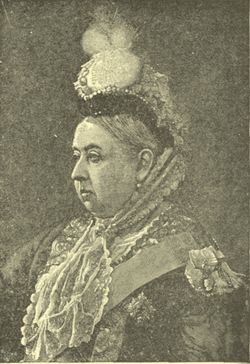
Well do I remember the effect produced on the audience of students, of which I was then one, when Lord Macaulay delivered his Rectorial address in the University of Glasgow, and when, after giving such pictures as he alone could paint, of the character of the four centuries that had closed since the university had been founded—each epoch presenting a scene of bloodshed and misgovernment—he sketched the possible future of the college, and anticipated the time when coming generations would tell how certain contemplated changes had been accomplished during the reign of "the Good Queen Victoria." The phrase was accentuated by an oratorical swing; and when it was given, the tremendous burst of enthusiasm showed that they who listened felt the great historian had chosen the right epithet, and that he intended it in the sense that, as some monarchs are called "Great" and some "Little," so for all time Victoria would be named "the Good Queen." This was said more than forty years ago, before Tennyson had fixed the "Household name," "Albert the Good," for
"That star Which shone so close beside Thee, that ye made One light together."
The epoch in our history which is embraced between the years 1837 and 1887, is unparalleled. At no time in the history of the nation, or of the world, has there been such rapid and beneficent progress. We, who are citizens of "the old country," scarcely realize the extent of our dominion. The Roman Empire was one-fourth its size; all the Russias contain an eighth less; it is sixteen times as large as France, and three times as large as the United States. The United Kingdom, with its colonies and dependencies, includes about one-fifth of the entire globe. The rapidity with which population has grown in some parts of our dominion may be measured by Australasia, which in 1837 had 134,059, and in 1885, 3,278,934, or twenty-three times as many more. When we turn from these figures to consider other fields of progress, we are still more amazed. It goes without saying that these last fifty years have seen the growth of railways and steamships from their infancy to their present world-embracing influence. The mileage of railways open in the United Kingdom in 1837 was about 294 miles, but a great proportion was worked by horses. In 1885 the mileage was 19,169, the gross receipts, £69,555,774; they carried about 1,275,000,000 passengers, and employed 367,793 men. Not a steamer had crossed the Atlantic by steam alone when the queen came to the throne, and her accession was in the year previous to that during which Wheatstone in this country, and Morse in America, introduced electric telegraphy. We, who enjoy express trains, six-penny telegrams, half-penny post-cards, and the parcel post, can scarcely realize that we are so near the time when mail-coaches and sailing-packets were almost the only means of conveyance, and when postage was a serious burden. The greatness of the changes in social life may be realized when we remember that, so recently as 1844, duelling was banished from the code of honor; that crime has diminished seventy-one per cent. since 1837; and that while fifty years ago Government did nothing for education, there are now 30,000 public schools under the Privy Council. These facts are suggestive of the extent of the advance. Or if, without touching on the marvellous victories of science, we try to form an estimate of religious progress, and take the tables for Protestant missions as giving a fair indication of the zeal and self-sacrifice of the churches, we find that while British contributions in 1837 amounted to £316,610, in 1885 they reached £1,222,261.
It may be said with truth that the progress thus indicated must have gone on, no matter who sat on the throne; but it would be unjust not to recognize the close influence which the Crown has directly and indirectly exercised on its advance. There has been no movement tending to the development of the arts and the industries of the country which has not enlisted the active sympathy of the royal family. From the first the Prince Consort recognized the important part which the sovereign could fulfil in reference to the peaceful victories of science and art. Beginning with agriculture—the improvement of stock and the better housing of agricultural laborers, we trace the effect of his constant toil in the series of industrial triumphs, of which the great exhibition of 1851 was the magnificent precursor; and, in recent years, the same kind of objects have always enlisted the best energies of the queen and her children.
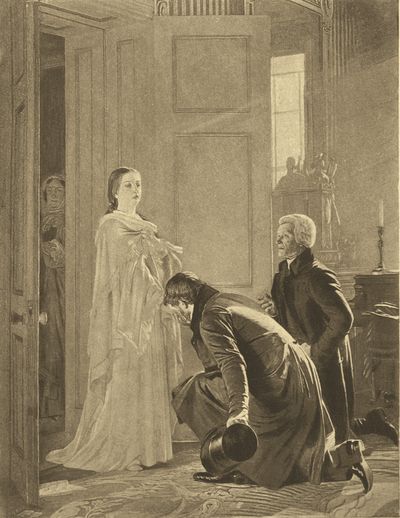
Victoria greeted as Queen.
The contrast is great and touching between the scene in Westminster Abbey, when, amid the pomp of a gorgeous ceremonial and the acclamation of her subjects, the fair girl-queen received the crown of Britain, and that other scene, when, after fifty years of a government that has been unblemished, she once more kneels in the same spot—a widow surrounded by her children and her children's children, bearing the burden of many sad as well as blessed memories, and encompassed with the thanksgivings of the three hundred millions of her subjects. We can imagine how oppressive, for one so loving, must then be the vision of the past, as she recalls, one after another, the once familiar and dear faces which greeted her coronation, those relatives, great ministers of state, and warriors of whom so few survive; and when all her happy married years and the years of parting and desolation appear in vivid retrospect. But if ever monarch had cause to bless God for His tender mercies, it must be she who can combine with the memory of her own life's hopes and trials the consciousness that, in the great work given her as a sovereign, she has been enabled to fulfil the beautiful desire of her innocent childhood, when, on her first being informed of her royal destiny, she indulged in no vain dream of power, but uttered the simple longing "to be good." That goodness has been her real greatness.
The life of her majesty is marked by three great stages—her youth, her married life, and her widowhood. Each is bound to each by the tie of a consistent growth, passing through those experiences which are typical of God's education of His children, whether high or low, rich or poor.
Her childhood, with its wise education, is very much the key to her after-life. Possessed naturally of a quick intellectual capacity, and an unusually accurate memory, a taste for music and the arts, and a deeply affectionate heart, she was admirably brought up by her mother, the Duchess of Kent, on whom the training of the future queen devolved from her infancy. If the education was as high as it was possible to afford a young and intelligent spirit, the moral influences were equally beneficial. The young princess, instead of being isolated within the formalities of a court, was allowed to become acquainted with the wants and sufferings of the poor, and to indulge her sympathies by giving them personal help. The contrast was a great one between the court of George IV., or even that of William, and the truly English home where the Duchess of Kent nurtured this sweet life in all that was simple, loving, and pure. There could scarcely have been a better school for an affectionate nature. All that we learn of her majesty at that time gives a consistent picture of great vivacity, thorough directness in her search after truth, warmth of heart, and considerateness for others, with a genuine love for all that is morally good. These were the characteristics which impressed those who saw her on the trying occasion when she was suddenly ushered into the foremost place in the greatest empire in the world. It was these characteristics which touched the hearts of the good archbishop and of the Chancellor of England when they announced her great destiny to the girl suddenly summoned from slumber. That first request, "My Lord Archbishop, pray for me!" revealed the depth of her character. It was the same when she had next day to pass through the ordeal of meeting the great councillors of state for the first time. Lord Melbourne, the Duke of Wellington, Peel, and the keen-eyed Secretary Greville, all felt the beautiful combination of dignity with unaffected simplicity, and of quick intelligence with royal courtesy. But they did not see the episode which followed the fatigue and excitement of the long formalities of the council, when the young queen rushed first of all to her mother's arms, there to indulge her feelings in a burst of tears, and then, with girlish naïveté, claiming the exercise of her royal prerogative to procure for herself two hours of absolute solitude.
The earlier years of her reign were happily blessed with the wise and beneficent influence of Lord Melbourne. His relationship to the youthful sovereign was more that of a father and able political instructor than of a formal first minister of the crown. He was too experienced not heartily to appreciate the beautiful character of his young mistress, and the interest he took in her political education, and in everything likely to further her prosperity and happiness, was evidently kindled by warm affection. She was equally favored in having as adviser so sagacious a relative as her uncle Leopold, the late King of the Belgians. The Duke of Wellington regarded her almost as a daughter; and there was also, ever at hand, another, whose trained intellect and loyal heart exercised no little influence on her career—Baron Stockmar—to whose lofty ideal of the functions of royalty, calmly balanced treatment of all questions of state policy, and high-toned moral sympathies, both the queen and the prince consort have amply expressed their indebtedness.