Part 2 — EDITORIAL.
Reading edition
TO REV. RUFUS WILMOT GRISWOLD.
My dear Parson,—I knew you would be gratified with my friendly notice of you in the March number of “Graham”—and your pleasant start of surprise, to express your ignorance of the writer, was well conceived—you wicked wag. People who do not know your ways might almost think you were honest for once in your life,—but I, who have seen you in your happy moods, understand what an exquisite point to your wit a falsehood imparts, and what a choice bit of clerical drollery you consider it, to offer to swear to an untruth.
You have adjusted, now, your long score with poor Poe, to your own satisfaction, I hope; for ignorant people will say, that this settlement of accounts after the death of your friend may be honest—and—may not be. You see it lays you open to suspicion, and may soil the surplice you wear. Your clerical mantle, like Charity, may cover a multitude of sins, but you should not wear it too unguardedly. Charity for the errors of the dead, you know, is allowable in funeral sermons, even over the cold remains of those the world scorned and spurned as its veriest reprobates. Even you will not class your friend—who you say was reconciled to you before he died—with outcasts who forfeit even the last offices of humanity. You would give even him a Christian burial. “Dust to dust—ashes to ashes,” methinks, should bury all animosities. You would not pursue your victim beyond the grave, and in the same hour pray, “Forgive us our trespasses, as we forgive those who trespass against us.” This would be horrible.
Now it will not do, my dear parson, to attempt to carry off this departure from Christian practice, with an affectation of great equity, in the performance of duty. “Give the devil his due” may be a very orthodox maxim, but you seem, in adopting it, to have started with the hypothesis that you had a devil to deal with; yet in the exercise of justice thus liberally, it would seem but fair to meet even this Personage face to face, that he might dispute the account if he felt aggrieved at your estimate. This last point, I think, you have a fair chance of attaining. Nor will it do to affect courage and great devotion to truth. It is very well to say, that vice should be held up that its deformity may be seen, so as to startle and deter others. You should be sure that the vice of your brother is not his misfortune, and that the sin which taints your own fingers, may not turn crimson in contrast before the eyes of the gazers. Courage, my dear parson, is a relative term. You may think it great courage, and a duty you owe to truth, to assail your friend for wishing to evade a matrimonial engagement, yet it would be the veriest weakness and wickedness—if you had set the worse example of evading your marital duties after the solemnization. He who sacrifices at the altar should have clean hands.
The jewels which sometimes ornament the remains of beauty or worth have tempted, before now, gentlemen of hardy nerve, but I do not remember that these have ever taken rank in the annals of knight-errantry. And, my dear parson—I am talking somewhat freely with you, but you must pardon me—the feat that you have performed with so much unction, the despoiling of the fame of a man who intrusted it to you as a jewel of inestimable value to him, has not received the applause of a single man of honor. Your claqueurs themselves, feel that your performance is damned. I have no doubt that some faint glimpses of the truth have reached even your mind. I would have you pray over this subject, my dear sir, for your feet stand upon slippery places. In all sincerity, I would have you revise your creed and reform your practice; for you do not seem to get even the poor applause of the world, for wrong-doing.
Geo. R. Graham.
Philadelphia, Sept. 20, 1850.
Errata.—Our first form having been worked off previous to the reception of the final proof of the leading article, the following errors will be found:— On page 266, 1st column, 17th line from bottom, for “with” read wrote. Page 266, 2d col., 2d line from bottom, for “region” read reign. Page 267, 2d col., 30th line from top, for “physical” read psychical. Page 269, 1st col., 9th line from bottom for “profession” read possession.
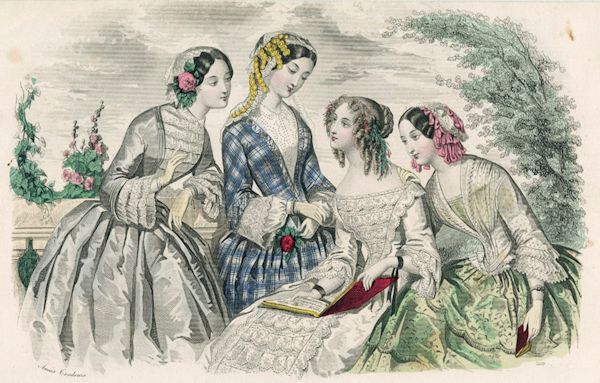
Anaïs Toudouze LE FOLLET Boulevart St. Martin, 69. Coiffures de Hamelin, pass. du Saumon, 21—Lingerie de la maison Schreiber, r. Montmartre, 32—Fleurs de Chagot, ainé, r. Richelieu 73. Robes de Mme Verrier Richard, r. Richelieu, 13—Dentelles de Violard, rue Choiseul, 4.
GREAT VOLUME OF “GRAHAM!”
THE MAGAZINE OF THE UNION!!
PREPARATIONS FOR 1851.
80,000 COPIES.
Graham’s Magazine, unrivaled in splendor and excellence, will commence a new volume with a
MAGNIFICENT JANUARY NUMBER.
Specimen copies of which will be ready December 1st, and will be furnished to all who desire to make up Clubs for the coming volume.
The original publisher of the work returns his sincere thanks for the hearty welcome with which his return to this favorite periodical has been hailed by the press and the public, and promises his readers that the past six numbers have afforded but a slight foretaste of the excellence and beauty of what is in store for the new volume. Of the early numbers we shall print EIGHTY THOUSAND copies, and stereotype the work for further increase.
STERLING ORIGINAL LITERATURE.
G. P. R. JAMES, the celebrated novelist, has been regularly engaged, and will furnish several brilliant romances during the year.
GEO. D. PRENTICE will write his exquisite poems exclusively for this Magazine.
HENRY W. LONGFELLOW,
J. R. LOWELL,
S. A. GODMAN,
E. P. WHIPPLE,
GRACE GREENWOOD,
J. M. LEGARE,
W. CULLEN BRYANT,
MRS. A. M. F. ANNAN.
WILL BE EXCLUSIVE CONTRIBUTORS.
A GALLERY OF LITERARY NAMES OF AMERICA.
GRAHAM’S UNRIVALED WRITERS
are re-engaged, and arrangements are perfected for a series of most splendid articles, from such writers as the following:
W. GILMORE SIMMS,
GEORGE D. PRENTICE,
ALFRED B. STREET,
N. P. WILLIS,
WM. CULLEN BRYANT,
NATHANIEL HAWTHORNE,
HENRY WILLIAM HERBERT,
JAS. FENIMORE COOPER,
RICHARD PENN SMITH,
H. HASTINGS WELD,
THEODORE S. FAY,
T. BUCHANAN READ,
H. C. MOORHEAD,
HENRY B. HIRST,
J. BAYARD TAYLOR,
GEO. H. BOKER,
R. H. DANA,
ROBT. T. CONRAD,
ROBT. MORRIS,
EPES SARGENT,
H. T. TUCKERMAN,
C. J. PETERSON,
R. H. STODDARD,
T. S. ARTHUR,
MRS. LYDIA SIGOURNEY,
MRS. E. C. KINNEY,
MRS. E. J. EAMES,
MRS. ELIZABETH OAKES SMITH,
MRS. JOSEPH C. NEAL,
AMELIA B. WELBY,
MRS. JULIET H. CAMPBELL,
MRS. ANN S. STEPHENS,
MRS. EMMA C. EMBURY,
MISS L. VIRGINIA SMITH,
MISS ENNA DUVAL,
MISS GRACE GREENWOOD,
MRS. SARAH H. WHITMAN,
MISS MARY L. LAWSON,
with many more, well known to the readers of the work, making this Magazine
THE ORGAN OF AMERICAN TALENT
in every department of Mind.
SPLENDID DEPARTMENT OF ART.
Our readers know well that Graham is never beaten in spirited designs and elegant engravings.
The January Number will contain some of the most exquisite productions of artistic skill, and the series then begun will be continued through the year.
Our artists in London, Paris, Italy and the United States, to whom WE PAY CASH for the best and freshest, promise us that GRAHAM SHALL NOT BE BEATEN! however others may boast.
In the department of Fashion we shall excel all that has ever been attempted either in the United States or Paris. The ARTISTS OF MONITEUR DE LA MODE engage to furnish us with the most splendid drawings—December and January numbers will contain specimens. In a word, wait for the January number—then compare and decide—it will eclipse all others, or we shall submit that we have not learned how a magazine of the most brilliant description can be produced. It will be worth $3 of itself.
TERMS—Single Copies $3.
PRICE OF CLUBS FOR 1851.
All orders for Graham’s Magazine, commencing with 1851, will be supplied at the following rates: Single subscribers, $3; Two copies, $5; Five copies, $10; and Ten copies for $20, and an extra copy to the person sending the club of ten subscribers. These terms will not be departed from by any of the Philadelphia three dollar magazines.
All orders to be addressed to
GEORGE R. GRAHAM,
No. 134 Chestnut Street, Philadelphia, Pa.
Transcriber’s Notes:
Archaic spellings and hyphenation have been retained as well as some spellings peculiar to Graham’s. Punctuation has been corrected without note. Other errors have been corrected as noted below. For illustrations, some caption text may be missing or incomplete due to condition of the originals used for preparation of the ebook. Errata have also been incorporated into the below noted corrections.
page 266, with his Fairy Queen ==> wrote his Fairy Queen
page 266, to the opening region ==> to the opening reign
page 267, the debateable ground ==> the debatable ground
page 267, the pirotal points of ==> the pivotal points of
page 267, a complete physical age ==> a complete psychical age
page 269, antiquity of profession ==> antiquity of possession
page 269, to elude the clumsey ==> to elude the clumsy
page 270, the apocalytic vision ==> the apocalyptic vision
page 272, once again their came ==> once again there came
page 274, blasphemy of the this fiendish ==> blasphemy of this fiendish
page 275, could the the child get away ==> could the child get away
page 278, zealous and and apparently ==> zealous and apparently
page 281, listening, however inadvertant ==> listening, however inadvertent
page 287, buffetted against the ==> buffeted against the
page 293, the bark’s bright goal ==> the barque’s bright goal
page 297, tu aimes, nous aimous ==> tu aimes, nous aimons
page 300, flight was a long, ==> flight was long,
page 304, beneath the waters’s flow ==> beneath the waters’ flow
page 305, just now, wan’t I ==> just now, wasn’t I
page 306, and at night’s he ==> and at nights he
page 311, They pause, when ==> They paused, when
page 313, take the hinmost ==> take the hindmost
page 314, arched eye-brow, that ==> arched eye-brows, that
page 316, Napolean! he hath come ==> Napoleon! he hath come
page 318, envious snow flury ==> envious snow flurry
page 321, in thy mandhood pure ==> in thy manhood pure
page 324, Melt’s round the corn-fields ==> Melts round the corn-fields