BALLADS OF THE CAMPAIGN IN MEXICO. NO. V.
Reading edition
———
BY HENRY KIRBY BENNER, U. S. A.
———
Buena Vista.
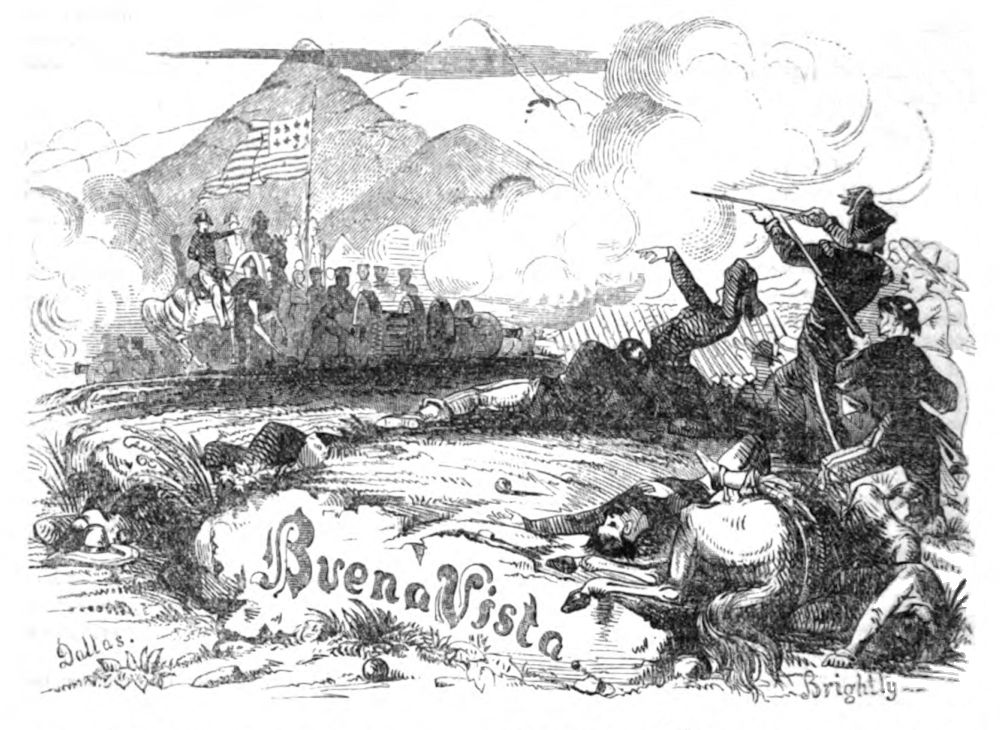
We lay at Aqua Nueva, sullenly, in stern repose,
Awaiting, with anxiety, the onset of our foes: —
We were few; but what of that? We were men, not one of whom
But was ready, when his country called, to meet a soldier’s doom,
And, looking toward the approaching fight with something like despair,
We were deadly as the lion when the hunter treads his lair.
Our foes, so said our scouts, when they came, at set of sun,
Were led by Santa Anna, and were more than five to one; —
They were more than twenty thousand, we, little more than four;
But deadlier fights, we knew, were fought by our ancestors of yore,
When, hand to hand, with axe and bill our fathers clove their way
At Agincourt, and Cressy, and purple Poitiérs.
Our general’s brow was care-worn; his eye leapt like a hound,
Seeking, wherever it rested, the advantage of the ground:
Between us and Saltillo lay a craggy mountain pass,
With sierra on sierra in many a granite mass —
The plain of Buena Vista, where, afterward, we stood
And fought till its ravines and sands were purple with our blood.
When the foe reached Aqua Nueva—when they found our army gone,
They pressed in marshaled masses, in solid thousands, on;
And noon beheld that river of human souls, for miles,
Like one of their own torrents, sweep through the wild defiles —
So, conscious of their strength, they came, while we, in mute surprise,
Looked wistfully and earnestly in one another’s eyes.
The foe had wedged us in, when a flag approached our ranks,
While the hovering enemy pressed on whence they might turn our flanks;
’Twas a summons to surrender—a summons unto men
Who had beat their bravest generals, and could do so once again:
We laughed in hearty scorn, for the rawest volunteer
Had grown so anxious for the fight he never thought of fear.
Then came a little pause, and we raised our eyes to heaven,
And prayed in silence that our sins and crimes might be forgiven;
For well we knew that many a heart which now beat high with pride,
Would lie ere night in icy rest along the mountain side.
And then we thought of Washington, whose spirit, from above,
Was gazing on his children with looks and eyes of love.
In our own green sunny land we were wont to mark the day
Which gave him to his country with many a mimic fray,
And now the thought ran through our souls that this, henceforth, should be
One which our children after us should hail with songs of glee;
And we gazed in one another’s eyes, and silently we swore
To do such deeds as history had never heard before.
We stood, each in our places, when, on our left, arose
The rattling roll of musketry from our advancing foes; —
They were mounting, troop by troop, the steep sierra’s side:
A moment! and our comrades, with hearty cheers, replied; —
Shot after shot, peal after peal, and we saw their scattered men
Rolling, like leaves before the storm, in terror, down the glen.
The night was cold and damp, but we scarcely felt a chill
As we lay, beside our arms, on the bleak and naked hill;
For our hearts were full of fire at the promise of the fray,
Which, we felt, would try our courage on the fast-approaching day,
While the murmur of the enemy, whose thousands hedged us round,
Came fitfully down the freezing wind, in gusts, along the ground.
At last the dawn arrived, and as the sun began
To kiss the summits of the hills, a thousand sparkles ran
Along the cliffs, like fire-flies on a sultry summer night,
And on the instant, every where was heard the din of fight —
On, like the sea, wave over wave, the army of our foe
Rolled toward our left, and pierced our ranks, and swept the red plateau.
We paused; we turned; some of us—fled, as the foe in thousands came,
And our guns in vain made breaches; and the air was red with flame:
We were staggering; we retreated; we were beaten; we would yield;
But Taylor’s eye shone every where at once along the field,
And the Mississippi volunteers, with Bragg, dashed madly on; —
We turned, and charged; and once again the purple field was won.
On our left the day was ours, when Santa Anna pressed
On our centre, now so weak, with his bravest and his best;
Once more our men retreated, when Bragg again came on,
And swept their ranks, but vainly; and every hope seemed gone:
Again—again—his cannon roared; again our rifles played,
And we hurled the beaten enemy in horror down the glade!
Night gathered round, and once again we made our bivouac
On Buena Vista, whence our foe had failed to drive us back.
On the morrow, wan and worn, but with spirits proud and high,
We would once more win the day, or, like soldiers, fall and die;
And we sunk in silent sleep, with an honest trust in God,
Where we lay the night before, on the cold and cheerless sod
But when the morning came, when the welcome sun arose,
We saw—each seeming in a dream—the files of flying foes;
And we lay on one another’s breasts—clasped one another’s hand,
And wept with joy, for God had saved our gallant little band —
God, and our courage, for we fought like heroes all will say
Who read in coming centuries the records of the fray.