INDIAN LEGEND OF THE STAR AND LILY.
Reading edition
———
BY KAH-GE-GA-GAH-BOWH.
———
In the wigwam of the Indian during the evenings of spring, that season when nature, loosed from the bondage of winter, awakes to new life, and begins to deck itself with beauties, the old sage gathers around him the young men of the tribe, and relates the stories of days long since departed.
I have seen these youths sit in breathless silence, listening to the old man’s narrative. Now and then the tear-drops would course down their cheeks, and fall to the ground, witnesses of the interest they felt in the words of their teacher.
To induce the sire to narrate a tradition, the Indian boys would contrive some ingenious plan by which to get some tobacco, which, when offered with a request for a story, would be sure of a favorable answer. Frequently it happens that from sunset to its rise these clubs are entertained, and they do not separate till daylight calls them to the chase.
One of the most interesting traditionary stories I ever heard related, was told by an elderly Indian, one evening in spring. The winter was just leaving, the snow and ice were fast disappearing, and the streams were swollen with the unusual quantity of water from the mountains.
“There was once a time,” said he, “when this world was filled with happy people, when all nations were as one, and the crimson tide of war had not begun to roll. Plenty of game were in the forests and on the plains. None were in want, for a full supply was at hand. Sickness was unknown. The beasts of the field were tame, and came and went at the bidding of man. One unending spring gave no place for winter, for its cold blasts or its chills. Every tree and bush yielded fruit. Flowers carpeted the earth; the air was filled with their fragrance, and redolent with the songs of myriad warblers that flew from branch to branch, fearing none, for there were none to harm them. There were birds then of more beautiful plumage than now.
“It was then, when earth was a paradise, and man worthy to be its possessor, that Indians were the lone inhabitants of the American wilderness. They numbered millions, and living as nature designed them to live, enjoyed its many blessings. Instead of amusement in close rooms the sports of the fields were theirs.
“At night they met on the wide, green fields. They watched the stars; they loved to gaze at them, for they believed them to be the residences of the good who had been taken home by the Great Spirit. One night they saw one star that shone brighter than all others. Its location was far away in the south, near a mountain peak. For many nights it was seen, till at length it was doubted by many that this star was as far off in the southern skies as it seemed to be. This doubt led to an examination, which proved the star to be only a short distance, and near the tops of some trees. A number of warriors were deputed to go and see what it was. They went and returned, saying that it appeared strange and somewhat like a bird. A council of the wise men was called to inquire into and, if possible, ascertain the meaning of the phenomenon.
“They feared that it was an omen of some disaster. Some thought it a precursor of good, others of evil. Some supposed it to be the star spoken of by their forefathers, as a forerunner of a dreadful war.
“One moon had nearly gone by, and yet the mystery remained unsolved.
“One night a young warrior had a dream, in which a beautiful maiden came and stood at his side, and thus addressed him:
“ ‘Young brave! charmed with the land of thy forefathers, its flowers, its birds, its rivers, its beautiful lakes and its mountains clothed with green, I have left my sister in yonder world to dwell among you.
“ ‘Young brave! ask your wise and your great men where I can live and see the happy race continually; ask them what form I shall assume, in order to be loved and cherished among the people.’
“Thus discoursed the bright stranger. The young man awoke. On stepping out of his lodge, he saw the star yet blazing in its accustomed place.
“At early dawn the chief’s crier was sent round the camp to call every warrior to the Council Lodge. When they had met, the young warrior related his dream. They concluded that the star they had seen in the south had fallen in love with mankind and that it was desirous to dwell with them.
“The next night five tall, noble-looking adventurous braves were sent to welcome the stranger to earth.
“They went and presenting to it a pipe of peace, filled with sweet-scented herbs, were rejoiced to find that it took it from them. As they returned to the village, the star, with expanded wings followed, and hovered over their homes till the dawn of day.
“Again it came to the young man in a dream and desired to know where it should live, and what form it should take. Places were named. On the tops of giant trees or in flowers. At length it was told to choose a place itself—and it did so. At first it dwelt in the wild rose of the mountains, but there it was so buried it could not be seen. It went to the prairie, but it feared the hoof of the buffaloe. It next went to the rocky cliff, but it was there so high that the children, whom it loved most, could not see it.
“ ‘I know where I shall live,’ said the bright fugitive, ‘where I can see the gliding canoe of the race I most admire. Children, yes, they shall be my playmates, and I will kiss their brows when they slumber at the side of the cool lakes. The nations shall love me wherever I am.’
“These words having been uttered, she alighted on the waters where she saw herself reflected.
“The next morning thousands of white flowers were seen on the surface of all the lakes and the Indians gave them this name; Wah-be-gwon-nee—(White Lily.)
“Now,” continued the old man, “this star lived in the southern skies. Its brethren can be seen far off in the cold north, hunting the great bear, while its sisters watch her in the east and west.
“Children, when you see the lily on the waters, take it in your hands and hold it to the skies, that it may be happy on earth, as its two sisters (the morning and evening stars) are happy in heaven.”
While tears fell fast from the eyes of all, the old man lay him down and was soon silent in sleep.
Since then I have often plucked the white lily and garlanded around my head; have dipped it in its watery bed, but never have I seen it without remembering the Legend of the Descending Star.
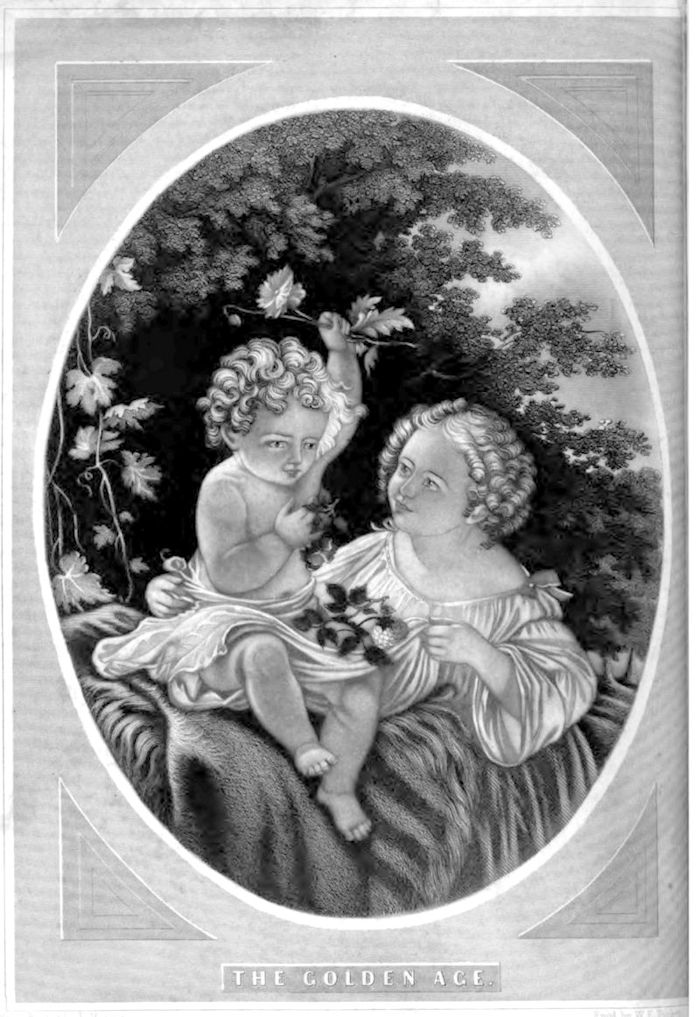
THE GOLDEN AGE.