Part 2 — HISTORY OF THE COSTUME OF MEN,
Reading edition
DURING THE EIGHTEENTH AND THE BEGINNING OF THE NINETEENTH CENTURY.
———
BY FAYETTE ROBINSON.
———
(Continued from page 198.)
Nor does the following present a much greater difference, and, but for the ear-rings and knee-breeches, would pass muster even now amid our infinite varieties of palelots, sacks and Hongroises. The boot-black represented in the cut is a miniature bonnet-rouge.
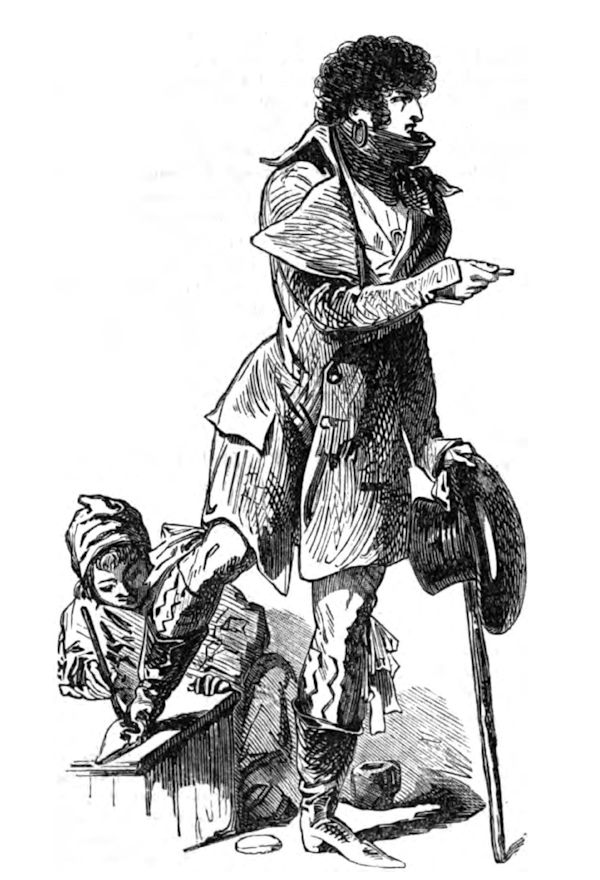
It is worth while to state that costumes, like opinions, reproduce themselves. As the ideas which were once in vogue, and have been abandoned, return and resume their influence and orthodoxy, so do the costumes of other days continually reappear, it is true, with a difference often striking enough, for men no longer wear either coats of mail or inexpressibles of velvet, yet the Norman cloak of the Black Prince, and the sack of Lauzun, the handsome French colonel, who, during our own Revolutionary war, turned the heads and carried away the hearts of half the women of Philadelphia, are still every day to be seen.
The same thing is observable in female costume. The long waists, tight sleeves and full skirts of old times have returned, and even the ungainly ruffs of Queen Elizabeth’s age have shown a disposition to return. The mode of dressing the hair is also retracing itself, so that there is little real difference between the traditional court-dress of former times and that of every-day life worn at present, except the train.
The following is a caricature of that day, but scarcely more outré than the bearded creatures from time to time seen in our own streets. It may be remarked that the passion for hair on the face always is consequent on a war. In the time of Henri IV, all the world was bearded; so during the days of Cromwell were his ironsides, and now men who never saw a shot fired, force the sublime into the ridiculous, by parading a moustache in every thoroughfare throughout the country.
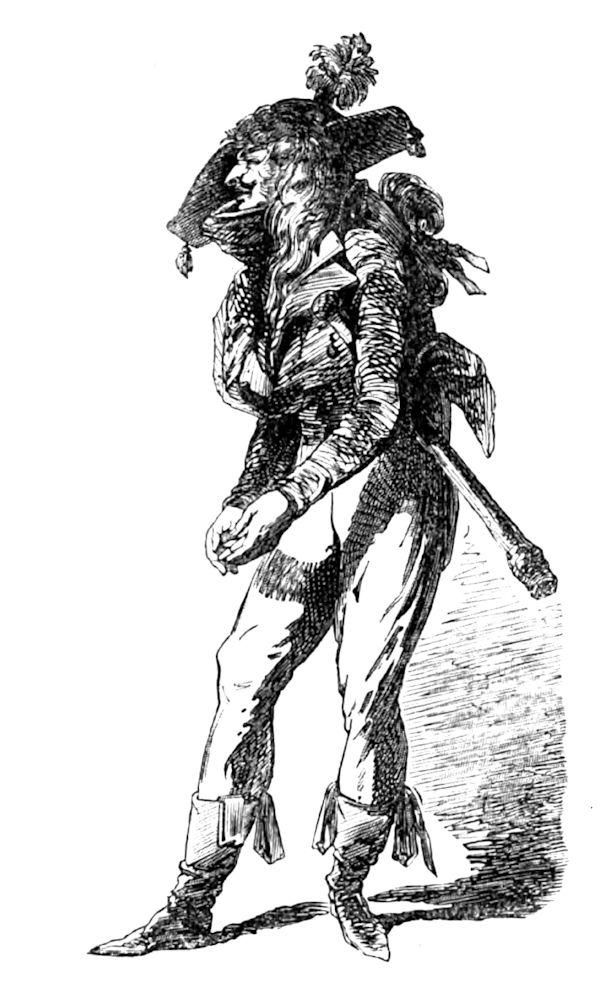
Who knows but that our own Mexican war may exert an influence on dress, and that some day the Ranchero’s striped blanket and broad-brimmed hat may become the fashion. Men will stalk about the streets in boots of cow-hide, and instead of hunting with dogs and rifles, the lazo or lariette will be adopted universally. All the world knows that immediately after the return of the army of the Duke of Wellington to England, from Waterloo, the military black stock was adopted, and it may be that the green pantaloons with the brown stripe, now worn, are an imitation of the dress of the Mexican veterans who were defeated at Cherebusco. The same may be said of the cloth caps, with the covers of oil-skin, now so much in vogue. It may be remarked that this article of dress has always followed the tenue of the army, the flat cap replacing the hussar’s, as the latter did the old gig-top leather apparatus.
Other nations of Europe did not participate in the French Revolution, but became imitators of the costumes it created. We have now come to the period of the Directory, which exerted its influence on costume, or rather the influence of which was reflected by the costume of the day.
The Directory and Consulate saw all France seized with fury for the antique. These were the days of the Romaines and Atheniennes, when David was toiling with the pencil to effect a reform of costume, and when Talma sought to introduce correct ideas of dress on the stage. The men of Paris still adhered to the English costume, which, fortified by their fiat, became that of the world. They compromised their English predilections, however, so far as to wear their hair à la Titus or à la Caracalla, what that was may be seen from the following engraving.
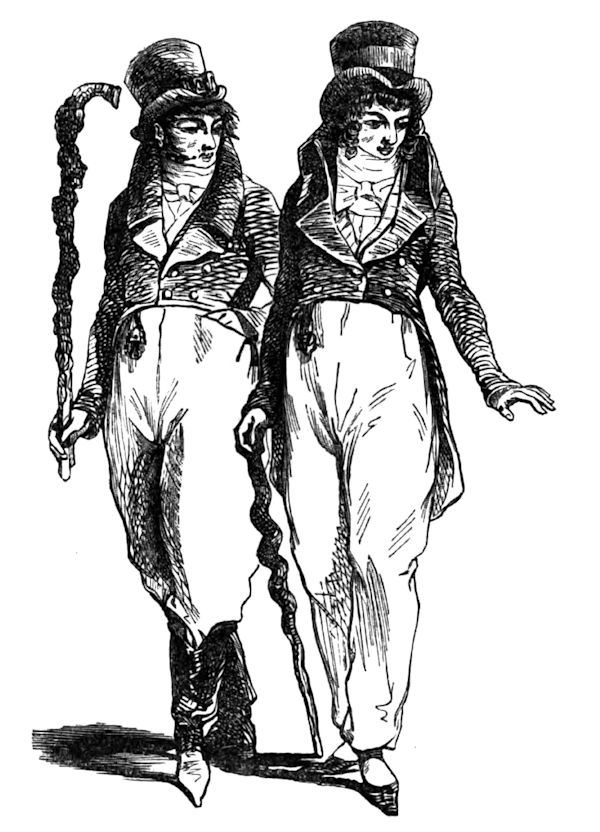
They seemed, however, to struggle to make this costume as unbecoming as possible, wearing the coats loose, the collars immense, the breasts small, and such pantaloons and shocking bad hats as were never seen before or since. The costume of a dandy of 1798 consisted of a blue coat, a white waistcoat, open in the breast, a finely worked shirt-bosom, fastened with a diamond pin, a huge muslin cravat, Nankin pantaloons, with black stripes down the seams, and thrust into the boots. (In society the boot was replaced by a small and pointed shoe.) The everlasting bludgeon was as indispensable in the street as the boots and the hat. To young Thelusson, when thus dressed and armed, Madame de Stael, who wore an oriental toilette, said, “Citizen, you bear the sceptre of ridicule.” “Madame,” replied he, “you are certainly competent to award it to whom you please.” Never were there so many strange costumes seen in any one city as in Paris at that time, when peruques, powder, hair à la Titus, cocked and round hats all were mingled together. Costume was indeed republican if the government was despotic.
[Conclusion in our next.