THE WOUNDED GUERILLA.
Reading edition
A SKETCH OF THE LATE CAMPAIGN.
———
BY MAYNE REID.
———
[SEE ENGRAVING.]
The city of Puebla lies in the centre of an immense plateau, seven thousand feet above sea level, and bordered by mountains of more than twice this altitude. Malinchi, rendered classic in the history of the first conquest, rises on the north; the Piñal bars up the eastern passes, while the great Cordillera of the Rio Frio forms its western boundary, thus separating the two great valleys of Puebla and Mexico by an almost impassible barrier. In this ridge lie the great snow mountains of Popocatepec and the “White Woman,” (la muger blanca,) known poetically as the “Twin Sisters.”
These mountains soar far above the regions of eternal snow. Popocatepec is a cone, and the gray fringe that marks the blending of the white glacier and the dark pines of the mountain forest, forms the circumference of a horizontal circle. On the White Woman this snow line is more irregular. On both mountains its altitude is variable, according to the season and the heat of the sun. Thus the melting of the snows in the sultry months of summer throws the gray fringe higher up the sides of Popocatepec and Ixticihuath, and irrigates the broad plains of Puebla and Tlaxcalla.
But for these snow-crowned mountains the plateau of Puebla would be a barren desert. As it is, the western segment of this plain may be termed the garden spot of Mexico.
As the traveler emerges from the western gate of Puebla, he beholds one of the loveliest pictures in the world. The delighted eye roams over broad fields of corn and wheat, and “frijoles,” bordered by fence rows of the picturesque maguey—here and there the cupolas of rich haciendas—the turrets of a flourishing village, and the spires of a rural church variegate the green landscape, while in the distance rises the dark Cordilleras of the Mexican Andes, over whose gloomy forests and frowning chasms the snowy crests of the “Twin Sisters” glisten with a dazzling whiteness.
This is, perhaps, the fairest picture in Mexico. Its beauty, however, did not protect it from the desolating influence of war, and during the occupation of Puebla by the American army, bands of robbers under the name of “guerilleros,” alike hostile to Mexican and American, roamed over the fairest portions of this district, committing every species of outrage upon its peaceful inhabitants.
The American army entered Puebla in the month of May, 1847. The inhabitants, one hundred thousand in number, were struck with astonishment at the boldness of the act. They had been expecting an army of at least ten thousand men. Instead of this, ninety dragoons rode into the piazza alone, where they halted to await the advance of the army, in all, not numbering four thousand men. Hundreds of Mexicans counted our soldiers as they crossed the bridge of “Noche buena,” and the feeling that existed in the breasts of the Poblanos, after our entry into their city, was one of shame, that they had permitted such a handful of men to take the old and warlike town of Puebla without a blow having been struck in its defense.
They might apparently have stoned us to death.
Santa Anna repulsed at Amozoc, had retreated upon San Martin, and now held that fair district with his rabble soldiery.
On finding that it was not in the power of the American commander to advance beyond Puebla for a time, the bright idea struck Santa Anna of rousing the national pride once more in defense of their capital. He consequently crossed the mountains at Rio Frio, and commenced fortifying the ancient city of the Aztecs, leaving however a large guerilla force, who roamed at will over the western plain of Puebla and occupied San Martin, Tlaxcalla, and Atlixco. These at first commenced hostilities by stopping the supplies of the Puebla market, which depends altogether upon the fertile districts of the west. Finding, however, that the American gold received in exchange for the fruits and vegetables of San Martin, served their purposes better than revenge, the guerillas at length permitted the produce to pass, levying a heavy contribution upon each article.
The hated “alcabala,” was abolished at the city gates, and the Indians and rancheros of Chohula, San Pablo, and San Martin, flocked to the grand Piazza of Puebla.
It was a rare sight in the bright mornings of June, this Piazza of Puebla. Hundreds of Indian girls seated in groups under their awnings of “petates,” gayly chatting with one another, or laughing with a clear ringing laugh at the bad Spanish of the American soldier. Who says that the Indians of Mexico are a dejected race? No such thing. We have seen more bright happy faces in the markets of Puebla than any where else. The slightest witticism—a mispronunciation of the names of any of their wares by a foreign tongue, will elicit peals of laughter from these merry market-girls, while the almost constant display of their small pearly teeth and sparkling eyes evinces the lightness of their hearts.
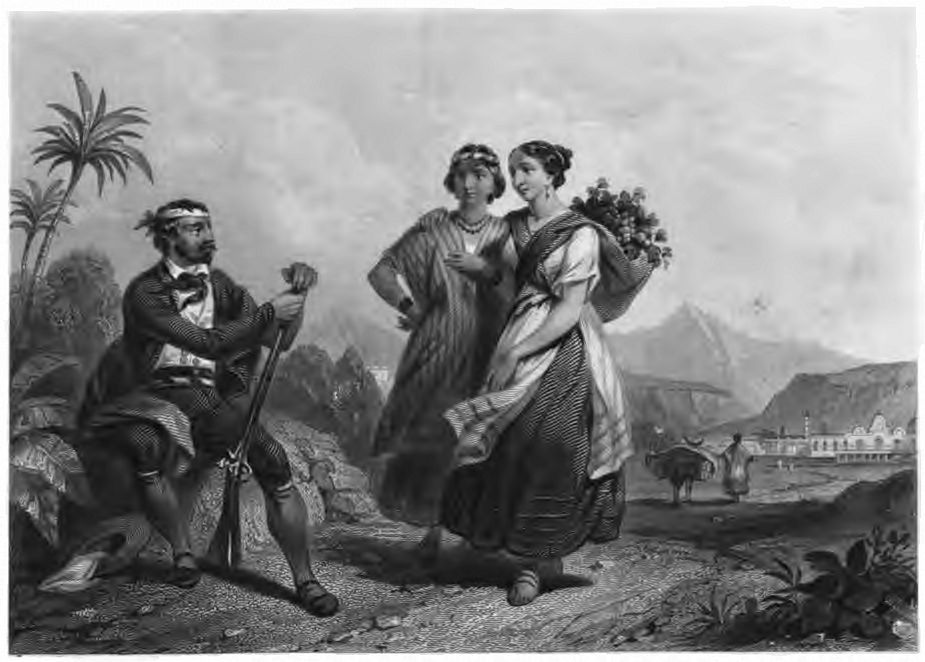
THE WOUNDED GUERILLA Engraved by Rice
The remnants of several nations exist in the plains of Puebla. These may be easily distinguished in the streets of the city by a singular custom. A few strands of worsted thread, blue, crimson, or purple, are twisted into the plaits of their luxuriant black hair. The difference of color in this worsted marks the tribe or village to which the wearer belongs, so that at a glance you may tell an Indian girl from Tlaxcalla or San Pablo from one of the Cholultecas.
The Indians of the last mentioned tribe are perhaps the most interesting to be met with in Mexico. Living at the foot of the great pyramid, on “haunted holy ground,” they are constantly reminded of the religion of their fathers, many of whose peculiar customs and habits they still preserve in all their pristine simplicity. The young girls of this tribe are strikingly handsome, and but for their malformation—the effect of early toil and careless rearing—the Cholultecas, with their dark Indian eyes and pearly teeth, would far eclipse with their beauty the daughters of the famed Castilian conquerors.
Of all the Indian maidens who visited the Piazza of Puebla, none attracted more admiration from the officer or soldier who thronged through this market than two sisters from Cholula. These girls were named Remedios and Dolores, after the appellations of two of the most popular saints in Mexico.
The elder, Remedios, was strikingly beautiful, and though admired by all, her dark Indian eye had made a deeper impression upon the heart of a young Ranger.
The occupation of these girls was that of weaving baskets from the fine fibres of the palma redonda, which wares, along with the flowers that grew in their little garden at Cholula, they brought once or twice a week to the city.
The young ranger spoken of, was frequently placed upon picket guard at a point on the Cholula road, and had thus become acquainted with the sisters, with whom he seemed to be on terms of friendly intercourse. He was frequently seen to accompany them beyond the confines of the city on their return homeward, and at parting the beautiful Remedios would linger behind her sister, and concealed by the friendly shelter of a maguey plantation, bid him farewell with a kiss. It was evident that the passion between the ranger and the fair Cholulteca was mutual.
Such was the state of affairs in the city. Let us follow the young girls to their native village at the foot of the far-famed pyramid.
Under the shade of a huge pepper-tree, stood a small but neat cottage of adobes. In front of this cottage was a little garden filled with bright flowers, and fenced in by a close wall of the octagonal columns of nopal. Outside of the little garden grew the giant maguey planted closely in rows, and running alongside pathways which led to other cottages similar to the one above mentioned. Such pathways form the lanes and streets of a Mexican-Indian village.
Over the cottage door is a little awning or shade formed by two or three poles and the broad leaves of the royal palm, and under this awning are seated the sisters Remedios and Dolores.
They have been silent for some time, each busily engaged with her work, which consists in weaving the beautiful palm-baskets, that meet with such ready sale in the piazza. Dolores is no doubt thinking upon the profits which her work will yield, and how she will rejoice the heart of her old and helpless father, who has no other support. Dolores is the old man’s favorite, and returns his parental fondness with a heart full of filial love.
The thoughts of Remedios are dwelling upon a far different object, and two or three times she has become so absent as to make strange mistakes in her work. Presently the fibre of palm which she has been weaving becomes entangled, and suddenly breaks.
“What are you doing, Remedios?” asks her sister. Then adds with a somewhat malicious laugh, “Thinking of Don Santiago! But come, sister, see better to your work, or we will not have our baskets ready for to-morrow’s market, and then how you would be disappointed!”
Remedios blushed, but made no other reply to the pleasantry of her sister.
Dolores looked in her face, and noticing the blush, said in a more serious tone,
“Ah, Remedios! if Pepe only knew.”
“Knew what?”
“Of Don Santiago.”
“And if he did?” exclaimed the elder sister, while her dark eyes flashed with indignation, “what is Pepe to me. I never loved him, and I never told him I did—he has no right to me more than another!”
At this moment a footstep reached the ears of the sisters, causing them to start and look up.
A young man of rather a forbidding appearance was coming up between the rows of magueys. He was dressed in the costume of an ordinary peasant, but the short carbine which he carried over his shoulder, and the belt and pouch slung across his breast, betokened that he was one of the enrolled guerillus, whose head-quarters were for the time in the village of Cholula.
The young man entered through the opening of the nopal fence, and striking the butt of his piece to the ground, stopped in front of the cottage, saluting the sisters with the usual exclamation for that hour “buenos tardes!” (good evening.)
The salutation was returned by both the sisters; but in such a manner by the elder, as showed that she felt a coldness, or rather a repugnance toward the object of it.
Pepe (the name of the intruder,) noticed this, and glared upon her with a scowl which bespoke a strange blending of fierce love with jealous anger. It was evident that he was now before them with some sinister design, and the sisters sat without speaking, but both trembling under the influence of his evil eye.
“So, Remedios, I have found out the reason why you rejected me so scornfully, but I will be revenged.”
“What mean you, Pepe?” asked the girl in a conciliatory tone.
“You know what I mean. I have heard and know well, too, of your partings on the road by the garita. I have been told all—but trust me you will take no more of these affectionate farewells, for this night I will have my revenge. We have laid our plans, and this night your Yankee lover will die—and if by to-morrow at noon you have not promised to be mine, you may dread the vengeance of my comrades, for they shall know all.
“Remember, to-morrow I return.”
So saying, the guerilla flung his carbine over his shoulder, and with an angry look strode from the cottage.
The young girls watched for a moment in silence his retreating form. When he had passed from their sight Remedios bent toward her sister, and in a half whisper asked,
“What does he mean when he says that he must die to night? Do you think he has some plot laid to assassinate Don Santiago?”
“No, to-night they are to attack the picket at the garita. You know that this is the day of Don Santiago’s guard. I overheard one of the guerillus talk of their plan as I came from the church.”
All that night Remedios was unhappy. She slept but little, thinking of the threat which had been uttered by the jealous Pepe, and with painful suspense she awaited the approach of day.
At an early hour the sisters, with their basket filled with the work of yesterday, and a profusion of beautiful flowers, started for Puebla.
Shortly after leaving the village they met an Indian woman coming from the direction of the city, driving an ass. This woman informed the sisters that there had been a severe skirmish near the garita between the guerillus and the guard, in which the former had been defeated and scattered. The guard had got information by some means of the intended attack, and had sent to Puebla for a reinforcement of mounted men, which had arrived just in time and by a circuitous route, and had attacked the guerillus in the rear, so that only a few of them escaped from either death or capture.
The sisters had scarcely bid adieu to the Indian woman, when on reaching a turn in the road they came upon one of the guerillus, seated upon a stone.
A handkerchief was bound around his head—his face, pale and haggard, was spotted with blood, and there was a look of wild revenge in his eye as he recognized the approach of the two girls.
They were at first alarmed on perceiving whom they had encountered, for it was Pepe who was before them, but when they saw that the guerilla was wounded, and apparently suffering, in the true spirit of womanly compassion both the young girls ran up to him and inquired what they could do to assist him.
This appeared for a moment to soften the bitter spirit of the wounded man, and in a manner of more tenderness than he usually exhibited, he requested one of them to bring him a draught of water, while the other rebound the handkerchief upon his wound.
The elder sister immediately ran to fulfill his request, while Dolores remained alone with the guerilla.
She unbound the handkerchief with tender care, and had commenced readjusting it, when the sudden trampling of horses’ hoofs was heard, and before the wounded man had time to escape, half a dozen rangers came galloping up the road.
The guerilla had seized his carbine, and was making for the chapparal, when one of his pursuers called at him to halt and they would spare him. Seeing the impossibility of escape, the man turned suddenly round and doggedly approached the party of rangers, who had halted upon the road.
At this moment Remedios returned, and recognizing one of the rangers, with an exclamation of delight called out—
“Don Santiago!”
“Ha!” cried the guerilla, “it is he!” And throwing up his carbine he fired at the young ranger, who had leaped from his horse, and was approaching the girl.
The ball took effect, passing through the fleshy part of the ranger’s arm. The shock, brought him to the ground, and the wild laugh of the guerilla told that he believed his vengeance had been complete.
The quick successive reports of half a dozen rifles for a moment drowned this laugh, and when they ceased it was heard no more. He that had uttered it lay by the road a bleeding corpse.