EDITH MAURICE.
Reading edition
BY T. S. ARTHUR.
[SEE ENGRAVING.]
How many beautiful, lovely-minded women do we meet in society, who are united, by marriage contract, with men whose tastes, habits and characters, cannot but be in every way uncongenial. And on the other hand, how often do we see the finest specimens of men unequally joined to women who seem to have no true appreciation of what is really excellent in morals or social life. The reason for such inequality is very apparent to all who observe with any intelligence. The affinities which govern among those who enter life's dazzling arena, are, in most cases, external instead of internal. Accomplishment, personal appearance, and family connections, are more considered than qualities of the heart. Beauty, wit, station and wealth, are the standards of value, while real merit is not thought of or fondly believed to exist as a natural internal correspondent of the external attractions so pleasant to behold. In this false and superficial mode of estimating character lies the bane of domestic happiness. Deceived by the merest externals, young persons come together and enter into the holiest relation of life, to discover, alas! in a few years, that there exists no congeniality of taste, no mutual appreciation of what is excellent and desirable in life, and, worse than all, no mutual affection, based upon clearly seen qualities of the mind. Unhappiness always follows this sad discovery, and were it not for the love of children, which has come in to save them, hundreds and thousands, who, in the eyes of the world, appear to live happily together, would be driven angrily asunder.
Aunt Esther, whose own experience in life, confirmed by much observation, made the evil here indicated as clear as noonday to her perceptions, saw the error of her beautiful niece, Edith, in courting rather than shunning observation while in society.
"You wrong yourself, dear," she would often say, "by this over carefulness about external appearance. You attract those who see but little below the surface, while the really excellent and truly intelligent avoid instead of seeking your society."
"Would you have me careless about my appearance, aunt?" Edith would sometimes say, in reply to these suggestions.
"By no means," Aunt Esther would reply. "A just regard to what is appropriate in externals marks the woman of true taste and right feelings. But you go beyond this."
"Then I violate the principles of taste in dressing."
"I will not say that you do very broadly. Most persons would affirm that you display a fine taste, and in using the word display would express my objection. I think a woman infringes good taste when she so arrays herself as to attract attention to her dress."
"As I do?"
"Yes, Edith, as you do. If you disguise from yourself the fact that you both love and seek admiration for personal appearance, you do not do so from others—at least not from me."
Aunt Esther did not wrong her niece by this judgment. It was Edith's weakness to love admiration; and what we love we naturally seek. Without actually infringing the laws of taste and harmony, she yet managed to dress in a style that always attracted the eye, and set off her really fine person in the most imposing manner. The consequence was that she had many admirers, some of whom were elegant and attractive young men. But none of these were drawn to the side of Edith from a love of her moral beauty. It was the beauty of her person, the fascination of her manners, and the sparkle of her wit, that made her an object of admiration.
Edith had a friend whom she dearly loved; a sweet, gentle, true-hearted girl, named Mary Graham. Those who were dazzled by an imposing appearance, passed Mary with indifference; but the few who could perceive the violet's odor by the way-side, as they moved along through life, sought her company, and found, in the heart of a loving woman, more of beauty and delight than she ever gives as a creature of show and admiration.
Different as they were, in many respects, Edith and Mary were alike in the possession of deep affections. Both loved what was pure and good; but, while one had an instinctive power of looking beneath the glittering surface, the other was easily deceived by appearances. While one shrunk from observation, the other courted attentions. The consequence was, that Edith had hosts of admirers, while only the discriminating few lingered near the retiring Mary. The one was admired for what she appeared to be, the other was loved for what she was.
Two young men, entirely dissimilar in character, yet thrown together as friends, by circumstances, met one evening, when one of them, whose name was Ashton, said to the other,
"Erskine! I met a glorious creature last night—a perfect Hebe!"
"Ah! Who is she?"
"Her name is Edith Maurice."
"She's a showy girl, certainly."
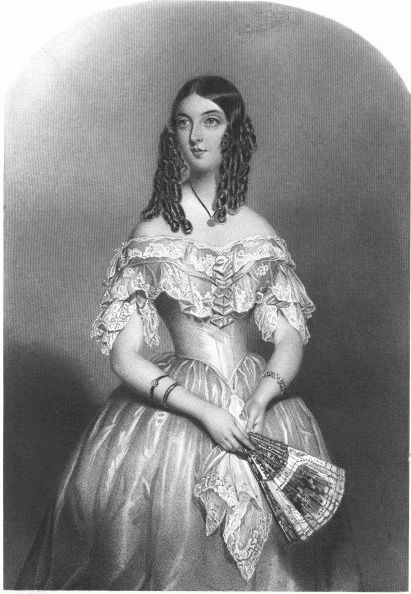
W. Drummond J. Addison
EDITH MAURICE.
Engraved Expressly for Graham's Magazine.
"Showy! She's a magnificent woman, Erskine. And so you've met her?"
"A few times."
"Were you not enchanted?"
"No. Your glorious creatures never turn my brain."
"You're an anchorite."
"Far from it. I delight in all things lovely; and, above all, in the presence of a lovely woman."
"A lovelier woman than Edith Maurice I have not seen for a twelvemonth."
"Though I have."
"You have, indeed!"
"I think so. She has a friend, named Mary Graham, whom I think far more interesting."
"Pray introduce me."
"I will, when opportunity offers."
Not long afterward an introduction took place, and Ashton spent a short time in the company of Mary Graham.
"That's your lovely woman," said the young man to his friend, in a tone of contempt, when they next met.
"To me she is exceedingly interesting," returned Erskine.
"Interesting! A duller piece of human ware it has not been my fortune to meet for these dozen years. I should say she has no soul."
"There you are mistaken. She is all soul."
"All soul! If you want to see a woman all soul, look at Edith Maurice."
"All body, you mean," replied Erskine, smiling.
"What do you mean by that?" inquired Ashton.
"All external. It is rather the beauty of person than the beauty of soul that you see in Edith; but, in Mary, every tone and motion but expresses some modification of the true beauty that lies within. Edith bursts upon you like a meteor; but Mary comes forth as Hesperus, scarcely seen at first, but shining with a purer and brighter light the more intently you gaze upon her."
"Not a meteor, my dear fellow," replied Ashton. "I repudiate that comparison. Edith is another Sirius, flashing on the eyes with an ever-varying, yet strong and beautiful light. As for your evening stars, with their unimpassioned way of shining—their steady, planet-like, orderly fashion of sending forth their rays—I never had any fancy for them."
"Every one to his taste," said Erskine. "As for me, I like true beauty—the beauty of the mind and heart."
"Oh, as for that," returned Ashton, lightly, "let people go in for hearts who understand such matters. I don't profess to know much about them. But I can appreciate, ay, and love a magnificent woman like Edith Maurice. You can have Mary Graham, and welcome; I will never cross your path."
From this time Ashton became the undisguised admirer of Edith. The young man was handsome, well educated, and had a winning address; yet, for all this, there was something about him from which the pure-minded girl at first shrunk. Erskine she sometimes met; and whenever she happened to be thrown into his company, she was charmed with his manners, and interested in his conversation. Unobtrusive as he was, she admired him more than any man she had yet seen. But the showy exterior of Edith hid from the eyes of Erskine her real worth. He looked upon her as vain, fond of admiration, and of course, as possessing little heart—and turned from her to find a congenial spirit in her friend Mary. Had Erskine sought to win the favor of Edith, a man like Ashton would have proved no rival. But Erskine evinced no disposition to show her any thing more than ordinary polite attentions, and with an inward sigh, she suffered the heart which shrunk at first with instinctive repugnance, to turn with its affections toward Ashton.
Vain with the thought of having so imposing and beautiful a woman as Edith for a wife, Ashton did not stop to inquire whether there was a relative fitness for mutual happiness, but pressed his suit with ardor, and won her consent before the half-bewildered girl had time for reflection. Friends, who understood the character of the young man, interposed their influence to save Edith from a connection that promised little for the future; but their interposition came too late. She was betrothed, and neither could nor would listen to a word against the man with whom she had chosen to cast her lot in life.
A brilliant and beautiful girl, Edith was led to the altar by one, who, as a man, was her equal in external attractions; but he was far from possessing her pure, true, loving heart. It did not take many months to lift the veil that had fallen before the eyes of Edith. Gradually the quality of her husband's mind began to manifest itself—and sad, indeed, was her spirit, at times, when these manifestations were more distinct than usual.
The experience of a single year was painful in the extreme. The young wife not only found herself neglected, but treated with what she felt to be direct unkindness. She had discovered that her husband was selfish; and though, to the world, he showed a polished exterior, she had found him wanting in the finer feelings she had fondly believed him to possess. Moreover, he was a mere sensualist, than which nothing is more revolting to a pure-minded woman. External attractions had brought them together, but these had failed to unite them as one.
No wonder that, in such a marriage, a few years robbed the cheeks of Edith of their roundness and bloom, and her eyes of their beautiful light. Those who met her, no longer remarked upon her loveliness, but rather spoke of the great change so short a period had wrought. A certain respect for himself caused Ashton to assume the appearance of kindness toward his wife, when any one was present; but at other times he manifested the utmost indifference. They had three children, and love for these held them in a state of mutual toleration and forbearance.
Ill health was the understood reason for the change in Edith's manner and appearance. Few, if any, knew the real cause. Few imagined that the fountain of her affections had become sealed, or only poured forth its waters to sink in an arid soil. In society she made an effort to be companionable and cheerful for the sake of others; and at home, with her children, she strove to be the same. But, oh! what a weary, hopeless life she led; and but for the love of her little ones, she would have died.
Mary Graham was united to Mr. Erskine, shortly after the union of Edith with Mr. Ashton—and it was a true marriage. A just appreciation of internal qualities had drawn them together, and these proved, as they ever do, permanent bonds.
Mary and Edith had retained a tender regard for each other, and met frequently. But in all their intercourse, with true womanly delicacy, Edith avoided all allusion to her own unhappy state, although there were times when her heart longed to unburden itself to one so truly a sympathizing friend.
One evening—it was ten years from the time of Edith's marriage—her husband came home in his usual cold and indifferent way; and while they sat at the tea-table, something that she said excited his anger, and he replied in most harsh and cutting words. This was no unusual thing. But it so happened that Edith's feelings were less under her control than usual, and she answered the unkindness with a gush of tears. This only tended to irritate her unfeeling husband, who said, in a sneering tone,
"A woman's tears don't lie very deep. But it's lost time to use them on me. I'll go where I can meet cheerful faces."
And then rising from the table, he put on his hat and left the house to spend his evening, as usual, in more congenial society.
Edith dried her tears as best she could, and going to her chamber, sought, by an effort of reason, to calm her agitated feelings. But such an effort for a woman, under such circumstances, must, as in this case, ever be fruitless. Calmness of spirit only comes after a more passionate overflow of grief. When this had subsided, Edith remembered that she had promised Mrs. Erskine, who lived only two or three doors away, to come in and spend the evening. Had she consulted her feelings now, she would have remained at home, but as she would be expected, she rallied her spirits as much as was in her power, and then went in to join her friend.
How different was the home of Mary to that of Edith. Mutual love reigned there. The very atmosphere was redolent of domestic bliss. Mr. Erskine was away when Edith joined Mary, and they sat and talked together for an hour before he returned. A short time before Edith intended going home, he came in, with his ever cheerful face, and after greeting her cordially, turned to his wife, and spoke in a voice so full of tenderness and affection, that Edith felt her heart flutter and the tears steal unbidden to her eyes. It was so different from the way her husband spoke. The contrast caused her to feel more deeply, if possible, than ever, her own sad, heart-wrung lot.
Rising suddenly, for she felt that she was losing the control of her feelings, Edith excused herself, and hastily retired. Mary saw that something had affected her friend, and, with a look, made her husband comprehend the fact also. He remained in the drawing-room, while Mary passed with Edith into the hall, where they paused for a moment, looking into each other's faces. Neither said a word, but Edith laid her face down upon the bosom of her friend, and sobbed passionately.
"What is it that pains you, Edith?" Mary asked, in a low, tender voice, as soon as her friend had wept herself into calmness.
Edith raised her face, now pale and composed, and pushing back with her hand a stray ringlet that had fallen over her cheek, said, with a forced but sad smile,
"Forgive my weakness, dear—I could not help it. A full heart will at times run over. But, good-night—good-night!"
And Edith hurried away.
A few years more and the history of a hopeless, weary life was closed. Is the moral of this history hard to read? No; all may comprehend it.