GRAHAM'S MAGAZINE. (continued 2)
Reading edition
No one heard her but Lucien and myself—and I was one listener more than she would have desired; for Lucien's ear alone was the ejaculation intended, the good for nothing little flirt. It produced the intended effect, for I saw Lucien watching her with admiring interest. She noted the impression, and cunningly kept it up. There was such a contrast between Effie and Kate, rather to Effie's disadvantage, I had to confess, and Kate's affected expressions of intense feeling, rather served to heighten Effie's natural coldness of manner. Why waste words—the conclusion is already divined. The coquette succeeded—and ere a week had passed Lucien was her infatuated, devoted admirer; Effie was quite forgotten. Lucien's two friends, wretched, and completely maddened by the cool, contemptuous rejections they received from Kate, left Stamford, vowing eternal hatred for womankind, and uttering deep, dire denunciations against all coquettes, leaving the field open to Lucien, who seemed to have perfectly lost all sense of propriety in his infatuation. Effie looked on as calmly and quietly as though she were not particularly interested. I fancied, for the credit of romance and sentiment, that her cheek was paler; and I thought I could detect at times a trembling of her delicate lips—but she said not a word. Mrs. Morris and I displayed much more feeling; but what could we do—and half amused, half vexed, we watched the conduct of the naughty little flirt. Suddenly Kate received a summons home—and right glad I was to hear of it. She announced it to us one evening, saying she expected her father the next day. The following afternoon she came over to our cottage, accompanied with two middle-aged gentlemen. The elder of the two was Mr. Barclay, her father, who had known Mrs. Morris in early life; the other she introduced as Col. Paulding, a friend. Col. Paulding's manner struck us with surprise. He called her "Kate;" and though dignified, was affectionate. She seemed painfully embarrassed, and anxious to terminate the visit. She answered our questions hurriedly, and appeared ill at ease. Lucien was not present, fortunately for her; and I fancied she watched the door, as if anxiously fearing his entrance; certain it was she started nervously at every distant sound.
"Will you revisit Stamford next summer, Miss Barclay?" I asked.
Kate replied that she was uncertain at present.
"I suppose Kate has not told you," said her father, laughingly, "that long before another summer she will cease to be mistress of her own movements. She expects to be in Germany next summer, I believe, with her husband," and he looked significantly at Col. Paulding, who was standing out on the lawn with Mrs. Morris, admiring the beautiful view, quite out of hearing distance. Effie was just stepping from the French window of the drawing-room into the conservatory to gather some of her pretty flowers for her visiters, as she heard Mr. Barclay say this. She turned with a stern, cold look, and regarded Kate Barclay quietly. Kate colored crimson, then grew deadly white, and trembled from head to foot; but her father did not notice it, as he had followed Col. Paulding and Mrs. Morris out on the lawn. There we three stood, Effie, cold and pale as a statue, and Kate looking quite like a criminal. She looked up, attempting to make some laughing remark, but the words died in her throat as she met Effie's stern, cold glance; she gasped, trembled, then rallied, and at last, with a proud look of defiance, she swept out on the lawn, and taking Col. Paulding's arm, proposed departure. She bade us good-bye most gracefully; but I saw that she avoided offering her hand to Effie. As the gate closed, she looked over her shoulder indifferently, and said, in a saucy, laughing tone,
"Oh, pray make my adieux to Mr. Decker. I regret that I shall not see him to bid him good-bye. I depend upon the charity of you ladies to keep me fresh in his remembrance;" and, as far as we could see her down the road, we heard her forced laugh and unnaturally loud voice.
Lucien came in a few minutes after they left, and Mrs. Morris delivered Kate's message. He looked agitated, and after swallowing his cup of tea hastily and quietly, he took up his hat and went out. He went to see Kate, but she, anticipating his visit, had retired with a violent headache immediately after her walk; but Lucien staid long enough to discover, as we had, Col. Paulding's relation to the fascinating coquette. This we learned long afterward. The next day Lucien left Stamford without saying more than cold words of good-bye. He did not go with Kate's party, we felt certain; and many weeks passed without hearing from him. Effie never made a remark; and our days passed quietly as they had before the appearance of Kate Barclay in our quiet little village. It was not long, however, before we saw in the newspapers, and read without comment, the marriage of Kate Barclay with Col. Paulding.
"See this," said Mrs. Morris to me one morning as I entered the drawing-room, and she handed me a letter. We were alone, Effie was attending to her plants in the conservatory. I took the letter and read it. It was a wild, impassioned one from Lucien. Two months had elapsed since his silent departure, and this first letter was written to Mrs. Morris. It was filled with self-reproaches, and earnest entreaties for her intercession and mine with Effie. He cursed his infatuation, and the cause of it, and closed with the declaration that he would be reckless of life if Effie remained unforgiving. As I finished reading the letter I heard Effie's voice warbling in wild and plaintive notes in the conservatory,
"How should I your true love know, From another one, By his cockle hat and staff, And his sandal shoon?"
And the scene at the opening of this story rose before my remembrance—the playful argument—the declaration made by her that true, pure love could not have any affinity with pride—and I was lost in reverie.
"What would you do, Enna?" inquired Mrs. Morris.
"Give the letter to Effie without remark," I replied. "We cannot intercede for him—he does not deserve to be forgiven."
The letter was given to Effie, who read it quietly; and if she evinced emotion, it was not before us. She said she was sorry for Lucien, for she had discovered a change in her own feelings. She did not love him as she fancied she had, and she could not in justice to herself fulfill their engagement—it was impossible. She wrote this to him, and all his wild letters were laid calmly and quietly aside. Can this be pride? I said to myself. But she seemed as though she suspected my thoughts, for the night before I returned to my city home, as we were leaning against the window-frame of our bed-room, listening the last time for that season to the tumbling, dashing water-music, she said,
"Enna, dear, it was not spirit and pride that made me act so unkindly to Lucien—indeed, it was not. But I mistook my feelings for him from the first. I fancied I loved him dearly, when I only loved him as a sister. Believe me, if that love had existed once for him, his foolish infatuation for Kate Barclay would not have been regarded by me one moment."
Two or three years passed, and Effie still remained unwedded, when, to our delight, Mr. Grayson, who had returned from Europe, again addressed her. She accepted him; and I was, indeed, happy when I officiated as bridesmaid for her. One year after that joyous wedding we stood over her bier, weeping bitter, bitter tears. We laid her in the grave—and the heart-broken mother soon rested beside her. Among her papers was a letter directed to me; it was written in expectation of death, although we did not any of us anticipate such a calamity.
"I am not long for this world, dear Enna," she wrote, "I feel I am dying daily; and yet, young as I am, it grieves me not, except when I think of the sorrow my death will occasion to others. When you read this I shall be enveloped in the heavy grave-clothes; but then I shall be at rest. Oh! how my aching, weary spirit pines for rest. Do not fancy that sorrow or disappointment has brought me to this. I fancied I loved Lucien Decker fondly, devotedly; and how happy was I when under the influence of that fancy. That fatal summer, at the time of his infatuation for that heartless girl, insensibly a chilling hardness crept over my feelings. I struggled against my awakening; and if Lucien had displayed any emotion before his departure, I might still have kept up the happy delusion. But in vain, it disappeared, and with it all the beauty of life, which increased in weariness from that moment. I sought for some object of interest—I married; but, though my husband has been devoted and kind, I weary of existence. Life has no interest for me. I hail the approach of death. Farewell."
I read these sad lines with eyes blinded with tears; and I could not help thinking how Effie had deceived herself; unconsciously she had become a victim of the very pride she had condemned.
EARLY ENGLISH POETS.
BY ELIZABETH J. EAMES.
I.—CHAUCER.
Yea! lovely are the hues still floating o'er Thy rural visions, bard of olden time, The form of purest Poesy flits before My mental gaze, while bending o'er thy rhyme. No lofty flight, bold, brilliant and sublime— But tender beauty, and endearing grace, And touching pathos in these lines I trace, Oh! gentle poet of the northern clime. And oft when dazzled by the gorgeous glow And gilded luxury of modern rhymes, Grateful I turn to the clear, quiet flow Of thy sweet thoughts, which fall like pleasant chimes From the "pure wells of English undefiled." Thou wert inspired, thou, Poetry's true child.
II.—SPENCER.
What forms of grace and glory glided through The royal palace of thy lofty mind! Rare shapes of beauty thy sweet fancy drew, In the brave knights, and peerless dames enshrined Within thy magic book, The Faerie Queene, Bright Gloriana robed in dazzling sheen— Hapless Irene—angelic Una—and The noble Arthur all before me pass, As summoned by the enchanter rod and glass. And glorious still thy pure creations stand, Leaving their golden footprints on the sand Of Time indelible! All thanks to thee, Oh! beauty-breathing bard of Poesy, That thou hast charmed a weary hour for me.
III.—SHAKSPEARE.
Oh! minstrel monarch! the most glorious throne Of Intellect thy Genius doth inherit. Compeer, or perfect rival thou hast none— O Soul of Song!—O mind of royal merit. Is not this high, imperishable fame The tribute of a grateful world to thee? A recognizing glory in thy name From a great nation to thy memory. Lord of Dramatic Art—the splendid scenes Of thy rich fancy are around us still; All shapes of Thought to make the bosom thrill Are thine supreme! Many long years have sped, And dimmed in dust the crowned and laureled head, But thou—thou speakest still, though numbered with the dead.
THE PORTRAIT.
[WITH AN ENGRAVING.]
BY ROBT. T. CONRAD.
And he hath spoken! Knew I not he would? Though flitting fears, like clouds o'er lakes, would cast Shadows o'er true love's trust. The tear-drop stood In his dark eye; he trembled. But 't is past, And I am his, he mine. Why trembled he? This fond heart knew he not; and that his eye Governed its tides, as doth the moon the sea; And that with him, for him, 't were bliss to die? Yet said I naught. Shame on me, that my cheek And eye my hoarded secret should betray! Why wept I? And why was I sudden weak, So weak his manly arm was stretched to stay? How like a suppliant God he looked! His sweet, Low voice, heart-shaken, spoke—and all was known; Yet, from the first, I felt our souls must meet, Like stars that rush together and shine on.
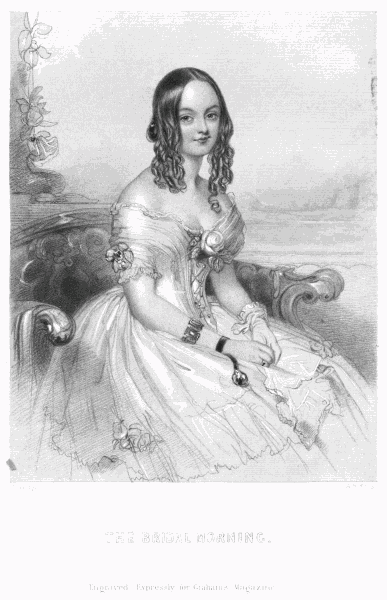
THE BRIDAL MORNING
J. Hayter A. B. Ross
Engraved Expressly for Graham's Magazine
THE ISLETS OF THE GULF.
OR, ROSE BUDD.
Ay, now I am in Arden; the more fool I; when I was at home I was in a better place; but Travelers must be content. As You Like It.