Part 2 — THE RASH OATH.
Reading edition
———
TRANSLATED FROM THE FRENCH BY MRS. JANE TAYLOE WORTHINGTON.
———
During my childhood my mother carried me every year, toward the close of autumn, to spend a month with one of my aunts. It has been a long while since then, but, nevertheless, the memory of my sojourn with her appears as vivid as the events of yesterday, and I fancy myself once more in her handsome château, which was situated on the right branch of the river Meuse, at the place where the stream, still far from its mouth, has not attained its greatest width, and where it is bordered with rugged rocks and precipitous steeps, which remind one of many portions of Switzerland, and of the delicious banks of the Rhine.
To linger near a beloved sister was a great pleasure to my mother; she had arrived, too, at that age when the glories of nature produce the deepest impression, and enjoyed with enthusiasm the exquisite landscape unrolled before our eyes. As to myself, I dwelt but little on the picturesque charms of the country. I was too young for the inhabitants of the château to interest themselves much concerning my amusements, and left to follow my own will, I discovered sources of happiness which I tested with all the eager vivacity of a child. First I found an orchard filled with young fruit, which, though still indifferent, I gladly availed myself of; then in the mountain I claimed a grotto, whose entrance I closed with boughs of trees, and pompously styled it my house; and lastly, I delighted in a gallery that was narrow and dimly lighted, and hung on both sides with old family portraits.
I saw there, warlike men, clothed in complete armor, the hand clenched, the head held high and proudly; others, habited in black, wearing immense ruffs, and having their hair braided, and their beards cut in a point; and others were handsome gentlemen, with coats of embroidered velvet, and coiffés, with enormous wigs, which covered even their shoulders.
The ladies there were yet more numerous. Some of them wore their hair in small curls, and long robes bordered with fur; others had hoops, and powdered heads, laden with plumes, pearls, and flowers, carrying in their hands an immense rose, or a very small bird. Several were in fancy costumes; there were Dianas, the quiver on their shoulders, the crescent on their brows; Floras, in white satin, sprinkled with blossoms; and shepherdesses, with a crook, and tiny hat.
I passed in this gallery every moment I could steal from my lessons and my mother. I glided there unperceived, and remained until I imagined all those figures, their eyes fixed on mine, seemed to move from their frames; sometimes I thought their features grew more stern, their smiles more scornful—and I would depart hastily, in fear and trembling, with the firm resolution to return no more. But what is it at last—the firm resolution of a little girl. By the next day I had forgotten the terrors of the preceding one, and found myself again in the gallery, feverish with emotion, and drawn by some powerful attraction I could not resist, to gaze on those old pictures I had so often contemplated.
Among these paintings, the one that I loved the best, that I always sought for, and that never frightened me, was the portrait of a youthful woman, dressed in a black robe. The sleeves were looped with agrafes, inlaid with pearls, leaving uncovered the loveliest arm in the world, and long, fair hair, entirely unadorned, flowed in large waves on her shoulders. With her large, blue eyes, her peculiarly regular features, and singularly gentle expression, her beauty would have been faultless, but for the frightful paleness which spread itself over her countenance. She was as white as the column of marble against which her brow was pictured as leaning; and I have frequently thought since, that there was, perhaps, something of coquetry in this posture. The melancholy face of the young lady, contrasted with the smiling visages of the dames who surrounded her, and this strange sadness, combined with the languid grace of her position, exercised over my mind a sort of inexplicable fascination. In my childish admiration, I asked myself if a being so beautiful had ever really existed. The impression produced by her haunted me every where; and I remembered it even in my dreams. One day, which had been appointed for a visit in the neighborhood, I contrived to escape, for the purpose of seeing again my cherished favorites, before leaving them for several hours. I had intended remaining with them but a moment; and I flattered myself my absence would be unperceived by the family. But gradually I forgot the anticipated trip, the pleasure awaiting me, my aunt, my mother, in fact, every thing, and lingered, as if chained to my stand, with eyes fixed rapturously on the Pale Lady, (it was thus I designated her,) and blending her image with the wildest adventures my youthful imagination could conceive.
Already I had been called twenty times, and the domestics were sent to search for me; but my abstraction was so profound, that I was insensible to all, and still lingered motionless before the portrait, when my aunt opened the door, and surprised me in the gallery. My lengthened absence had begun to occasion alarm, and the frightened manner of my aunt recalled suddenly my wandering thoughts. Perhaps conscious of my fault, or it may be, ashamed of being thus entrapped, I threw myself into my aunt’s arms, and a few tears moistened my cheeks. The reprimand died upon her lips, but yielding to the astonishment inspired by my intense admiration for these old pictures, she said,
“My child, you are beholding a woman who has been very beautiful, and very unhappy.”
“Very unhappy!” I had then imagined rightly. “Dear aunt, will you relate to me her history!”
“Not this morning, they are waiting for us; and beside, you are yet too young.”
“Too young to hear her history? Ah! how unfortunate that is! But never mind, by our next visit I shall be twelve years of age, then I will be tall—promise I may hear it then.”
She granted the wished for promise, and a few days afterward we quitted the château.
The following year we repaired, as usual, to my aunt’s, and had scarcely exchanged the greeting caresses, before, longing to satisfy my impatient curiosity, I seized my aunt’s hand with an air of gravity whose cause she did not comprehend. I conducted her to the gallery, and pausing before my favorite picture, “Good aunt,” I said, “now is the time to fulfill your promise!” She regarded me, surprised and smiling, and deferred only until that evening the recital of the history so much desired.
Orders were issued to prepare the gallery for our reception, and in the presence of the portrait of Wilhelmine de Cernan, I learned the strange misfortunes of her life. They appeared to me so interesting that I have since endeavored to find further details to fill the deficiency of my memory; and it is her history which, in my turn, I am about to relate to you.
Wilhelmine de Cernan, reared by her mother in the country, had grown to girlhood in the seclusion of her own family, and the intimacy of a few cherished friends. Her simple tastes prompted her to love retirement, and her disposition, naturally a melancholy one, shrunk timidly from much which usually makes the happiness of women. The pleasures of society, those gay balls and animated assemblies youth is prone to love so intensely, had for her no attractions. Her mother, by whom she was idolized, never imagined that this tendency of character could injure her daughter; she therefore never sought to subdue it, and only throve to inculcate those doctrines of piety which had formed the basis of her own education.
Religion appeared to the spirit of Wilhelmine robed with all its noblest and sublimest coloring; and its mystical beauty tinged for her the most trivial details of life. She seemed almost like an angel, who claimed communion every day, every moment, with heaven. God and her mother! in these two thoughts lay all her existence.
When she had attained the age of eighteen, the Baron de Breuil was presented to her as a desirable connection, and scarcely pausing to interrogate her heart as to the nature of her sentiments, she tranquilly accepted his hand, confident that she could repose on her mother the care of her happiness. Wilhelmine could not, in truth, have made a selection more worthy of her, for M. de Breuil was in all respects a good and estimable man. His château was but a league distant from the residence of Madame de Cernan; the mother and daughter met daily, and nothing was changed for Wilhelmine. The baron believed himself the most fortunate of men, and was unceasingly occupied in cultivating the powers of his young wife. He lavished all his care to adorn her intellect, to direct her talents, and to elevate her mind to the appreciation of whatever is truly grand and beautiful. One portion of their time was dedicated to reading, another to drawing, a third to music and exercise; and they never concluded a day without a visit to some poor dwelling, where their presence carried consolation and benefit. In the midst of these peaceful employments and pure pleasures, the life of Wilhelmine glided tranquilly on. The spectacle of crime had never saddened her eyes; and misery had appeared to her only to be relieved. It seemed as if an existence so uniform, so gentle, should have lasted long; but He whose will is not as our will, had ordained otherwise. At the end of two years of happiness, the Baron de Breuil was attacked by violent illness, and the physicians soon declared his life was in imminent danger. Wilhelmine, bathed in tears, never quitted the bedside of her husband, but, unable to conceal the agony of her grief, she lavished upon him all the attentions of the truest tenderness. Himself resigned to death, but profoundly grieved by the deep affliction of his wife, he endeavored to console her by the most comforting expressions; but Wilhelmine, overcome by anguish, would listen to nothing he could say. She sunk at length into a state of torpor, from which she could scarcely be aroused, even by her desire to attend on the invalid.
“God is merciful!” at last said M. de Breuil to her, “he will sustain you in your misfortune, he will enable you once more to find charms in existence. You are young; the future proffers you bright days; the prospect of life before you is calm and smiling. Alas! I fondly hoped we might have trodden its pathway together; but Heaven has ordained otherwise. Perhaps another—”
“Never!” exclaimed Wilhelmine, “never! I love another after loving you! I unite my lot with another’s! I forget you! Ah! rather would I die a thousand times!”
“Wilhelmine! Wilhelmine! grief at this time distracts you, but remember, nothing here is eternal, not even an affection as pure is ours. Believe a man who has had much experience; your heart will feel the ‘strong necessity of loving.’ Happy will he be who fulfills that want! May he be worthy of that enjoyment!”
Wilhelmine covered her husband’s hands with kisses; she seemed almost indignant at being thus misunderstood, thus illy judged; she repulsed these mournful predictions; but the dying one drew her gently toward him, “My love, life departs, the last moment approaches. Here, take back this ring, I release thee from all thy promises!”
“Ah! have pity on me! retain this ring, and if ever your fatal prophecies should be realised; if ever I bestow on another the affection you should bear with you, unbroken in the tomb, it is from yourself I will demand the right; it is in your grave I will seek this ring; it is from your finger I will dare to take it! Most solemnly I swear it!”
“Wilhelmine! no impious words—no rash oaths!” The baron pronounced these words with difficulty—and they were his last. He revived only to fall into renewed paroxysms, and after a few hours, expired in the arms of his despairing wife.
Wilhelmine sincerely mourned for the man who had acquired so many claims on her gratitude. During a long period the young widow remained shut up in her château, surrounding herself with all objects calculated to recall her past felicity, and seeming to revel in her sorrow, by refusing every means by which it might have been alleviated.
At the end of three years, an event obliged her to leave this solitude. Madame de Cernan fell dangerously ill. Wilhelmine, terrified by the peril of her mother, forgot her grief, and made preparations for immediate departure. A celebrated physician resided at Brussels, and it was decided they should travel to that city. The tenderness of a daughter is sometimes as inexhaustible as that of a mother; and only those who have seen their parents on the brink of the grave, who have experienced the agony of their loss, can comprehend the profundity of filial love. Wilhelmine dreaded the moment when she might read in the physician’s eyes, the sentence of life or death for her mother; and at length that moment, so feared while it was desired, arrived. The doctor reassured her concerning the illness of Madame de Cernan; but her convalescence, he said, must be tedious, and they must not think of removing their residence for several months.
Wilhelmine was for some time faithful to her preconceived plan of living alone with her mother. She could not, however, refuse forming a few acquaintances. Madame de Cernan had met with one of her early friends; and the sauvagerie of the young widow was not proof against the pressing solicitations of this lady. She consented at first to see her unceremoniously, then accepted invitations to her soirées, and finally avowed she found them exceedingly entertaining. In truth, the very best society was to be found in the saloons of the Comtesse D’A——, for they united all that Belgium contained of the lovely and the intellectual. Among the gentlemen, the nephew of Madame D’A——, Edmond de Gaser, was distinguished by the beauty of his person, the original tone of his mind, and the uncommon variety of his acquirements. Among the ladies, Wilhelmine soon occupied a prominent station; and her gentleness and reserve prevented the jealousy her loveliness and talent were calculated to awaken.
There was a continual contest as to who could most surround her with homage, who bestow the most flattering tokens of friendship.
Edmond de Gaser speedily became very devoted to Madame de Breuil, and, indeed, this conquest could not have failed to gratify the vanity of any woman less destitute of coquetterie—for Edmond had been reared with strict principles; his few years of life had already been shadowed by trouble, and he had acquired by severe and philosophic studies a judgment of rare solidity. Edmond combined with the advantages of rank and fortune, those qualities of mind which, in all social communities, elevate a man above those otherwise his equals.
Wilhelmine never dreamed of incurring danger in encouraging the sentiments of benevolence and interest inspired by M. de Gaser. Knowing nothing of what is commonly called love, except through the medium of a few novels, she imagined the dawnings of passion were attended by the violent and peculiar emotions of which she had read such false portraitures; and she calculated on defence from these in the purity of her own heart. This dangerous security proved fatal to her peace.
When she at length perceived the nature of her sentiments, it was too late to subdue them—for she loved M. de Gaser with all the devotedness of an ardent nature, and a vivid imagination; remorse even added depth to her affection. Since the moment she had comprehended that her feeling for Edmond was neither esteem nor friendship, but a more absorbing attachment, the recollection of her husband arose in her heart with all the impetuosity of an appealing conscience. She would have taken refuge in flight, but winter was at its height, and she dared not cause her mother to undertake at that time, a journey whose consequences would have been fatal to her health. Every thing was in opposition to poor Wilhelmine; the representations of her mother, who treated the griefs which engrossed her as mere idle scruples; the opinion of the world, which might have served to authorise in her own eyes a second marriage; and, more than all, the constant presence of Edmond—for had she ceased to see him, it would have seemed a tacit confession of weakness. The tears she almost continually shed, destroyed her health; and when, on the arrival of spring, they prepared to leave Brussels, it was not for Madame de Cernan, but for Wilhelmine, the journey offered dangers, so completely had she been, in a short time, exhausted by grief.
Nevertheless, the day for their departure was fixed. Wishing to avoid a final interview with M. de Gaser, she denied herself to visitors; but Edmond, charmed at the thought of Wilhelmine’s no longer suffering, entered by a different door, and penetrated into the garden of the hotel. He stood fixedly regarding the windows which he supposed were those of Madame de Breuil’s apartment, when suddenly, in a turn of the path, he perceived her walking slowly, her eyes bent on the ground, like a person giving way to most profound abstraction. The exclamation uttered by Edmond on recognising her, aroused her from her reverie. Wilhelmine being no longer able to control her emotion, Edmond realised that he was beloved; and this belief lent him courage to declare a tenderness which had until now been only told by his looks. Troubled and irresolute, Wilhelmine seemed not to hear him, but, nevertheless, every word re-echoed through her heart. At last, with that impetuosity of determination which sometimes succeeds to prolonged uncertainty, she answered, “In six months I will be your wife!” and then hastily quitted him, leaving M. de Gaser intoxicated with happiness.
The next day Madame de Cernan and her daughter were on their homeward way. The nearer Wilhelmine approached the places she had frequented with M. de Breuil, the sadder became her thoughts. When the sombre turrets of the castle became visible, enveloped in the morning clouds, a torrent of tears flowed from Wilhelmine’s eyes. “Never! never!” she passionately exclaimed, and threw herself in the arms of her mother. Madame de Cernan did not endeavor to repress the emotions which the aspect of these places was calculated to call forth in the refined mind of her daughter; she waited patiently until time should familiarize her to these memories; but the time which calmed the paroxysms of sorrow, also restored all her incertitudes. No longer to love Edmond, seemed a sacrifice beyond her strength; and would he not, then, have the right to reproach her with the loss of the happiness she had promised him? Unfortunate woman! she should have concealed her love; then, at least, she would have suffered alone. There were even moments when Wilhelmine wished to go and reclaim her marriage-ring; when she would revel in all the horror inspired by the thought, and encourage it in a spirit of penitence; again, she would repel it with fright and indignation; but, nevertheless, this idea pursued her incessantly, and even in her sleep she heard a voice murmur to her, “Go, seek thy ring in the tomb!”
Madame de Breuil consulted the venerable priest who had always instructed and guided her. Under the sacred seal of confession she implored his counsel; prostrate at his feet, she entreated him to decide her destiny. Never had the confessor directed a penitent in a case so difficult; he paused for many moments, and seemed unwilling to pronounce—but the young widow insisted.
“My daughter,” at last said the minister of truth, “it has been said, ‘Thou shalt not swear!’ and you have failed to follow this command; you have disobeyed God—you ought to submit to the consequence of your fault. It has been before Heaven; beside a dying bed you have pronounced a terrible vow—this vow you must fulfill.”
“O, mercy! mercy!” cried the penitent
“Yes, my daughter, I but repeat the words spoken to you by the voice of conscience; I only say to you what you say each day to yourself. Either renounce Edmond, or demand from the dead your marriage-ring.”
“My father!” replied Wilhelmine, trembling and overwhelmed, “my father, to renounce Edmond is impossible, I love him a thousand times more than myself; he is dearer even than M. de Breuil, whom I loved so well. In mercy, curse me not! for all will be expiated to-day. You decree that I should descend into our family vault. I will go. You tell me to touch the hand of a skeleton. I will touch it. You order me to ask from the dead the ring which alone can unite me to Edmond. Well, I will ask it, even if I must die in the sad place I go to sully with my presence!”
The worthy confessor, alarmed by this tone of excitement, sought to calm her, and recommended the deferring until a future period an undertaking so solemn.
“Father! it is this very hour I must perform the deed; but my mother knows nothing of it. My poor mother! she would never consent to her child’s passing through such an ordeal. One person only must accompany me in this mournful visit, and he is the man who knew the secret, the man who advised it—yourself! Will you consent to follow me?”
The venerable priest, surprised by a resolution so sudden, surprised, above all, by the change which had come over the mind and language of Wilhelmine, could not resist the impetuosity of his penitent, and yielded, in opposition to his better judgment, to the ascendency of a strong and overbearing will.
“I will follow you!” was his reply. He silently selected the key of the vault, where lay the remains of the members of the family of Breuil, he lighted a torch, and advanced toward the chapel, beneath which the tomb was situated.
“Madame!” he said impressively to Wilhelmine, “this is the moment to have courage. The action you are about to commit is a solemn one, but it should not dismay you. You are fulfilling a sacred promise, you are acquitting yourself of a painful duty. God approves it, you have nothing to fear;” and taking her hand, they descended together the stairs that no step had trodden since the death of the baron. They entered the vault. Wilhelmine concentrated all her energy; she advanced, still guided by the priest. He lifted the stone which covered the tomb, and removed every obstacle. Wilhelmine, with averted eyes, put forth her hand; she wished to accomplish her vow without contemplating the hideous spectacle before her—but the ring must be grasped. She looks, and a cry of astonishment burst from her lips. She had expected to behold remains disfigured, and perhaps not recognizable; but she sees her husband, such as he ever was during the happy days they passed together; his countenance still retained its expression of goodness and tenderness. It was still M. de Breuil, the husband so well-beloved; doubtless he reposed, he only slept. Alas! soon he may awaken, to ask an account of the fidelity which should have been eternal; he may speak to her in threatening words; he may crush her with scorn, on learning the cause of this, her first visit. Such were the thoughts that startled the young widow, as she gazed on her husband’s form. She had not strength to bear such a scene, and striving to support herself on her companion’s arm, she faltered, tottered, and fell lifeless. The priest, fearing this pure spirit had departed to rejoin that of the dead, carried the young widow to her apartment, and informed her mother of the cause of this terrible shock.
Wilhelmine recovered her consciousness, only to sink into the most alarming delirium. A burning fever attacked her, and during several days her death was momentarily expected. But at last her youth triumphed over this crisis, she recovered her health, and at the end of two months had regained sufficient strength to walk a few steps in her chamber. She passed before a mirror, and accidentally glanced at its image of herself; what was her amazement at beholding a face whiter than alabaster itself. She tried to close her eyes, but could not cease regarding it. It was herself, these were indeed her features, but could illness have produced a change so sudden and mysterious? Alas! this paleness never departed more!
Her former intentions were irrevocably arrested, she resolved not to see Edmond again, and the prayers of her lover and her mother were equally unavailing. She consecrated herself solely to good works, and to those exercises of piety and benevolence which her too exclusive affection for M. de Gaser had for a time interrupted. She lived the life of a saint, shedding blessings around her, and endeavoring to procure for others the happiness she could no longer obtain for herself.
Wilhelmine’s appearance continued as she had seen it the first day of her convalescence. She had now forsaken the world, and the world speedily forgot her; but a small number of friends ceased not to offer her pity and consolation. While still young, she was attacked by a disease of languor, which left no room for hope, and ere long Wilhelmine had reached her last hour. A few moments before her death she bade a touching farewell to all her friends, and turning to Madame de Cernan, she said—
“My mother, relate to them the particulars of my history; tell them to beware of making rash vows; it is a vow which has killed me!”
My aunt shed tears as she concluded this recital, and I wept bitterly over the mournful destiny of the pale lady. After the day I learned this mournful chronicle, I evinced as much solicitude to avoid finding myself in the vicinity of the portrait gallery as I had hitherto displayed anxiety to visit its attractions. I could not pass before her picture without my heart beating quicker at the remembrance of the sorrows of Wilhelmine. It seemed to me as if I heard her speak her last words, and I would repeat to myself as I glided in terror before her—“O! beware of rash vows, for it is a vow which has killed me!”
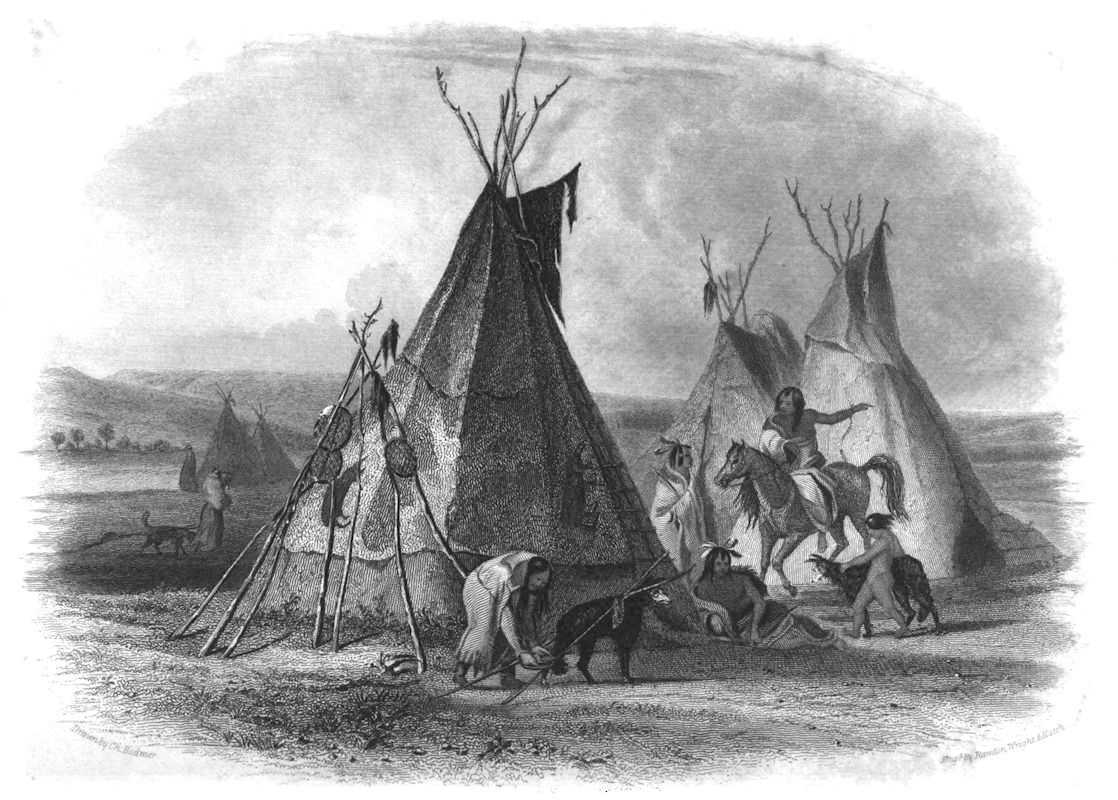
Drawn by C. H. Bodmer. Engd. by Rawdon, Wright & Hatch.
A Skin Lodge of an Assiniboin Chief.
Engraved Expressly for Graham’s Magazine.