Part 8 — REVIEW OF NEW BOOKS.
Reading edition
Past and Present, and Chartism. By Thomas Carlyle. New York: Wiley & Putnam. 2 parts, 12mo.
In these works Carlyle states his views regarding the source and character of the evils afflicting the British nation, and the means by which they may be mitigated and removed. “Past and Present” is the most splendidly written and carefully meditated of the two. It contains many sentences of remarkable force and beauty, with numerous touches of that savage humor peculiar to Carlyle. The tone of the work, however, is one of perfect discontent. The style bristles with the author’s usual extravagance about society and government, declaring both to be shams and unveracities, and sneering at all plans for improvement which the ingenuity or benevolence of others have framed. If we understand Carlyle aright, he considers that the constitutional government of England is a humbug; that William the Conqueror, and Oliver Cromwell were the best governors that England has ever had; that since Cromwell’s time the country has been governed by Sir Jahesh Windbag, strong in no faith but that “paragraphs and plausibilities will bring votes;” and that everybody is a fool or a flunkey except Thomas Carlyle. He hates every form of government which it is possible to establish in this world—democracy among the rest. If his work may be said to have any practical bearing on politics, it is this—that a governor is wanted with force enough to assume arbitrary power, and exercise it according to the dreams of mystics and sentimentalists. His system is a compound of anarchy and despotism. His ideal of a governor is of a man, with an incapacity or indisposition to explain himself, who rises up some day and cries—“the government of this country is a lie, the people cannot make it a reality, but I can and will.” His notion of the wretched condition of society is disheartening enough. Man, he tells us, has lost all the soul out of him. “This is verily the plague-spot—centre of the universal social gangrene, threatening all modern things with frightful death. You touch the focal-centre of all our disease, of our frightful nosology of diseases, when you lay your hand on this. There is no religion; there is no God; man has lost his soul, and vainly seeks antiseptic salt. Vainly: in killing kings, in passing Reform Bills, in French Revolutions, Manchester Insurrections, is found no remedy. The foul elephantine leprosy reappears in new force and desperateness next hour.” Sad condition of poor depraved humanity! A whole generation, except one man, without souls, and that one exception without his senses! It is curious to notice the illusions of an understanding so powerful when governed by a sensibility so tempestuous. It would be unjust, however, to deny the depth of many detached thoughts, and truth of some of his speculations in this volume.
It would doubtless be unjust to deny Carlyle’s claim to be considered a thinker, but he is an intense rather than a calm and comprehensive one. A comprehensive thinker looks at every thing, not singly, but in its relations; an intense thinker seizes hold of some particular thing, exaggerates it out of its proper place in the economy of the world, and looks at every thing in its relation to his own hobby. In reasoning on the evils of society and government, it is useless to growl or snarl at what you desire to improve. If a man cannot look an evil in the face without rushing off into rage at its prevalence, and considering that evil as the root of all others, he will do little for reform. Indeed, Carlyle appears to us to find delight in getting the world into a corner. Nothing pleases him more than to shoot a sarcasm at statesmen and philanthropists who are grappling practically with some abuse; in this way warning everybody to avoid particular medicines, and come to him for an universal panacea. Thus his works on social evils are substantially little more than savage jests at the depravity of mankind, and contemptuous fleers at those who are attempting to mitigate it. It is needless to remark that he is not always consistent; but this, it seems to us, is the general character of his political writings. He criticises human life as he would a play or a novel, and looks to his own taste alone in passing his judgments.
Many objections have been made to Carlyle’s style. Now style, to be good for any thing, should be characteristic of the writer; and certainly Carlyle’s style, viewed in this light, is very good. It is an exponent of himself. The fault lies in the man, not in the style. Those who contrast the diction of the Life of Schiller with Past and Present, should recollect that a change as great has occurred in the character of the author. No other style than his present could fully express the whole meaning of his thoughts. Most of his ideas are commonplace enough in themselves; and their originality consists in the peculiar modification they have received from his own mind.
The Constitutional History of England from the Accession of Henry VII. to the Death of George II. By Henry Hallam. From the Fifth London edition. New York: Harper & Brothers. 1 vol. 8vo.
This great work was originally published in 1827. Since that period the author has made many additions to it. The present edition is printed from the latest London issue, in 1846, and is therefore the best and most complete edition in the country. The Harpers have printed it in clear, readable type, on good paper, and have placed it at a price so moderate as to bring it within the means of the humblest student. Of the value and importance of the work it is hardly necessary to speak, as it has forced reluctant praise even from those whose principles and policy it condemns. It has taken a prominent place among those standard books which no library can be supposed to be without. There are probably few books since Adam Smith’s Wealth of Nations, which have equaled this in the task of demolishing prejudice, and guiding public opinion aright. The space of political history which the volume occupies, has long been the battle-ground of opposing sects, factions, and parties. Historians, who have explored it most successfully, have generally been unduly influenced by their political or religious prejudices, in their accounts of events and estimates of persons. The Whig and the Tory, the Catholic, the Churchman, and the Puritan, each has bent the truth of history to the purposes of party, and accommodated, like poets, the shows of things to the desires of the mind. This has turned English political history into historical romance. Cranmer, Burleigh, Charles I., Strafford, Laud, Hampden, Cromwell, Sidney, Marlborough, Somers, Sunderland, have been so often passed from the partisan who daubs to the partisan who damns, as to appear like the heroes of bad novels, rather than mortal men.
Mr. Hallam has been especially able and courageous in his opposition to all this perversion of facts and character. Though himself a moderate Whig, and a sturdy friend of the popular element of the Constitution, he is as remorseless in breaking the idols of the Whigs as of the Tories. He holds no terms with the declamation of either side; and, indeed, takes a peculiar delight in weighing in his impartial scales every English politician who has been the object of stereotyped admiration or hatred. Parties naturally individualize their principles, and depend a good deal for their influence on the character of their great men, and the charm of their catch-phrases. They naturally dislike that their saints and martyrs should be subjected to calm scrutinizing criticism, and deprived of their exaggerated virtues, and exhibited, naked and shivering, to the profane eyes of the crowd. Mr. Hallam, from his mind and disposition, was admirably calculated to perform this work well. Without doing positive injustice to any statesman, and heartily praising all who have labored in their generation for the public good, he has considered truth of more importance than the service of party, and has not spared the excesses of tyranny and fanaticism, even when committed by the champions of freedom and toleration. Many a fine bubble, blown up to a beautiful magnitude by the breath of political superstition, bursts the moment it feels the prick of his pen, and is “resolved into its elemental suds.” A critic very happily characterizes his work as eminently judicial. “Its whole spirit is that of the bench, not of the bar. He sums up with a calm, steady impartiality, turning neither to the right nor the left, glossing over nothing, exaggerating nothing, while the advocates on both sides are alternately biting their lips to hear their conflicting mis-statements and sophisms exposed.”
Clarsach Albin, and Other Poems. By James M. Morrison. Including his Correspondence with Clark, McCammon, and Longlap. Phila.: Zieber & Co.
We advise those who understand the Scottish dialect to read this unpretending little book. The subjects of the poems are not such as to excite much attention, and the interest of the very clever rhyming correspondence carried on by the author with Messrs. Clark, McCammon, and Longlap, must, of course, be in a great measure evanescent; but there is a sly humor, a readiness of rhythm, and very often a burst of pure poetical feeling, which will repay the reader. While we thank him for this little book, from which we have derived much pleasure, the author will allow us to say, that he is capable of far better things; and we hope to have from his pen, at some future day, a collection of pure lyrics, in good broad Scotch, both serious and playful.
Feudal Times; or the Court of James the Third. A Scottish Historical Play. By Rev. James White. New York: William Taylor & Co.
The merits of this play consist in the general vigor of its style, the elevation of its sentiment, and the bustle of its action. It appears well calculated to succeed in representation. The characters, however, and many of the incidents, show little invention or imagination; and the whole drama presents greater evidence of the playwright than the dramatist. Compared, however, with the usual run of plays, and tested by the rather gentle rules now applied to dramatic compositions, it would honorably pass muster. The interest centres in Cochrane and Margaret, two lofty natures, placed among a herd of feudal barons, and becoming their victims. There are many striking passages of poetry in the play.
Aunt Kitty’s Tales. By Maria J. McIntosh. New York: D. Appleton & Co. 1 vol. 12mo.
The authoress of these pleasant stories has won a deserved celebrity by her novel, entitled “To Seem and To Be”—a book which deserves a high place among works on practical morals. The present volume is designed more particularly for the young, and, we trust, will find its way to that interesting portion of society. We cordially join in Aunt Kitty’s wish that her efforts for the improvement of her young friends will not prove unsuccessful, and that her stories will be found “not altogether unworthy teachers of those lessons of benevolence and truth, generosity, justice, and self-government, which she designed to convey through them.”
Streaks of Squatter Life, and Far-West Scenes. By John S. Robb. Phila.: Carey & Hart. 1 vol. 12mo.
These sketches, hastily dashed off in a few hours of the author’s leisure from engrossing business, show quite an eye for character, and are exceedingly amusing. With more care in composition, and a higher aim, Mr. Robb might write a fine humorous novel. The “Streaks” in this volume are full of life, but they are too coarse. Every writer in this style would do well to study the art with which Dickens delineates the lowest and most vulgar characters, without any sacrifice either of taste or propriety.
Modern Chivalry, or the Adventures of Captain Farrago and Teage O’Regan. By H. H. Breckenridge. Phila.: Carey & Hart. 2 vols. 12mo.
This novel belongs to Carey & Hart’s Library of Humorous American Works. It is a reprint of an old book. The style is clear and familiar, the humor such as touches the risibilities, and the strokes of satire sometimes peculiarly happy. Though the author formed himself on the model of Fielding, the allusions and subject matter are essentially American. The illustrations by Darley are excellent. Like all true humorists the author makes his pleasantries the vehicle of knowledge and wisdom. He has sound political maxims embodied in jokes, and curious bits of learning swimming on the surface of his humor.
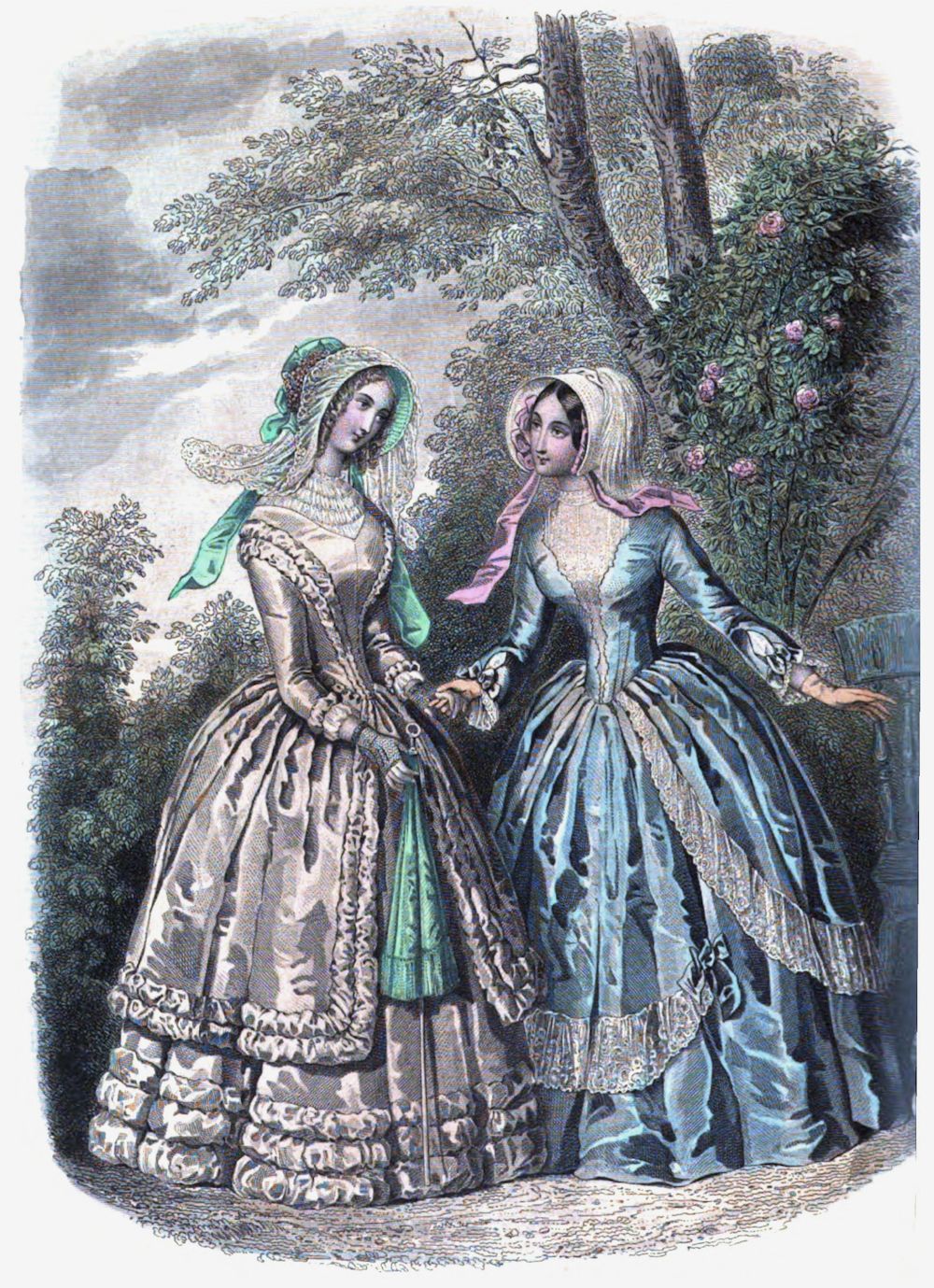
LE FOLLET
Boulevart St. Martin, 61.
Chapeaux de Mme. Penet, r. Nve. St. Augustin, 4,—Plumes et fleurs de Mme. Tilman, r. Ménars, 5;
Robes de Palmyre;—Dentelles de Violard, r. de Choiseul, 2 bis.;
Ombrelle de Lemarechal, bt. Montmartre, 17.
Graham’s Magazine.
Transcriber’s Notes:
Table of Contents has been added for reader convenience. Archaic spellings and hyphenation have been retained. Punctuation and obvious type-setting errors have been corrected without note. Other errors have been corrected as noted below. For illustrations, some caption text may be missing or incomplete due to condition of the originals available for preparation of the eBook. A cover has been created for this eBook and is placed in the public domain.
page 332, ce que tu mange, ==> ce que tu manges,
page 333, will soon loose her ==> will soon lose her
page 335, true diplomate will ==> true diplomat will
page 344, They had drank of ==> They had drunk of
page 346, pay the exhorbitant ==> pay the exorbitant
page 347, lady rung the bell ==> lady rang the bell
page 347, own and her childrens’ ==> own and her children’s
page 351, quarter of the word, ==> quarter of the world,
page 356, than he out knife and ==> than he pulled out a knife and
page 363, built of sold timber ==> built of solid timber
page 360, added [To be continued.
page 375, barren in ought save ==> barren in aught save
page 375, by an irresistable impulse, ==> by an irresistible impulse,
Le Follet, Chapeau de Mme. ==> Chapeaux de Mme.
[End of Graham's Magazine, Vol. XXX, No. 6, June 1847]