Part 6 — MR. KERR MUDGEON.
Reading edition
OR “YOU WONT, WONT YOU?”
———
BY JOSEPH C. NEAL.
———
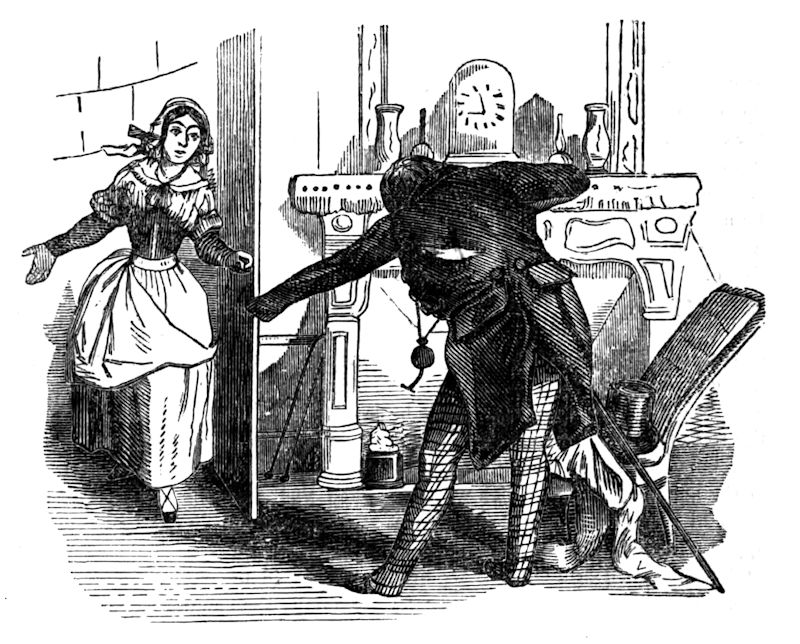
There; now!
You see—do you not?—Nay, you may almost hear it, if you listen attentively. Mr. Kerr Mudgeon—great many of the Kerr Mudgeons about, in various places—but this Mr. Kerr Mudgeon—going to a party as he was—desirous too, as people generally are on such occasions, of looking particularly well—and all ready, to his own infinite satisfaction—all ready except the final operation of putting on his bettermost coat—has torn that important article of gentlemanly costume—one may work without a coat, you know, and work all the easier for the relief; but it is not altogether polite to leave it at home on a peg when you go to a party. Torn his coat—not through his own fault, as Mr. Kerr Mudgeon would tell you explicitly enough—he never is, never was, never can be in fault—but because of that coat’s ill timed and provoking resistance to the operation of being donned. The coat might have known—who is ever thus to be trifled with in the process of dressing? Yes, the coat must have known. Ah, coats and the makers of coats have much to answer for. Kerr Mudgeon is ruffled, ruffles of this sort, causing a man to look none the handsomer or the more amiable for the ruffle. Such ruffles are not becoming.
“Ho! ho! wont go on, hey?” cried Mr. Kerr Mudgeon, and Mr. Kerr Mudgeon panted and Mr. Kerr Mudgeon blew, on the high pressure principle, until the steam of his wrath had reached its highest point.
It is a fearful moment with the Kerr Mudgeons, when it is manifest that something must break—a blood vessel or the furniture, or the peace of the commonwealth. Why will things animate and inanimate conspire to bring about such a crisis? Kerr Mudgeons would be sweet tempered if you would only permit them.
The coat positively refused to go on any further—the contumacious raiment. What could Kerr Mudgeon do in such a strait of perverse broad cloth?
“Tell me you wont go on,” muttered Kerr Mudgeon, setting his teeth, as a rifleman sets his trigger; “I’ll make you go on, I will,” shouted he.—
There’s no such word as fail with Mr. Kerr Mudgeon. Something is sure to be done when he is once fairly roused to the work. It is a rule of his to combat like with like; and so—and so—stamping his foot determinedly, and gathering all his forces for a grand demonstration against the obstinacy of tight sleeves, he carried his point as he proposed to carry it, by a rushing coup de main, to the material detriment of the fabric.—But what of that? Was it not a victory for Kerr Mudgeon? The coat had yielded to the force of his will; and if the victory had been gained at cost, is it not always so with victories?—Glory—is that to be had for nothing?—No—depreciate the cost of glory, and pray tell me what becomes of glory?—It is glory no longer. A luxury, to be a luxury, must be beyond the general reach—too expensive for the millions—too costly for the masses.
“And now—ha! ha!—ho! ho!—he! he!—come off!” shrieked Mr. Kerr Mudgeon; “Now you’ve done all the mischief you could, come off.” Kerr Mudgeon divested himself of the fractured, but now humbled, penitent and discomfitted coat, and following up his first success, like an able tactician, he danced in a transport of joy upon its mangled fragments and its melancholy remains. Ghastly moment of triumph o’er a foe. Alas, Kerr Mudgeon be merciful to the vanquished when incapacitated for the war.
But no—coolness comes not on the instant—not to the Kerr Mudgeons. They have no relationship to the Kew Cumbers. They disdain the alliance; and Mr. Kerr Mudgeon’s coat had been conquered only—not punished.
“That’s what you get by being obstinate,” added he, as he kicked the expiring coat about the room, knocking down a lamp, upsetting an inkstand, and doing sundry other minor pieces of mischief all of which, of course, he charged to the account of the coat, as aforesaid—It was coat’s fault altogether. Mr. Kerr Mudgeon is not naturally in a passion. He would not have been in a passion had it not been for the coat—not he—the coat was the incendiary cause; and we trust that every coat, frock or body—sack-coat or any other of the infinite variety of coats now in existence, with all other coats that are to be, may take timely example and salutary warning from the doleful fate of Mr. Kerr Mudgeon’s coat, that there may be no sewing of tares, and an exemption from rent. A coat is never improved by participation in battle.
And this unhappy coat, which has thus fallen a victim to its incapacity to adapt itself to the form and pressure of circumstances, is by no means a singular case in the experience of Mr. Kerr Mudgeon. We mention it rather as a symbol and as an emblem of the trials and vexations that ambuscade his way through life, to vex him at unguarded moments and shake him from his propriety. Boots, it will appear, have served him just so, particularly on a warm morning when unusual effort fevers one for the day. Did you ever see Kerr Mudgeon in a contest with his boots, when the leather, like a sturdy sentinel, refused ingress to Kerr Mudgeon’s heel and declared that there “was no admission” to the premises, in despite of coaxings, of soap, and of the pulverizations of soap-stone? If you never saw that sight, you ought to see it, before you shuffle off this mortal coil—indeed you ought, as Kerr Mudgeon toils and pants at the reluctant boots, in the vain effort “to grapple them to his sole, with hooks of steel.” Then it is most especially that a Kerr Mudgeon is “lovelily dreadful,” like ocean in a storm. Whether Salt Petre will explode or not, just set the Kerr Mudgeons at a tight boot, and you shall hear such explosions of tempestous wrath as were never heard under other circumstances. The Gun Cotton is like lambs-wool in the comparison, as Kerr Mudgeon hops about in a state of betweenity, the boot half on, half off, declining either to go forward or to retreat. We pity that boot should Kerr Mudgeon find a failure to his deep intent. It has sufferings in store—a species of storage which is never agreeable.
Corks, too—did you ever dwell upon a Kerr Mudgeon endeavoring to extract a cork, without the mechanical appliances of a screw? The getting out of corks with one’s fingers is always more or less of a trial. There is donkeyism in corks; and those that will yield a little, are generally sure to break. Concession, conciliation, and compromise demand under these circumstances, that if the cork will not come out, it should be made to go in, to employ the ingenuity of future ages in fishing it up with slip-knots and nooses. But Kerr Mudgeon with a cork—he never, “Mr. Brown,” can be prevailed upon to “give it up so;” not even if you find the cork-screw for him. Rather would he hurt his hand, loosen his teeth, break his penknife or twist a fork into an invalid condition, than allow himself to be ingloriously baffled by the contemptible oppugnation and hostility of a cork and a bottle, thirsty and impatient as he may be for the imbibation of the contents thereof. If all else fail—Kerr Mudgeon enraged, and the bystanders in an agony of nervousness at the scene—“smack” goes the bottle’s neck against a table or “whack” over the back of a chair—“you wont, wont you!”—or in the more protracted and aggravating case, “smash!” goes the whole bottle to the wall, for the embellishment of paper hangings and the improvement of carpeting—Victoria!
Something is always the matter, too, with the bureau when he would open or shut a drawer.—Either it will not come out or it wont go in. That drawer must take the consequences; and doors—lucky are they to escape a fractured panel, if doors prove refractory, as doors sometimes will.—Nobody can open a door so featly as a Kerr Mudgeon.
“You wont, wont you?” and so he appeals to the ultima ratio regum—the last reasoning of Kings—which means as many of thumps, cuffs and kicks as may be requisite to the purpose. It is a knock-down argument.
Pooh! pooh!—how you talk of the efficacy of the soft answer in the turning away of wrath.—Nonsense, Mr. George Combe, that wrath to the wrathful is only fuel to the flame. Mr. Kerr Mudgeon has no faith in passive resistance and in other doctrines of that sort. Smite his cheek, and then see what will come of the smitation. Go to him if you want “as good as you give,” and you will be sure to obtain measure, exact, yea, and running over.
And so Mr. Kerr Mudgeon has always a large stock of quarrel on hand, unsettled and neat as imported—feuds everywhere, to keep him warm in the winter season. A good hater is Mr. Kerr Mudgeon—a bramble bush to scratch withal.
“Try to impose on me,” says Kerr Mudgeon, “I’d like to see ’em at it. They’ll soon find I’m not afraid of anybody;” and he therefore seeks to impress that fact with distinctness on everybody’s mind; and, in consequence, if anybody has unexpended choler about him—a pet rage or so, pent up, or a latent exasperation—make him acquainted with Kerr Mudgeon, and observe the effect of the contact of such a spark as Mudgeon with an inflammable magazine. Should you find yourself peevish generally, and a little crusty or so, to those around you—primed, as it were, for contention, should it be fairly offered, stop as you go to business, at Kerr Mudgeon’s. He will accommodate you, and you will feel much better afterward, you will—“calm as a summer morning,” as the politicians have it.
Kerr Mudgeon rides; and his horse must abide a liberal application of whip and spur, sometimes inducing it as a corollary—is a tumble to be regarded as a corollary from the saddle?—inducing it as a corollary, that Kerr Mudgeon must abide in the mire, with a fractured tibia or fibia, as the case may be. “You wont, wont you?”— and there are horses who don’t, when not able clearly to understand what is to be done. Now, the horse swerves, and Kerr Mudgeon takes the lateral slide. Again the steed bows—with politeness enough—and Kerr Mudgeon is a flying phenomenon over his head—gracefully, like a spread-eagle in a fit of enthusiasm. When he is down he says he never gives up to a horse.
Kerr Mudgeon delights also to quicken the paces of your lounging dog, by such abrupt and sharp appeal to the feelings of the animal as occasion may suggest; and often there is an interchange of compliment, biped and quadrupedal, thus elicited, returning bites for blows, to square accounts between human attack and canine indignation. Some dogs do not appreciate graceful attentions and captivating endearments. “Dogs are so revengeful,” says Kerr Mudgeon. His dogs always run away; “dogs are so ungrateful, too,” quoth he.
Unfortunate Kerr Mudgeon!—What is to become of him until the world is rendered more complaisant and acquiescent, prepared in all respects to go his way?
In the street, he takes the straightest line from place to place, having learnt from his schoolboy mathematics, that this is decidedly the shortest method of going from place to place. And yet, how people jostle him, first on the right hand and then on the left? Why do they not clear the track for Kerr Mudgeon?
Then at the Post Office, in the hour of delivery.
Kerr Mudgeon wants his letters. What is more natural than that a man should want his letters?
“Quit scrouging!” says somebody, as he knocks Mr. Kerr Mudgeon in the ribs with his elbow.
“Wait for your turn!” cries somebody else, jostling Mr. Kerr Mudgeon on the opposite ribs.
Still Kerr Mudgeon struggles through the press, resolved upon obtaining his letters before other people obtain their letters, having his feet trampled almost to a mummy, his garments disarranged, if not torn, and in addition to bruises, perhaps losing his fifty dollar breast-pin, to complete the harmony of the picture; but still obtaining his letters in advance of his competitors—five minutes saved or thereabouts—what triumph! what a victory! To be sure, after such a struggle, Mr. Kerr Mudgeon consumes much more than the five minutes, in putting himself to rights, and finds himself in a towering passion for an hour or two, besides groaning for a considerable length of time over his bruises and his losses, all of which might have been escaped by a few moments of patience. But then the victory—“you wont, wont you?” Was Kerr Mudgeon ever baffled by any species of resistance? Not he.
“People are such brutes,” says he; “no more manners than so many pigs—try not to let me get my letters as soon as any of them, will they? I’ll teach ’em that a Kerr Mudgeon is not to be trifled with—just as good a right to be first as anybody; and I will be first, wherever I go, cost what it may.”
We do not know that Kerr Mudgeon ever entered into a calculation as to the profit and loss of the operation of the rule that governed his life in intercourse with society. Indeed, we rather think not. But it is probable that in the long run, it costs as much as it comes to, if it does not cost a great deal more, thus to persist in having one’s own way in every thing. In crossing the street now, when the black and fluent mire is particularly abundant, Mr. Kerr Mudgeon insists upon the flag-stones—“as good a right as anybody,” and thus pushes others into a predicament unpleasant to their boots and detrimental to their blacking, so that their understandings become clouded, as they lose all their polish. In general, such a course as this does very well—but it will sometimes happen, as it has happened, that two Kerr Mudgeons meet—the hardest fend off—and thus our Kerr Mudgeon is toppled full length into a bed much more soft than is altogether desirable, which vexes him.
Did you, of a rainy day, ever see Kerr Mudgeon incline his umbrella to allow another umbrella to pass? We are sure you never did. Kerr Mudgeon’s umbrella is as good as anybody’s umbrella, and will maintain its dignity against all comers, though it has been torn to fragments by the sharp points of other umbrellas, which thought themselves quite as good as it could pretend to be—and so, Kerr Mudgeon got himself now and then into a fray, to say nothing of suits for assault and battery, gracefully and agreeably interspersed. Ho! ho! umbrellas!—“you wont, wont you?”
Kerr Mudgeon walks with a cane—carries it horizontally under his arm, muddy at the ferule perchance; and canes thus disposed, come awkwardly in contact with the crossing currents of persons and costumes. But what does he care for the soiled garments of the ladies or the angry countenances of offended gentlemen? Is not Kerr Mudgeon with his cane, as good as anybody else and his cane? Horizontally—he will wear it so. That’s his way.
“The world don’t improve at all,” cries Kerr Mudgeon. “They may make speeches about it, and pass resolutions by the bushel; but it is my candid opinion that it grows obstinater and obstinater every day. It never yields an inch, and a man has to push, and to scramble, and to fight forever to make any headway for himself—black and blue more than half the time. Every day shoots up all over rumpuses and rowses. But, never mind—the world needn’t flatter itself that it’s a going to conquer Kerr Mudgeon and to put him down too, as it does other people. Kerr Mudgeon knows his rights—Kerr Mudgeon is as good as anybody else. Kerr Mudgeon will fight till he dies. He was never made to yield, and he never intends to yield, so long as his name is Kerr Mudgeon. It’s a good name—never disgraced by movements of the knuckle-down character, and I’m determined to carry on the war just as all the Mudgeons did that went before me. If a horse kicks me, I’ll kick him back; and I wouldn’t get out of the way, like Mr. Daniel Tucker in the song, if a thirty-two pound shot was coming up the street, or a locomotive was a whizzin’ down the road. Stand up straight—that’s my motto. Give ’em as good as they can bring; that’s the doctrine; and while a single bit of Kerr Mudgeon remains—while any of his bones hang together, that’s him squaring off right in the centre of the track, ready for you, with his coat buttoned up and a fist in each of his hands.”
Kerr Mudgeon’s face is settled grimly into the aspect of habitual defiance. His brows are forever knitting, not socks or mittens, but frowns, and his mouth is knotted like a rope. When he looks around, it seems to be an inquiry, as to whether any gentleman present is disposed to pugilistic encounter,—if so, he can be accommodated; and the whole disposition of his garments indicates contention—war to the knife.
Kerr Mudgeon complains that he has no friends, and is beginning to stand solitary and alone, with but a dreary prospect before him, in a world that grows “obstinater and obstinater every day;” and he has yet to learn, if such learning should ever penetrate through the armor of hostility wherewith he is begirt, that perhaps, if we desire to have a smooth and easy time of it, we must ourselves begin by being smooth and easy. The belligerent ever meets with belligerents. There’s no difficulty about that. There is a sufficiency of war in every atmosphere, if you are disposed to condense it upon yourself; and no one eager to enjoy the pleasure, need wander far in search of quarrels. Kerr Mudgeon finds them everywhere—“rumpuses and rowses”—But it is a shrewd doubt whether one’s general comfort is greatly promoted by the aggravation of rudeness and roughness. It is easier to bend a little to inclement blasts, than to be snapped off by perpendicular resistance—easier to go round an obstacle than to destroy your temper and your clothing, in the exhausting effort to clamber over it; and it may be said of every quarrel in which Kerr Mudgeonism is engaged, that probably both parties are in fault, though Kerr Mudgeonism is in all likelihood, the responsible party.
Yet, “you wont, wont you?” is a great temptation to combativeness and destructiveness. Is it not, all ye people of the Kerr Mudgeon temperament?
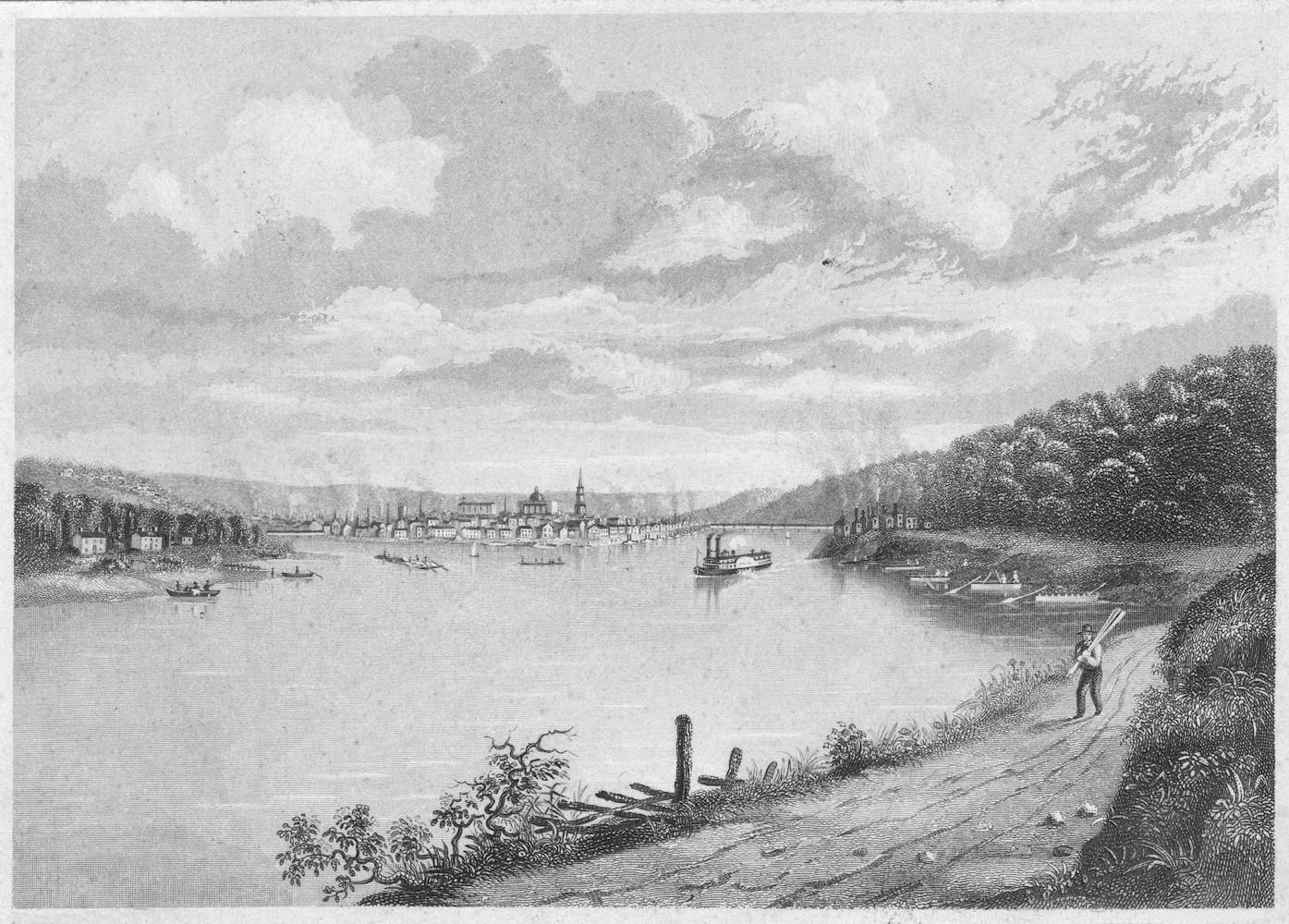
Painted by Frankenstein Engraved by A. W. Graham
PITTSBURG
Engraved expressly for Graham’s Magazine