Part 3 — REVIEW OF NEW BOOKS.
Reading edition
History of the Thirty Years’ War. Translated from the German of Frederick Schiller. By the Rev. A. J. W. Morrison, M. A. New York: Harper & Brothers. 1 vol. 12mo.
In the opinion of Carlyle this is the best philosophical history that Germany has produced. The Harpers have reprinted it in the cheap and elegant series of valuable books, entitled their “New Miscellany.” The volume presents a graphic and exceedingly interesting view of one of the most terrible and devastating wars with which Europe was ever cursed. It represents the struggle of the Protestant States against the overgrown power of Austria, and the various motives, religious and devilish, which animated the parties during the contest. The skill and bravery of the commanders engaged in the war, give a personal as well as general interest to the narrative. On the one side we have Gustavus Adolphus, Count Thorn, Mansfield, Bernard of Weimar, Banner, Torstensohn, on the other Wallenstein, Tilly, Piccolimini, Pappenheim, and Hatzfeld. Gustavus Adolphus and Wallenstein are, of course, the leading objects of interest. In reading this history the mind becomes so accustomed to the devastation of provinces, the murder of peasants, and horrible outrages on all the decencies and sanctities of life,—that fire, famine and slaughter become mere commonplaces and matters of course. We read, at last, the most terrible accounts of wretchedness and cruelty, with hardly a shudder. Schiller, in summing up the various evils of this war, a war which devastated whole provinces, reduced towns and cities to ashes, “smothered the glimmering sparks of civilization in Germany, and threw back the improving manners of the country into their pristine barbarity and wildness,” still finds consolation in the thought that from this fearful war Europe came forth free and independent. “In it she first learned to recognize herself as a community of nations; and this intercommunion of States, which originated in the thirty years’ war, would alone be sufficient to reconcile the philosopher to its horrors.” There is, in truth, some consolation in the idea that a soul of goodness abides in things evil,—that men, mad with passion or drunk with fanaticism, cannot hack each other to pieces, without having their blind fury directed by a higher power to a good result.
The History of Civilization from the Fall of the Roman Empire to the French Revolution. By F. Guizot. Translated by William Hazlitt. New York: D. Appleton & Co. 4 vols. 12mo.
No person can have watched the course of the prominent American publishers of the United States, without observing a manifest improvement, within the last three or four years, in the character of the books they reprint, and the style of their execution. The house of Appleton & Co. have been especially distinguished for the intrinsic value, and the cheapness and elegance, of their publications. Their mercantile daring, in hazarding capital on books which were not considered, until lately, profitable speculations, deserves the highest praise. The present edition of Guizot’s admirable work on Civilization, is one of their most important additions to the stock of works, combining great learning and profound thought, with some of the most charming qualities of style. The first portion of the present publication, on the General History of Civilization in Europe, is well known; but the other three volumes, containing Guizot’s lectures on the History of Civilization in France, have been but lately translated. Guizot is probably the greatest historian that France has produced, in the combination of those qualities which go to make up a genius for history. He yields to none in the research which collects facts, the understanding which analyses and arranges them, and the imagination which represents them as realities, and endows them with substantial life and meaning. To all these advantages, he adds a beautiful clearness, vigor and brilliancy of style, in narrating the progress of events and setting forth their laws and principles. The present history is at once popular and profound. It is calculated to delight and instruct the common reader as well as the student. We cordially recommend it to all, as a book containing a vast amount of erudition and thought, devoted to the illustration of a subject in which everybody has an interest, and calculated to improve the literary taste of the reader, as well as to inform and enlarge his understanding.
Stories from the Italian Poets. By Leigh Hunt. New York: Wiley & Putnam. 1 vol. 12mo.
This is one of the most entertaining volumes of the season. It contains a summary in prose of Dante’s Divine Comedy, and various stories from the poems of Pulci, Boiardo, Ariosto and Tasso, with occasional passages versified, and some interesting critical notices of the lives and genius of the poets. In the criticisms Hunt evinces a knowledge of his authors, founded on a long acquaintance with them, and a keen enjoyment of their excellencies. The account of the Divine Comedy is the best, for the general mind, which we have yet seen in English, and is calculated to give delight to thousands, to whom Cary’s translation would be a bore. The stories from Pulci are exquisite for their mirthful beauty. The tales from Boiardo, Ariosto and Tasso, will introduce the common novel reader into a new world of beauty, heroism and romance. The passages of grandeur and sublimity, of pathos and sweetness,—the images both delicate and magnificent, with which the volume abounds,—make its circulation in this country a thing devoutly to be wished. It will enable the reader to obtain some idea of the splendor and opulence of the Italian mind, in all which enchants the senses and thrills the imagination.
Hunt’s critical notices and occasional comments are very characteristic. His style has the same sweetness and felicity which constitute the charm of his other essays; and is dotted over with those little impertinences of personal opinion, from which nothing that he writes is wholly free. His remarks on Dante throw more light upon his own character than that of his subject. From the very constitution of his mind he revolts at all infliction of suffering, even for sin. He would have ice-creams in Pandemonium. He is inexpressibly shocked at Dante’s severity and spleen, and speaks many a fair word for the poor rascals whom the austere Florentine has consigned to perdition. His comments on the remorseless severity of the punishments in Hell,—his indignation that Cato should be placed in Purgatory while his wife, Marcia, sojourns in the pit,—his exceptions to some of the persons placed on high seats in heaven,—are often exquisitely amusing. It requires a man like Hunt to criticise a man like Dante.
The Poetical Works of Thomas Moore. New York: D. Appleton & Co. 1 vol. 8vo.
This is a splendid edition of one of the most popular of English poets. It has ten fine steel embellishments, and its general execution places it very nearly on a level with the English edition. As a specimen of American typography it is very honorable to the enterprising publishers. It is the only complete edition of Moore ever published in this country, being reprinted from the London collection, lately edited by the poet himself, and containing his autobiographical prefaces and illustrations. In these the poet very pleasantly prattles about his own life and works, and is exhibited as the most graceful of egotists. The volume contains an immense number of brilliant verses, ranging in subject from the romantic poem to the political squib. Without depth of passion, elevation of sentiment, or grandeur of imagination, the poems of Moore still evince a quickness of sensibility, an opulence of fancy, and a brilliancy of wit, which have made them among the most popular works produced within the present century. His poems are lit up with an incessant shower of sparkling fancies. Almost everything he has written is full of glitter and point—his sentiment as well as his satire. His songs are often epigrams of feeling. Though, as a poet, he can hardly stand by the side of Wordsworth, Shelley, Coleridge, or Byron, in the greatest qualities of the bard, yet no one can glance over the present volume without being impressed with the brilliant genius of its author, and fascinated with the stores of wit, fancy, learning and sentiment, which glisten and gleam on every page.
The French Revolution. A History. By Thomas Carlyle. Newly Revised by the Author, with Index. New York: Wiley & Putnam. 3 Parts. 12mo.
This is Carlyle’s grandest work—a prose epic on the great event of modern history. In our narrow limits we cannot hope to do any thing like justice, to the imagination, fancy, learning, humor, pathos, sublimity, characterization, with which the volumes abound. In spite of some obstinate faults, in spite of much false and pernicious doctrine, in spite of the style, no work ever written on the French Revolution equals this in the clearness with which it represents the causes of that revolution, in the vividness with which it brings up its different events in magnificent pictures, speaking directly to the eye, and in the grandeur of its delineations of the principal actors in the drama. The portraits of Mirabeau, Danton, Robespierre, are masterpieces. Every page glows with vital life. The words are all alive with meaning. They paint objects so distinctly that we become observers of the scenes to which they relate. Carlyle, in truth, is a master of expression as distinguished from mere fluency. He selects the “inevitable best word,” or compounds it, with an unmistakable tact and sureness. If to his other great qualities he joined calmness, comprehension, mental honesty, the present work would be almost perfect. Viewing it with an eye to all its faults, it must be pronounced a work of great genius and power.
The Life and Correspondence of John Foster. Edited by J. E. Ryland. New York: Wiley & Putnam. 2 vols. 12mo.
Foster is well known as the author of a volume of essays, laden with weighty thought and acute observations on character and life. The present volume, containing his letters and journals from his earliest to his latest years, is one of great value, not merely to his own sect, the Baptists, but to all who can appreciate originality of character and thought. Foster was a hard, determined, patient thinker, gifted with much imagination, and impressing on every thing he wrote the invincible honesty of his character. His correspondence reveals to us the inmost recesses of his mind and disposition, and constitutes a kind of psychological autobiography, replete with materials of interest and instruction. The separate thoughts scattered over these volumes would alone be sufficient to reward abundantly the trouble of its perusal. One of the strongest peculiarities of genius, Foster says in one place, “is the power of lighting its own fire.” Of a soft and pensive evening, he remarks—“It is as if the soul of Eloisa pervaded all the air.” Shakspeare, he observes, had perceptions of every kind; “he could think every way. His mind might be compared to that monster the prophet saw in his vision, which had eyes all over.” Again he says—“Lord Chatham did not reason; he struck, as by intuition, directly on the results of reasoning; as a cannon-shot strikes the mark without your seeing its course through the air as it moves towards its object.” When shown a piece of ornamental worsted-work, with a great deal of red in it, he said “it was red with the blood of murdered time.” The volumes are full of thoughts and observations equally striking and pointed.
The New Timon. A Romance of London. Philadelphia: Carey & Hart. 1 vol. 12mo.
This poem has excited no inconsiderable interest in London. It is reprinted from the third English edition. Bulwer has been mentioned as the probable author, but this must be a mistake, unless Bulwer has essentially changed his literary opinions. Wordsworth, Keats and Tennyson, each of whom the author of “Pelham” has warmly praised, the author of “Timon” most ignorantly and pertly ridicules. The poem, it must be admitted, has much merit. It is written in a vigorous style, contains numerous passages of flashing description, much keen portraiture of prominent English politicians, and many beautiful scenes of pathos and passion. The pith and nerve of the verse, the half-misanthropic, half-romantic tone of the sentiment, the frequent allusion to contemporary events and persons, and the bitter sharpness of the satire on social evils,—often remind the reader of Byron. The work evidences a brilliant and restless intellect, ill at ease with the manners and institutions of society, scornful, dogmatic and perverse, but quite felicitous in running keen observations into the moulds of fancy and wit. Kinglake, the author of Eothen, might have written it. The author’s character is a composite, made up of Diogenes and Alcibiades.
Memoirs of the Life of Addison. By Miss Aiken. Philadelphia: Carey & Hart. 1 vol. 12mo.
The publishers of this volume have started a “Library for the People,” of which the Life of Addison constitutes No. 5. It makes a volume of about 300 pages, elegantly printed. The price is only fifty cents, or one-fourteenth of the cost of the English edition. All the mistakes of the English edition, so acutely pointed out by Macaulay, have been corrected in the American reprint. The work is well written, and introduces us to a most interesting period of English literature and history. The correspondence of Addison confers great value upon the work. Most of the letters were never before printed. The beautiful character of the subject, joined to the immense influence which his writings have exerted on English letters and manners, give to the details of his virtuous and well-spent life a peculiar interest and charm. A volume which introduces us so completely to Addison, and strengthens that affectionate companionship with him, which his works may have commenced, cannot fail to be popular.
The Poetry of Wit and Humor. Selected from the English Poets. With an Illustrative Essay, and Critical Comments. By Leigh Hunt. 1 vol. 12mo.
The matter of this book will ensure its success. It contains extracts from Chaucer, Shakspeare, Ben Jonson, Beaumont and Fletcher, Suckling, Dryden, Pope, Goldsmith and Wolcot, with running comments on the authors and on particular passages of the poems. The essay on Wit and Humor, though it does not exhaust the topic, is ingenious, and pleasantly illustrated. We do not think that in the case of a few of the authors, Hunt has hit upon the happiest selections. Few, for example, would obtain an idea of the comic genius of Fletcher from the specimens quoted in the volume. The task, however, was a difficult one to perform; and the editor, in compiling an entertaining volume, has done all that perhaps could be expected, in the limited space to which he was confined.
The Island Bride, and other Poems. By James F. Colman. Boston: Wm. D. Ticknor & Co. 1 vol. 12mo.
The most superficial glance over this volume would convince even the supercilious critic, that the author is destined to take a high rank among American poets. “The Island Bride” contains nine Cantos of Spenserian verse, finished in diction, poetical in feeling, and replete with thought, fancy and imagination. It is one of the very few long poems in American literature, which more than repay perusal. The other pieces are of much merit, and bear unmistakable marks of power. The most surprising quality manifested in the volume, is perhaps the correct taste which is everywhere observable throughout its pages. It seems the work of a veteran in composition, rather than the first volume of a youthful poet. We should be pleased, had we time, to make it the subject of a more extended notice; but at present, we can do little more than cordially commend it to the notice of our readers.
Classical Antiquities, a Compendium of Roman and Grecian Antiquities, with a Sketch of Ancient Mythology. By Joseph Salkeld. New York: Harper & Brothers. 1 vol. 12mo.
The object of this volume is a good one, and it will be found eminently useful. To read modern books understandingly, some knowledge of the religion, government and manners and customs of the Greeks and Romans, is indispensable, from the multitude of allusions to them throughout every department of modern literature. In addition to this, the subject of Classical Antiquities is sufficiently interesting of itself, to justify the reading of a much larger book than the present. The “way of life” among two nations, which have once held a vast dominion on earth, by virtue of their power and policy, and still hold even a vaster dominion over the mind by virtue of their literature, must be interesting to every reflective and curious mind.
Rationale of Crime, and its Appropriate Treatment; being a Treatise on Criminal Jurisprudence considered in relation to Cerebral Organization. By M. B. Sampson. With Notes and Illustrations by E. W. Farnham. New York: D. Appleton & Co. 1 vol. 12mo.
The character of this volume is indicated by its title. It is the application of the principles of phrenology to the phenomena of crime. The notions of the author are illustrated by a number of portraits of criminals and other persons, the shape of whose heads are said to indicate the bent of their characters. The book is readable, even to unbelievers in the science of bumps. Phrenology, however, to all intents and purposes, is an exploded system; and thieves and murderers cannot, at this day, save themselves from punishment, by exhibiting in extenuation of their crime, the most gigantic organs of acquisitiveness and destructiveness.
Notes on the Northwest and Valley of the Upper Mississippi. By Wm. J. A. Bradford. New York: Wiley & Putnam. 1 vol. 12mo.
A work like this has long been wanted. The large mass of readers are singularly deficient in accurate knowledge respecting the great region of which it treats. Mr. Bradford has interesting chapters on the physical geography, history, topography, pursuits, health, geology, botany, monuments, and aboriginal inhabitants of the Northwest. Under this name he includes the country between Lakes Superior and Michigan, east,—the Illinois and Missouri Rivers, and the Northern Boundary of the United States,—including Iowa and Wisconsin, part of Michigan northwest of the Straits of Mackinaw, and Northern Illinois and Missouri.
Poetry and Truth from my Life. From the German of Goethe. By Parke Godwin. New York: Wiley & Putnam. 2 Parts, 12mo.
It is singular that this is the first good English translation of the celebrated work of Goethe on his own life. As a record of the external influences and internal experiences, which went to form the character of Germany’s master-intellect, it is one of the most important works of the age. Carlyle, in referring to it, well says—“what would we give for such an autobiography of Shakspeare, of Milton, even of Pope or Swift?” The publishers have included it in their series of “Choice Books”—an enterprise which they have successfully extended to eighty numbers, without any evidence of exhausting their materials.
Something for Every-Body: Gleaned in the Old Purchase, from Fields often Reaped. By Robert Carlton. New York: D. Appleton & Co. 1 vol. 12mo.
This book well bears out its title. It is a collection of anecdotes, personal adventures, and hits upon popular errors. The author is a shrewd observer of life and character, and has an eye for the tendencies of popular movements. There is much sense and humor in his remarks on the various moral reforms of the day. He is “a gentleman of the old school,” and perhaps does not always do complete justice to the objects of his sarcasm or indignation; but he well probes their weak points.
Sartor Resartus: the Life and Opinions of Herr Teufelsdröckh. In Three Books. New York: Wiley & Putnam. 1 vol. 12mo.
This edition of Carlyle’s celebrated work on the philosophy of clothes, is revised by the author; and Wiley & Putnam are authorized by him, to “print and vend the same in the United States.” The book, itself, with all its wildness of style, is one of the most fascinating works of the century—full of splendid imagination, deep thought, and humorous insight into life, character and manners. Its wealth of pictorial expression, would alone entitle it to a high rank among works of imagination. The present edition is altogether the best and most elegant ever published in the United States.
Experimental Researches on the Food of Animals, and the Fattening of Cattle; with Remarks on the Food of Man. By Robert Dundas Thomson, M. D. New York: D. Appleton & Co. 1 vol. 12mo.
This work presents the results of an extensive series of original experiments, undertaken by order of the British government. It is full of matter important at once to the practical agriculturist and the scientific physiologist. The publishers have issued it in a cheap form, so as to bring it within the reach of the humblest means. The author is evidently a patient man of science, who may be relied upon as a close observer of facts, and strict reasoner from them. No farmer can well dispense with the book.
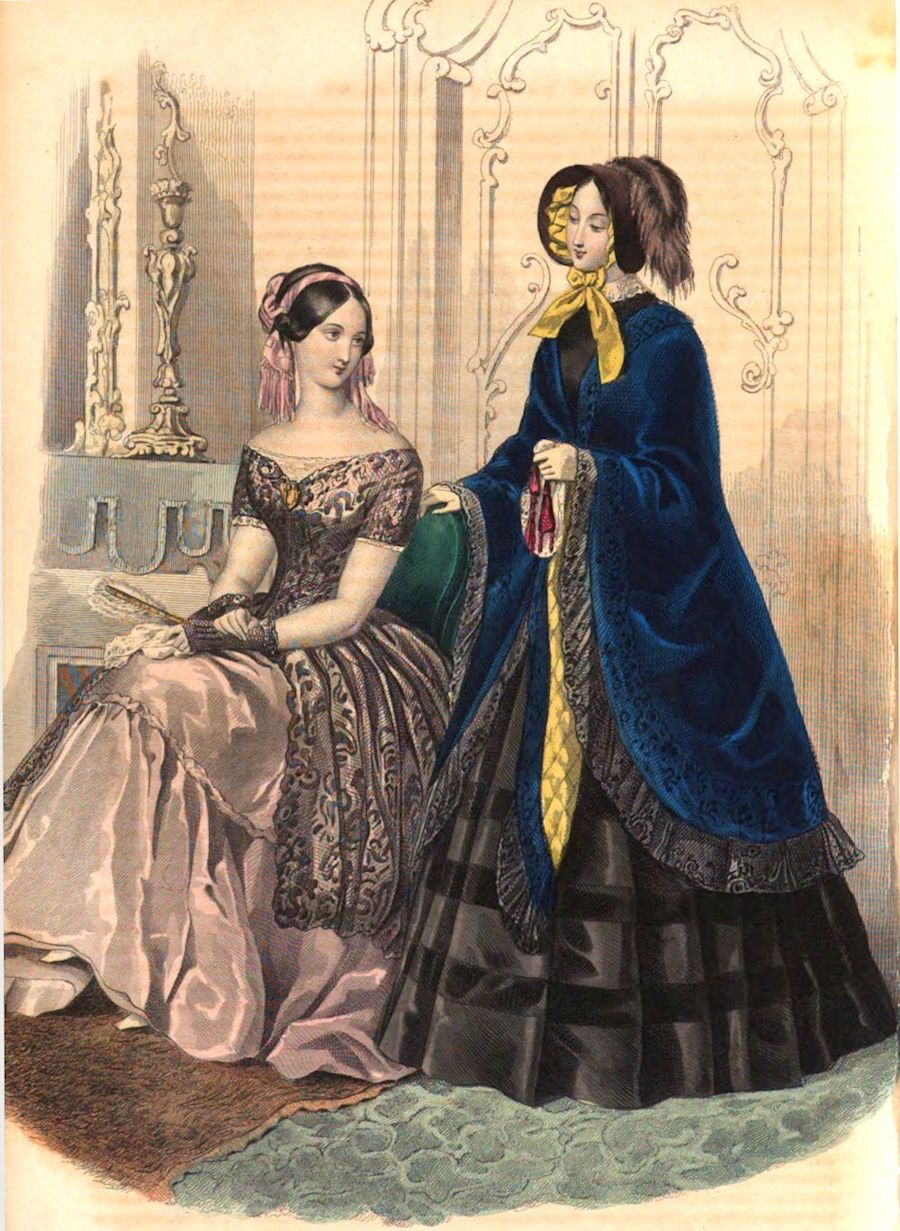
LE FOLLET
Boulevart St. Martin, 61.
Coiffure de Normandin, passage Choiseul, 19—Chapeaux de Mme. Baudry, r. Richlieu 87;
Toilettes de Mme. Ferrière Pennona, r. Mondovi, 1—plumes de Mme. Tilman, rue Minars, 5;
Dentelles de Violard, r. de Choiseul, 2bis—Mouchoirs de L. Chapron & Dubois, r. de la Paix, 7;
Essences & flacons de Guerlain, r. de la Paix, 11—Chaussures de Hoffmann, r. du Dauphin, 9.
Graham’s Magazine.
Transcriber’s Notes:
Table of Contents has been added for reader convenience. Archaic spellings and hyphenation have been retained. Punctuation has been corrected without note. Other errors have been corrected as noted below. For illustrations, some caption text may be missing or incomplete due to condition of the originals available for preparation of the eBook.
page iv, by Charles E. Cathrall, 149 ==> by Charles E. Cathrall, 140
page iv, Fox and Saukie Indians, ==> Saukie and Fox Indians,
page 5, a suprise took place ==> a surprise took place
page 21, like barks again put ==> like barques again put
page 28, thou seeest, hearest, ==> thou seest, hearest,
page 30, the streets, massacreing ==> the streets, massacring
page 31, supremay of the Pope! ==> supremacy of the Pope!
page 31, they were massacreing men, ==> they were massacring men,
page 46, your neice, I might ==> your niece, I might
page 51, with a manifest distate ==> with a manifest distaste
page 54, this arrangment, but in ==> this arrangement, but in
page 55, was a taunt top-mast, ==> was a taut top-mast,
page 60, would be villified ==> would be vilified
page 144, Firm of Domby & Son ==> Firm of Dombey & Son
Le Follet, Chapeau de Mme. Baudry ==> Chapeaux de Mme. Baudry
[End of Graham's Magazine, Vol. XXX, No. 1, January 1847, George Rex Graham, Editor]