A NIGHT AT HADDON HALL.
Reading edition
———
BY THE AUTHOR OF “LETTERS FROM ANCIENT CASTLES.”
———
The following extraordinary circumstance, which occurred to a young lady whilst on a visit at the house of an English nobleman of the highest rank, is, I believe, unparalleled for acute mental anguish and excitement, during the hours of its continuance. It was related to us by the descendant of a person who resided in the Hall during its occurrence, and I have every reason to believe it to be substantially true, in all its main features. In order to make it more intelligible, and give it that effect to which it seems well entitled, a short description of the place may perhaps be allowed.
Haddon Hall, in the county of Derby, is situated in the upper or mountainous part of the county, called, from that circumstance, the High Peak. The manor of Haddon, at the time of the Norman invasion, in the year 1066, was given by the conqueror to William Peverel, his natural son, whose descendants were named Avenel, and in them it remained till towards the close of the twelfth century, when it changed possessors by the union of Avicia Avenel with Sir Richard de Vernon, whose heirs held it for three centuries, at which time it became the properly of the noble family who now retain it, by the marriage of Dorothy, daughter of Sir George Vernon, with Sir John Manners, second son of the Earl of Rutland, in 1565, very nearly three hundred years ago. Sir George Vernon had the proud title of King of the Peak conferred upon him by courtesy, in consequence of his splendid hospitality, and immense number of servants and retainers, during the reign of King Henry the Eighth.
The gray towers of ancient Haddon are beautifully situated, on a rocky eminence, in the valley of the Derbyshire Wye, one of the many lovely streams in that picturesque county. It is surrounded by a park, abounding with ancient oaks of gigantic size, and a terrace garden of the greatest beauty. This noble old place, although long since abandoned by the family of the Duke of Rutland, for the more modern and magnificent Palace of Belvoir, in Lincolnshire, is still kept in perfect order and repair, and is probably the most perfect specimen of a baronial residence extant in England. The tapestries, teeming with subjects from holy writ and heathen mythology, still adorn the walls, covering the wainscotings and doors; and any one wishing to exemplify the scenery of Shakspeare, where Hamlet slays Polonius behind the arras, has only to visit Haddon and find a true original of that from which the immortal poet painted his terrific scene. The antique heir-looms of the Vernons and Rutlands are all in place as they stood centuries ago. The lofty state-bed, with its gorgeous but faded hangings, worked by the fair hands of lady Katherine De Roos, wife of Sir George Manners, is a splendid specimen of the period. The suits of ancient armor, in which many a gallant knight did battle during the wars of the rival roses, are hanging on their original pegs in the armory under the long gallery. The chapel, in the crypt of the castle, the most ancient part of it, exhibits huge pillars coeval with the times of the Saxons, whilst the walnut tree pulpit and pews are richly carved with the symbols of the catholic faith. The silver dogs, or andirons, are yet on the ample hearths of the long gallery, and, at the upper end of the banqueting hall, on the dais, or elevated part of the floor, still stands, firm as a rock, the huge long oak table on which, heretofore, the lord of the mansion feasted his friends and tenants. Over one side of this hall is the music gallery, where the minstrels of yore played and sang, its antique and curious front highly adorned with gothic carving. Against the door post of the banqueting hall is the hand bolt—used in the old times as a mode of punishing the domestics who had been guilty of irregularities. It consists of an iron ring, by which the wrist of the offender can be locked in, and secured, as high as he can reach, above his head; and the unlucky culprit who refused to take off his horn of liquor in turn, or committed any petty offence against the laws of conviviality, had the alternative presented to him of quaffing a beaker of salt and water, or having his arm bolted in, whilst a quantity of cold spring water was poured down the upraised sleeve of his doublet, until it ran over the tops of his boots. The iron cresset is yet fixed on the loftiest pinnacle of the watch-tower, wherein the beacon fires blazed during alarms in the civil wars. All, all are there; and it is impossible to walk through the mazes of such a perfect, such a glorious specimen of the olden time, without an innate, reverential, awful feeling, as if you had been born and had lived during those antique days, and were removed backward in the world many hundreds of years. You feel as if you were become part and parcel of the ancient things which at every turn meet your wondering eye. Any stranger, used to a town life, might well be excused, on entering Haddon, for entertaining thoughts and feelings of a grave and sombre cast, when every article recalls the memory of those who, for so many ages, have departed for “that undiscovered country from whose bourne no traveler returns.”
It is now very many years ago, during the life of one of the dukes of Rutland, who was facetiously named “John of the Hill,” from his perpetual residence on the moors and ardor in the chase, that a large party had assembled at Haddon to enjoy the recreation of autumnal sports. Among the guests was a young lady named Chamberlain, of good birth but impoverished fortune, owing to lamentable reverses in her family. She was the companion of a lady of high rank, and as such, of course, possessed of superior accomplishments.
Miss Chamberlain was mistress of extraordinary acquirements, added to an energy of mind and force of character seldom to be found in a beautiful girl of eighteen. She, with the Countess of Carlisle, whose protégé she was, arrived at the Hall on the evening previous to the night of the terrifying scenes about to be related.
The house being full of company, the room which the groom of the chambers appropriated to Miss Chamberlain was that particular one still shown at the eastern angle of the inner, or rather upper quadrangle, overlooking the terrace garden. That particular room had not been occupied for many months, and, as it was then October, Miss Chamberlain found when she retired a good wood fire blazing on the hearth. She had found in the library the earliest known edition of the immortal Dante, and, being well versed in its language, she carried the volume to her room. Having carefully bolted the door, before letting fall the arras which covered it, she sat long reading the divine work. In such a place, at such an hour, there is no doubt that the terrific pictures presented to the imagination by the power of such an author as Dante, had much effect in imbuing her mind with a greater feeling of awe for what was to follow. Having closed the volume, made her toilet, and imprisoned the last ringlet, the innocent girl turned to the antique mirror to take a last smiling glance at those charms which had that evening called forth many a delicate compliment from the young and gallant Marquis of Granby, the Duke’s son. She then, with profound piety, recommended herself to the Divine protection, extinguished her lamp, and, by the light of the still clear fire, retired to the farther side of the great o’ercanopied bed. She lay long awake, recalling the incidents of the day, and ruminating on the fearful drama she had been perusing. Sleep at length assumed his dominion over her, and the last sounds of the numerous domestics about the hall had long died away, ere she awoke from her first slumber, during which she had dreamed a fearful dream. The moon, which was then in its last quarter, had just risen, and shed a faint pale light through the mullions of the gothic window, the glass whereof, being set in lead in small lozenge shaped squares, made that light less, and the fire, being now all but extinguished, was not visible on the hearth. On awaking, Miss Chamberlain fancied she heard a slight—very slight movement, or breathing in the room, but it was so like the usual sighing amongst the old trees on the terrace, she imagined it proceeded from them. Yet she felt some apprehension, accompanied by a slight palpitation of the heart. Her eyes naturally turned toward the fire-place, but she could at first scarcely trace the outline of the mantel distinctly. After long gazing toward it, however, a horrible impression began by degrees to take possession of her mind, that she saw something like a human being reclining before the fire, but the idea stole over her senses so imperceptibly, that it was long before she could bring herself to believe it was any thing real. The antiquity of the place, the profound solitude of the room, its distance from the more inhabited parts of the castle, and, above all, the singularly grotesque figures worked on the faded arras, began by degrees to force ideas of spectral apparitions on her mind. A slight motion of the figure, whatever it was, at last put all doubt at rest, and convinced her it lived and moved; but whether it was human or brutal she could not decide. Miss Chamberlain was naturally courageous, but the unusual combination of circumstances kept her spell-bound. She tried to scream, but the will refused to obey the impulse, her eyes were riveted on the figure, and a cold shivering rushed through her nerves, and paralized every effort to master fear. With eyes strained to their utmost power, she at length fancied she could distinguish a pair of thin, bony hands, or paws, extended over the embers as if to gather warmth from them. Then she imagined she could see a long grizzly gray beard hanging down stiff from its breast or chin, but the head appeared to be so low there was no appearance of neck. There, however, the being or spectre certainly sat, in the posture of an Egyptian mummy. A cloud having passed from before the moon, a greater degree of light was now thrown into the chamber, and, as the spectral visitant turned toward the place whence the ray proceeded, the lady perceived, beyond the possibility of a doubt, that it was a man, whose head was entirely bald, having an immensely long white beard! The certainty appalled her—she had neither power to move nor speak, but lay as in a trance. Although reason did not desert her, horror overpowered every faculty, particularly when, at last, she saw him slowly rise from the hearth—a man of gigantic stature—with nothing upon him but the remains of a thin ragged garment. His rising upward was so exceedingly slow, as if to avoid noise or alarm, that before he attained a fully erect position his head seemed to touch the ceiling of the lofty room; his long spider-like limbs were of enormously disproportionate length, and the idea entered the appalled gazer’s mind, that the shriveled fingers she had observed were those of a goule coming to strangle her. The moon now showed her his giant figure distinctly, and the dismayed lady became petrified with horror on seeing him slowly and softly approach the bed where she lay. Silent and stealthily he moved until he was quite near, when, gently raising the bed clothes on the opposite side to where Miss Chamberlain reposed, he slid under them, apparently perfectly unconscious that there was any person there except himself. Who can describe the overpowering terror and dismay which now seized our appalled heroine? In the same bed with a loathsome and monstrous being whose purpose was unknown, and whose power, if exerted, was evidently irresistible. Although utterly deprived of volition, the lady yet retained presence of mind sufficient to know that her only safety depended on remaining as if perfectly unconscious and immovable. She did not dare to draw a breath—and surgeons know how astonishingly, how completely, respiration may be checked and mastered in moments of anxiety. There she lay, more dead than alive, almost as much paralized as a corpse in a coffin, and there too lay the demon visiter by her side, inanimate, and, apparently, as unconscious as a stone.
Long did both retain their respective positions, although once, in turning his head, Miss Chamberlain felt his grizzly beard brush her beautiful cheek. After a considerable interval, every second of which seemed to her an age, he began to breathe regularly and heavily, the sure prelude of sleep, and she began to entertain a hope that escape was not impossible—provided she could so far restrain her feelings as still to hold her breath, and remain immovable. This, by extraordinary exertion, and a noble firmness of purpose, she was enabled to do, and in half an hour she had the unutterable delight to feel assured, by the uniform regularity of his breathing, that her detested and loathsome companion was indeed asleep. But how to escape from the bed and the room, now became her sole consideration. It did occur that, if she could reach the door, raise the arras, and withdraw the bolt from the staple, without disturbing the sleeper, she could soon gain the long gallery through which she well remembered to have passed, and that, although the upper quadrangle of the castle was now still as the grave, there were watchmen in the lodge within the entrance tower both night and day. These, and the noble mastiffs which she had noticed and caressed, she fully expected to alarm in case of need.
Cautiously and gradually she withdrew one of her arms from under the silk coverlet, and began with extreme care to draw aside the clothes, pausing every second to listen whether there was the least irregularity in his respiration; but finding it still uniform, she became reassured, and at length succeeded in so far disengaging herself as to be enabled to place one foot on the matted floor. By degrees she withdrew the other also, and leaning on her left arm began to glide softly from the bed; in retiring from which the slightest rustle of her drapery seemed to her strained ear like a crash of thunder. Well nigh did she expire with terror, when on finally withdrawing herself, the heavy breathing of her detested companion suddenly stopped! Already were his long bony fingers around her throat, she felt herself struggling, quivering, tugging in the agonies of death, and her eyeballs starting from their sockets. She felt all this, at least in imagination, as the heavy breathing ceased. Providentially for her, although the moon now shone in full upon the arras which covered the door, the heavy velvet curtains which fell in large folds from the frieze of the canopy overhead threw a deep shadow where the trembling fair one stood, and she was also partially hidden by one of those large and high old fashioned screens, which were then so much in use, and indeed indispensable, for intercepting drafts of air from the huge chimneys and ill closed windows. There in breathless anxiety she stood, as immovable and as cold as a marble statue. Although the dreaded giant appeared to rise up, she soon had the inexpressible delight to hear that he only turned on the bed, and that it was toward the opposite side to that she wished to gain. Long did she stand riveted to the spot, petrified with fear and shivering with apprehension, but she was every moment gathering fresh courage and resolution (now that she was relieved from such near contact with the mysterious visiter,) and determined, with an almost preternatural impulse, that, if assaulted, she would defend herself to the last extremity.
At length she heard the breathing become again regular, and unable longer to struggle against fear and hope, she stepped silently but determinedly toward the door. Cautiously and slowly was the arras raised and put aside with the left hand, while in her right she firmly grasped the bolt. Who can feel or describe the rapture which fluttered her heart, as she now bravely, fearlessly and rapidly drew the fastening from its staple! But, as it loudly started back, she heard the bedstead crash, and the tall figure of that monstrous being leaped from it toward her! The blood rushed to her heart as the door gave way to her concentrated strength, she rushed from the room, and flew with wild speed and dreadful screams, along the corridor and into the long gallery.
If any one has ever heard the quick, sharp, piercing shriek of a woman in the last extremity of peril, he can easily conceive the terrible energy of Miss Chamberlain’s screams to escape from her pursuer, and awaken the Duke of Rutland and his gallant son. The deep shrillness of her anguished cries pierced every ear throughout the towers of Haddon. At that still moment, in the dead hour of midnight, there was not one living creature within the walls, but started up appalled. The dogs set up a most dismal howl, and the castle bell quickly rung out its deafening tones on the night air. Upward of one hundred and thirty persons, who had been reposing in confident security, were flying in every direction. The watchmen in the entrance tower seized their iron lamps, flew across the lower quadrangle and rushed up the stone staircase leading to the state apartments, which they reached almost in a second, and to their inexpressible relief found the duke hurrying toward the long gallery, accompanied by his intrepid heir, who grasped a gleaming sabre in his hand. The awful screams, they knew, proceeded from that quarter of the building, but alas, if those terrific sounds had arisen suddenly, they had as suddenly ceased, for all was now hushed and still.
Lord Granby, preceding his father, flew toward the gallery, joined at every step by his numerous friends, and servants bearing lights, and arriving at the foot of the well known circular steps, which lead up to the gallery, he found, to his horror and dismay, the body of Miss Chamberlain lying on her face, in a pool of blood which was streaming from her mouth, whilst her long beautiful hair and dress were in the wildest disorder. Groans of mingled pity and indignation burst from all present, but it was no time to stand still. The marquis threw aside his sword, and kneeling down, raised the bleeding victim in his arms; but all animation was extinct, and life itself had apparently left her.
By desire of the duke’s physician, the body was immediately borne to the apartments of the Countess of Carlisle, whilst the groom of the chambers led on the now large assembly to the apartment which had been assigned to the maiden. On reaching it a single glance revealed that it had been occupied by two persons, but who it was that had dared to violate the lady’s privacy, remained a mystery, for the apartment was now as still and desolate as when its doors were first opened to the reader.
A thorough search throughout the entire castle was instantly commenced. As the fastening of Miss Chamberlain’s apartment was on the inside, and could not be opened from without, it was plain that the intruder, whoever he was, must have concealed himself there before she retired. On this subject the groom of the chambers underwent a long and close examination, but nothing was elicited from him which tended in the remotest degree toward a discovery of the mystery.
It was remarked, and well remembered, that the whole of the gentlemen had remained in the great hall long after the ladies had retired to their respective apartments, and the eagerness with which every guest or retainer now joined in the search, indicated their general earnestness for the instant investigation of the subject, and the detection and punishment of the bold adventurer who had been guilty of the wanton and unparalleled crime. Every effort, however, was unavailing.
Meantime, by a prompt application of the lancet, and other usual restoratives, the ladies had the unspeakable pleasure of seeing Miss Chamberlain begin to show signs of returning animation. The physician, however, gave strict injunctions that on the return of her reason no allusion whatever should be made to the terrible circumstances under which she was found, and that should she herself show an inclination to speak of them she should as gently as possibly be restrained. The Countess of Carlisle sat by her side, and with tender solicitude endeavored by every means which affection and good sense could suggest, to soothe and quiet her mind. In this she was so successful that although her lovely protégé had a long succession of fainting fits, she was finally near the break of day lulled into a gentle sleep, from which after a few hours she awoke perfectly rational. When she was apparently about to speak of her adventure the countess informed her of the physician’s desire that she should refrain from mentioning the occurrences of the night until she had gained more strength, as it had been found that the injuries occasioned by her fall were so severe that her immediate restoration could be accomplished only by more than usual carefulness and quiet.
On the following day, however, the restriction was removed, and during the afternoon, as the Duchess of Rutland and Lady Carlisle were sitting beside the couch on which she reclined, she related to them nearly all the particulars with which the reader is now acquainted, but added that after her escape through the door of her apartment, she could recollect nothing whatever, except a frightful concussion, as if she had been suddenly struck down and killed by the dreaded spectre whom she supposed to be in pursuit of her. This was doubtless occasioned by the severity of her fall down the steps, the effect of which was increased tenfold by the velocity of her flight along the gallery, unconscious that there was any stair before her.
A more thorough search having been instituted in the room which Miss Chamberlain had occupied, it was discovered that under the arras, behind the bed, and close to the floor, there was a small square sliding panel, of sufficient size to admit a man’s body. Such contrivances, in ancient buildings, not unfrequently lead into secret passages, but here, contrary to the usual custom, instead of descending it gradually rose within the massive pile of stone. The walls of old castellated buildings are sometimes of extraordinary thickness, varying from six to eighteen feet. This dark passage at Haddon, evidently erected for purposes of secrecy and safety during the feudal times, appeared to be coeval with the most ancient towers of the edifice, and it was quite unknown to any servant, or even to a member of the Rutland family. After ascending to a considerable height it again descended and led into a subterranean passage which was followed with much difficulty, from the decay and falling in of the stones which once had formed the steps of stairs. There were also two or three abrupt, acute angles, which, at their turning, branched off and divided into others, but one of these was always found (after following it for some distance) to end in what is called a blind alley; apparently intended to mislead or waylay any one in pursuit who was unacquainted with the intricacies and windings of the labyrinth. The true path was, therefore, followed with extreme difficulty, particularly as the air within it was so impure that lights could not easily be made to burn. It was ultimately found that the passage terminated behind a handsome gothic stone pavilion which was erected on the upper terrace of the garden, and within a foot of the high wall that serves as an embankment to retain the steep rising ground of the hill park. The pavilion was overgrown with old tangled ivy, and encircled with aged lilac bushes, pleached and intertwisted so closely, in every fantastic form, as to preclude the possibility of ingress or egress through them, toward the back of the building, and there was no other way of getting at the secret entrance behind the pavilion, except by climbing over the pinnacle stone roof, a feat impossible without a ladder, or by going round into the hill park, and there descending by the very narrow space between the back wall of the pavilion and the stone rampart.
The miserable and monstrous creature who had occasioned the catastrophe which had so nearly proved fatal to Miss Chamberlain, was soon discovered, by the sagacity of a favorite beagle belonging to the duke, hid in the hollow of an old oak, which grew in the bottom of a secluded dell in a distant part of the park. When found, he was lying asleep, coiled up more in the manner of an adder than of a human being. His appearance when he emerged from the tree was indeed frightful, as, in addition to a stature far above the common standard, he was emaciated to the last degree of attenuation—a perfect living skeleton. His head was, as Miss Chamberlain had stated, entirely bald, and his long grizzly white beard hung down nearly to his waist. But beyond all these revolting circumstances, there was a terrific wildness in his manner and look which might well occasion doubts whether he was not some “goblin damned.” It turned out, however, that he was a harmless lunatic, who had escaped from an asylum in the vicinity. How he had discovered the secret passage leading into the castle, he could not or would not divulge. When the keeper of the asylum arrived to reclaim him, by the power which such people invariably acquire over maniacs he soon ascertained that for nearly a month previously he had frequented the room which had so unfortunately been assigned to the heroine of our history, and during the nights reposed on the bed; and that he had sustained life in the mean time by the exertion of that inexplicable cunning with which maniacs are so frequently endowed, enabling him, without detection, to plunder the butler’s pantry during the silence and darkness of the nights.
He was a native of Darly Dale, in the immediate neighborhood, and as Haddon, like most houses of the English nobility, was then, as it still is, freely shown to strangers, he had probably before he was deprived of reason become acquainted with the intricacies of the ancient Hall. The reason why he selected it as his place of retreat on escaping from the asylum arose, it was believed, from his having been a rejected suitor of pretty Maude, the house-keeper’s daughter. The painful circumstance of his rejection had bereft the unfortunate being of reason. Sooth to say, the charms of Maude, if the traditions may be credited, had captivated one much less likely to be rejected than her gigantic admirer—no less a person than the then humble retainer of the Duke of Rutland but in after years commander-in-chief of the English cavalry, who at the bloody battle of Minden, by one irresistible charge performed at the exact moment when victory or defeat hung vibrating in the scales, gained for himself and his country immortal honor, by the total overthrow and rout of the French army.
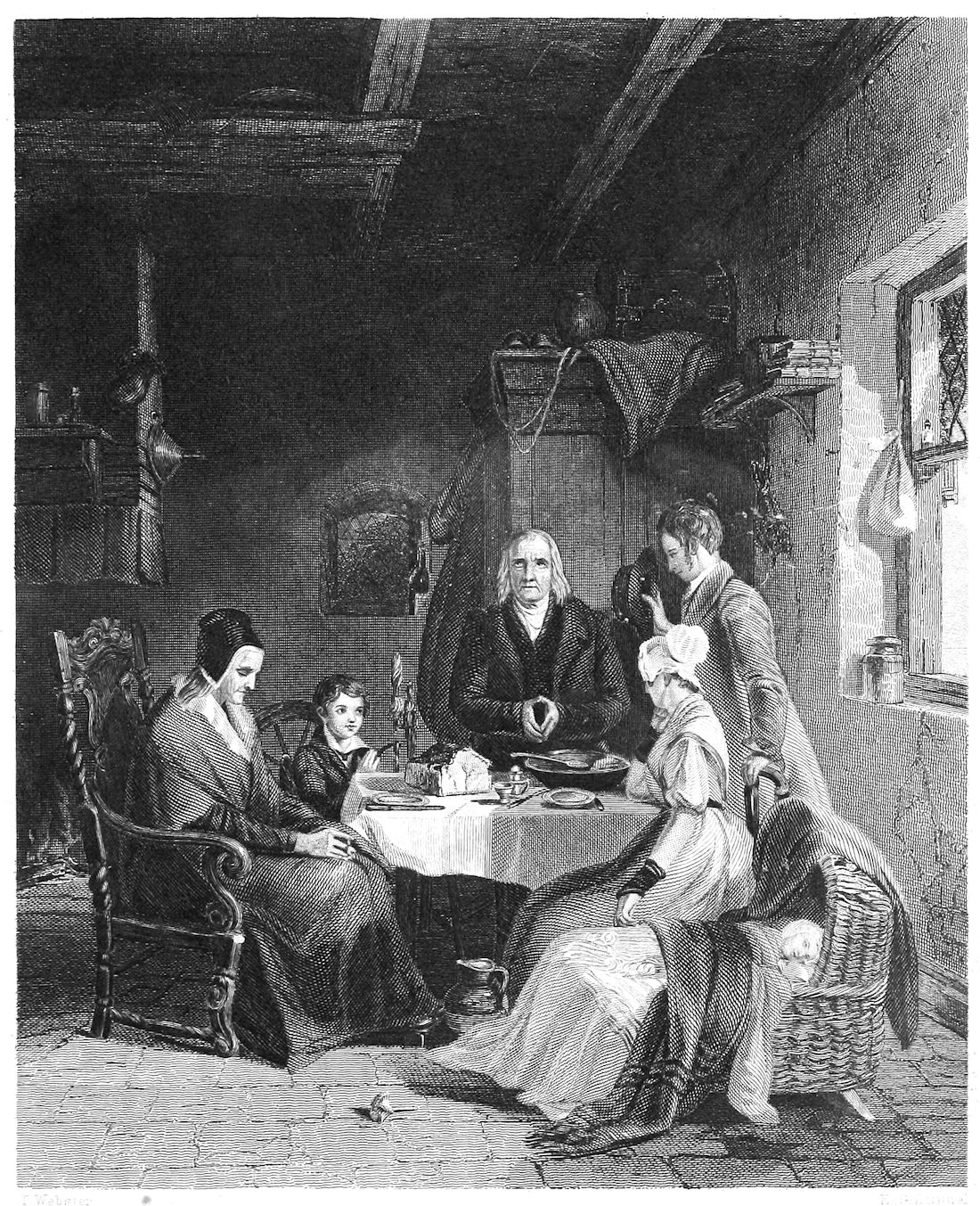
T. Webster E. G. Dunnel
The Blessing.
Engraved expressly for Graham’s Magazine.