SCENE VI. Before the castle.
Reading edition
Hautboys, servants of Macbeth attending. Enter Duncan, Malcolm, Donalbain, Banquo, Lenox, Macduff, Rosse, Angus, and attendants.
Duncan. This castle hath a pleasant seat; the air
Nimbly and sweetly recommends itself
Unto our gentle senses.
Banquo. This guest of summer,
The temple-haunting martlet, does approve,
By his lov’d mansionry, that the heaven’s breath
Smells wooingly here: no jutty frieze,
Buttress, nor coigne of vantage, but this bird
Hath made his pendent bed, and procreant cradle;
Where they most breed and haunt, I have observ’d,
The air is delicate.
Enter Lady Macbeth.
Duncan. See, see! our honor’d hostess!
The love that follows us, sometime is our trouble,
Which still we thank as love. Herein I teach you,
How you shall bid God yield us for your pains,
And thank us for your trouble.
Lady. All our service,
In every point twice done, and then done double,
Were poor and single business, to contend,
Against those honors, deep and broad, wherewith
Your majesty loads our house: for those of old,
And the late dignities heap’d up to them,
We rest your hermits.
Dun. Where’s the Thane of Cawdor?
We cours’d him at the heels, and had a purpose
To be his purveyor: but he rides well;
And his great love, sharp as his spur, hath holp him
To his home before us: fair and noble hostess,
We are your guest to night.
Lady. Your servants ever
Have theirs, themselves, and what is theirs, in compt,
To make their audit at your highness’ pleasure,
Still to return your own.
Dun. Give me your hand:
Conduct me to mine host; we love him highly,
And shall continue our graces towards him.
By your leave, hostess.
When I read the sleep-walking scene of Lady Macbeth, I think that the most perfect piece of writing ever seen in profane literature. When I fall upon the above, it appears to me that is the most delicate and exquisite in the whole range of our author’s works. Is it possible that the same tremendous hand which painted the royal tigress, at length cowed by the aspect of another world, has drawn, with a pencil of air, this lovely and inexpressibly soft scene, where the perfume of a balmy atmosphere is fresh and soothing on your forehead, and in your nostril, and where the eye as well as the smell and ear (for I can hear the breeze murmur among the green branches, and the screams of joy uttered by those temple-haunting birds as they chase each other down the air,) is filled with delight. What a warm and living picture it is, with the fewest possible words! An old castle pleasantly situated—its massive turrets look down over a peaceful, rural scene, the pure-scented air recommending itself sweetly and nimbly to our gentle senses! Who that has spent six or eight hours of the early morning at a sedentary occupation, in a room, till the senses were wearied and the limbs ached with sitting—and the lungs played languishingly and the blood moved sluggishly—and the pulse beat feebly with exhaustion—who has not, on going forth, felt this soothing sensation, as some pleasant landscape spread its tranquil and soft-colored beauties before his eye, some picturesque building broke the sameness of the picture by its bold outlines in the foreground, the ever happy birds darting about the house eaves—and the life-breathing, cool, odorous air filling his veins with sweet impulses, stirring all that is agreeable in his heart, cooling the fever of the heated brain, and sending off, with its benign blessing, a world of sad feelings or melancholy forebodings.
In three lines we have this effect; and further, who expresses this pleasing, living thought—Duncan! the doomed victim of the assassin’s dagger. Yes, he feels the sweetness of nature, and he feels it for the last time. Look around thee, old man; those swells of verdant ground, those murmuring and soft waving trees, those shadows thickening and blackening as the eye pierces into the wood, this blue and bending sky with a few sleeping, fleecy clouds, thou shalt never see them more. Nature, always so tender and exquisite, has new and unutterable charms when we are never to behold it again.
Then Banquo acknowledges the softening influence of the scene.
Banquo. This guest of summer,
The temple-haunting martlet, does approve,
By his loved mansionry, that the heaven’s breath
Smells wooingly here: no jutty frieze,
Buttress, nor coigne of vantage, but this bird
Hath made his pendent bed and procreant cradle:
Where they most breed and haunt, I have observ’d,
The air is delicate.
Here is a picture which the reader sees as if by mere accident, and the imagination follows out each hint and goes from one salient point to another till the life-like scene rises before it. The luxuriancy and blandness of summer, the beautiful martlets filling the air as we have watched them with boyish delight a thousand times, with their noisy joy. They never appear so pretty as when coming in and out of their nests under the eaves of a house or barn, and still more in the buttresses and angles of an old castle. “Their loved mansionry” gives an additional impression of the beauty their “pendent beds and procreant cradles” add to the rough old castle which itself is brought finely out from the canvass by the light reflecting from each jutty frieze, buttress and coigne of vantage.
Banquo continues the remark with a thought expressive of an observing, nature-loving mind returning, with new pleasure, to the repose of peace and the thoughts and the occupations which there have room to unfold themselves, after the bloody tumult of brutal war.
I do not know, but I suppose it must be a truth in natural history, that the birds spoken of generally build their nests where the air is purest. See, also, the superior charm which the little observation possesses, from the lips of this noble soldier, dropped in a peaceful, sunshiny moment, skilfully thrown in after the furious storms of war, and before the yet more frightful tempest of guilt which is speedily to fall like a thunderbolt upon this group of human beings, apparently so far removed from danger, and about to commence a new era of contentment.
Remark here the people collected in a circle beneath the dark frowning battlements of the war-like castle now bathed in summer light, and in the natural ease and gentle satisfaction of their hearts discussing such beautiful trifles as, however graceful and soothing, the busy warriors of those rude times had but small time to occupy themselves with. Who are they? what are their fates? Alas they are but too striking types of their fellow creatures who in the midst of life are in death. Duncan’s hours are numbered. Beneath the walls of the castle which his aged eyes survey with such admiration—whose strong turrets and picturesque buttresses are now painted with the golden light of a calm summer afternoon—which he expects to enter to a banquet, and from which he intends to go forth in the morning with renewed hope and happiness—beneath those dire walls in a few hours is to take place a scene, the farthest possible removed from his suspicions, and he is to be called, like Hamlet, without any reckoning, into the presence of his God. Thus under the crushing and unpausing hand of Destiny the good and the bad go down alike in a world through which he will pass most easily who builds his hopes elsewhere.
Banquo too is a good man. You even perceive, in those few words, that he has a delicacy of nature which has perhaps preserved him pure from contaminating influences and illusive temptations. He too is marked, without demerit of his own, to go down beneath the wheels of the dreadful impending event.
He too, in a few brief days, is doomed to be cut off—thrust headlong into eternity, while guilt remains unhurt and triumphs in the successful execution of all its plans.
For Macduff—the pious—lion-hearted—affectionate Macduff, is prepared a fate, if possible, yet more awful. His castle—the scene of many a happy hour, many a fond and merry family sport, is about to be surprised. His wife, his babes “savagely slaughtered,”
“wife, children, servants,”
all that could be found, fiercely drawn down into the general ruin which the sinful heart of one man spreads around him. How truly is mortality painted in these events! How plainly we see what stuff life is made of! and how sternly are we taught the folly of supposing the end of man to be “here, on this bank and shoal of time.”
Malcolm, Donalbain, Rosse, and Angus, driven from their country by terror of the bloody tyrant—(now the beloved and trusted of all)—and lastly Lenox, whom we find at a later period in attendance on Macbeth, and the witness of his bursts of guilty and ferocious desperation, but at length joined with the advancing enemy.
Into the midst of this circle, on the brink of ruin when they think themselves most secure, enters Lady Macbeth. Her mere appearance touches a chord of terror in the soul of the reader, although they whom she addresses view her with very different feelings. The unsuspecting king greets in her his “honored hostess,” and pours out upon her a heart full of gratitude and love. The cruel hypocrite—so firm in the anticipation of guilt, so haughtily superior to all the prejudices of superstition—all the idle dreams of religion and a Providence—yet so ignorant of their real nature and destined to be so thoroughly wrecked in the tempest her rash hand is so eager to raise—replies with shameful effrontery and mature wickedness:
“all our service,
In every point twice done, and then done double,
Were poor and single business, to contend
Against those honors deep and broad, wherewith
Your majesty loads our house.”
In the concluding part of the scene remark how admirably are drawn the profound hypocrisy of Lady Macbeth and the entire confidence and deeply deceived friendship of the unsuspecting king.
“Where’s the Thane of Cawdor!
We coursed him at the heels and had a purpose
To be his purveyor: but he rides well;
And his great love, sharp as his spur, hath holp him
To his home before us: fair and noble hostess,
We are your guest to night.
Lady. Your servants ever
Have theirs, themselves, and what is theirs, in compt
To make their audit at your highness’ pleasure,
Still to return your own.
King. Give me your hand:
Conduct me to mine host; we love him highly,
And shall continue our graces towards him.”
Thus it is with man. All around us is deceit. We know not how to distinguish the false from the true. Duncan must have had more than human sagacity to suspect wile in the chivalric soldier who had just risked his life in his defence, or in the “fair and noble hostess” who received him beneath her roof with such apparent love, gratitude and veneration.
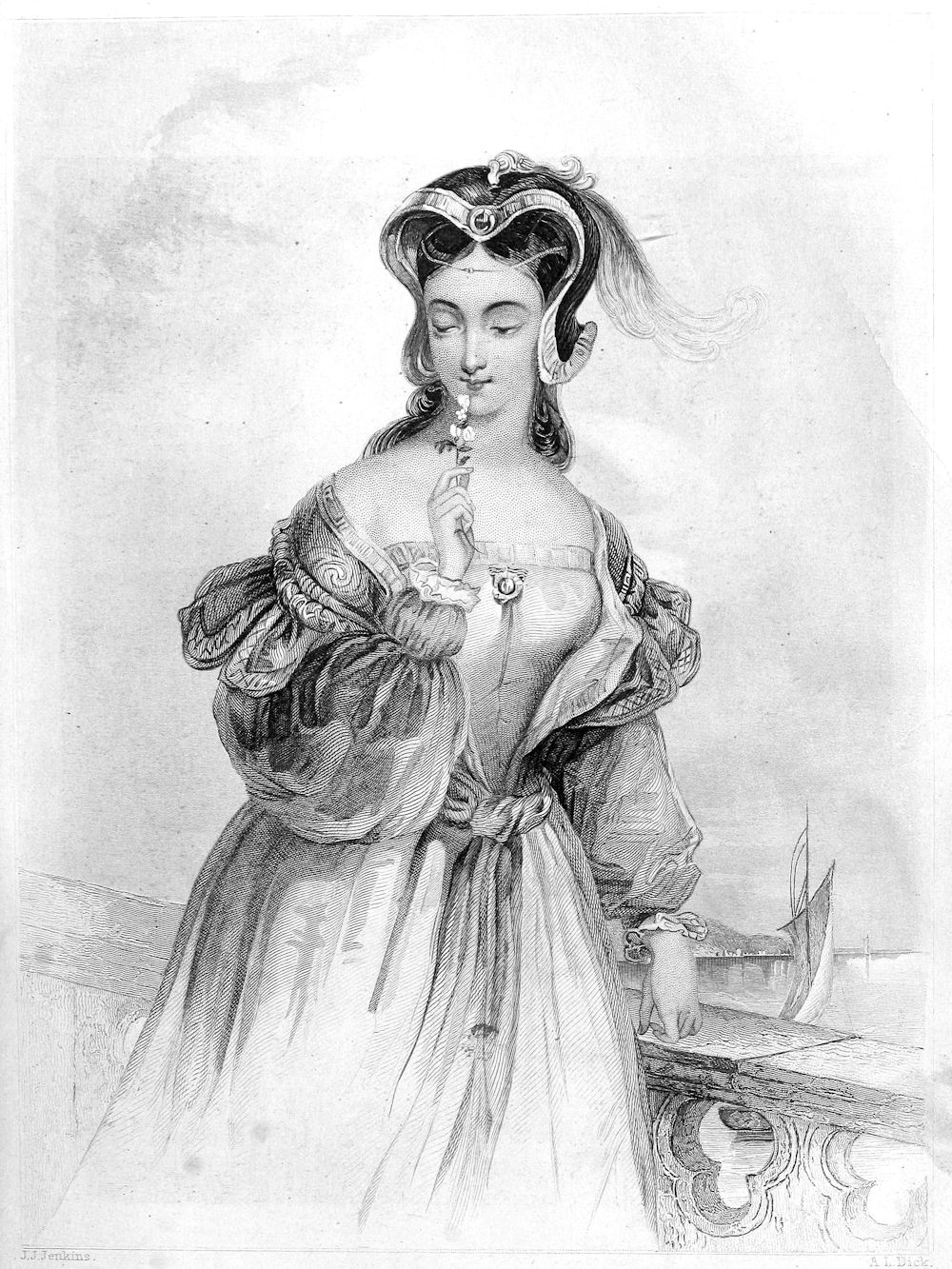
J. J. Jenkins. A. L. Dick.
The Lady Alice
Engraved expressly for Graham’s Magazine.