Part 1 — REVIEW OF NEW BOOKS.
Reading edition
Notes of a Tour through Turkey, Greece, Egypt, Arabia Petræa, to the Holy Land; including a Visit to Athens, Sparta, Delhi, Cairo, Thebes, Mount Sinai, Petræa, &c. By E. Joy Morris. Two vols. 12 mo. pp. 550. Philadelphia, Carey & Hart: 1842.
Were we disposed to be hypercritical, we should begin by finding some fault with the title of these volumes. It is quite too long, besides being tautological. Why speak of a tour through Egypt, and a visit to Thebes! Or of a tour through Greece and a visit to Athens? It would be as proper to announce a journey through England, including a visit to London. He who travels over a country of course visits its capital. If he supposes the readers of his journal do not know what city enjoys that distinction, it is even then better to let them acquire this geographical information by degrees. Too great and sudden developments may defeat his object; a man’s vision is sometimes obscured by excess of light.
Of the improbabilities which are scattered throughout the work we have space only to notice one or two. Mr. Morris informs us that the harem of the Governor of Smyrna, which he encountered on board a steamer, “consisted of some half-dozen ladies, (wives,) and, with attendants, amounted to near thirty persons.” Rather too many wives for the simple Aga of Smyrna, and more than the Koran allows. The holy book of the Mahommedan permits no one, save the Grand Sultan—the representative of the prophet—to have more than two; and that highest of dignitaries, and hereditary favorite of the immortals, has but four. The Governor of Smyrna, we are assured by a competent authority, has but one wife, and she is of Turkish descent, and not, as our author avers, a Circassian. Had she been of Circassia she would have been a concubine, not a wife, or, as the author blunderingly calls her, a Sultana. That title belongs only to the favorite wife of the Sultan. Our traveller tells us that he offered to this lady some sweet-meats, although her husband and the keeper of his harem were both present! An averment which we would be as chary of believing as if it were that the “light” of the Grand Seigneur’s palace had accepted an invitation to swim with him in the Bosphorus!
Mr. Morris tells us that he found in the slave market of Constantinople two beautiful Georgian girls, “destined for the harems of the rich,” in cages, but that he was “only indulged with a glance at them through the bars!” Now a cage, or such a place as he intended to describe by that word, even for the ugliest Numidian, would not be tolerated in Constantinople for an hour; nor has there been for many years a Georgian girl publicly exhibited in the markets of that city. When a writer, sensible of the dulness of his performance, seeks to impart to it some interest by weaving into its chapters romantic fictions, he should be careful to give them an air of probability. We have not time nor inclination to point out other “attractions” in these volumes of a similar description.
While writing of Athens and Constantinople, Mr. Morris doubtless had by his side Mr. Colton’s “Visit” to those places; and in his notices of Arabia Petræa and Egypt he has availed himself of the information acquired by Mr. Stevens and Professor Robinson. He has made what, in the language of the trade, is called a readable book; but it possesses neither originality, vigor, nor freshness; and his delineations, besides lacking these qualities, are often tediously long and needlessly particular. He does not pretend to give any new topographical information, and his work contains none. It was probably written out from slight notes taken during his tour, and the more elaborate descriptions of other travellers. It evinces some taste and judgment in the selection of themes, and is now and then graced by a classical allusion or quotation, gleaned, perhaps, from the guide-books, which make authorship so easy to the tourist.
Punishment by Death: Its Authority and Expediency. By Rev. George B. Chester. One vol. 12mo. pp. 156. New York: M. W. Dodd.
Several able sermons on this important subject have issued from the press. This is a more extended and elaborate effort. It displays learning, research, and philosophical acumen, and is worthy of general and serious attention. We know of no treatise in our language, on this subject, so well calculated for circulation among the people at large. It is brief, clear, comprehensive, written in an interesting style, and often rising to a strain of vivid and stirring eloquence.
About half the volume is devoted to the argument from Scripture; in which the original Noahic ordinance is taken as the ground-work, commented upon in the Mosaic statutes, and confirmed in the New Testament. The writings and experience of Paul are examined, and the course of the Divine Providence is shown to be consentaneous with this argument. The state of legislation and society in the antediluvian world, as well as afterwards, are investigated, with the origin of government, and the nature of its sanction in the Scriptures.
The remainder of the book is taken up with the argument from Expediency. The question is examined, What constitutes the perfection of criminal jurisprudence! The efficacy of punishment by death in restraining crime is argued, and also that the abrogation of this punishment would prove a premium on the crime of murder, through the desire of concealing other crimes. The law of nature is examined, with the powerful convictions of conscience on this subject, as sustaining the Divine legislation, and demanding support also in human law. Various objections are considered and answered, with the occasion of the prejudice against Capital Punishment. The book concludes with a chapter on the power and solemnity of the argument from analogy, in reference to the sanctions of the Divine Government.
A Popular Treatise on Agricultural Chemistry: intended for the use of the Practical Farmer. By Chas. Squarey, Chemist. One vol. Lea & Blanchard: Philadelphia.
An excellent work, in which most of what is really valuable in the treatises of Liebig, Davy, Johnson and Daubeny, has been condensed for the practical reader.
Tecumseh, or the West Thirty Years Since: A Poem: By George H. Colton. 12mo. pp. 412. New York: Wiley & Putnam, 1842.
We alluded to this work very briefly in a former number, and now recur to it mainly for the purpose of presenting some specimens of the author’s versification, by which the reader may be enabled to judge of its general execution. “Tecumseh” is a narrative, founded on the history of that great chief whose name is chosen for its title, and whose efforts to unite the various divisions of the red race into one grand confederacy, to regain their lost inheritance, though unsuccessful, should secure to him a fame as lasting as is awarded to the most celebrated heroes and patriots of the world.
The measure of the main part of the poem—extending to nine long cantos—is octo-syllabic. It is free, and generally correct, though in some cases marred by inexcusable carelessness, and phraseology more tame and meaningless than, had he kept his manuscript for a few years, the author would have permitted to go before the critics. The hero, with the wily prophet, Els-kwa-ta-wa, who was his evil genius through life, is introduced in the second canto. Distinguished
“By his broad brow of care and thought,
By his most regal mien and tread,
By robes with richest wampum wrought,
And eagle’s plume upon his head,”
he emerges with his companion from a forest;
“Nor e’er did eye a form behold
At once more finished, firm and bold.
Of larger mould and loftier mien
Than oft in hall or bower is seen,
And with a browner hue than seems
To pale maid fair, or lights her dreams,
He yet revealed a symmetry
Had charmed the Grecian sculptor’s eye,
A massive brow, a kindled face,
Limbs chiselled to a faultless grace,
Beauty and strength in every feature,
While in his eyes there lived the light
Of a great soul’s transcendant might—
Hereditary lord by nature!
As stood he there, the stern, unmoved,
Except his eagle glance that roved,
And darkly limned against the sky
Upon that mound so lone and high,
He looked the sculptured God of Wars,
Great Odin, or Egyptian Mars,
By crafty hand, from dusky stone,
Immortal wrought in ages gone,
And on some silent desert cast,
Memorial of the mighty Past!
And yet, though firm, though proud his glance,
There was upon his countenance
That settled shade, which oft in life
Mounts upward from the spirit’s strife
As if upon his soul there lay
Some grief which would not pass away.
“The other’s lineaments and air
Revealed him plainly brother born
Of him, who on that summit bare
So sad, yet proudly met the morn:
But, lighter built, his slender frame
Far less of grace, as strength, could claim;
And, with an eye that, sharp and fierce,
Would seem the gazer’s breast to pierce,
And low’ring visage, aye the while
Inwrought of subtlety and guile,
Whose every glance, that darkly stole,
Bespoke the crafty, cruel soul.
There was from all his presence shed
A power, a chill mysterious dread,
Which made him of those beings seem,
That shake us in the midnight dream.
Yet were his features, too, o’ercast
With mournfulness, as if the past
Had been one vigil, painful, deep and long
Of hushed Revenge still brooding over wrong.
No word was said: but long they stood,
And side by side, in thoughtful mood,
Watched the great curtains of the mist
Up from the mighty landscape move;
’Twas surely spirit-hands, they wist,
Did lift them from above.
And when, unveiled, to them alone
The solitary world was shown,
And dew from all the mound’s green sod
Rose, like an incense, up to God,
Reclined, yet silent still, they bent
Their eyes on Heaven’s deep firmament—
As if were open to their view
The stars’ sun-flooded homes of blue—
Or gazed, with mournful sternness, o’er
The rolling prairie stretched before;
While round them, fluttering on the breeze,
The sere leaves fell from faded trees.”
At the close of a conference which ensues, Tecumseh expresses his determination to
“go forth
Through the great waters of the North,
Round the far South, and o’er the West
By the lone streams, nor ever rest,
Till all the tribes united stand
In battle for their native land.”
There are scattered through the poem many passages of minute and skilful description of external nature, and interwoven with the main history is a story of love, resulting, in the end, like most tales of the kind, in the perfect felicity of the parties. Some episodes, by which the narrative is broken, are well-wrought, and the entire poem possesses a deep and sustained interest. The rapid action of the narrative is illustrated by the following passive, descriptive of the last conflict, in which Tecumseh fell:
“Forth at the peal each charger sped,
The hard earth shook beneath their tread,
The dim woods, all around them spread,
Shone with their armor’s light:
Yet in those stern, still lines assailed
No eye-ball shrunk, no bosom quailed,
No foot was turned for flight;
But, thundering as their foemen came,
Each rifle flashed its deadly flame.
A moment, then recoil and rout,
With reeling horse and struggling shout,
Confused that onset fair;
But, rallying each dark steed once more,
Like billows borne the low reefs o’er
With foamy crest in air,
Right on and over them they bore,
With gun and bayonet thrust before,
And swift swords brandish’d bare.
Then madly was the conflict waged,
Then terribly red Slaughter raged!
“How still is yet yon dense morass
The bloody sun below!
Where’er yon chosen horsemen pass,
There stirs no bough nor blade of grass,
There moves no secret foe!
Yet on, quick eye and cautious tread,
His bold ranks Johnson darkling led.
Sudden from tree and thicket green,
From trunk, and mound, and bushy screen,
Sharp lightning flashed with instant sheen,
A thousand death-bolts sung!
Like ripened fruit before the blast,
Rider and horse to earth were cast,
Its miry roots among;
Then wild, as if that earth were riven,
And, pour’d beneath the cope of heaven,
All hell to upper air were given,
One fearful whoop was rung,
And, bounding each from covert forth,
Burst on their front the demon birth.
‘Off! off! each horseman to the ground!
On foot we’ll quell the foe!’
And instant, with impetuous bound,
They hurl’d them down below.
“Then loud the crash of arms arose,
As when two forest whirlwinds close;
Then filled all heaven their shout and yell,
As if the forests on them fell!
I see, where swells the thickest fight,
With sword and hatchet brandish’d bright
And rifles flashing sulphurous light
Through green leaves gleaming red—
I see a plume, now near, now far,
Now high, now low, like falling star,
Wide waving o’er the tide of war,
Where’er the onslaught’s led;
I see, beneath, a bare arm swing,
As tempest whirls the oak,
Bosom and high crest shivering
The war-club’s deadly stroke;
The eager infantry rush in,
Before their ranks, with wilder din,
The wav’ring strife is driven—
Above the struggling storm I hear
A lofty voice the war bands cheer,
Still, as they quail with doubt or fear,
Yet loud and louder given;
And, rallying to the clarion cry,
With club and red axe raging high,
And sharp knives sheathing low,
Fast back again confusedly
They drive the staggering foe.”
We conclude our extracts with a graphic description of a forest scene, from the last canto.
“Within a wood extending wide
By Thames’s steeply winding side,
There sat upon a fallen tree,
Grown green through ages silently,
An Indian girl. The gradual change
Making all things most sweetly strange,
Had come again. The autumn sun,
Half up his morning journey, shone
With conscious lustre, calm and still;
By dell, and plain, and sloping hill
Stood mute the faded trees, in grief,
As various as their clouded leaf.
With all the hues of sunset skies
Were stamp’d the maple’s mourning dies;
In meeker sorrow in the vale
The gentle ash was drooping pale;
Brown-seared the walnut raised its head,
The oak displayed a lifeless red;
And grouping bass and white-wood hoar
Sadly their yellow honors bore;
And silvered birch and poplar rose
With foliage gray and weeping boughs;
But elm and stubborn beech retained
Some verdant lines, though crossed and stained,
And by the river’s side were seen
Hazel and willow palely green,
While in the woods, by bank and stream
And hollows shut from daylight gleam,
Where tall trees wept their freshening dews,
Each shrub preserved its summer hues.
Nor this alone. From branch and trunk
The withered wild-vines coldly shrunk,
The woodland fruits hung ripe or dry,
The leaf-strown brook flowed voiceless by;
And all throughout, nor dim nor bright.
There lived a rare and wondrous light
Wherein the colored leaves around
Fell noiselessly; nor any sound,
Save chattering squirrels on the trees,
Or dropping nuts, when stirred the breeze,
Might there be heard; and, floating high,
Were light clouds borne along the sky.
And, scarcely seen, in heaven’s deep blue
One solitary eagle flew.”
From these passages the general character of the work may be inferred. It is too long: it would be unwise to extend a poem on any theme to nine cantos, of near fourteen thousand lines; and besides its diffuseness, in parts, it has other faults, to which we have already alluded. It is the first production, however, of an author just freed from the University; not yet, apparently, twenty-two years old; and, so regarded, the severest critic must deem it remarkably free from errors in design and execution.
Some half dozen elaborate metrical tales, founded on Indian histories or traditions, have before appeared in this country, of which but one—the “Yamoyden” of Sands and Eastburn—is comparable to this; and that is inferior to it in unity, and, indeed, in almost all its essential features. The admirable proem to “Yamoyden,” in which Sands laments in such touching strains the early death of his associate and friend, is not rightly considered a part of the poem to which it is prefixed. To this Mr. Colton has produced nothing equal; nor is he worthy yet to be ranked with Sands as a poet. But “Tecumseh,” until some nobler work is written, must be considered the best poem of its class written by an American.
Memoir of India and Avghanistoun, with Observations on The Present State and Future Prospects of those Countries. By J. Harlan, late Counsellor of State, Aid-de-Camp, and General of the Staff, to Dost Mahomed, Ameer of Cabul. One vol. 12mo. Philadelphia: J. Dobson, 1842.
General Harlan resided in India and Avghanistoun eighteen years, and his official stations during that period were such as he would have chosen had his principal object been to form a correct judgment in regard to the social and political conditions of those countries. The facts and opinions contained in this work must therefore command regard, especially since the recent military operations in that quarter have drawn so much attention to the British East Indian Empire. The volume comprises remarks on the late massacre of the British Army in Cabul, and the British policy in India; a reply to the Count Björstjerna’s work on that country; the Russian influence in central Asia; the foreign relations of the Indo-British government; the moral, religious and political character and condition of the Indians and Avghans; and the results of missionary exertions and prospects of Christianity among them; together with an interesting sketch of the history and personal character of Dost Mahomed, one of the most remarkable individuals that have appeared in the oriental nations during this century. In an appendix, the author indulges in some speculations on a passage in the Book of Daniel, which he supposes has reference to the present condition of the Mahommedan countries, and indicates the speedy extinction of the Ottoman empire. The book is illustrated with maps and a portrait of the Ex-Ameer of Cabul.
We shall look with some anxiety for General Harlan’s “Personal Narrative of Eighteen Years’ Residence in Asia,” which we believe is now in press.
History of the Expedition under the command of Captains Lewis and Clarke, to the sources of the Missouri, thence across the Rocky Mountains, and down the river Columbia to the Pacific Ocean: Performed during the years 1804, 1805, 1806, by order of the Government of the United States. Two vols. Harper & Brothers: New York.
The expedition of Lewis and Clarke was the first ever made through the Oregon Territory to the Columbia River. An account of their tour was published soon after their return; but as that work has since gone out of print, and as the Oregon Territory is now a subject of much interest, the Messrs. Harpers have issued the present volumes, in which unimportant details in the former edition have been omitted, and explanatory notes have been added, by Archibald M’Vickar, Esq. The volumes form Nos. 154 and 155 of the Family Library. Perkins & Purvis: Philadelphia.
The Life of Wilbur Fisk, S. T. D. first President of the Wesleyan University. By Joseph Holdich. One vol. 8vo. Pp. 455. New York: Harper & Brothers.
Wilbur Fisk was one of the purest and most useful men of our time. With a temperament remarkably sanguine and ardent, all his qualities were so subdued and harmonized by religion, as to form one of the finest models of elevated Christian character that has been presented to the world. He was a native of Brattleborough, Vermont, where he was born in 1792. In his early years he enjoyed no advantages that are not within the reach of almost every young man of New England. When about twenty-two years of age he began to study the law, but soon after turned his attention to the ministry, and in the spring of 1818 was licensed to preach by a Conference of the Methodist Episcopal Church. In 1823 he was made a ruling elder, and in 1825, principal of the Methodist Seminary of Wilbraham. In 1829, he received the degree of Doctor in Divinity, from Augusta College, and from Brown University, and the following year was elected to the presidency of the Wesleyan University at Middletown. In the autumn of 1835, he visited Europe, and passed about a year on the continent and in Great Britain. The record of his travels, published soon after his return, has been one of the most popular works of its kind written by an American. He died at Middletown, after a long and painful illness, borne with singular fortitude and resignation, on the twenty-second of February, 1840. The Memoirs before us, by his friend Professor Holdich, are written with ability and candor; but the most interesting portions of the work are Dr. Fisk’s admirable private letters, distinguished alike for a beauty of style, simplicity, earnestness, and affection, that indicates, better than any labored delineation by another hand, his high character and endowments. Philadelphia: H. Perkins.
A Narrative of Voyages and Commercial Enterprises. By Richard J. Cleveland. Two vols. 12mo. Cambridge: John Owen, 1842.
This is one of the many narratives of adventures at sea given to the public in consequence of the success of Mr. Dana’s “Two Years before the Mast.” The author, who retired from the merchant service more than twenty years ago, presents some interesting reminiscences of voyages to India, South America, and other parts of the world, written in a style of simple elegance rather unusual for a veteran sailor. The industry and enterprise of the New Englanders is in nothing more conspicuous than in their mercantile marine, and we infer from his pleasant work, that Mr. Cleveland has done his part to gain for them their enviable reputation.
Athanasion, and other Poems. By the Author of “Christian Ballads.” New York: Wiley & Putnam.
The author of “Christian Ballads” is the Rev. Arthur Cleveland Coxe, Rector of St. Anna’s Chapel, Morrisania, near New York: a young poet who has won an enviable reputation by numerous contributions to the periodical literature of the day, and by some more elaborate writings. “Athanasion” is, perhaps, his best metrical composition. It has, with many excellencies, some defects, which we lack space and inclination to point out in this number of our Magazine. The volume before us is printed in a style equal to that of the best English impressions.
Fathers and Sons: a Novel. By Theodore E. Hook, Esq. Two vols. 12mo. Philadelphia: Lea & Blanchard, 1842.
Theodore Edward Hook was one of the most popular of the authors who died in the last year. His table wit, it is said, in freshness and exuberance, was never equalled in England; and the humor that pervades his writings will keep them in favor probably for centuries. The novel before us was his last. It appeared originally by separate chapters in the New Monthly Magazine, of which he was editor; and he was engaged in its revision when seized by the disease which terminated his career. His first work—excepting some plays written in his boyhood—was “Sayings and Doings,” published in 1824. It was followed by a second and third series of the same work; by “Maxwell,” “The Parson’s Daughter,” “Jack Brag,” “Births, Deaths, and Marriages,” “Gilbert Gurney,” “Gurney Married,” “Precepts and Practice,” several volumes of biography, and “Fathers and Sons.” He died on the twenty-second day of September, 1841, in the fifty-third year of his age.
His last work has all his peculiarities; the most felicitous humor; graphic delineations of character; and incidents interesting and ingeniously diversified. We have not space for an analysis of its plot; and one is the less necessary, as, notwithstanding the “hardness of the times,” very few will permit the last legacy of Theodore Hook to go unread.
Sermons and Sketches of Sermons, by the Rev John Summerfield, M. A. With an Introduction, by the Rev. Thomas E. Bond, M. D. One vol. 8vo. Pp. 437. Harper & Brothers: New York.
John Summerfield was one of those remarkable men who have appeared from time to time to electrify the religious world, by eloquence the most persuasive, and lives which served as samples by which those who would might guide their course to heaven. He began to preach in Ireland, when but twenty years of age, and soon after came to the United States, where he continued to labor as an evangelist until his death, which occurred sixteen years ago. Most of the sermons and sketches of sermons included in the volume before us were written down after their public delivery. They possess a deep interest, especially to those who remember the sainted author, more worthy of canonization than were ninety-nine hundredths of those whose names are included in the calendar. Henry Perkins: Philadelphia.
Practical Geology and Mineralogy; with Instructions for the qualitative analysis of Minerals. By Joshua Trimmer, F. G. S.—Itum est in viscera terræ. One vol. Lea & Blanchard: Philadelphia.
A valuable elementary treatise on Geology. For the convenience of those who have not access to cabinets of minerals, the author has collected various chemical and mineralogical details, to enable any person easily to recognise the different minerals when discovered in the fields. In the purely geological part of the work, Mr. Trimmer has confined himself to facts and classifications and a few universally admitted inferences, avoiding all questions affecting the higher generalizations, since they are still and must long continue to be matters of controversy. The work is illustrated with wood-cuts. We commend it to students in geology.
Italy and the Italian Islands, from the earliest ages to the present time. By William Spalding, Esq. With engravings and illustrative maps and plans. Three vols. Harper & Brothers: New York.
This is an able and comprehensive work, and may be consulted with confidence by persons who wish to inquire concerning the history, scenery, antiquities, topography, and present condition of Italy. The author is, perhaps, less profound than he would have been if he had contemplated a more voluminous treatise. For all purposes, however, of general reference, or as a guide to more detailed inquiries, his volumes may be consulted with advantage. The account of the social, religious and political revolutions of the ancient and modern Italians, and the history of the rise and progress of the arts and literature in Italy, constitute two of its most valuable divisions.
These volumes form Nos. 151, 152 and 153 of the Family Library, and are published in the usual style of that excellent series. Carey & Hart: Philadelphia.
A Discourse on Matters pertaining to Religion; by Theodore Parker, Minister of the Second Church in Roxburgh, Massachusetts. Pp. 505, 8vo. Boston: Charles C. Little and James Brown. 1842.
This is a bold and eloquent attack on the doctrines of the Bible, by one who avows himself to be a Christian minister, and is ordained and settled over a religious congregation. Some of the readers of Mr. Parker’s “Discourse” who are unacquainted with the writings of the German rationalists, may fancy that he is a man of deep research and profound scholarship; but there is little danger that an intelligent student in theology will be so deceived. The work embraces the substance of five lectures, delivered in Boston during the last autumn. The author denies the inspiration of the Holy Scriptures, the divinity of Jesus Christ, and most of the other ideas of what he terms the “popular theology.” We leave him and his labors to the critics of the Christian churches.
Masterman Ready, or, the Wreck of the Pacific. Written for Young People. By Captain Marryat, R. N. Second Series. One vol., 18mo. New York: D. Appleton & Co.
This is a sequel to the entertaining volume published under the same title last year. Though “Masterman Ready” is an entertaining story, it is far from being equal in any respect, save its freedom from the coarser kind of jests, to “Peter Simple,” “Jacob Faithful,” or the other early works of the author.
Means and Ends, or Self-training. By the author of Redwood, Hope Leslie, Home, Poor Rich Man, &c., &c. Second edition. One vol. Harper & Brothers: New York.
One of the best of Miss Sedgwick’s smaller works. It is written in a light, rambling style, enforcing truths by anecdotes or short stories. It has been deservedly popular, and we predict that it will pass to a third and even fourth and fifth edition.
What’s to be Done? or, the Will and the Way. By the author of “Wealth and Worth,” &c. One vol. 12mo. Pp. 232. New York: Harper & Brothers.
The pleasant little volume entitled “Wealth and Worth,” which we commended to our readers a month or two since, has been succeeded by another work from the same pen, which we think even superior to its predecessor. It is a story of American life, conveying, as its piquant title indicates, a useful and impressive moral. The style is animated and pure, and the sketches of character are graphic, forcible, and various; while the plot preserves a deep and natural interest. “Wealth and Worth” has gone through five large editions in the course of as many months—a remarkable instance of rapidly attained popularity. A success equally decided must attend the spirited little tale of “What’s to be Done?”
The Divine Rule of Faith and Practice, or a Defence of the Catholic Doctrine, that Holy Scripture has been since the Times of the Apostles the Sole Divine Rule of Faith and Practice to the Church, against the dangerous Errors of the Authors of the Tracts for the Times and the Romanists, as, particularly, that the Rule of Faith is “made up of Scripture and Tradition together,” &c: In which also the Doctrines of the Apostolical Succession, the Eucharistic Sacrifice, &c., are fully discussed. By William Goode, M. A., of Trinity College, Cambridge. Two vols. 8vo. Philadelphia: Herman Hooker.
This is probably the most learned and able theological work that has been published in England or America during the year. Those who have read the “Tracts for the Times,” and all who feel any interest in the religious controversies of the age, will thank us for directing to it their attention.
Diary and Letters of Madame D’Arblay: Edited by her Niece. Parts I. and II. Philadelphia, Carey & Hart.
Miss Burney, afterward Madame D’Arblay, is best known to the literary world as the authoress of “Evelina,” one of the most admirable and popular novels in the English language. She died early in the year 1841, at the advanced age of ninety, and two volumes of her autobiographical remains have since been published in London, both of which are included in these “parts” of the American edition. She was intimately acquainted with Johnson, Sheridan, Burke, Boswell, and other eminent persons of their time; and her diary, including a great number of interesting anecdotes and reminiscences of her early career, is one of the most entertaining works of the day.
Rufus Winter Griswold, a gentleman of fine taste and well known literary abilities, has become associated with us as one of the editors of this Magazine. The extensive literary knowledge of Mr. G. renders him a most valuable coadjutor.
The connection of E. A. Poe, Esq., with this work ceased with the May Number. Mr. P. bears with him our warmest wishes for success in whatever he may undertake.
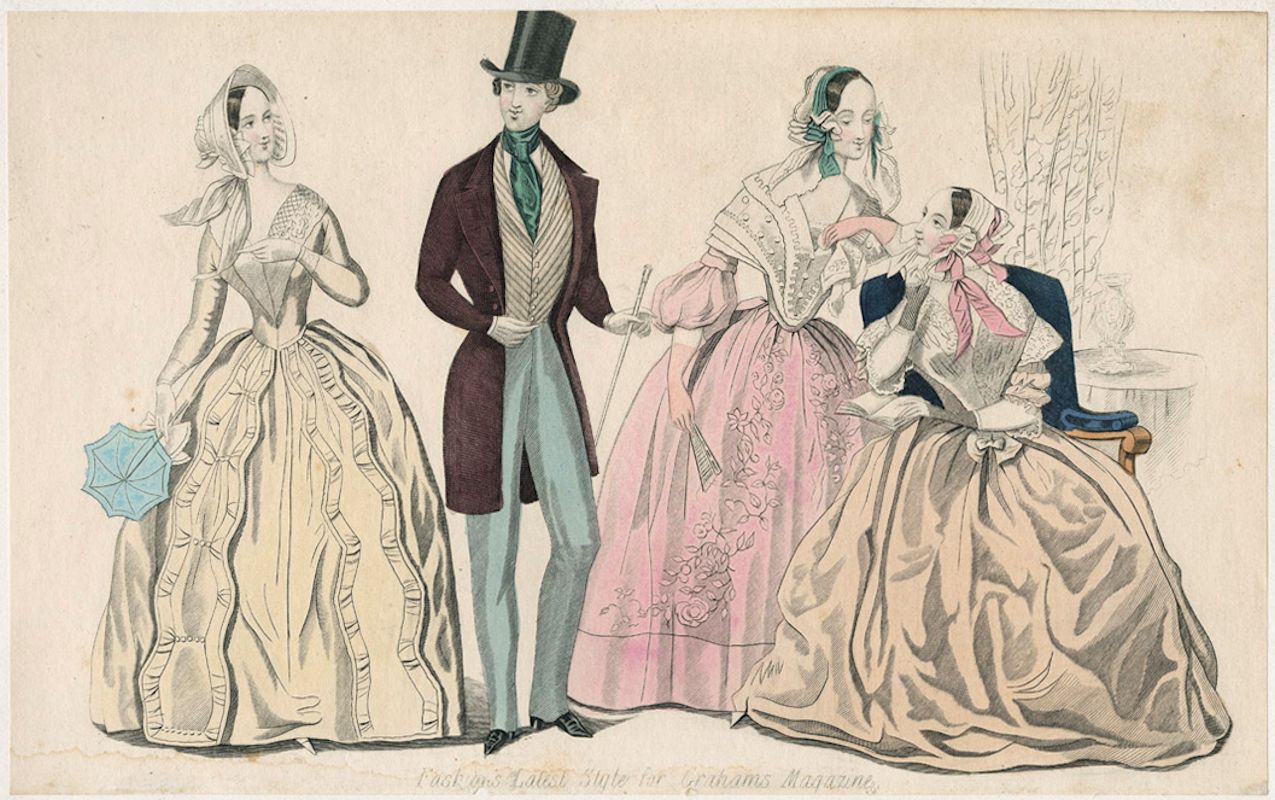
Fashion’s Latest Style for Graham’s Magazine
Transcriber’s Notes:
Table of Contents has been added for reader convenience. Archaic spellings and hyphenation have been retained. Obvious punctuation and typesetting errors have been corrected without note.
[End of Graham’s Magazine, Vol. XXI, No. 1, July 1842, George R. Graham, Editor]