THE WIRE SUSPENSION BRIDGE.
Reading edition
This elegant structure is thrown across the Schuylkill, on the site once occupied by an airy and graceful wooden erection, for years the pride of our city, and celebrated as being the longest bridge of a single arch in the known world. The boldness of the architect in thus spanning a river three hundred and fifty feet wide, was the theme of universal admiration. Few will forget Fanny Kemble’s poetic comparison, when she said the bridge looked like a white scarf flung across the water. The destruction of this favorite fabric, by fire, in the fall of 1838, was regarded as an irreparable loss.
The conflagration presented a grand picture. The flames were first seen towards the western entrance of the bridge, and in a very few minutes the whole fabric was a mass of fire. The wind was down the stream, and catching the flames as they broke from the flooring of the bridge, it swept them far away under, until a fiery cataract, reaching from shore to shore, seemed pouring horizontally down the river. By this time spectators began to throng around, and before the bridge fell, thousands lined the adjacent shores and covered the side of the overhanging hill, looking down on the scene below, as from the seats in an amphitheatre.
This splendid sight continued for some time, the gazers looking on in a rapt silence, until suddenly a low murmur, followed by an involuntary shiver, ran through the crowd, as the bridge, with a graceful curtesy, descended a few feet, hesitated, and then, with a gentle, swan-like motion, sank, like a dream, down on the waters. But the moment the fabric touched the wave, a simmering, hissing sound was heard, while ten thousand sparkles shot up into the air and sailed away to leeward. The fire still, however, burned fiercely in the upper works, which had not reached the water; while volumes of smoke rolled down the river, blending the earth, the wave, and the sky into one dark, indistinct mass, so that the burning timbers, occasionally detached from the bridge, and borne along by the current, seemed, almost without the aid of fancy, to be lurid stars floating through the firmament. The moon, which was just rising, and which occasionally burst through the dense veil of smoke, appeared almost side by side with these wild meteors, and added to the illusion. The effect was picturesque; at times even sublime.
More than two years elapsed before the bridge was replaced by the present elegant structure, whose airiness and grace more than reconcile us to the loss of its predecessor.
This new fabric is, we believe, the finest, if not the only, specimen of its kind in the United States. The plan is simple. Two square towers of solid granite, thirty-two feet in height, are built on either abutment. Over each of these towers, on iron rollers, pass five wire cables, each cable being composed of two hundred and sixty strands, each strand being an eighth or an inch thick. The length of each cable is six hundred and fifty feet. These cables are secured, on each shore, in pits, distant from the towers one hundred feet, and continuing under ground fifty feet further, to a point where they are securely fastened at the depth of thirty feet. These pits are built over so as to exclude the rain, but not the air; and the cables, being painted, are thus preserved from rust. The cables, in stretching from tower to tower, form a curve, the lowest point of which is at the centre of the bridge. The causeway is of wood, and hangs, by smaller wire cables, from these larger ones. The width of the bridge is twenty-seven feet, and its length, from abutment to abutment, three hundred and forty-three feet. The strength of the bridge has been tested by a weight of seventy tons. The structure is painted white throughout, and has already won the name of the most graceful bridge in the country.
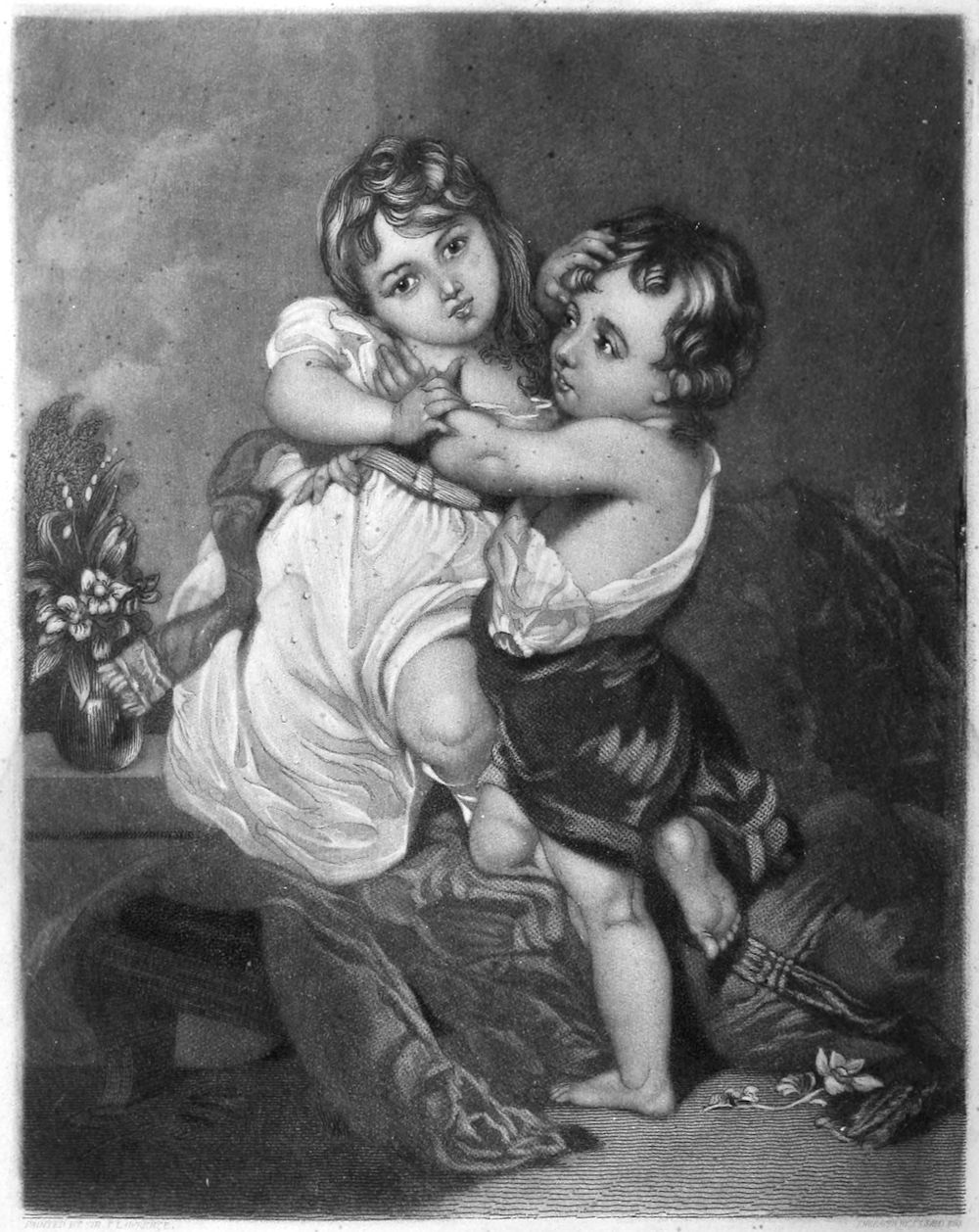
Painted by Sir T. Lawrence Eng’d by H.S. Sadd, N.Y.
The Proffered Kiss.
Engraved Expressly for Graham’s Magazine.