THE BRIDE.
Reading edition
Ros. Ah, sir, a body would think she was well counterfeited.
“The earl is out, sir—and so is Lord William;” said the obsequious lacquey, as I was ushered into Fairlie Hall, “will you amuse yourself in the library until dinner, or take a stroll in the park? You will probably meet with some of the family about the grounds.”
Such was the salutation that greeted me on alighting at the princely mansion of the earl of Fairlie, whither I had come at the invitation of his only son—one of my inseparable friends at Oxford. The visit had been promised for more than two years; and I was actuated to it, not only by the desire of spending the vacation with my friend, but by a lurking wish to behold the Lady Katharine, his only sister, whose beauty I had heard extolled by a hundred lips. So I had given up a contemplated run to the continent and come down to Fairlie Hall.
After changing my dress and gazing from the windows of my chamber, I began to feel ennuied and descending the ample staircase I determined on a stroll into the magnificent park, which surrounded the hall for some miles on every hand. My walk led me by a wild woodland path into one of the most romantic recesses of the forest. Naturally of a dreamy cast of mind, I walked on in a sort of reverie, until I was suddenly recalled to my more sober senses by coming in front of a little summer house, perched airily on a rock, and overlooking a mimic waterfall. Feeling somewhat fatigued with my day’s travel, I walked in and sat down. There was little furniture in the room, but on a table in the centre, lay a copy of Spencer, as if some one had lately been there. Picking up my favorite poet I began reading, but whether the interminable allegory exercised a drowsy influence over me, or whether it was the sharp morning air in which I had been riding that affected me, I cannot say, but in a few minutes I fell into a light doze, such a one as while it gives a dreamy character to our thoughts, or lulls them altogether into repose, never assumes wholly the character of sleep, and is dissipated by the slightest noise. Mine was soon broken, by a quick light step on the greensward without, and a musical female voice singing a gay ditty. Starting up I beheld an apparition standing in the door of the summer house, whose exceeding loveliness I was doubtful, for a moment, whether to refer to earth or heaven.
This apparition bore the form of a young lady apparently about eighteen, of a tall shapely figure, attired in a light summer dress—the sleeves of which, being looped up at the shoulders, revealed a pair of exquisitely rounded arms which might have vied with those of the fabled Euphrosyne. Her dress came low down towards the bust, displaying the full charms of her unrivalled shoulders and all the graceful swelling of her snowy and swan-like neck. Her face was of the true oval shape, and on either side of it flowed down her luxuriant auburn ringlets. The features, without being regular, formed a combination of surpassing beauty. The delicately arched eye-brows; the finely chiselled nose; the small round chin; the rich lips whose luxuriance rivalled that of the full blown rose; and the smooth pearly cheek, through which the vermeil blood might be seen wandering in ten thousand tiny veins—so transparent was the hue of the skin—united to form a countenance which would have been beautiful, even without the constantly changing expression which gave animation to each feature. The appearance of this wondrously lovely being, just as I awoke from the half dreamy sleep I have described, in which the visions of the poet and the sound of the waterfall had contributed to fill my mind with fantastic images, made me doubt, for a moment, whether the heavenly Una herself or one of her attendant nymphs had not emerged on my dreaming vision. But the changing expressing of her features soon convinced me that she was no airy visitant. At first a look of surprise darted over her fine countenance, and she retreated a step backwards, while the blood mantled her cheek, brow, and bosom, and even tinged the ends of her delicate fingers. In an instant, however, she regained her composure. No so myself. I had been equally startled, but was longer in recovering my ease. A silence of a minute thus occurred, during which we stood awkwardly regarding each other, but at length the ludicrousness of the scene striking the fancy of the fair apparition, she burst into a merry laugh, in which, despite my wounded vanity, I was forced to follow her. She had now fully recovered from her momentary embarrassment and advancing said,
“Mr. Stanhope I presume, for we have been expecting you for some days.” I bowed. “I see I must introduce myself. The Lady Katharine, daughter of the Earl of Fairlie.”
This then was the Lady Katharine of whom I had heard so much! There was something in the gaiety and originality of the address that pleased me, while at the same time it increased my embarrassment. I bowed again and was about to reply, but in bowing I inadvertently made a step backwards, and trod on a pet greyhound, which accompanied this wilful creature. The animal with a cry sought shelter by its mistress’ side, who, by this time, had sunk into one of the seats.
“Poor Lama,” she said petting him, “you must be careful how you get in the way of a bashful gallant again,” and then, turning to me, she said in a tone of gay raillery. “Ah, Mr. Stanhope, you Oxford gentlemen, knowing as you are in history, Greek, and Latin, are all alike awkward at a bow—at least William is so, and his particular friend of whom I have heard so much, and of whom I really hoped otherwise, is no better.”
There was much in this galling to my vanity, but it carried with it some alleviation. I had then been the subject of conversation with this fair being, and she had thought favorably of me. This idea did much to restore me to the use of my tongue, which otherwise would have been gone forever, under the merciless raillery of the Lady Katharine. Besides I saw that I was losing ground with my fair companion, and that it was necessary to call some assurance to my aid. I rallied therefore and replied:
“Let me not be condemned without trial. Lady Katharine may yet soften her sentence—or at least in the court of fashion over which she is queen, I may have a chance of improvement.”
There was a tone of easy badinage in this, so different from what she had been led to expect from my former embarrassment, that the lady looked up in unaffected surprise.
“Very well, I declare—you improve on acquaintance. Why you have almost earned for yourself the favor of being my knight homewards—quite indeed, only that you have lamed my poor Lama. So I must even leave you to Spencer, which I see you have been reading, and depart. We will meet at dinner and I will see by that time if you have improved in your bows.”
“Not so, fair lady,” said I, “Spencer would never forgive me, and I would indeed be unworthy to be called true knight, if I permitted damsel to brave the perils of this enchanted forest alone.” And I started forward to accompany her.
She looked at me a minute dubiously, as if puzzled what to make of my character, as she said:
“I pardon you, for this once, and allow you to accompany me. We shall,” she continued, looking at her watch, “have scarcely time to reach the hall before the dinner bell will sound.” And with the words, off she tripped, with a bound as free as that of her agile greyhound. I followed, determined not to be outdone, but to maintain the gay rattling tone I had assumed, as the only one fitted to cope with this wilful creature. I had so far succeeded that when we parted at the hall to dress for dinner, I really believe she would have been puzzled to say what part of my conversation had been serious or what not. She must have been completely in the dark as to my real sentiments on any one of the many subjects we had discussed. Indeed she admitted as much to me at dinner, where I managed to secure a place beside her.
“You are a perfect puzzle—do you know it, Mr. Stanhope? At least I have not yet decided what to think of you. At first I set you down for the most bashful young man I had ever seen, and now you seem as if nothing could intimidate you. Why, when pa was introduced to you, you talked politics with him as if you had known him for years, and three minutes after you were discussing the fashions with little Miss Mowbray, as if you had been a man-milliner all your life. I scarcely know whether to think you a cameleon, or attribute your wit to the champaigne.”
“Neither, Lady Katharine, while a better reason may be found nearer home.”
“Ah! that wasn’t so badly said, although a little too plain. We ladies like flattery well enough, but then it must be disguised.”
“And it would be almost impossible to flatter you!—is that it?”
“You puzzle me to tell, I declare, whether that is a compliment or otherwise—but see, pa is waiting to drink champaigne with you.”
In such gay conversation passed the dinner and evening; and when I retired for the night it was with the consciousness that I was in a fair way to fall in love with the Lady Katharine. I lay awake for some two hours, thinking of all I had said and of her replies; and I came to the conclusion that she was, beyond measure not only the loveliest but the most fascinating of her sex.
I had been among the first of the numerous guests to arrive; but the remainder followed so close after me that in a few days the whole company had assembled. It was an unusually gay party. The morning was generally spent by the gentlemen in shooting among the preserves, leaving the ladies to their indoor recreations or a ride around the park. On these rides the gentlemen sometimes accompanied them. Lady Katharine was always the star of the party; it was around her our sex gathered. But, fascinating as I felt her to be I was, of all the beaux, the most seldom found at her bridle-rein; and perhaps this comparatively distant air was the most effectual means I could have taken to forward my suit. At least I fancied more than once that I piqued the Lady Katharine.
We still kept up the tone of badinage with which our acquaintance had commenced. There was a playful wit about the Lady Katharine which was irresistible; and I flattered myself that she was pleased with my conversation, perhaps because it was different from that of her suitors in general. But whether her liking for me extended further than to my qualities as a drawing-room companion I was unable to tell. If I strove to hide my love from her, she was equally successful in concealing her feelings whatever they might be. Yet she gave me the credit of being a keen observer.
“You take more notice of little things than any one of your sex I ever saw,” she said to me one evening. “The ladies have a way of reading one’s sentiments by trifles, which your sex generally deem beneath its notice. But you! one would almost fear your finding out all one thinks.”
“Oh! not at all,” said I. “At any rate, if your sex are such keen observers they are also apt at concealment. What lady that has not striven to hide from her lover that she returned his passion, at least until he has proposed, and that even though aware how wholly he adores her? We all alike play a part.”
“Shame, shame, Mr. Stanhope! Would you have us surrender our only protection, by betraying our sentiments too soon? And then to say that we all play a part, as if hypocrisy—in little things, it is true, but still hypocrisy—was an every-day affair. You make me ashamed of human nature. You really cannot believe what you say!”
This was spoken with a warmth that convinced me the words were from the heart. I felt that however flippant the Lady Katharine might be to the vain and empty suitors that usually thronged around her, she had a heart—a warm, true, woman’s heart—a heart that beat with noble emotions and was susceptible to all the finer feelings of love. I would have replied, but at this instant the Duke of Chovers approached and requested the honor of waltzing with her.
The Duke of Chovers was a young man of about five and twenty. The calibre of his mind was that of fashionable men in general; but then he enjoyed a splendid fortune and wore the ducal coronet. He was confessedly the best match of the season. The charms of the Lady Katharine had been the first to divert his mind from his dress and horses. It was whispered that a union was already arranged betwixt him and my fair companion. As if to confirm this rumor, he always took his place by her bridle-rein. The worldly advantages of such a connexion were unanswerable; and I had been tortured by uneasy fears ever since I heard the rumor. Now was a fair opportunity to learn the truth. I had heard the Lady Katharine jestingly say a few days before, in describing a late ball, that she refused to waltz with Lord —— because she thought him unmarried, and that when she discovered her mistake she was piqued at herself for losing the handsomest partner in the room. The remark was made jestingly and casually, and was by this time forgotten by her. But I still remembered it. Yet I know that if she was betrothed to him she would accept his offer. How my heart thrilled, therefore, when I heard her decline it! His grace walked away unable to conceal his mortification.
“You should not be so hard-hearted,” said I, “although the duke ought have known that you waltz with none of the proscribed race of bachelors.”
She looked at me in unaffected surprise.
“How did you discover that?” she said. “We have had no waltzing since you came,” and then, reflecting that these hasty words had confirmed my bold assertion, she blushed to the very brow and looked for a moment confused.
Our conversation was interrupted by her brother and one or two new acquaintances who had driven home with him. I soon sauntered away. My deductions respecting her and the duke were shaken, I confess, before the evening was over, by seeing them sitting tête-à-tête, by one of the casements, while the guests avoided them, as if by that tacit agreement under which lovers are left to themselves.
The attentions of his grace became daily more marked, and there was an evident embarrassment of manner in the Lady Katharine under them. A month slipped away meanwhile, and the time when the company was to break up drew near.
We were out on a ride one morning, and the duke, as usual, had established himself at her bridle-rein, when, in cantering along the brow of a somewhat precipitous hill, overlooking the country for miles around, the horse of the Lady Katharine took fright, from some cause, and dashed towards the edge of a precipice that sank sheer down for nearly a hundred feet. The precipice was several hundred yards to the right, but the pace at which the frighted steed went, threatened soon to bring him up with it, while the efforts of the rider to alter his course appeared to be unavailing. Our party was paralyzed, and his grace particularly so. I alone retained my presence of mind. Driving my spurs deep into the flanks of my steed, I plunged forward at full gallop, amid the shrieks of the females and the warnings of the gentlemen of the party. But I knew I could trust my gallant hunter. The Lady Katharine heard my horse’s hoofs, and turned around. Never shall I forget her pleading look. I dashed my rowels again into Arab, for only a few paces yet remained betwixt the Lady Katharine’s frightened animal and the edge of the precipice. One more leap and all would have been over; but luckily at that instant I came head and head with her furious steed, and catching him by the bridle, I swung him around with a superhuman strength. But I was only partially successful. The animal plunged and snorted, and nearly jerked me from the saddle.
“For God’s sake dismount, my dear Lady Katharine, as well as you can, or all is over.”
The daring girl hesitated no more, but seizing a favorable instant when the animal, though trembling all over, stood nearly still, she leaped to the earth. The next instant her steed plunged more wildly than ever, and seeing that she was safe I let go the bridle. He snorted, dashed forward and went headlong over the precipice. In an instant I had dismounted and was by the Lady Katharine’s side. I was just in time to catch her in my arms as she fainted away. Before she recovered, the landau, with the rest of the party, came up. I saw her in the hands of her mother, and then giving reins to Arab, under pretence of sending medical aid, but in reality to escape the gratulations of the company, I dashed off.
When I entered the drawing-room before dinner, there was no one in the apartment but the Lady Katharine. She looked pale, but on recognizing me, a deep blush suffused her cheek and brow, while her eye lit up for the instant, with an expression of dewy tenderness that made every vein in my body thrill. But these traces of emotion passed as rapidly as they came, leaving her manner as it usually was, only that there was an unnatural restraint about it, as if her feelings of gratitude were struggling with others of a different character. She rose, however, and extended her hand. There was nothing of its usual light tone in her voice, but an expression of deep seriousness, perhaps emotion, as she said,
“How shall I ever thank you sufficiently, Mr. Stanhope, for saving my life?” and that same dewy tenderness again shone from her eyes.
“By never alluding, my dear Lady Katharine, to this day’s occurrence. I have only done what every other gentleman would have done.”
She sighed. Was she thinking of the tardiness of the duke? I thought so, and sighed too. She looked up suddenly, with her large full eyes fixed on me, as if she would read my very soul; while a deep roseate blush suffused her face and crimsoned even her shoulders and bosom. There was something in that look that changed the whole current of my convictions, and bid me hope. In the impulse of the moment, I took her hand. Again that conscious blush rushed over her cheek and bosom; but this time her eyes sought the ground. My brain reeled. At length I found words, and, in burning language poured forth my hopes and fears, and told the tale of my love. I ceased; her bosom heaved wildly, but she did not answer. I still knelt at her feet. At length she said,
“Rise.”
There was something in the tone, rather than in the word, which assured me I was beloved. If I needed further confirmation of this it was given in the look of confiding tenderness with which she gazed an instant on me, and then averted her eyes tremblingly. I stole my arm around her, and drew her gently toward me. In a moment she looked up again half reproachfully, and gently disengaged herself from my embrace.
“We have been playing a part, dear Lady Katharine!” said I, still retaining her hand.
A gay smile, for the instant, shot over her face, but was lost as quickly in the tenderness which was now its prevailing expression, as she said,
“I’m afraid we have! But now, Henry, dear Henry, let me steal away, for one moment, before they descend to dinner.”
I restrained her only to press my first kiss on her odorous lips, and then she darted from the room, leaving me in a tumult of feelings I cannot attempt to describe.
The duke had never been the Lady Katharine’s choice, and she had only waited for him to propose in form to herself personally, to give him a decided refusal. Although I was but the heir of a commoner—of a wealthy and ancient family it is true; and he was the possessor of a dukedom, she had loved me, as I had loved her, from the first moment we had met. The duke had been backed by her parents, but when we both waited on them, and told them that our happiness depended on their consent, they sacrificed rank to the peace of their daughter, and gave it without reluctance. Before winter came the Lady Katharine was my Bride.
J. H. D.
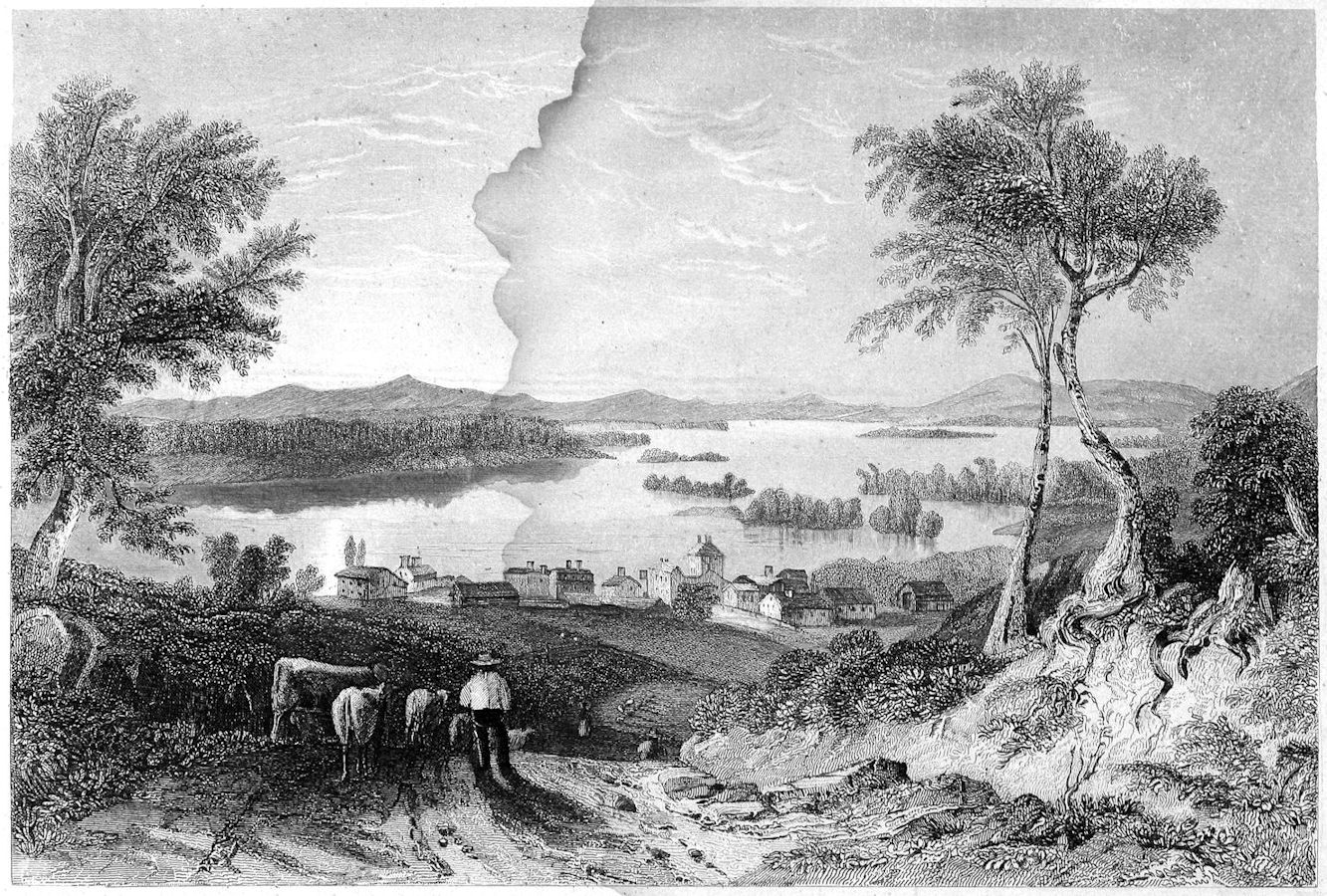
W. H. Bartlett. A. J. Dick.
CENTRE HARBOUR.
(Lake Winnipisseogee)
Engraved expressly for Graham’s Magazine