THE TWO DUKES.
Reading edition
———
BY ANN S. STEPHENS.
———
(Continued from page 144.)
A still more important scene than that which we have described in Lady Jane Seymour’s chamber was passing in the Lord Protector’s closet. A portion of those noblemen forming his council had been hastily summoned to assist in the examination of Lord Dudley, who was brought up from his prison in the new and damp rooms, near the Strand, where he had spent a night of discomfort, which by no means reconciled his proud spirit to the degradation heaped upon it. Though a member, and most powerful one, of his own council, the Lord Protector had neglected to summon the Earl of Warwick to the examination of his son, and Dudley was far too anxious for a good understanding between his own father and the family of his betrothed, to solicit his interference, or even send news of his arrest to the haughty earl. He dreaded the fiery indignation with which the intelligence might be received, and even felt a sensation of relief when he found his father’s seat vacant at the tribunal before which he was so ignominiously arraigned. He was sensible that the Earl of Warwick, as well as the duke, was willing to avail himself of any excuse which might terminate the contract existing between himself and the Lady Jane. His affection for the sweet girl was both sincere and ardent, and though he felt the insult offered by her father with the irritation of a proud, sensitive spirit, he suffered still more deeply from a consciousness that she was a sharer in his trouble, and that the proceedings to which he was an unwilling party were not only a degradation to his manhood but liable to separate him from the object of his affections forever.
With these indignant and conflicting feelings the young nobleman presented himself before the Lord Protector and the few councillors whom he had gathered to his assistance—men who seemed but ill at ease in the position which they held, and were in truth far more anxious to appease the duke than to join him in rash measures against a family which had already rendered itself fearful throughout the kingdom by the might of its power. The artisan was there, craven and abject, yet with something of insolence in his manner; but whether he was brought forward as a witness or a prisoner the proud young man did not deign to inquire; under any circumstances to be so associated was a cruel insult which made the blood tingle in his veins. It was with a firm lip and an eye darkling with subdued excitement that Lord Dudley placed himself before the council table to be questioned like a criminal by the man he had loved almost as a father. The duke seemed touched by some regretful feelings, and a flush came up to his forehead as he encountered the proud glance which was bent upon him by the prisoner. At another time he would have shrunk from mingling the pure name of his child with an investigation so strange in its nature—with questions which might even endanger the honor of his name, but this consideration was lost in his dislike of the Earl of Warwick—a man whom he feared and hated almost as much as he could fear and hate mortal being. Ambition was the leading characteristic of both—such ambition as at last rendered their strife for power like the struggle of two gladiators in mortal combat. They were bold combatants, and hitherto the strife had been a quiet and subtle one. Now a kingdom was looking on. Somerset had sprung into the arena, struck the first blow, and he was well aware that his station and power depended on the victory which he was contending for—that Warwick must be driven from the council of the nation or himself from the protectorship. He little knew how still and subtle had been the windings of his enemy, and with how deep a triumph he received the news of his son’s arrest. We have said that Dudley had caught one glimpse of his betrothed on his way to the council, and for her sake he condescended to answer, with haughty calmness, the questions propounded by her father. His account of the share he had taken in the St. Margaret’s riot was simple, and given in few words.
He had sallied forth, as usual, on his morning ride with the ordinary number of attendants and without the most remote suspicion that any disturbance was threatened. He described the manner in which he had become entangled with the crowd, but avoided all mention of the Lady Jane till called upon by her father to state how she came under his protection. He explained all about the condition in which he had found her—the struggle with which she was conducted through the crowd—their entrance to the church and every thing that transpired till the poor girl was exposed to public outrage by the violence of her own parent. There was truth and dignity in the young man’s statement, which, against his will, convinced the duke of his injustice. But he had already proceeded too far, and he felt that to leave the charge against his prisoner unsubstantiated was to make himself still more unpopular with the people, and fling a fearful power into the hands of his rival. Family affection, his daughter, everything was forgotten in the strife to maintain his tottering power, and though his eye quailed and his brow crimsoned as he perpetrated the insult, that cringing artisan was called forward to disprove the solemn statement of a high born and honorable man.
Lord Dudley turned very pale and drew back with a stern brow and folded arms as the wretch gave his infamous story. The artisan had enough of low born cunning to see that any statement, calculated to implicate the noble youth, would be received as an atonement for the base fraud which he had committed, and persisted in the assertions that he had previously made. When the jewels and the ring were produced he turned, like a coward hound, from the stern glance fixed on him by the young noble, but still in a tone of low bravado, asserted that the ring had been given by the Lady Jane, and that Lord Dudley had rewarded his exertions in bringing them together with the emeralds.
Lord Dudley shut his teeth hard and folded his arms more tightly, as if to repress an impulse to smite the worm where he stood, but turning his flashing eyes from the miscreant to the Duke of Somerset he once more forced himself to composure. The artisan proceeded to substantiate his evidence by assertions regarding the manner and words of the lady, and was going on adding falsehood to falsehood, when the gentle girl, whom he so cruelly aspersed, opened the door and glided into the room. She moved forward to a chair which stood directly in front of the wretch, and grasping the back with her hand, stood regarding him with a look of calm and almost solemn indignation. So noiseless was her entrance that she had been more than a minute in the room before those assembled there became conscious of her presence. As the perjured man lifted his eyes in uttering a sentence, they met the rebuke of that calm glance and quailed beneath it. He faltered in what he was saying and shrunk back to avoid the frown of her innocent presence. When the duke saw his child standing before him, her robe hastily girt round her person, her hair wound in a heavy web over her head, and her sweet face bearing upon each feature evidence of late and bitter suffering, he started to his feet with an exclamation of displeasure and would have demanded the cause of her intrusion, but the change which had fallen upon her was so great that he stood gazing upon her face, lost in a degree of astonishment that had something of awe in it. He could scarcely believe that the face so calm, so pale and resolute, was that of his quiet and child-like daughter. The fountains of a resolute and noble heart had been troubled for the first time, and their overflow left upon her face an expression that never left it again—the impress of such thoughts and feelings as exalt and strengthen the heart they wring. The Lady Jane had become suddenly capable of acting for herself.
“Father,” she said, turning her large eyes from the perjurer to his judge, “Father, I have heard enough to prove how base a thing may be dared even in the presence of a parent; that man has spoken falsely, the ring which you hold was taken from my finger when I lay helpless, and so terrified that I was almost unconscious of the loss, and only remember now as in a dream that a strange grasp was on my hand, a wrench that pained me; then I fainted and forgot all till my mother spoke of the ring a few moments since in my chamber. The emeralds my Lord Duke—” she hesitated a moment and her eyes filled as if with regret that she had uttered so cold a tittle, “the emeralds—my father, were not Lord Dudley’s but my mother’s gift, and I bound my hair with them yesterday morning when I went forth according to your command to take the air; they must have broken loose from my head, for behold here is a proof that they were my own and not Lord Dudley’s.”
As she spoke the Lady Jane unbound the rich masses of her hair, which had not been smoothed since the previous day, and disentangled a fragment of the emerald band which still sparkled within it. They were broad smooth gems linked together with its delicate chain work of gold, and each with a fanciful device cut upon its surface. One of those which the duke held, still remained firm in its setting, a link or two of the chain adhered to it, and those links corresponded in size and workmanship with the fragment which Lady Jane had taken from her hair.
“Still,” said the Duke of Somerset, willing to exculpate his daughter, but determined at all hazards to make good his charge against Dudley, “still does this in no way clear the prisoner from his participation in the riot. We saw him with our own eyes amid the mob, we—”
The duke broke off suddenly, for as the last words left his lips, the closet door was flung open and a tall man, almost regally arrayed, and of imperious presence, entered the room. He cast one quick glance at the Lord Protector, from under his eyebrows, and moving tranquilly to a chair by the council table sat down.
“Go on, my lord duke; I am rather late, but do not let my entrance disturb these august proceedings,” he said, blandly, though there was a slight trembling of the voice which told how tumultuous were the passions concealed beneath all that elaborate and courteous display of words.
The Duke bowed stiffly, and his face was crimson to the temples. Lord Dudley grew pale and red by turns, half disposed to approach his father, and as yet uncertain that he was aware of the position in which he was placed before the council. The Lady Jane trembled visibly and grasped the chair against which she stood for support, while the councillors looked in each other’s faces confused and at a loss how to act.
All this time Warwick sat with his elbow resting on the table, supporting his chin with the palm of his bent hand, and gazing with a doubtful smile, quietly into the duke’s face, as if they had been the best friends on earth.
“Go on, my lord duke, go on,” he said slightly waving his right hand, “Pray do not allow my late and abrupt entrance to interrupt the flow of your grace’s eloquence.”
“Excuse me,” replied the duke, rising from his seat, “this subject must be a painful one, alike to your Lordship and myself. We scarcely expected the Earl of Warwick would choose to meet us in council this morning.”
“And therefore did not summon him to the examination of his son and heir. It was kindly managed, my lord duke, very kindly; be assured the earl of Warwick will not forget this delicacy. Nor will the king, whom I left but now, so deeply impressed with the generous care which your grace bestows on the honor of my humble house, that he has summoned such noblemen of your council as were deemed worthy of the generous silence with which your grace has honored me, to meet him at Somerset House, where, with permission, I will have the pleasure of conducting my son.”
There was cool and cutting irony in this speech which would have lashed the exciteable protector to fury, but for the startling intelligence which it conveyed, regarding the young king. This so over-powered him that he sat pale and with gleaming eyes gazing on the composed and smiling features of the earl, speechless and for a moment bereft of all presence of mind.
Without seeming to notice the effect his speech had made on the protector, Warwick arose, threw back his velvet cloak with a careless toss that exposed the sable facings, and smoothing the folds over his shoulder with elaborate care, as if no deeper thought than that of personal appearance entered his mind, approached Lord Dudley and taking his arm seemed about to conduct him from the room without further ceremony.
“My Lord of Warwick,” exclaimed Somerset starting to his feet and suddenly finding voice, “that young man is a prisoner under arrest for treason, and shall not leave this presence save with a guard of armed men.”
“This young man is my prisoner, under the king’s warrant, and he not only leaves this room without other guard than his father’s arm, but denies the right of any man here, to question or retain him.”
The Earl of Warwick turned as he spoke, and for the first time that day, all the haughty fire of his soul burst into the usually quiet but fine black eyes, which dwelt upon the Lord Protector’s face.
“What—what means this? am I to be braved at my own council table? I—”
The Earl of Somerset broke off, for so intense was his rage, that words were denied him, and specks of foam rushed up to his white lips in their place.
“No, my lord duke,” replied Warwick, once more recovering the composure which he seldom lost, even in moments of the deepest excitement, “not at your own council table; that no longer exists. The council of this nation is sitting now at Somerset House, and I preside there by a choice of the majority, and by desire of King Edward.”
The Duke of Somerset fell back in his chair as if a sudden blow had stunned him, and shading his pale face with his scarcely less pallid hand, remained motionless and silent. The Lady Jane sprang to his side, flung her arm around his neck, and as Lord Dudley broke from the hold which Warwick placed on his arm, she put him calmly away with her disengaged hand. Then lifting her face to the earl, she said, “Your work is done. Leave my father to those who love him.” For one moment a shade of feeling swept over Warwick’s face, but it was instantly banished, and a courteous inclination of the head was all the reply he made. After a moment he turned to the few councillors still retaining their seats in silent consternation, and invited them in the name of King Edward and their colleagues, sitting at Somerset House, to join himself and son there.
There was a brief and whispered consultation around the board; then all, save one man arose, casting furtive glances at the fallen protector, as if they were anxious to escape from his presence unnoticed. The duke lifted his head, and a smile of mingled bitterness and pain passed over his pale features as he saw this movement of his friends. The Lady Jane too, blanched a little whiter and lifted her large clear eyes with an expression of painful astonishment, as if her generous nature could scarcely force itself to believe the selfishness with which she was surrounded.
With cringing and noiseless steps, those men whom Somerset had deemed his true and tried friends, those that would cling to him through good and through evil report—had glided from his presence and stood in the corridor, consulting together in whispers and waiting anxiously for Warwick to come forth, that they might offer him their support unchecked by the presence of the fallen noble to whom, in his prosperity, they had cringed with servile spirits, ready to kneel at any shrine which possessed stepping stones for their own ambition.
One man there was, a gray-haired and frank old nobleman, poor and proud, of a high name, but dignified in his poverty, who had never cringed to the protector or flattered him in the plenitude of his power, but who put away the hand which his antagonist extended as he passed round the table and knelt down by the fallen duke, with a true homage which had more of feeling in its silence than hours of protestation could have conveyed. The duke had leaned forward to the table, and one hand was pressed over his eyes, the other hung nervelessly by his side, and the quivering lips of that brave old man—for he was braver in his moral strength than a thousand battle heroes, went to his heart. One large tear forced itself through his fingers, and dashing it away, the Duke of Somerset arose a more dignified man in his adversity than he had ever been in prosperity.
“My Lord of Warwick,” he said, “this is your hour of triumph—how obtained your own heart can best reply.”
“No, your grace’s rashness is my answer,” interrupted Warwick, with a bland and courteous inclination, “but I have no time for cavil and recrimination. The king is waiting, and methinks there has been enough of high words for a lady’s presence. Lady Jane, we should all crave pardon for discussing state affairs in so gentle a presence. Permit my son to lead you from the room.”
The young girl looked up and hesitated, then drawing nearer to the duke, she said very mildly—
“My father will permit me to stay. That which concerns him cannot be improper for his daughter to witness.”
The earl seemed embarrassed by her refusal, but after a moment resumed his usual composed manner.
“Forgive me,” he said, “if I am compelled to perform the first duty of my office in a manner which might have been avoided,” and stepping to the door, the Earl of Warwick beckoned with his hand to some persons in the corridor. Instantly three men, whom Somerset knew, entered the closet, and there at his own council table, and in the presence of his child, arrested him for treason.
A death-like stillness reigned throughout the room for the duration of a minute after the warrant was read. Until this moment Dudley had remained inactive, confused and uncertain how to interfere in a scene which seemed passing before him like a wild dream, but now he stepped forward firmly and with the air of a man resolved to act from his own honest impulses at all hazards.
“My lord,” he said, addressing his father, “you will not proceed to such extremities against an old friend.”
Warwick looked in his son’s face, and a slight sneer curled his lip as he muttered, “old friends, indeed—well.”
“I am certain,” resumed Dudley, “your own honorable heart must revolt at an act so cruel. If the Duke of Somerset has offended the king let his majesty find some other person than the Earl of Warwick to proceed against him, lest those who deem that there is little of friendly feeling between the houses of Somerset and Warwick, may impute other motives than a love of justice to the prosecution.”
Dudley spoke in a low voice, but every tone fell upon the anxious ear of Lady Jane, and a flash of gratified affection, half pride and half tenderness filled her eyes. For she knew how deep was the reverence he rendered to the earl, and how much of moral courage was in the heart which could have the displeasure of a man so imperative and haughty, but who had even preserved the affections as well as the fear of his family.
“Very prettily argued, my clerkly son,” replied Warwick, lightly—“but pray can you tell me what the good people of England may think of the nobleman, who took advantage of his power to cast a son, and heir of that same ‘old friend’ whom you prate of into a damp hole in his palace, to herd him with a cur like that, and drag him before a picked number of councillors to be examined, on a question which touched his honor and life itself? Love is a question to amuse the people more than any act of mine. If His Grace of Somerset has seen fit to tread upon a serpent’s nest, the world will not marvel that his foot is stung where it would have crushed.
“No, Dudley, no—the king has rightly decided, and he who would have heaped ignominy on my son shall drain the cup he has drugged! Even as he forced the heir to my house to this closet in base contact with a wretch like that cringing cur yonder, shall he go forth and in like company.”
Dudley heard his father out with habitual reverence, but still opened his lips to expostulate once more against the course he was pursuing, but Warwick turned impatiently away.
“Tush man,” he said with a quick wave of the hand, “have done with this and meet me at Somerset House within the hour. The king desires it. If your grace is ready,” he added, turning to Somerset as if extending the most trifling invitation on earth, “we will proceed at once to the council.”
Somerset arose, folded a cloak about him, and though his face was very pale, moved toward the door without speaking a word. The guard closed in around him, and he left the closet like one in a bewildering dream. He had entered that room but an hour before, arrogant in the consciousness of power, second to none in the kingdom; he left it a prisoner and a ruined man.
Warwick gave a sign that the artisan should be secured and followed the fallen duke. The old councillor kept by the side of his friend, and on their way through the corridor the Duchess of Somerset came through a side door and approached her husband, but seeing how pale he was, and that many persons were around him, she drew back disappointed in the womanly impulse which had induced her to seek an interview before he went from the palace, that the cause of her child might be justly understood.
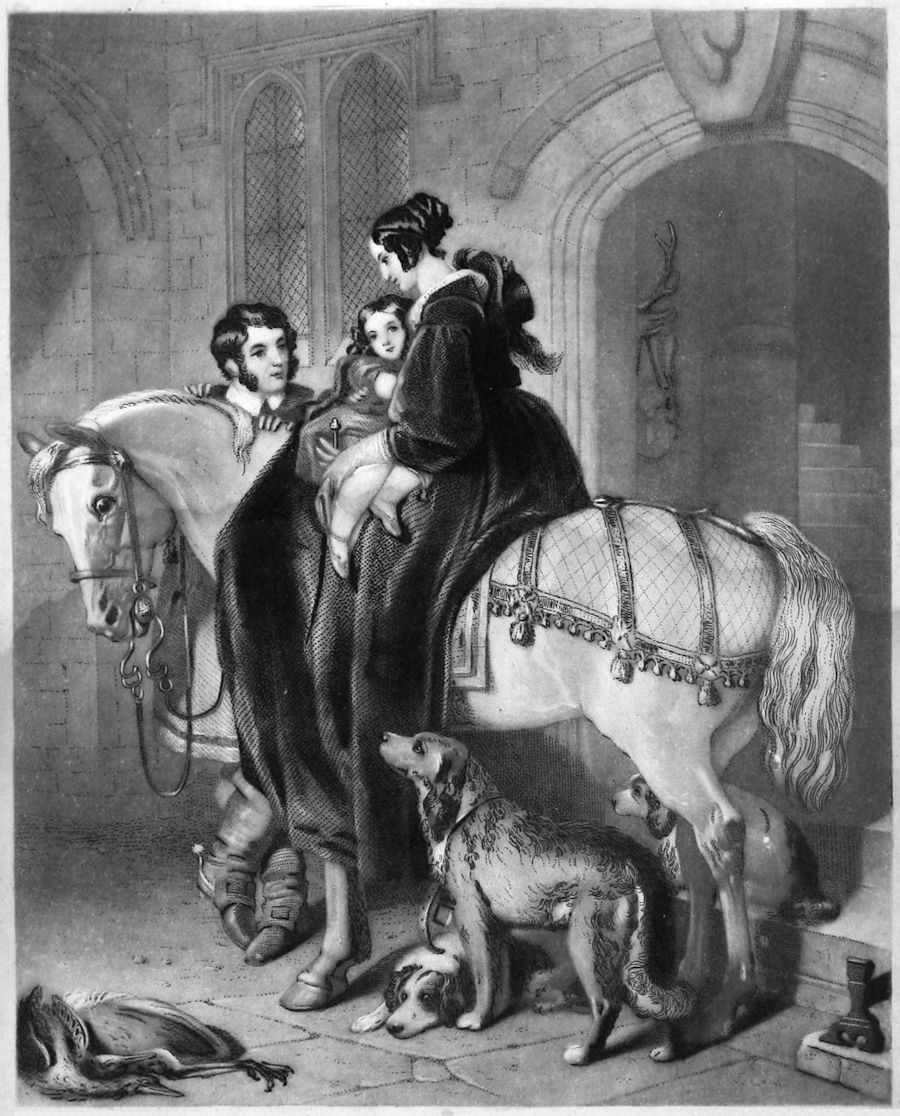
PAINTED BY R. LANDSEER. ENGRAVED BY J. SARTAIN.
Return from Hawking.
Engraved expressly for Graham’s Magazine