Part 2 — REVIEW OF NEW BOOKS.
Reading edition
Barnaby Rudge; By Charles Dickens, (Boz) Author of “The Old Curiosity-Shop,” “Pickwick,” “Oliver Twist,” etc. etc. With numerous Illustrations, by Cattermole, Browne & Sibson. Lea & Blanchard: Philadelphia.
We often hear it said, of this or of that proposition, that it may be good in theory, but will not answer in practice; and in such assertions we find the substance of all the sneers at Critical Art which so gracefully curl the upper lips of a tribe which is beneath it. We mean the small geniuses—the literary Titmice—animalculae which judge of merit solely by result, and boast of the solidity, tangibility and infallibility of the test which they employ. The worth of a work is most accurately estimated, they assure us, by the number of those who peruse it; and “does a book sell?” is a query embodying, in their opinion, all that need be said or sung on the topic of its fitness for sale. We should as soon think of maintaining, in the presence of these creatures, the dictum of Anaxagoras, that snow is black, as of disputing, for example, the profundity of that genius which, in a run of five hundred nights, has rendered itself evident in “London Assurance.” “What,” cry they, “are critical precepts to us, or to anybody? Were we to observe all the critical rules in creation we should still be unable to write a good book”—a point, by the way, which we shall not now pause to deny. “Give us results,” they vociferate, “for we are plain men of common sense. We contend for fact instead of fancy—for practice in opposition to theory.”
The mistake into which the Titmice have been innocently led, however, is precisely that of dividing the practice which they would uphold, from the theory to which they would object. They should have been told in infancy, and thus prevented from exposing themselves in old age, that theory and practice are in so much one, that the former implies or includes the latter. A theory is only good as such, in proportion to its reducibility to practice. If the practice fail, it is because the theory is imperfect. To say what they are in the daily habit of saying—that such or such a matter may be good in theory but is false in practice,—is to perpetrate a bull—to commit a paradox—to state a contradiction in terms—in plain words, to tell a lie which is a lie at sight to the understanding of anything bigger than a Titmouse.
But we have no idea, just now, of persecuting the Tittlebats by too close a scrutiny into their little opinions. It is not our purpose, for example, to press them with so grave a weapon as the argumentum ad absurdum, or to ask them why, if the popularity of a book be in fact the measure of its worth, we should not be at once in condition to admit the inferiority of “Newton’s Principia” to “Hoyle’s Games;” of “Ernest Maltravers” to “Jack-the-Giant-Killer,” or “Jack Sheppard,” or “Jack Brag;” and of “Dick’s Christian Philosopher” to “Charlotte Temple,” or the “Memoirs of de Grammont,” or to one or two dozen other works which must be nameless. Our present design is but to speak, at some length, of a book which in so much concerns the Titmice, that it affords them the very kind of demonstration which they chiefly affect—practical demonstration—of the fallacy of one of their favorite dogmas; we mean the dogma that no work of fiction can fully suit, at the same time, the critical and the popular taste; in fact, that the disregarding or contravening of Critical Rule is absolutely essential to success, beyond a certain and very limited extent, with the public at large. And if, in the course of our random observations—for we have no space for systematic review—it should appear, incidentally, that the vast popularity of “Barnaby Rudge” must be regarded less as the measure of its value, than as the legitimate and inevitable result of certain well-understood critical propositions reduced by genius into practice, there will appear nothing more than what has before become apparent in the “Vicar of Wakefield” of Goldsmith, or in the “Robinson Crusoe” of De Foe—nothing more, in fact, than what is a truism to all but the Titmice.
Those who know us will not, from what is here premised, suppose it our intention, to enter into any wholesale laudation of “Barnaby Rudge.” In truth, our design may appear, at a cursory glance, to be very different indeed. Boccalini, in his “Advertisements from Parnassus,” tells us that a critic once presented Apollo with a severe censure upon an excellent poem. The God asked him for the beauties of the work. He replied that he only troubled himself about the errors. Apollo presented him with a sack of unwinnowed wheat, and bade him pick out all the chaff for his pains. Now we have not fully made up our minds that the God was in the right. We are not sure that the limit of critical duty is not very generally misapprehended. Excellence may be considered an axiom, or a proposition which becomes self-evident just in proportion to the clearness or precision with which it is put. If it fairly exists, in this sense, it requires no farther elucidation. It is not excellence if it need to be demonstrated as such. To point out too particularly the beauties of a work, is to admit, tacitly, that these beauties are not wholly admirable. Regarding, then, excellence as that which is capable of self-manifestation, it but remains for the critic to show when, where, and how it fails in becoming manifest; and, in this showing, it will be the fault of the book itself if what of beauty it contains be not, at least, placed in the fairest light. In a word, we may assume, notwithstanding a vast deal of pitiable cant upon this topic, that in pointing out frankly the errors of a work, we do nearly all that is critically necessary in displaying its merits. In teaching what perfection is, how, in fact, shall we more rationally proceed than in specifying what it is not?
The plot of “Barnaby Rudge” runs thus: About a hundred years ago, Geoffrey Haredale and John Chester were schoolmates in England—the former being the scape-goat and drudge of the latter. Leaving school, the boys become friends, with much of the old understanding. Haredale loves; Chester deprives him of his mistress. The one cherishes the most deadly hatred; the other merely contemns and avoids. By routes widely different both attain mature age. Haredale, remembering his old love, and still cherishing his old hatred, remains a bachelor and is poor. Chester, among other crimes, is guilty of the seduction and heartless abandonment of a gypsy-girl, who, after the desertion of her lover, gives birth to a son, and, falling into evil courses, is finally hung at Tyburn. The son is received and taken charge of, at an inn called the Maypole, upon the borders of Epping forest, and about twelve miles from London. This inn is kept by one John Willet, a burley-headed and very obtuse little man, who has a son, Joe, and who employs his protégé, under the single name of Hugh, as perpetual hostler at the inn. Hugh’s father marries, in the meantime, a rich parvenue, who soon dies, but not before having presented Mr. Chester with a boy, Edward. The father, (a thoroughly selfish man-of-the-world, whose model is Chesterfield,) educates this son at a distance, seeing him rarely, and calling him to the paternal residence, at London, only when he has attained the age of twenty-four or five. He, the father, has, long ere this time, spent the fortune brought him by his wife, having been living upon his wits and a small annuity for some eighteen years. The son is recalled chiefly that by marrying an heiress, on the strength of his own personal merit and the reputed wealth of old Chester, he may enable the latter to continue his gayeties in old age. But of this design, as well as of his poverty, Edward is kept in ignorance for some three or four years after his recall; when the father’s discovery of what he considers an inexpedient love-entanglement on the part of the son, induces him to disclose the true state of his affairs, as well as the real tenor of his intentions.
Now the love-entanglement of which we speak, is considered inexpedient by Mr. Chester for two reasons—the first of which is, that the lady beloved is the orphan niece of his old enemy, Haredale, and the second is, that Haredale (although in circumstances which have been much and very unexpectedly improved during the preceding twenty-two years) is still insufficiently wealthy to meet the views of Mr. Chester.
We say that, about twenty-two years before the period in question, there came an unlooked-for change in the worldly circumstances of Haredale. This gentleman has an elder brother, Reuben, who has long possessed the family inheritance of the Haredales, residing at a mansion called “The Warren,” not far from the Maypole-Inn, which is itself a portion of the estate. Reuben is a widower, with one child, a daughter, Emma. Besides this daughter, there are living with him a gardener, a steward (whose name is Rudge) and two women servants, one of whom is the wife of Rudge. On the night of the nineteenth of March, 1733, Rudge murders his master for the sake of a large sum of money which he is known to have in possession. During the struggle, Mr. Haredale grasps the cord of an alarm-bell which hangs within his reach, but succeeds in sounding it only once or twice, when it is severed by the knife of the ruffian, who then, completing his bloody business, and securing the money, proceeds to quit the chamber. While doing this, however, he is disconcerted by meeting the gardener, whose pallid countenance evinces suspicion of the deed committed. The murderer is thus forced to kill his fellow servant. Having done so, the idea strikes him of transferring the burden of the crime from himself. He dresses the corpse of the gardener in his own clothes, puts upon its finger his own ring and in its pocket his own watch—then drags it to a pond in the grounds, and throws it in. He now returns to the house, and, disclosing all to his wife, requests her to become a partner in his flight. Horror-stricken, she falls to the ground. He attempts to raise her. She seizes his wrist, staining her hand with blood in the attempt. She renounces him forever; yet promises to conceal the crime. Alone, he flees the country. The next morning, Mr. Haredale being found murdered, and the steward and gardener being both missing, both are suspected. Mrs. Rudge leaves The Warren, and retires to an obscure lodging in London (where she lives upon an annuity allowed her by Haredale) having given birth, on the very day after the murder, to a son, Barnaby Rudge, who proves an idiot, who bears upon his wrist a red mark, and who is born possessed with a maniacal horror of blood.
Some months since the assassination having elapsed, what appears to be the corpse of Rudge is discovered, and the outrage is attributed to the gardener. Yet not universally:—for, as Geoffrey Haredale comes into possession of the estate, there are not wanting suspicions (fomented by Chester) of his own participation in the deed. This taint of suspicion, acting upon his hereditary gloom, together with the natural grief and horror of the atrocity, embitters the whole life of Haredale. He secludes himself at The Warren, and acquires a monomaniac acerbity of temper relieved only by love of his beautiful niece.
Time wears away. Twenty-two years pass by. The niece has ripened into womanhood, and loves young Chester without the knowledge of her uncle or the youth’s father. Hugh has grown a stalwart man—the type of man the animal, as his father is of man the ultra-civilized. Rudge, the murderer, returns, urged to his undoing by Fate. He appears at the Maypole and inquires stealthily of the circumstances which have occurred at The Warren in his absence. He proceeds to London, discovers the dwelling of his wife, threatens her with the betrayal of her idiot son into vice and extorts from her the bounty of Haredale. Revolting at such appropriation of such means, the widow, with Barnaby, again seeks The Warren, renounces the annuity, and, refusing to assign any reason for her conduct, states her intention of quitting London forever, and of burying herself in some obscure retreat—a retreat which she begs Haredale not to attempt discovering. When he seeks her in London the next day, she is gone; and there are no tidings, either of herself or of Barnaby, until the expiration of five years—which bring the time up to that of the Celebrated “No Popery” Riots of Lord George Gordon.
In the meanwhile, and immediately subsequent to the re-appearance of Rudge; Haredale and the elder Chester, each heartily desirous of preventing the union of Edward and Emma, have entered into a covenant, the result of which is that, by means of treachery on the part of Chester, permitted on that of Haredale, the lovers misunderstand each other and are estranged. Joe, also, the son of the innkeeper, Willet, having been coquetted with, to too great an extent, by Dolly Varden, (the pretty daughter of one Gabriel Varden, a locksmith of Clerkenwell, London) and having been otherwise mal-treated at home, enlists in his Majesty’s army and is carried beyond seas, to America; not returning until towards the close of the riots. Just before their commencement, Rudge, in a midnight prowl about the scene of his atrocity, is encountered by an individual who had been familiar with him in earlier life, while living at The Warren. This individual, terrified at what he supposes, very naturally, to be the ghost of the murdered Rudge, relates his adventure to his companions at the Maypole, and John Willet conveys the intelligence, forthwith, to Mr. Haredale. Connecting the apparition, in his own mind, with the peculiar conduct of Mrs. Rudge, this gentleman imbibes a suspicion, at once, of the true state of affairs. This suspicion (which he mentions to no one) is, moreover, very strongly confirmed by an occurrence happening to Varden, the locksmith, who, visiting the woman late one night, finds her in communion of a nature apparently most confidential, with a ruffian whom the locksmith knows to be such, without knowing the man himself. Upon an attempt, on the part of Varden, to seize this ruffian, he is thwarted by Mrs. R.; and upon Haredale’s inquiring minutely into the personal appearance of the man, he is found to accord with Rudge. We have already shown that the ruffian was in fact Rudge himself. Acting upon the suspicion thus aroused, Haredale watches, by night, alone, in the deserted house formerly occupied by Mrs. R. in hope of here coming upon the murderer, and makes other exertions with the view of arresting him; but all in vain.
It is, also, at the conclusion of the five years, that the hitherto uninvaded retreat of Mrs. Rudge is disturbed by a message from her husband, demanding money. He has discovered her abode by accident. Giving him what she has at the time, she afterwards eludes him, and hastens, with Barnaby, to bury herself in the crowd of London, until she can find opportunity again to seek retreat in some more distant region of England. But the riots have now begun. The idiot is beguiled into joining the mob, and, becoming separated from his mother (who, growing ill through grief, is borne to a hospital) meets with his old playmate Hugh, and becomes with him a ringleader in the rebellion.
The riots proceed. A conspicuous part is borne in them by one Simon Tappertit, a fantastic and conceited little apprentice of Varden’s, and a sworn enemy to Joe Willet, who has rivalled him in the affection of Dolly. A hangman, Dennis, is also very busy amid the mob. Lord George Gordon, and his secretary, Gashford, with John Grueby, his servant, appear, of course, upon the scene. Old Chester, who, during the five years, has become Sir John, instigates Gashford, who has received personal insult from Haredale, (a catholic and consequently obnoxious to the mob) instigates Gashford to procure the burning of The Warren, and to abduct Emma during the excitement ensuing. The mansion is burned, (Hugh, who also fancies himself wronged by Haredale, being chief actor in the outrage) and Miss H. carried off, in company with Dolly, who had long lived with her, and whom Tappertit abducts upon his own responsibility. Rudge, in the meantime, finding the eye of Haredale upon him, (since he has become aware of the watch kept nightly at his wife’s,) goaded by the dread of solitude, and fancying that his sole chance of safety lies in joining the rioters, hurries upon their track to the doomed Warren. He arrives too late—the mob have departed. Skulking about the ruins, he is discovered by Haredale, and finally captured, without a struggle, within the glowing walls of the very chamber in which the deed was committed. He is conveyed to prison, where he meets and recognises Barnaby, who had been captured as a rioter. The mob assail and burn the jail. The father and son escape. Betrayed by Dennis, both are again retaken, and Hugh shares their fate. In Newgate, Dennis, through accident, discovers the parentage of Hugh, and an effort is made in vain to interest Chester in behalf of his son. Finally, Varden procures the pardon of Barnaby; but Hugh, Rudge and Dennis are hung. At the eleventh hour, Joe returns from abroad with one arm. In company with Edward Chester, he performs prodigies of valor (during the last riots) on behalf of the government. The two, with Haredale and Varden, rescue Emma and Dolly. A double marriage, of course, takes place; for Dolly has repented her fine airs, and the prejudices of Haredale are overcome. Having killed Chester in a duel, he quits England forever, and ends his days in the seclusion of an Italian convent. Thus, after summary disposal of the understrappers, ends the drama of “Barnaby Rudge.”
We have given, as may well be supposed, but a very meagre outline of the story, and we have given it in the simple or natural sequence. That is to say, we have related the events, as nearly as might be, in the order of their occurrence. But this order would by no means have suited the purpose of the novelist, whose design has been to maintain the secret of the murder, and the consequent mystery which encircles Rudge, and the actions of his wife, until the catastrophe of his discovery by Haredale. The thesis of the novel may thus be regarded as based upon curiosity. Every point is so arranged as to perplex the reader, and whet his desire for elucidation:—for example, the first appearance of Rudge at the Maypole; his questions; his persecution of Mrs. R.; the ghost seen by the frequenter of the Maypole; and Haredale’s impressive conduct in consequence. What we have told, in the very beginning of our digest, in regard to the shifting of the gardener’s dress, is sedulously kept from the reader’s knowledge until he learns it from Rudge’s own confession in jail. We say sedulously; for, the intention once known, the traces of the design can be found upon every page. There is an amusing and exceedingly ingenious instance at page 145, where Solomon Daisy describes his adventure with the ghost.
“It was a ghost—a spirit,” cried Daisy.
“Whose?” they all three asked together.
In the excess of his emotion (for he fell back trembling in his chair and waved his hand as if entreating them to question him no farther) his answer was lost upon all but old John Willet, who happened to be seated close beside him.
“Who!” cried Parkes and Tom Cobb—“Who was it?”
“Gentlemen,” said Mr. Willet, after a long pause, “you needn’t ask. The likeness of a murdered man. This is the nineteenth of March.”
A profound silence ensued.
The impression here skilfully conveyed is, that the ghost seen is that of Reuben Haredale; and the mind of the not-too-acute reader is at once averted from the true state of the case—from the murderer, Rudge, living in the body.
Now there can be no question that, by such means as these, many points which are comparatively insipid in the natural sequence of our digest, and which would have been comparatively insipid even if given in full detail in a natural sequence, are endued with the interest of mystery; but neither can it be denied that a vast many more points are at the same time deprived of all effect, and become null, through the impossibility of comprehending them without the key. The author, who, cognizant of his plot, writes with this cognizance continually operating upon him, and thus writes to himself in spite of himself, does not, of course, feel that much of what is effective to his own informed perception, must necessarily be lost upon his uninformed readers; and he himself is never in condition, as regards his own work, to bring the matter to test. But the reader may easily satisfy himself of the validity of our objection. Let him re-peruse “Barnaby Rudge,” and, with a pre-comprehension of the mystery, these points of which we speak break out in all directions like stars, and throw quadruple brilliance over the narrative—a brilliance which a correct taste will at once declare unprofitably sacrificed at the shrine of the keenest interest of mere mystery.
The design of mystery, however, being once determined upon by an author, it becomes imperative, first, that no undue or inartistical means be employed to conceal the secret of the plot; and, secondly, that the secret be well kept. Now, when, at page 16, we read that “the body of poor Mr. Rudge, the steward, was found” months after the outrage, &c. we see that Mr. Dickens has been guilty of no misdemeanor against Art in stating what was not the fact; since the falsehood is put into the mouth of Solomon Daisy, and given merely as the impression of this individual and of the public. The writer has not asserted it in his own person, but ingeniously conveyed an idea (false in itself, yet a belief in which is necessary for the effect of the tale) by the mouth of one of his characters. The case is different, however, when Mrs. Rudge is repeatedly denominated “the widow.” It is the author who, himself, frequently so terms her. This is disingenuous and inartistical: accidentally so, of course. We speak of the matter merely by way of illustrating our point, and as an oversight on the part of Mr. Dickens.
That the secret be well kept is obviously necessary. A failure to preserve it until the proper moment of dénouement, throws all into confusion, so far as regards the effect intended. If the mystery leak out, against the author’s will, his purposes are immediately at odds and ends; for he proceeds upon the supposition that certain impressions do exist, which do not exist, in the mind of his readers. We are not prepared to say, so positively as we could wish, whether, by the public at large, the whole mystery of the murder committed by Rudge, with the identity of the Maypole ruffian with Rudge himself, was fathomed at any period previous to the period intended, or, if so, whether at a period so early as materially to interfere with the interest designed; but we are forced, through sheer modesty, to suppose this the case; since, by ourselves individually, the secret was distinctly understood immediately upon the perusal of the story of Solomon Daisy, which occurs at the seventh page of this volume of three hundred and twenty-three. In the number of the “Philadelphia Saturday Evening Post,” for May the 1st, 1841, (the tale having then only begun) will be found a prospective notice of some length, in which we made use of the following words—
That Barnaby is the son of the murderer may not appear evident to our readers—but we will explain. The person murdered is Mr. Reuben Haredale. He was found assassinated in his bed-chamber. His steward (Mr. Rudge, senior,) and his gardener (name not mentioned) are missing. At first both are suspected. ‘Some months afterward,’ here we use the words of the story—‘the steward’s body, scarcely to be recognised but by his clothes, and the watch and ring he wore—was found at the bottom of a piece of water in the grounds, with a deep gash in the breast where he had been stabbed by a knife. He was only partly dressed; and all people agreed that he had been sitting up reading in his own room, where there were many traces of blood, and was suddenly fallen upon and killed, before his master.’
Now, be it observed, it is not the author himself who asserts that the steward’s body was found; he has put the words in the mouth of one of his characters. His design is to make it appear, in the dénouement, that the steward, Rudge, first murdered the gardener, then went to his master’s chamber, murdered him, was interrupted by his (Rudge’s) wife, whom he seized and held by the wrist, to prevent her giving the alarm—that he then, after possessing himself of the booty desired, returned to the gardener’s room, exchanged clothes with him, put upon the corpse his own watch and ring, and secreted it where it was afterwards discovered at so late a period that the features could not be identified.
The differences between our pre-conceived ideas, as here stated, and the actual facts of the story, will be found immaterial. The gardener was murdered not before but after his master; and that Rudge’s wife seized him by the wrist, instead of his seizing her, has so much the air of a mistake on the part of Mr. Dickens, that we can scarcely speak of our own version as erroneous. The grasp of a murderer’s bloody hand on the wrist of a woman enceinte, would have been more likely to produce the effect described (and this every one will allow) than the grasp of the hand of the woman upon the wrist of the assassin. We may therefore say of our supposition as Talleyrand said of some cockney’s bad French—que s’il ne soit pas Français, assurément donc il le doit être—that if we did not rightly prophesy, yet, at least, our prophecy should have been right.
We are informed in the Preface to “Barnaby Rudge” that “no account of the Gordon Riots having been introduced into any work of fiction, and the subject presenting very extraordinary and remarkable features,” our author “was led to project this tale.” But for this distinct announcement (for Mr. Dickens can scarcely have deceived himself) we should have looked upon the Riots as altogether an afterthought. It is evident that they have no necessary connection with the story. In our digest, which carefully includes all essentials of the plot, we have dismissed the doings of the mob in a paragraph. The whole event of the drama would have proceeded as well without as with them. They have even the appearance of being forcibly introduced. In our compendium above, it will be seen that we emphasised several allusions to an interval of five years. The action is brought up to a certain point. The train of events is, so far, uninterrupted—nor is there any apparent need of interruption—yet all the characters are now thrown forward for a period of five years. And why? We ask in vain. It is not to bestow upon the lovers a more decorous maturity of age—for this is the only possible idea which suggests itself—Edward Chester is already eight-and-twenty, and Emma Haredale would, in America at least, be upon the list of old maids. No—there is no such reason; nor does there appear to be any one more plausible than that, as it is now the year of our Lord 1775, an advance of five years will bring the dramatis personae up to a very remarkable period, affording an admirable opportunity for their display—the period, in short, of the “No Popery” riots. This was the idea with which we were forcibly impressed in perusal, and which nothing less than Mr. Dickens’ positive assurance to the contrary would have been sufficient to eradicate.
It is, perhaps, but one of a thousand instances of the disadvantages, both to the author and the public, of the present absurd fashion of periodical novel-writing, that our author had not sufficiently considered or determined upon any particular plot when he began the story now under review. In fact, we see, or fancy that we see, numerous traces of indecision—traces which a dexterous supervision of the complete work might have enabled him to erase. We have already spoken of the intermission of a lustrum. The opening speeches of old Chester are by far too truly gentlemanly for his subsequent character. The wife of Varden, also, is too wholesale a shrew to be converted into the quiet wife—the original design was to punish her. At page 16, we read thus—Solomon Daisy is telling his story:
“I put as good a face upon it as I could, and, muffling myself up, started out with a lighted lantern in one hand and the key of the church in the other”—at this point of the narrative, the dress of the strange man rustled as if he had turned to hear more distinctly.
Here the design is to call the reader’s attention to a point in the tale; but no subsequent explanation is made. Again, a few lines below—
“The houses were all shut up, and the folks in doors, and perhaps there is only one man in the world who knows how dark it really was.”
Here the intention is still more evident, but there is no result. Again, at page 54, the idiot draws Mr. Chester to the window, and directs his attention to the clothes hanging upon the lines in the yard—
“Look down,” he said softly; “do you mark how they whisper in each other’s ears, then dance and leap to make believe they are in sport? Do you see how they stop for a moment, when they think there is no one looking, and mutter among themselves again; and then how they roll and gambol, delighted with the mischief they’ve been plotting? Look at ’em now! See how they whirl and plunge. And now they stop again, and whisper cautiously together—little thinking, mind, how often I have lain upon the ground and watched them. I say—what is it that they plot and hatch? Do you know?”
Upon perusal of these ravings we, at once, supposed them to have allusion to some real plotting; and even now we cannot force ourselves to believe them not so intended. They suggested the opinion that Haredale himself would be implicated in the murder, and that the counsellings alluded to might be those of that gentleman with Rudge. It is by no means impossible that some such conception wavered in the mind of the author. At page 32 we have a confirmation of our idea, when Varden endeavors to arrest the murderer in the house of his wife—
“Come back—come back!” exclaimed the woman, wrestling with and clasping him. “Do not touch him on your life. He carries other lives beside his own.”
The dénouement fails to account for this exclamation.
In the beginning of the story much emphasis is placed upon the two female servants of Haredale, and upon his journey to and from London, as well as upon his wife. We have merely said, in our digest, that he was a widower, italicizing the remark. All these other points are, in fact, singularly irrelevant, in the supposition that the original design has not undergone modification.
Again, at page 57, when Haredale talks of “his dismantled and beggared hearth,” we cannot help fancying that the author had in view some different wrong, or series of wrongs, perpetrated by Chester, than any which appear in the end. This gentleman, too, takes extreme and frequent pains to acquire dominion over the rough Hugh—this matter is particularly insisted upon by the novelist—we look, of course, for some important result—but the filching of a letter is nearly all that is accomplished. That Barnaby’s delight in the desperate scenes of the rebellion, is inconsistent with his horror of blood, will strike every reader; and this inconsistency seems to be the consequence of the afterthought upon which we have already commented. In fact the title of the work, the elaborate and pointed manner of the commencement, the impressive description of The Warren, and especially of Mrs. Rudge, go far to show that Mr. Dickens has really deceived himself—that the soul of the plot, as originally conceived, was the murder of Haredale with the subsequent discovery of the murderer in Rudge—but that this idea was afterwards abandoned, or rather suffered to be merged in that of the Popish Riots. The result has been most unfavorable. That which, of itself would have proved highly effective, has been rendered nearly null by its situation. In the multitudinous outrage and horror of the Rebellion, the one atrocity is utterly whelmed and extinguished.
The reasons of this deflection from the first purpose appear to us self-evident. One of them we have already mentioned. The other is that our author discovered, when too late, that he had anticipated, and thus rendered valueless, his chief effect. This will be readily understood. The particulars of the assassination being withheld, the strength of the narrator is put forth, in the beginning of the story, to whet curiosity in respect to these particulars; and, so far, he is but in proper pursuance of his main design. But from this intention he unwittingly passes into the error of exaggerating anticipation. And error though it be, it is an error wrought with consummate skill. What, for example, could more vividly enhance our impression of the unknown horror enacted, than the deep and enduring gloom of Haredale—than the idiot’s inborn awe of blood—or, especially, than the expression of countenance so imaginatively attributed to Mrs. Rudge—“the capacity for expressing terror—something only dimly seen, but never absent for a moment—the shadow of some look to which an instant of intense and most unutterable horror only could have given rise?” But it is a condition of the human fancy that the promises of such words are irredeemable. In the notice before mentioned we thus spoke upon this topic—
This is a conception admirably adapted to whet curiosity in respect to the character of that event which is hinted at as forming the basis of the story. But this observation should not fail to be made—that the anticipation must surpass the reality; that no matter how terrific be the circumstances which, in the dénouement, shall appear to have occasioned the expression of countenance worn habitually by Mrs. Rudge, still they will not be able to satisfy the mind of the reader. He will surely be disappointed. The skilful intimation of horror held out by the artist, produces an effect which will deprive his conclusion of all. These intimations—these dark hints of some uncertain evil—are often rhetorically praised as effective—but are only justly so praised where there is no dénouement whatever—where the reader’s imagination is left to clear up the mystery for itself—and this is not the design of Mr. Dickens.
And, in fact, our author was not long in seeing his precipitancy. He had placed himself in a dilemma from which even his high genius could not extricate him. He at once shifts the main interest—and in truth we do not see what better he could have done. The reader’s attention becomes absorbed in the riots, and he fails to observe that what should have been the true catastrophe of the novel, is exceedingly feeble and ineffective.
A few cursory remarks:—Mr. Dickens fails peculiarly in pure narration. See, for example, page 296, where the connection of Hugh and Chester is detailed by Varden. See also in “The Curiosity-Shop,” where, when the result is fully known, so many words are occupied in explaining the relationship of the brothers.
The effect of the present narrative might have been materially increased by confining the action within the limits of London. The “Notre Dame” of Hugo affords a fine example of the force which can be gained by concentration, or unity of place. The unity of time is also sadly neglected, to no purpose, in “Barnaby Rudge.”
That Rudge should so long and so deeply feel the sting of conscience is inconsistent with his brutality.
On page 15 the interval elapsing between the murder and Rudge’s return, is variously stated at twenty-two and twenty-four years.
It may be asked why the inmates of The Warren failed to hear the alarm-bell which was heard by Solomon Daisy.
The idea of persecution by being tracked, as by bloodhounds, from one spot of quietude to another is a favorite one with Mr. Dickens. Its effect cannot be denied.
The stain upon Barnaby’s wrist, caused by fright in the mother at so late a period of gestation as one day before mature parturition, is shockingly at war with all medical experience.
When Rudge, escaped from prison, unshackled, with money at command, is in agony at his wife’s refusal to perjure herself for his salvation—is it not queer that he should demand any other salvation than lay in his heels?
Some of the conclusions of chapters—see pages 40 and 100—seem to have been written for the mere purpose of illustrating tail-pieces.
The leading idiosyncrasy of Mr. Dickens’ remarkable humor, is to be found in his translating the language of gesture, or action, or tone. For example—
“The cronies nodded to each other, and Mr. Parkes remarked in an under tone, shaking his head meanwhile, as who should say ‘let no man contradict me, for I won’t believe him,’ that Willet was in amazing force to-night.”
The riots form a series of vivid pictures never surpassed.
At page 17, the road between London and the Maypole is described as a horribly rough and dangerous, and at page 97, as an uncommonly smooth and convenient one.
At page 116, how comes Chester in possession of the key of Mrs. Rudge’s vacated house?
Mr. Dickens’ English is usually pure. His most remarkable error is that of employing the adverb “directly” in the sense of “as soon as.” For example—“Directly he arrived, Rudge said, &c.” Bulwer is uniformly guilty of the same blunder.
It is observable that so original a stylist as our author should occasionally lapse into a gross imitation of what, itself, is a gross imitation. We mean the manner of Lamb—a manner based in the Latin construction. For example—
In summer time its pumps suggest to thirsty idlers springs cooler and more sparkling and deeper than other wells; and as they trace the spillings of full pitchers on the heated ground, they snuff the freshness, and, sighing, cast sad looks towards the Thames, and think of baths and boats, and saunter on, despondent.
The wood-cut designs which accompany the edition before us are occasionally good. The copper engravings are pitiably ill-conceived and ill-drawn; and not only this, but are in broad contradiction of the wood-designs and text.
There are many coincidences wrought into the narrative—those, for example, which relate to the nineteenth of March; the dream of Barnaby, respecting his father, at the very period when his father is actually in the house; and the dream of Haredale previous to his final meeting with Chester. These things are meant to insinuate a fatality which, very properly, is not expressed in plain terms—but it is questionable whether the story derives more, in ideality, from their introduction, than it might have gained of verisimilitude from their omission.
The dramatis personae sustain the high fame of Mr. Dickens as a delineator of character. Miggs, the disconsolate handmaiden of Varden; Tappertit, his chivalrous apprentice; Mrs. Varden, herself; and Dennis, a hangman—may be regarded as original caricatures, of the highest merit as such. Their traits are founded in acute observation of nature, but are exaggerated to the utmost admissible extent. Miss Haredale and Edward Chester are common-places—no effort has been made in their behalf. Joe Willet is a naturally drawn country youth. Stagg is a mere make-weight. Gashford and Gordon are truthfully copied. Dolly Varden is truth itself. Haredale, Rudge and Mrs. Rudge are impressive only through the circumstances which surround them. Sir John Chester is, of course, not original, but is a vast improvement upon all his predecessors—his heartlessness is rendered somewhat too amusing, and his end too much that of a man of honor. Hugh is a noble conception. His fierce exultation in his animal powers; his subserviency to the smooth Chester; his mirthful contempt and patronage of Tappertit, and his brutal yet firm courage in the hour of death—form a picture to be set in diamonds. Old Willet is not surpassed by any character even among those of Dickens. He is nature itself—yet a step farther would have placed him in the class of caricatures. His combined conceit and obtusity are indescribably droll, and his peculiar misdirected energy when aroused, is one of the most exquisite touches in all humorous painting. We shall never forget how heartily we laughed at his shaking Solomon Daisy and threatening to put him behind the fire, because the unfortunate little man was too much frightened to articulate. Varden is one of those free, jovial, honest fellows at charity with all mankind, whom our author is so fond of depicting. And lastly, Barnaby, the hero of the tale—in him we have been somewhat disappointed. We have already said that his delight in the atrocities of the Rebellion is at variance with his horror of blood. But this horror of blood is inconsequential; and of this we complain. Strongly insisted upon in the beginning of the narrative, it produces no adequate result. And here how fine an opportunity has Mr. Dickens missed! The conviction of the assassin, after the lapse of twenty-two years, might easily have been brought about through his son’s mysterious awe of blood—an awe created in the unborn by the assassination itself—and this would have been one of the finest possible embodiments of the idea which we are accustomed to attach to “poetical justice.” The raven, too, intensely amusing as it is, might have been made, more than we now see it, a portion of the conception of the fantastic Barnaby. Its croakings might have been prophetically heard in the course of the drama. Its character might have performed, in regard to that of the idiot, much the same part as does, in music, the accompaniment in respect to the air. Each might have been distinct. Each might have differed remarkably from the other. Yet between them there might have been wrought an analogical resemblance, and, although each might have existed apart, they might have formed together a whole which would have been imperfect in the absence of either.
From what we have here said—and, perhaps, said without due deliberation—(for alas! the hurried duties of the journalist preclude it) there will not be wanting those who will accuse us of a mad design to detract from the pure fame of the novelist. But to such we merely say in the language of heraldry “ye should wear a plain point sanguine in your arms.” If this be understood, well; if not, well again. There lives no man feeling a deeper reverence for genius than ourself. If we have not dwelt so especially upon the high merits as upon the trivial defects of “Barnaby Rudge” we have already given our reasons for the omission, and these reasons will be sufficiently understood by all whom we care to understand them. The work before us is not, we think, equal to the tale which immediately preceded it; but there are few—very few others to which we consider it inferior. Our chief objection has not, perhaps, been so distinctly stated as we could wish. That this fiction, or indeed that any fiction written by Mr. Dickens, should be based in the excitement and maintenance of curiosity we look upon as a misconception, on the part of the writer, of his own very great yet very peculiar powers. He has done this thing well, to be sure—he would do anything well in comparison with the herd of his contemporaries—but he has not done it so thoroughly well as his high and just reputation would demand. We think that the whole book has been an effort to him—solely through the nature of its design. He has been smitten with an untimely desire for a novel path. The idiosyncrasy of his intellect would lead him, naturally, into the most fluent and simple style of narration. In tales of ordinary sequence he may and will long reign triumphant. He has a talent for all things, but no positive genius for adaptation, and still less for that metaphysical art in which the souls of all mysteries lie. “Caleb Williams” is a far less noble work than “The Old Curiosity-Shop;” but Mr. Dickens could no more have constructed the one than Mr. Godwin could have dreamed of the other.
Wakondah; The Master of Life. A Poem. George L. Curry and Co.: New York.
“Wakondah” is the composition of Mr. Cornelius Mathews, one of the editors of the Monthly Magazine, “Arcturus.” In the December number of the journal, the poem was originally set forth by its author, very much “avec l’air d’un homme qui sauve sa patrie.” To be sure, it was not what is usually termed the leading article of the month. It did not occupy that post of honor which, hitherto, has been so modestly filled by “Puffer Hopkins.” But it took precedence of some exceedingly beautiful stanzas by Professor Longfellow, and stood second only to a very serious account of a supper which, however well it might have suited the taste of an Ariel, would scarcely have feasted the Anakim, or satisfied the appetite of a Grandgousier. The supper was, or might have been, a good thing. The poem which succeeded it is not; nor can we imagine what has induced Messrs. Curry & Co. to be at the trouble of its republication. We are vexed with these gentlemen for having thrust this affair the second time before us. They have placed us in a predicament we dislike. In the pages of “Arcturus” the poem did not come necessarily under the eye of the Magazine critic. There is a tacitly-understood courtesy about these matters—a courtesy upon which we need not comment. The contributed papers in any one journal of the class of “Arcturus” are not considered as debateable by any one other. General propositions, under the editorial head, are rightly made the subject of discussion; but in speaking of “Wakondah,” for example, in the pages of our own Magazine, we should have felt as if making an occasion. Now, upon our first perusal of the poem in question, we were both astonished and grieved that we could say, honestly, very little in its praise:—astonished, for by some means, not just now altogether intelligible to ourselves, we had become imbued with the idea of high poetical talent in Mr. Mathews:—grieved, because, under the circumstances of his position as editor of one of the very best journals in the country, we had been sincerely anxious to think well of his abilities. Moreover, we felt that to speak ill of them, under any circumstances whatever, would be to subject ourselves to the charge of envy or jealousy, on the part of those who do not personally know us. We, therefore, rejoiced that “Wakondah” was not a topic we were called upon to discuss. But the poem is republished, and placed upon our table, and these very “circumstances of position,” which restrained us in the first place, render it a positive duty that we speak distinctly in the second.
And very distinctly shall we speak. In fact this effusion is a dilemma whose horns goad us into frankness and candor—“c’est un malheur,” to use the words of Victor Hugo, “d’où on ne pourrait se tirer par des periphrases, par des quemadmodums et des verumenimveros.” If we mention it at all, we are forced to employ the language of that region where, as Addison has it, “they sell the best fish and speak the plainest English.” “Wakondah,” then, from beginning to end, is trash. With the trivial exceptions which we shall designate, it has no merit whatever; while its faults, more numerous than the leaves of Valombrosa, are of that rampant class which, if any schoolboy could be found so uninformed as to commit them, any schoolboy should be remorselessly flogged for committing.
The story, or as the epics have it, the argument, although brief, is by no means particularly easy of comprehension. The design seems to be based upon a passage in Mr. Irving’s “Astoria.” He tells us that the Indians who inhabit the Chippewyan range of mountains, call it the “Crest of the World,” and “think that Wakondah, or the Master of Life, as they designate the Supreme Being, has his residence among these aerial heights.” Upon this hint Mr. Mathews has proceeded. He introduces us to Wakondah standing in person upon a mountain-top. He describes his appearance, and thinks that a Chinook would be frightened to behold it. He causes the “Master of Life” to make a speech, which is addressed, generally, to things at large, and particularly to the neighboring Woods, Cataracts, Rivers, Pinnacles, Steeps, and Lakes—not to mention an Earthquake. But all these (and we think, judiciously) turn a deaf ear to the oration, which, to be plain, is scarcely equal to a second-rate Piankitank stump speech. In fact, it is a bare-faced attempt at animal magnetism, and the mountains, &c., do no more than show its potency in resigning themselves to sleep, as they do.
Then shone Wakondah’s dreadful eyes
—then he becomes very indignant, and accordingly launches forth into speech the second—with which the delinquents are afflicted, with occasional brief interruptions from the poet, in proper person, until the conclusion of the poem.
The subject of the two orations we shall be permitted to sum up compendiously in the one term “rigmarole.” But we do not mean to say that our compendium is not an improvement, and a very considerable one, upon the speeches themselves,—which, taken altogether, are the queerest, and the most rhetorical, not to say the most miscellaneous orations we ever remember to have listened to outside of an Arkansas House of Delegates.
In saying this we mean what we say. We intend no joke. Were it possible, we would quote the whole poem in support of our opinion. But as this is not possible, and moreover, as we presume Mr. Mathews has not been so negligent as to omit securing his valuable property by a copyright, we must be contented with a few extracts here and there at random, with a few comments equally so. But we have already hinted that there were really one or two words to be said of this effusion in the way of commendation, and these one or two words might as well be said now as hereafter.
The poem thus commences—
The moon ascends the vaulted sky to-night;
With a slow motion full of pomp ascends,
But, mightier than the Moon that o’er it bends,
A form is dwelling on the mountain height
That boldly intercepts the struggling light
With darkness nobler than the planet’s fire,—
A gloom and dreadful grandeur that aspire
To match the cheerful Heaven’s far-shining might.
If we were to shut our eyes to the repetition of “might,” (which, in its various inflections, is a pet word with our author, and lugged in upon all occasions) and to the obvious imitation of Longfellow’s Hymn to the Night in the second line of this stanza, we should be justified in calling it good. The “darkness nobler than the planet’s fire” is certainly good. The general conception of the colossal figure on the mountain summit, relieved against the full moon, would be unquestionably grand were it not for the bullish phraseology by which the conception is rendered, in a great measure, abortive. The moon is described as “ascending,” and its “motion” is referred to, while we have the standing figure continuously intercepting its light. That the orb would soon pass from behind the figure, is a physical fact which the purpose of the poet required to be left out of sight, and which scarcely any other language than that which he has actually employed would have succeeded in forcing upon the reader’s attention. With all these defects, however, the passage, especially as an opening passage, is one of high merit.
Looking carefully for something else to be commended we find at length the lines—
Lo! where our foe up through these vales ascends,
Fresh from the embraces of the swelling sea,
A glorious, white and shining Deity.
Upon our strength his deep blue eye he bends,
With threatenings full of thought and steadfast ends;
While desolation from his nostril breathes
His glittering rage he scornfully unsheathes
And to the startled air its splendor lends.
This again, however, is worth only qualified commendation. The first six lines preserve the personification (that of a ship) sufficiently well; but, in the seventh and eighth, the author suffers the image to slide into that of a warrior unsheathing his sword. Still there is force in these concluding verses, and we begin to fancy that this is saying a very great deal for the author of “Puffer Hopkins.”
The best stanza in the poem (there are thirty-four in all) is the thirty-third.
No cloud was on the moon, yet on His brow
A deepening shadow fell, and on his knees
That shook like tempest-stricken mountain trees
His heavy head descended sad and low
Like a high city smitten by the blow
Which secret earthquakes strike and topling falls
With all its arches, towers, and cathedrals
In swift and unconjectured overthrow.
This is, positively, not bad. The first line italicized is bold and vigorous, both in thought and expression; and the four last (although by no means original) convey a striking picture. But then the whole idea, in its general want of keeping, is preposterous. What is more absurd than the conception of a man’s head descending to his knees, as here described—the thing could not be done by an Indian juggler or a man of gum-caoutchouc—and what is more inappropriate than the resemblance attempted to be drawn between a single head descending, and the innumerable pinnacles of a falling city? It is difficult to understand, en passant, why Mr. Mathews has thought proper to give “cathedrals” a quantity which does not belong to it, or to write “unconjectured” when the rhythm might have been fulfilled by “unexpected” and when “unexpected” would have fully conveyed the meaning which “unconjectured” does not.
By dint of farther microscopic survey, we are enabled to point out one, and alas, only one more good line in the poem.
Green dells that into silence stretch away
contains a richly poetical thought, melodiously embodied. We only refrain, however, from declaring, flatly, that the line is not the property of Mr. Mathews, because we have not at hand the volume from which we believe it to be stolen.
We quote the sixth, seventh, eighth, and ninth stanzas in full. They will serve to convey some faint idea of the general poem. The Italics are our own.
VI.
The spirit lowers and speaks: “Tremble ye wild Woods!
Ye Cataracts! your organ-voices sound!
Deep Crags, in earth by massy tenures bound,
Oh, Earthquake, level flat! The peace that broods
Above this world, and steadfastly eludes
Your power, howl Winds and break; the peace that mocks
Dismay ’mid silent streams and voiceless rocks—
Through wildernesses, cliffs, and solitudes.
VII.
“Night-shadowed Rivers—lift your dusky hands
And clap them harshly with a sullen roar!
Ye thousand Pinnacles and Steeps deplore
The glory that departs; above you stands,
Ye Lakes with azure waves and snowy strands,
A Power that utters forth his loud behest
Till mountain, lake and river shall attest,
The puissance of a Master’s large commands.”
VIII.
So spake the Spirit with a wide-cast look
Of bounteous power and cheerful majesty;
As if he caught a sight of either sea
And all the subject realm between: then shook
His brandished arms; his stature scarce could brook
Its confine; swelling wide, it seemed to grow
As grows a cedar on a mountain’s brow
By the mad air in ruffling breezes took!
IX.
The woods are deaf and will not be aroused—
The mountains are asleep, they hear him not,
Nor from deep-founded silence can be wrought,
Tho’ herded bison on their steeps have browsed:
Beneath their hanks in darksome stillness housed
The rivers loiter like a calm-bound sea;
In anchored nuptials to dumb apathy
Cliff, wilderness and solitude are spoused.
Let us endeavor to translate this gibberish, by way of ascertaining its import, if possible. Or, rather, let us state the stanzas, in substance. The spirit lowers, that is to say grows angry, and speaks. He calls upon the Wild Woods to tremble, and upon the Cataracts to sound their voices which have the tone of an organ. He addresses, then, an Earthquake, or perhaps Earthquake in general, and requests it to level flat all the Deep Crags which are bound by massy tenures in earth—a request, by the way, which any sensible Earthquake must have regarded as tautological, since it is difficult to level anything otherwise than flat:—Mr. Mathews, however, is no doubt the best judge of flatness in the abstract, and may have peculiar ideas respecting it. But to proceed with the Spirit. Turning to the Winds, he enjoins them to howl and break the peace that broods above this world and steadfastly eludes their power—the same peace that mocks a Dismay ’mid streams, rocks, et cetera. He now speaks to the night-shadowed Rivers, and commands them to lift their dusky hands, and clap them harshly with a sullen roar—and as roaring with one’s hands is not the easiest matter in the world, we can only conclude that the Rivers here reluctantly disobeyed the injunction. Nothing daunted, however, the Spirit, addressing a thousand Pinnacles and Steeps, desires them to deplore the glory that departs, or is departing—and we can almost fancy that we see the Pinnacles deploring it upon the spot. The Lakes—at least such of them as possess azure waves and snowy strands—then come in for their share of the oration. They are called upon to observe—to take notice—that above them stands no ordinary character—no Piankitank stump orator, or anything of that sort—but a Power;—a power, in short, to use the exact words of Mr. Mathews, “that utters forth his loud behest, till mountain, lake and river shall attest the puissance of a Master’s large commands.” Utters forth is no doubt somewhat supererogatory, since “to utter” is of itself to emit, or send forth; but as “the Power” appears to be somewhat excited he should be forgiven such mere errors of speech. We cannot, however, pass over his boast about uttering forth his loud behest till mountain, lake and rivers shall obey him—for the fact is that his threat is vox et preterea nihil, like the countryman’s nightingale in Catullus; the issue showing that the mountains, lakes and rivers—all very sensible creatures—go fast asleep upon the spot, and pay no attention to his rigmarole whatever. Upon the “large commands” it is not our intention to dwell. The phrase is a singularly mercantile one to be in the mouth of “a Power.” It is not impossible, however, that Mr. Mathews himself is
—busy in the cotton trade
And sugar line.
But to resume. We were originally told that the Spirit “lowered” and spoke, and in truth his entire speech is a scold at Creation; yet stanza the eighth is so forgetful as to say that he spoke “with a wide-cast look of bounteous power and cheerful majesty.” Be this point as it may, he now shakes his brandished arms, and, swelling out, seems to grow—
As grows a cedar on a mountain’s top
By the mad air in ruffling breezes took
—or as swells a turkey-gobbler; whose image the poet unquestionably had in his mind’s eye when he penned the words about the ruffled cedar. As for took instead of taken—why not say tuk at once? We have heard of chaps vot vas tuk up for sheep-stealing, and we know of one or two that ought to be tuk up for murder of the Queen’s English.
We shall never get on. Stanza the ninth assures us that the woods are deaf and will not be aroused, that the mountains are asleep and so forth—all which Mr. Mathews might have anticipated. But the rest he could not have foreseen. He could not have foreknown that “the rivers, housed beneath their banks in darksome stillness,” would “loiter like a calm-bound sea,” and still less could he have been aware, unless informed of the fact, that “cliff, wilderness and solitude would be spoused in anchored nuptials to dumb apathy!” Good Heavens—no!—nobody could have anticipated that! Now, Mr. Mathews, we put it to you as to a man of veracity—what does it all mean?
As when in times to startle and revere.
This line, of course, is an accident on the part of our author. At the time of writing it he could not have remembered
To haunt, to startle, and waylay.
Here is another accident of imitation; for seriously, we do not mean to assert that it is anything more—
I urged the dark red hunter in his quest
Of pard or panther with a gloomy zest;
And while through darkling woods they swiftly fare
Two seeming creatures of the oak-shadowed air,
I sped the game and fired the follower’s breast.
The line italicized we have seen quoted by some of our daily critics as beautiful; and so, barring the “oak-shadowed air,” it is. In the meantime Campbell, in “Gertrude of Wyoming,” has the words
—the hunter and the deer a shade.
Campbell stole the idea from our own Freneau, who has the line
The hunter and the deer a shade.
Between the two, Mr. Mathews’ claim to originality, at this point, will, very possibly, fall to the ground.
It appears to us that the author of “Wakondah” is either very innocent or very original about matters of versification. His stanza is an ordinary one. If we are not mistaken, it is that employed by Campbell in his “Gertrude of Wyoming”—a favorite poem of our author’s. At all events it is composed of pentameters whose rhymes alternate by a simple and fixed rule. But our poet’s deviations from this rule are so many and so unusually picturesque, that we scarcely know what to think of them. Sometimes he introduces an Alexandrine at the close of a stanza; and here we have no right to quarrel with him. It is not usual in this metre; but still he may do it if he pleases. To put an Alexandrine in the middle, or at the beginning, of one of these stanzas is droll, to say no more. See stanza third, which commences with the verse
Upon his brow a garland of the woods he wears,
and stanza twenty-eight, where the last line but one is
And rivers singing all aloud tho’ still unseen.
Stanza the seventh begins thus
The Spirit lowers and speaks—tremble ye Wild Woods!
Here it must be observed that “wild woods” is not meant for a double rhyme. If scanned on the fingers (and we presume Mr. Mathews is in the practice of scanning thus) the line is a legitimate Alexandrine. Nevertheless, it cannot be read. It is like nothing under the sun; except, perhaps, Sir Philip Sidney’s attempt at English Hexameter in his “Arcadia.” Some one or two of his verses we remember. For example—
So to the | woods Love | runs as | well as | rides to the | palace;
Neither he | bears reve | rence to a | prince nor | pity to a | beggar,
But like a | point in the | midst of a | circle is | still of a | nearness.
With the aid of an additional spondee or dactyl Mr. Mathews’ very odd verse might be scanned in the same manner, and would, in fact, be a legitimate Hexameter—
The Spi | rit lowers | and speaks | tremble ye | wild woods
Sometimes our poet takes even a higher flight and drops a foot, or a half-foot, or, for the matter of that, a foot and a half. Here, for example, is a very singular verse to be introduced in a pentameter rhythm—
Then shone Wakondah’s dreadful eyes.
Here another—
Yon full-orbed fire shall cease to shine.
Here, again, are lines in which the rhythm demands an accent on impossible syllables.
But ah winged with what agonies and pangs.
Swiftly before me nor care I how vast.
I see visions denied to mortal eyes.
Uplifted longer in heaven’s western glow.
But these are trifles. Mr. Mathews is young and we take it for granted that he will improve. In the meantime what does he mean by spelling lose, loose, and its (the possessive pronoun) it’s—re-iterated instances of which fashions are to be found passim in “Wakondah”? What does he mean by writing dare, the present, for dared the perfect?—see stanza the twelfth. And, as we are now in the catachetical vein, we may as well conclude our dissertation at once with a few other similar queries.
What do you mean, then, Mr. Mathews, by
A sudden silence like a tempest fell?
What do you mean by “a quivered stream;” “a shapeless gloom;” a “habitable wish;” “natural blood;” “oak-shadowed air;” “customary peers” and “thunderous noises?”
What do you mean by
A sorrow mightier than the midnight skies?
What do you mean by
A bulk that swallows up the sea-blue sky?
Are you not aware that calling the sky as blue as the sea, is like saying of the snow that it is as white as a sheet of paper?
What do you mean, in short, by
Its feathers darker than a thousand fears?
Is not this something like “blacker than a dozen and a half of chimney-sweeps and a stack of black cats,” and are not the whole of these illustrative observations of yours somewhat upon the plan of that of the witness who described a certain article stolen as being of the size and shape of a bit of chalk? What do you mean by them we say?
And here notwithstanding our earnest wish to satisfy the author of Wakondah, it is indispensable that we bring our notice of the poem to a close. We feel grieved that our observations have been so much at random:—but at random, after all, is it alone possible to convey either the letter or the spirit of that, which, a mere jumble of incongruous nonsense, has neither beginning, middle, nor end. We should be delighted to proceed—but how? to applaud—but what? Surely not this trumpery declamation, this maudlin sentiment, this metaphor run-mad, this twaddling verbiage, this halting and doggerel rhythm, this unintelligible rant and cant! “Slid, if these be your passados and montantes, we’ll have none of them.” Mr. Mathews, you have clearly mistaken your vocation, and your effusion as little deserves the title of poem, (oh sacred name!) as did the rocks of the royal forest of Fontainebleau that of “mes déserts” bestowed upon them by Francis the First. In bidding you adieu we commend to your careful consideration the remark of M. Timon “que le Ministre de l’Instruction Publique doit lui-même savoir parler Français.”
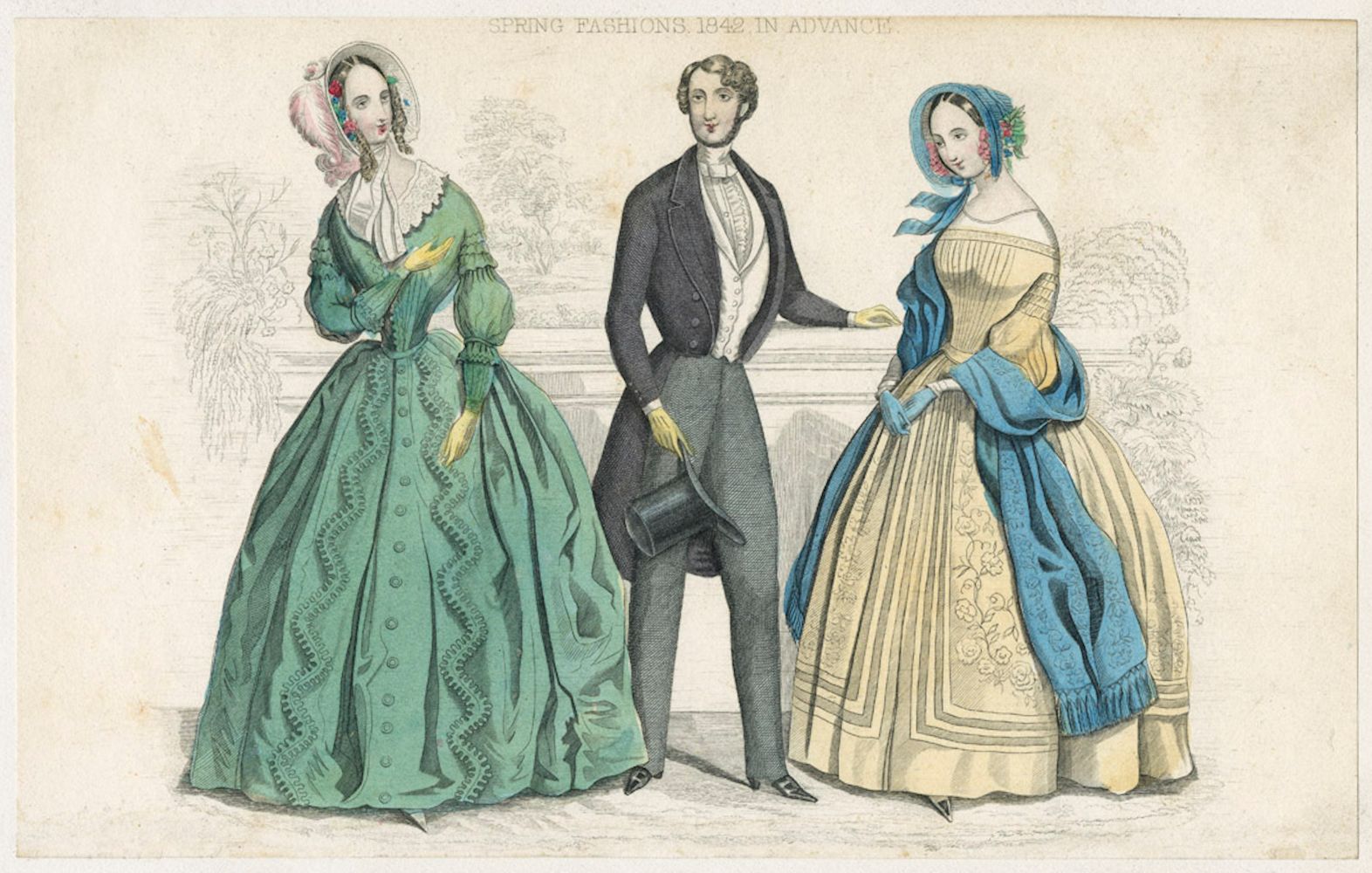
SPRING FASHIONS. 1842 IN ADVANCE.
Transcriber’s Notes:
Table of Contents has been added for reader convenience. Archaic spellings and hyphenation have been retained. Obvious punctuation and typesetting errors have been corrected without note. Other errors have been corrected as noted below.
A cover has been created for this ebook and is placed in the public domain.
page 97, joyous laugh, Miss Heyward resumed ==> joyous laugh, Mrs. Heyward resumed
[End of Graham’s Magazine, Vol. XX, No. 2, February 1842, George R. Graham, Editor]