ANGLING.
Reading edition
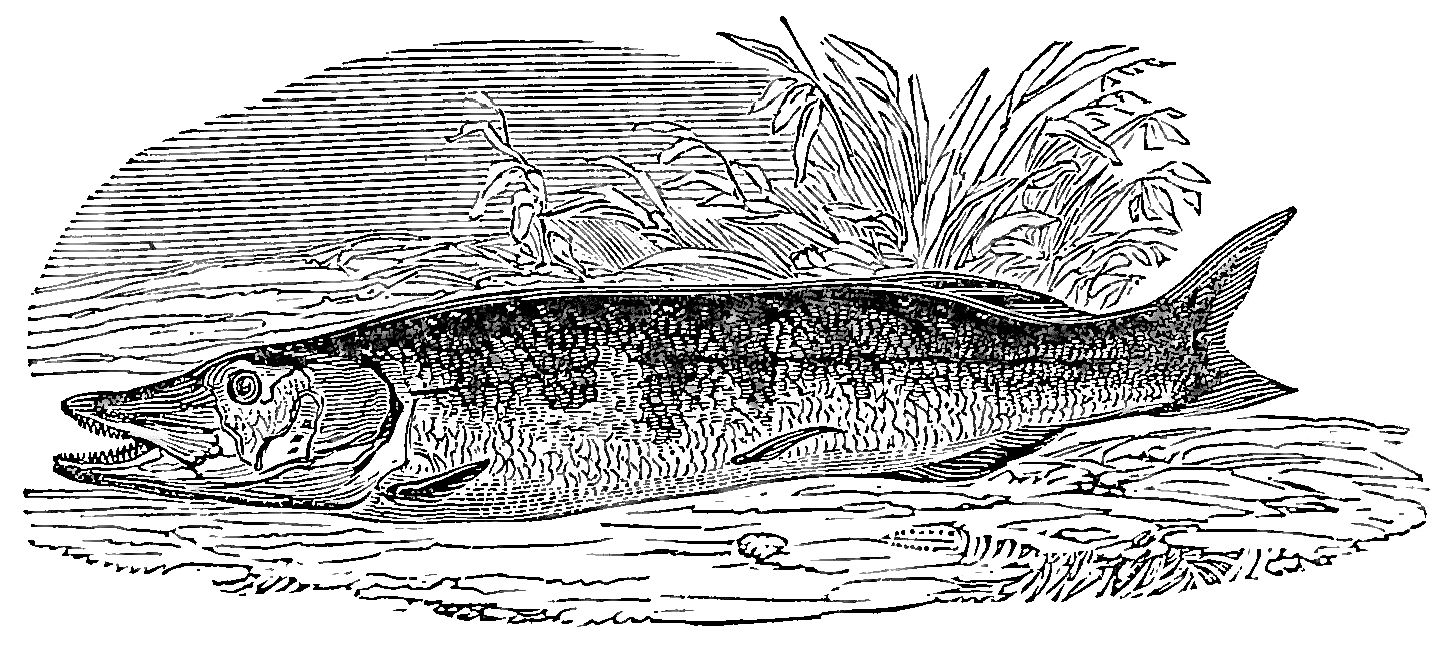
THE PIKE.
The pike is in season from May to February, and is most frequently angled for by trolling with a strong topped rod. The hooks are generally fastened to a bit of brass wire for a few inches from the shaft, to prevent the line from being snapped. Different methods are used in angling for pike. Trolling, in the more limited sense of the word, signifies catching fish with the gorge-hook, which is composed of two, or what is called a double eel-hook; live-bait fishing is practised with the aid of a floated line; and snap-fishing consists in the use of large hooks, so baited as to enable the angler to strike the fish the moment he feels it bite, immediately after which he drags it nolens volens ashore.
Trolling for pike may be practised during the winter months, when trout fishing has ceased; and the colder season of the year is in fact more convenient for the sport, owing to the decay or diminution of the weeds which usually surround their favorite haunts. With the exception of chub and dace, which bite pretty freely at the bottom all winter, scarcely any other fish can be relied upon for sport during the more inclement portion of the year. To bait a gorge-hook, take a baiting-needle, and hook the curved end to the loop of the gimp, to which the hook is tied. Then introduce the point of the needle into a dead bait’s mouth, and bring it out at the middle of the fork of the tail, by which means the piece of lead which covers the shank of the hook, and part of the connecting wire, will lie concealed in the interior of the bait: the shank will be in the inside of its mouth, and the barbs on the outside, turning upward. To keep the bait steady on the hook, fasten the tail part just above the fork to the gimp, with a silk or cotton thread; or a neater method is, to pass the needle and thread through the side of the bait, about half an inch above the tail, so as encircle the gimp in the interior. The baits used vary in weight from one to four ounces, and the hooks must be proportioned to the size of the fish with which they are baited. The barbs of the hook ought not to project much beyond the sides of the mouth, because, as the pike generally seizes his prey cross-wise, and turns it before it is pouched or swallowed, if he feels the points of the hook he may cast it out entirely.
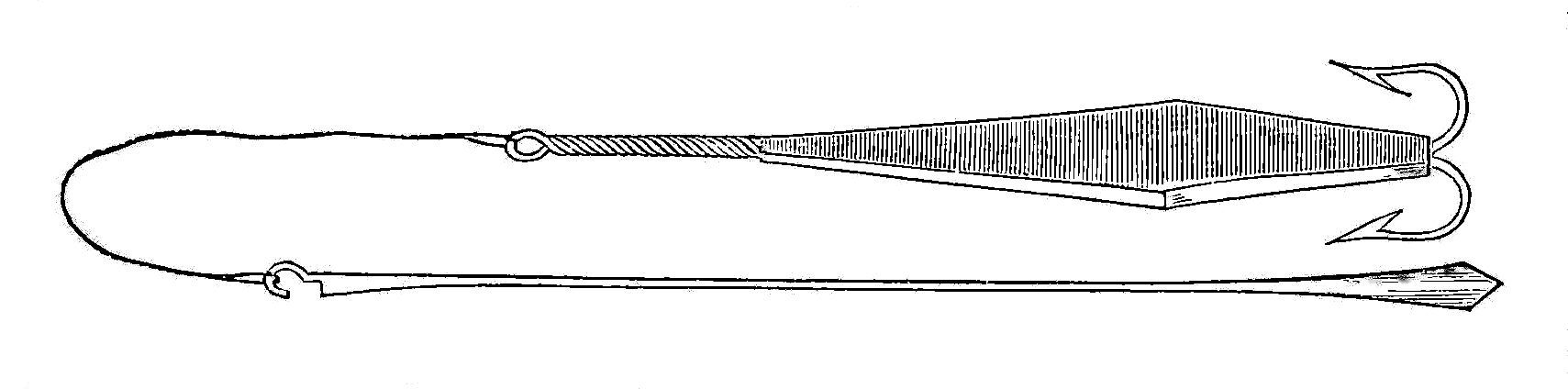
In trolling for pike, it is advised to keep as far from the water as possible, and to commence casting close by the near shore, with the wind blowing from behind. When the water is clear and the weather bright, some prefer to fish against the wind. “After trying closely,” says Mr. Salter, “make your next throw farther in the water, and draw and sink the baited hook, drawing it straight upward near to the surface of the water, and also to right and left, searching carefully every foot of water; and draw your bait with the stream, because you must know that jack and pike lay in wait for food with their heads and eyes pointing up the stream, to catch what may be coming down; therefore experienced trollers fish a river or stream down, or obliquely across; but the inconsiderate as frequently troll against the stream, which is improper, because they then draw their baited hook behind either jack or pike when they are stationary, instead of bringing it before his eyes and mouth to tempt him. Note.—Be particularly careful, in drawing up or taking the baited hook out of the water, not to do it too hastily, because you will find by experience that the jack and pike strike or seize your bait more frequently when you are drawing it upward than when it is sinking. And also farther observe, that when drawing your bait upward, if you occasionally shake the rod, it will cause the bait to spin and twist about, which is very likely to attract either jack or pike.”
These fish are partial to the bends of rivers and the bays of lakes, where the water is shallow, and abounding in weeds, reeds, water lilies, &c. In fishing with the gorge-hook, when the angler feels a run, he ought not to strike for several minutes after the fish has become stationary, lest he pull the bait away before it is fairly pouched. If a pike makes a very short run, then remains stationary for about a minute, and again makes one or two short runs, he is probably merely retiring to some quiet haunt before he swallows the bait; but if, after remaining still for three or four minutes, he begins to shake the line and move about, the inference is that he has pouched the bait, and feels some annoyance from the hook within, then such part of the line as has been slackened may be wound up, and the fish struck. It is an unsafe practice to lay down the rod during the interval between a run and the supposed pouching of the bait, because it not unfrequently happens that a heavy fish, when he first feels the hooks in his interior, will make a sudden and most violent rush up the river or along the lake, and the line is either instantly broken, or is carried, together with both the rod and reel, for ever beyond the angler’s reach. “When the pike cometh,” says Colonel Venables, “you may see the water move, at least you may feel him; then slack your line and give him length enough to run away to his hold, whither he will go directly, and there pouch it, ever beginning (as you may observe) with the head, swallowing that first. Thus let him lye until you see the line move in the water, and then you may certainly conclude he hath pouched your bait, and rangeth about for more; then with your trowl wind up your line till you think you have it almost streight, then with a smart jerk hook him, and make your pleasure to your content.”
The fresher and cleaner the bait is kept, whether for trolling, live-bait, or snap-fishing, the greater is the chance of success.
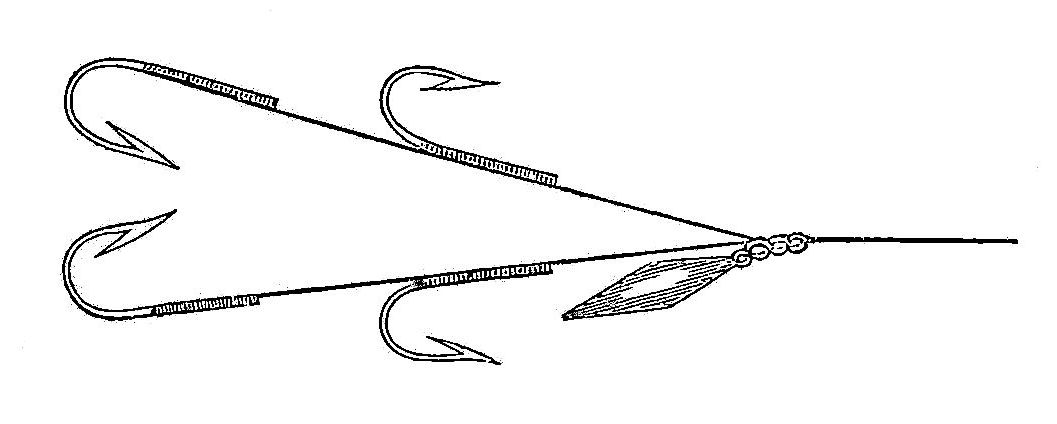
As pike, notwithstanding their usual voracity, are sometimes, as the anglers phrase it, more on the play than the feed, they will occasionally seize the bait across the body, and, instead of swallowing it, blow it from them repeatedly and then take no farther notice of it. The skilful and wily angler must instantly convert his gorge into a snap, and strike him in the lips or jaws when he next attempts such dangerous amusement. The dead snap may be made either with two or four hooks. Take about twelve inches of stout gimp, make a loop at one end, at the other tie a hook (size No. 2,) and about an inch farther up the gimp tie another hook of the same dimensions; then pass the loop of the gimp into the gill of a dead bait-fish, and out at its mouth, and draw the gimp till the hook at the bottom comes just behind the back fin of the bait, and the point and barb are made to pierce slightly through its skin, which keeps the whole steady: now pass the ring of a drop-bead lead over the loop of the gimp, fix the lead inside the bait’s mouth, and sew the mouth up. This will suffice for the snap with a couple of hooks. If the four-hooked snap is desired (and it is very killing,) take a piece of stout gimp about four inches long, and making a loop at one end, tie a couple of hooks of the same size, and in the same manner as those before described. After the first two and the lead are in their places, and previous to the sewing up of the mouth, pass the loop of the shorter gimp through the opposite gill, and out at the mouth of the bait; then draw up the hooks till they occupy a position corresponding to those of the other side: next pass the loop of the longer piece of gimp through that of the shorter, and pull all straight: finally, tie the two pieces of gimp together close to the fish’s mouth, and sew the latter up.
Some anglers prefer fishing for pike with a floated line and a live bait. When a single hook is used for this purpose, it is baited in one or other of the two following ways: Either pass the point and barb of the hook through the lips of the bait, toward the side of the mouth, or through beneath the base of the anterior portion of the dorsal fin. When a double hook is used, take a baiting-needle, hook its curved end into the loop of the gimp, and pass its point beneath the skin of the bait from behind the gills upward in a sloping direction, bringing it out behind the extremity of the dorsal fin; then draw the gimp till the bend of the hooks are brought to the place where the needle entered, and attach the loop to the trolling line. Unless a kind of snap-fishing is intended, the hooks for the above purpose should be of such a size as that neither the points nor the barbs project beyond either the shoulder or the belly of the bait.
Snap-fishing is certainly a less scientific method of angling for pike than that with the gorge or live-bait; for when the hooks are baited, the angler casts in search, draws, raises, and sinks his bait, until he feels a bite. He then strikes strongly and drags or throws his victim on shore; for there is little fear of his tackle giving way, as that used in snap-fishing is of the largest and stoutest kind. “This hurried and unsportsmanlike way of taking fish,” it is observed in the Troller’s Guide, “can only please those who value the game more than the sport afforded by killing a jack or pike with tackle, which gives the fish a chance of escaping, and excites the angler’s skill and patience, mixed with a certain pleasing anxiety, and the reward of his hopes. Neither has the snap-fisher so good a chance of success, unless he angles in a pond or piece of water where the jack or pike are very numerous or half starved, and will hazard their lives for almost any thing that comes in their way. But in rivers where they are well fed, worth killing, and rather scarce, the coarse snap-tackle, large hooks, &c. generally alarm them. On the whole, I think it is two to one against the snap in most rivers; and if there are many weeds in the water, the large hooks of the snap, by standing rank, are continually getting foul, damaging the bait, and causing much trouble and loss of time.”
Pike sometimes rise at an artificial fly, especially in dark, windy days. The fly ought to be dressed upon a double hook, and composed of very gaudy materials. The head is formed of a little fur, some gold twist, and (if the angler’s taste inclines that way, for it is probably a matter of indifference to the fish) two small black or blue beads for eyes. The body is framed rough, full, and round, the wings not parted, but made to stand upright on the back, with some small feathers continued down the back to the end of the tail, so that when finished they may exceed the length of the hook. The whole should be about the bulk of a wren.
During clear and calm weather in summer and autumn, pike take most freely about three in the afternoon: in winter they may be angled for with equal chances of success during the whole day: early in the morning, and late in the evening are the periods best adapted for the spring.
This fish is also angled for in a variety of ways by fixed or set lines, and also by trimmers, or liggers, as they are provincially called in some parts of England. Horsea Mere and Heigham Sound are two large pieces of water in the county of Norfolk, not far from Yarmouth, noted for their pike, as partly immortalised in old Camden’s famous lines of lengthened sweetness long drawn out,—
“Horsey Pike,
None like.”
Mr. Yarrell received the following returns from a sporting gentleman, of four days’ fishing with trimmers in these waters, in the month of March, 1834: viz. on the 11th at Heigham Sounds, 60 pike, weighing 280 pounds; on the 13th at Horsea Mere, 89 pike, weighing 379 pounds; on the 18th, again at Horsea Mere, 49 pike, weighing 213 pounds; on the 19th, at Heigham Sounds, 58 pike, weighing 263 pounds: the four days sport producing 256 fish, weighing together 1135 pounds.
As the mode of using trimmers in these extensive broads affords great diversion, and is rather peculiar, we shall here quote Mr. Yarrell’s account of it. “I may state that the ligger or trimmer is a long cylindrical float, made of wood or cork, or rushes tied together at each end; to the middle of this float a string is fixed, in length from eight to fifteen feet; this string is wound round the float except two or three feet, when the trimmer is to be put into the water, and slightly fixed by a notch in the wood or cork, or by putting it between the ends of the rushes. The bait is fixed on the hook, and the hook fastened to the end of the pendent string, and the whole then dropped into the water. By this arrangement the bait floats at any required depth, which should have some reference to the temperature of the season,—pike swimming near the surface in fine warm weather, and deeper when it is colder, but generally keeping near its peculiar haunts. When the bait is seized by a pike, the jerk looses the fastening, and the whole string unwinds,—the wood, cork, or rushes, floating at the top, indicating what has occurred. Floats of wood or cork are generally painted, to render them more distinctly visible on the water to the fishers, who pursue their amusement and the liggers in boats. Floats of rushes are preferred to others, as least calculated to excite suspicion in the fish.”
Pike are occasionally taken in the English lakes above 30 pounds in weight, and Dr. Grierson mentions one killed in Loch Ken, in Galloway, which weighed 61 pounds. The color of the young fish is of a greenish hue, but it afterward becomes rather of a dusky olive brown upon the upper parts, marked on the sides with mottled green and yellow, and silvery white on the abdomen. We do not think highly of its flesh, although by many it is held in some esteem.