THE ATMOSPHERE AND ITS CURRENTS.
Reading edition
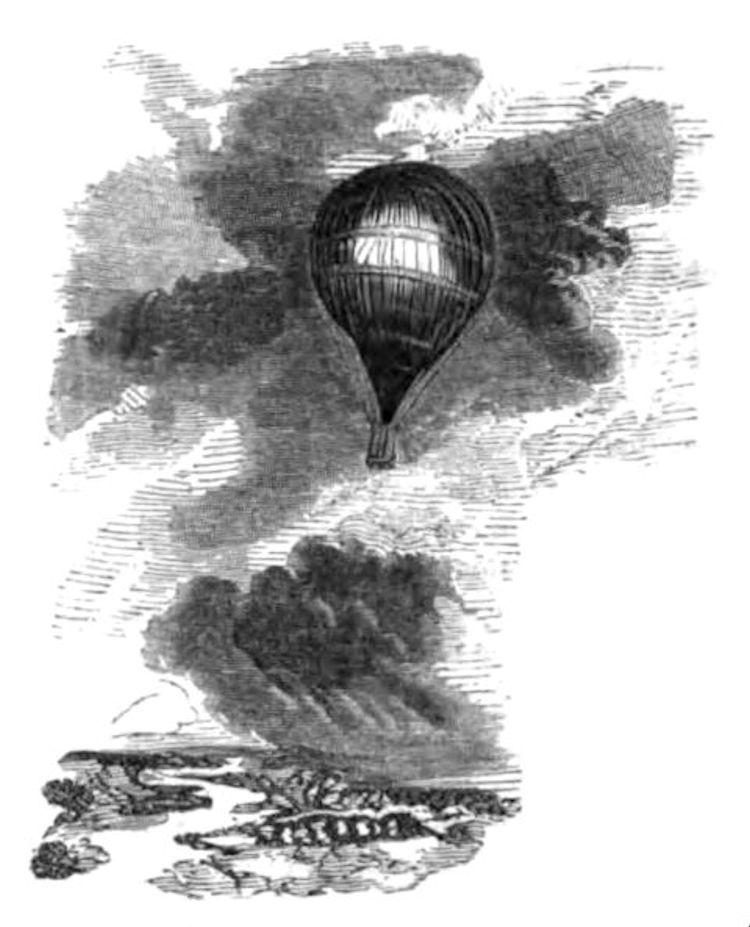
It has been mentioned as a part of the planetary constitution of our globe, that a gaseous envelope environs its mass, the atmosphere, which requires the attention of the astronomer, on account of its influence in displacing the celestial bodies, and contributing to their visibility, by refracting and reflecting the rays of light. This elastic fluid is the scene of interesting phenomena, and performs important functions in the economy of nature. Besides being essential to the life of man, and the animal races, whose existence would terminate in a few minutes without the respiration of it; the exhalation of moisture from the surface of the earth is mainly owing to the common air we breathe, which receives and sustains the vapors formed into clouds, distributes them over different regions by its incessant motions, and tempers by its currents those extremes of heat and cold to which various localities are subject. It is in these last-named offices that the atmosphere demands the notice of the physical geographer. The consideration of its actual constitution does not belong to his province, but a general view of the fluid may be appropriate before we proceed to those agitations and changes which are in constant action, and upon which the welfare of organized beings so materially depends.
The atmosphere is, then, an integral portion of the earth, a body of air revolving with the solid mass upon its axis, the higher strata, of course, increasing in velocity with the distance from the axis of revolution. From hence a conclusion may be drawn respecting its height, for an absolute limit is put to its elevation by this feature of its physical condition. There is a point where the centrifugal force, or the tendency to fly off from the centre, will counterbalance the centripetal, or the gravitation toward the centre, and beyond that point the latter will be vanquished. It is obvious that no portion of the atmosphere can extend beyond the point where the two influences balance, or are in equilibrium, and the projectile force becomes greater than that of gravitation, or its projection into space would follow. At the distance of 6.6 radii from the centre of the earth, or at an elevation of 22,200 miles, about the eleventh part the distance of the moon, this point is fixed, beyond which it is impossible for the atmosphere in the smallest quantity to extend. This consideration is only of importance to show that physical laws rigidly restrict it within finite bounds, for any portion of air at that distance must have a tenuity which is utterly inconceivable. The indications of the height of the atmosphere drawn from its weight, as shown by the barometer, reduce its elevation within a vastly circumscribed limit. A column of the whole circumambient air is nearly equal in weight to a similar column of mercury of thirty inches, or of water of thirty-four feet, which would give it an elevation of but 27,000 feet, or rather under five miles, if its density were uniform. But the elasticity of the air causes it to expand with the diminution of its own pressure, which becomes less at every step from the surface of the earth; and owing to this expansion we must place the limit to its height at a far greater distance than that suggested by the simple barometrical measurement of its weight. A pretty common opinion prevails that its extreme boundary does not exceed forty or fifty miles, and we have sensible evidence on the high lands of the globe, that for all the purposes serviceable to vegetable and animal life, the atmospheric zone is of very contracted elevation. It is a well-known property of the air that the temperature diminishes with its height, a circumstance referable to the general physical law, that as the density of gases decreases they acquire an increased capacity for heat. The higher, therefore, a body ascends in the atmosphere, the greater is the quantity of heat abstracted from it, the surrounding fluid becoming more rare. Hence the perpetual snow, and the piles of glaciers, that crown the summits of mountains, at whose base the orange and the citron bloom, and man pants in the fierce sultriness of a torrid climate.
But while the atmosphere may be considered generally as an aerial zone of the earth, the companion of the massy spheroid in its annual revolution round the sun, and rotating with it upon its axis, it has independent movements which present very complex phenomena, however clear the causes which put them in operation. The particles of air are constantly suffering displacement, and it is easy to conceive of various circumstances disturbing the dilatable and elastic fluid in which we live. A body in movement will communicate its motion to the adjoining particles, which may be sensibly propagated by them to a considerable distance; but this cause operates so slightly in the production of atmospheric currents that it might be entirely overlooked. It will be sufficient to state that some of the vast oceanic streams are supposed to produce a corresponding flow in the air. The varying attractions of the sun, moon, and planets on the atmosphere, will occasion tides in it analogous to those of the ocean, or an alteration in the heights of vertical columns of air, winds and currents arising from the resulting inequalities of horizontal pressure; but La Place has proved the action of this cause to be scarcely appreciable. The atmospheric agitations of which we are sensible, both the more violent and gentle, appear to proceed either from a change in the temperature of a portion of the air, or from a change in the quantity of water which it holds in a state of vapor. In both these cases a temporary destruction of the equilibrium subsisting between different parts of the atmosphere is produced, and its particles are set in motion to restore the balance. The effect of heat upon a volume of air is to rarefy and expand, to increase its bulk and diminish its density. When any portion, therefore, of the earth’s surface is more heated than the surrounding districts, the air there ascends and flows over the adjoining cooler and denser strata, causing an upper outward current, while the colder and denser fluid rushes toward the spot where the balance has been lost by expansion, and a lower inward current is produced. An easy experiment will illustrate this interchange. In a room warmed by a good fire, if a candle be held at the crevice between the door and the floor, an inward current will be observed from the exterior colder air, but near the ceiling, by the same means, an outward flow will be detected. In the other condition an addition of vapor to the atmosphere gives rise to a wind blowing on all sides away from the district of evaporation, while an abstraction of it by showers creates a partial vacuum, toward which the air rushes from all points of the compass. The diversity of the winds in power is principally owing to the different degrees of vigor with which these causes act.
The currents of the atmosphere display an endless variety in their velocity and force, from the zephyr, which scarcely stirs the leaves of the forest, to the gale under which its mightiest branches bend, and the hurricane which tears up its trees by the roots, and destroys the habitations of mankind. It has been observed that in the temperate zone the most violent winds occur, when neither the heat nor the cold common to such localities are at its maximum—that they generally extend over a considerable tract of country—and are accompanied by sudden and great falls in the mercury of the barometer. The latter circumstance attends the storms of the tropics, but they are often confined within narrower limits than the extra-tropical hurricanes. It was noticed by the superstitious as a coincidence, not without meaning, that at the time of Cromwell’s death the enchained winds were liberated, and went forth raving and howling through the land, uprooting the largest trees, and whirling them about like straws, and toppling down chimneys and turrets; but the same tempest, at the self-same hour, dashed the vessels of the Baltic sea even upon the strand, and buried Venetian argosies in the Adriatic, shivered the pines of Norway, and swept before it the cypresses of the Bosphorus—a similar war of the elements attending the termination of the earthly career of Cardinal Wolsey, Bonaparte, and George IV. Sometimes the upper regions of the atmosphere have been remarkably agitated, while the lower stratum of the air has been quite calm. Lunardi, on one occasion, traveled at the rate of seventy miles an hour in his balloon, while at Edinburgh; when he ascended, the air was quite tranquil, and continued so throughout his expedition. To ascertain the velocity and force of winds, a variety of experiments have been made with instruments constructed for the purpose. The following table contains some results obtained by Smeaton, inserted in a volume of the Philosophical Transactions:—
VELOCITY OF THE WIND.
Miles per Hour.Feet per Second.Perpendicular Force on one Square Foot, in Avoirdupois Pounds and Parts.Characteristics.
11·47.005Hardly perceptible.
22·93·020 }Just perceptible.
34·4·044 }
45·87·079 }Gentle, pleasant wind.
57·33·123 }
1014·67·492 }Brisk wind.
15221·107 }
2029·341·968 }Very brisk wind.
2536·373·075 }
3044·014·429 }High wind.
3551·346·027 }
4058·687·873 }Very high wind.
4566·019·963 }
5073·3512·300Storm.
6088·0217·715Great storm.
80117·3631·490Hurricane.
100147·749·200Hurricane carrying trees and buildings before it.
The currents of the atmosphere far surpass in velocity those of the rivers and the ocean, a gentle pleasant wind blowing at a rate equal to that of the mighty Father of Waters when in flood, but a hurricane will outstrip the swiftest locomotive in its speed. In speaking of the direction of currents of air and water, the indicating terms are employed in an inverse sense, an easterly wind signifying a breeze coming from that quarter, an easterly stream a flow of water toward it. Winds may be divided into three classes or genera, the Permanent, the Periodical, and the Variable; of which, the first excepted, there are many different species. We shall prefer, however, to consider them under their local recognized titles.
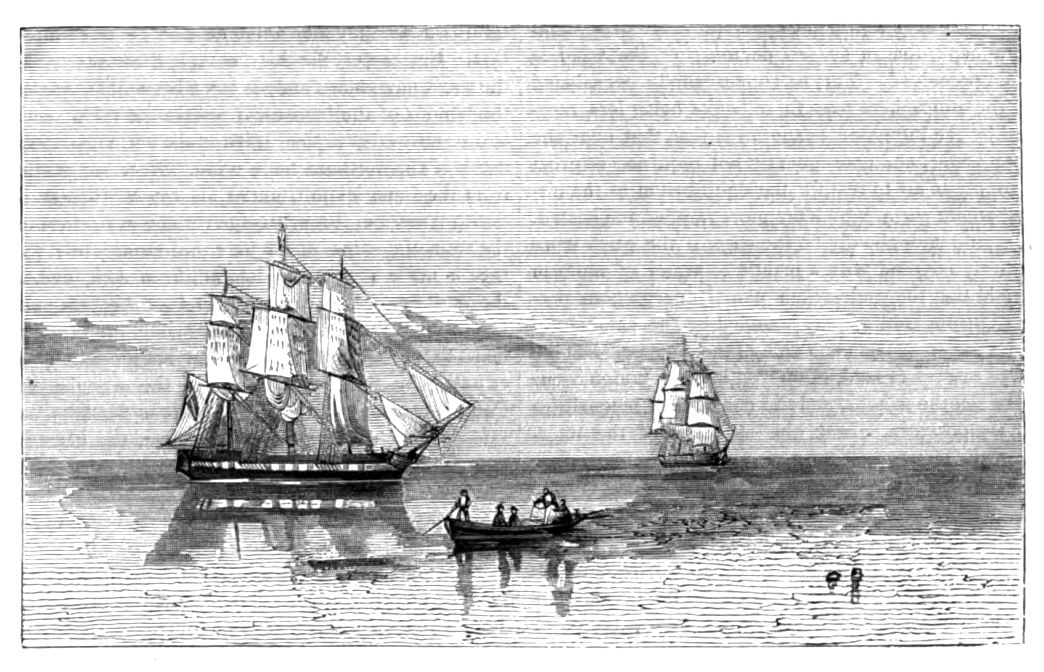
A Calm at Sea.
1. Trade winds. These are permanent, following the same direction throughout the year. They are met with between the tropics, and a few degrees to the north and south of those limits. The well-known name applied to them is a phrase of doubtful origin, but probably derived from the facilities afforded to trade and commerce by their constant prevalence and generally uniform course, though Hakluyt speaks of the “wind blowing trade,” meaning a regular tread or track. The parallels of 28° north and south latitude mark the medium external limits of the trade winds, between which, with some variations, their direction is from the north-east, north of the equator, and from the south-east, on the other side of the line, hence called the north-east and south-east trades. They are separated from each other by the region of calms, in which a thick foggy air prevails, with frequent sudden and transient rains attended by thunder and lightning. This region, in the Atlantic, extends across the whole ocean from the coasts of Africa to those of America, but its position shifts, being sometimes entirely north of the equator, and but rarely reaching one or two degrees south; and hence it may be considered as belonging to the northern hemisphere. The region also varies in breadth from two and a half to ten degrees, but usually occupies a width of four or five. These variations are dependent upon the position of the sun, which has an influence likewise upon the strength, direction, and situation of the trade winds themselves. When the sun has a northern declination, and approaches the tropic of Cancer, the boundary line of the north-east trade wind extends to 32° north latitude, and the wind has a more easterly direction, but the parallel of 25° is its northern boundary, and the wind inclines more north when the sun is south of the equator, and approaches the tropic of Capricorn. At that season, the southern boundary of the south-east trade wind extends to 30° S. lat., and the whole ocean is swept by it between that line and about 1° N. lat. The general width of the south-east trade is about 9° greater than that of the north-east, the region of calms, as before stated, being almost wholly in the northern hemisphere. In the basin of the Atlantic, the zone of the trade winds becomes broader, and their direction more easterly, as the coast of America is approached, the breezes blowing to the very shore. This is not the case on the African side of the Atlantic, where, through a tract of sea extending from fifty to eighty miles off shore, these winds are not found at all, but contrary westerly breezes prevail. The irregularity is easily explained. Owing to the rarefaction which the air undergoes over the great hot desert of the Sahara, the colder air from the contiguous sea rushes in to supply the partial vacuum created, and keep up the equilibrium of the atmosphere, producing winds blowing toward the shore.
In the Pacific Ocean, a similar zone is occupied by permanent north and south-easterly breezes, or trade winds, though subject to a variety of interruptions. An instance of irregularity occurs along the coasts of Peru and Chili, where the general direction of the wind is south, and a steady south-easterly wind is only experienced at the distance of five or six hundred miles from the shore. The numerous shoals and islands which are found in the Pacific, prevent uniformity in the tropical movements of the atmosphere. That intelligent hydrographer Captain Horsburgh has observed, that where shoal coral banks shoot up out of the deep water in many places between the tropics, a decrease of the prevailing wind is frequently experienced; for when a steady wind is blowing over the surface of the deep water, no sooner does a ship get upon the verge of a shoal coral bank, than a sudden decrease of the wind is often perceived. This he supposes to be occasioned by the atmosphere over these banks being less rarefied by the increased evaporation than that over the deep water, and consequently not requiring so great a supply of air to restore the equilibrium as the circumjacent parts, which are more rarefied and heated. It would undoubtedly be the case, if the earth were entirely covered with a mantle of water of uniform depth, that the trade-winds would everywhere prevail, throughout a zone, bounded by the parallels of from 25° to 32° on each side of the equator. But the large masses of land, of uneven surface, which occur between the tropics, and the consequent inequalities of temperature, check the tendency of the intertropical atmosphere to a regular course, introduce derangement in its movements, so that it is only in the great open seas that the trade-winds are experienced. Still, it has been observed that, in some countries under and near the equator, constant easterly winds are found, which are no doubt identical in their cause with those that distinguish the equatorial regions of the ocean. They are met with on lands which exhibit extensive level plains, where nothing occurs to obstruct their passage and alter their direction. Thus, along the immense low tract drained by the Amazon an easterly wind prevails, by the assistance of which, the voyager is enabled to ascend rapidly against the strong current of the river. This wind blows from the estuary of the Amazon, where it is moderate, to its sources at the foot of the Andes, where it has gathered such strength, that Humboldt found it difficult to make head against it. The plain traversed by the lower course of the Orinoco has a similar easterly breeze, but of less force.
We owe the discovery of the trade winds to Columbus, and this would have been prominently connected with his name, had it not been supplanted by the glory of a greater achievement, the revelation of a new world to the knowledge of mankind. The ancients were entirely unacquainted with these permanent breezes, and though maritime adventure had been largely prosecuted by the Portuguese at the instigation of Prince Henry, they had not penetrated into the region of the trades. Proceeding cautiously along the shores of Barbary, they had explored the coasts of Africa to Cape de Verde, rescued the Azore Islands from the “oblivious empire of the ocean,” and afterward, under Vasco di Gama, doubled the Cape of Good Hope; but these voyages carried them clear of the district of the north and south-east trade winds. But soon after leaving the Canaries in the Santa Maria, Columbus fell in with the former, which in the summer extend to the latitude of those islands, and—for the first time—a sail from the Old World swelled before the steady breath of the northern tropic. This circumstance, favorable to the success of his expedition, speedily excited the apprehensions of his crew, who found themselves borne, day after day, by a permanent breeze, farther from their native shores, and inferred the impossibility of returning, as they observed no change in its direction. Fortunately for his fame, and for the world, the great navigator firmly held on his course, reached the bounds of the before-supposed illimitable ocean, and re-crossed it in the region of the variables, to the north of the northern trade wind. Now, in passing from the Canaries to Cumana, on the north coast of South America, it is scarcely ever necessary to touch the sails of a ship; and with equal facility the passage is made across the Pacific, from Acapulco, on the west coast of Mexico, to the Philippine Islands. If a channel were cut through the Isthmus of Panama, the voyage to China would be remarkably facilitated by the trade winds of the Atlantic and Pacific Oceans; be more speedy, agreeable, and safe than the usual route by the Cape, the chief interruption to its uniformity occurring in the Caribbean Sea and the Gulf of Mexico, where the trade wind blows impetuously, the sea is stormy, and the sky gray and cloudy.
The theory respecting the origin of the trade winds, adopted by Doctor Dalton, Professor Daniell, and Sir John Herschel, was first proposed by George Hadley, the brother of the inventor of the quadrant, and embodies features of the previous theories of Halley and Galileo, who both grappled with this great geographical phenomenon. It is founded upon the rarefaction of the atmosphere of the torrid zone by the powerful heat to which that region is subject, in connection with the different velocities of the earth’s surface, in different degrees of latitude, in the diurnal rotation. Heat rarefies and expands a volume of air in a ratio equivalent to an addition of about seventy feet to the ordinary height of the atmosphere for every degree of thermometrical measurement. As the sun is always vertical at some place within the tropics, the average temperature of the earth’s surface in that region, bounded by the parallels of 23½° on each side of the equator, is much higher than in latitudes to the north and south; and the incumbent air acquiring this higher temperature, is thereby rarefied and expanded. The consequence is, that in obedience to hydrostatical laws, masses of air are continually buoyed up from the surface, or swelled round the torrid zone in the form of a protuberant belt, the upper strata flowing over, and running off in streams north and south toward the poles, where—having been cooled and condensed—they descend, and flow over the surface toward the equator, pouring in a perpetual current of air to supply the place of that buoyed up by the heat of the tropics. Thus, there is a constant current in the higher regions of the atmosphere, proceeding from the equator northward and southward to the poles; and, if the earth were at rest, there would be a constant wind in the lower regions of the atmosphere blowing directly from the poles to the equator, while in equatorial regions the two streamlets would meet, and neutralize each other’s influence. But the earth is not at rest! It is incessantly whirling upon its axis, the surface moving at a rate which varies according to the extent of the circumference. The velocity at the equator, where the circumference is the greatest, is about sixteen miles a minute; at 30° of latitude, which is below the most southerly point of Europe, it is about fourteen miles in the same time; and at 45°, or about the centre of France, it is about eleven miles. As the distance from the equator increases, north and south, the rate of the rotation thus becomes less, because the circle of the earth’s circumference diminishes in extent. Now a current of air flowing from the north or south polar regions, and setting toward the equator, will encounter as it proceeds an increased rotatory motion eastward, the direction of the earth’s axical revolution; and, not acquiring the new velocity at once, it will be left behind, and seem to deflect toward the west just in proportion as it does not keep up with the earth to the east. Hence, what would simply be a north or south wind but for the earth’s rotatory motion, becomes a north-east and south-east wind as it approaches those regions where, the velocity of the globe being so much greater than where it originated, it lags behind it in its easterly course. This is the exact path of the trade winds—breezes, with few exceptions, uniform in their direction, perpetual in their motion, and steady in their force—which wafted Columbus across the Atlantic, impelled the Portuguese from their southerly course, and bore them to the Brazils, and have since been important auxiliaries to the communication of the eastern with the western continent.
The existence of a current in the upper regions of the atmosphere counter to that below, assumed by the preceding theory, is not mere hypothesis. Clouds, though of rare occurrence in the district of the trade winds, have been observed to take a direction contrary to that which the surface-breezes would have given them. A circumstance remarkably in favor of the counter-current inferred from theory, occurred in the year 1812. There was then an eruption of the volcano of St. Vincent, one of the West India Islands, which covered the island of Barbadoes with a quantity of the ashes and volcanic matter ejected. The trade wind here blows with great power, and it is certain that the volcanic ashes would have been conveyed in a direction from Barbadoes, instead of toward it, by its action. To account for their transportation thither, it is necessary to suppose that the volcano ejected them to an elevation within reach of a superior stratum of air, blowing contrary to the course of the inferior current. When Humboldt was upon the Peak of Teneriffe the west wind blew with such violence that he could scarcely stand, though the island below was under the influence of the ordinary north-east trade wind; and the remark has often been made, that in the elevated parts of the Canary Islands, a contrary wind has been experienced to that which has been prevailing over the general surface.
All mariners and passengers have spoken with delight of the region of the trade winds, not only on account of the favoring gale, but its genial influence, the transparent atmosphere, the splendid sunsets, and the brilliancy of the unclouded heavens, day and night. Columbus, in recording his first voyage into their territory, compares the air, soft and refreshing without being cool, to that of the pure and balmy April mornings he had experienced in Andalusia, wanting but the song of the nightingale and the sight of the groves, to complete the fancy that he was sailing along the Guadalquivir, “It is marvelous,” observes Las Casas, “the suavity which we experience when half way toward these Indies; and the more the ships approach the lands so much more do they perceive the temperance and softness of the air, the clearness of the sky, and the amenity and fragrance sent forth from the groves and forests; much more certainly than in April in Andalusia.” Humboldt lingers with pleasure, upon his first acquaintance with the tropical regions at sea, upon the mildness of the climate and the beauty of the southern sky, gradually opening new constellations to the view, stars contemplated from infancy progressively sinking and finally disappearing below the horizon, an unknown firmament unfolding its aspect, and scattered nebulæ rivaling in splendor the milky way. “A traveler,” he states, “has no need of being a botanist, to recognize the torrid zone, on the mere aspect of its vegetation; and without having acquired any notions of astronomy, without any acquaintance with the celestial charts of Flamstead and De la Caille, he feels he is not in Europe, when he sees the immense constellation of the Ship, or the phosphorescent clouds of Magellan, arise on the horizon. We pass those latitudes, as if we were descending a river, and we might deem it no hazardous undertaking, if we made the voyage in an open boat.” Mr. Bailey, in his Four Years in the West Indies, relates an adventure, nearly answering to that here referred to. The master of one of the small fishing smacks that ply along the coast of Scotland, who had no other knowledge of navigation than that which enabled him to keep his dead reckoning, and to take the sun with his quadrant at noon-day, having heard that sugar was a very profitable cargo, determined, by way of speculation, upon a trip to St. Vincent, to bring a few hogsheads of the commodity on his own account into the Scottish market. Accordingly, he freighted his vessel; made sail; crossed the Bay of Biscay in a gale; got into the trade winds, and scudded before them, at the rate of seven knots an hour, trusting to his dead reckoning all the way. He spoke no vessel during the whole voyage; and never once saw land until on the morning of the thirty-fifth day, when he descried St. Vincent’s right ahead, and running down, under a light breeze, along the windward coast of the island, came to anchor. The private signal of the little vessel was unknown to any of the merchants, and it immediately attracted notice. The natives were perfectly astonished—they had never heard of such a feat before; and deemed it quite impossible that a mere fishing smack, worked only by four men, and commanded by an ignorant master, should plow the billows of the Atlantic, and reach the West Indies in safety—yet so it was. This relation justifies the title given by the Spaniards to the zone where the trade winds are constant, el Golpo de las Damas, the Sea of the Ladies, on account of the ease with which it may be navigated, the uniform temperature prevalent night and day, and its pacific aspect.
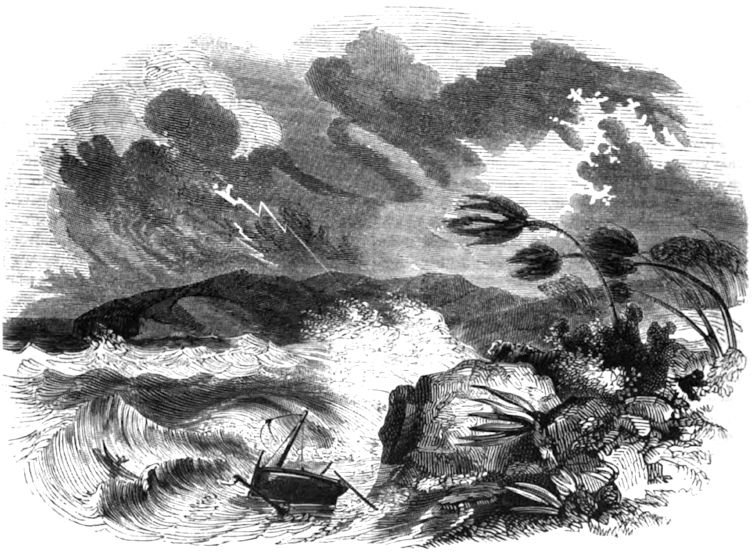
Commencement of the Monsoon.
2. Monsoons. These are periodical winds, which sweep the northern part of the Indian Ocean, changing their direction after an interval of about six months, and hence the term Monsoon, the Anglicised form of the Persic mousum, or the Malay moossin, signifying a season, referring to their periodicity. Avoiding all minute detail, we shall merely give the range, direction, and duration of these singular, yet highly useful currents, and that in a very general way. From 3° south of the equator to the northern shores of the Indian Ocean, including the Arabian Sea, the Bay of Bengal, and the Chinese Sea, a south-west wind blows from April to October, and then a north-east wind sets in, and prevails through the next half year, from October to April. From 3° to 10° south of the equator a south-east wind blows from April to October, and a north-west during the succeeding six months. Without attending to local variations, these are the general phenomena. There is a south-west wind prevailing north of the equator from April to October, and southward of this, through a certain space, at the same season, a south-east wind. There is a north-east wind north of the equator from October to April, and coincidently, a north-west wind between 3° and 10° south of the line. The western boundary of the region of the monsoons is the African shore; its eastern limit is supposed to be about the meridian of 136° east longitude, which cuts the island of New Guinea; its northern confine is near the parallel of 27° north latitude, which intersects the Loo Choo islands; its southern extremity has been already stated. The monsoons are much stronger than the trade winds, and may be called gales, but they are by no means of uniform force, either as it respects themselves or each other, the same monsoon occasionally blowing with such violence that ships are obliged to reef their sails. It must not be imagined that these winds are confined to the ocean. They extend over the whole of Hindûstan to the Himalaya, the north-east monsoon bringing copious rains to its eastern shores, and the south-west monsoon performing the same office for its western coast.
The change of the monsoon—the periodical shifting of the wind—the most singular feature of the case, is a gradual process, usually occupying about a month, which reduces the reign of the two annual monsoons, north and south of the equator, to five months each, the remaining two months being spent in the transitions. In each interval of change, calms, light variable breezes, alternate with storms of tremendous violence. Mr. Caunter thus describes the scene at Madras, in the interim between the cessation of one monsoon and the setting in of another: “On the 15th of October, the flag-staff was struck, as a signal for all vessels to leave the roads, lest they should be overtaken by the monsoon. On that very morning some premonitory symptoms of the approaching “war of elements” had appeared. As the house we occupied overlooked the beach, we could behold the setting in of the monsoon in all its grand and terrific sublimity. The wind, with a force which nothing could resist, bent the tufted heads of the tall, slim cocoa-nut trees almost to the earth, flinging the light sand into the air in eddying vortices, until the rain had either so increased its gravity, or beaten it into a mass, as to prevent the wind from raising it. The pale lightning streamed from the clouds in broad sheets of flame, which appeared to encircle the heavens as if every element had been converted into fire, and the world was on the eve of a general conflagration, whilst the peal, which instantly followed, was like the explosion of a gunpowder magazine. The heavens seemed to be one vast reservoir of flame, which was propelled from its voluminous bed by some invisible but omnipotent agency, and threatened to fling its fiery ruin upon every thing around. In some parts, however, of the pitchy vapor by which the skies were by this time completely overspread, the lightning was seen only occasionally to glimmer in faint streaks of light, as if struggling, but unable, to escape from its prison, igniting, but too weak to burst, the impervious bosoms of those capacious magazines in which it was at once engendered and pent up. So heavy and continuous was the rain, that scarcely any thing, save those vivid bursts of light which nothing could arrest or resist, was perceptible through it. The thunder was so painfully loud, that it frequently caused the ear to throb; it seemed as if mines were momentarily springing in the heavens, and I could almost fancy that one of the sublimest fictions of heathen fable was realized at this moment before me, and that I was hearing an assault of the Titans. The surf was raised by the wind and scattered in thin billows of foam over the esplanade, which was completely powdered with the white, feathery spray. It extended several hundred yards from the beach; fish, upward of three inches long, were found upon the flat roofs of houses in the town, during the prevalence of the monsoon, either blown from the sea by the violence of the gales, or taken up in the water-spouts, which are very prevalent in this tempestuous season. When these burst, whatever they contain is frequently borne by the sweeping blast to a considerable distance over-land, and deposited in the most uncongenial situations; so that now, during the violence of these tropical storms, fish are found alive on the tops of houses; nor is this any longer a matter of surprise to the established resident in India, who sees every year a repetition of this singular phenomenon. During the extreme violence of the storm, the heat was occasionally almost beyond endurance, particularly after the first day or two, when the wind would at intervals entirely subside, so that not a breath of air could be felt, and the punka afforded but a partial relief to that distressing sensation which is caused by the oppressive stillness of the air so well known in India.” It is an extraordinary but well-ascertained fact, that as soon as one monsoon ceases, though a month may elapse before the succeeding one appears, the clouds take the direction of the approaching monsoon, and thus from the regions of the atmosphere herald its advent to the dwellers below.
We naturally inquire concerning the origin of these peculiar movements, but must be content with a very scanty measure of information upon the subject. The laws which nature obeys in these periodical changes are undoubtedly identical with those which give rise to atmospheric currents in general, but their mode of operation is in this case obscure. The north-east and south-east monsoons, the former on the north and the latter on the south side of the equator, may be considered as trade winds, explicable upon the same principles, but counteracted for a certain time by causes which produce winds from a different quarter, the south-west and north-west monsoons. It has been observed that the south-west monsoon, which prevails to the north of the equator, is coincident with the sun being vertical to that region, when Hindûstan, Siam, and the adjacent countries receive their maximum of heat. Consequently, the incumbent air, being rarefied, ascends, and a rush of colder air to supply its place, is produced from the southward, which is then receiving the oblique rays of the sun, and which presenting a surface of water is immensely less heated than the lands to which the luminary is perpendicular. In like manner, the north-west monsoon, which prevails south of the equator, is coincident with the sun being south of it likewise, and vertical to the region, when the sandy plains of New Holland become powerfully heated, and the air over them rarefied, creating a wind by the rush of the colder northern air toward the point of rarefaction. These are the explanations commonly given, and though in several respects they do not account for all the phenomena, yet the probability is, that they present the correct theory, anomalous circumstances arising from the influence of causes which are local and as yet unknown. The monsoons are more valuable as auxiliaries to commerce than the trade winds, owing to the change in their direction, for a ship may proceed to a distant port with one monsoon and be aided on its return by its successor.
3. Land and sea breezes. A line in one of our popular songs,
“How sweetly the breeze blows off the shore,”
refers to the wind which begins at evening to blow from the coasts situated between and near the tropics: and an equally grateful breeze blows by day from the sea to the shore in those warm climates. The inequality of the solar action on the land and water, together with the tendency of the atmosphere to preserve an uniform density, is the cause of these periodically shifting currents. During the day the land acquires a temperature higher than that of the ocean, and the air over it is therefore rarefied and ascends, and the cooler air from the sea glides in to fill the partial vacuum produced. At night, the land rapidly cools with the atmosphere over it, but the sea and the air in connection with it retain a nearly equal temperature, in consequence of which, the colder and heavier land-air displaces the less dense or lighter air over the water, and a wind from the shore is created. The smoke of Vesuvius beautifully exemplifies this diurnal change in the direction of the atmospheric currents along the shore, its long tail stretching landward for a few hours, and then veering round to seaward. In the Mediterranean and the West Indies, the land breeze usually begins at six or seven o’clock in the evening, and blows until eight in the morning, when the sea breeze begins, increasing till mid-day, and gradually dying away in the afternoon, a period of stillness occurring between the changes, as between the ebbing and flowing of the tide. The sea-breeze of the Mediterranean in summer is said to be perceptible sometimes as far north as Norway. These draughts of the cool air of the ocean are important benefactions to various countries, where the heat would otherwise be insupportable. Along the coast of Malabar, the alternate breezes are powerfully felt, the land wind extending in summer a considerable distance out to sea, redolent with the roses and spices of the shore. Though the land and sea breezes are most sensible in tropical countries, yet in far remote latitudes, and especially around lakes, the same diurnal shifting in the direction of the wind is experienced. The change of temperature in the air over a spacious lake, caused by the succession of day and night, has been computed to be about thirty times less than that which takes place in the atmosphere of the surrounding land—the air over the land being much more heated during the day, and much less heated during the night, than that over the lake—an inequality of temperature which necessarily occasions a breeze from the lake by day, and toward it by night.
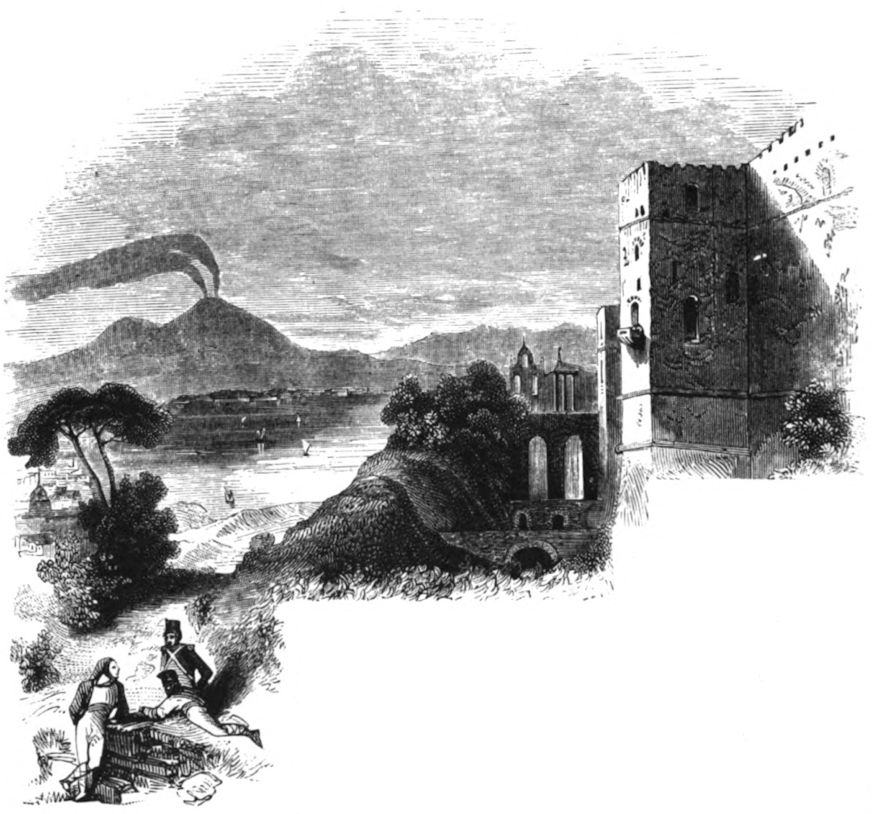
Vesuvius from St. Elmo.
The old and faithful voyager, Captain Dampier, in a quaint but pleasing style, has given the most exact description of these remarkable winds, as they occur in tropical latitudes. “These sea-breezes do commonly rise in the morning about nine o’clock, sometimes sooner, sometimes later; they first approach the shore so gently, as if they were afraid to come near it, and ofttimes they make some faint breathings, and, as if not willing to offend, they make a halt, and seem ready to retire. I have waited many a time, both ashore to receive the pleasure, and at sea to take the benefit of it. It comes in a fine, small, black curl upon the water, whereas all the sea between it and the shore, not yet reached by it, is as smooth and even as glass in comparison. In half an hour’s time after it has reached the shore, it fans pretty briskly, and so increaseth, gradually, till twelve o’clock; then it is commonly strongest, and lasts so till two or three a very brisk gale; about twelve at noon it also veers off to sea two or three points, or more in very fair weather. After three o’clock, it begins to die away again, and gradually withdraws its force till all is spent; and about five o’clock, sooner or later, according as the weather is, it is lulled asleep, and comes no more till the next morning.
“Land-breezes are as remarkable as any winds that I have yet treated of; they are quite contrary to the sea-breezes; for those blow right from the shore, but the sea-breeze right in upon the shore; and as the sea-breezes do blow in the day and rest in the night, so, on the contrary, these do blow in the night and rest in the day, and so they do alternately succeed each other. For when the sea-breezes have performed their offices of the day, by breathing on their respective coasts, they, in the evening, do either withdraw from the coast, or lie down to rest. Then the land-winds, whose office it is to breathe in the night, moved by the same order of divine impulse, do rouse out of their private recesses, and gently fan the air till the next morning, and then their task ends, and they leave the stage. There can be no proper time set when they do begin in the evening, or when they retire in the morning, for they do not keep to an hour, but they commonly spring up between six and twelve in the evening, and last till six, eight, or ten in the morning. They both come and go away again earlier or later, according to the weather, the season of the year, or some accidental cause from the land. For, on some coasts, they do rise earlier, blow fresher, and remain later than on other coasts, as I shall show hereafter.
“These winds blow off to sea, a greater or less distance, according as the coast lies more or less exposed to the sea-winds; for, in some places, we find them brisk three or four leagues off shore; in other places, not so many miles, and, in some places, they scarce peep without the rocks; or if they do sometimes, in very fair weather, make a sally out a mile or two, they are not lasting, but suddenly vanish away, though yet, there are every night as fresh land-winds ashore, at these places, as in any other part of the world. Indeed, these winds are an extraordinary blessing to those that use the sea in any part of the world within the tropics; for as the constant trade-winds do blow, there could be no sailing in these seas; but by the help of the sea and land-breezes, ships will sail 200 or 300 leagues, as particularly from Jamaica to the Lagune of Trist, in the Bay of Campeachy, and then back again, all against the trade-wind. The seamen that sail in sloops or other small vessels in the West Indies do know very well when they shall meet a brisk land-wind by the fogs that hang over the land before night; for it is a certain sign of a good land-wind to see a thick fog lie still and quiet, like smoke over the land, not stirring any way; and we look out for such signs when we are plying to windward. For if we see no fog over the land, the land-wind will be but faint and short that night. These signs are to be observed chiefly in fair weather; for in the wet season fogs do hang over the land all the day, and it may be neither land-wind nor sea-breeze stirring. If in the afternoon, also, in fair weather, we see a tornado over the land, it commonly sends us forth a fresh land-wind. These land-winds are very cold, and though the sea-breezes are always much stronger, yet these are colder by far. The sea-breezes, indeed, are very comfortable and refreshing; for the hottest time in all the day, is about nine, ten, or eleven o’clock in the morning, in the interval between both breezes; for then it is commonly calm, and then people pant for breath, especially if it is late before the sea-breeze comes, but afterward the breeze allays the heat. However, in the evening again, after the sea-breeze is spent, it is very hot till the land-wind springs up, which is sometimes not till twelve o’clock or after.”
4. Etesian winds. The ancients gave this designation, from annual, to periodical winds which blow from the north-east in the summer months, for about six weeks, throughout the Mediterranean and adjacent countries, but mostly in the eastern branch, including the Adriatic and the Archipelago. The term Meltem is now applied to them by the fishermen, a corruption, probably, of mal temps, referring to the fury with which they blow, and to the danger to which their small craft become exposed. On land, they are more favorably regarded. These winds are noticed by Pliny, Seneca, and Cicero, the latter of whom says, that in Italy they are equally comfortable and salutary to men, beasts, and birds, and likewise beneficial to vegetation, by moderating the violent heat of the weather during the inclement season of the dog-days. In the Levant, they commence toward the middle of July, about nine in the morning, continuing only in the day-time. The sun at that season is powerfully heating the earth under the tropic of Cancer, and rarefying the atmosphere south of the Mediterranean, thus giving birth to the north-east etesian gales.
5. Khamsin, Samiel, Simoom, Harmattan, Sirocco. These are local titles of winds differing greatly in geographical position and direction, and also in some of their properties, but prevalent in desert regions, or in countries adjacent to them, and having one universal character of being hot blasts. The Khamsin is a hot south wind, which soon after the vernal equinox begins to blow in Egypt, continuing at intervals during a period of about fifty days, to which the name refers. The two next are entirely identical, the Samiel being the name given by the Turks to the wind which the Arabs called the Simoom. It is common in Syria, Arabia, and Nubia, deleterious in its mildest forms, occasionally destructive, many a pilgrim to the shrine of the Prophet at Mecca, and merchant to the marts of Bagdad, having perished by its noxious suffocating influence. Bruce suffered from it when ascending the Nile, he and his company becoming so enervated as to be incapable of pitching their tents, oppressed as well by an intolerable headache. “The poisonous simoom,” he remarks, when at Chendi, “blew as if it came from an oven; our eyes were dim, our lips cracked, our knees tottering, our throats perfectly dry; and no relief was found from drinking an immoderate quantity of water.” The most complete account of the simoom and its effects has been given by Volney, whose accuracy here has been repeatedly confirmed. “Travelers,” he states, “have mentioned these winds under the name of poisonous winds; or, more correctly, hot winds of the desert. Such in fact is their quality; and their heat is sometimes so excessive that it is difficult to form an idea of their violence without having experienced it; but it may be compared to the heat of a large oven at the moment of drawing out the bread. When these winds begin to blow, the atmosphere assumes an alarming aspect. The sky, at other times so clear in this climate, becomes dark and heavy; the sun loses its splendor, and appears of a violet color. The air is not cloudy, but gray and thick; and is in fact filled with an extremely subtle dust, that penetrates everywhere. This wind, always light and rapid, is not at first remarkably hot, but it increases in heat in proportion as it continues. All animated bodies soon discover it by the change it produces in them. The lungs, which a too rarefied air no longer expands, are contracted and become painful. Respiration is short and difficult, the skin parched and dry, and the body consumed by an internal heat. In vain is recourse had to large draughts of water; nothing can restore perspiration. In vain is coolness sought for; all bodies in which it is usual to find it deceive the hand that touches them. Marble, iron, water, notwithstanding the sun no longer appears, are hot. The streets are deserted, and the dead silence of night reigns everywhere. The inhabitants of towns and villages shut themselves up in their houses—and those of the desert in their tents, or in pits they dig in the earth—where they wait the termination of this destructive heat. It usually lasts three days, but if it exceeds that time it becomes insupportable. Wo to the traveler whom this wind surprises remote from shelter! he must suffer all its dreadful consequences, which sometimes are mortal. The danger is most imminent when it blows in squalls, for then the rapidity of the wind increases the heat to such a degree as to cause sudden death. This death is a real suffocation; the lungs being empty are convulsed, the circulation disordered, and the whole mass of blood driven by the heat toward the head and breast; whence that hæmorrhage at the nose and mouth which happens after death. This wind is especially fatal to persons of a plethoric habit, and those in whom fatigue has destroyed the tone of the muscles and vessels. The corpse remains a long time warm, swells, turns blue, and is easily separated; all of which are signs of that putrid fermentation which takes place when the humors become stagnant. These accidents are to be avoided by stopping the nose and mouth with handkerchiefs; an efficacious method is also that practiced by the camels, who bury their noses in the sand, and keep them there till the squall is over. Another quality of this wind is its extreme aridity, which is such, that water sprinkled upon the floor evaporates in a few minutes. By this extreme dryness it withers and strips all the plants, and by exhaling too suddenly the emanations from animal bodies, crisps the skin, closes the pores, and causes that feverish heat which is the invariable effect of suppressed perspiration.” The current of the simoom is seldom of any considerable breadth, but different examples of it have been traversing a tract of country of but scanty area at the same time, and several cases of disaster from it upon an extensive scale are upon record. The opinion is now commonly held, that the destruction of the Assyrian army, when
“The angel of death spread his wings on the blast,
And breathed in the face of the foe as he passed
And the eyes of the sleepers waxed deadly and chill,
And their hearts but once heaved, and forever grew still,”
was accomplished by the agency of the simoom, directed by the Almighty Will over the host of Senacherib—an interpretation which the terms of the prophetic announcement of the avenging stroke remarkably support: “Behold I will send a blast upon him.”
The Harmattan, a periodical hot wind from the desert, differs remarkably from the simoom. It blows from the interior of the great Sahara, from the north-east, over Senegambia and Guinea, to that part of the coast of Africa lying between Cape Verde in 15° north latitude to Cape Lopez in 1° south latitude, a coast line of upward of two thousand miles. It occurs during December, January, and February, generally three or four times in that season. The harmattan is the local name of the wind among the Fantees, a nation on the Gold Coast. It comes on indiscriminately at any hour of the day, at any time of the tide, or at any period of the moon, continuing sometimes only a day or two, at other times five or six days, and it has been known to last upward of a fortnight. A fog or haze is one of the peculiarities which always accompanies this wind, occasioning a gloom which frequently renders even near objects obscure, through which the sun appears for a short time about noon, having a wild red aspect. Though the wind blows out to sea for ten or twelve leagues, the fog is confined to the land, and leaves a deposition of fine whitish particles upon the grass and trees. Extreme dryness is another property of the harmattan. No dew falls during its continuance, nor is there the least appearance of moisture in the atmosphere. Vegetables of every kind suffer; all tender plants and most of the productions of the garden are destroyed; the grass withers, and becomes dry like hay; vigorous evergreens feel the pernicious influence; the branches of the lemon, orange, and lime trees droop, the leaves become flaccid, and so parched as to be easily rubbed to dust between the fingers, should the harmattan blow for several successive days. Among other extraordinary effects of the extreme dryness, it is stated, that the covers of books, though closely shut up in a trunk, are bent as if they had been exposed to a fire. Household furniture cracks, the panels of the doors split, and any veneered work flies to pieces. Another, and the most striking feature of the harmattan, is its salubrity. Though prejudicial to vegetable life, and occasioning disagreeable parching effects on the human species, yet it is highly conducive to health, those laboring previously under fevers generally recover during its prevalence, the feeble gain strength, and malignant diseases disappear. It seems that as this wind immediately follows the rainy season on the African coast, during which diseases are induced by an excess of moisture, the harmattan, invested with extraordinary dryness, removes humidity from the atmosphere, and counteracts its effects.
The Sirocco is analogous to the Khamsin, but milder. It is a hot south-east wind prevailing in the Mediterranean, in Italy and Sicily, but felt most violently in the country around Naples, and at Palermo. It sometimes commences faintly about the summer solstice, but blows occasionally with great force in the month of July. Mr. Brydone, writing from Palermo, and referring to July 8th, observes—
“On Sunday, we had the long-expected sirocco wind, which, although our expectations had been raised pretty high, yet I own greatly exceeded them. Friday and Saturday were uncommonly cool, the mercury never being higher than 72½: and, although the sirocco is said to have set in early on Sunday morning, the air in our apartments, which are very large, with high ceilings, was not in the least affected by it at eight o’clock, when I rose. I opened the door without having any suspicion of such a change, and, indeed, I never was more astonished in my life. The first blast of it on my face felt like the burning steam from the mouth of an oven. I drew back my head and shut the door, calling out to Fullarton that the whole atmosphere was in a flame. However, we ventured to open another door that leads to a cool platform, where we usually walk; this was not exposed to the wind, and here I found the heat much more supportable than I could have expected from the first specimen I had of it at the other door. It felt somewhat like the subterraneous sweating-stoves at Naples, but still much hotter. In a few minutes, we found every fibre greatly relaxed, and the pores opened to such a degree, that we expected soon to be thrown into a profuse sweat. I went to examine the thermometer, and found the air in the room as yet so little affected that it stood only at 73. The preceding night it was at 72½. I took it out in the open air, when it immediately rose to 110, and soon after to 112; and I am confident, that in our old lodgings, or anywhere within the city, it must have risen several degrees higher. The air was thick and heavy, but the barometer was little affected—it had fallen only about a line. The sun did not once appear the whole day, otherwise I am persuaded the heat must have been insupportable; on that side of our platform which is exposed to the wind, it was with difficulty we could bear it for a few minutes. Here I exposed a little pomatum, which was melted down as if I had laid it before the fire. I attempted to take a walk in the street, to see if any creature was stirring, but I found it too much for me, and was glad to get up stairs again. This extraordinary heat continued till three o’clock in the afternoon, when the wind changed at once, almost to the opposite point of the compass.” All nature languishes under the influence of this wind: vegetation droops and withers; the Italians suffering from it not less than strangers. When any feeble literary production appears, the strongest phrase of disapprobation they can bestow is—era scritto in temps del sirocco, “it was written in the time of the sirocco.” There can be little doubt but that this hot south-east wind sweeps across the Mediterranean from the shores of Africa. It is some compensation that the season of this oppressive blast is also that of the north-east Etesian winds, and not unfrequently, after a few hours’ experience of the enfeebling influence of the sirocco, the tramontane—or north wind—follows with its invigorating breath.
Hot winds, resembling the sirocco of Sicily and Italy, prevail in New South Wales, and are supposed to derive their heat from tracts of unknown deserts in the intertropical regions of that island-continent. “One might almost fancy,” says Mrs. Meredith, “the Ancient Mariner to have experienced one during his ghostly voyage, he so accurately describes their aspect—
All in a hot and copper sky,
The bloody sun, at noon,
Right up above the mast did stand,
No bigger than the moon.
The sirocco of that country always blows from the north-west. At Sydney, its oven-like temperature is moderated by the mid-day sea-breeze; but in the interior it is severely felt, and is often fatal to the vegetation. Every green thing droops and dies, dried up like half-burnt paper. Large tracts of cultivated land, covered with luxuriant green crops of wheat or barley, just going into ear, are scorched, shriveled, and absolutely blackened by the heat, and become fit for nothing but to be cut as litter; and of course the delicate plants and flowers of the gardens are not spared by the “burning breath of the fervid Air-king.”
6. Hurricanes.—Sudden and tremendous bursts of storm are common in mountainous districts, and in the plains which lie at the base of those vast piles of nature’s building. Their peaks, exposed by elevation to intense cold, and covered with perpetual snow, cool and condense the warm air rising up from the regions below, which descends with an impetus proportioned to its own gravity and the lighter condition of the air over the regions below, and a tempest ensues upon considerable condensation and rarefaction in adjoining regions of the atmosphere. This is the origin of the pamperos, or south-west winds, which rush from the snows of the Andes, and sweeping over the level pampas with unchecked violence, become hurricanes before their arrival at Buenos Ayres, and carry to the city clouds of dust collected from the plains, occasioning almost total darkness in the streets. So sudden is the operation of the pampero, that persons bathing in the river Plate have been drowned by the agitation of its waters, through the tempest, before they could possibly reach the shore. Captain Fitzroy relates, when in his ship upon the river, that a small boat had been hauled ashore above high-water mark, and fastened with a strong rope to a large stone; but the pampero set in, and afterward the boat was found far from the beach, shattered to pieces, but still fast to the stone, which it had dragged along.
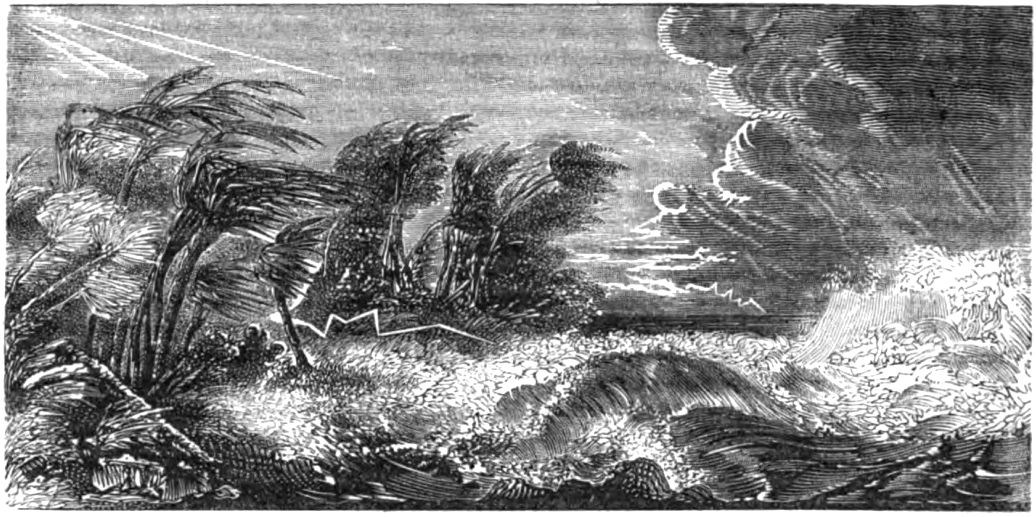
Hurricane in the Tropics.
But this violent movement of the atmosphere is remarkably beneficial in its general effect to the inhabitants of the pampas of Buenos Ayres and on the banks of the Plata. The prevailing winds through a great part of the year are northerly; and these passing over extensive marshy tracts bring with them a degree of humidity, which renders the land rife with fever and pestilence, till the pampero rushes down from the Andes and clears the atmosphere. A somewhat similar wind is one of our own physical phenomena, hitherto unexplained, to the violence of which the tourist to the Cumberland lakes may occasionally be exposed in spring and autumn. This is the Helm-wind. Hutchinson, in the history of the county, and the Rev. J. Watson, in a report to the British Association, have given an account of its singular features. When not a breath of air is stirring, or a cloud is to be seen, a line of clouds will be suddenly formed over the summits of the lofty ridge of mountains at Hartside, extending several miles on the western side. To this collection of vapors the term Helm is applied from its shape. It exhibits an awful and solemn appearance, spreading a gloom over the regions below, like the shadows of night. Parallel to this, another line of clouds, called the Bar, begins to form. The two lines unite together at their extremities, and embrace between them an elliptical cloudless space, from half a mile to four or five miles in breadth, and from eight to thirty miles in length; the breadth being from east to west, and the length from north to south. Soon after the complete formation of the Helm-bar, a violent wind issues from the space between the clouds, generally blowing directly from the east, and with such power that trees have been dismantled of their foliage, stacks of grain dispersed, and heavy vehicles overturned. The Helm-wind has continued for as much as nine days together, with a noise resembling that of a violent sea-storm, but it is seldom accompanied with any rain. It has been suggested, that the air from the coast of Northumberland, being cooled as it rises to the summit of the mountains, and there condensed, descends from thence with great force, by its gravity, into the district, to the west of Hartside, the scene of the phenomenon: but obviously a variety of other causes must enter into its production.
In several parts of the globe, an extensive vacuum being suddenly created in the atmosphere by the agency of electricity, the surrounding air rushes in with immense impetuosity from all points of the compass, blowing in gusts of resistless power, destroying all the productions of the earth, leveling forests and the finest buildings, and inundating whole tracts of country by the deluge of rain with which they are accompanied. These storms seldom occur far out in the open ocean, or beyond the tropics, or nearer the equator than nine or ten degrees. Their principal localities are the West India Islands, those of Madagascar, Mauritius, and Bourbon, the north-west coast of Africa, the Bay of Bengal, and the Chinese Sea, where they are variously called hurricanes, tornadoes, and typhoons. A heavy swell upon the sea, a dusky redness of the sky, a close oppressive air, and a wild irregularity in the appearance of things, are the usual precursors of a tropical tempest. Though generally confined to the districts mentioned, where they are of frequent occurrence, the extra-tropical latitudes, at more distant intervals, experience the force of the hurricane.
When were the winds
Let slip with such a warrant to destroy?
When did the waves so haughtily o’erleap
Their ancient barriers, deluging the dry?”
This is the language of Cowper in the Task, respecting the year 1783, when—amid the other events of that portentous season, noticed upon a previous page—a succession of storms, accompanied with violent rains, visited the whole of Great Britain, and caused considerable damage. But what is known in our records as the “Great Storm,” occurred on the night of the 26th and the morning of the 27th of November 1703, and has been referred to by almost all the writers of that period. Derham, in the Philosophical Transactions for the year following, states—
“Of the preceding parts of the year (1703), the months of April, May, June, and July were wet in the southern parts of England, particularly in May, when more rain fell than in any month of any year since 1690; June also was very wet; and though July had considerable intermissions, yet on the 28th and 29th there fell violent showers of rain, and the newspapers gave accounts of great rains that month from divers places of Europe. On Thursday, November 25th, the day before the tempest, in the morning there was a little rain, the winds high in the afternoon. In the evening there was lightning, and between nine and ten o’clock at night, a violent but short storm of wind, and much rain. Next morning, November 26th, the wind was S. S. W., and high all day, and so continued till I was in bed and asleep. About twelve that night the storm awakened me, which gradually increased till near three that morning, and from thence till near seven it continued with the greatest violence; then it began to abate slowly and the mercury to rise swiftly.” This tempest filled the whole kingdom with terror, and produced immense commercial loss, and many melancholy accidents. The country between the Loire in France and the Trent in England was the chief scene of its ravages. The historians of those times give an affecting account of the dismal appearance of the district. Houses unroofed—steeples blown down—stacks of corn scattered abroad—vessels dismasted or wrecked—and upward of eight thousand persons drowned. “The wind,” says Oldmixon, “blew west-south-west, and grumbled like thunder, accompanied with flashes of lightning. It threw down several battlements and stacks of chimneys at St. James’ Palace; tore to pieces tall trees in the Park; and killed a servant in the house. The Guard-house at Whitehall was much damaged, as was the Banqueting-house. A great deal of lead was blown off Westminster Abbey; and most of the lead on churches and houses either rolled up in sheets or loosened. The pious and learned prelate Doctor Richard Kidder, Bishop of Bath and Wells, and his lady, were killed by the fall of part of the old episcopal palace at Wells. The Bishop of London’s sister, Lady Penelope Nicholas, was killed in like manner at Horsely in Sussex, and Sir John Nicholas—her husband—grievously hurt.” Upward of 800 houses, 400 windmills, and 250,000 timber-trees were thrown down; 100 churches unroofed; 300 sail lost upon the coast; 900 wherries and barges destroyed on the Thames; the Eddystone light-house, built by Winstanley, was overthrown; 15,000 sheep, besides other cattle, were drowned by the overflowing of the Severn; and Rear-Admiral Beaumont, with the crews of several ships, perished on the Goodwin Sands.
The West Indies and the vicinity of the Mauritius seem to be two principal foci of hurricanes, from their frequency and tremendous violence in those localities. Of thirteen hurricanes, described by Colonel Reid, in his interesting attempt to develop the law of storms, eleven took place in the neighborhood of the Mauritius and Madagascar, which sanctions an opinion prevalent among seamen, that gales are commonly avoided by ships steering in a course so as to keep well to the eastward of the Mauritius. To give some idea of a tropical hurricane, the particulars gathered by Colonel Reid from various sources, respecting that which desolated several of the West India Islands in the year 1831, are here introduced. It passed over Barbadoes, St. Lucia, St. Domingo, and Cuba, swept the northern shores of the Gulf of Mexico, raged simultaneously at Pensacola, Mobile, and New Orleans, entered the adjoining states, and seems to have been disorganized by the opposition offered to its progress by the mountain region of the Alleghanies. The hurricane accomplished the distance of 2000 miles in 150 hours, at an average velocity of 13½ miles an hour, but the rate of its progressive motion was insignificant in comparison with that of its rotatory movement, a feature hereafter to be adverted to. Before its arrival at St. Vincent, a cloud was observed to the north by a resident, so threatening in its aspect and peculiar in its color, that of olive green, that, impressed with a sense of impending danger, he hastened home, and by nailing up his doors and windows saved his house from the general calamity. In this island, the most remarkable effect of the storm was the destruction of an extensive forest at its northern extremity, the trees of which were killed without being blown down. In 1832, these trees were frequently examined by Colonel Reid, and appeared not to have been killed by the wind, but by the immense quantity of electric matter rendered active during the storm. When at its height, two negroes at Barbadoes were greatly terrified by sparks of electricity passing off from one of them, as they were struggling in the darkness, in the garden of Coddrington College, to reach the main building, after the destruction of their hut. Such was the quantity of spray carried inland from the sea by the wind, that it rained salt water over the whole island, which killed the fresh-water fish in the ponds, and several ponds continued salt for some days after the storm. The afternoon that ushered in the hurricane, that of the 11th of August, was one of dismal gloom, but about four o’clock, there was an obscure circle of imperfect light toward the zenith subtending an angle of 35° or 40°. Variable squalls of wind and rain, with intervening calms, prevailed till midnight, when the lightning flashed fearfully, and a gale blew fiercely from the north and north-east. At 1 A. M. the wind increased, but suddenly shifted its quarter, blowing from north-west and intermediate points. Toward three o’clock, after a little intermission, the hurricane again burst from the western points, hurling before it thousands of missiles—the fragments of every unsheltered work of human art. The strongest houses vibrated to their foundations, and the surface of the earth trembled as the destroyer passed over it. There was no thunder at any time distinctly heard, but the horrible roar and yelling of the wind, the noise of the ocean, whose waves threatened the destruction of every thing in Barbadoes that the other elements might spare, the clattering of tiles, the falling of roofs and walls, and the combination of a thousand other sounds, formed a hideous and appalling din. As soon as the dawn rendered outward objects visible, and, the storm abating, permitted the inhabitants of Bridgetown to venture out, a grand but distressing picture of ruin presented itself. From the summit of the cathedral tower, the whole face of the country appeared the wreck of its former condition. No sign of vegetation could be observed, except here and there a few patches of sickly green. The surface of the ground exhibited the scorching and blackening effect of the lightning. A few remaining trees, stripped of their boughs and foliage, wore a cold and wintry aspect; and the numerous villas in the neighborhood, formerly concealed amid thick groves, were exposed and in ruins.
In the year 1837, three hurricanes occurred in the West Indies and adjacent parts of the Atlantic, the narratives of which, as collected by Colonel Reid from different observers, present some singular features. The first passed over Barbadoes on the 26th of July. The sky assumed a blue-black appearance, with a red glare at the verge of the horizon. The flashes of lightning were accompanied with a whizzing noise, like that of a red-hot iron plunged in water. The barometer and sympiesometer fell rapidly and sunk to 28·45 inches. The Antigua hurricane, the second of that year, commenced in the Atlantic, on the night of the 31st of July, and was encountered by Captain Seymour, in the brigantine Judith and Esther of Cork. He observed near the zenith a white appearance of a round form, and while looking stedfastly at it, a sudden gust of wind carried away the topmast and lower scudding sails. During the hurricane the eyes of the crew were remarkably affected, their sight became dim, and every one of their finger-nails turned quite black, and remained so nearly five weeks afterward. The captain inferred, from the universality of the effect, that it could not have been produced by the firmness of the grasp with which they were holding by the rigging, but that the whole was caused by an electric body in the elements. On the 2d of August, in another situation, the Water Witch was caught by the skirts of the same storm, the wind blowing in squalls from the W. and N. N. W. till the evening, when “a calm succeeded,” states Captain Newby, “for about ten minutes; and then, in the most tremendous, unearthly screech I ever heard, it recommenced from the south and south-west.” The third hurricane of the year was met with by the Rawlins, about midnight of the 18th of August, when, after blowing violently for twelve hours from the north, in an instant a perfect calm ensued for an hour, and then, quick as thought, the wind sprung up with tremendous force from the south-west, no swell whatever preceding the convulsion. During this hurricane, an extraordinary phenomenon presented itself, resembling a solid, black, perpendicular wall about 15° or 20° above the horizon, which disappeared and became visible again several times, described by one of the observers, as “the most appalling sight he had ever seen during his life at sea.” A similar spectacle is described by an officer on board the ship Tartarus, during a hurricane on the American coast in the year 1814:—“No horizon appeared, but only a something resembling an immense wall within ten yards of the ship.” The power of the wind was remarkably exemplified during the great hurricane of 1780, which at Barbadoes forced its way into every part of the Government-house, and tore off most of the roof, though the walls were three feet thick, and the doors and windows had been well barricaded. Obliged to retreat from thence, the governor and his family fled to the ruins of the foundation of the flag-staff, and, compelled to relinquish that station, they with difficulty reached the cannon of the fortifications, under the carriages of which they took shelter. But here they were not secure, for the cannons were moved by the fury of the wind, and they dreaded every moment that the guns would be dismounted, and crush them by their fall. From the preceding accounts it appears that the agency of electricity is frequently extensively developed in hurricanes; that they have a progressive motion; that calms of short duration occur during their continuance; after which the wind bursts forth from a quarter different to that from which it has been blowing—peculiarities which have led to a theory respecting storms which may be considered as established in its leading principles.
Down to a very recent date, a hurricane was generally deemed to be simply a gale of wind pursuing with immense velocity a rectilinear direction. Colonel Capper departed from this idea after investigating the storms of the Indian Ocean, and published the conclusion in the year 1801, that the hurricanes he had examined in that region were real whirlwinds of varying diameter, having a progressive as well as a rotatory motion. The evidence collected from the records of an immense number of storms in the Atlantic by Mr. Redfield, of New York, and in the Indian Ocean by Colonel Reid, seems to place beyond all dispute the fact, that they occur in the form of a ring, having an outer circle, where the air revolves with intense velocity, and an interior space, the diameter of which is sometimes equal to several hundred miles, the vortex of the whirlwind, which is the scene of gusts and lulls, a comparatively slow progressive motion on the surface of land and sea distinguishing the whole. A hurricane which occurred at New Brunswick in the year 1835 strikingly exhibited the character of a revolving storm; for, while about the centre bodies of great weight were carried spirally upward, at the extremities the trees were thrown in opposite directions. The same circumstance was observed at Barbadoes in 1831, near the northern coast: the trees which the hurricane uprooted lay from N. N. W. to S. S. E., having been thrown down by a northerly wind, while in some other parts of the island they lay from S. to N., having been prostrated by a southerly wind. It is evident, therefore, that the direction of the wind at a particular point affords no indication of the course in which the whole revolving mass of the atmosphere is advancing. Another singular conclusion respecting storms, which the American and Anglican philosophers, along with Professor Dove of Berlin, have arrived at by independent investigations, is, that the hurricanes in the southern hemisphere revolve in a counter direction to those in the northern; and while the axis of a storm in the North Atlantic has a progressive motion from the equator obliquely toward the north pole, that of one in the Indian Ocean proceeds obliquely from the equator toward the south pole. In the Pacific Ocean, a region of hurricanes, their revolving motion appears to be sanctioned by the evidence which has been obtained respecting them. Mr. Williams, the missionary, describes a hurricane at Raratonga, one of the Hervey Islands, during which the rain descended in deluging torrents, the lightning darted in fiery streams among the dense, black clouds, the thunder rolled deep and loud through the heavens, and the island trembled to its very centre as the war of the elements raged over it. Scarcely a banana or plaintain tree was left, either on the plains, or in the valleys, or upon the mountains; hundreds of thousands of which, on the preceding day, covered and adorned the land with their foliage and fruit, and immense chestnuts, which had withstood the storms of ages, were laid prostrate on the ground, while those that remained erect had scarcely a branch, and were all leafless. It was observed, that when the gale ended, the wind was in the west, whereas in the early part of its action the east end of the chapel had been blown in, which shows the wind then to have been in the east. The hurricanes of New South Wales have been observed to develop the same peculiarity. Mr. Meredith traced the path of one in the centre, and found at the termination a circle plainly shown, in which the trees lay all ways.
The cause of this rotatory motion of storms remains in obscurity, but it is probably due in part to the same law under which eddies or whirlpools are formed in water, by two currents being obliquely impelled against each other. The great hurricanes may thus be considered identical with the small local whirlwinds, which are common with us in the summer season, carrying upward and along the dust and loose grass in spiral columns, exhibiting a progressive and rotatory motion. In the region of the sandy deserts these atmospheric whirls transpire upon a great scale, raising up immense quantities of the loose particles in columns to a considerable height, which sweep along with prodigious violence, and have occasionally swallowed up whole caravans in their tremendous vortex.
“Man mounts on man, on camels camels rush,
Hosts march on hosts, and nations nations crush,
Wheeling in air the winged islands fall,
And one great earthy ocean covers all.”
“One of the largest of these pillars of sand,” says a modern traveler, Caille, “crossed our camp, overset all the seats, and whirling us about like straws, threw one of us on the other in the utmost confusion. We knew not where we were, and could not distinguish any thing at the distance of a foot. The sand wrapped us in darkness like a fog, and the sky and the earth seemed confounded and blended in one. Whilst this frightful tempest lasted we remained stretched on the ground motionless, dying of thirst, burned by the heat of the sand, and buffeted by the wind. We suffered nothing, however, from the sun, whose disk, almost concealed by the clouds of sand, appeared dim and deprived of its rays.” Bruce has sketched with spirit several of these desert whirlwinds, of which he was an eye-witness:—“At one o’clock,” he states, “we alighted among some acacia trees at Waadi el Halboub, having gone twenty-one miles. We were here at once surprised and terrified by a sight surely one of the most magnificent in the world. In that vast expanse of desert, from W. to N. W. of us, we saw a number of prodigious pillars of sand at different distances, at times moving with great celerity, at others stalking on with a majestic slowness; at intervals we thought they were coming in a few minutes to overwhelm us; and small quantities of sand did actually more than once reach us. Again they would retreat so as to be almost out of sight, their tops reaching to the very clouds. There the tops often separated from the bodies, and these, once disjoined, dispersed in the air, and did not appear more. Sometimes they were broken in the middle, as if struck with large cannon-shot. About noon they began to advance with considerable swiftness upon us, the wind being very strong at the north. Eleven of them ranged alongside of us about the distance of three miles. The greatest diameter of the largest appeared to me at that distance as if it would measure ten feet. They retired from us with a wind at S. E., leaving an impression upon my mind to which I can give no name, though surely one ingredient in it was fear, with a considerable deal of wonder and astonishment. It was in vain to think of flying; the swiftest horse, or fastest sailing ship, could be of no use to carry us out of this danger; and the full persuasion of this riveted me as if to the spot where I stood. The same appearance of moving pillars of sand presented themselves to us this day, in form and disposition like those we had seen at Waadi Halboub, only they seemed to be more in number and less in size. They came several times in a direction close upon us; that is, I believe, within less than two miles. They began immediately after sunrise like a thick wood, and almost darkened the sun. His rays shining through them for near an hour, gave them an appearance of pillars of fire. Our people now became desperate; the Greeks shrieked out and said it was the day of judgment; Ismael pronounced it to be hell; and the Turcorories, that the world was on fire.” The procession of tall columns of dust, the upper end seeming to vanish off, or puff away like light smoke, and the lower apparently touching the earth, is not unusual on the large plains of New South Wales, in dry weather. They move in a perpendicular position, quietly and majestically gliding along one after another, but really so fast that the fleetest horse is unable to keep pace with them. According to Mrs. Meredith, when they are crossing a brook, the lower portion of the dust is lost sight of, and a considerable agitation disturbs the water, but immediately on landing the same appearance is resumed. “As some vanish,” she remarks, “others imperceptibly arise and join the giant waltz; and when I first observed this most singular display, I amused myself by fancying them a new species of genii relaxing from their more laborious avocations, and having a sedate and stately dance all to themselves. When the dance ends, these dusty performers always appear to sit down among the neighboring hills.” To the same class with these rotating and progressing pillars of sand, that singular phenomenon called the waterspout clearly belongs, a whirlwind raising into a columnar mass the waters of the sea, and causing the aqueous vapors in the atmosphere to assume the same form, the two frequently uniting, the whole presenting a magnificent spectacle.
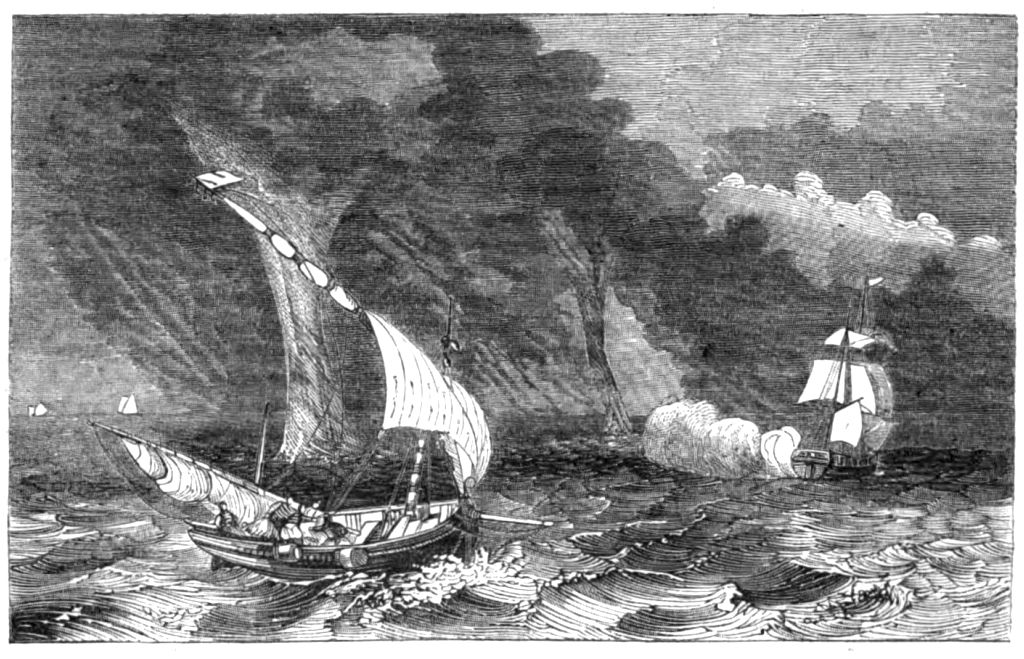
Waterspout.
The Greeks applied the term Prester to the waterspout, which signifies a fiery fluid, from its appearance being generally accompanied with flashes of lightning, and a sulphureous smell, showing the activity of the electrical principle in the air. Lucretius refers to it in the following terms:—
Hence, with much ease, the meteor may we trace
Termed, from its essence, Prester by the Greeks,
That oft from heaven wide hovers o’er the deep.
Like a vast column, gradual from the skies,
Prone o’er the waves, descends it; the vexed tide
Boiling amain beneath its mighty whirl,
And with destruction sure the stoutest ship
Threat’ning that dares the boist’rous scene approach.
Waterspouts exhibit various aspects, but a frequent appearance has been thus described, as it has been observed at sea. Under a dense cloud, a circular area of the ocean, in diameter from 100 to 120 yards, shows great disturbance, the water rushing toward the centre of the agitated mass, from whence it rises in a spiral manner toward the clouds, assuming a trumpet-shape, with the broad end downward. At the same time, the cloud assumes a similar form, but the position of the cone is inverted, and its lower extremity, or apex, gradually unites with the upper extremity of the ascending column of water. At the point of junction, the diameter is not more than two or three feet. There is thus a column of water and vapor formed, extending from the sea to the cloud, thin in the middle, and broad at the two extremities, the sides of which are dark, which gives it the appearance of a hollow tube. It moves with the wind, and even in calm weather, when no wind is perceptible, the position shifts. Sometimes the spout preserves the perpendicular in its motion, but frequently, from the wind not acting with equal force upon its upper and lower extremities, or the one being more susceptible of impulsion than the other, it assumes an inclined position, and the column is speedily ruptured by the unequal velocity of its parts. A few minutes suffices in general for the duration of the phenomenon, but several have been known to continue for near an hour. Instances of repeated disruption and formation have been witnessed, and in the Mediterranean, as many as sixteen waterspouts have been observed at the same time. The mariners of former days were accustomed to discharge artillery at these moving columns, to accelerate their fall, fearful of their ships being crossed by them, and sunk or damaged—a practice alluded to by Falconer in the opening of the second canto of The Shipwreck: but the principal danger arises from the wind blowing in sudden gusts in their vicinity, from all points of the compass, sufficient to capsize small vessels carrying much sail. Waterspouts on land are not uncommon, and in this case there is no ascending column of water, but only a descending inverted cone of vapor. Vivid flashes of lightning frequently issue from them, and deluges of rain attend their disruption. A remarkable spout appeared and burst on Emott Moor, near Coln in Lancashire, in the year 1718, about a mile distant from some laborers digging peat, whose attention was directed to it by hearing an unusual noise in the air. Upon leaving the spot in alarm, they found a small rippling stream converted into a roaring flood, though no rain had fallen on the moor; and at the immediate scene of action, the earth had been swept away to the depth of seven feet, the naked rock appeared, and an excavation had been made in the ground by the force of the water discharged from the spout, upward of half a mile in length.
It is a time of fear and peril to man and beast when the hurricane develops its giant strength, yet, contemplated apart from the probability of some fatal catastrophe, there is no scene more intensely sublime in the varied panorama of nature, than that exhibited to the senses of sight and hearing, by the dense black masses of clouds that roll in wild confusion through the air, the tumultuous aspect of the ocean, the agitation of the woods, and the voice of the tempest, varying from the melancholy wail, to the piercingly shrill cry and deafening roar, and occasionally combining every kind of intonation in its sound. However destructive these extraordinary agitations of the atmosphere—however terrible such a situation as that of Æneas on the stormy sea, helpless and hopeless, stretching his folded hands to the stars, and lamenting that he had not fallen with fierce Hector on the Ilian plains—it is unquestionable, that neither “breeze, or gale, or storm,” could be dispensed with in the economy of nature; for the various forms of life which the common air sustains, are preserved in vigor by that conflict of the elements which works occasional disaster. A variety of natural causes in operation upon the surface of the globe, and in its interior, concur to derange that constitution of the atmosphere which is alone salubrious, to vitiate the fluid, convert the medium of life and health into a cause of fever, pestilence, and death, thus changing every scene where the machinery of human existence is in movement into a Grotto del Cane, completely arresting all its wheels—an effect which would undoubtedly transpire without an antagonistic influence in constant action. In the process of supporting mankind and animals, the atmosphere is deprived of its oxygen, and exhaled in a morbid condition unfit for combustion and the sustenance of life; and the respiration of plants contributes also to its derangement. The exhalations from the low swampy regions of the earth are a further cause of deterioration, and hence the malarious mass to which the Pontine marshes, and similar districts, give birth. The provision against the reduction of the atmosphere to a universally disorganised and vitiated condition is the currents that prevail in it, which disperse and separate the poisonous ingredients, render them innocuous by bringing them into new combinations, and thus keep up that due proportion between the component parts of the aerial envelop, upon which its life-conserving property hinges, yet which the functions of life are perpetually destroying. The ordinary play of the winds, whispering in gentle breezes and rushing in powerful gales, has been ordained by the Author of life to subserve this purpose, and the dread tornado is also an efficient agent in the regeneration. In its alembic, it has been remarked, “the isolated poisons will be re-distilled; by the electric fires which it generates, their deleterious sublimations will be deflagrated; and thus will the great Alchymist neutralize the azotic elements which he has let loose, and shake the medicinal draught into salubrity.” The baneful effects of a stagnant condition of the atmosphere are exemplified in the feeble physical frame, and short term of years, of those who in the “city full” are cooped up in sites were there is no sufficient ventilation, and the inhabitants of many deep inclosed valleys exhibit physical and mental deterioration as a consequence of the same cause. The numerous examples of cretinism, or idiocy, with goitres, found about the villages and hamlets of the Lower Valais, and the Val d’Aosta in Switzerland—valleys, which have low marshy spots at the bottom, surrounded by high mountains, where the fresh air does not circulate freely, and where the reflected rays of the sun are very powerful in summer—Saussure attributed to the stagnation of the atmosphere; and though such instances of physical deformity and intellectual incapacity may be the combined effect of various causes, it is in harmony with the known effect of the one referred to, to suppose it materially to contribute to the result. The cagots of the deep Pyrenean valleys answer to the cretins of the Alps.
In closing this notice of atmospheric currents, we refer to observations made upon the ordinary winds of Great Britain. From an average of ten years of the register kept by order of the Royal Society, it appears that at London the wind blows annually in the following proportions:—
Days.
South-west112
North-east58
North-west50
West53
South-east32
East26
South18
North16
The same register shows, that the south-west wind blows at an average more frequently than any other wind during every month of the year, and that it blows longest in July and August; that the north-east blows most constantly during January, March, April, May, and June, and most seldom during February, July, September, and December; and that the north-west wind blows oftener from November to March, and more seldom during September and October, than any other months.