SPECTRAL ILLUSIONS.
Reading edition
———
BY THOMAS MILNER, M. A.
———
A series of curious and interesting phenomena, involving the apparent elevation and approach of distant objects, the production of aerial images of terrestrial forms, of double images, their inversion, and distortion into an endless variety of grotesque shapes, together with the deceptive aspect given to the desert-landscape, are comprehended in the class of optical illusions. Different varieties of this singular visual effect constitute the mirage of the French, the fata morgana of the Italians, the looming of our seamen, and the glamur of the Highlanders. It is not peculiar to any particular country, though more common in some than others, and most frequently observed near the margin of lakes and rivers, by the sea-shore, in mountain districts and on level plains. These phantoms are perfectly explicable upon optical principles, and though influenced by local combinations, they are mainly referable to one common cause, the refractive and reflective properties of the atmosphere, and inequalities of refraction arising from the intermixture of strata of air of different temperatures and densities. But such appearances in former times were really converted by the imagination of the vulgar into supernatural realities; and hence many of the goblin stories with which the world has been rife, not yet banished from the discipline to which childhood is subject,—
“As when a shepherd of the Hebrid Isles
Placed far amid the melancholy main,
(Whether it be lone fancy him beguiles,
Or that aerial beings sometimes deign
To stand, embodied, to our senses plain)
Sees on the naked hill, or valley low,
The whilst in ocean Phœbus dips his wain,
A vast assembly moving to and fro,
Then all at once in air dissolves the wondrous show.”
Pliny mentions the Scythian regions within Mount Imaus, and Pomponius Mela those of Mauritania, behind Mount Atlas, as peculiarly subject to these spectral appearances. Diodorus Siculus likewise refers to the regions of Africa, situated in the neighborhood of Cyrene, as another chosen site:—“Even,” says he, “in the severest weather, there are sometimes seen in the air certain condensed exhalations that represent the figures of all kinds of animals; occasionally they seem to be motionless, and in perfect quietude; and occasionally to be flying; while immediately afterward they themselves appear to be the pursuers, and to make other objects fly before them.” Milton might have had this passage in his eye when he penned the allusion to the same apparitions:—
“As when, to warn proud cities, war appears
Waged in the troubled sky, and armies rush
To battle in the clouds; before each van
Prick forth the airy knights, and couch their spears,
Till thickest legions close, with feats of arms
From either side of heaven the welkin rings.”
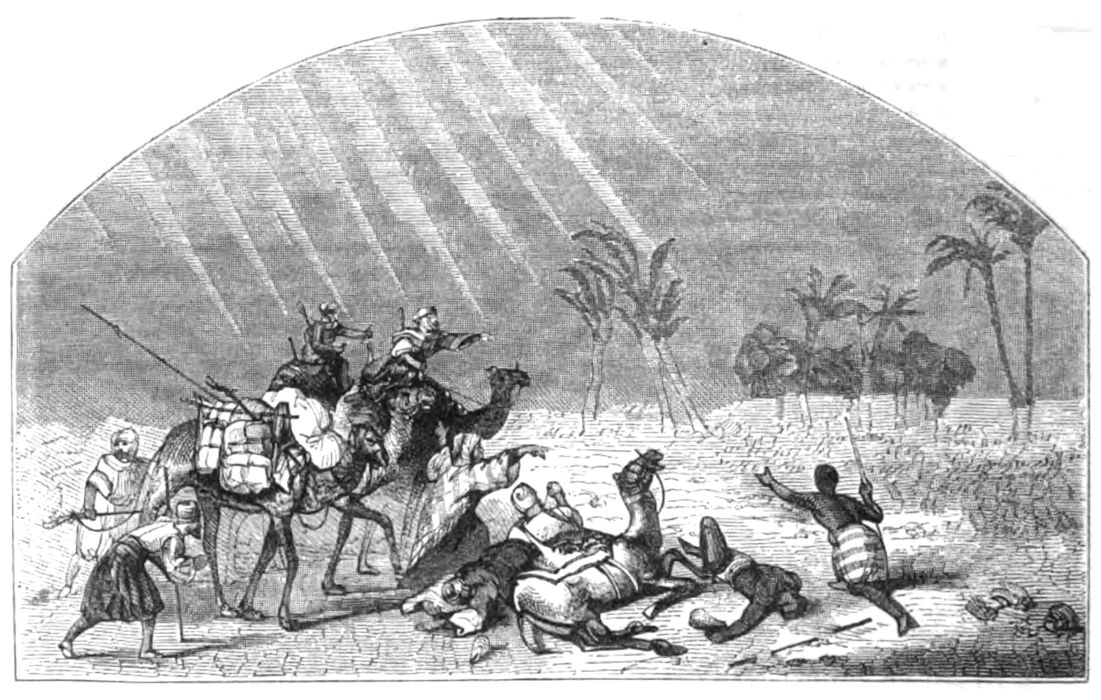
The Mirage of the Desert.
The mirage is the most familiar form of optical illusion. M. Monge, one of the French savans, who accompanied Buonaparte in his expedition to Egypt, witnessed a remarkable example. In the desert between Alexandria and Cairo, in all directions green islands appeared, surrounded by extensive lakes of pure, transparent water. Nothing could be conceived more lovely or picturesque than the landscape. In the tranquil surface of the lakes, the trees and houses with which the islands were covered were strongly reflected with vivid and varied hues, and the party hastened forward to enjoy the refreshments apparently proffered them. But when they arrived, the lake on whose bosom they floated, the trees among whose foliage they arose, and the people who stood on the shore inviting their approach, had all vanished; and nothing remained but the uniform and irksome desert of sand and sky, with a few naked huts and ragged Arabs. But for being undeceived by an actual progress to the spot, one and all would have remained firm in the conviction that these visionary trees and lakes had a real existence in the desert. M. Monge attributed the liquid expanse, tantalizing the eye with an unfaithful representation of what was earnestly desired, to an inverted image of the cerulean sky, intermixed with the ground scenery. This kind of mirage is known in Persia and Arabia by the name of Serab or miraculous water, and in the western deserts of India by that of Tehittram, a picture. It occurs as a common emblem of disappointment in the poetry of the orientals.
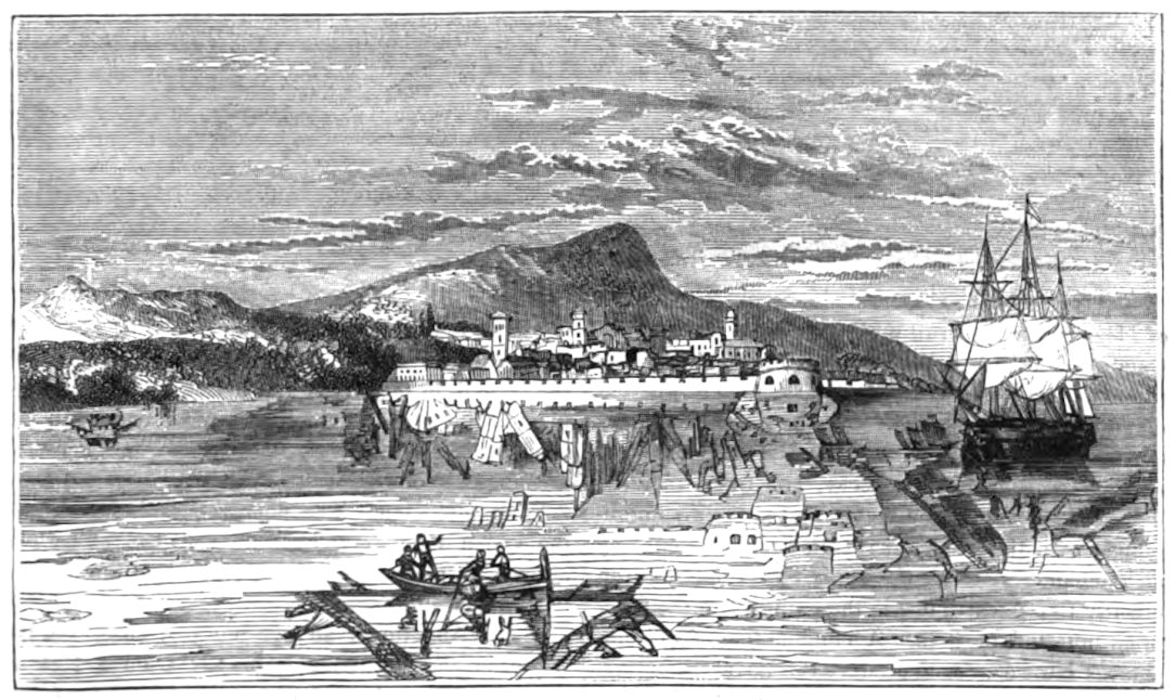
Atmospheric Illusion.
In the Philosophical Transactions for the year 1798, an account is given by W. Latham, Esq., F.R.S., of an instance of lateral refraction observed by him, by which the coast of Picardy, with its more prominent objects, was brought apparently close to that of Hastings. On July the 26th, about five in the afternoon, while sitting in his dining-room, near the sea-shore, attention was excited by a crowd of people running down to the beach. Upon inquiring the reason, it appeared that the coast of France was plainly to be distinguished with the naked eye. Upon proceeding to the shore, he found, that without the assistance of a telescope, he could distinctly see the cliffs across the Channel, which, at the nearest points, are from forty to fifty miles distant, and are not to be discovered, from that low situation, by the aid of the best glasses. They appeared to be only a few miles off, and seemed to extend for some leagues along the coast. At first the sailors and fishermen could not be persuaded of the reality of the appearance, but they soon became thoroughly convinced, by the cliffs gradually appearing more elevated, and seeming to approach nearer, that they were able to point out the different places they had been accustomed to visit, such as the Bay, the Old Head, and the Windmill at Boulogne, St. Vallery, and several other spots. Their remark was that these places appeared as near as if they were sailing at a small distance into the harbor. The apparition of the opposite cliffs varied in distinctness and apparent contiguity for nearly an hour, but it was never out of sight, and upon leaving the beach for a hill of some considerable height, Mr. Latham could at once see Dungeness and Dover cliffs on each side, and before him the French coast from Calais to near Dieppe. By the telescope the French fishing-boats were clearly seen at anchor, and the different colors of the land on the heights, with the buildings, were perfectly discernible. The spectacle continued in the highest splendor until past eight o’clock, though a black cloud obscured the face of the sun for some time, when it gradually faded away. This was the first time within the memory of the oldest inhabitants, that they had ever caught sight of the opposite shore. The day had been extremely hot, and not a breath of wind had stirred since the morning, when the small pennons at the mast-heads of the fishing-boats in the harbor had been at all points of the compass. Professor Vince witnessed a similar apparent approximation of the coast of France to that of Ramsgate, for at the very edge of the water he discerned the Calais cliffs a very considerable height above the horizon, whereas they are frequently not to be seen in clear weather from the high lands above the town. A much greater breadth of coast also appeared than is usually observed under the most favorable circumstances. The ordinary refractive power of the atmosphere is thus liable to be strikingly altered by a change of temperature and humidity, so that a hill which at one time appears low, may at another be seen towering aloft; and a city in a neighboring valley, may from a certain station be entirely invisible, or it may show the tops of its buildings, just as if its foundations had been raised, according to the condition of the aerial medium between it and the spectator.
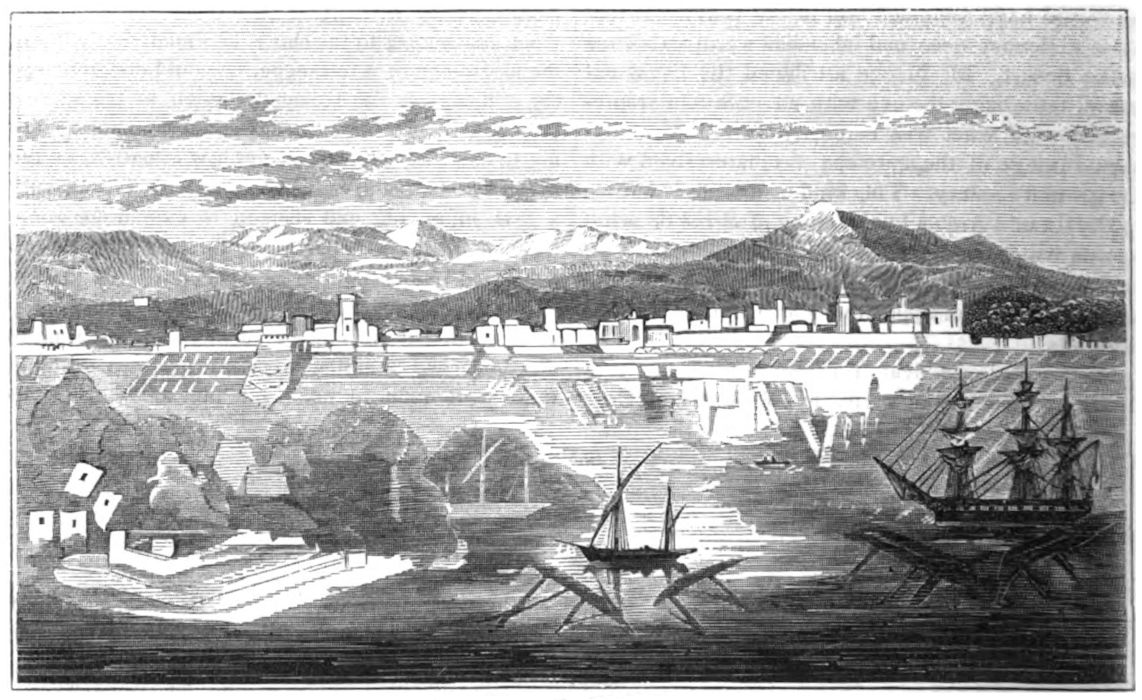
Fata Morgana at Reggio.
Of all instances of spectral illusion, the fata morgana, familiar to the inhabitants of Sicily, is the most curious and striking. It occurs off the Pharo of Messina, in the strait which separates Sicily from Calabria, and had been variously described by different observers, owing, doubtless, to the different conditions of the atmosphere at the respective times of observation. The spectacle consists in the images of men, cattle, houses, rocks, and trees, pictured upon the surface of the water, and in the air immediately over the water, as if called into existence by an enchanter’s wand, the same object having frequently two images, one in the natural and the other in an inverted position. A combination of circumstances must concur to produce this novel panorama. The spectator, standing with his back to the east on an elevated place, commands a view of the strait. No wind must be abroad to ruffle the surface of the sea; and the waters must be pressed up by currents, which is occasionally the case, to a considerable height, in the middle of the strait, so that they may present a slight convex surface. When these conditions are fulfilled, and the sun has risen over the Calabrian heights so as to make an angle of 45° with the horizon, the various objects on the shore at Reggio, opposite to Messina, are transferred to the middle of the strait, forming an immovable landscape of rocks, trees, and houses, and a movable one of men, horses, and cattle, upon the surface of the water. If the atmosphere, at the same time, is highly charged with vapor, the phenomena apparent on the water will also be visible in the air, occupying a space which extends from the surface to the height of about twenty-five feet. Two kinds of morgana may therefore be discriminated; the first, at the surface of the sea, or the marine morgana; the second, in the air, or the aerial. The term applied to this strange exhibition of uncertain derivation, but supposed by some to refer to the vulgar presumption of the spectacle being produced by a fairy or magician. The populace are said to hail the vision with great exultation, calling every one abroad to partake of the sight, with the cry of “Morgana, morgana!”
Father Angelucci, an eye-witness, describes the scene in the following terms:—“On the 15th of August, 1643, as I stood at my window, I was surprised with a most wonderful, delectable vision. The sea that washes the Sicilian shore swelled up, and became, for ten miles in length, like a chain of dark mountains; while the waters near our Calabrian coast grew quite smooth, and in an instant appeared as one clear polished mirror, reclining against the aforesaid ridge. On this glass was depicted, in chiaro scuro, a string of several thousands of pilasters, all equal in altitude, distance, and degree of light and shade. In a moment they lost half their height, and bent into arcades, like Roman aqueducts. A long cornice was next formed on the top, and above it rose castles innumerable, all perfectly alike. These soon split into towers, which were shortly after lost in colonnades, then windows, and at last ended in pines, cypresses, and other trees, even and similar. This was the Fata Morgana, which, for twenty-six years, I had thought a mere fable.”
Brydone, writing from Messina, evidently in a dubious vein, states:—“Do you know, the most extraordinary phenomenon in the world is often observed near to this place? I laughed at it at first, as you will do, but I am now convinced of its reality, and am persuaded, too, that if ever it had been thoroughly examined by a philosophical eye, the natural cause must long ago have been assigned. It has often been remarked, both by the ancients and moderns, that in the heat of summer, after the sea and air have been much agitated by winds, and a perfect calm succeeds, there appears, about the time of dawn, in that part of the heavens over the straits, a great variety of singular forms, some at rest, and some moving about with great velocity. These forms, in proportion as the light increases, seem to become more aerial, till at last some time before sunrise they entirely disappear. The Sicilians represent this as the most beautiful sight in nature. Leanti, one of their latest and best writers, came here on purpose to see it. He says the heavens appeared crowded with a variety of objects: he mentions palaces, woods, gardens, etc., besides the figures of men and other animals, that appear in motion amongst them. No doubt the imagination must be greatly aiding in forming this aerial creation; but as so many of their authors, both ancient and modern, agree in the fact, and give an account of it from their own observation, there certainly must be some foundation for the story. There is one Giardini, a Jesuit, who has lately written a treatise upon this phenomenon, but I have not been able to find it. The celebrated Messinese Gallo has likewise published something on this singular subject. The common people, according to custom, give the whole merit to the devil; and, indeed, it is by much the shortest and easiest way of accounting for it. Those who pretend to be philosophers, and refuse him this honor, are greatly puzzled what to make of it. They think it may be owing to some uncommon refraction or reflection of the rays, from the water of the straits, which, as it is at that time carried about in a variety of eddies and vortices, must consequently, say they, make a variety of appearances on any medium where it is reflected. This, I think, is nonsense, or at least very near it. I suspect it is something of the nature of our aurora borealis, and, like many of the great phenomena of nature, depends upon electrical cause; which, in future ages, I have little doubt, will be found to be as powerful an agent in regulating the universe as gravity is in this age, or as the subtle fluid was in the last. The electrical fluid in this country of volcanoes, is probably produced in a much greater quantity than in any other. The air, strongly impregnated with this matter, and confined betwixt two ridges of mountains—at the same time exceedingly agitated from below by the violence of the current, and the impetuous whirling of the waters—may it not be supposed to produce a variety of appearances? And may not the lively Sicilian imaginations, animated by a belief in demons, and all the wild offspring of superstition, give these appearances as great a variety of forms? Remember, I do not say it is so; and hope yet to have it in my power to give you a better account of this matter.”
Ingenious as Brydone was, he here indulges a most unfortunate speculation, which, had he enjoyed the good fortune of personally observing the phenomenon, most likely, he would not have proposed. It is to be accounted for upon optical principles, which M. Biot, in his Astronomie Physique, thus applies, from Minasi’s dissertation upon the subject:—“When the rising sun shines from that point whence its incident ray forms an angle of forty-five degrees, on the sea of Reggio, and the bright surface of the water in the bay is not disturbed either by wind or current—when the tide is at its height, and the waters are pressed up by the currents to a great elevation in the middle of the channel; the spectator being placed on an eminence, with his back to the sun, and his face to the sea, the mountains of Messina rising like a wall behind it, and forming the back-ground of the picture—on a sudden there appear in the water, as in a catoptric theatre, various multiplied objects—numberless series of pilasters, arches, castles, well-delineated regular columns, lofty towers, superb palaces, with balconies and windows, extended alleys of trees, delightful plains, with herds and flocks, armies of men on foot, on horseback, and many other things, in their natural colors and proper actions, passing rapidly in succession along the surface of the sea, during the whole of the short period of time while the above-mentioned causes remain. The objects are proved, by accurate observations of the coast of Reggio, to be derived from objects on shore. If, in addition to the circumstances already described, the atmosphere be highly impregnated with vapor and dense exhalations, not previously dispersed by the action of the wind and waves, or rarified by the sun, it then happens that, in this vapor, as in a curtain extended along the channel to the height of above forty palms, and nearly down to the sea, the observer will behold the scene of the same objects not only reflected on the surface of the sea, but likewise in the air, though not so distinctly or well-defined. Lastly, if the air be slightly hazy and opaque, and at the same time dewy, and adapted to form the iris, then the above-mentioned objects will appear only at the surface of the sea, as in the first case, but all vividly colored or fringed with red, green, blue, or other prismatic colors.”
Aerial images of terrestrial objects are frequently produced as the simple effect of reflection. Dr. Buchan mentions the following occurrence:—“Walking on the cliff about a mile to the east of Brighton, on the morning of the 18th of November, 1804, while watching the rising of the sun, I turned my eyes directly to the sea, just as the solar disc emerged from the surface of the water, and saw the face of the cliff on which I was standing represented precisely opposite to me, at some distance from the ocean. Calling the attention of my companion to this appearance, we soon also discovered our own figures standing on the summit of the opposite apparent cliff, as well as the representation of a windmill near at hand. The reflected images were most distinct precisely opposite to where we stood; and the false cliff seemed to fade away, and to draw near to the real one, in proportion as it receded toward the west. This phenomenon lasted about ten minutes, till the sun had risen nearly his own diameter above the sea. The whole then seemed to be elevated into the air, and successively disappeared. The surface of the sea was covered with a dense fog of many yards in height, and which gradually receded before the rays of the sun.” In December, 1826, a similar circumstance excited some consternation among the parishioners of Miqué, in the neighborhood of Poitiers, in France. They were engaged in the exercises of the jubilee which preceded the festival of Christmas, and about three thousand persons from the surrounding parishes were assembled. At five o’clock in the evening, when one of the clergy was addressing the multitude, and reminding them of the cross which appeared in the sky to Constantine and his army, suddenly a similar cross appeared in the heavens, just before the porch of the church, about two hundred feet above the horizon, and a hundred and forty feet in length, of a bright silver color tinged with red, and perfectly well-defined. Such was the effect of this vision, that the people immediately threw themselves upon their knees, and united together in one of their canticles. The fact was, that a large wooden cross, twenty-five feet high, had been erected beside the church as a part of the ceremony, the figure of which was formed in the air, and reflected back to the eyes of the spectators, retaining exactly the same shape and proportions, but changed in position and dilated in size. Its red tinge was also the color of the object of which it was the reflected image. When the rays of the sun were withdrawn the figure vanished.
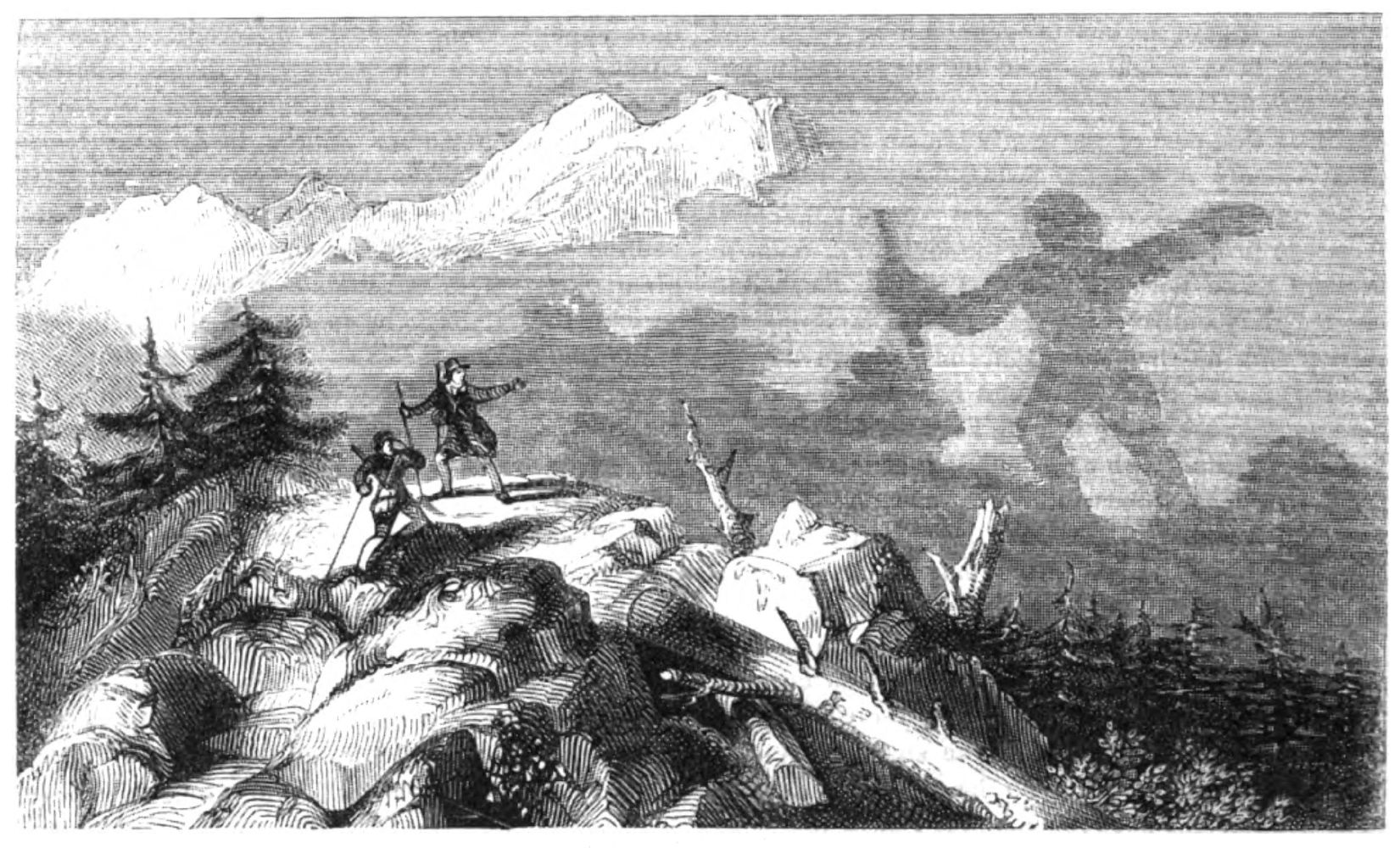
Spectre of the Brocken.
The peasantry in the neighborhood of the Harz Mountains formerly stood in no little awe of the gigantic spectre of the Brocken—the figure of a man observed to walk the clouds over the ridge at sunrise. This apparition has long been resolved into an exaggerated reflection, which makes the traveler’s shadow, pictured upon the clouds, appear a colossal figure of immense dimensions. A French savan, attended by a friend, went to watch this spectral shape, but for many mornings they traversed an opposite ridge in vain. At length, however, it was discovered, having also a companion, and both figures were found imitating all the motions of the philosopher and his friend. The ancient classical fable of Niobe on Mount Sipylus belongs to the same category of atmospheric deceptions; and the tales, common in mountainous countries, of troops of horse and armies marching and counter-marching in the air, have been only the reflection of horses pasturing upon an opposite height, or of the forms of travelers pursuing their journey. On the 19th of August, 1820, Mr. Menzies, a surgeon of Glasgow, and Mr. Macgregor began to ascend the mountain of Ben Lomond, about five o’clock in the afternoon. They had not proceeded far before they were overtaken by a smart shower; but as it appeared only to be partial, they continued their journey, and by the time they were half way up, the cloud passed away, and most delightful weather succeeded. Thin, transparent vapors, which appeared to have risen from Loch Lomond beneath, were occasionally seen floating before a gentle and refreshing breeze; in other respects, as far as the eye could trace, the sky was clear, and the atmosphere serene. They reached the summit about half-past seven o’clock, in time to see the sun sinking beneath the western hills. Its parting beams had gilded the mountain-tops with a warm glowing color; and the surface of the lake, gently rippling with the breeze, was tinged with a yellow lustre. While admiring the adjacent mountains, hills, and valleys, and the expanse of water beneath, interspersed with numerous wooded islands, the attention of one of the party was attracted by a cloud in the east, partly of a dark red color, apparently at the distance of two miles and a half, in which he distinctly observed two gigantic figures, standing, as it were, on a majestic pedestal. He immediately pointed out the phenomenon to his companion; and they distinctly perceived one of the gigantic figures, in imitation, strike the other on the shoulder, and point toward them. They then made their obeisance to the airy phantoms, which was instantly returned. They waved their hats and umbrellas, and the shadowy figures did the same. Like other travelers, they had carried with them a bottle of usquebaugh, and amused themselves in drinking to the figures, which was of course duly returned. In short, every movement which they made, they could observe distinctly repeated by the figures in the cloud. The appearance continued about a quarter of an hour. A gentle breeze from the north carried the cloud slowly away; the figures became less and less distinct, and at last vanished. North of the village of Comrie, in Perthshire, there is a bold hill called Dunmore, with a pillar of seventy or eighty feet in height built on its summit in memory of the late Lord Melville. At about eight o’clock of the evening of the 21st of August, of the year 1845, a perfect image of this well-known hill and obelisk, as exact as the shadow usually represents the substance, was distinctly observed projecting on the northern sky, at least two miles beyond the original, which, owing to an intervening eminence, was not itself at all in view from the station where the aerial picture was observed. The figure continued visible for about ten minutes after it was first seen, and was minutely examined by three individuals. One of these fancied that there was a projection at the base of the monument, as represented in the air, which was not in the original; but, upon examining the latter the next morning, the image was found to have been more faithful than his memory; for there stood the prototype of the projection, in the shape of a clump of trees, at the base of the real obelisk.
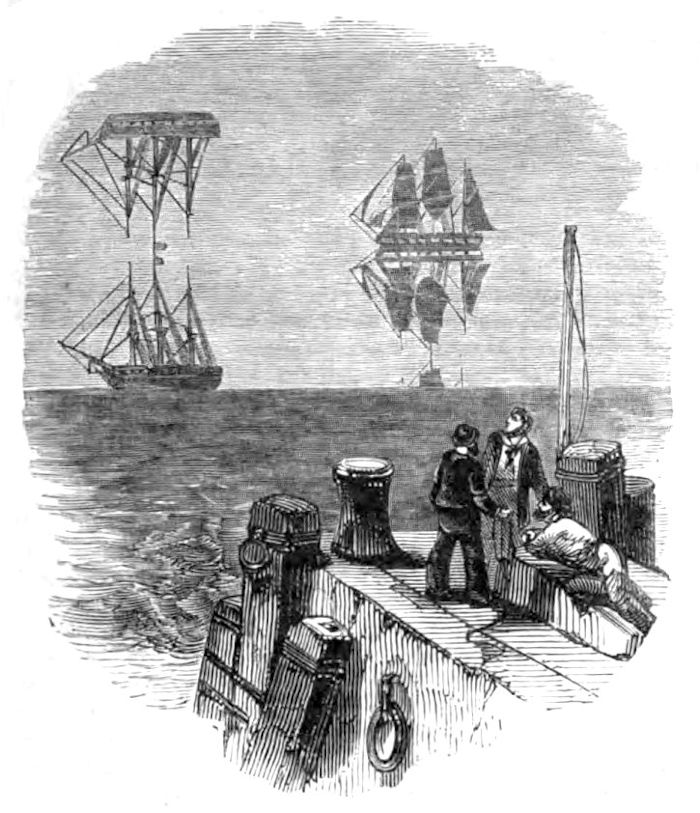
In northern latitudes the effects of atmospheric reflection and refraction are very familiar to the natives. By the term of uphillanger the Icelanders denote the elevation of distant objects, which is regarded as a presage of fine weather. Not only is there an increase in the vertical dimensions of the objects affected, so that low coasts frequently assume a bold and precipitous outline, the objects sunk below the horizon are brought into view, with their natural position changed and distorted. In 1818, Captain Scoresby relates that, when in the polar sea, his ship had been separated for some time from that of his father, which he had been looking out for with great anxiety. At length, one evening, to his astonishment, he beheld the vessel suspended in the air in an inverted position, with the most distinct and perfect representation. Sailing in the direction of this visionary appearance, he met with the real ship by this indication. It was found that the vessel had been thirty miles distant, and seventeen beyond the horizon, when her spectrum was thus elevated into the air by this extraordinary refraction. Sometimes two images of a vessel are seen, the one erect and the other inverted, with their topmasts or their hulls meeting, according as the inverted image is above or below the other. Dr. Wollaston has shown that the production of these images is owing to the refraction of the rays through media of different densities. Looking along a red-hot poker at a distant object, two images of it were seen, one erect and the other inverted, arising from the change produced by the heat in the density of the air. A singular instance of lateral mirage was noticed upon the Lake of Geneva by MM. Jurine and Soret, in the year 1818. A bark near Bellerire was seen approaching to the city by the left bank of the lake; and at the same time an image of the sails was observed above the water, which, instead of following the direction of the bark, separated from it, and appeared approaching by the right bank—the image moving from east to west, and the bark from north to south. When the image separated from the vessel, it was of the same dimensions as the bark; but it diminished as it receded from it, so as to be reduced to one-half when the appearance ceased. This was a striking example of refraction, operating in a lateral as well as a vertical direction.
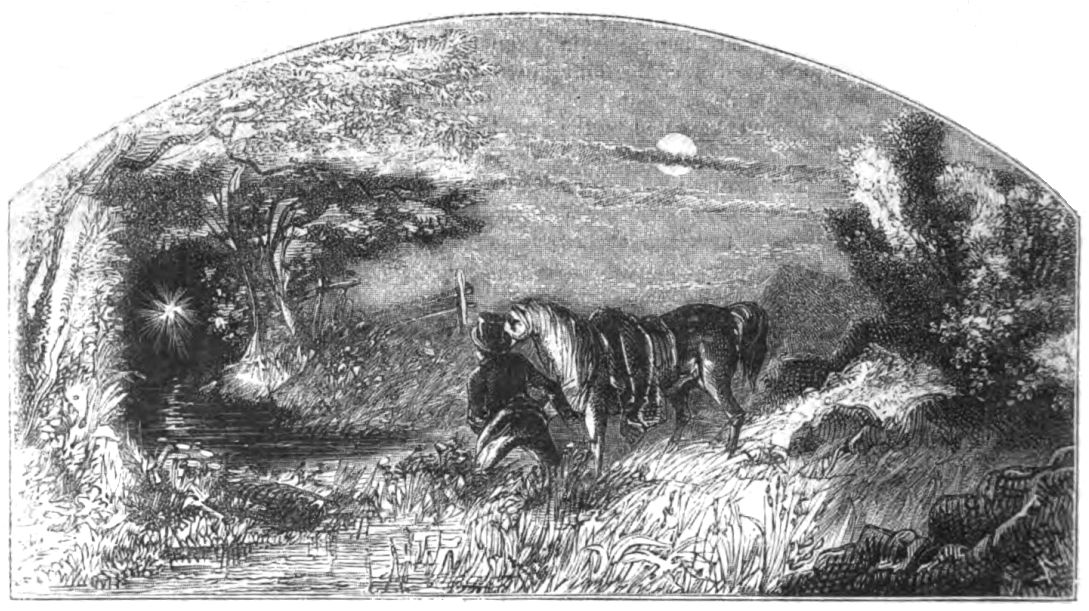
Ignis Fatuus. This wandering meteor known to the vulgar as the Will-o’-the-Wisp, has given rise to considerable speculation and controversy. Burying-grounds, fields of battle, low meadows, valleys, and marshes, are its ordinary haunts. By some eminent naturalists, particularly Willoughby and Ray, it has been maintained to be only the shining of a great number of the male glow-worms in England, and the pyraustæ in Italy, flying together—an opinion to which Mr. Kirby, the entomologist, inclines. The luminosities observed in several cases may have been due to this cause, but the true meteor of the marshes cannot thus be explained. The following instance is abridged from the Entomological Magazine:—“Two travelers proceeding across the moors between Hexham and Alston, were startled, about ten o’clock at night, by the sudden appearance of a light close to the road-side, about the size of the hand, and of a well-defined oval form. The place was very wet, and the peat-moss had been dug out, leaving what are locally termed ‘peat-pots,’ which soon fill with water, nourishing a number of confervæ, and the various species of sphagnum, which are converted into peat. During the process of decomposition these places give out large quantities of gas. The light was about three feet from the ground, hovering over the peat-pots, and it moved nearly parallel with the road for about fifty yards, when it vanished, probably from the failure of the gas. The manner in which it disappeared was similar to that of a candle being blown out.” We have the best account of it from Mr. Blesson, who examined it abroad with great care and diligence.
Ignis Fatuus.
“The first time,” he states, “I saw the ignis fatuus was in a valley in the forest of Gorbitz, in the New Mark. This valley cuts deeply in compact loam, and is marshy on its lower part. The water of the marsh is ferruginous, and covered with an iridescent crust. During the day bubbles of air were seen rising from it, and in the night blue flames were observed shooting from and playing over its surface. As I suspected that there was some connection between these flames and the bubbles of air, I marked during the day-time the place where the latter rose up most abundantly, and repaired thither during the night; to my great joy I actually observed bluish-purple flames, and did not hesitate to approach them. On reaching the spot they retired, and I pursued them in vain; all attempts to examine them closely were ineffectual. Some days of very rainy weather prevented further investigation, but afforded leisure for reflecting on their nature. I conjectured that the motion of the air, on my approaching the spot, forced forward the burning gas, and remarked that the flame burned darker when it was blown aside; hence I concluded that a continuous thin stream of inflammable air was formed by these bubbles, which, once inflamed, continued to burn, but which, owing to the paleness of the light of the flame, could not be observed during the day.”
The ignis fatuus of the church-yard and the battle-field arise from the phosphuretted hydrogen emitted by animal matter in a state of putrefaction, which always inflames upon contact with the oxygen of the atmosphere; and the flickering meteor of the marsh may be referred to the carburetted hydrogen, formed by the decomposition of vegetable matter in stagnant water, ignited by a discharge of the electric fluid.