THE ROWSEVILLERS.—No. II.
Reading edition
THE CAPTAIN’S COURTSHIP.
The cloth had just been removed, at my second dinner with the club, when the President called on a Mr. Rowley for a story. He tossed off a tumbler of Port—to clear the cobwebs, as he said, from his throat—and began.
“You all know I am a lawyer, and that men who would be witty have a way of quizzing our profession by saying that we cannot tell a story without dragging in our craft. I have no objection to the notion of these smart gentlemen, and shall not even trouble myself to refute them, but go on with my story.
“When I was a student, just after the close of the late war, I used to pay occasional visits to Mount Holly, which was even then a passable county town, and remarkable for its pretty girls, its gay winters, and the quantity of wine drunk by its bar. There wasn’t a lawyer in the place who couldn’t carry his two bottles, and as for wit, these barristers were famed for it from Cape May to Hackensack. But it is not so much with the Mount Holly bar as with Captain Slashbey, one of the clients of the wittiest member there, that my story has to do.
“I first met the gallant captain on a hunting excursion into the pines. He was a portly little gentleman, with a rubicund face, a constant flow of humor, and an opinion of his own good looks rather singular, I must say, at forty-five. He had very short legs and a very round person, and altogether reminded you of a fat pigeon walking upright. He had been in the service during the war, and at the reduction of the army, finding himself pretty well in debt, and without a sous in his pockets, had settled at Squankum, a place in the very heart of the cedar swamps. And very convenient it was for Slashbey, for, like Galway, in Ireland, a sheriff’s writ hadn’t been seen there in the memory of man. It was once attempted to execute a capias there, but the forgemen and squatters rose in a mass, and though the light horse were ordered out, the arrest had to be given up. Now the captain was a popular man in Squankum, and therefore was as safe as in a sanctuary. He thirsted now and then, it is true, for the good things of civilized life afar off, and would often make a dash into Mount Holly, like a guerilla, taking care, however, to retreat before his creditors had wind of his approach. But at length he grew tired of this life,—I’ll thank you for the bottle—and determined to extricate himself from it by marrying an heiress; for the captain was a gallant man, you must know, and, like Will Honeycombe, had a high notion of his own powers.
“There was a merry little vixen at the county town—a gay witty black-eyed rogue as ever lived—who was, in the captain’s opinion, the very pattern for a wife. She would have made an anchorite forswear his creed, and was besides an heiress to a very pretty fortune. Undaunted by the crowds of suitors for her hand, Slashbey determined to enter the lists, nothing doubting, on the faith of certain smiles with which she always welcomed him, that he would carry off the prize. He began his preparations like a Napoleon. He bought a new pair of buff cassimeres, endued a shining blue coat with metal buttons, and ordered a wig from the most fashionable perruquier in Philadelphia, for unluckily the captain was as bald as a cannon ball. Thus accoutred, he laid regular siege to his charmer, dancing her and sleighing her whenever he could venture out of his cedar swamps without being chased by a bailiff. The heiress smiled on the captain, her suitors cursed the lucky rival, and Slashbey spent his time betwixt studying his glass and singing ‘none but the brave deserve the fair.’
“It was just when he thought he was on the point of success that a grand ball was given at ——, and the captain, determining to carry his charmer by assault, forgot his usual prudence and escorted the heiress in his gig. Never did the little fellow look more gallant. I was at the ball, and faith! could scarcely keep my eyes off him. His wig was curled irresistibly, his new coat shone with resplendent lustre, his cassimeres fit him as a mould does a bullet, and he sported his new buff gloves with more vanity than a rider does his colors at a race. But, alas! his glory was destined soon to wane. One of his rivals, whose nose the captain had valorously pulled, determining on revenge, had informed the sheriff of Slashbey’s whereabouts, and just as he was leading his charmer triumphantly to the dance, the myrmidons of justice pounced on him, and after a desperate struggle he was secured, on the charge of an assault and battery. But this was not the worst. Before the court opened the next day, a dozen writs in civil suits had been lodged against his body. The captain was beside himself. He trembled at the exposé of his affairs—he trembled for his heiress.
“ ‘We could laugh this battery out of court,’ he said; ‘but what the devil can I do with these creditors? I’m a ruined man. And to come just now, the infernal rascals! Oh, Anna Matilda!’ he exclaimed with a love-lorn look of his crow-feet eyes, ‘it’s all up with you and your fortune now. What would the fellows of the tenth say if they heard of it?’
“ ‘Cheer up,’ said his attorney laughingly; ‘your case will come up among the first, and we may yet find a way to get you off. It’s all the result of envy. These young boys can’t endure that Mars and Apollo should meet together in your person,’ and the barrister winked wickedly to me, as Slashbey, marshalled by the sheriff, preceded us into the hall of justice.
“It was with a rueful countenance that he took his seat in the court. The room was densely filled with the usual motley assemblage at a county sessions. Loafers half in rags, and shopmen in the latest cut, portly farmers with huge mud-stained boots, and drovers carrying heavy loaded whips, here a sober Quaker with a broad-rimmed beaver, and there a gay young lawyer with more wit than briefs, long men and short men, fat ones and lean ones, some with merry round faces, and others with countenances as sour as crab-apples, officers and loungers, attorneys and clients, filled up every vacant space outside the bar, whiling away the time until the appearance of the judge, by speculating on the prospects of a crop, or discussing the points of a case set down for trial at the term. At length his honor made his appearance, and, bustling and bowing through the crowd, assumed the bench, wiped the perspiration from his rubicund face, coughed with judicial gravity, and ordered the crier to open the court. That high functionary accordingly started to his feet, and in a nasal twang mumbled over a formula which no one could hear distinctly, but which appeared to be a recapitulation of the iniquities of those in authority generally, and of his honor in particular, as it ended with a hope that God would save the commonwealth and the honorable court. After the crier sat down, a very lean man, with a very sharp nose, and a very squeaking voice, called out ‘John Smith,’ whereupon a little fat man jumped up and said ‘here;’ but the clerk, without seeming to notice him, went on and called Joseph Thomson, Zerubabel Thomson, Joab Johnson, and the Lord knows how many more Thomsons and Johnsons, all of whom severally jumped up and said ‘here.’ Then, the jury being empannelled, the case came on, and the attorneys got into towering passions, and seemed as if they could have eaten each other up, while the jury smiled and nodded, and their foreman—the little fat man—stroked his chin and looked extremely wise. After this was gone through with, there was a general buzz through the room, when suddenly the judge cried ‘order,’ and then the sheriff cried ‘order,’ and the sleepy constables and tipstaves opened their eyes and echoed ‘order’ more lustily than either; whereupon his honor turned over one or two big books bound in white calf,—ah! this is prime Port—consulted his notes for a moment, and then proceeded to sum up the evidence and charge the jury.
“The next case was that of Slashbey—and the same formality was gone through with until about half of the jury had been sworn, when the attorney-general rose to acquaint the court that the panel was exhausted and that therefore he prayed a tales from the lookers on. These few and simple words of the attorney-general acted on the spectators like the upsetting of a crowded bee-hive. Instantly there was a great rush towards the door. Drovers and farmers, shopmen and gentlemen, staid Quakers and burly topers, all started in the race at once, tumbling and scrambling over each other in their haste to reach the entrance, while the tipstaves shouted ‘order’ until they were hoarse, and the sheriff and his deputies sprang to the door in order to close it before the egress of their prey. It was a moment of general confusion, and Slashbey was forgotten in the mêlée. Even the judge had eyes only for the scrambling fugitives.
“ ‘Now,’ said I, nudging Slashbey, who sat by me not far from the casement; ‘now’s your time—clear the window at a leap—my horse Thunderer is fastened not twenty yards off—ride like the devil, and don’t draw rein till you get to Squankum.’
“Slashbey understood my plan as readily and rapidly as I had conceived it, and, just waiting to see that the coast was clear, he placed his hands on the sill, and, portly as he was, shot through the open window like a bomb, unseen by all except his honor, who caught sight of the fugitive’s coat tails as they disappeared outside.
“ ‘An escape!’ shouted the judge, starting to his feet; ‘sheriff, your prisoner. The captain’s off.’
“On the instant the talesmen were forgotten, and sheriff, deputies, tipstaves and freeholders turned around, with open mouths and curious eyes. It was a minute or more before the matter could be explained, and by that time I saw that Slashbey had got mounted. I shouted ‘stop thief’ at this, and sprang out of the window, as if in pursuit, followed by the sheriff and his constables, tumbling helter-skelter over each other after me. The officers no sooner caught sight of the fugitive than they roared lustily to stop him, while the sheriff bawled for the ‘posse comitatus’ like a bull of Bashan. It was no time to respect property, so I followed the example of the officers, and sprang on the first steed I came across, eager to see the fun.
“The court house stood nearly at the opposite end of the village, from that out of which led the road to Squankum, and when I mounted my horse, Slashbey was scouring down the main street some hundred yards ahead. Before a minute, however, the sheriff and his pack were in full cry at the fugitive’s heels, while as many of the spectators as could find horses and vehicles started off, a few to aid the law, but most to enjoy the sport. And, by my faith! what a sight it was! Foremost in the chase gallopped the sheriff, his hat off and his queue flying behind, bawling himself red in the face by cries of ‘stop thief,’ ‘head him off,’ ‘maintain the laws,’ amid the laughter of some and the shouts of others of the crowd. At every few leaps Slashbey would turn his face ruefully around to see whether his pursuers gained on him or not—reminding one of Tam O’Shanter, of blissful memory, when he saw the witches yelling after him. The captain would never have won the prize at Astley’s for horsemanship, and now, what betwixt his hurry and affright, he rode like a frightened monkey at a circus. Gilpin did not create more excitement in his famous race. The shopmen left their counters, the blacksmith hurried from his forge, the school children followed the pedagogue to the window, and the very chanticleers, unwilling to let the hubbub go by without they partook in it, flapped their wings on the garden fences and crowed lustily. But with your leave, I’ll pause to fill my glass, for a man telling a story is like a steam-engine—he can’t get on without he keeps the fire blazing.
“The race was now at its height. The uproar was tremendous. Up flew the windows, and out popped the heads. The women shrieked, the pigs squealed, the men laughed, the boys cheered, and a dozen curs hurried yelping and snapping at Thunderer’s heels, who, alarmed at the hue and cry around him, pricked up his ears, snorted, and fairly taking the bit in his teeth, went off at a frantic pace. You would have died with laughter had you seen Slashbey then. Holding on to the rein with one hand, he grasped the mane desperately with the other, and, sticking his feet up to the heels in the stirrup, he leaned forward until he lay almost prostrate on the horse’s neck, while the tails of his coat flying up behind disclosed the fair rotundity beneath, over which his shining new buff cassimeres were stretched as tight as a drum-head. At every leap he bounced three feet from the saddle. The shouts of the posse in his rear increased, while the captain’s rueful looks behind became more frequent. Some cried ‘murder,’ others bawled ‘stop thief.’ The perspiration poured down the captain’s cheeks. He gasped for breath. And, to crown all, as he got opposite his charmer’s dwelling, a puff of wind swept off his wig—for his hat had been left in the court house in his hurry—and the envied locks sailing away to the rear amid convulsive shouts of laughter on the part of the crowd, betrayed the bald pate of Slashbey glistening like burnished silver in the sun.
“ ‘Go it, fat ’un, and never mind the scratch,’ roared a ragged spectator, who was fairly dancing with delight.
“ ‘Hip—ho—heave ahead there,’ shouted another, shieing a missile at the fugitive.
“ ‘Whow—whow—whoa,’ halloed others, running out in front of Thunderer and waving their arms and hats before his eyes, but scampering hither and thither as soon as the frightened steed drew near.
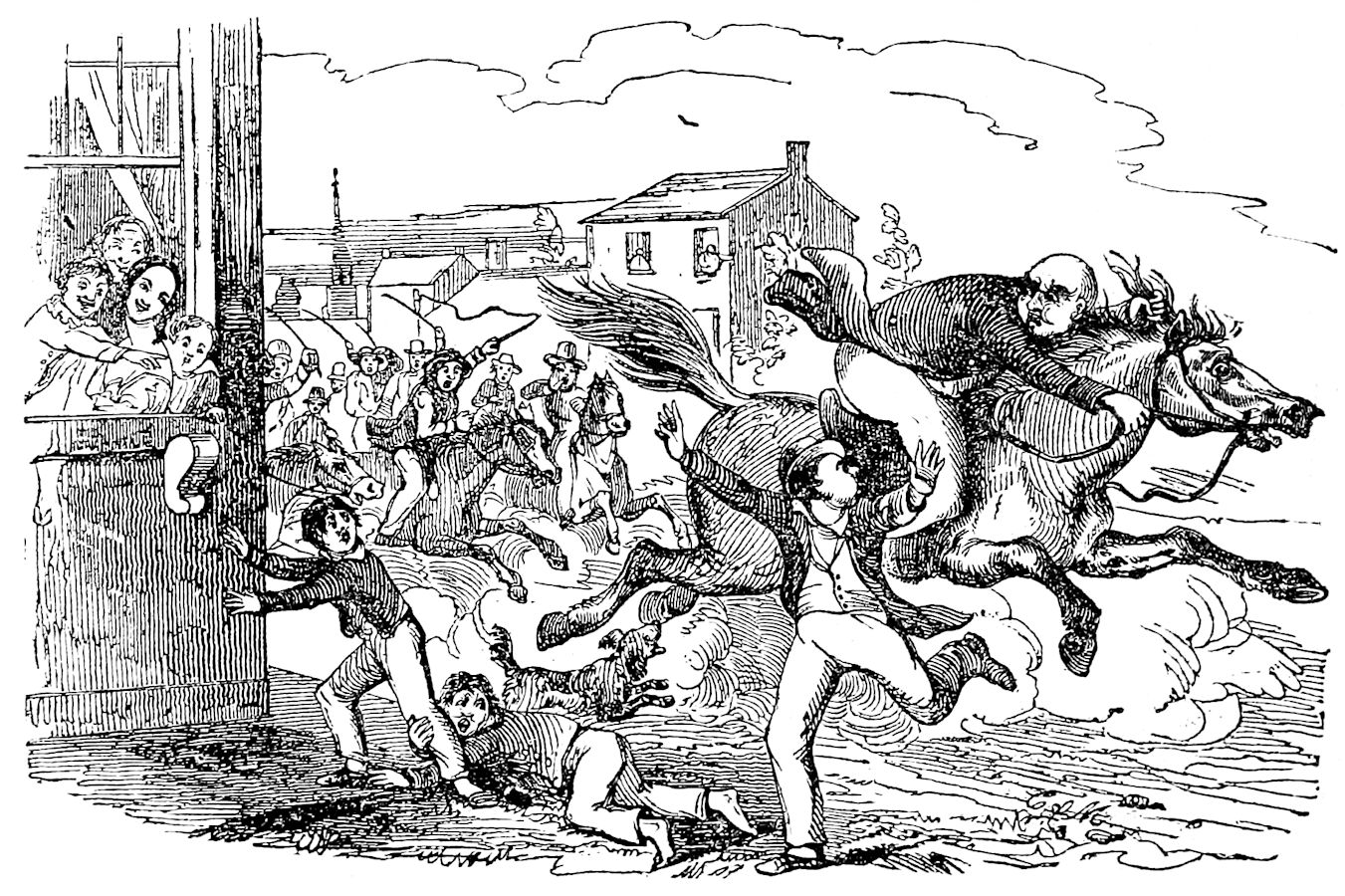
“The captain felt his heart sink within him at this accumulation of disasters, and he could scarcely summon courage to look up, but he made a desperate effort, and—oh! shades of the gallant tenth—there was his mistress at the window pointing to his glossy pate, and laughing until the tears ran out of her eyes.
“The captain felt that his last hope was gone, and in a moment of despair would have reined in his horse, but Thunderer took the matter in his own hands and kept on at a thrashing pace, amid the shouts and pelting of the crowd. He dashed down the cross-street, clattered over the bridge, and in a few minutes crossed the brow of the neighboring hill in a cloud of dust. The motley group in pursuit kept on, but when Thunderer’s mettle was up there wasn’t his match in the whole county, so that before long, one after another of the posse drew in, leaving only the sheriff and his deputies in pursuit. These, too, gave out before they reached the vicinity of the enchanted land, in other words, the cedar swamps this side of Squankum.
“The joke clove to the captain’s name closer than a brother. The little vixen of an heiress had all along been coquetting with “the gallant warrior,” and now she was the loudest among the laughers at her wigless beau. She filled up Slashbey’s cup of sorrow by marrying, shortly after, the gallant whose nose the captain had pulled.
“What branch of the service,” asked a spooney lieutenant from the bottom of the table, after the laughter had somewhat subsided, “did you say your friend belonged to?”
“I didn’t particularize,” coolly said the narrator, “but I believe it was the flying artillery.”