Act 2 — Holly and Mistletoe Drill. By Imogen A. Storey.
Reading edition
An even number of small boys of uniform height must be used for this drill. Usually it will be found necessary for the Juniors to call in the aid of children outside the society, which will furnish a fine opportunity to win new members.
At the rear of the stage a small hut should be constructed of light framework, and covered with heavy brown paper. The roof and window-sills of this must be spread with cotton to represent snow.
On the floor of the stage a heavy white cloth should be stretched, and in the rear and at the sides boughs of evergreens covered with cotton should be arranged to represent the woods.
The floor of the stage must be laid off as shown by diagrams to prevent mistakes. Half of the children must be dressed in fairylike suits of white, carrying a half-hoop trimmed with mistletoe and white satin ribbons, the ribbons tied at each end of the hoop. The others must be costumed in like manner, only in red, having hoops trimmed in holly and red ribbons. All must wear green gauze wings.
When the drill begins, old Santa and his wife should be seen busy in their little house, fixing toys. If presents are to be distributed, they must be placed in the hut previous to the beginning of the exercise. The children enter skipping to music, following the lines shown in Diagram A, mistletoes on the right and hollies on the left, or the reverse.
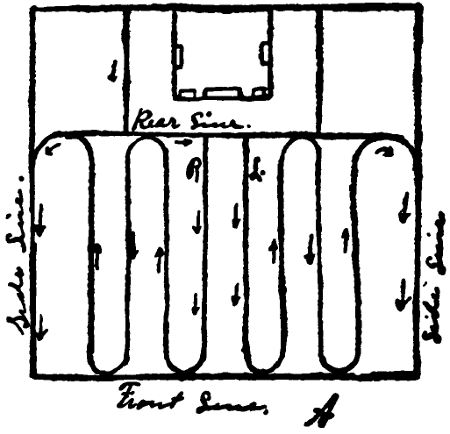
Diagram A.
They skip, following lines as indicated by arrows in A, with arms in upward bend position and hoops arched overhead. When the leaders reach lines R and L, the skip step is changed to a march, and they join hoops with partners so as to make a complete hoop with bows at each side. This is a very easy movement, though it may seem the contrary. Those on the right extend the inside arm straight to the side, shoulder-high, holding the end of hoop with the arch down. Those on the left extend their arms in the same way with the arch up. Each child grasps the end of the partner’s hoop with his own in the inside hand.
On the leader’s reaching the front line the first position of the hoops is resumed by all with skip step. When the side lines are reached, they turn on the diagonal lines and begin a fancy step, dropping the hoop down around the neck like a boa. On a change of music drop the hoop, and advance the inside foot diagonally to inside (towards partner), and place it on the floor, first count; hop on the advance foot, and swing the outside leg across in front, bending the knee so that the foot which is crossed over comes almost as high as the knee of the inside leg, second count; swing the same foot diagonally forward to the outside again, and place it on the floor, third count; hop on it, and swing the inside leg across in front of the outside, fourth count. This step is called “swing-cross step,” which somewhat explains the movement. On the leaders’ reaching the front line the skip step with first position of hoop is resumed by all. On reaching the side lines again, instead of coming down diagonal lines as before, they turn on the rear lines as shown in B, and come down the lines R and L in C, with the following fancy step:
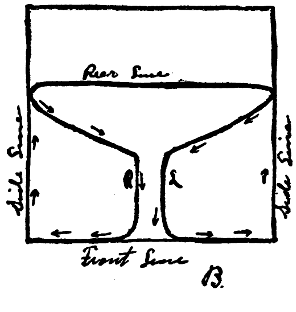
Diagram B.
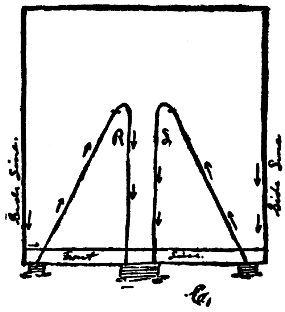
Diagram C.
Advance the inside foot, and touch the toe to the floor, and the inside arm straight to the side and the outside hand on the chest, the arch of the hoop up, first count; change the weight to the forward foot, the hoop arched overhead the same as in skipping, second count; repeat the same to the opposite side, third and fourth counts. Continue this until the front line is reached. Then resume the skip step, and follow lines as before in A.
When they reach the side lines, old Santa steps to the front door of his hut, and blows a whistle or horn, and the skip step is changed to a run on the toes. The players run down the side lines, and turn on the lines shown in C leading to the hut. When the leaders reach the cross marks on these lines, a signal from the piano or another blast from old Santa’s horn is given for them to halt, which should be executed by them together. After they have halted, old Santa steps down from his door, and gives another blast, and all should turn facing inside; that is, towards lines R and L. Old Santa should walk up and down inspecting them.
Old Santa, in deep tones: “I have decided to engage you, Mistletoe and Holly Berry fairies, to do some work for me this beautiful Christmas night, for I am getting old and lame. Can I depend on you?”
Fairies all together: “Yes, sir.”
Old Santa: “I want you to take each child in this audience a gift from me and my wife. Will you do it?”
“Yes, sir; indeed we will,” should come in loud, emphatic tones from the little fairies. Santa should go back to the door of his little hut and receive the gifts from Mrs. Santa Claus, who hands them out to him. Santa must call out the names as he gives them to the fairies, as they file past on lines shown in C, turning on lines R and L, thence down the steps in the centre. After distributing the gifts they return for more by side steps as shown in C. In this way the presents, even for a large audience, can be easily disposed of.