CLIMATE, AGRICULTURE AND HEALTH.
Reading edition
The Weather Bureau has made public a statement in regard to the climate of Alaska, which says: "The climates of the coast and the interior of Alaska are unlike in many respects, and the differences are intensified in this as perhaps in few other countries by exceptional physical conditions. The fringe of islands that separates the mainland from the Pacific Ocean from Dixon Sound north, and also a strip of the mainland for possibly twenty miles back from the sea, following the sweep of the coast as it curves to the northwestward to the western extremity of Alaska form a distinct climatic division which may be termed temperate Alaska. The temperature rarely falls to zero; winter does not set in until Dec. 1, and by the last of May the snow has disappeared except on the mountains.
"The mean winter temperature of Sitka is 32.5, but little less than that of Washington, D. C. The rainfall of temperate Alaska is notorious the world over, not only as regards the quantity, but also as to the manner of its falling, viz.: in long and incessant rains and drizzles. Cloud and fog naturally abound, there being on an average but sixty-six clear days in the year.
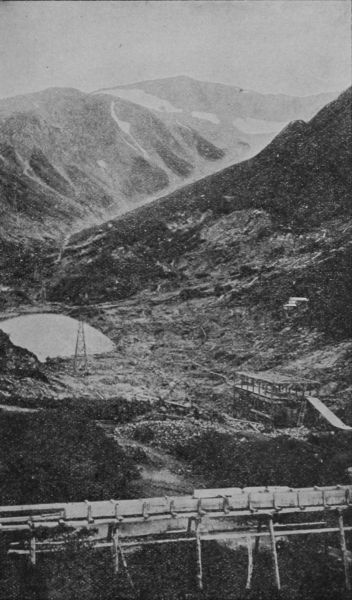
GENERAL VIEW OF SILVER BOW BASIN, NEAR JUNEAU.
"North of the Aleutian Islands the coast climate becomes more rigorous in winter, but in summer the difference is much less marked.
"The climate of the interior is one of extreme rigor in winter, with a brief but relatively hot summer, especially when the sky is free from cloud.
"In the Klondike region in midwinter the sun rises from 9:30 to 10 a. m., and sets from 2 to 3 p. m., the total length of daylight being about four hours. Remembering that the sun rises but a few degrees above the horizon and that it is wholly obscured on a great many days, the character of the winter months may easily be imagined.
"We are indebted to the United States coast and geodetic survey for a series of six months' observations on the Yukon, not far from the site of the present gold discoveries. The observations were made with standard instruments, and are wholly reliable. The mean temperatures of the months October, 1889, to April, 1890, both inclusive, are as follows: October, 33 degrees; November, 8 degrees; December, 11 degrees, below zero; January, 17 below zero; February, 15 below zero; March, 6 above; April 20 above. The daily mean temperature fell and remained below the freezing point (32 degrees) from Nov. 4, 1889, to April 21, 1890, thus giving 168 days as the length of the closed season of 1889-'90, assuming that outdoor operations are controlled by temperature only. The lowest temperatures registered during the winter were: Thirty-two degrees below zero in November, 47 below in December, 59 below in January, 55 below in February, 45 below in March, and 26 below in April.
"The greatest continuous cold occurred in February, 1890, when the daily mean for five consecutive days was 47 degrees below zero.
"Greater cold than that here noted has been experienced in the United States for a very short time, but never has it continued so very cold for so long a time as in the interior of Alaska. The winter sets in as early as September, when snow-storms may be expected in the mountains and passes. Headway during one of those storms is impossible, and the traveler who is overtaken by one of them is indeed fortunate if he escapes with his life. Snowstorms of great severity may occur in any month from September to May, inclusive.
"The changes of temperature from winter to summer are rapid, owing to the great increase in the length of the day. In May the sun rises at about 3 a. m. and sets about 9 p. m. In June it rises about half past 1 in the morning, and sets at about half past 10, giving about twenty hours of daylight and diffuse twilight the remainder of the time.
"The mean summer temperature in the interior doubtless ranges between 60 and 70 degrees, according to elevation, being highest in the middle and lower Yukon valleys."
Accurate data of the temperature in the Klondike district were kept at Fort Constantine last year. The temperature first touched zero Nov. 10, and the zero weather recorded in the spring was on April 29.
Between Dec. 19 and Feb. 6 it never rose above zero. The lowest actual point, 65 below, occurred on Jan. 27, and on twenty-four days during the winter the temperature was below 50.
On March 12 it first rose above the freezing point, but no continuous mild weather occurred until May 4, after which date the temperature during the balance of the month frequently rose above 60 degrees.
The Yukon River froze up on Oct. 28 and broke up on May 17.
The long and severe winter and the frozen moss-covered ground are serious obstacles to agriculture and stock raising. The former can change but little with coming seasons, but the latter, by gradually burning off areas, can be overcome to some extent. On such burned tracts hardy vegetables have been and may be raised, and the area open to such use is considerable. Potatoes do well and barley will mature a fair crop.
Live stock may be kept by providing an abundance of shelter and feed and housing them during the winter. In summer an abundance of the finest grass pasture can be had, and great quantities of natural hay can be cut in various places.
Diseases: In spite of all that is heard in the newspapers regarding the healthfulness of the climate of Alaska and the upper Yukon, the Census Report of Alaska offers its incontestable statistics to the effect that the country is not more salubrious, nor its people more healthy than could be expected in a region of violent climate, where the most ordinary laws of health remain almost totally ignored. From the Government Report we quote the following:
"Those diseases which are most fatal to life in one section of Alaska seem to be applicable to all others. In the first place, the native children receive little or no care, and for the first few years of their lives are more often naked than clothed, at all seasons of the year. Consumption is the simple and comprehensive title for the disease which destroys the greater number of the people of Alaska. Aluet, Indian and Eskimo suffer from it alike; and all alike exhibit the same stolid indifference to its slow and fatal progress, make no attempt to ward it off, take no special precautions even when the disease reaches its climax.
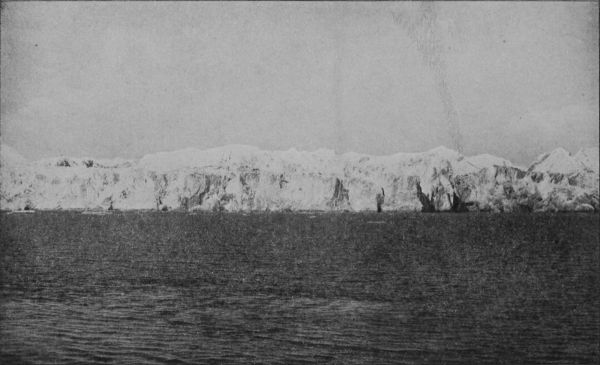
MUIR GLACIER (MIDDLE PORTION).
Next to consumption, the scrofulous diseases, in the forms of ulcers, eat into the vitals and destroy them until the natives have the appearance of lepers to unaccustomed eyes. As a consequence of their neglect and the exigencies of the native life, forty or fifty years is counted among them as comparatively great age, and none are without the ophthalmic diseases necessarily attendant on existence in smoky barabaras. Against snow-blindness the Eskimo people use peculiar goggles, but by far the greater evil, the smoke poisoning of the opthalmic nerve is neither overcome nor prevented by any of them. All traders carry medicine chests and do what they can to relieve suffering, but it requires a great deal of medicine to make an impression on the native constitution, doses being about four times what would suffice an Englishman or American.