MAPS (continued 4)
Reading edition
"We don't want the room for a week. We'll take it for a night, though. We're on our way to the mines," said Mr. Adams.
"So is everybody else," sharply answered the clerk. "For one night the room is five dollars apiece, and I'll be losing money at that."
"All right. We've got a trunk out in front. Have it sent up, please."
"Can't do it, sir. Every man is his own porter, in this town. The stairs are fairly wide. I'll show you up."
The Mexicans had dropped the trunk on the long porch, and refused to carry it another inch. And when they were to be paid off, they insisted that the two dollars meant two dollars apiece! Bystanders gravely agreed that this was the correct price.
"Whew!" sighed Mr. Adams, with a quizzical smile, after he had paid. "No wonder that twenty dollars a day is small wages, out here. What an enormous amount of money there must be in circulation! Grab an end, Charley. Come along, Grigsby. Let's inspect our quarters."
XV
THE SIGHTS OF SAN FRANCISCO
Charley took one end of the trunk, his father the other, and piloted by the hotel man, with Mr. Grigsby, lugging the hand baggage, in their wake, they climbed two flimsy flights of stairs to the third floor! The hotel man led the way down a narrow hall of rough boards, and flung open a door.
"Here's your room," he announced, shortly. "Don't ask for what you don't see. We haven't got it. You're lucky, gentlemen, not to be obliged to sleep in a tent—and San Francisco nights are cold. Five dollars each, please."
"Certainly," said Mr. Adams; and he and Mr. Grigsby settled for the party.
"Well," remarked Mr. Grigsby, when the hotel man alertly left, "I've been in worse quarters."
"Don't bump your head," warned Mr. Adams.
It was a dormer room. The ceiling, of bare rafters, sloped sharply. The walls also were bare, made of unsurfaced boards, warped and cracked. There were two "beds": one a low bunk, home-made and solid but not pretty, the other a wobbly canvas cot. Each had a pair of gray blankets as bedclothes. There were a couple of rickety chairs, a home-made table bearing a wash pitcher and a tin basin, with a towel hanging from a nail over it, beside a cracked looking-glass, and in the end of the room a small window dulled by dust. Charley tried to look out through the window, but could dimly see only the tops of the roofs, across. From below, and from the city around, floated in through the thin floors and walls a medley of voices and bustle.
"Guess we'd better unpack some of our stuff, and sort what washing we want done," quoth his father, cheerily. "When we take it out we can look about and get what other supplies we need; eh, Grigsby? What are your plans?"
"Same as yours, if you say so," answered the Frémonter.
"You mean to say you'll go along with Charley and me?"
"Why, yes. This town's too crowded for me, already. Doesn't strike me as a very healthy place to loaf in. Money, money; that's all I've heard. So I'm off for the diggin's, like the rest."
"Good. Shake," approved Mr. Adams, and Charley felt delighted. The Frémonter was such a fine man; a loyal friend in need. "We'll stick together as long as you can stand our company."
"Agreed," quoth Mr. Grigsby, shaking. "There'll be room enough in the hills for us to spread out, if we want to."
They overhauled their baggage and wrapped their wash in some old newspapers that had been stuffed into the trunk. Then they sallied forth.
"Pshaw! There's no lock on the door," exclaimed Charley's father. "I hate to leave all our stuff scattered around, in that fashion."
"It'll be all right, I reckon," said Mr. Grigsby. "Ask the clerk about it."
"The door to our room has no lock," spoke Mr. Adams, to the hotel man, when they had tramped below. "We've got quite a bunch of goods lying open."
"That's all right, sir," answered the clerk. "They'll not be touched. Not a door in this hotel has a lock. Thieves are given short shift in San Francisco, and they know it. You can leave a bucket of gold out in the street and it'll all be there when you want it again."
"Beg your pardon, gentlemen," spoke a voice near at hand, "but I see you're carrying a newspaper or two. Would you sell them?"
He was a brusque, bearded man, in miner costume, but he spoke like a person of education.
"I'll give you a dollar apiece," cried another man, hurrying forward; and almost immediately the three in the Adams party were surrounded by a crowd.
"Wait a minute," bade the first man. "I was here first. I'll give you a dollar apiece."
Charley gasped. Were they crazy?
"But, gentlemen, these are only some old papers we happened to have as fillers," protested Mr. Adams, as much astonished as Charley.
"How many have you got?" demanded the second speaker.
"Probably a dozen."
"Where from?"
"St. Louis; two or three from New York, maybe."
"I'll give you eight dollars for the lot."
"Give you nine," bid somebody else.
"But they're six weeks old, gentlemen," informed Mr. Adams.
"Only six weeks old?" queried the first man. "I'll give you ten dollars for a dozen! And here's your money." He held out a ten-dollar gold piece.
"Go up and get the other papers, Charley," directed Mr. Adams. "If these men are crazy it isn't our fault. When you see the papers, if you don't want them you needn't take them, sir," he said to the man.
"I'll take them," laughed the man, grimly. "Papers only six weeks old? Why, stranger, that's fresh news out here. You can sell a thousand at a dollar apiece."
"Wish I had them, then," remarked Mr. Adams. And Charley scuttled away. He brought back all the crumpled papers that he could find. They sold every one—the first lot at ten dollars for a dozen, and the three more, in which the washing was wrapped, at dollar apiece on delivery later!
"This will pay for our washing, at least," commented Mr. Adams. "Is there a laundry near here?" he asked, of the clerk.
"Right around the corner."
"Thank you."
They went out—Charley sighing as he thought of the big stack of old newspapers, back home. Why, they might have brought out a hundred more! What a queer town this was, where people would pay a dollar apiece for old papers! He resolved to write to his mother the first thing, and tell her when she came out to bring every old paper she could find.
The air was much chillier than when they had arrived. A strong, gusty wind was blowing, carrying clouds of dust, and because of this, and a raw fog, the sunshine had waned from gold to gray. Nevertheless, something in the atmosphere made them all step out briskly.
Around the corner of the plaza a torn canvas sign before a dingy tent-house said: "Washing Done." And in through the open door they filed. A short, stout Frenchman, apparently, stood behind the board counter, and bowed at their approach. He wore a little black spike or goatee, and his face fairly shone above a collarless shirt. From a room behind sounded vigorous scrubbing and rinsing.
"You do washing?" demanded Mr. Adams.
"Oui, m'sieur."
"Here's some. When can we get it?"
"To-morrow morning, at the ten o'clock. And does m'sieur wish ze repassage—what you call ir-ron?"
"What's the charge?" asked Mr. Grigsby.
"Seex dollair the dozen, m'sieur, for ze wash; the same for ze ir-ron."
"There goes your newspaper money, Adams," laughed the Frémonter. "I think I'll do my own washing, after this."
"We have to live, my wife and I, messieurs," explained the Frenchman, spreading his hands. "In France we live on ze very little. In New York we have one très bon café, and we charge ze very little. But out here——" and he shrugged his shoulders. "We wash, and for zis meesairable caban—what you call it? hut—we pay ze price of 500 dollair ze month."
"Wash what we've brought, but don't you dare to iron them; eh, Grigsby?" said Mr. Adams.
"Ze rough wash it shall be, messieurs," bowed the stout Frenchman.
"On the trap trail we washed twice a year—spring and fall," commented Mr. Grigsby, as they trudged out. "That's plenty often enough here, too, the way prices run."
"Look at the crowd!" exclaimed Mr. Adams, as they emerged at the corner; for part way up a hilly street a great throng had gathered in front of a low building, and a constant stream of other people were hastening that way. "What's the matter up there?" he inquired, of a passerby.
The man scarcely paused. He only turned his head, to drawl:
"Post-office, mister, and the mail's come in."
"That must be the mail we brought," cried Charley.
"If you came on the California, you brought it, sonny," informed another stranger.
"When's the office open, sir?" inquired Mr. Adams.
"Whenever the mail's distributed, of course," replied the man. "I hear the California fetched about 25,000 pieces, in all languages from American to Chinese. The postmaster and two assistants have been working all night and they'll probably work all day and another night."
"Well, we don't expect anything this time; do you, Grigsby?"
The Frémonter shook his head.
"Nor do I," volunteered the strange man. "But I've a partner up there who's been expecting a letter for six months. See those lines of hopefuls? By noon they'll be extended two blocks. The first in line must have got there as soon as the ship was sighted, last evening. I've known men to wait in line for a week, and have their meals brought to them. And then as like as not they didn't get their letter."
"I was thinking that we'd get what few supplies we need," said Mr. Adams, as they resumed their way, "and start out for the diggin's in the morning. There'll be some way of getting up there, I suppose."
"Yes, by boat, horse or foot," answered the Frémonter. "I don't reckon we want to buy any horses, and it's a long trail afoot. I'll see about a boat if you'll lay in what supplies you think we'll need."
"All right. Sugar, salt, flour, bacon and potatoes will be enough, won't it?"
"Plenty. I'll meet you at the hotel at noon. Adios."
"Adios," replied Mr. Adams and Charley; and the tall Frémonter strode away.
The throng at the post-office seemed to have no effect on the rest of the down-town, for the streets were as crowded as before with hurrying people, mostly men. New Yorkers, Arkansans, Illinoisans, Britishers, Germans, Frenchmen, Swedes, Mexicans, Malays with long curved knives, the queer Chinamen, and some swarthy persons, in brown ponchos (or cloaks with a hole in the middle for the head), who his father said were Peruvians and Chilians—all these passed hither-thither, only pausing to bargain with each other or at the shops, until Charley's brain whirled at the many odd sights. There were a few women, but none who looked to him anything like his mother.
Across the plaza his father espied a new sign, in front of a shop built of boxes. It said: "Potatoes for Sale. Just Received."
"That's what we want, Charley," he spoke; and for the place they made. The potatoes were in open sacks, just inside the door—and that was the shop's whole stock of goods.
"How much are your potatoes, my man?" asked Mr. Adams. "They look pretty good."
"One dollar and a half. Yes, sir; they are good ones; came in only this morning."
"Let me have a bushel, then, at a dollar and a half," bade Mr. Adams, with satisfaction. "That's not an unreasonable price, is it, Charley!"
"We don't sell by the bushel; I quoted you the price by the pound," explained the potato merchant.
"What!" gasped Charley's father, again astounded. "You don't mean a dollar and a half a pound?"
"You bet," smiled the merchant. "And going like hot cakes at that. I'll not have a potato left, by night."
"Come on, Charley," laughed Mr. Adams. "We'll wait and grow our own potatoes."
"I'll take all you can grow at your own price," challenged the merchant, after them, as if growing potatoes out here in California was impossible.
Suddenly a score of voices yelled: "Look out! Look out!" The crowd jostling and bartering in the plaza parted and rushed to one side and another, and people plunged headlong into the store doors. Mr. Adams grabbed Charley by the arm and dragged him in the nearest doorway, too. Amidst wild shouts and a cloud of dust, into the plaza charged a lean red bull, with curving sharp horns and frothing mouth; close at his heels pursued, on dead run, a horseman in Mexican costume, swinging his riata, or noosed rawhide. The bull dodged—bolted right over a stand where cakes were on sale—and over the stand sped the horseman, too. His noose shot forward—it fell exactly over the bull's wide horns, and to one side veered the quick horse. He braced as the rawhide tautened; it snapped tight, and head down, heels up, the bull capsized in a twinkling. The fiery horse held hard, bracing with his legs, while the Californian sat straight and easy. As the bull struggled, with a shrill whoop another rider like the first raced in, threw at full speed, and noosed the bull by the two hind legs. With wave of hand and flash of teeth the vaqueros, or cowboys, rode away, dragging the bull through the plaza and out. The plaza filled up again, the shops resumed business, and nobody appeared to be annoyed. Even the cake seller gathered his cakes and joined in the laughter while several persons helped him set up his booth again. Truly, this San Francisco was a light-hearted, generous place.
"I should think that a man would make surer money farming than digging for gold," declared Mr. Adams, after he and Charley had noted eggs priced at twelve dollars a dozen, squashes at a dollar a pound, and some cabbages at two dollars apiece! "Hello; there's Lieutenant Sherman." For a spruce military figure was briskly crossing this plaza of Portsmouth Square.
Lieutenant Sherman saw them, as he approached and smiled.
"Not off to the mines yet?" he greeted.
"Not yet. I was just saying to Charley that farming looked better to me than mining, in this country, judging by prices of common produce."
"It's all shipped in," stated the lieutenant, in his quick voice. "Nobody now has any time for farming; and before this excitement everybody had too much time. The Californians lived on beef, tortillas and beans, all of which was easy. They wouldn't take the trouble even to milk a cow. The missions tried to teach agriculture to the Indians, and now since some Americans have taken up ranches a few patches have been ploughed, for the home table. But the wheat, barley and live stock, which grow without attention, are about all you'll find on tens of thousands of acres. California is dry and barren. I've ridden over a great deal of it, and I once wrote East that I wouldn't give two counties in Ohio, Kentucky or Tennessee for the whole territory. It never will amount to anything except for gold production. When do you start?"
"To-morrow morning."
"All right. Good luck to you. Our headquarters offices are in the old custom-house; drop in if you need any information I can give you. General Persifor Smith and family are lodged in the lower room of the old Hudson's Bay Company house on Montgomery Street. Every servant but one, and he is a negro, has deserted us; and the general does the marketing and sometimes the cooking. The rest of us occupy the second floor, and hustle for our meals the best we can. You're well out of this hurly-burly where the commander of all the United States forces on the Pacific coast must do his own housework! When we move over to the new post at Benicia perhaps things will be better."
So saying, the busy lieutenant strode on.
By the time that Charley and his father had succeeded in purchasing what few supplies they could afford, they had pretty nearly seen San Francisco. It certainly was a queer jumble. Buildings and population alike were of the hasty, rough-and-ready style; but already a brick store, for the merchant firm of Howard & Mellus, had gone up and had cost a dollar a brick! In the stores, no matter how constructed, every kind of goods was being sold, signs bore high-sounding names such as the Alhambra, Delmonico's, United States Hotel, and other signs were being added hourly; from the wharf on Montgomery Street to the top of the Clay Street hill beyond the post-office busy hammers beat a great chorus, in the bay flew hundreds of flags, and in the streets school-teachers, bankers, lawyers and farmers rubbed elbows with Mexicans, Peruvians, Chinamen and Kanakas, while all talked in terms of thousands of dollars. Why, here was New York, New Orleans and St. Louis thrown together and boiled down.
Up at the post-office the post-master and his clerks evidently were still sorting out the 25,000 letters, for the lines of waiters were unbroken.
Mr. Grigsby was promptly on hand, at noon, in the hotel. He reported that he had engaged passage on a sail-boat, the Mary Ann, for the town of Sacramento, 120 miles north up the Sacramento River.
"That is," he added, "if you want to try the American River country, where the first diggin's are. Sacramento is the old embarcadero [which, as Charley found out, was the Spanish for boat-landing] for Sutter's Fort, up the American. The fare is thirty dollars, and I paid ten dollars apiece down, to hold our places till two o'clock."
"All right," approved Mr. Adams. "We'll go. Now let's eat. Hear the dinner bells! It must be a hungry town."
And that would seem so, indeed. From every hotel and restaurant issued a clamor of hand-bells and of gongs, each apparently vying with the other to make noise. It sounded like a Fourth of July! People began to rush into the Parker-house, and in a jiffy the long tables were filled. The Adams party got seats just in time.
The price of the meal was two dollars, for beef (splendid beef, too), bread, potatoes, and coffee or chocolate. There wasn't any milk or butter. However, as Mr. Grigsby remarked, one could easily eat a dollar's worth of potatoes at a helping! The food was very good and well cooked. Charley heard somebody say that the cook was a famous chef from New York, and drew a salary of $2000 a month. Even the waiters (who were men in shirt-sleeves) were paid $300 a month, and board.
"I believe I'll go up to the room and rest a bit," announced Mr. Adams, after dinner. "The rest of you can do as you please."
"You aren't sick, are you, dad?" asked Charley, anxiously.
"Not a bit. I feel a hundred per cent. stronger than when we left home. But I mustn't overdo. I'll take a nap and write a letter to your mother. There'll be a mail out next week, and not another for maybe thirty or forty days. Shall I leave the letter open for you?"
"Yes, please," bade Charley, a lump in his throat at the mere thought of his mother. "I'll add a lot to it after I come back."
"I'll tell her we've not found our gold mine yet, but we've sold our newspapers for a dollar apiece and spent that for washing," laughed his father.
"Tell her to send us out all the old papers she has," begged Charley, excitedly. "And potatoes and cabbages, from the garden!"
"I saw a man buy a whole cargo of eggs, down at the water-front," put in Mr. Grigsby, "at thirty-seven and a half cents a dozen, and he turned right around and resold 100 dozen of them at six dollars the dozen! You can't afford to be sick here, Adams. The doctors charge $50 for a visit, and the same for every hour after the first look-in. Come along, Charley, and we'll see the sights while I do a few errands on my own account. I hear Colonel Frémont's in town. Maybe we can catch him."
XVI
CHARLEY HEARS A CONVERSATION
"If you're looking for Colonel Frémont, you'll likely find him at the United States Hotel," hailed the hotel clerk, as Charley and Mr. Grigsby passed the counter. "He's there with General Vallejo, I understand."
"Good!" exclaimed Mr. Grigsby. "You know who Frémont is," he said, to Charley; and Charley nodded. Of course he knew. Frémont was the great explorer—Frémont the Pathfinder, they called him. He it was who, arrived in California on his third exploring expedition for the Government, early in 1846, had been on hand to lead in the taking of California from Mexico. His stories of his travels made fine reading. "Well, this General Vallejo is Don Mariano Guadalupe Vallejo. He was the military governor of Upper California before the war, but he's been a great friend of the Americans, although he was the first man they captured in the uprising of Forty-six. Nobody has a word to say against General Vallejo. He wanted California to belong to the United States, and said so, when other Californians were favoring England and France instead of Mexico, after it was seen that Mexico couldn't hold it. Fact is, General Vallejo it was who started San Francisco. Not this San Francisco, but Benicia, at the other end of the bay. He donated the land, and only asked that the city be named Francisca, after his wife, Francisca Benicia. He gave a tract an mile wide by five miles long. It's a better site for a big city than this is, they say, because it's not so steep and is only across a narrow strait from the mainland, and has deep-water anchorage. Most of the steamers go there now, to anchor, and it has the naval and military headquarters, at Mare Island and at the new post going up. This place was only Yerba Buena—Good Herb Cove—a landing-place for the San Francisco mission. But the settlers already here got ahead of the Vallejo plan, and renamed their town San Francisco, because of San Francisco Bay; and the name has made it grow. The general and Thomas O. Larkin (who was the Government consul and agent) and Doc Robert Semple, who's an old-time trapper from Kentucky and is about seven feet high, went ahead and started the other town, and having lost out on Francisca called it by Mrs. Vallejo's other name, Benicia. But it never has amounted to much as a town. I thought I'd tell you about General Vallejo. He and Frémont are a good pair—Americans both, though one is French, born in Georgia, the other is Mexican, born in California."
The same boys whom Charley had seen in the morning were scratching for gold in front of the United States Hotel, and quarreling over their finds, which stuck to the moistened heads of the pins they were using.
"There he is, now—and the General with him," spoke Mr. Grigsby, quickening pace as he and Charley approached across the street.
Two men were just leaving the hotel porch. One was of medium height, erect and slender, in a broad silvered Californian hat and a short velvet jacket embroidered with gilt. The other was taller and heavier and darker, in ordinary citizen's clothes. Charley guessed that the first was Colonel Frémont.
That was so, for going directly to him, Mr. Grigsby extended his brown, sinewy hand, saying:
"Colonel, do you remember me?"
Colonel Frémont gave him one flashing glance out of a pair of deep-set, very keen, dark blue eyes. A handsome man was the Pathfinder, with such eyes, a clean-cut, imperious nose, and a crisp full brown beard.
"Hello, Grigsby," he said, grasping the hand heartily. "Do you think I could forget one of my own men? The General remembers you, too, I'll wager."
"With pleasure," said General Vallejo; and he, also, shook hands. He was older than Colonel Frémont, was General Mariano Guadalupe Vallejo, and even more commanding in his appearance. His face was large and dignified, in its black beard, his forehead was high and broad, and his dark eyes piercing.
Mr. Grigsby introduced Charley, and they both shook hands with him.
"We're off to the mines in the morning, and I wanted to pay my respects and introduce this boy, here, before we left," explained Mr. Grigsby. "Are your family here, Colonel? And yours, General?"
"The General's are north at Sonoma, I believe," answered the Pathfinder. "Mine are on their way back to Monterey. What trail do you take, Grigsby? The northern mines, or the southern?"
"We'll try the northern, up the American; by boat as far as Sacramento."
"Our old stamping-ground of the American fork, eh?" remarked the Colonel. "I well recall our first trip in, across the mountains, in that winter of early Forty-four, when Sutter's Fort was the only habitation. Who'd have thought that in five years there'd be towns all along the old trail, and thousands of white men pushing in from mountains and ocean both, to scratch and burrow like gophers! You won't know the place, Grigsby! When were you there last?"
"A year ago."
"You won't know it, just the same."
"No," agreed General Vallejo, earnestly.
"There's still plenty of gold, is there?" queried Mr. Grigsby. This was an important question, to Charley.
The Colonel shrugged his shoulders and laughed. The General gravely smiled. Answered the Colonel:
"Gold? Lots of it, and people finding it. The diggings along the American and the Yuba and the Feather are in full blast; and then there are the southern mines, up the San Joaquin Valley, in the Mokelumne and Calaveras districts. I'm going over there myself to-morrow or next day. If you see Captain Sutter up north, tell him that any help he can give you will be appreciated by me."
"Your rancho is prosperous, Colonel?"
"Fairly so. You know we've named it Mariposa, or Lily Ranch. I had intended to stock it to cattle, but the mining excitement has changed my plans and all my ranch machinery is stored here in town. The land has so much mineral on it, we've discovered, that I'll work that first if the Government doesn't object. Unfortunately mineral claims are not supposed to go with Mexican land grants. While my family are here we make our quarters in the Happy Valley section. I have a saw-mill started back of San José, too. Should you come that way, be sure and stop off with me."
"And should you come to Sonoma, do me the honor of making my house your home," said the General. "And pray do not forget that in September we of California hold a statehood convention at Monterey, to frame a State constitution. All good citizens are requested to be present."
"The State of California, already! Think of that!" exclaimed Mr. Grigsby.
"And a free State, too, if we can make it so," added Colonel Frémont, his blue eyes aglow. "California's free now, to everybody. One man is as good as another. I was born in the South, but I'm against slavery. California has started gloriously free, and she ought to remain so."
"I'm with you, there, gentlemen," quoth Mr. Grigsby. "Certainly this is the one population, away out here like a big family, where slavery has no place or reason. Anybody who will work ought to be allowed to make a living. This gold and land weren't put here for the benefit of a few."
They all shook hands again. The Colonel and the General paced away, on their business. Mr. Grigsby and Charley went ahead on theirs. And Charley never forgot his first meeting with the celebrated Pathfinder and the stately ex-governor.
He was tired enough when he and Mr. Grigsby had completed their errands. But he found his father rested and up, and waiting with the home letter just finished. Charley added four pages; but he had so much to tell that he didn't say half of it. 'Twas a wonderful country, let alone the marvelous journey behind it. He only regretted that he didn't pick up a little gold, in the streets, so as to enclose that in the letter, too.
His father had made arrangements to store their trunk, and what clothes they would not need while at the mines.
"Now all that remains is to get our washing early—and, by the way, the Frenchman promises to have it ready by six o'clock—and a pack animal at Sacramento," he pronounced. "That is, if we can find one."
"If Captain Sutter is there, we'll find our pack animal," asserted Mr. Grigsby.
"And if we don't, we can carry our own packs," declared Mr. Adams. "That's the way the majority of the people are going in. By the way, several persons have told me we ought to try the southern mines, up the San Joaquin, beyond the new town called Stockton. But of course we have our reasons."
"It's all luck, to the greenhorn," replied the Fremonter. "But I think the American or the Feather country fits that map better."
After supper they took a stroll, before they turned in early to get a good night's sleep. Surely there never was a gayer, busier place than San Francisco at night. The wind, which had been blowing most of the day, dropped, at evening, and a dense fog floated in. In the fog the lights of lamps, lanterns and candles shone weirdly from doors and windows and through canvas walls. Now about every other store appeared to be a saloon or gambling room, all crowded. There were other places of amusement, also, even to a sort of a theatre, where miners were dancing with one another, on the floor, to the sound of a fiddle and cracked accordion, while on a stage a thin woman with painted red cheeks was singing and prancing. An auctioneer was selling real estate, from a dry-goods box in the plaza. Stores were open, the streets were thronged, hammering and music and shouting were mingled just as in the night before; and after the Adams party had gone to bed they found it hard work to sleep.
The hotel itself was noisy, for voices carried right through the floors and the thin partitions. Charley tried not to listen, and was just dozing off at last, when a new conversation, somewhere along the hall, made him prick up his ears. There evidently were two men.
"You've never heard of Tom, have you?" asked one voice.
"Not a word, since he started back to the States to find his relatives," answered a gruffer voice.
"Hadn't many, had he?"
"Nephew by marriage, is all he ever mentioned."
"He did well while he was here, and it's a pity he threw up and left. Somebody's jumped his claims by this time, sure. Fact is, you can't leave a claim over night, without having somebody jump into it and squat. People are getting crazy, running 'round wild-like and grabbing any land they fancy. The Government will have to step in and make laws."
"That's right; but Tom had one claim that he banked on and said nobody could find."
"You mean the Golden West?"
"Yes. Somewhere up north."
"In the American or the Feather country, I always imagined. He was saving it till he could get that nephew, I reckon, to work it with him. A quartz claim. I saw specimens from it. Well, let's go to sleep. So long."
"So long."
Charley's heart beat rapidly. "The Golden West!" That was the very name of the mine they were seeking—the mine that had been given to them by the mysterious Californian back in St. Louis! In the American River or Feather River country, the two men had said; and "Tom"; but beyond that they didn't seem to know much more than did anybody else. They had spoken of a nephew, though. He wasn't entitled to it, was he—even if the man in St. Louis had been looking for him? The man had given it to him, Charley, and to his, Charley's, father, because they had helped him. Shucks! Now the nephew might be hunting for it, and the long-nosed man and partners were hunting for it, and it didn't belong to any of them.
Charley had half a mind to get out of bed and find those two men. He wanted to see them, at least. But to snoop through the hall, asking people in the rooms if they had been talking about "Tom," would be a crazy proceeding. No; all he could do was to wait till morning and tell his father and Mr. Grigsby what he had heard. He wished that they weren't sleeping so soundly, and snoring without a pause. He could scarcely wait—until he fell asleep himself.
It appeared to be the fashion in San Francisco to sleep late. Perhaps everybody was tired out. The early morning hours were the only quiet hours, and when Charley was wakened by the movements of his father and Mr. Grigsby, the rest of the hotel seemed to be still in bed.
"All aboard, Charley," bade his father, leaning over the bunk. He was dressed, and so was Mr. Grigsby. The air in the room was chill and gray.
"All right," answered Charley. "But wait a minute. I want to tell you and Mr. Grigsby what I heard, while you were asleep. Got to speak low, though." And with them listening, close to him as he sat up, he repeated every word of the conversation. "That nephew doesn't get any of it, just the same; does he?" he added. "It's ours."
"Now, Charley," laughed his father, "you're going too fast. Nobody can have it till after somebody finds it. We've come 6000 miles, and what do we know? There was a man named Tom, who is supposed to have had a mine in Northern California named the Golden West, and a nephew back in the States. That's too indefinite to argue about."
"A quartz claim," reminded Mr. Grigsby. "That's one clue of value. There aren't many quartz claims in the country. Nearly all the mining is placer. People prefer to dig in the dirt rather than blast in the rock. It's quicker."
"Quartz let it be, then," agreed Mr. Adams. "That does help out a bit; but we won't discuss ownership yet, except with that man Jacobs. Him I'll resist to the full extent of law and strength."
"What is a quartz claim?" queried Charley.
"Well," said Mr. Grigsby, "gold may be loose in the dirt, or held in rock. The first is a placer, the other is a vein or lode. Nearly all the mining out here is placer mining, where the dirt is dug out and washed away, leaving the gold. But of course the gold in the placer beds must have come out of a vein somewhere above. It doesn't grow like grass. 'Cording to the scientific idee it was melted into the rock, first, like into quartz, and then was worn away by the weather and carried into the dirt. I don't fancy breaking up rock, to get gold, when in a placer it's already been broken for you. But they say quartz mining can be made to pay well, if you have the proper machinery. As like as not this man 'Tom' was waiting for machinery."
"Tom." Tom who? And what was his nephew's name? And did his nephew know about the mine? And was he out here looking for it? These and other questions Charley kept putting to himself, because nobody could answer them for him. The main thing now, anyway, was to get off, to the "diggin's."
They paid their bill, shouldered their baggage, and wearing their complete miner's costumes (Charley sporting his knife and his belt) they proceeded down to Long Wharf and the Mary Ann. On their way they collected their washing from the bowing Frenchman.
Long Wharf was the principal wharf, where they had climbed the stairs when landing from the California, and was at the foot of Clay Street, just beyond Montgomery, only a few blocks from the plaza of Portsmouth Square. The tide was half in, partially covering the ugly mud-flats, and extending all around the wharf.
Considerable of a crowd had collected, on the wharf. They were in flannel shirts and boots and coarse trousers belted about with pistol and knife, and were laden with baggage rolls. Evidently they, too, were off to the mines; perhaps by the Mary Ann.
"That must be the schooner, out yonder—I can see Mary Ann on her stern," spoke Mr. Grigsby. "And I reckon that's her boat coming in."
"I'll get you out quicker'n that, stranger, if you're for the Mary Ann," cut in an alert by-stander. "Five dollars for the trip; safety guaranteed."
"Not to-day," smiled Mr. Grigsby.
A skiff was being pulled in, from a schooner anchored out a short distance. At a nod from Mr. Grigsby, Charley and his father pressed forward with him, to meet the boat at the foot of the long stairs. Yes, it was from the Mary Ann; and they and a dozen others (or as many as the boat would hold) tumbled in.
The Mary Ann was a small schooner, about fifty feet long and twenty feet wide. She had one little cabin with four rooms, so that the passengers were expected to sleep on deck or in the hold, where bunks had been built along the sides, with the dining table (of boards) in the middle! However, who cared, when they were off to the mines and this was one way to get there?
"How long'll it take us, to Sacramento, captain?" hailed one of his passengers.
"Five days with luck; two weeks without," snapped the captain, a very short, red-faced little man, giving orders right and left and sending mate and sailors running, as the Mary Ann swung free from her anchorage. Up went the foresail and out shook the jib. Leaning, the Mary Ann slowly gathered way, gliding through the ripples.
The great Bay of San Francisco was beautiful. The morning sun had broken through the fog, to gild the hundreds of ships, and the dancing water. Heeling to a smart breeze, the Mary Ann soon passed vessel after vessel lying at anchor—among them the California herself. The jumble of low buildings and tents forming the city of San Francisco dwindled, behind; the uproar of voices and hammers died; and heading for the north the Mary Ann clipped merrily along, the Golden Gate entrance on her left, the rolling hills of the California mainland distant on her right.
Her passengers numbered thirty-seven—about seven more than she ought to hold, decided Charley. Everybody was in high feather at the prospects of being on the way to the "diggin's." They pressed against the weather rail, mounted atop the cook's galley and the cabin roof, and several of the boldest even climbed aloft to the cross-trees of fore-mast and mainmast, where they cheered and whooped. Yes, it seemed to be a sort of pleasure excursion. Voices were constantly shouting.
"That's Goat Island, isn't it? The first one we passed."
"There's Alcatraz."
"Hurrah for Angel Island! Anybody want to land?"
"Is this still San Francisco Bay?"
"Of course it is."
"Where's San Pablo Bay, then?"
"At the end, before we turn into the Sacramento River."
The Mary Ann was making good time. The red-faced little captain stood near the wheel, with folded arms and vigilant eye, as if he was very proud of her. All the shipping at anchor had been left behind long ago, and now the schooner seemed to have joined with a regular procession of small boats, hastening in the same direction as she. Some were sail-boats, many were skiffs and launches; all were crowded, and in a great hurry.
The bay narrowed, and between two points called San Pablo (or Saint Paul) and San Pedro (or Saint Peter), guarded by islands called the Brothers and the Sisters, the Mary Ann entered San Pablo Bay, which really was a round basin forming the north end of San Francisco Bay.
The bell below was ringing for dinner, but the Mary Ann had turned more toward the east, and against the land, in front, could be seen the masts of more shipping.
"That must be at Mare Island, and at Benicia beyond," said Mr. Grigsby. "You know how Mare Island gets its name? Because there used to be a big herd of elk on it, led by an old mare. The Government's going to make a naval station of it. Benicia is the town General Vallejo donated the site of. There's where the army headquarters are being built. Well, guess we'll have time to eat, before we get there."
"Come ahead, Charley," bade his father.
The dinner really was very good; and if anybody still was hungry, a sign on the cook's galley announced, invitingly: "Pies One Dollar." Charley saw several of the miners buying pies and eating them.
When the Adams party came up on deck again, the Mary Ann had passed Mare Island, where some vessels, among them two ships of war, were anchored, and was entering a narrow opening named the Straits of Carquinez. On the right the mountains approached very close. On the left appeared more shipping, and the houses and tents of a town. This was Benicia, and a prettily located place it was, too, with the ground sloping upward, behind it, and the massy brown crest of Mount Diablo, landmark seen from the Golden Gate, rising across the strait, before.
Beyond Benicia the straits opened into Suisun Bay—a pocket into which emptied the Sacramento River and the San Joachin River. The San Joaquin River came in on the south. Anybody going to the southern gold mines would sail up the San Joachin to Stockton; but the Mary Ann was bound for the Sacramento and the northern mines; so she kept on, through Suisun Bay, past a town of one house, on the south side, and named (people said, laughing) the New-York-of-the-Pacific, for the mouth of the Sacramento.
XVII
ON TO THE DIGGIN'S
Suisun Bay was bordered with reedy marshes where the rushes grew higher than a man's head. It seemed to be a great hunting ground, for ducks, geese and swans flew in armies—a beautiful sight in the sunset. These quite excited the Mary Ann's passengers, until suddenly somebody noted, distant in the east, ahead, a long broken line of bluish white.
"Mountains!"
"Look at the mountains, boys!"
"No! Those are clouds."
"No, siree! Mountains, with snow on 'em!"
"Hooray for the Sierras, boys! There's where the gold lies."
"See them?" bade Mr. Grigsby, to Charley and his father. "That's the main range of the Sierra Nevada—the Snowy Range, as the Spanish goes. It divides California from the Great Desert. Over it Carson led Frémont and us other fellows, in winter, through ten and twenty feet of snow, to the headwaters of the American River and down the American River to Sutter's Fort and the Sacramento. How far away is that range, do you think?"
"Near a hundred miles, I should judge," calculated Mr. Adams.
Various passengers were guessing twenty, fifty, one hundred and two hundred miles—making all kinds of wild assertions. But Charley's father had struck pretty accurately, for he had seen mountains before, in Mexico.
"Just about," approved Mr. Grigsby. "The nearest perhaps seventy-five. But Sacramento's more than sixty miles yet, by the river, and the high Sierras are one hundred miles up the American from there."
As evening fell, the Mary Ann was entering a wide channel through the marshes where the San Joaquin River from the south and the Sacramento, further on the east, emptied into Suisun Bay. The mouth of the San Joaquin, said several people, was narrow and shallow, and boats ascending for Stockton and the southern mines frequently went aground if the tide was out; but the Sacramento was wide and deep. A mist or fog began to veil the shores and water, and passengers prepared to go to bed. The Adams party decided to sleep rolled in their blankets on deck—which suited Charley exactly. He had grown fond of this open-air sleeping, and planks did not seem hard any more.
The breeze died, and in the dusk the anchor rattled out, holding the schooner short, near the mouth of the Sacramento. All night the wild fowl screamed—and all night the mosquitoes hummed. Charley stuck his head under his blanket and slept fairly well.
The sun rose red, and so did many of the passengers, for the mosquitoes had been fierce indeed. But everybody was good-natured; a few hardships must be expected, in making a fortune. With the morning breeze the Mary Ann hoisted in her anchor. All sails set again, she glided through the slough, and struck the current of the Sacramento.
The Sacramento proved to be a fine, noble stream, flowing 200 and 300 yards wide, with gentle current and plenty of "sea room" around and under. The banks were heavily timbered clear to the water's edge, flowers blossomed gaily, and through grassy openings in the timber on the right were given glimpses of the distant foothills, over-topped by the blue-misted snow-crests behind them. It certainly looked like a wonderful country, not only for mining but for farming, also.
The banks appeared mainly deserted, save where squatters, as they were called, had taken land, cleared it, and had piled up wood to sell. There was one spot which Mr. Grigsby said was an Indian village, and he pointed out reed huts. But the most interesting feature was the boats, most of them going up, a few coming down.
There were two schooners, larger than the Mary Ann, but crowded as full, which, just ahead, tacking back and forth, sometimes were near, sometimes far. There were also smaller boats, skiffs and scows, full to the gunwales, their passengers rowing and paddling hard, as if in a race. In one funny hand-made skiff the men were using boards and even pans. They scarcely paused to cheer the Mary Ann as she triumphantly glided past, and her passengers yelled:
"Bye-bye!" "See you later!" "We're bound for the mines. Where are you going?" "Want a tow?" And so forth, and so forth. Another boat was a suspiciously built yawl, which looked much like the boat in which Charley had slept, over the stern of the California. It held nine men, three of them in sailor costumes; and on the bows a name evidently had been scratched out. Rowing desperately, the men in it barely glanced up as the Mary Ann passed. They appeared to be anxious to sheer off.
"Here's a runaway, I'll bet my hat," exclaimed the captain of the Mary Ann, who happened to be standing near the Adams party. "It's a ship's boat, and those men row like sailors—let alone their clothes. They've taken French leave, for the mines. It's impossible to hold a crew, in San Francisco Bay. If they can't steal a boat they'll swim ashore and make their way on foot."
Now down the river came a broad scow, made of rough planks, and steered by sweeps. As it passed, the men in it (who wore miners' costumes) waved their hands—and see; they held up gunny sacks and salt bags, stuffed full and heavy.
"Just from the mines," they shouted. "Back from the land of gold. You're too late. We got it all."
The sight of those fat, heavy sacks created intense excitement aboard the Mary Ann. The passengers rushed to the near rail; eyes bulged and voices volleyed in a chorus of questions—and several persons almost jumped overboard.
"Where'd you get it?"
"How much?"
"There's more, isn't there?"
"Wait a minute!"
"Stop the ship, captain!"
"Hey! Show us a handful!"
Charley was as excited as anybody. Big sacks of gold! Think of that! Look at them! But the captain laughed, winking at Mr. Grigsby.
"Sand, boys; sand," he drawled. "That's a trick of those up-river fellows. They load with bags of sand for ballast, and show them to the other crowd. Bah!"
At this Charley felt better, although he did not begrudge anybody a sack of gold, if only there was enough left.
The Mary Ann made rather slow progress. The river, always broad and smooth, curved in mighty sweeping bends, so that sometimes the breeze was dead ahead. Then the Mary Ann must tack and tack, gaining only a few yards in several hundred. At night she tied up, to a tree; and several of her passengers caught some fish from the rail. Charley tended a line, for a few minutes, and caught a cat-fish that weighed twenty pounds; he couldn't pull it in until his neighbor helped.
The Sacramento evidently flowed through a wide valley, for mountains were visible beyond the timber on either hand. Each evening the schooner stopped for the night, tying or anchoring. Not until noon of the fifth day on the river was any sign of settlement along the banks encountered, although boats continued frequent. But that noon a large ranch was passed, where a settler by the name of Schwartz had been wise enough to start in raising vegetables. He had made over $15,000 already, claimed people aboard the schooner—yet for all that nobody on the Mary Ann seemed ready to farm instead of mine.
Next, ahead on the right bank, above the Schwartz ranch, appeared a collection of houses and tents. The Mary Ann waxed excited again.
"There's Sacramento!"
"Get your things together, boys."
"Is that Sacramento, cap'n?"
"No, sir," answered the captain, shortly. "That's only Sutterville."
"Do we stop?"
"No, sir; we do not."
"Where's Sacramento?"
"Three miles above."
"This must be the town old Captain Sutter's started," remarked Mr. Grigsby, surveying it narrowly. "Well, he's taken plenty of land to spread out in." And that was so, for about twenty houses were scattered along the high bank for half a mile. "Hope the old captain's up at Sacramento. I'd like to see him."
"How large is Sacramento, stranger?" asked a neighbor at the rail.
"Large, you say?" answered another. "Make yore guess. Last April when I came out with my pile it had four houses. Now I'm told it's boomin' wuss'n San Francisco—and you know what that means."
"So you've been to the mines, have you?" invited Mr. Adams.
"Yes, sir; I have, sir. You bet I have, sir."
"How'd you make it?"
"To the tune of $20,000 in two weeks, sir. Then I was fool enough to quit, and spend it all in San Francisco. But here I'm back again, for $50,000."
Instantly everybody within sound of his voice deluged him with questions, as to "How much could be dug in a day," and other foolish remarks. Charley stared at him. This certainly was a wonderful land. If a man could make and spend $20,000 and then expect $50,000 more, why should anyone remain poor?
"Look at the ships!" cried voices, as the Mary Ann rounded a curve.
Against the timber to the right, before, rose a score and more of mast-heads. Above the timber floated a cloud of brown dust, as if stirred by many feet. And beyond the masts, in the midst of the trees, could be descried tents and houses—a great number, laid out in streets, with a levee of earth and sod piled high with freight and baggage, fronting the river. This was Sacramento, at last!
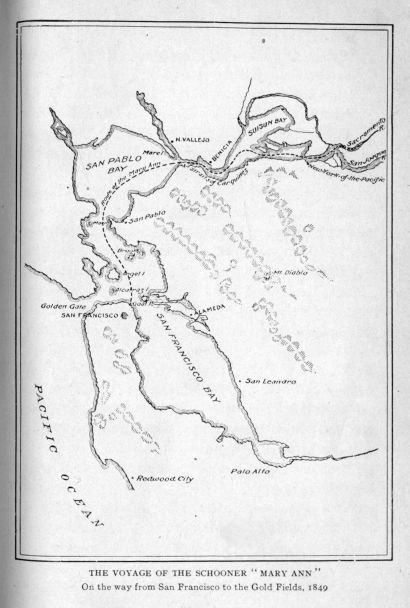
The voyage of the schooner "Mary Ann". On the way from San Francisco to the Gold Fields, 1849
The Mary Ann glided in on a long tack. Down fluttered her main-sail, presently down fluttered her fore-sail; and as she swung to, spilling the breeze from her jibs, close to the bank at the end of the levee, a sailor sprang into the water and swimming until he could wade carried a hawser ashore. This he made fast to the great root of a tree, washed bare by the waters. All up and down the banks other vessels were moored likewise, to trees and trunks and roots, so that some of the branches brushed the yards and spars. A number of cook's galleys had been set up on shore, as cabins, and several ship's figure-heads were established like sign-posts! It was a queer water-front—and what a swarm of people it exhibited!
From the Mary Ann Sacramento looked even busier than San Francisco. It was better laid out, too, for the streets were regular and straight.
"Four houses and fifty people three months ago; 5,000 people now and houses going up so fast you can't count 'em," said the red-faced captain, as in obedience to his orders the mate dropped the schooner's boats. "Wish I'd bought some lots here when they were offered to me—three for a thousand apiece."
"What are they worth now?" asked Charley, breathless.
"Well, sonny, a lot twenty feet wide is selling for $2,300." And the captain turned away.
The passengers were piling ashore; some would not wait for a boat; the Mary Ann had swung close to the bank, and they made running jumps from the rail, to land sprawling in the shallows or to plump out of sight and swim. When the Adams party finally stepped from the skiff to the levee (which was called embarcadero, of course) they were fairly deafened by a multitude of cries from citizens who insisted upon their buying lots. But Mr. Grigsby sighted a stout, ruddy-faced man; and exclaiming: "There's Captain Sutter!" made for him.
He and the captain shook hands heartily, and Mr. Grigsby brought his friend over to the rest of the party.
"Captain Sutter, gentlemen," introduced the Frémonter (and Charley felt quite like a man, to be included in "gentlemen"). "The first American settler in California, and the friend of all the other Americans who came after. You've heard of Sutter's Fort. He was the boss."
Captain Sutter was a short, stoutly built man, with crisp mustache and goatee, and a military way. His complexion was florid, his eyes very blue, and his forehead so high that probably he was bald. He looked to be German (though really he was Swiss), and he spoke with a German accent. His manner was very courtly, as he bowed and shook hands.
"Yes, of Sutter's Fort—but where is that now?" he said. "These gold seekers, they run over it; they leave me nothing. They have no rights of land to respect. Ach, what is the country coming to? All here was mine, once. See, now! Somebody put up a city, on this embarcadero where I landed my supplies for my fort. My saw-mill is a hotel—the City Hotel—and for it and the land it is on somebody gets $30,000 per year, they tell me. Nobody work for me any more; even my Indians go to mining gold, and my wheat fields are stepped all over. My new city which I start only three miles below, and call by my name—my gute name which when I was useful was so popular—is neglected, and everybody flock here. I once was rich; now soon I am bankrupt; all because my men discovered this gold. This gold, I hate it. It will be the ruin of this country."
"Well, captain, I'm sorry to hear this from you," said Mr. Grigsby. "But I'm powerful glad to see you, anyway. You've been too generous. You gave away your land, so as to help build up the country."
"Yes," answered the captain. "I did not want the gold, but I did not think the people would go crazy and flock over everything and obey me not at all. Well, what can I do for you, my friends?"
"We're going in to the mines, captain," informed Mr. Grigsby. "How's the horse and mule market? We want a pack animal of some kind. Colonel Frémont said you might be able to help us. I saw him in San Francisco."
"The grand Colonel!" exclaimed Captain Sutter. "For my real American friends I would do anything yet." He spread his hands. "But horses and mules? One time I remember I had many for you—that time you came out of the mountains so nearly famished to my fort. Now times are different. Horse and mule sell for $100, where they used to be ten. Maybe when the emigrants begin to come in, over the mountains, with their beasts, things will be different. I hear 30,000 are on the way, for the American River and the Sacramento. But I guess I know of one mule. I will try. Come this way, gentlemen. Leave your baggage. It will be safe—safer than the land it is on."
Captain Sutter led the way from the levee, crowded with people and baggage and freight. What a beautiful city this Sacramento was growing to be! The buildings were mainly of rough-sawn timber, with some of clay, and of course many tents; but the streets were wide, and straight, and everywhere great trees had been left standing, many of them six feet through at the ground. Business of buying and selling real estate and goods was at full blast. As he trotted along, the captain proved talkative.
"You saw my own city of Sutter's Ville, below?" he asked. "That is a much better site; not? It is high and dry, while this place—bah! Gentlemen, in the spring I have moored my boats to the tops of trees on that very embarcadero! But we shall see. I have hired Lieutenant Sherman of the Army to survey between my town and this, and connect the two; and maybe soon they will be one. Lieutenant Davidson, of the Army—he is surveying my town now, for fine streets and big lots."
"Davidson? Lieutenant J. W. Davidson, I suppose," remarked Charley's father; and Captain Sutter nodded. "He was with General Kearny in that overland march with the First Dragoons, from Santa Fé to San Diego, in the summer of Forty-six, when the Army was sent to capture California."
"Yes, sir," answered the captain. "But my friend Frémont and Kit Carson and Mr. Grigsby, here, and the American settlers, they got in ahead of the United States Army. Still, we needed the Army, like we needed the Navy; and we need them still. It is another of General Kearny's officers, Lieutenant John Warner, who surveyed this Sacramento City. A brave man, a very brave man. Three lance wounds he got, in the battle of San Pasqual, when the Californians would have prevented the Army from entering to San Diego. He is now already far up in the Sierra Nevada, at the head of the Feather River, surveying for a railroad route, I hear. Think, gentlemen! Soon a railroad, maybe!"
Captain Sutter had led the way to a rude hut of woven grass walls and thatch roof, on the outskirts of the town. Here he halted, and called:
"Ho, Pedro! Amigo (friend)!"
An Indian came out. Yes, an Indian—but different from the Indians whom Charley had seen in Missouri. He was squatty, dark and wrinkled, his hair cut short, and cotton shirt and trousers as his clothes. The captain spoke to him in Spanish. Pedro listened, and with a nod, turning, made off at a trot. In a moment he came back, leading from a shed among a clump of trees a small donkey.
"A burro, 'pon my word!" exclaimed Mr. Adams. "I haven't seen a donkey like that out of Mexico!"
"It is the best Pedro has," explained the captain. "These gold seekers so crazy they have robbed him, because they think he is nothing but an Indian. There will be troubles with my Indians, if the whites do not treat them better. Anyway, gentlemen, this animal is not so small as his size. He will carry all you put aboard him, and Pedro will sell him for twenty-five dollar, since you are friends of mine. Otherwise, he would not sell him at all."
"Good," said Mr. Adams. "Bueno," he added, so that Pedro might understand. "We'll take him, and glad of it."
So they bought the burro (a funny little creature with shaggy head, enormously long ears, and small hoofs) and led him away, Charley proudly holding the rope.
"You are lucky, my friends," spoke Captain Sutter; "one other animal there was, which I found for those friends of yours who came through the day before yesterday."
"What!" exclaimed Mr. Adams, sharply. "Who were they?"
"A rather small, dark man with a very long nose, sir, and two companions. They came by trail, from San Francisco, they said, and wanted a pack animal. They told me of my friend Grigsby, who had recommended them to me if they saw me, and of course I was happy to oblige them."
"Great thunder!" muttered Mr. Grigsby, as he and Mr. Adams stared at one another. But he quickly added, as if not to hurt the honest captain's feelings: "Very good, captain. When did they leave? Going up the American?"
"They left immediately, and I think they spoke of the American," answered the captain. "Yes," he continued, placidly, "it was a large bay mule, with one ear under-bitten—a notch taken out of it. I was of course happy to oblige them; but this burro I saved for you."
No, there was no use in telling the captain of his mistake, and making him feel bad; and Mr. Adams shook his head warningly at Charley. But what nerve, on the part of the long-nosed man! However, Mr. Adams only said:
"We'd better set right out, then, Grigsby."
"Can I do anything more for you, gentlemen?" inquired Captain Sutter.
"No, thank you, captain. We're fixed nicely. Now we'll pack up and leave at once. Time is precious, you know, to us gold seekers. Where is Jim Marshall? Up at the saw-mill?"
"Yes, at Coloma, but the saw-mill is not running. We have nobody to run it. Ah," mused the captain, "everyone is in a great hurry, like you. They see nothing but gold, much gold. It was not so in the old days. Well," he added, extending his hand, "good-bye, gentlemen, and good luck. Maybe we shall meet again."
They shook hands with him, thanked him once more for his kindness, and he trotted off—evidently as "hurried" as other people.
XVIII
THE TRAIL OF THE ENEMY
"Evidently we have to do with a very cunning gang of rascals," remarked Mr. Adams, as with the burro they hastened back for the levee and their baggage. "How did they know enough to trade on your name, Grigsby?"
Mr. Grigsby smiled grimly.
"They probably saw I was a Frémont man—may have heard us talking; and they took the chance. Naturally enough they'd guess that I knew the captain. All we early Americans in California knew him, and he stood ready to help us out. Well, sir, they left a clue, at any rate. We'll follow as fast as we can."
"Do you think we'll catch them?" asked Charley, eagerly.
"We'll do our best, whether we catch 'em or not," answered the Frémonter. "It's a big country, up yonder in the mountains, as they'll find out. Now, I'm thinking that we can't do better than to take the trail up the south branch of the American, to the saw-mill, and see Jim Marshall. He's been living right in the middle of things and may know something we'll want to hear."
"You mean the Marshall who discovered this California gold, for Americans?" queried Charley's father. "Well, I'd certainly like to see him, and have Charley see him; and the place, too."
"All right. Maybe we can kill two birds with one stone," answered the Frémonter. "And from the mill we can work north, to the other branch of the American."
The baggage was undisturbed, on the levee. Charley held the burro, and his father and Mr. Grigsby proceeded to pack her. Mr. Grigsby had stopped at a store, on their way, and bought two crowbars, a new rope and a pack-saddle, and some dried-beef. The crowbars cost $1.50 each, the rope cost $5, and the pack-saddle, of oak and rawhide and shaped like two letter X's fastened together by the middle, cost $8. The meat was the cheapest. It came in long strips, and sold by the yard—six yards for fifty cents!
The Frémonter was of course an expert at packing a horse or mule, and Mr. Adams knew considerable about it, from his army experience. Charley wondered at the neatness with which his comrades hoisted aboard all the variously shaped articles, and tied them fast so that they balanced.
"They call this the diamond hitch," grunted Mr. Grigsby, as he hauled tight, while the little burro stood with ears meekly drooped. "Rope makes the shape of a diamond—see? But it's only the regular trappers' pack throw. I've used it a thousand times and more. Well, we're all ready; hurrah for the gold mines. Charley, you can lead the critter. I'll go ahead, to show the road."
"Hurrah for the gold mines!" echoed Charley; and away they trudged.
As they left the hurly-burly of the embarcadero, and threaded their way through the bustling town, which was like another San Francisco, nobody appeared to notice their march. It probably was an old story, and besides, the people were too busy running about, bargaining in real estate, making money quick.
The dust was floating high, from the many feet; and as the street became a road out of the town, the dust was thicker than ever, from parties on before. It lay brown and powdery, ankle-deep and hot to the boots. The sun blazed down fiercely. Leading the little burro, in his heavy clothing Charley soon was streaming with perspiration; before, tramped with long stride the Frémonter, a rifle on shoulder; at the rear stanchly limped Mr. Adams, well laden with gun and pistol and the few articles that he and Mr. Grigsby had divided.
The burro's pack displayed crowbars and shovels and picks and gold pans and camp equipage; and to Charley's mind the little procession looked very business-like.
After following the dusty road through a flat brown plain, in about a mile and a half they passed what Mr. Grigsby said was the famous Sutter's Fort. With its thick clay walls and square towers at the corners, pierced with loopholes, it did indeed look like a fort. Inside the walls were several clay buildings where the captain had lived and stored his goods and taught his Indians to do white man's work. He had erected his fort here in 1839, and had been given all the land about, by the Mexican government of California. But now the fort was deserted; the doors and windows had been broken in, most of the wood had been torn out and carried off, and the fields about had been used as pasturage by the gold seekers. No wonder that the captain felt aggrieved; and it was pretty hard on him, when really because of his saw-mill had gold been discovered. This was poor reward for having settled the country and built a saw-mill—and a flour mill besides.
"There's the Rio Americano," spoke Mr. Grigsby, pointing ahead, after they had passed old Fort Sutter.
About a quarter of a mile before on the left, a line of trees indicated the course of a river—the American. And a fine stream it proved to be, flowing clear and sparkling between wooded grassy banks. The road, still dusty, turned slightly, and ascended along the river, making toward the rolling brown foothills which shimmered in the blue distance, with the mighty snow-crests of the Sierra Nevada range glinting beyond them.
In the shallows and on the bars of the American parties of miners were at work digging away with spades and picks, and squatting to wash out the gold in their pans. They all were so busy that they seemed to note nothing on either side of them or overhead. Their eyes were glued to the sand and the holes and the pans. Other parties had halted by the way, for rest in the shade of trees; and these hailed the Adams party with the usual calls: "How far to the diggin's, strangers?" "This is the American, ain't it?" "Say! How much do you s'pose a man can dig in a day, up there?" "Where you folks from, and where you bound?" "Is it always this hot in Californy?" And so forth, and so forth.
Several parties on their way back to Sacramento also were met; they were brown and hairy and rough and ragged, and some of them limped weakly as if they could scarcely carry their weapons, picks, spades, crowbars and blanket-rolls. They all were received with a perfect volley of excited queries from the resting parties—to which they replied with wave of hand and sometimes with a triumphant flourish of a fat little sack.
But Mr. Grigsby paused not for the gold seekers in the river, or under the trees, or on the way down. He tramped stoutly, with his long stride; Charley just as stoutly followed behind, leading the packed burro, and at the tail of the burro strode, a little unevenly, the tall and soldierly Mr. Adams.
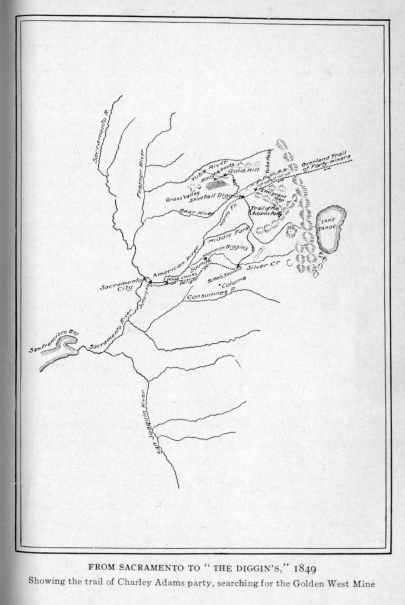
From Sacramento to "the diggin's," 1849. Showing the trail of Charley Adams' party, searching for the Golden West Mine
The dusty road continued through the wide rolling plain which formed the east half of the great Valley of the Sacramento. The herbage was short and brown, except at the margin of the streams, and the hot landscape was broken by occasional large spreading trees, singly and in clumps. As the foothills gradually drew nearer, the number of miners became greater. Finally, at sunset, Mr. Grigsby halted at a grassy hollow, near the American, where there was a considerable camp of men, and even two women. A rude sign announced the title "Woodchuck's Delight."
"We'll camp, too, I reckon," he quoth, dropping his pack; and Charley was glad to hear the words. "How are you?" greeted Mr. Grigsby to the nearest miners, as he turned to unpack the burro.
"Howdy, strangers? Where you from and where you going?"
"Just coming in, or have you made one pile?"
"That's a burro, ain't it? Will you sell him?"
"What might your names be, strangers?"
To these and other queries Mr. Grigsby answered good-naturedly, as he and Mr. Adams stripped the little burro. The camp consisted of a few tents and of men who merely had thrown their blankets down here and there, as if to cook their suppers and rest till morning. The great majority had come afoot, many without even pack animals; a sprinkling of horses and mules were staked out, at pasture; and speedily Mr. Grigsby led the burro aside, to stake him out, too. He laid back his ears, stretched out his shaggy head, and made short runs at the other animals near him, until he had cleared a grazing spot all his own. Then he hee-hawed triumphantly, and lay down for a luxurious roll.
Mr. Adams and Charley tossed the bedding to a place which appeared as good as any other, for sleeping, and got out the "grub" and cooking utensils.
"Charley, you're expected to supply the wood and water, and help me with the camp chores generally," directed his father. "We'll let Grigsby do the hunting and camp locating and burro tending, and I'll cook and wash dishes. That will be our regular system. How about it, Grigsby?"
"Sounds like a pretty good arrangement," agreed the Frémonter, tersely. "But I'm perfectly willing to chip in wherever necessary."
"Get some wood, Charley," bade Mr. Adams. "That's first. There's the axe." And he proceeded to sort out the food, while Mr. Grigsby busied himself with the bedding.
Charley seized the axe from amidst other tools, and lustily chopped wood from a tree which already had been half demolished by other campers. In fact, it looked as though very soon no trees would be left, along this trail; which was a great pity.
Having brought enough wood, he took an iron kettle and trudged to the river. Several miners were at work, along the banks, and on a bar in the middle; one was working right where Charley arrived—a low place, like a miniature gully, where the soil was bare and sandy clay. He had dug a small trench, and was shoveling some of the loose dirt into his gold pan.
Charley could not help but watch, for a moment.
"Are you getting anything?" he ventured.
The man appeared to be a rough fellow, unshaven and tanned red, in faded blue flannel shirt, old trousers belted with a leather strap, and bare feet. But when he smiled, and pausing a second, answered, he spoke in a pleasant voice, with as good language as from Charley's father or any other cultured person.
"Oh, a few pinches. See——?" and he swirled his pan level full of water, until the water and much of the dirt had flowed out over the edges. He did this again—picked out a number of pebbles and large particles of dirt—swirled once more, and tilted the pan, almost empty, for Charley to see.
Hurrah! Sure enough, there was a thin seam of yellow, lying in the angle of sides and bottom! And breaking it, was a small irregular particle, of blackish hue tinted with the yellow in spots. Charley's eyes bulged. Gold! Was this the way they did it?
The man picked out the small lump, and turned it in his fingers.
"One little nugget. Worth probably twenty dollars," he remarked. "The rest of the pans—these are two pans washed out—average about twelve cents." Then, at sight of Charley's excited face, he laughed heartily. "You look as though you had the gold fever, boy, and had it bad," he said. "But these pans are nothing. They wouldn't sum up more than four dollars a day—and nobody in California would work long for four dollars a day. It's too low down on the river to pan out real wages. I'm just amusing myself. Got a pan? Come in and try your luck. The ground's free."
"I can't, now," stammered Charley. "I'm getting water for supper. Maybe I can later, though. Will you be here after a while?"
"Oh, as like as not," answered the man, calmly scraping out the yellow stuff with the point of his knife, and dropping it into the usual brown buckskin sack—which, Charley noted, bulged a little at the bottom. "I used to be a preacher; now I seem to be a miner. What's your name and where'd you come from and where are you going, as the fashion of asking questions is."
Charley briefly told him (for he liked this ex-preacher immensely), but of course he didn't mention that they were on the trail of the Golden West claim. He simply said that they were bound up the American. Then he dipped his water and hastened back to the camp, where he found his father waiting.
"I saw a man panning gold," he announced.
"Getting anything?" asked Mr. Grigsby, not at all excited.
"Yes. A nugget and a lot of dust besides. He said he'd help me pan, if I'd come back after supper. Can I, dad?"
"Oh, I guess you can, if you have no chores," consented his father, with a smile at Mr. Grigsby.
Charley had no idea that his father was such a cook. Mr. Adams went at the matter in great shape—and even Mr. Grigsby, lying near, rewrapping a place on the pack saddle, apparently found nothing to criticise.
Mr. Adams (and it looked odd to see him, a man, busy cooking!) had bread batter already started. He took one of the gold pans, dumped into it some flour, a pinch or two of saleratus, and a quart or two of the water. He mixed away with his hands, adding flour and water until the batter was correct, formed it into a loaf, laid it in another pan, well greased with bacon rind, covered it with the first pan, and set the "oven" well down among coals that he had raked out to one side. He poured a little water into the fry pan, or spider, laid in a lot of chunks and strips of dried-beef or jerky, and salted it and put it on the fire. He took out a handful of coffee beans that had been roasting in the fry pan before he used the pan for the stew (and how good they smelled!), crushed them in a piece of cloth between two stones, and turned them into the coffee-pot.
"You must have been there before," commented Mr. Grigsby.
"Well, I've been a soldier, you know," explained Mr. Adams. "This is soldiers' fare; that's all."
"Strangers, you're new to the diggin's, I reckon," asserted a caller, who strolled in and coolly sat down. He was an exceedingly powerful man—as tall as the Frémonter, broad and heavy, a veritable giant. His shaggy whiskers were bright red. He wore a broad-brimmed black hat, below which hung his red hair to mingle with his whiskers; his red shirt was open at the hairy throat, his stained coarse trousers were belted with a piece of rawhide, through which was thrust a knife and pistol, and he was barefooted. He certainly was the biggest and most ferocious-looking man that Charley had ever seen. Yet he acted very harmless.
"Why so?" queried Mr. Adams, examining his bread.
"'Cause you're bread eaters, 'stead o' bein' flap-jackers. By that I take it you've not been up into the flapjack country yon," and he jerked his head in the direction of the foothills and mountains. "When a man makes his squar' meals out o' flapjacks an' sow-belly, then he can call himself a miner."
"You've been there, in the flapjack country, I suppose," invited Mr. Adams.
"Have I, stranger? Wall, I should shout! I was one of the fust into the diggin's after Jim Marshall discivvered color. Fact is, I'm jest down from thar now, only stoppin' hyar at Woodchuck's Delight to rest my feet. They've got rheumatiz powerful bad, wadin' in the water so much."
Charley had noted that many of the men in the camp were barefooted, as if their feet were sore; evidently Woodchuck's Delight was a sort of a resting place.
"How are things at the saw-mill diggin's?" queried Mr. Grigsby.
"Peterin' out, stranger," replied the red-whiskered man. "Quiet as a Quaker Sunday. I was thar about a month ago."
"Is Marshall mining?"
"Not much. He's grumblin', mostly. Thar's a man, who when he struck a big thing jest natter'ly didn't know what to do with it. It made him pore instead o' rich. The rush o' people tromped an' dug all over him, an' he doesn't appear to have enough spunk to stand up for himself. He seems to think he owns the hull country, 'cause he was thar fust, an' 'cordin' to his notion nobody can mine without his leave. But as matter o' fact, he was too blamed slow to locate any claims; an' when the miners agreed to let him have 100 feet, he didn't get to work on it. He seems to expec' the Government to pay him for his discivvery, while he sits 'round waitin' an' grouchin'. But that sort o' thing doesn't go, out hyar, whar every man must look out for himself an' do his part."
"Never heard of a claim called the Golden West, in those parts, did you? A quartz claim?"
"Nary Golden West, stranger; or any other quartz claim; 'cept that thar was a party through on the trail a day or two ago, inquirin' for that same name—the Golden West. But they didn't say whether it was lode or placer."
"Three men, with a bay mule—one man small and dark, long nose?" pursued Mr. Grigsby.
"You've got 'em, stranger."
"Which way were they bound?" asked Mr. Adams.
"I reckon they went on up the American."
Mr. Grigsby and Charley's father exchanged glances; then Mr. Adams spoke quickly, as if to drop the subject.
"Will you have supper with us, sir?" For the bread was done.
"No, thank 'ee; I'm well lined with flapjacks and sowbelly, to last me till mornin'," replied the red-whiskered man. However, he stayed while the party cleaned up everything that Mr. Adams had cooked.
Now it was near the close of twilight; and Charley, fidgeting anxiously, wondered whether he might not try for gold, just once. His father must have read his thoughts, for he said suddenly:
"Get out your pan, Charley, if you want to, and try your luck. We'll tend to the chores."
Charley needed no second bidding. He grabbed the one clean pan, and down to the river he ran. He fancied that he heard the red-whiskered man call after him, with joking advice, and he knew that other campers, whom he passed, laughed at his eagerness; but who could tell—perhaps he would find gold as well as anybody.
The ex-preacher was still there, in his "diggin's," working away.
"Hello!" he welcomed, cheerily. "Come in and spell me. I'm tired. There's your dirt, all ready for you."
Into the shallow ditch jumped Charley, as bold as an old-timer, and scooped some dirt into his pan. The ex-preacher sat down on the side of the ditch and watched him.
"Don't put in too much dirt at once, boy," he cautioned. "Half full is enough. That's right. Now sink it to the rim in the water, and swirl it around and back again, so the current will carry the dirt off. Don't be afraid to keep it moving. That's it. The gold is heavy, you know; the dirt goes and the gold stays behind. Whoa'p! Let's see. No, it's all gone, this time. You've washed the pan clean. Try again. Take things easy."
That proved to be no easy job, though. The pan was large, the dirt and water weighted it down, and as Charley squatted and tried to swirl it around, at just the right level, presently his back and his arms were aching together.
"Slow, now," bade his instructor, becoming interested. "Raise the pan a bit and swash the water—flip it out along with the dirt, a little at a time. Be careful of that black sand—it's heavy and carries the gold. Here; I'll get rid of the sand for you," and taking the pan he cleverly swirled it, occasionally dipping up more water, until the sand had flowed off.
"There you are!" he laughed, gaily thrusting the pan back into Charley's hands. "And there's your color, sure enough. See it? A ten-cent pan, the first time. Good!"
Charley anxiously peered. In the rounded angle of bottom and side, a narrow gleam of yellow! Could it be possible? Yes; there it was, the gold; actually, real gold, and he had washed it—or at least, he had washed most of it.
"Shall I try some more?" he asked, excitedly.
"Sure. Go ahead. We always wash several pans, before we clean up. Now do it all yourself. You know how."
This time Charley succeeded in getting rid of everything but a very little of the sand; and behold, the yellow seam was deeper. After the third pan he could wait no longer; he out with his buckskin sack, and with the point of his knife scooped his gold in. A little sand went along with it, but who cared?
"We'd better quit for the night, I guess," remarked his new friend, who appeared as delighted as he. "I expect you've made as much as half a dollar. Now it's time for tenderfeet to go to bed."
Through the dusk Charley trudged back to the fire, with his pan and his gold, feeling much indeed like a regular Forty-niner.
His father and Mr. Grigsby were sitting by the fire, talking, when in he burst upon them.
"I got some! I got some!" panted Charley.
"Did you? All right. Show up."
"It's in my sack. See?" And Charley "showed." "I didn't stay to pan much. But I learned how."
"A trace of gold, and considerable sand," pronounced Mr. Grigsby. "But that's enough, for a starter—only you want to dry that stuff out, lad, and blow the sand away. Understand?"
"We've decided to push right along, Charley," said his father, just as if he and Mr. Grigsby considered Charley as much of a partner as they were, "up the trail to Marshall's place; then we can turn north for the north branch of the American, or for the Yuba and the Feather beyond. They're all mining districts. Do you agree?"
"I agree," assented Charley. "And whenever we camp we can wash out gold, can't we?"
His father laughed.
"Certainly. By the time the mine is reached, may you'll have filled your sack."
Charley yawned mightily. The future seemed golden bright—yet he felt as though he couldn't keep awake long enough to discuss it. His father yawned; so did Mr. Grigsby; already the majority of the campers were stretched out in their blankets, some of them snoring; and to bed went the Adams party, also.
Charley removed his boots and trousers and flannel shirt; and rolling himself in his army blanket used them as a pillow—the fashionable scheme, he noticed. He was asleep so soon, and slept so "fast," that he was perfectly astonished to wake into daylight and breakfast time.
The camp of Woodchuck's Delight was breaking apart, for a number of its tender-footed inhabitants had started on, up or down the trail. As his father and Mr. Grigsby were packing the burro, the red-whiskered giant of the evening before passed by, and waved an "Adios."
"It's almost time that we met some of the overland crowd, isn't it?" remarked Mr. Adams, as they took up the march, in the same order as before.
"Not quite," answered Mr. Grigsby. "That's a four months' trip, and I don't reckon any of 'em got away much before the middle of April. It'll be two or three weeks or more, yet, when the first of them cross the range."
"Will they all come this way?" appealed Charley. Thirty thousand there were, so people said; and what a procession they would make!
"No. There's that southern trail, around by the Gila, and to San Diego or up through Los Angeles. And the northern trail, to Oregon and then down. But the Eastern papers advised taking the Oregon trail up the Platte and across South Pass beyond Fort Laramie, to Fort Hall; then south to the Mary's River that Frémont named the Humboldt, down the Humboldt to the Sinks, over to the Truckee and across the Sierra to the head of the north fork of the American—the way we came in with Frémont in Forty-five. And there's that other way, about our trail of Forty-four: by the Carson River, which is south of the Truckee, over Carson's Pass of the Sierra, to the South Fork of the American—which would strike down this trail, like as not, to Sacramento. But in my opinion the trail up the Truckee to the North Fork is the best, and the bulk of the people will come that way."
So saying, Mr. Grigsby shouldered his long rifle, and strode out, to lead. Charley occupied the middle, with the burro. His father limped in the rear.
XIX
A GREAT DISCOVERY
Coloma, near to the celebrated Sutter's saw-mill, was about thirty miles on east, up the trail. The trail did not always keep to the American, but diverged from it. However, streams flowing into the American were crossed, and ever the trail waxed more interesting. Several new towns were passed—one, called the Mormon Diggings, was inhabited largely by Mormons from Salt Lake. Here mining was in full blast, with many improved methods, as by "cradles," which were boxes set upon rockers and rocked like a cradle so that the water and sand were flowed out as from a pan; and by long boxes called "Long Toms," set on an incline so that when the water and dirt were flowed down them, their cleats, nailed across the bottom on the inside, caught and held the heavy sand and gold. Then the cleats were cleaned and the gold separated. As further into the foothills the trail led, the more numerous were the miners; and when the first of the mountains were entered, every gulch and ravine held its busy population.
Now the mountains, high and thickly timbered, clustered before and on either side, when, on the afternoon of the second day (for Mr. Adams traveled slowly on account of his lame leg), Mr. Grigsby, ahead, pointed and said:
"There's the saw-mill."
So it was—a large frame building, apparently not all completed, amidst a clearing of stumps, on the edge of a ravine near the foot of a slope. Several log cabins and a number of tents stood near it; and shacks and tents dotted the gullies around. But, as Captain Sutter had said, the mill was not running; and as the red-whiskered man had alleged, the locality was not bustling.
"I expect the place has been all worked out, by the first rush," commented Mr. Grigsby, as he led on, up the well-marked trail.
"This is where the gold was discovered in Forty-eight, is it?" queried Charley's father, as on the edge of the clearing they paused, to take breath, and gaze about them.
"Yes, sir; and unless I'm much mistaken, there's Jim Marshall himself, in front of that cabin."
So saying, followed by his party the Frémonter crossed the clearing, as if making for one of the cabins before whose open door a man was sitting, on a stool. The man appeared scarcely to notice their approach, and barely turned his head when, halting, Mr. Grigsby addressed him.
"How are you, Jim? I met you down at Sutter's, after the war. My name's Grigsby."
"Yes, I remember your being 'round there," responded Mr. Marshall, in a soft, slow drawl, rising to shake hands. "The country wasn't so full, then."
He was a rather tall, well-built man, with long brown beard and slouch hat. He had wide brown eyes, with a sombre gaze in them. In fact, his whole countenance was sober and a bit sullen.
"So you're still at the mill."
"I have been, but I'm going out. There's no place for me here. The man who discovered this gold ain't given an ounce of it," and Mr. Marshall's voice was bitter. "What did I get for all I did when I opened that mill-race? Nothing; not even gratitude. It's Government land, they say, and so the people flock in and take it, and my only chance is to rustle like everybody else. Do you think that's fair? No, sir! If I had my percentage of all the gold being mined around here I'd be a rich man. Instead, they give me a hundred feet, and expect me to dig like the rest. Bah! I'll starve, first."
Although Mr. Marshall was trying to make this a tale of woe, Charley, for one, could not quite see the reasonableness in it.
"Well, Jim," hastily soothed Mr. Grigsby, "this is a country of hustle, and most of us have to look out for ourselves. You were here first, and I suppose people figured on your making the most of opportunity. Anyway, I wish you'd take us over to the mill-race and show these two partners of mine just where you discovered the gold. We aren't going to stay, but we'd like to see that much."
"Yes, I can do that," assented Mr. Marshall. "Leave your animal here, if you want to. There aren't many white people about" (and he spoke bitterly, again) "to steal it."
Charley tied the burro to the cabin. Mr. Marshall led the way over to the mill, which was abandoned and idle, and paused on the brink of a wide ravine that extended back to the mill wheel.
The ravine was ragged and torn, its bottom bare to the rocks and its sides gashed by countless holes. A number of Chinamen and Indians were working in it, scraping about and filling pans and wicker baskets with loose dirt, which they washed in the stream trickling through. But there were no white men.
"That was the tail-race," explained Mr. Marshall, "which led off the water after it had passed under the wheel. After we got the mill to going, about the middle of January, last year, we found the tail-race wasn't big enough to carry off the water fast and make a current that would turn the wheel. So I threw the wheel out of gear, one night, and lifted the head-gate of the race full open, to flow a hard stream through and wash the tail-race deeper. Next morning early, which was January 24, I went down with Weimer (you know Weimer, Mr. Grigsby; he served in the Frémont battalion during the conquest), who was helping me, to see what the water had done. We shut it off first, of course, above. Well, the tail-race certainly had been scoured a good bit, and we were looking in, as we walked, congratulating ourselves on the job, when I saw a sparkle of yellow on a flat bed-rock. I went down in and picked it up, and I was sure it was gold. I sent an Indian back to the men's cabin for a tin plate. I didn't want to say much about the find till I'd made certain that it wasn't copper, but during the day Weimer and I searched about and found a little more. We tried it out with potash in Mrs. Weimer's soap kettle, and it didn't tarnish. The other men got excited, and the next day started to poking about on their own account, in the rain. I took what I had down to the fort, and the captain and I locked ourselves in and tested it with nitric acid, weighed it, pounded it, did everything we could think of, and made dead certain that gold it was. Next day the captain himself came up to the mill, and we all found gold. It was everywhere. Of course that set us up in great shape, but the captain made us promise to keep the matter a secret for six weeks until he had finished a flour-mill that he was building at the fort, or else he wouldn't be able to get anybody to work for him at wages. But some of the men showed their dust down at the store at the fort, buying goods, and the cat was out of the bag. Everybody deserted the old captain, his grist-mill hasn't been finished to this day, his crops weren't reaped, his saw-mill property was overrun with a regular army, some of the people tried to save a bed of gravel for him, but that's gone now, neither his rights or mine are respected, I don't own an ounce of gold and am busted, and he'll be busted soon. There's no gratitude in this country," and Mr. Marshall turned gloomily away.