OUR PRACTICAL DRESS INSTRUCTOR.
Reading edition
LADY'S SCARF MANTELET.
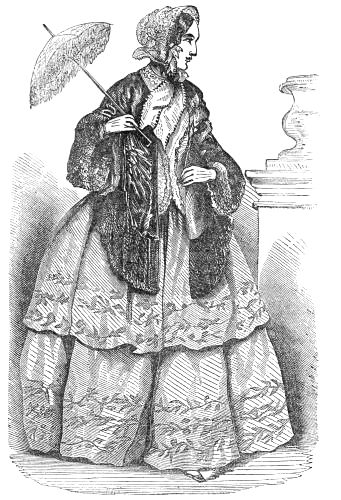
THE newest style of mantle is the Scarf Mantelet. Its graceful shape, lightness, and elegance have made it a great favorite. This mantle is made of muslin or silk, and trimmed with lace as fancy dictates.
DESCRIPTION OF DIAGRAMS OF LADY'S SCARF MANTELET.
Fig. 1.—Front.
Fig. 2.—Back. Join a to a and b to b.
We also add the diagrams of a very pretty jacket.
DESCRIPTION OF DIAGRAMS OF LADY'S JACKET.
Fig. 3.—Front.
Fig. 4.—Back.
Fig. 5.—Side-piece. Join a, a, a.
Fig. 6.—Sleeve in full. (This shape is very much worn for morning and evening dress.) A Shoulder.
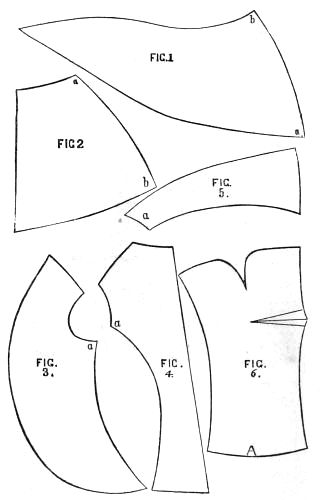
DIAGRAMS OF LADY'S SCARF MANTELET, AND LADY'S JACKET.
[See larger version]

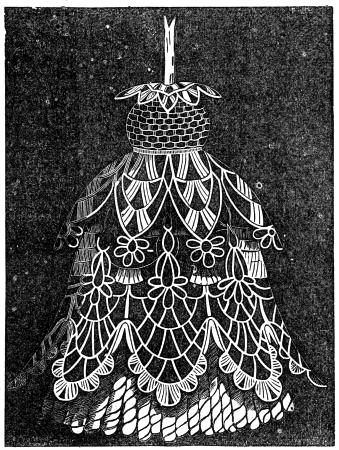
CROCHET TASSEL COVER.
Material.—Crochet thread, No. 1; Penelope needle, No. 3.
COMMENCE with 12 chain, make it round by working a single stitch in the first chain stitch.
1st round.—(4 chain and 2 plain in the foundation chain, 7 times.)
2d.—1 chain (2 treble, 3 chain and 2 treble, all in the 4 chain of the first round), then 1 chain, 1 plain on the 2 plain. Repeat 6 times more.
3d.—Miss 1, 1 plain in the 1 chain, 3 chain, miss 2 (3 treble, 3 chain and 3 treble, in the 3 chain of the last round), then 3 chain, miss 2, 1 plain in the next 1 chain. Repeat 6 times more.
4th.—5 chain, keep this chain at the back of the last round, and work 1 plain between the 2 plain stitches of the last round. Repeat 6 times more, leaving the points formed in the last round in front.
5th.—(2 chain and 1 plain, 3 times, in each of the 5 chains of the last round.)
6th, 7th, 8th, and 9th.—(2 chain and 1 plain, in the 2 chain, 21 times.)
10th.—(1 chain and 1 plain, in the 2 chain, 21 times.)
11th.—42 plain.
12th.—41 plain, 1 single.
13th.—(6 chain, miss 4, and 2 plain, on the lower edge of the stitches of the last round, 7 times), the upper edge of the stitches of the 12th round are left at the back to form the foundation of the inner part of the tassel.
14th.—2 chain (3 treble, 3 chain, and 3 treble, all in the 6 chain); then 2 chain and 1 plain, on the 2 plain of the 13th round. Repeat 6 times more.
15th.—1 chain, miss 2, 1 plain in the 2 chain; then 2 chain, miss 2 (3 treble, 3 chain and 3 treble, in the 3 chain), 2 chain, miss 2, 1 plain in the 2 chain. Repeat 6 times more; then 1 plain in the 1st chain stitch.
16th.—4 chain, miss 6, 3 treble in the 3 chain; then 5 chain, turn, miss 4, 1 single on the 1st stitch of these 5 chain to form a round loop; turn, and work (5 chain and 1 plain, in the round loop, 5 times), then 3 treble in the same 3 chain of the 15th round as before, 4 chain, miss 6, 1 plain in the 1 chain. Repeat 6 times more, and fasten off, which finishes the outside.
To form the under part of the tassel, return to the 12th round, the upper edge of the stitches having been left on the inside of the tassel, and commencing on the first stitch, work for the
1st round.—42 plain, 1 single on the 1st stitch of the round.
2d.—(5 chain, miss 2, and 1 plain, 14 times.)
3d.—(5 chain, miss 4, and 1 plain, in the 5 chain, 14 times.)
4th.—1 chain, miss 4, 1 plain in the 5 chain, then 9 chain, 1 plain in the same 5 chain, then 1 chain, 6 treble in the next 5 chain. Repeat 6 times more.
5th.—1 chain, miss 5, 1 treble in the 9 chain (then 3 chain and 1 treble in the same 9 chain, 3 times); 1 chain, miss 5, 3 treble in the 3d stitch of the 6 treble, then 3 treble in the next stitch. Repeat 6 times more.
6th.—1 chain, miss 5, 1 plain in the 3 chain, then 3 chain, miss 3 (2 long, 5 chain and 2 long, all in the next 3 chain), 3 chain, miss 3, 1 plain in the next 3 chain, 1 chain, miss 5, 3 treble in the 3d treble stitch, and 3 treble in the next stitch. Repeat 6 times more.
7th.—1 chain, miss 5, 1 plain in the 3 chain, then 2 chain, miss 3, 1 plain in the 5 chain, then (5 chain and 1 plain, in the same 5 chain, 5 times) 2 chain, miss 3, 1 plain in the 3 chain, then 1 chain, miss 5, 3 treble in the 3d treble stitch, and 3 treble in the next stitch. Repeat 6 times more.
8th.—3 chain, miss 9, 1 plain in the 5 chain, 3 chain, miss 5, 1 treble in the next 5 chain, 3 chain, miss 5, 1 treble in the next 5 chain, 3 chain, 1 treble in the same 5 chain as before, 3 chain, miss 5, and 1 treble in the next 5 chain, 3 chain, miss 5, 1 plain in the next 5 chain, 3 chain, miss 9, 1 plain on the centre of the 6 treble. Repeat 6 times more; then 3 chain, miss 3, 1 plain in the first 3 chain.
9th.—3 chain, miss 3, 1 treble in the next 3 chain, then 3 chain, miss 3, 1 treble in the next 3 chain, 3 chain, miss 3 (1 long, 3 chain, 1 long, both in the 3 chain), 3 chain, miss 3, 1 treble, 3 chain, miss 3, 1 treble, 3 chain, miss 3, 1 plain in the 3 chain, miss 1, 1 plain in the next 3 chain. Repeat 6 times more.
10th.—Miss 2, 3 plain in the 3 chain, *, miss 1, 1 plain, 1 treble, 3 chain, 1 treble, and 1 plain, all in the next 3 chain. Repeat from * 4 times more; then miss 1, 3 plain in the 3 chain. Repeat from the commencement of the round, 6 times more, and fasten off.

NETTED CAP, FOR MORNING WEAR.
Materials.—Crochet thread, No. 4; and, to embroider the pattern, a skein of pink or blue Shetland wool, or embroidery cotton, No. 16; steel mesh, No. 14, and a flat ivory mesh, one quarter of an inch in width—this will make an ordinary cap; but, if any other size is required, the meshes and thread must be coarser or finer.
COMMENCE with the crochet thread, and No. 14 mesh, on a foundation of 20 stitches; work 40 rows of 20 stitches each. This piece forms the centre of the crown, cut it off the foundation, and run a string along the four sides, about four or five stitches from the edges, so as to work all round the square.
1st round.—Work down the first side thus: net a stitch plain, then net 2 stitches in one stitch, 15 plain, 2 stitches in one, 2 plain, and along the other side, *, net 2 stitches in one, 15 plain, 2 stitches in one, and 2 plain. Repeat from * twice more.
2d.—Net 3 plain then (2 stitches in one, and 10 plain, 8 times).
3d.—Plain.
4th.—(Net 11 plain, and 2 stitches in one, 8 times.)
It will now be advisable to take out the string, and run it into the 1st round to keep the work even. Net 15 rounds plain.
20th.—Net 2 stitches in one, then 20 plain, 2 stitches in one, 79 plain. Net 4 rounds more the same as last, working 2 stitches more at the end of each round, so that the 20 plain stitches are always over those of the preceding round; when finished, turn back. Net to within 20 stitches of the end of the round, turn back again, and leaving the 20 stitches to form the back of the cap, work for the front, 8 rows plain, netting two stitches in the last stitch of each row. Then 12 rows plain without increasing; and for the foundation of the border double the cotton and work 6 rows plain.
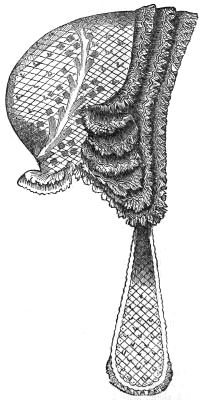
Embroider the cap with the pink wool in darning stitch, passing the needle about 6 times in each square of the netting.
THE BORDER.—With the thread, and No. 14 mesh, net 6 stitches plain, and continue working backwards and forwards for about 9 yards; then to form.
THE EDGE.—Run a string in the loops which form the selvedge, so as to work on the other selvedge.
1st row.—With flat mesh, net 4 stitches in every other stitch of the selvedge.
2d.—With 14 mesh, plain netting, working a stitch in every stitch of the first row. Then, with the pink wool, embroider the plain netting.
To make up the cap, sew a row of the border to the last thick row of the cap, fulling it at the ears, plain across the front to the centre, then draw 5 loops close together to make it rather pointed, plain again, and full at the other ear, and across the back, sew on another row of the border the same, attaching it to the first thick row; then sew on a third border, very full, and in a zigzag form on the ears, but the same as before across the front.
THE STRINGS.—With the thread and No. 14 mesh, net 12 stitches, and continue working backwards and forwards for 5 inches, then net 2 stitches in one at the end of every third row, until it is increased to 28 stitches; then net 8 rows, leaving 3 stitches unworked at the end of each row; and for
THE EDGE.—With the flat mesh, commence in the last stitch of the side, and net 4 stitches in every other stitch across the uneven rows; then one row plain, with No. 14 mesh. Work another string the same, and embroider them as the cap.

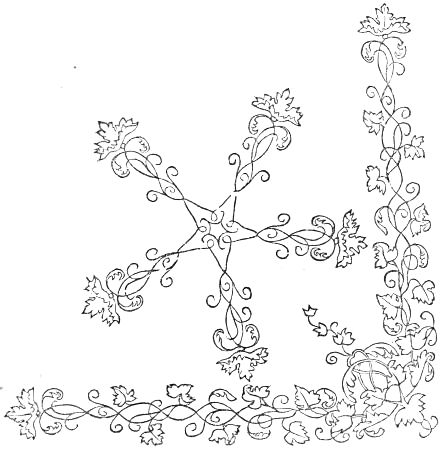
BORDER AND CORNER FOR POCKET-HANDKERCHIEF.

CHEMISETTES, UNDERSLEEVES, AND CAPS.
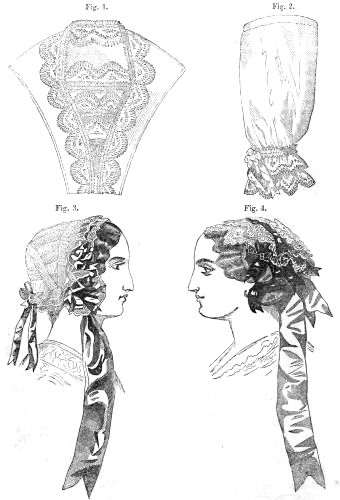
OUR readers can scarcely imagine the difficulty we meet with in presenting novelties in this department. The shades of fashion are so various, and yet so slight, that, in giving new designs from month to month, those not accustomed to scrutinize closely may not notice the peculiarities they are intended to present, or that each month has its peculiar and seasonable adaptation. For instance—
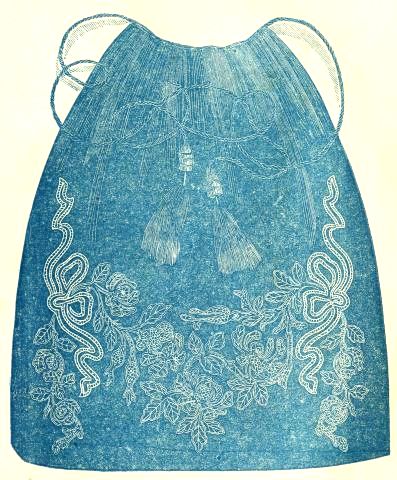
APRON IN BRODERIE EN LACET.
Fig. 1, a wrought lace chemisette and stomacher, is intended for the mild opening season, when cambric embroideries would be too heavy for the style of dress. The prevailing form of the opening of the basque corsage is also denoted by it—low, square, or a broad oval on the bust. The construction of the chemisette of broad scalloped lace, is simple enough, on a foundation of Grecian net or coach blonde.
Fig. 2 is an undersleeve to correspond, made sufficiently loose at the wrist for the hand to pass through. The box plaiting or quilling of satin ribbon, which heads the lace in both Figs. 1 and 2, is fastened in the sleeve by a rosette. This is of course only caught on, and is easily removed when the lace is to be done up; it may be of any shade, and is very stylish in evening dress.
Fig. 3 is a rather close morning cap for a lady of middle age, made of alternate rows of clean muslin puffs and fine Valenciennes insertion. It has a crown, front piece, and frill. The border is a medium Valenciennes edge sewn in the insertion, two rows slightly frilled. Bows and strings of violet-colored satin ribbon.
Fig. 4.—Breakfast cap for a young married lady, consisting of a crown piece, and two rows of edging, of Maltese lace. Bows and ends of rich ribbon, medium width between the rows, a knot of broader ribbon behind, a little to the right. For description of Maltese lace, see fashion article.
APRON IN BRODERIE EN LACET.
(See Blue Plate in front of Book.)
Materials.—Seven-eighths of a yard of wide black glace silk, two knots of cerise Russia silk braid, one knot of pale vert-islay ditto, and a dozen skeins of sewing-silk to match each braid.
BRODERIE EN LACET signifies a design out-lined as if merely for braiding, but with the flowers and other parts filled in with point lace stitches, so as to make a solid piece of embroidering on the silk. For no article is this novel style of work more suitable than for aprons, which it renders exceedingly ornamental, at a very small expenditure of time and trouble, the very simplest of the point lace stitches only being used in this work. Of course, the size of our page precludes our giving even the half of the apron the full size. The design must be enlarged according to the size required, the pattern procured, and the silk marked in the same way as ordinary braiding or embroidery.
Braiding should always be done with a strand of the silk of which the braid is made. Before beginning, cut off a yard of the braid and draw out the threads for sewing with. Thread the end of the braid on a large darning-needle, and draw it through the silk to the wrong side for the commencement, and do the same at every necessary break, sending the ends down. Run the braid on very smoothly, taking the stitches across it slanting and cut along the centre, as is usually done. The braid should lie perfectly flat, and the edges be smooth and even.
The knots at the side suspending the wreath are done in the green braid, the two parallel lines of which are connected by close herring-bone stitch, or point d'Alençon, as it is called in lace-work. All the fancy stitches are done with the common sewing-silk, not with the strands of the braid. The leaves need have merely the veinings worked in Venetian bars; those, however, who do not mind the trouble, will do well to fill them first with Brussels lace, and work the fibres over that; the improved effect will quite repay the extra work. The roses are filled up closely in the Brussels and Venetian lace, the narrow parts being connected with English bars. The lower part of each bud has a rosette in it, the remainder is filled with Venetian lace.

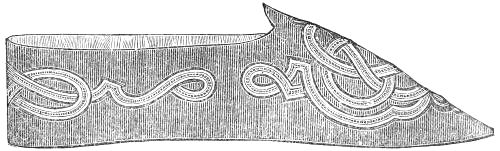
LADY'S SLIPPER.
Gold braid on velvet or cloth.
JACKET FOR A RIDING-DRESS.
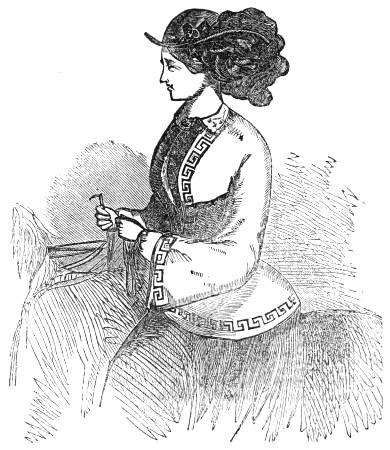
THE material is merino, or very fine lady's cloth; the color a light shade of cinnamon brown. The basque, or skirt, at the waist is rather long, and the jacket is edged all round with a Greek border in soutache. It is made rather open in front, so as to show a waistcoat of plain blue cashmere fastened with gold buttons. The collar to be worn with this jacket is of cambric, and may be either worked or plain. The undersleeves, also of cambric, are full, and the fulness gathered at the wrists on bands of needlework. Necktie of black velvet. Our illustration shows only the jacket of this riding-dress; but we may mention that the skirt of the habit should be of the same material, and that the hat worn with it should be of gray felt, ornamented with a feather of the same color, and the crown encircled by a band of blue ribbon fastened in a rosette on one side.

COTTAGE FURNITURE.
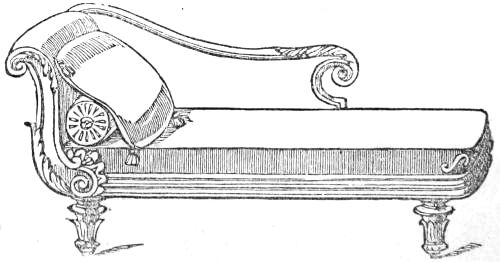
The above figure is a handsome pattern for a couch. The castors are sunk in the legs.
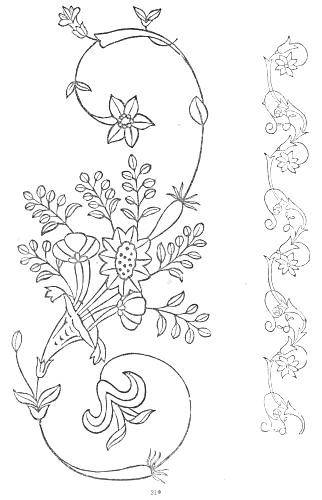
PATTERNS FOR EMBROIDERY.

WE put aside, for this month, a number of short articles, in order to give our readers the pleasure of an introduction to the celebrated singing-master, to whose instructions the Swedish Nightingale owes, in a great measure, the restoration of her wonderful voice, and her unequalled power in using it. Very important lessons are contained in this interesting sketch, translated from the German of Elise Polko.
Rue Chabannais, No. 6.—In one of the most insignificant streets of splendid Paris, the narrow little Rue Chabannais, there stands a tall, dark-looking house known as No. 6. Ugly, rambling, old-fashioned buildings stand on each side, and have posted themselves opposite to it also, like old duennas mounting guard, squinting down incessantly with their dim eyes, their unwashed windows, upon the gray house with its broad doorway. The inhabitants of the little street, on the contrary, regard it with a certain pride mingled with a tender friendliness of feeling, and rejoice like children over each brilliant equipage that stays its rapid course before No. 6, as well as over every unpretending fiacre that there deposits its light burden.
At all hours of the day, graceful female figures glide over the threshold of the large dark house, and the modiste of the Rue Chabannais, who arranges her fluttering caps, ribbons, and veils so invitingly in the corner window, might make valuable studies for costume from the many and divers figures, great and small, who so heedlessly pass by her well-displayed treasures. One may see rich heavy silks, and simple black woollen robes, superb velvet mantillas and delicate light shawls, the careless and yet striking costume, the carefully-chosen and usually brilliant garb of slender German women, the elegant and coquettish French bonnet, and the great roof-like straw hat which shelters the fair brow of the English lady. One might be tempted to think some skilful gardener must have his abode here, and all the flowers were flocking to him for advice about their tender lives, from the glorious exotic of the greenhouse to the humblest field flower that needs only its drop of dew.
But men too, young and old, whose figures and faces remind us neither of flowers nor spring, enter mysterious No. 6 with rapid steps, and strangely do their countenances differ in expression as they come out again. Sometimes there is a bright smile and a beaming eye, but most of them have a deep and earnest look, and a brow furrowed with anxious thought—traces which vanish soon enough in the Place Louvois or the gay and brilliant Rue Richelieu.
"Perhaps a second Lenormand has fixed her residence in the large house, disclosing strange secrets to the curious, and uttering dark oracles!" Ah, no! such magicians are sought only under cover of twilight and the dark shadows of night—never in bright day.
Now, shall I solve the riddle of the gray house? Will you follow me up the broad stone stairway? Forward, then! Many a light foot has lingered anxiously on these steps, doubtful whether to go further; this iron railing has been touched by many a trembling hand, and these white walls have echoed many a sigh. At last we have mounted the third flight; let us take breath! Many a young heart has beat audibly before this closed door, believe me! for we are standing before the dwelling of
MANUEL GARCIA,
the greatest singing-master of our time.
One of the most charming of fairies (and I tell you for your comfort there are still many of them who, to escape the roar and tumult of our mad world, hide themselves far down in the flower-cups), at my earnest request, has lent me her fragrant veil for an hour or two; we wrap it around us and are invisible, and now we can boldly enter the rooms of the artist. Passing through a small antechamber, we carefully open a folding door on the right, and enter a simple apartment, partially darkened, and tastefully and comfortably furnished. Two beautiful busts arrest our attention; one bears the inscription "Eugenie Garcia," the other the immortal name "Marie Malibran." Two familiar portraits adorn the walls: the pleasant kindly face of the Swedish Nightingale, and the earnest countenance of Pauline Viardot.
Silvery sounds, full and powerful, reach our ear from the adjoining room; they attract us irresistibly; we follow them, gently open a side door and find ourselves in the very sanctum of the master, in the atelier of the artist. The long folds of the red silk curtains are partially drawn, so that a rosy light falls upon every object; a fine piano stands in the middle of the room; arm-chairs by the fireplace; a luxurious divan on one side covered with scattered music; the elegant marble table loaded with books, portfolios, music-books, papers of all kinds; music-stands in every direction, on one of which, beside the singer, we see an open volume of exercises. "L'école de Garcia, l'art du chant." A breath of poetry seems to pervade the apartment. Garcia sits at the piano, his scholar stands at some distance before him.
The maestro is very tall, unusually slender, and of a truly feverish vivacity. His face is small and deadly pale; his dark, slightly curled hair falls over a high forehead. His eyes are dark, restless, flashing, and inspired. Now he listens with fixed attention to the full, swelling notes that flow from the lips of the songstress; the next he throws back his head impatiently; a word of warning or of blame is rapidly addressed to the pupil; sometimes a kindly smile, a slight sarcasm, a pleasant jest, all strangely intermingled with sudden starts, angry stamping of the feet, and stern frowns of displeasure. How rarely a word of praise! But one single warm word of commendation from such a master is a sunbeam that has power to penetrate and unfold every fast closed bud of zeal and earnest effort.
How cautiously Garcia handles the precious possession intrusted to his care, the human voice! How tenderly he protects it! how carefully he watches it! how anxiously he strives to preserve that pure, brilliant freshness of youth which is the greatest charm a voice can possess.
It is really impossible to lose this flower-like bloom under Garcia's guidance; whatever may be said or has already been said to the contrary, such a reproach can never come home to a master whose whole method is so entirely according to nature. And how strenuously does he insist upon resting pauses in his hours of instruction! Hear what he says to that listening pupil who looks up to him with such eager expectation:—
"Freshness and spontaneousness are the most precious qualities of the voice, but they are also the most fragile. The voice which loses them never regains them; its tone is gone, never to return."
"During the first days of practising, the pupils should not devote themselves to their exercises more than five minutes consecutively; but studies thus regulated may be resumed four or five times a day, provided they be separated by long intervals. Afterwards, the time devoted to practice, by increasing it five minutes at a time, may be extended to half an hour, a limit which should never be exceeded. At the end of five or six months, you may increase the number of half hours of exercise to four, but be careful in going beyond it, remembering always that these periods be separated by long rests."
The singer begins again. Her own figure stands before her in the large mirror that hangs behind the master's back; no movement of her face can escape her; every contraction of her eyebrows, every slight wrinkle in her forehead, every ungraceful movement of her mouth is truly reflected there. And no trick passes unreproved, for Garcia's piercing eye watches with fixed attention every feature of the singer. But he does not arrange and prescribe how the cheekbones are to move, or the lips to open; he does not confuse the ideas of his pupils by incomprehensible, wordy descriptions of the position of the mouth and the posture of the head; he simply repeats the teaching of the famous old Italian singing-masters, Tosi and Mancini: "Every singer should hold his mouth as he is in the habit of doing when he smiles naturally, that is, so that the upper teeth may be moderately and perpendicularly separated from the lower ones." Without directing the posture of the body like a drill-sergeant, Garcia says briefly, but decidedly: "Keep the body erect, tranquil, well-balanced on the two limbs, and at a distance from any other point of support." The arms must be held a little back, "so as not to interfere with the play of the chest." The lesson is finished. The maestro kindly dismisses his pupil, again repeats, with condensed brevity, the main point of to-day's instruction, appoints the task for home practice, and encourages the timid departing scholar with heart-cheering words of courage and hope.
But look! scarcely has the door closed when it is again opened. A pale young man, accompanied by some sober-looking, elderly gentlemen, bows in an awkward and yet assuming manner, and, with a smile of conscious self-satisfaction, presents different letters of recommendation, among which such names as Meyerbeer, Auber, Spontini, shine out. It is a singer from one of the provinces; enchanted with the praises of his table-companions, he is about to devote himself to the stage. His rich father and richer uncle have come with him to Paris; Cousin Meyerbeer sends him to Garcia, as he has already sent him from Pontius Auber to Pilate Spontini. With what indifference Garcia throws aside these great letters, but how carefully he begins to test the young man's abilities! The aspiring devotee to art has brought with him his favorite air, his show-piece; Verdi is his idol among composers! The recitation begins; Garcia accompanies him. The voice is weak and yet sharp, already half-cracked; the flow of it unnatural and cramped; the most terrible effort is apparent at every note; false respiration too, and indistinct pronunciation. The master grows more and more impatient; his feet begin to jerk as if seized with sudden cramps; he plays faster and faster; with feverish haste, his slender hands run over the keys, his face changing with every sound; his eyes flash more and more restlessly; his teeth are pressed against his lips; suddenly, he springs from his seat, with the half-smothered exclamation, "Assez, Monsieur, assez, je vous prie!" He sinks exhausted into a chair; an awful pause ensues. At last the master quietly and decidedly explains to the singer the grounds upon which he is obliged to refuse his request, in spite of all the recommendations of Meyerbeer and Spontini. His candor and calmness towards the offended amateur are worthy of admiration. He concludes by kindly advising the astonished aspirant, if he has not implicit faith in his words, to seek another teacher, and dismisses the deluded worshipper of Verdi with the most refined courtesy.
How frequently does he reject lady pupils who, with great assumption and half-ruined voices, come to him that his hand may scatter a few flowers over their remains! How impatient he is of all musical narrowness, want of talent, and laziness! His severity in such cases has given him a bad reputation, his violence has forced tears from many eyes; but his justice remains unimpeachable. He will not for a moment feign for a scholar an interest he does not feel, or that has been forfeited by any of the defects I have mentioned; he is unsparing in making them feel how little he cares for such pupils. Holding a book in one hand, with the other he carelessly strikes an accompaniment, and as he diligently reads on, only the monotonous "encore" at the end of a solfeggia proves that the ear of the master has been attending.
The more untrained and untutored the voice that is brought to him, the more thankfully he receives it. How joyfully does he then devote himself to his arduous task! how unwearied is his attention! how carefully and conscientiously does he watch over the treasure intrusted to him! On the other hand, he is most unwilling to under-take "repairs" and "final embellishments," which, artist-like, he confesses without disguise; and singers who, with this in view, seek the master's studio, will have but little satisfaction in his lessons. * * * * * *
But hush! hush! My gracious protectress gives me a gentle warning, and touches the magic veil we had wrapped about us. Let us obey her timely hint, nor provoke one kind spirit to anger! Farewell, good master Garcia! Heartily do we rejoice that we have listened to thee; believe me, we shall often wing our way back to thee without fairy help, even in the spirit, that we may look on thee with gratitude and admiration. And the golden and silvery sounds which thy magic power draws from young rosy lips will again flow forth and bear us on in their clear stream; the bright, pearly drops of brilliant roulades will refresh and quicken us into new life; and oh, joy! the poor troubled heart will hear no more the sharp, cutting, irreconcilable discords of the everyday world.
AN AMERICAN ARTISTE ABROAD.—Miss Adelaide Phillips, of Boston, has lately made a very successful débût at Brescia (Italy), in the character of Arsace in Rossini's Semiramide. "The public were lavish of well-merited applause," says the Italian critic. Miss Phillips first sang, as a child, at the Boston Museum. She went, about two years since, to Italy, to complete her musical education. Biscaccianti sang for her benefit, and Jenny Lind, though she refused to sing for her, it is understood, gave her $1,000, and letters of recommendation to her old teacher, Garcia. Miss Phillips is the fifth American who has, within the last few years, succeeded on the Italian stage.
TRUE HAPPINESS IN A PALACE.—Frederick William III., King of Prussia, married, in 1793, Louisa, daughter of the Duke of Mecklenburg-Strelitz. The union was one of elevated love and perfect confidence, the character of the wife presenting a combination of excellencies that dignify her sex and ennoble humanity. Among her graces, that of doing good to the poor was always in exercise. The king allowed her a certain sum for her charities, which she often exceeded, and when the treasurer informed the king of this, he had a way of gradually replenishing the drawer in her desk.
She would say, "What angel has filled that drawer for me again?" To which the king—that the angels were legion, although he knew only one; and then repeated the beautiful verse—
"He gives his favors to his favorites while sleeping."
This high and tender appreciation of the queen's graces and virtues appeared at all times. Himself grave, often morose, silent, and somewhat sarcastic, he knew well how to make use of and shelter himself behind the serene smiles and ever-genial, gracious demeanor of the queen, to whom he used to say, when assailed by the plaudits of their subjects: "Now, Louisa, you must salute them for me; you can do it better than I; but how you can hold out so long, I cannot think."
Much is said of her sly playfulness and ready repartee, one anecdote of which we cannot resist giving. The king, who was extremely careful and judicious in his expenditure, and whose maxim it was that the secret of dollars lies in groschen—exactly similar to our saying about pennies and pounds—on entering the queen's apartments one morning, espied a pretty new headdress, of which he jestingly inquired the price.
The queen replied in the same tone: "It is not always right that men should know the price of women's dress; they don't understand it, and think everything too dear."
"Well, but do tell me the price for this cap, for I should like to know."
"Oh, certainly I will! I bought it a great bargain; I only gave four dollars for it."
"Only! an enormous price for such a thing. What a large sum of money!" and running on in the same vein, he saw from the window an old invalid veteran of the guard, whom he beckoned to come in, saying to him as he entered: "The lady who is sitting on that sofa has a great deal of money; now, what ought she pay for that little cap on the table? You must not be dazzled by the beautiful pink ribbons, but say what you think it is worth."
The old soldier shrugged his shoulders, and said, after a pause: "Why, I suppose it would cost some groschen" (pence).
"There, now!" said the king; "do you hear that? Groschen, indeed! That thing cost four dollars. Now go and ask that pretty lady for four dollars. She can well afford to give you as much as she can afford to pay for that."
The queen smilingly opened her purse, and presented the four dollars to the old man. "And now," continued the queen, archly imitating the king's tone, "you see that noble gentleman standing at the window; he has much more money than I have. All I have is from him, and he gives very freely. Now go and ask for double of what you have got from me: he can afford to give you eight dollars."
The king saw at once that he was caught in his own trap, and laughingly gave the old man the sum she had so charmingly forced from him.
Such domestic happiness is seldom found in a palace; when it is, we see how it adds to the glory of royalty. Every married pair are royal in their own home, and if every husband and wife would study to make each other happy, like Frederick and Louisa of Prussia, there would be no question about the "rights" of either. Both would find their best happiness in their respective duties.
A MISTAKE.—The following paragraph we are sorry to see ascribed to the lady editor of the "Book":—
"Mrs. Hale says there is more talent and general information displayed by the press of the United States, taken collectively, than can be found in Congress and all the Legislatures taken collectively."
Mrs. Hale never presumed thus to criticize or compare the merits of editors and statesmen. The opinion belongs to Mr. Godey—he can answer for himself.
TO CORRESPONDENTS.—The following articles are accepted: "Mrs. Clark's Experience as a Servant," "The Schottisch Partner," "Stanzas," "Autumn Dying," "The Thrice Wedded," "Memory's Retrospect," "The Mother's Lesson," "My blighted Rose-buds," "Come unto me," "To Miss Laura," "Lines," "Two Mothers," "I Pray for the Loved at Home," "The Smiling Boy," "A loving Heart," "Legend of Long Pond, or Lake of the Golden Cross," "Deacon Downright."
The following articles are declined: "Valuable Copyrights," "The Grave;" "The Sabbath of the Soul." (Poetical in idea, and evinces genius as well as taste; but unequal, and the closing lines poor. The writer may feel sure of success if energy does not fail.) "Turkish Battle Song," and the translation of the "Forty-seventh Ode of Anacreon," are both declined. Neither war nor wine is a fitting theme for our "Book," nor do we need poetry of any kind. "To Belle Irene." The following, the first and best stanza, is all we have room for. (There is power in the writer, and he does not lack imagination, but he dashes off his lines in such hot haste, that he often leaves metre and measure far behind. A little more care in the versification would be a great improvement.)
"I may not love thee, yet within my heart, When night and darkness set my spirit free, And I am musing from the world apart, Soft low requiems murmur words of thee; And upward gushing from joy's smouldered fire, Shadowlessly, in fresh and tameless glee, A wind-wail sweeps through Hope's halcyon lyre, Like zephyr's music o'er summer's golden sea."
"Lines about Tecumseh," "To Mary," "I Would;" "Tears." We give below an extract, the poem being too extended for its one idea; the writer is capable of better things:—
"Tears my bleeding heart hath known, Tears of sorrow sadly shed, Tears I've mingled with thine own, Tears while weeping for the dead. Tears so brightly let them flow Tears from eyes too freely given, Tears that none but angels know, Tears from kind hearts wildly riven."
"Mrs. Penelope Pennington's Disappointments." (The article is well written, the subject commonplace.) "A Leaf from the Life of an Old Maid" was declined; the acceptance noted in September was by mistake; the "Book" is sent, nevertheless, as the author will undoubtedly succeed, and we can wait. Many articles on hand are not yet examined.

BOOKS BY MAIL.—Now that the postage on printed matter is so low, we offer our services to procure for our subscribers or others any of the books that we notice. Information touching books will be cheerfully given by inclosing a stamp to pay return postage.
From LIPPINCOTT, GRAMBO, & CO. (successors to Grigg & Elliot), No. 14 North Fourth Street, Philadelphia:—
A NEW AND COMPLETE GAZETTEER OF THE UNITED STATES. Giving a full and comprehensive review of the present condition, industry, and resources of the American confederacy; embracing, also, important topographical, statistical, and historical information, from recent and original sources; together with the results of the census of 1850, and population and statistics in many cases to 1853. By Thomas Baldwin and J. Thomas, M. D. The enterprising publishers of this valuable and important work may very justly feel gratified in being able to present it to the public, and with equal truth do they claim it to be the most elaborate, comprehensive, and perfect "Gazetteer" of the United States that has ever issued from the press. Instead of 800 pages, to which the work was originally restricted, it has swelled to 1,400 pages, embracing at least 10,000 names of places not to be found in any other "Gazetteer," together with the appropriate statistics and information. Neither the hope of profit, nor the pressure of competition has induced the publishers to present their work before it was complete, or before all the ample materials furnished by the census of 1850, and other statistics and important facts in the hands of editors, were "fully digested and arranged." The expense incurred in the production of this unequalled "Gazetteer," in which, besides the editors and their assistants, several thousand correspondents in all parts of the United States were engaged, has consequently been very great, amounting, as we learn, to more than $30,000.
But, if the publishers have reason to feel gratified in the result of their labors, we think the American public should be congratulated in having within command and ready for use a volume which presents so faithfully the present condition of the country, in all the ramifications of population, trade, commerce, wealth, etc., and which foreshadows the future as unerringly as it records the history of the past. The great public, therefore, always alive to its own interests, will lose no time in discovering the propriety, as well as the justice of rewarding the spirited publishers of the "New and Complete Gazetteer," by purchasing the volumes as fast as they can be got ready. And this, we think, will be the result as soon as its merits are generally known. As a book of reference, it will be indispensable to editors, authors, merchants, and men of enterprise in all the departments of business. In families, it will also be found to furnish the readiest means in impressing the young inquirers with an amount of history in relation to the extent, climate, soil, productions, and general statistics of their country, which they might search in vain for in the various histories prepared for their exclusive benefit.
From A. HART (late Carey & Hart), corner of Fourth and Chestnut Streets, Philadelphia:—
HEROIC WOMEN OF THE WEST: containing Thrilling Examples of Courage, Fortitude, Devotedness, and Self-Sacrifice, among the Pioneer Mothers of the Western Country. By John Frost. LL.D., author of "Pictorial History of the World," "History of the United States," etc. etc. This is a handsome and interesting volume, in which are graphically narrated the heroic deeds of forty of the pioneer women of the West. It has many beautiful illustrations.
From TICKNOR, REED, & FIELDS, Boston, through C. G. Henderson, Philadelphia:—
HAPS AND MISHAPS OF A TOUR IN EUROPE. By Grace Greenwood. This is a very clever and readable book, its style fluent, flashy, and flowery. Every sentence is highly wrought and carefully polished, and every sentiment, good, bad, and indifferent, is expressed in the highest pitch the English language will bear; and, when it would bear no more, the climax has sometimes been given in words borrowed from softer, sweeter, or stronger and more thrilling vocabularies than our coarse mongrel Saxon. We know Grace Greenwood to be a graceful and polished writer; but in this volume she has evidently labored too ardently to dignify and garnish poetically common incidents and common sayings, which would have appeared to much better advantage in commonplace prose. But all this, we presume, proceeds from her determination to let her feelings have their full sweep; and thus, as they have directed her, and as she has been differently impressed by similar sights and images, we find her at one time subdued and almost in tears before a painting of the Madonna, and at another hurling impassioned imprecations upon the heads of those who foster a worse than pagan superstition. We do not wonder, therefore, after reading her book, that, near the close of her tour, the over-excited author felt an inexpressible longing for rest "in a comfortable home among her dear English friends."
From R. T. YOUNG, New York, through J. L. GIHON, Philadelphia:—
HISTORY OF NEW AMSTERDAM; or, New York as it was in the Days of the Dutch Governors. Together with Papers on Events connected with the American Revolution, and on Philadelphia in the Times of William Penn. By Professor A. Davis, Corresponding Member of the N. Y. Hist. Society, Hon. Member of the N. Y. S. of Letters, and formerly Chaplain to the New York Senate. Six fine illustrations. The younger classes of historical readers will find this a very attractive and very instructive volume.
From TICKNOR, REED, & FIELDS, Boston, through W. P. HAZARD, Philadelphia:—
AUTOBIOGRAPHY OF AN ACTRESS; or, Eight Years on the Stage. By Anna Cora Mowatt. These simple and unaffected memoirs will greatly interest the many warm and ardent friends of the authoress. They will, at the same time, endear her to a numerous class of readers who have hitherto had no opportunities to form just judgments of her character, her talents, and her noble struggles through a professional life, such as is generally supposed to be more dangerous to those who enter upon it than almost any other they could make choice of. We see, however, in this instance, as in many that have passed before, that where the virtues of the heart and the energies of the mind are combined in motive and effort, the profession itself is elevated, and the professor triumphs.
From PHILLIPS, SAMPSON, & CO., Boston, through R. H. SEE & Co., Philadelphia:—
OUTLINES OF THE GEOLOGY OF THE GLOBE, AND OF THE UNITED STATES IN PARTICULAR: with two Geological Maps, and Sketches of Characteristic American Fossils. By Edward Hitchcock, D.D., LL.D.: President of Amherst College, and Professor of Natural Theology and Geology. This work has been prepared as a sequel to "Elementary Geology," published by the author in 1847. It forms a most valuable addition to the original work, as will be seen by a single glance at the maps.
From M. W. DODD, opposite the City Hall, New York, through C. G. HENDERSON, Philadelphia:—
THE LECTURES COMPLETE OF FATHER GAVAZZI, as Delivered in New York. Reported by an eminent Stenographer, and revised and corrected by Gavazzi himself. Including translations of his Italian addresses with which the greater part of the lectures were prefaced. To which are prefixed, under his authority and revision, the life of Gavazzi, continued to the time of his visit to America. By G. B. Nicolini, his friend and fellow-exile, author of the "History of the late Roman Republic." The fulness of the title, and the great celebrity acquired by the author in the delivery of his lectures, release us from any obligation we might otherwise be under of explaining the controversial character of this work.
ORIENTAL AND SACRED SCENES, from Notes of Travel in Greece, Turkey, and Palestine. By Fisher Howe. This is a very beautiful volume, with maps and colored illustrations. The incidents narrated, the descriptions of the cities and monuments visited, and the just and appropriate reflections of the author, are calculated not only to gratify the curiosity, but to leave deep and salutary impressions upon the mind of the reader. The Christian public will be the more interested in the sale of this handsome volume, when informed that the profits are specifically devoted to the cause of promoting the Gospel in the East under the American Board of Commissions for Foreign Missions.
From J. S. REDFIELD, 110 and 112 Nassau Street, New York, through W. B. ZIEBER, Philadelphia:—
SKETCHES OF THE IRISH BAR. By the Rt. Hon. Richard Lalor Shiel, M. P. With Memoir and Notes, by R. Shelton Mackenzie, D.C.L. In two volumes. These volumes will greatly interest such readers as may desire to investigate the Irish character, as displayed under the higher influences of education, talents, and patriotism, and when aroused into action by motives of rivalry or ambition for place and power. Independent of these personal characteristics, the volume contains a great deal of information connected with the actual history of Ireland not yet embodied in any other work that has come under our notice.
THE PARTISAN. A Romance of the Revolution. By W. Gilmore Simms, Esq., author of "The Yemassee," "Guy Rivers," "Martin Faber," etc. etc. A new and revised edition. The first edition of this work was so favorably received by the critics, and was so generally read, it would seem unnecessary for us to call particular attention to its merits as a history or a romance. We may say, however, with great justice, that in his revision of the work the author has availed himself of all the new facts brought to bear upon his subject by the critical observations of friends, and that the volume now presents a complete history of all the leading events in the war of the Revolution in South Carolina, dating from the fall of the city of Charleston, in 1780.
From J. P. JEWETT & CO., Boston:—
DRESS AS A FINE ART. By Mrs. Merrifield. The publisher, in his preface, says: "This work of Mrs. Merrifield's has been circulated among the forty thousand subscribers of the 'London Art Journal.'" He might have added, "and also among the hundred thousand subscribers of the 'Lady's Book;'" for we have published nearly every word of it. Still, the book before us is beautifully got up, and, the articles being gathered together and placed before the reader upon beautiful type and paper, it must command a great sale, as it is an admirable work. That may be taken for granted, or it never would have appeared in "Godey." The book is a splendid specimen of typography.
NOVELS, SERIALS, PAMPHLETS, &c.
From Garrett & Co., 18 Ann Street, New York, through T. B. Peterson, 102 Chestnut Street, Philadelphia: "Dashes of American Humor." By Howard Paul. Illustrated by John Leech. This is a collection of amusing stories.
From Bunce & Brothers, New York, through T. B. Peterson, Philadelphia: "Annie Vincent; a Domestic Story." By the author of the "Twin Sisters."
From D. Appleton & Co., 200 Broadway, New York, through C. G. Henderson & Co., Philadelphia: "An Attic Philosopher in Paris; or, a Peep at the World from a Garret." From the French of Emilie Souvestre. There are many excellent thoughts and worthy examples within the unpretending paper cover of this little volume.—"Linny Lockwood: a Novel." By Catharine Crowe, author of "Susan Hopley," etc.
From T. B. Peterson, 102 Chestnut Street, Philadelphia: "The Young Duke; or, the Younger Days of George the Fourth." By B. D'Israeli, M. P., P. C., author of "Henrietta Temple," etc. etc. With a beautiful portrait of the author. Complete. Price 37 cents.—"Memoirs and Correspondence of Thomas Moore." Edited by the Rt. Hon. Lord John Russell, M. P. Part 6. Price 25 cents.—"Contarini Fleming: an Autobiography." By B. D'Israeli, M. P., P. C., author of "The Young Duke," etc. With a portrait of the author.
From J. S. Redfield, New York, through W. B. Zieber, Philadelphia: "The Partisan: a Romance of the Revolution." By W. Gilmore Simms, Esq., author of "The Yemassee," "Guy Rivers," etc. etc. This is a new and revised edition of one of the author's most popular works.—"Poems, Descriptive, Dramatic, Legendary, and Contemplative." By William Gilmore Simms, Esq. In two volumes. The first of these volumes contains "Norman Maurice: a Tragedy;" "Atlantis: a Tale of the Sea;" "Tales and Traditions of the South;" "The City of the Silent." The second volume embraces "Southern Passages and Pictures;" "Historical and Dramatic Sketches;" "Scripture Legends;" "Francesca da Rimini." These, and the prose writings of Mr. Simms, have established his fame as a chaste and brilliant writer. We hope he will receive from the publication of his prose and poetical writings, in their present complete and uniform editions, the pecuniary reward to which his incessant literary labors so justly entitle him.
From Ticknor, Reed, & Fields, Boston, through W. P. Hazard, Philadelphia: "Poems and Parodies." By Phœbe Carey. The name of this author and the character of her poetry are familiar in every town and country in the United States that can boast a newspaper. This is a handsome collection, and will be sought after by her numerous friends.—"The Young Voyagers; or, the Boy Hunters in the North." By Captain Mayne Reid, author of the "Boy Hunters," "The Desert Home," etc. With twelve illustrations by W. Harvey. Captain Reid has been a great traveller, and he describes men, and birds, and beasts, and strange and startling incidents with wonderful minuteness.
From Herman J. Meyer, New York: "The United States Illustrated; in Views of City and Country." With descriptive and historical articles. Edited by Charles A. Dana. We have received Parts 8, 9, and 10, East and West, of the first volume of this beautiful and truly national work. All connected with this work deserve great credit for the literary and artistic excellence exhibited in every number.

OUR APRIL NUMBER.—We do not perceive any falling off in the "Lady's Book." As we commenced, so we go on. We have, at a very considerable expense, procured the very latest style for bonnets, dresses, and mantillas, for spring wear. These may be depended upon, as they are not mere reprints taken from other publications, but designed and engraved expressly for Godey. We will furnish patterns of the dresses for $1 50, and of the mantillas for $1.
THE Dairy House and Piggery in this number are from the excellent work on Rural Architecture published by C. M. Saxton, New York. We can furnish the work complete, postage free, on receipt of $1 25.
"THE Trials of a Needlewoman" continues to increase in interest. Our exchanges and private letters pronounce this Mr. Arthur's best story.
BY the way, for the last ten or fifteen years, we have considered Godey's Fashions unrivalled. No other magazine equals him in this particular. So says the "Illinois Union," and so says almost every one of our exchanges. It is useless to enlarge upon this subject. It is conceded.
THE "Germantown Telegraph," whose editor was also caught with the imported story—"Marrying through Prudential Motives"—comes out like an honorable gentleman, as he is, and thus speaks he:—
"JUSTICE, THOUGH THE HEAVENS FALL!—Some two or three weeks ago, we found in one of our respectable New York exchange papers an excellent story, purporting to have been taken from 'La Belle Assemblée;' entitled 'Marrying through Prudential Motives,' which was no doubt much admired by our readers; but the paternity of which belongs to 'Godey's Lady's Book,' instead of the Parisian journal, which, it appears, had unhandsomely appropriated the production without any acknowledgment of the original ownership. Coming back to us with a French godfather, of course, it was a thousand times better than the domestic article, and therefore it 'took' surprisingly. Our own apology is, not that we ever deny our friend Godey any of the merit that belongs to his elegant and popular magazine, but simply that the story in question was overlooked at the time of its publication, in the multiplicity of good things always filling its pages, and that when it was published in our own columns, it came under our eye for the first time at the opportune moment. Our desire is at all times to do 'justice though the heavens fall;' and to none would we yield it more promptly than the gentlemanly proprietor of the 'Lady's Book.'"
BACK numbers from January can be supplied throughout the year, as the work is stereotyped.
WHITE'S BONNET ESTABLISHMENT IN SECOND ABOVE CHESTNUT STREET.—Mr. White has got into his new building, and we unhesitatingly pronounce it one of the handsomest fronts in the city. It is of brown stone of the finest quality, and is now the palace of the longest business street probably in the world. Second Street is about five miles long, and if one side of the street was placed at the end of the other, it would make a straight line of ten miles of stores.
THE "Georgia Times" has caught us. We certainly must plead guilty to his charge:—
"Godey is up to the highest notch, and seems determined that none shall outstrip him. Our junior has just given us an idea. Oh, we've got you, Uncle Louis—caught you in a mistake one time! You said there should be no 'difference between your January and February numbers:' and there is, for the February number is the better! Now then, sir, ain't you caught?"
A PROPER ACKNOWLEDGMENT.—We find in the New York journals copies of a correspondence between W. C. Bryant, Gulian C. Verplank, Jonathan Sturges, F. W. Edmonds, A. B. Durand, and other eminent citizens, as a committee, and Abraham M. Cozzens, Esq., President of the American Art Union, on the occasion of presenting a service of plate to the latter, as a testimony on the part of the donors of their "appreciation of his long and faithful services to the cause of Art in the United States." We can add our own assurance to that of the committee—for circumstances have made us familiar with the fact—that, "for a series of years," Mr. Cozzens has "devoted both time and labor, at a great sacrifice of his personal interests, to the promotion of a taste for the Fine Arts among his countrymen, and to the encouragement of native artists," and we cordially agree with them that his "distinguished services render him worthy of this tribute"—the tribute being a complete and costly dinner set of massive silver. We may add, moreover, that besides his special merits as a patron and promoter of Art, Mr. Cozzens is a fine, frank, generous, right-minded, true-hearted gentleman, who wins his honors fairly, and knows how to wear them gracefully.
BURTON has produced "Shakspeare's Midsummer's Night Dream" in most splendid style at his theatre in New York, and Marshall has brought it out at the Bowery. Opinions seem to differ among the New York press as to which house has produced it in the best manner.
A HAPPY HIT.—"The Three Bells," gratefully dedicated to the noble Captain Crighton. A very pretty piece of music, which everybody ought to purchase. It will keep before them the memory of "the greatest captain of the age."
THE Sewing-Machine published in our February number is Messrs. Grover, Baker, & Co.'s patent, whose advertisement will be found on our cover.
THAT "Republican" man of McArthur is hard to please. We have not a. little "Godey" to spare. There are five of them, and we wish there were a dozen.
FRENCH FURNITURE.—The furniture which is now made in the ateliers of Paris is unparalleled in magnificence and extravagance. Bedroom, as well as drawing-room furniture, is laden with sculpturing and ornaments. Gilt furniture is much in vogue for drawing-rooms; the rich brocatelles and damasks produce a beautiful effect in the gilt frames. The superb furniture of the state-rooms of the Tuileries is of gilt; when illuminated by a thousand wax lights, the effect is gorgeous. This style of furniture is only suitable for large reception-rooms.
THE following is dreadfully touching, and what is more, it is pointed. It cannot possibly affect any of our subscribers, however, for there is not one of them but would scorn the implication of being a delinquent to the "Lady's Book." We need hardly say that it is an imitation of Hood's "Song of the Shirt":—
"Toil, toil, toil! As the constant drop on a stone, So this ceaseless, endless work, Wears away body and bone! Though the Poet sputter and write, Though the Orator bully and bawl, If it were not for the Editor's pen, What were the use of it all? Toil, toil, toil, Christians, Mormons, and Jews: Is there a man on this weary earth But grows richer by reading the news? Richer, richer, richer, As they read it by sunlight and taper? And yet there isn't a soul of them all But grudges to pay for his paper!"
THE INSTRUCTIVE CHARACTER OF THE LADY'S BOOK.—This is the point that we wish to urge upon the public; that every number is full of instruction as well as amusement. Several of our exchanges have commented upon this matter. Our title would seem to mislead—and why it should, it is hard to tell. We would not publish a book for a lady, and pay so poor a compliment to her understanding as to fill it with mere trifling matter. We aim at nobler purposes, and we challenge an investigation and a comparison with any magazine, as to which contains the most instructive matter, either to a lady or gentleman. Look at our descriptions of Factories of various kinds; our Model Cottages; our receipts upon every subject; our essays; our practical instructions to every lady how to cut and make her own dresses; the various kinds of needlework for ladies; our accounts of the several gold regions, Nineveh, Babylon, &c. The editor of the "Ithaca Chronicle" says: "We have just received the January No., for 1854, and can truly say it is more welcome to our table than any other magazine we now receive. The present number contains one hundred pages of reading matter—not flimsy trash—but of such as is instructive to any person who will read it with a desire to gain knowledge."
YOUNG HYSON AND POTATOES.—The "Stroudsburg Jeffersonian" says: "Our wife would rather go without her Young Hyson at any time (and she is passionately fond of it too), than miss the smiles of Godey; or a new dress, rather than to be without his patterns for making it." The "Christian Advocate" of Missouri expresses his astonishment that we are acquainted with the virtue of the potato:—
"Mr. Godey, at the back of his ARM-CHAIR, gives a list of excellent receipts for cooking potatoes. From the nice and superb manner in which he has always gotten out his book for the ladies, we had no certain evidence that he had much acquaintance with that invaluable esculent, the potato. It seems, however, we were mistaken. Success to him."
Not acquainted with potatoes! Why, my dear sir, it is the A B C of cooking, and is the first thing to be learned; besides, as a caterer for the ladies, we are bound to know a little of everything.
THE NEW MANTEAU DE LA COUR, required to be worn by the ladies at the French court, is even more unpopular than was anticipated. Husbands don't like it on account of the expense, and wives shrink from the dancing-master's drill, without which, the wearers of the costume cannot hope to avoid appearing ridiculous. The Empress alone has train-bearers; but other ladies must concentrate all the powers of their mind upon their trains to escape a catastrophe. At the last reception-night there were not more than two hundred ladies present out of eight hundred invited. Under these circumstances it is thought impossible to enforce the regulation announced, that ladies not availing themselves of invitations on January the first, would not be again asked to court during the year.
VERY neat and pretty compliment from the "North Carolina Whig and Advocate":—
"Godey is always prompt, always welcome, and always interesting. If we were asked to point out the best number of the 'Lady's Book,' we should reply in the language of Dr. Johnson when asked which of Shakspeare's plays he most admired? 'The last I read,' the Doctor answered."
THERE has been some pleasantry on the part of the press touching that unfortunate milkmaid in our February number being on the wrong side of the cow. Our answer is very plain, and gentlemen should make inquiry before they criticize. The girl was left-handed, and the cow would not be milked on the other side. She was—that is the cow—a queer creature.
DEDICATORY ADDRESS, delivered before the members of Hesperian Lodge, upon the opening of their new hall, by Anson G. Chester, of the "Morning Express." In as short a notice as our space will permit us to give, we cannot do justice to the merits of this beautiful address. We could only do so by publishing the whole of it. Mr. Chester is well known as one of the best poets in this country. His prose is poetic, and worthy of its distinguished author. We wish also to pay a compliment to the handsome dress in which the pamphlet is presented to the public. Messrs. A. M. Clapp & Co. may well be proud of it. The cover is the prettiest piece of type-work we have seen in a long time.
FRANKLIN INSTITUTE REPORT of the twenty-third exhibition. The address, by George Harding, Esq., that is given in this number, is an able production, and worthy of its author. There is perhaps no similar case on record of a young man, who has hardly been at the bar for two years, who has taken so high a stand as Mr. Harding. He is engaged in almost every patent case that is brought before our courts.
THE "Charleston Weekly News" says of Mrs. Hale's "New Book of Cookery," and the "New Household Receipt Book":—
"These two works will prove invaluable to housekeepers. Mrs. Hale has absolutely exhausted her subject. There is nothing in the wide world, we believe, appertaining to the 'cuisine,' from the homeliest to the most recherché dishes, receipts for the preparation of which cannot be found in these volumes. We think that all the ladies who have the direction of 'a home department,' should send a vote of thanks to the author of this Encyclopædia of what should certainly be ranked among the fine arts."
We can furnish one or both.
WE enter our protest against those children's sayings that are now going the rounds of the press. They are horribly blasphemous; and the whole wit in them seems to be in making a familiar use of God's holy name.
THE "Boston Olive Branch" comes to us in a new dress, and looks very handsome. It is an excellent paper, and well conducted. Its circulation is very large. Mr. Norris, the publisher, has authority from us to club his paper with the "Lady's Book." We wish also to say a word of another excellent paper published in another part of our Union, the "Georgia Citizen," L. F. W. Andrews, editor and publisher. There is no paper we open with more satisfaction. It is sprightly and solid. Mr. Andrews, its editor, is a man of sterling sense and honesty. We know him well, and esteem him highly. Our merchants would do well to select it for their advertising patronage. The price is $2 50 a year.
"DORSEY'S DISPATCH," at Wetumpka, Ala., is another of our excellent exchanges. Mr. D. formerly edited the "State Guard," which is now the "Dispatch." Dorsey is as well known in Alabama as we are in Pennsylvania, and the reason is that he publishes an excellent paper.
RAPP'S PENS.—If those persons ordering these pens will please say whether the order is their own writing, we shall be the better able to tell what kind of a pen will best suit them.
MUCH obliged to "A. T. T.," and publish her acrostic:—
ACROSTIC.
God speed thee, beauteous book, in thy pathway to fame! Oh, may thy life be long, and cherished be thy name! Deem not my humble song one-half thy charms could tell, E'en if I were a bard of some romantic dell; Yet can I sing thy praise in my own humble way: Sweet friend of lonely days, despise not thou my lay. Long may thy coming be welcomed by young and old, As, gathering round the hearth, they do thy leaves unfold! Dressed in thy wintry garb, or in thy summer sheen, Yet beautiful art thou, our literary queen. Bright are the smiles thou bring'st unto the humble cot, Our lonely hours to cheer, to ease our humble lot. Oh, may'st thou ever be admired as thou art now, Kind wishes thee attend, and laurel wreath thy brow! THERESA.
BEDCHAMBER OF THE EMPRESS EUGENIE OF FRANCE.—The upholsterers have furnished it a magnificent sky-blue silk tenture along the walls, which is fixed by gold frames, in the style of Louis XV. The arm-chairs, chairs, sofas, and lounges are of the same style and like silk. As for the bed, all made with gilt carved wood, it is covered with a couvre pieds of Maline lace, and the curtains, of blue silk and lace, are hung down all around it, in the same manner as the old beds of our grandmothers. The carpet is also of a blue color, and so thick that one would take it for a bear skin. It was made at Aubusson, expressly for the place in which it lays. The ceiling of the room was painted by Mr. Bresson, and it represents a group of geniuses throwing flowers from rich baskets. The painting is so well done that no one could believe that the figures are not alive. In short, this magnificent bedroom is the ne plus ultra of riches and elegance.
Well, this is all well enough in its way; but who would not prefer being plain Mrs. Smith or Mrs. Godey, or any other Mrs.—never being certain, for a moment, when your husband goes out, that he is not to be shot at. Even if you want to go and pay a friendly visit only one or two squares off, you must wait until six horses are harnessed up, a body of cavalry dressed and mounted, the streets cleared of the crowd, and a host of other little etceteras. Dear me, we should soon be tired of royalty!
FEMALE SHOEMAKERS.—It is stated that in Washington some of the most respectable women, married and single, engage in the shoemaking business as an agreeable pastime, as well as from motives of economy. "The gaiters which cost us three dollars at the stores," writes a female, "cost us one day's labor and sixty cents for the best material bought at retail. One of us has made five pair of ladies' gaiters in a week. Many of us make shoes for ourselves and children, without neglecting other household duties. On Capitol Hill, alone, there are thirty ladies thus employed, and about two hundred in the city. We find it very easy to make two pair of children's shoes in a day, and they cost here one dollar and twenty-five cents a pair."
We understand that many ladies in this city stitch and prepare their own gaiter boots, and have them made up by the shoemaker. Others again find out the journeymen and employ them. We understand that at least one to one and a half dollars are thus saved on one pair of boots.
PUNCH—than whom there is no greater satirist upon women—says:—
A LIVING SUPERIORITY.—Woman has this great advantage over man—she proves her will in her lifetime, whilst man is obliged to wait till he is dead.
"NEW YORK SPIRIT OF THE TIMES."—This excellent paper, under the editorial supervision of W. T. Porter, Esq., continues to flourish and take the lead as a paper of genius, wit, and humor. It is one of the most successful and popular publications of the day.
A COMPLIMENT TO TWO.—"I inclose you the amount necessary to pay for 'Godey's Lady's Book' and 'Arthur's Home Gazette,' which I have taken and paid for since the first number was issued. The 'Lady's Book' I have taken for fourteen years. I would not be without either of them for twice the amount of the subscription. S. A. M."
It is a pleasure to record such instances as the above. This is one of our long-continued subscribers.
PRECOCITY.—A young lady, twelve years of age, has sent us a club of subscribers to the "Lady's Book." She will make a good wife some day for one of the unfortunate bachelor editors who loan their "Lady's Books."
TEARS AND LAUGHTER.—God made both tears and laughter, and both for kind purposes; for as laughter enables mirth and surprise to breathe freely, so tears enable sorrow to vent itself patiently. Tears hinder sorrow from becoming despair and madness, and laughter is one of the very privileges of reason, being confined to the human species.
AN old maid, who confesses to thirty-five, says "she doesn't believe—not a bit of it—in the nonsense that men talk about breaking their hearts!" It's her firm belief that there never was a man yet who broke his heart, or, if there was, that he broke it as a lobster breaks one of his claws, another one shooting up very gradually in its place.
LITTLE CHILDREN.—"No man can tell," wrote Jeremy Taylor, "but he who loves his children, how many delicious accents make a man's heart dance in the pretty conversation of those dear pledges. Their childishness, their stammering, their little anger, their innocence, their imperfections, their necessities, are so many little emanations of joy and comfort, to him that delights in their persons and society."
WE are receiving repeated applications from our subscribers to publish in some number this year the celebrated engraving of "CHRIST HEALING THE SICK," from Benjamin West's great picture. If we thought it would be agreeable to the mass of our subscribers, we would do so with pleasure, but we don't like the idea of publishing one engraving twice, it looks as if we were short of engravings. Shall we republish it for the benefit of the new subscribers this year? What say you?
THE spring patterns in this number, from the establishment of Mrs. Suplee, must command general attention. They are the style for the present season.
"RAILROAD POLKA" and the "Reading Polka," the first dedicated to R. L. Stevens, President of the Camden and Amboy Railroad, and the other to the Rev. W. A. Good, A. M. "The Grave of my Mother," and "Mary's Beauty," two songs. These last have the prettiest colored vignettes we have ever seen printed on music sheets. J. W. Gougler, of Reading, is the publisher of the above, and our city music publishers must look to their laurels, for such attractive music is seldom found. J. G. Gould, Swaim's Buildings, has all the above for sale.
THE "Keeseville Gazette" is responsible for the following:—
"When is 'Godey's Lady's Book' as great a source of self-abnegation as a certain observance in the Catholic Church? When it is Lent."
"HOW TO MAKE A DRESS."—By the time this number reaches our subscribers, the second edition of this work will be ready. We have been obliged to delay numerous orders: but we shall now be ready with a very large edition to supply all who may order the work.
THE editor of "Moore's Western Lady's Book" says:—
"We have heard it said that Godey is a bachelor, but WE don't believe it, for we cannot see how he can remain such in his present business. How is it, Godey? Suppose you 'let the cat out.' The Western ladies are very CURIOUS to know."
Yes, my dear madam, we are married. Sorry to disappoint the Western ladies; but we have a son fast growing up to man's estate. He will be in the market soon, and is almost as good-looking as his father. It was to him that the following lines were addressed:—
"I believe you isn't married, Ned? You doesn't know the sweets Vat waits upon that happy state Ven man and vomen meets. The buzum's warm emotions, Ned, The drops within the eyes; The nice vashed things, the darned stockings, And all them tender ties."
VERY brief, expressive, and complimentary:—
"P. S. When ——'s subscription runs out, don't stop her 'Book.' Next to myself and her sister, loves she 'Godey's Lady's Book.'"
WORTHY OF BEING IMITATED.—A subscriber in Maryland, who was in arrears, sent on his subscription at the full price, $4 a year, and added the interest. Another, a lady, sent us $4 a year for three years, and paid her subscription to 1855. Another, a gentleman, remitted his subscription in full up to 1860. We fancy that there are few other publications can give such instances as these.
SOMETHING ABOUT COOKS.—We heard an anecdote about "the new cook" that is worth telling. "Betty," says the mistress, "I want those shells warmed for dinner"—meaning the pastry shells. "Yis, ma'am." And, sure enough, Betty brought up the shells after dinner—a large tray full of them. "Why, what have you there, Betty?" "The shells, ma'am; and they are quite hot." "Shells!" exclaimed the indignant mistress. "Why, those are oyster shells!" "Sure they are, ma'am; and, as you had oysters last night, and I didn't see any other shells, I thought it was these you wanted warmed."
WE extract the following from Mrs. Partington's "Carpet Bag of Fun":—
A STRING OF EPITAPHS.
"WEEP, stranger, for a father spilled From a stage-coach, and thereby killed: His name was John Sykes, a maker of sassengers, Slain with three other outside passengers." "Here lies the body of James Monk, Suddenly drowned when he was drunk; He paid his score, and cheated no man— De mortius nil nisi bonum." "His jacet, Tom and Titus Tressel, Lost by the swamping of their vessel. A leak she sprung and settled fast; Payment of Nature's debt was asked, And it was paid—the debtors failing To give security by bailing. Full many a storm they nobly braved, And tho' they're lost, we hope they're saved."
MRS. PARTINGTON ON FUNNY-GRAPHY.—And Ike read, "Mr. Wightman submitted a detailed report on the subject of introducing phonotopy, as a study, into the primary schools." "Stop, Isaac," said Mrs. Partington, threateningly holding up her finger, and slightly frowning, "don't make light of anything serious that you are reading—it isn't pretty." "But it's so in the paper, aunt," said Ike; and he again read the sentence, emphasizing the word "phonotopy" prodigiously. Mrs. Partington adjusted her specs, and looked at it, letter by letter, to be assured. "Well, if ever!" said she, holding up her hands; "I declare I don't know what they're gwine to do next. They're always organizing or piano-fortin the schools, and now this funny topy comes along to make 'em laugh, I s'pose, when they ought to be getting their lessons. Sich levity is offal. They do have sich queer notions, nowadays! I can't make head nor tail of 'em, I'm shore."
CONCERT HALL, PHILADELPHIA.—We beg leave to recommend this splendid room to all who wish to occupy it for exhibitions of any kind, concerts, balls, lectures, &c. Mr. Andrews, the lessee, is very attentive, and he is ably seconded by his right-hand man, Mr. Hood. In fact, politeness to visitors by all concerned seems to be the ruling feature.
THE EYELASHES AND EYEBROWS.—In Circassia, Georgia, Persia, and India, one of the mother's earliest cares is to promote the growth of her children's eyelashes by tipping and removing the fine gossamer-like points with a pair of scissors, when they are asleep. By repeating this every month or six weeks, they become, in time, long, close, finely curved, and of a silky gloss. The practice never fails to produce the desired effect, and it is particularly useful when, owing to inflammation of the eyes, the lashes have been thinned or stunted.
LA PIERRE HOUSE.—The Boston "Olive Branch" says of this magnificent hotel:—
"'La Pierre House.' Such is the name of a new hotel just opened in Philadelphia, of the most magnificent character. As described in the 'Inquirer,' we should deem it to surpass, in finish and in splendor of furnishment, the regal glory of a palace. Hear how it describes one of the suite of rooms: 'It consists of a parlor and chamber, is extremely beautiful, and furnished in the very richest possible manner, yet with a quietness and repose of taste that are very pleasing and striking. The rooms are separated by a rose-colored and white brocatelle curtain, intertwined with a graceful drapery of lace, suspended from a golden arch. The bedstead is of the richest carving in rosewood, exquisitely adorned with rose and lace drapery, pendent from an ornamental canopy above.'"
A CIRCUMSTANCE of this kind could only happen in Paris, and we somewhat doubt that it ever occurred there:—
On Thursday, a beautiful equipage was seen in the Champs Elysées, containing an elderly gentleman and a lady; the latter, though her face was covered with a thick veil, appeared to be young and handsome. The gentleman, an Englishman, Sir Edward ——, is said to be one of the oddest and most eccentric fellows ever produced by prolific Albion. A talented pianist was lately summoned to his house. His services were required for an evening party, and a generous recompense was promised. The musician came early, and he was introduced into a spacious drawing-room, where many persons were already assembled. This apartment, which was magnificently furnished, was but dimly lighted by two lamps, and scarcely heated at all—the splendid fireplace, adorned with costly bronzes, containing only a wretched fire, which cast a sepulchral glare over the rich furniture. The host went to meet the musician as soon as the footman had announced him, and received him in a most flattering manner. A lady, most sumptuously and elegantly dressed, was seated on a sofa. "Allow me to introduce you to Lady ——, my wife!" said Sir Edward. The musician made a profound obeisance, which the lady, nevertheless, took no notice of; she sat straight and immovable, and fixed an unearthly gaze on the new-comer. There was another lady in an arm-chair, leaning with her elbow on a round table, and apparently reading a book with the greatest attention. "My sister, Miss Emily," said Sir Edward. "Mademoiselle," said the pianist, with a bow; but in vain did he repeat the word and the salutation to call the attention of the young lady; she neither moved nor raised her eyes from the book. "She has always loved reading very much," said Sir Edward. "Rather more than politeness would warrant!" thought the artiste to himself. The remainder of the company consisted of five or six gentlemen. The artiste observed, with astonishment, that all these persons affected a strange immobility, just like the lady and sister of Sir Edward. "Will you take a seat at the piano?" said Sir Edward. "What do you wish me to play?" asked the musician. "Shall I select the pieces, or will madam have the kindness to point out some favorite morceau?" Miladi did not reply, and Sir Edward, answering for her, said, "My wife and I have the same taste in music, so play a piece of Mozart or Listz, and one of your own compositions." "I will begin my own, therefore; for after those masters mine would not be acceptable!" modestly replied the artiste. The sofa on which Miladi was seated was very near the piano, and placed in such a manner that the artiste had the lady opposite him. He looked at her while he was playing, in order to read in her countenance the impression which the music might produce on her. The handkerchief which Miladi held in her hand, having, after a while, fallen to the ground, the musician rushed forward to pick it up: and, in doing so, could not refrain from uttering an exclamation of surprise. "What is the matter with you?" said Sir Edward. "Oh, sir, the lady—the pretended lady!" "Alas!" interrupted Sir Edward, "I only possess the image of an adored wife!" And it was then explained that the worthy baronet, being inconsolable for the loss of certain friends, always travelled about with their image in wax! A party of living friends afterwards assembled, and the evening was spent very agreeably.
HOUSEKEEPERS, look at this; and, before you engage a cook, inquire if she has a husband. This is an illustration of that that said husband going to the paternal abode, with something to feed the young ravens, after having paid a visit to his wife. It is simply "the husband of your cook leaving your house."
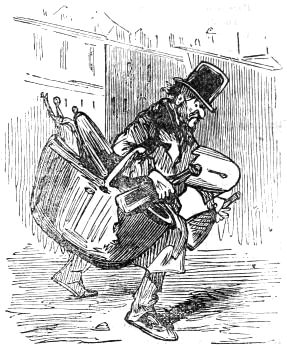
SOUND REASONING—and, as such, will be recognized by those who have been humbugged by the Brown and other lecturers who have honored us with visits from abroad:—
Lectures vs. Books.—Why a man should put on his overcoat and comforter, and a woman wrap herself in furs, mufflers, cloaks, and shawls, and the children bundle up, to face a strong nor'-wester, and go out to hear a lecture of dubious excellence, or a concert that, after all, is little better than a bore, while at home a goodly array of philosophers and poets, story-tellers and grand advisers, stand waiting to offer their services; yet not one of which looks sad if his neighbor is preferred before him—this we would wonder at, if it were not everybody's habit. If a man has weak eyes, or his thoughts find no anchorage, and if he cannot afford the luxury of a private reader, let him visit the public lecture-room, and he can get much good from it. Or if, for his sins, he has lost his home, let him go to the concert and mortify himself. But we who have homes cannot afford, first, the sacrifice of our home comforts, second, the loss of precious winter evening hours, and third, the price of tickets, unless we know of a surety that they will admit us to choice performances.
SINGULAR INSCRIPTIONS ON TOMBSTONES.
On the Duke of Marlborough:—
Here lies John, Duke of Marlborough Who run the French through and through; He married Sarah Jennings, spinster, Died at Windsor, and was buried at Westminster.
In St. Bennet's, Paul's Wharf, London:—
Here lies one More, and no more than he: One More and no More! how can that be? Why one More, and no more, may well lie here alone, But here lies one More, and that is more than one!
From Broom Churchyard, England:—
God be praised! Here is Mr. Dudley, senior, And Jane, his wife, also, Who, while living, was his superior; But see what death can do. Two of his sons also lie here, One Walter, t'other Joe; They all of them went in the year 1510 below.
In St. Michael's Churchyard, Aberystwith, is another, to the memory of David Davies, blacksmith:—
My sledge and hammer lay reclined, My bellows, too, have lost their wind, My fire's extinct, my forge decayed, And in the dust my vice is laid; My coal is spent, my iron gone, My nails are driven—my work is done.
The following epitaph is transcribed from one of the local histories of Cornwall:—
Father and mother and I, Lies buried here as under, Father and mother lies buried here, And I lies buried yonder.
From Cunwallow Churchyard, Cornwall. [It may be read either backwards or forwards.]
Shall we all die? We shall die all, All die shall we— Die all we shall.
In St. Germain's, in the Isle of Man, the following very singular epitaph is yet to be seen, in Latin, over the tomb of Dr. Samuel Rutter, formerly prebendary of Litchfield, and afterwards Bishop of Sodor and Man:—
In this house, Which I have borrowed from My brethren, the worms, lie I, SAMUEL, by Divine permission, Bishop of this island. Stop, reader; Behold and smile at THE PALACE OF A BISHOP! who died May 30, in the year 1653.
SOME FEW INSTRUCTIONS IN CROCHET-WORK, which may be of use to some of our lady readers.
In the first instance, the crochet-hook should be very smooth, made of fine steel, and fixed in handles. The stitches used are chain, slip, single, double, treble, and long treble crochet.
Chain Stitch (ch) is made by forming a loop on the thread, then inserting the hook, and drawing the thread through the loop already made. Continue this, forming a succession of stitches.
Slip Stitch is made by drawing a thread at once through any given stitch and the loop on the needle.
Single Crochet (sc). Having a loop on the needle, insert the hook in a stitch and draw the thread through in a loop. You have then two on the hook; draw the thread through both at once.
Double Crochet (dc). Twist the thread round the hook before inserting it in the stitch, through which you draw the thread in a loop. There will then be three loops on the hook; draw the thread through two, and then through the one just formed and the remaining one.
Treble Crochet (tc), and Long Treble (long tc), are worked in the same way; in treble the thread is put twice, in long treble three times, before inserting it into the stitch.
Square Crochet is also sometimes used. The squares are either open or close. An open square consists of one dc, two ch, missing two on the line beneath before making the next stitch. A close square has three successive dc. Thus any given number of close squares, followed by an open, will have so many times three dc, and one over; therefore any foundation for square crochet must have a number that can be divided by three, having one over.
To contract an Edge. This may be done in dc, tc, or long tc. Twist the thread round the hook as often as required, insert it in the work, and half do a stitch. Instead of finishing it, twist the thread round again, until the same number of loops are on, and work a stitch entirely; so that, for two stitches, there is only one head.
To join on a Thread. In joining, finish the stitch by drawing the new thread through, leaving two inches for both ends, which must be held in.
To use several Colors. This is done in single crochet. Hold the threads not in use on the edge of the work, and work them in. Change the color by beginning the stitch in the old color and finishing it with the new, continuing the work with the latter holding in the old. If only one stitch is wanted in the new color, finish one stitch and begin the next with it; then change.
To "Purl" in Netting. Bring your thread forward, and take up the inner side of the stitch, putting your needle downwards in the stitch instead of upwards, as you do in plain knitting.
PHILADELPHIA AGENCY.
"W. J. M."—Cannot send the "Lady's Book" previous to January, 1851. Wish we had the eight years to send you.
"Clara S."—Will find explanations of the abbreviations of crochet terms in this number; also March number, page 279; and in our May number we will give further directions.
"L. M. H."—Sent you patterns by mail on 18th.
"Miss A. R."—Sent your hair bracelet on the 18th.
"Miss P. S."—Sent your ring and thimble on the 19th.
"O. V. H."—Sent your gold pen on 19th.
"B. A. C."—Sent the cap patterns by mail on 19th.
"M. P. R." commits the common error of not dating letter nor giving place of residence. The postmark, like every other postmark, is illegible. One-half the letters we receive have the same omissions, giving us a great deal of trouble. We can supply the numbers; but how can we tell what the postage will be when we don't know their destination? The price of the numbers will be 25 cents. The communication was received too late for March number.
"Miss E. P."—Sent your patterns on 20th.
"Graduate" is informed that he had better advertise in the papers here for the situation he wants. There is no other way of procuring it. We have used the masculine in answering this, as "Graduate" omits letting us know whether we are addressed by a male or female. If a female, why not write the first name in full, or prefix Mrs. or Miss?
"T. G. B."—Sent Rigolet by Adams's Express on 28th.
"C. C. D."—Sent Odd Fellows' Regalia by Adams & Co.
"Miss E. C. G."—Sent cotton on the 30th.
"J. W. K."—Sent jet cross on 30th.
"Miss C. R. L."—Sent apron pattern on the 2d.
"M. R. E. P."—Sent jacquette pattern 4th.
One of our subscribers wrote us upon the subject of cutting dresses by our patterns. We have mislaid the letter. Will she please write again?
"Miss T."—Sent cotton by mail. The postage will be expensive; but cheaper than express.
"A. S. C."—Sent dress on the 7th by mail.
"Miss D. H."—Sent patterns by mail on 7th.
"Helen."—Boots to button at the side for winter wear are very fashionable here. Bronze or blue gaiter boots $3, French kid slippers $1 50. Never heard of such a mono-mania; make him wear girl's clothing until he reforms.
"S. S. S."—Sent goods by mail (the cheapest way) on the 7th.
"T. S. H."—Sent Rapp's pen by mail on the 14th.
"Miss M. F."—Sent breastpin by mail on 14th.
"Mrs. J. A. C."—Wrote and sent you circular of prices of Boardman & Gray's pianos.
"M. S. L."—Sent jewelry by mail on 18th.
"Bed Quilts."—Marseilles are almost invariably used now. Of course, they are fashionable.
"J. S. B."—Too late for March number. Cannot furnish "Lady's Book" from the commencement. We have only as far back as 1851.
"Mrs. A. V. Du B."—Sent patterns by mail on 18th.
No orders attended to unless the cash accompanies them.
All persons requiring answers by mail must send a post-office stamp.

"The wicked borroweth and payeth not again."
THE "Pennsylvania Trojan" says: "The present is decidedly the best number, in point of illustrations, reading matter, paper, and typography, ever issued, and every way worthy of the wide-spread reputation of L. A. Godey. We cannot lend this number, to show it to our friends, for Mrs. M. has taken charge of it, and is copying some very pretty patterns of embroidery from it. However, she will take pleasure in displaying its beauties to you."
Sent you a duplicate of that prospectus sheet, friend "Trojan."
GOOD.—A letter from a Ky. editor: "I have about one dozen BORROWING subscribers, who all like your 'Book' remarkably well, I presume, from their eagerness to get hold of it. I have lost one or two of these, however, as they have sent on and subscribed for themselves."
Don't lend, and we shall have the remainder of them soon.
A letter from a lady in New York State:—
"SIR: I have endeavored to be as punctual as possible in making up my club for 1854. The 'Lady's Book,' with its many charms, has become very necessary to our happiness. I am gratified that there are a few ladies among us who are sufficiently endowed with a sense of the beautiful and interesting to appreciate its worth. One of its admirable traits is that it bears acquaintance well. That race of beings who borrow everything they read is not extinct in this vicinity. But that habit, like that of drinking ardent spirits, is growing less, as decent people are ashamed to practise it."
"No loss but what falls on my head." The "Advocate," Stamford, says: "By the way, if the individual who so unceremoniously borrowed the August number will be kind enough to return it, we shall be saved the necessity of troubling Mr. Godey for a duplicate."
Of course, we had to send it.
ONE of our lady subscribers takes two copies of the "Lady's Book," so that she can have one to lend. Hard case; but it is the only way, she says, that she can secure a copy for her own perusal. We would suggest to her to slip in the copy proposals for a club of six. The price to each one would only be $1 67 for a year's subscription.

ANSWERS TO ENIGMAS IN MARCH NUMBER.
9. Mist.
10. The letter G.
11. A windmill.
12. Faith, Hope, Charity.
ENIGMAS.
13.
THE treasure that I render you Surpasses any mine of gold; 'Tis clear my sterling value, too, Is far too precious to be sold. My current stock your wants supplies, Your draughts on me I liquidate, Relieving your necessities, And keeping solvent your estate. In my transactions, though I'm deep, Still truth is e'er ascribed to me; And well continually I keep With folks who use me prudently. In banks, I never do intend My "floating capital" to trust; On firmer footing I depend, And what I am would you be—just.
14.
I'M able, by the aid of tea, A banquet to support; And when I'm following the sea, Retain my ship in port: But when effaced, then must I be Fictitious in report.
15.
I'M good for nothing, save when kept, As many a soul can tell; And should exist conceal'd, except 'Gainst honor I rebel. The happiness of many a heart Will oft depend on me; Its ease, alas! will oft depart, Whene'er I cease to be.

CHEAP CONTRIVANCE FOR FILTERING.—A very cheap and good contrivance for filtering is to take a large garden flower-pot, and lay in the bottom a piece of sponge, so as to cover the hole. Upon this put a few smooth, clean pebbles, to keep the sponge in its place, and fill up the pot, to within two or three inches of the brim, with a mixture of one part of powdered charcoal to two parts of fine sharp sand. Then cover the top of the pot with a piece of clean white flannel, tied tightly round the rim with a twine, but so as to sink or sway down in the centre. Set the flower-pot in a pan or tub, and pour the water into the flannel, letting it filter through the charcoal, &c.; and, by the time it has passed through the sponge, and come out at the bottom, it will be clear.
TO CLEANSE A TEAKETTLE FROM FUR.—Heat the kettle rapidly over a fire of shavings, having previously made it quite dry. The expansion will separate the fur from the metal, and it may then be easily removed.
TO REMOVE STAINS OF ACIDS, &C.—Stains caused by acids may be removed by tying some pearlash up in the stained part; scrape some soap in soft cold water, and boil the linen till the stain is gone. Many stains may be removed by dipping the linen in some sour buttermilk, and drying it in a hot sun, washing it afterwards in cold water. It may be found necessary to repeat this once or twice.
TO TAKE OUT IRONMOULD.—Wet the ironmould with water, and then lay the linen on a hot water-plate and put on the part a little essential salt of lemons. When it becomes dry, wet it again, and renew the process, being particular that the plate is boiling hot. Dip the linen into a good deal of water, and wash it as soon as the stain is removed, to prevent any damage from the acid.