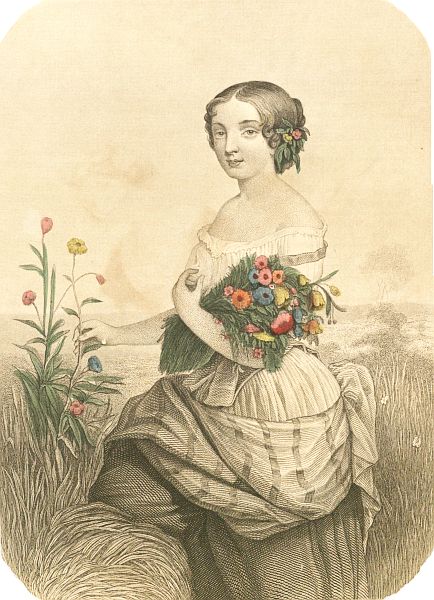
SPRING.—A BALLAD
Reading edition
BY MARY SPENSER PEASE. (See Plate.)
Spring, with its glad influences Stealing up from bosky dell, Once more quickens Nature's heart-pulse With its sunny, witching spell. Each new morn the boughs hang thicker With the leaves of Nature's book; Each new eve adds a new chapter To the life of bird and brook. Each new morn the world is greener; Age forgets its shriveled years In the warmth and life upspringing Out from Winter's chill and tears. Each new morn the song grows sweeter— Song of loving bee and bird; Each new eve, from youth and maiden, Softer cadences are heard. Each new morn her heart beat warmer, Dreaming o'er his tale of love; Each new eve, that tale repeated, Brighter spells around her wove. At the early, early daybreak, To caress her as she slept, Greetingly, the light spring zephyr Through her open lattice crept. Roving mid the golden tangles Of her tresses' braidless flow, Nestling in the half-veiled dimples Of her bosom white as snow. Mingling with her fragrant breathing, Closely to her ear it came, Murm'ring to her gentle dreaming, In sweet music, his dear name. "Through the valley, o'er the mountain," Sang the zephyr in her ear, "At my own sweet will, I wander All the loving, livelong year. "With the lowly, tender grass-blade, With the solemn, stately trees, With each swelling bud and blossom Sport I ever as I please. "All the humble wayside flowers— Daisy, king-cup, light harebell; All the tall and proud ones—Kalmia, Rose, and orchis—know me well. "Of the brightest, sweetest flower-buds, Sheltered by the mountain's brow, Blooming in the wide, wide valley, Loveliest of them all art thou. "That is why he loves thee dearly, Modest, gentle as thou art, The proud lord of wood and manor The proud lord of thy young heart. "Oh, I heard a song last evening, Sung to tremulous guitar, Through the yellow, mellow moonlight, Floating on the air afar; "Breathing warmest, truest passion For one bearing thy sweet name, Telling of that passion thwarted Bending unto station's claim: "Telling how the claim of station Must at last be overborne, By a will and faith unyielding, By a love no time can turn. "'I must see her at the day-dawn,' Sighed he, at the ballad's close, 'By the brook in the still copse-wood, Where the purple violet grows.'" Rose the maiden from her slumbers, Fresher than the break of dawn, Binding up her heavy tresses, Looked she out upon the lawn. Like a shower of yellow guineas Flashing back the morning sun, Crocuses and dandelions Half the golden fields had won. From the green and yellow shining, Flecking it with flakes of white, Drooping lilies, palest snow-drops, Spread their petals to the light. Looking out upon the copse-wood, As she clasped her simple dress, Suddenly the thought came o'er her, "I will seek its wilderness. "By the brook down in its thicket, Where the purple violet grows, I shall find the wild sweetbriar, And the wind-flower, and—who knows? "Who knows but my Edgar Lincoln May be wandering that way, Tempted by this fragrant morning— Brightest morning yet of May. "Oh, I know he loves me dearly, And he knows I love him well; That my love is deep and boundless, More than tongue of mine can tell." On she wandered, singing lightly Snatches of some olden song— How a lord and lowly maiden Loved each other well and long: How the haughty claim of station Came at last to be o'erborne By a will and faith unbending, By a love no time could turn. Singing lightly, on she wandered Over hill and meadow lone; Said she "This broad wood and valley Soon I'll proudly call my own. "Not one beggar, not one hungered Shall there be in all the land; Not one loathing life from hardship, When I'm lady proud and grand." Wandering on, she plucked wild flowers, Flowers filled with morning dew, Looking backward ever, ever, Listening for a step she knew. Press the flowers to thy soft bosom, Braid them in thy shining hair, Love them while their tender petals Fragrant life and freshness wear; For too soon they'll droop and wither, Plucked and worn but one short day, And too soon thy youth and freshness May, like them, be flung away. Light of heart, she nears the copse-wood, From its depths sweet voices throng; Voices of the jay and blue-bird, And the wild wood-robin's song. By the water-brook she's standing, Where the purple violets grow, Where the wind-flower and sweetbriar, And the starry woodbines blow. By the water-brook she's standing, And her heart begins to fail; Still she watches, still she listens, Hearing but the night-owl's wail. Silent shadows flit around her, Looming darkly, broad, and tall; But one shadow well remembered Sees she not among them all. Ah, perhaps—perhaps he may be To his vow a traitor base! Down into the clear brook glancing There she sees her own sweet face. Down into the clear brook gazing There she sees her own sweet face; Sees she also there reflected One of noble, manly grace. "Effie! Effie! late last evening," Spake he, circling her soft waist, "My proud sire—and soon thine, darling— Read the lines thy hand had traced; "Breathing of thy sweet self, Effie, Full of tenderness and truth— 'Such a heart, such wit and wisdom Must be cherished, by my sooth!' "Thus my sire—the lines re-reading Traced by thy beloved hand— Still he spake, 'Such wit, such wisdom. Would grace lady of the land!' "Then it was, my darling Effie, Pleaded I thy cause and mine— 'Yes, yes, yes, I've watched thee, youngster, Watched thee sigh, and pale, and pine!' "More he said, my darling Effie— For he knew my death he'd mourn That the haughty claim of station Is at last by love o'erborne."
SPRING. Engraved expressly for Godey's Lady's Book by J.B. Neagle.