V POEMS OF PUEBLO LAND
Reading edition

EARTH’S TERRACED BOWL
The art of the Pueblo Indians is so intimately woven into the pattern and fabric of their lives that it can hardly be called an art. It is never merely ornamental, and therefore dispensable; it is the intrinsic and indispensable mode of performing the essential acts of living, and its technique is an immediate reflection of the conditions of life. The forms which adorn the painted olla are those cloud, vegetation, and life forms which are spontaneously associated with the thought of water—a thought which is ever-present among these agriculturists in an arid country. The beads which trick out festal costumes are talismans, emblematic in the very nature of their materials and hues; and the colors which are ceremonially significant are the colors which Nature makes so varied and vivid in the soil and sky and vegetation of the Southwest. Dances themselves are as much in the character of agricultural operations and political duties as of festal holidays; and the Powers and Forces which to us are superstitions or personifications are for them normal presences. We speak of art and symbolism in connection with their modes of aesthetic expression because these are the terms with which we most nearly describe them; but it is always important in interpreting such an art to bear in mind that it has little in common, spiritually, with what in our own culture is analogous to it.
Earth’s Terraced Bowl is an interpretation of the imagery of this Pueblo art-in-life. Its purpose is to aid in our comprehension of a beautiful and ancient culture, setting the coloristic and symbolic elements into relationship with the life which they express. The site described is the plateau above the Rio Grande, at the foot of the Sangre de Cristo range, where Santa Fé is built over the ruins of an ancient pueblo, and in its modern development is bringing into new expression the art and architecture of the ancient peoples. The images chosen are, first, the Pueblo woman potter, fashioning her ceremonial bowl, of which the terraced rim is emblem of the cloud-terraces that rise above the mountains in ever-changing variety; second, the man drilling emblematic beads of shell and turquoise, of jet and abalone, such as these Indians have used from beyond the dawn of history; third, the great mid-summer dance, now devoted to the mystery of the union of heaven and earth as it appears in vegetation and in the life which is dependent upon vegetation; and fourth, the festivals of fertility and of harvest, which complete, as it were, the definition of the life of man in this simple setting.
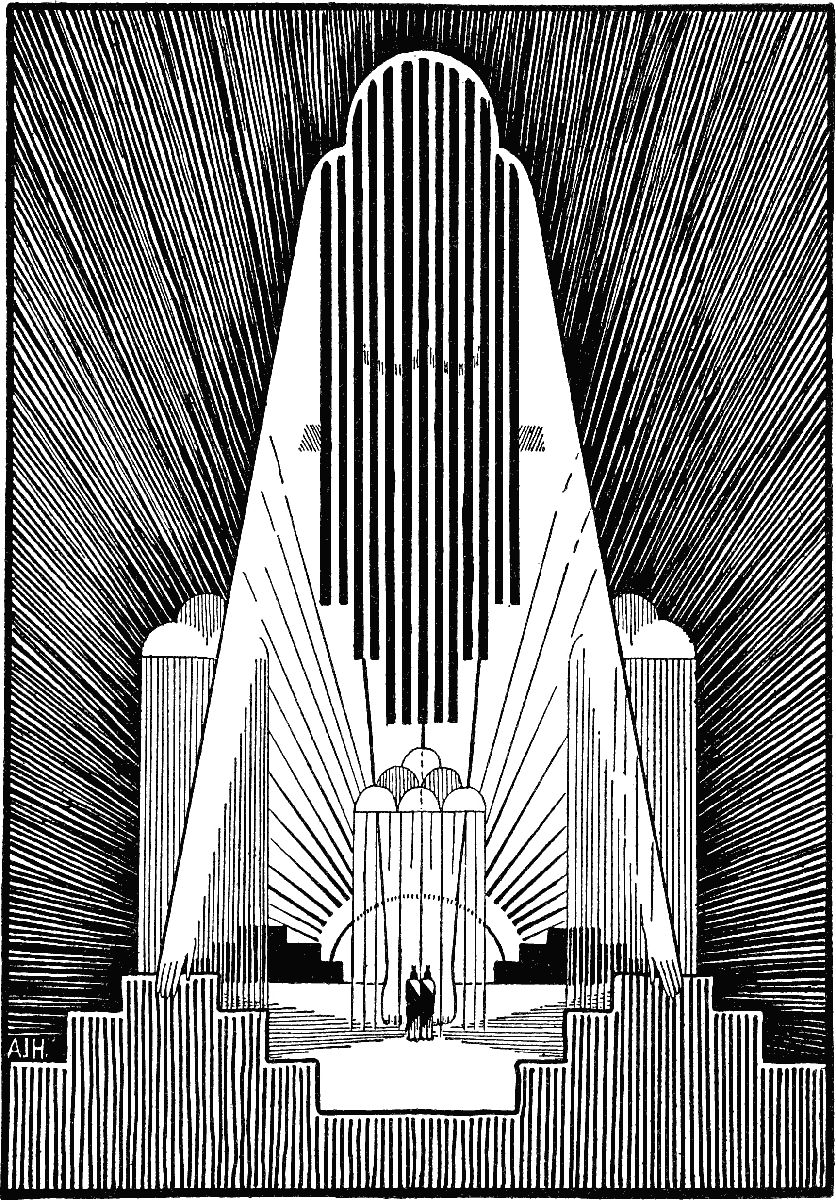
Earth’s Terraced Bowl—I
The Woman who dwells in the Place of Mists, The Woman who appears in dissolvent skies, Her body is very slender and luminous, Her hands touch the extremity of the Earth, Her feet touch softly upon the Earth!
EARTH’S TERRACED BOWL
I
Four are the terraced Mountains that uphold the Heaven in that Land and Four are the Colors that pattern the Life of Man.
In that land where the stars of the night are ever near and burning, —eyes of spirit watchers through the Black pine forest; In that land where the azures of day are quivering and intense, —precious the blue turquoise in the womb of the treasure hill; In that land where the red-scarred mesas sunder and canyon the earth, —walls of jasper and sard ribboned with malachite; In that land whose corners are keyed by heaven-locking mountains,—— Glorieta, the Herald of Morn, Sandia, who purpleth the South, Jemez, the hearth-fire of Evening, And fourth, the Hills of the North, The cloud-gloomed and crimson-flared Mountains of Bleeding Christ.... In that land doth the white cumulus froth unto the blue summit of Day, and the ochres and beryls of earth fade into violet Night; In that land do the terraced hills uphold the terracing clouds; In that land do the Weavers of Rain spin filaments many and delicate, silvering horizons many, veiling with luminous veils, baptismal with blessing.... There also marcheth the Sun in the splendor of Beauty; There also wandereth the Moon in the softness of Beauty; There all the colors unite, patterned in Beauty; There all the cloud-forms assemble, vestured in Beauty; Daily in that land man walketh in Beauty; Nightly in that land man dreameth in Beauty.
II
There the Indian Woman adorneth her potter’s work with symbols of the life that falleth from Heaven and of the life of Earth that ariseth responsive thereto.
Behold, where the Indian Woman fashioneth her Bowl of red clay! Ceremonial water it shall contain, Ceremonial meal it shall contain; It shall contain the Water and the Bread of Life, Even as holdeth this Earth the Water and the Bread of Life! Behold, earthen-red is the Bowl, smooth-rounded and rising rimmed, bordered with terraces four,—— Yea, as riseth this Earth four-terraced into the Heaven! Behold, fair-painted is the Bowl, with the forms of Heaven painted,—— cloud-terraces thereon painted, filaments of spun rain thereon painted, the wayward-darting lightning thereon painted,—— With curves many, with angles many, with lacings of thin lines, painteth she them, cunning-handed.... Who are they who give answer unto the rains, save the leaf and the flower? Who are they who joy in the freshness of sweet dews, save the bird and the butterfly? To whom shall the moisture be more precious than unto the Seeds of Life? Wherefore these also, cunning of hand, she painteth fair upon the Bowl. Therewith, painteth him who sitteth upon the margin of the high cloud, fluting,—— Him with the rain-pack humped upon his back, him the Cloud-Musician, flower-garlanded, fluting,—— Him also she painteth, cunning-handed, singing as she fashioneth her earthen Bowl, singing as she painteth thereon the forms of Heaven, singing the Song of the Cloud-Musician, singing the Song of the Beautiful Sky!
And this is her Song of the Beautiful Sky and of the Spirit Mother whose abode is in the Pool of Heaven.
“Beautiful Sky! The mountains are dark behind me; The sun is low beyond them. To the billowing cloud blown over the plain, the mountains are bidding farewell, The sun is touching it in farewell.... “Underneath, it is of the deepest blue, like the waters of soundless pools; Underneath, it is fringed with fringes of light-falling rain. But above, its face is sunward; Above, it is filmed with pale gold, as of the day-seen moon.... “Beautiful Sky! In the heart of the cloud is a perfect Rainbow, seven-hued with beauty; Over her is a perfect Rainbow—— Her spirit mother!”
III
There the Indian Man maketh him beads that are symbols of Earth’s Quarters and of the Place of Man’s Life, central in the World.
Behold, the Indian Man, where he drilleth and polisheth—— Where he maketh him beads of four significant colors, Talismans shapeth him, singing the Song of his Central Life! White shell beads—— Are not the disks of Dawn faint-lustrous, as on the Eastern crests fall the earliest footfalls of Morning? Turquoise beads—— Broken are the shapes, irregular spaces of azure, where the white clouds part, to mottle and pattern the sky.... Talismans of crystal—— Clear is the bubble of Day, zenith-high it is blown when all things are perfect! So the Father and the Mother In their Night of Meditation First the lustre of the Dawn laid, Then the azure light of Morning, Touched them with translucent crystal, Touched, and lighted perfect Day! Talismans of black stone—— Jet as the starless Night, as the cloud-enfolded Night.... Talismans of abalone—— Opalled as is Evening on the Western Sea, many-reflecting,—— These also shapeth he him, remembering.... For whither shall they pass, whose sun is in the West? And whither shall they pass, whose lodge is in the deep Earth? Theirs are the many reflections of the Sunset land! Theirs is the black unfathomed Night! Behold, the Indian, where he sitteth beside his hearth, Making him beads of four significant colors; Singing the Song of his Central Life, Singing the Song of this Middle Place!
The four colors of the Wheel of Day and the four colors of the Circle of the Earth unite in the Middle Place, this is the song of the Indian Man, as the winds of his mind are singing it.
“White light of Dawn, Blue light of Day, Saffrons of Sunset, Thereafter swooning Night: “In the Middle Place all are gathered together—— Morning and the East, Nooning and the South, The vanishing Eve of the West, And Northering Night: “In the Middle Place all colors meet, To the Middle Place the Four Winds blow: The Circle of the Earth, The Wheel of Day, In the Middle Place they are united: “I am the Middle Place! I am the Central Man! The life of the Four Winds is my breathing life, All colors unite to illuminate me!”
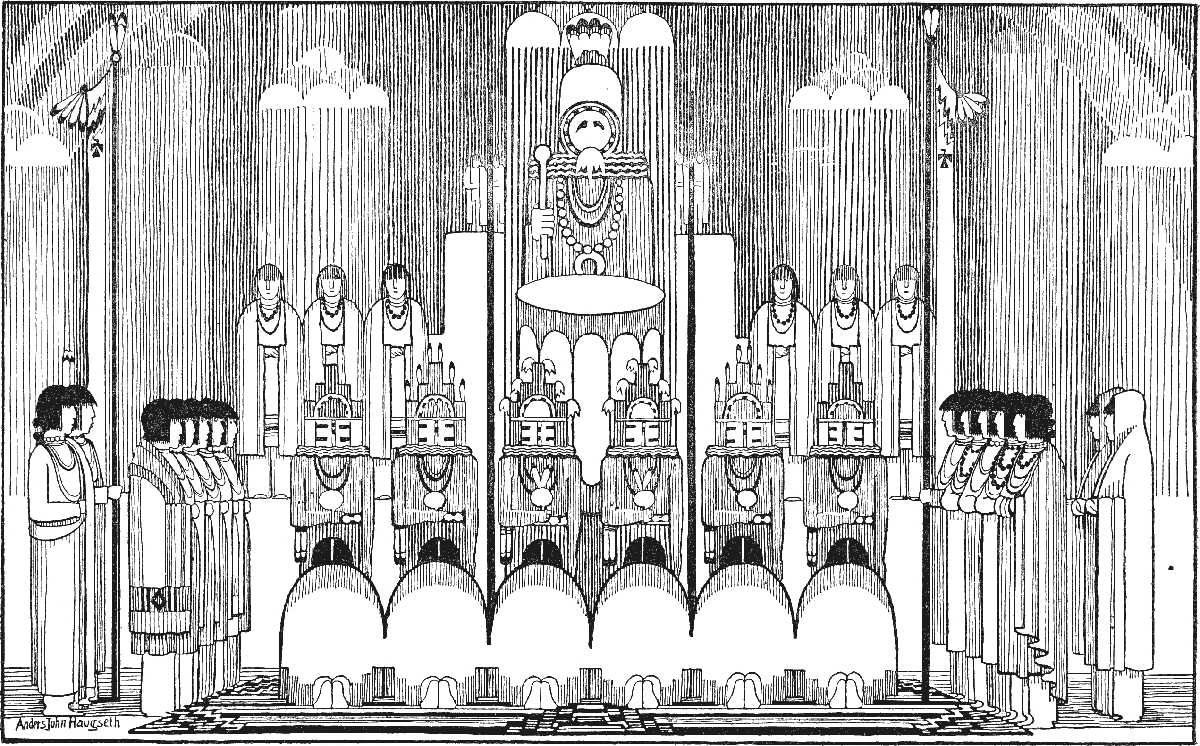
Earth’s Terraced Bowl—II
I am the Middle Place! I am the Central Man! The Life of the Four Winds is my breathing life, All colors unite to illuminate me!
IV
There, also, the tribes of the Red Men dance the images of man’s life: the Fertilization of the Fields, they dance; the upgrowing of the Corn; and the Summer, and the Winter, which are the seasons of life.
Behold, the Musicians of Summer, the Indian Musicians, chanting! Yellow and blue are the colors of the drums, whereto the dancers dance—— The Dancers of Summer, crested with iridescent feathers, like the many colors of flowers, Crested with wisps of featherdown, like the cloud-breaths of summer winds in the blue bowl of Heaven.... Is not blue the color of the South, whence the Summer cometh? Is not the resplendent Sun robed in shining yellow? Twain are the Seasons of the Year, as they dance alternating: The Summer advances dancing, and it recedes; The Winter advances dancing, and it recedes.... Twain also are the divisions of men, as they dance in alternation. Behold, the Musicians of Winter, the Indian Musicians, chanting! Red and green are the colors of their drums, whereto their dancers dance—— The Dancers of Winter, their bodies with red earth many-symboled, in their hands the cypress-green rhythmically waving.... Is not the bare earth red, where it gleams between the snows? Are not the snow-bent brows of the cypress Wintergreen? Twain are the Great Seasons, as they dance the Year, alternating; Twain also are the divisions of men where they dance the Life of the World—— Male and female they dance, twofold in each division,—— verily, as the Year is twofold in each division.... Particolored their drums, where they dance, particolored their festal costumes; Their voices they uplift in song, in the Song of the Color Mixer, singing Him who apportioneth all, who adorneth the World in Beauty, who maketh all perfect in Beauty!
Here followeth the Song of the Color Mixer, who createth the World with the music of his drum, who painteth the Year with his light.
“Shining in four Times, Shining in four Directions,—— Thus the Color Mixer hath created it! “First is the blue—— The little clouds that float up from the South, These are the breaths of Spring! “Thereafter, the green—— All the Earth waveth with green-verdant feathers Where the Summer Sun cometh forth, radiant in the East! “Red-yellow is the third color—— In the West the mountains of Autumn are variegated,—— Red earth and yellow, red berries and yellow! “White also is a color—— Many times it is shadowed with blue, As if the Wintry North were remembering Spring! “These make up the Year, These make up the World,—— Thus the Color Mixer hath created it!”
V
The Tribes of the Red Men rejoice in their fields, thinking with thankfulness of the Cloud Spirits which have caused the Goodness of Life to descend, and of the Rainbow Woman who hath woven the colors of her body into the several-colored maize, and of the Corn Maidens, with the pollen-hued butterflies at their lips.
Behold, the Tribes, where they rejoice in the bounties of the harvest! Men and women are there, and youths, laughter-loving; Mothers are there, and children merry of limb; The friendly animals are there, the sport-eager dog, the burro, burden-bearing. Many songs are sung in the midst of the maize-fields; Many colors gleam where the people move to and fro, Where they gather the sheathéd ears, the ears hard-ripened, Where they gather the crispéd maize, gleaning the several colors. Many the songs that are sung, and many the altars made precious With gift of well-drilled bead, with polished talisman, With fields of waving feathers bearing the plume-winged prayers, Where from the terraced Bowl the sacred meal is scattered....
While the harvesters bethink them, Singing, where the maize they gather, Of the dancing Cloud-born Women, Of the Maidens of the Mist-Foam, Of the Daughters of the Sunbeams, Of the shining Rainbow-Mother In her stripes of many colors, Like the corn of many colors....
The Song of the Rainbow Woman, whose body archeth the Fields of Life, is on the lips of the Harvesters.
“The Woman who dwells in the Place of Mists, The Woman who appears in dissolvent skies, Her body is very slender and luminous, Her hands touch the extremity of the Earth, Her feet touch softly upon the Earth! “Adorned is her body with many and beautiful colors, With the green of tender grass it is adorned, With the blue of feathery lupine it is adorned, With the red of glowing cactus, With the yellow of bright pollen.... “Daughter Corn is likewise adorned with colors, Blue corn there is and red corn, Yellow corn there is and white corn: All corn grows upon the bladed green, Touched by the luminous sunlight, watered by crystal dews.... “The Woman who dwells in the Place of Mists, Arching the caverns of the clouds, Arching the Earth with Beauty! Bride she is of the luminous Sun,—— Their offspring is corn of all colors!”
VI
The colors of the World’s Quarters and the colors of the Year are united in the Land itself, to paint the walks of Man’s Life with beauty.
Thus speaketh that Land where the colors are gathered together, Thus singeth the Heart of Man in the shining land of the mesas, Where he watcheth the Weavers of Rain spin and pattern their fabrics, Where Earth lifteth terraced hills and the Heavens are terraced with glories! Four are the Hills of the Life of Man, Four are the steps of Earth’s terraced Bowl, Its corners are keyed with Heaven above, Its Pattern of old was made whole— in that Land where man walketh in Beauty, in that Land where man dreameth in Beauty!
THE CORN MAIDENS
(A Pueblo Cycle)
The Chief Singer remembereth the Powers of Life:
Five are the Beings which alone are necessary—— Five are the Great Beings which man must know if he would live. Whereof the first is the Shining Sun, father of all things illumined with life; Whereof the second is Earth, Mother of Men; Whereof the third is Water, who is Elder of All; And the fourth whereof is Fire, who is Elder of All. Central is the fifth—— Central are our Brothers and Sisters of the Fields of Corn, Central are our Brothers and Sisters the Seeds of Growing Things. Five are the Beings which alone are necessary—— Five are the Beings whereby men live.
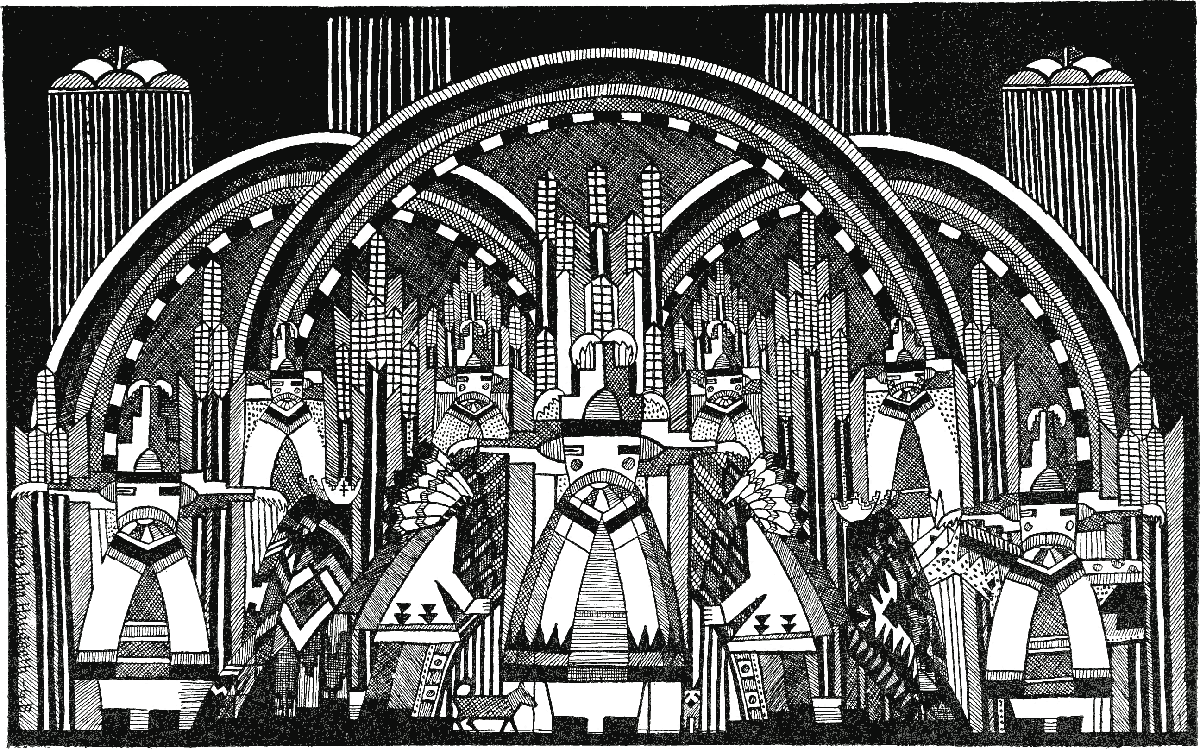
The Corn Maidens
All, all is beautiful! The Seeds of Life are beautiful! The Gifts of Life are beautiful! Men walk in beauty! The Children walk in beauty!
The Warriors of Light issue from Sipapú:
Hail to the Light! Hail to the Light!
The Sun of our Day is arisen, The glory of Dawn fills our eyes! Forth from the gloom of our prison, Greeting the azuring skies! Led on by the Warriors of Morning, Led forth by the Archers of Light, New splendors our bodies adorning, We come from the mothering Night! Our hearts are as dancers upleaping! Our spirits a jubilant song! Like summer-winged birds we come sweeping, Throng within luminous throng! Hailing the Light in its wonder! Hailing the Heaven in its blaze! Where the Dawning hath burst it asunder, Filling with glory our days!
Hail to the Light! Hail to the Light!
The Earth is like a great drum beneath their feet:
The Earth is throbbing like a drum—— Booming, reverberating, Throbbing with deep pulsation.... So my heart is beating deeply, So my heart is reverberating....
The Corn Maidens are greeted with choric song:
O ye Maidens! O ye Maidens! O ye Maidens of the Corn! Treasure bringing, Pleasure singing, Joy with you is yearly born! With beauty ye our lives adorn!
Ye are the Sisters of the singing Trees; Ye are the Daughters of the sighing Fields; O’er your silks and tassels throng the humming bees Gathering the honeys which your pollen yields! Round your grateful roots the nursing waters run, Under leafy shelters the swelling corn-ears form, With their precious kernels growing one by one, Ripening for the harvest-day, sheathéd from all harm! Earth with fields a-dancing ye make beautiful! Earth with hues entrancing ever ye make fair! The vessel of rejoicing ye keep forever full! The singing of your voices fills the singing air!
O ye Maidens! O ye Maidens! O ye Maidens of the Corn! Planting, tilling, Baskets filling—— Joy with you is yearly born, Where with beauty, where with beauty Yearly ye our lives adorn!
The Flute Musician summoneth to cool slumber:
Cool wells of water, Clear wells of sweet water, I slumber beside them.... Star phantoms in water, Dream phantoms in water, I gaze on them slumbering.... Echoing voices of women, Echoing from the still water, I harken them slumbering.... Liquid melodies lingering, Floating faint o’er the water, Soothe my soul in its slumber.... Where the pools lie silent, Deep and placid the water, I sink into slumber.... Where life’s wanderings vanish, Sunk in the shadowless water, Fade the dim phantoms of slumber....
The Morning Star summoneth the Corn Maidens:
Come away! Come away! Come away! Over the crest of the Southland, Over the marge of the Year! Into the Gardens of Summer, Into Fields ever green, ever dear! Unto the Land of Rejoicing, Unto the Dancers of Cheer!
Where the Sons of Morning waken through the circles of the Sky, And the zonéd World refreshened turneth with exultant cry, While the flaming Sun ascendant leapeth shouting zenith-high! There the fields in glowing colors down the bright horizons throng; There the minstrel winds beguiling mellow music bear along, And the heart of life upspringeth in a jubilance of song!
Come away! Come away! Come away! Into the Gardens of Summer, Over the marge of the Year! Fleet to the Land of Rejoicing—— Fleet with the Dancers of Cheer!
The Corn Maidens linger in the Place of Mist and Dew:
Mists of Morning dreamily ascending—— Earth and Heaven in one being blending.... Upcoming corn, Tender-green corn.... Breaths of Summer balmy-fragrant blowing—— Crystal dews upon the corn-leaves glowing.... Silkening corn, Tasseling corn.... Butterflies from honey-cups sweet sipping—— Pollen-dews upon the corn low-dripping.... Ear-forming corn, Kernelling corn.... Feathered wings of birds the blue sky covering—— Golden haze o’er all the cornfields hovering.... Ripening corn, Hardening corn.... Many colors through the wide fields dancing—— Laughing sunlight o’er the cornlands glancing.... Crisp-sheathéd corn, Harvest-ripe corn....
Sun’s Gleam parteth the mists and revealeth the Rainbow Woman:
Sun Gleam! Sun Gleam! Part thou the Mists of their Concealment! Cleave thou the clouds that do them veil! Sun Gleam! Sun Gleam! Bare thou the way to their revealment! Blaze to their biding-place swift trail!
The Choir watcheth with eagerness:
Lo, now she cometh glory-vestured—— Daughter of Joy! Daughter of Day! Lo, now she cometh beauty-splendored, Crested with Sun-Father’s ray! She bursteth the seals of the Night, The lair of the hidden layeth bare! She scattereth with lances of light The demons of Earth and of Air! She maketh still places to shout, The caverns of silence to sing! The choirs of the hills wide about With joy of her radiance ring! Lo, she darteth her arrows flame-feathered! The fog-hidden bursteth aglow! Up, up, from the arches of crystal Springeth the Mist-Mother’s Bow!
The Rainbow Woman approacheth the Zenith:
O Woman of the Rainbow, we hail thee! Daughter of Sun Gleam, we hail thee! The Place of Concealment is found! Abode of the precious Corn Maidens!
The Choir chanteth the beauty of the World:
All, all is beautiful! Once again all is beautiful! The Fathering Sun, The Mothering Earth, Yearn unto one another, Warm unto one another, Where all is beautiful! The rain-fringéd clouds, The light-gleaming dew,—— Crystal of Heaven, Crystal of Earth,—— In their freshness all is beautiful! Fair blossoms of flowers, Fair pollens of corn,—— The meadows rejoice in them, The fields rejoice in them,—— In their fragrance all is beautiful! Colored plumes of the World, Colored kernels of corn,—— Day they make precious, Life they make precious,—— In their fruitfulness all is beautiful! Yea, all, all is beautiful! The Seeds of Life are beautiful! The Gifts of Life are beautiful! Men walk in beauty! The Children walk in beauty!
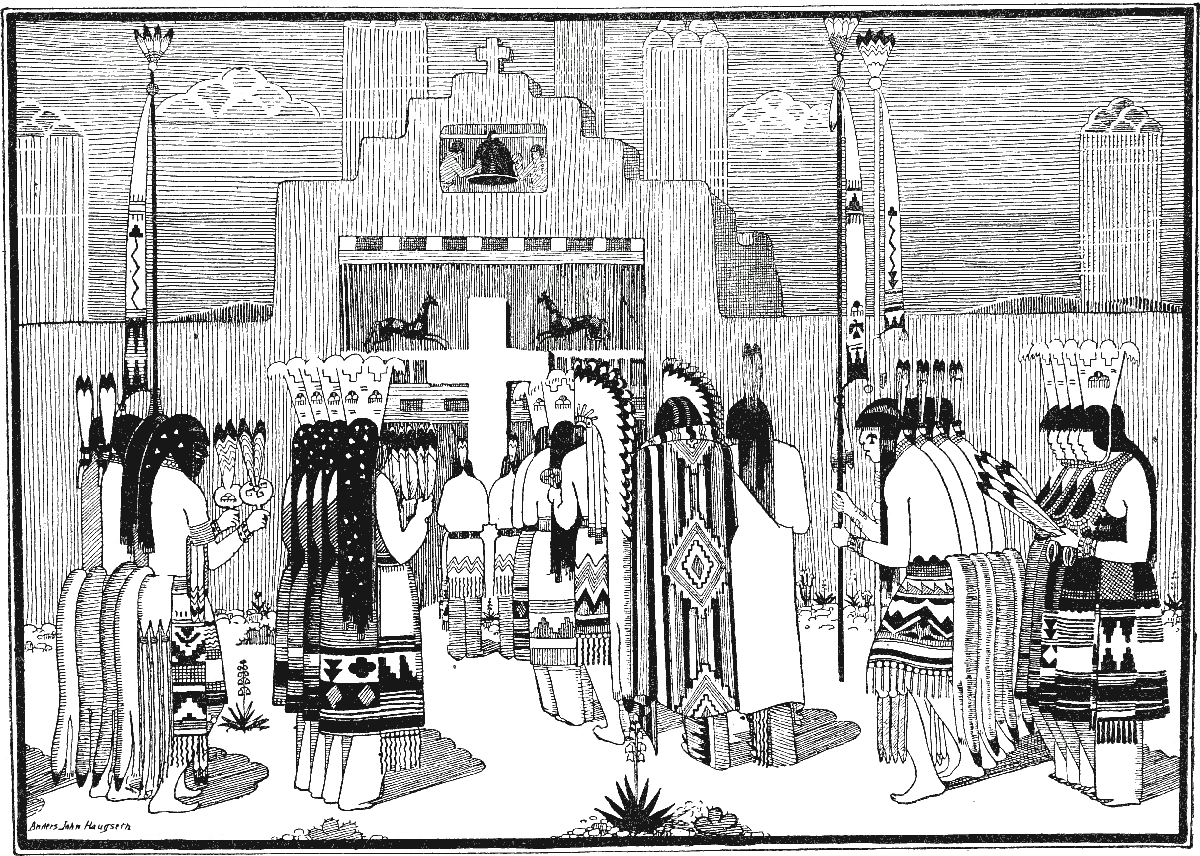
Saint Dominic’s Day—I
They gather at the mud-walled church, A crew of motlied folk, In gala dress their saint to bless, In striped and fringéd cloak....
SAINT DOMINIC’S DAY
August 4, Pueblo of Santo Domingo
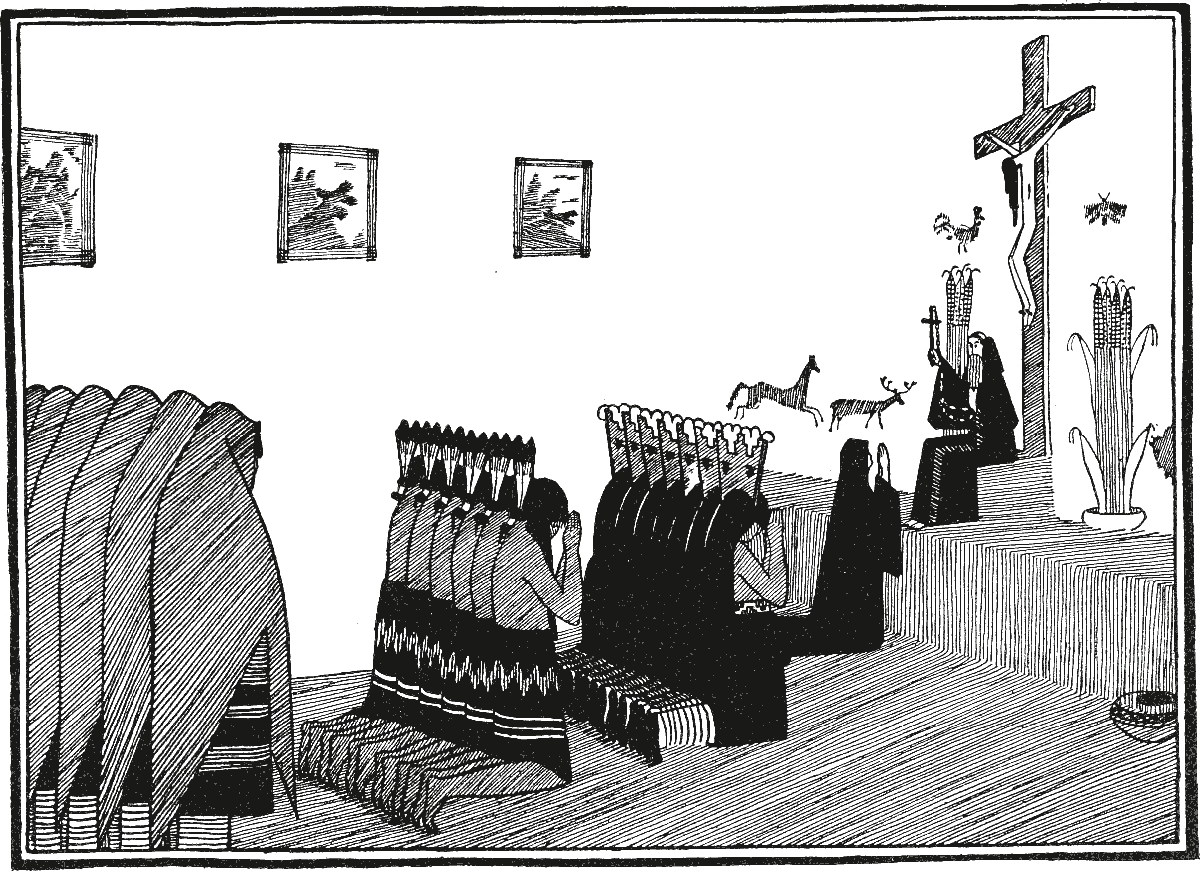
A blessed Saint is Dominic And blessed folk are they, In many a land, ’neath many a sun, Who keep his holy day—— Who gift of waxen tapers bring And kneel them down to pray: Who kneel before his image bright With golden-bearded face And gilded robe and coronet And beg of him a grace—— Where they keep the dear Saint’s festival In many an outland place. ’Tis in the time of the tasseled maize When the fields are plumed with green And the mesas of the terraced land Red-wall them in between, While overhead the cloud-flecked sky Is lazily serene,—— ’Tis in this time men dance the corn That the harvest be not lean. They gather at the mud-walled church, A crew of motlied folk, In gala dress their Saint to bless, In striped and fringéd cloak, In beaded shirt and blanket gay, Answering the bellman’s stroke: They heed them well the chiméd bell, They go within to pray Where golden-bearded Dominic In festival array—— The blessed Saint in festal paint—— Smiles pleasantly that day: He smiles upon each worshipper Who enters at the door And makes the sign of Christian faith From the bowl that stands before—— The bowl with olden pagan things Obscurely patterned o’er,—— Who kneels before the sanguined rail, The Virgin in her blue, The Christ upon his painted Cross,—— And nigh them, bright of hue, A pony and a buffalo Some dark-skinned artist drew, With cock and stag and butterfly, And maize just as it grew All greened and bannered in the fields Long ages ere the day The foreign priest had brought the feast Of Dominic that way—— The long-robed priest had taught the feast And taught the words to say When in the time of tasseled maize For plenty men must pray: And so they gather at the church, As now for many a year, Within its old adobe walls Holy mass to hear While they kneel where dear Saint Dominic Sits smiling pleasant cheer,—— For corn will grow as all men know If Dominic be near. With beating drum and rattling shell, With gunshot and with shout, Beneath a flaunting canopy They bring the bright Saint out,—— The priest with gold-rimmed spectacles, The friar gowned and stout, The squaw, the chief, the blanket-man,—— Color a-flame in the motlied clan,—— The lanky long-haired scout Nigh a bronzen, earringed Navaho Lingering thereabout. They march them down the earthen street,—— Each house must Dominic grace; They chant a hymn in the Latin tongue Which Old World centuries have sung; They come to the village place, Where in his shrine made blanket-gay, They set the Saint to face The motlied throng that march with song Into the sunny space—— White, golden-bearded Dominic Sainting a dark-skin race. Oh, skies are blue where all day through The painted dancers come With plumes a-flare in their dusky hair, With rattle and with drum—— In bright array with bannered display, All timed to the rhythmic drum! Oh, earth is fair in the sunny air, With her fields of flowing green, Where the mesas of the terraced land Red-wall them in between—— And the folk are gay as they dance the day That the harvest be not lean!
Saint Dominic’s Day—II
They kneel before the sanguined rail, The Virgin in her blue, The Christ upon his painted cross,— And nigh them, bright of hue, A pony and a buffalo Some dark-skinned artist drew.
With naked bodies striped and daubed, With flaming parrot crest, Bright necklaces, and terraced crowns Adorned with floating featherdowns—— Earth with the sunlight blest! And ghostly white Koshare clowns, Like souls that know no rest—— Like living souls with ancient things Uncannily possessed! To rattle and drum the dancers come, The dust-brown earth they beat, While the singers intone an heathen drone Where they follow with rhythmic feet—— An heathen drone which their sires had known Would make the harvest sweet! They come before Saint Dominic, They dance the growing maize, Its planting and its tasseling, Full-bladed summer days, And the dews and rains that fill the grains, And the purple harvest haze—— The life that lies in Mother Earth And in bright Sun-Father’s rays: Dancing they sing the antique song That made the maize to grow Or ever Christian priest or saint Their sires had come to know—— Dancing they sing an heathen thing Out of the long ago—— That brought fair yield to the tilléd field Dim centuries ago. Yes, a blessed Saint is Dominic And blessed folk are they Who come with dancing feet to meet Upon his holy day—— Who tapers bring and old songs sing And reverently pray Kneeling before his image bright With its golden-bearded face, As the priests had taught when first they brought Their Saint to the dark-skin race,—— Who should keep each year his festival In their ancient dancing-place.
Flower Alone
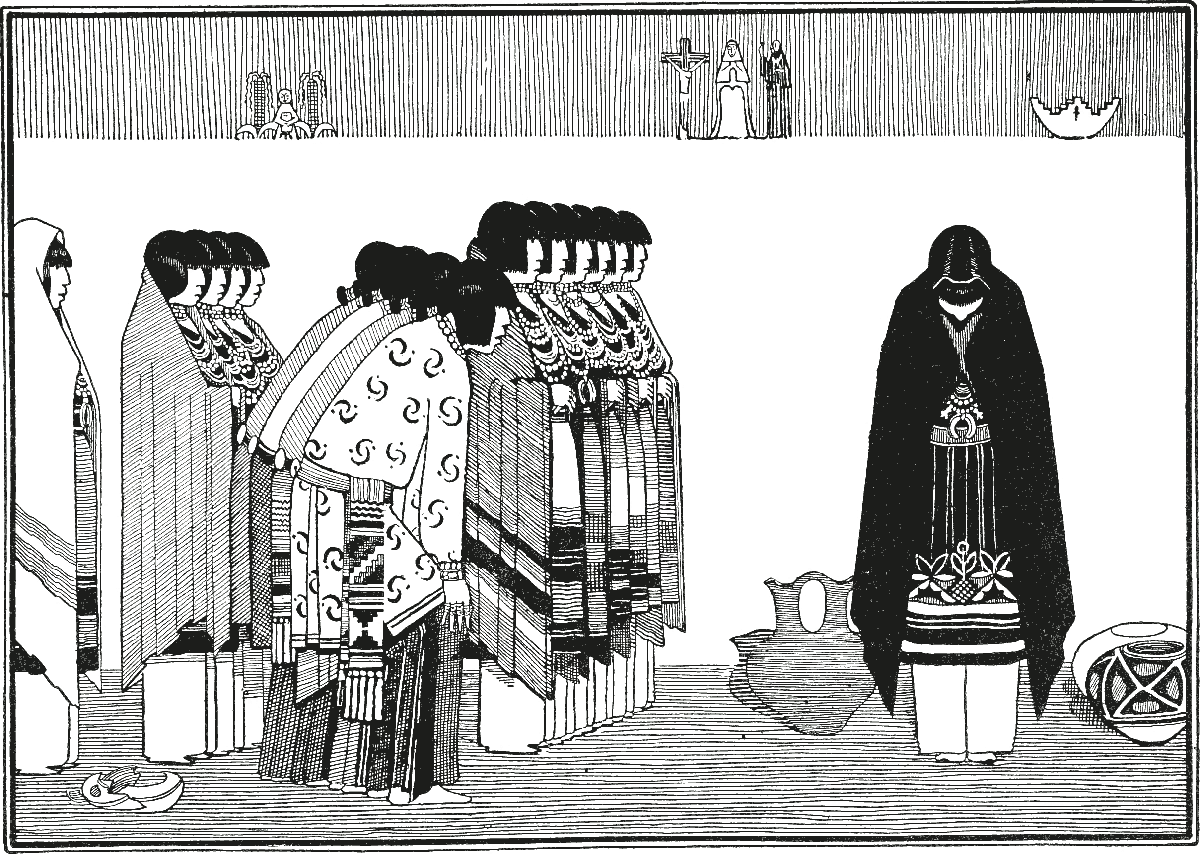
They mocked her for her outland ways, They jeered her kin and clan.
FLOWER ALONE
A Santa Clara woman In Sant’ Domingo town, Her rights were less than human That day at red sundown,—— They made her less than dogs are made Within the stranger town. Oh, she was wicked merry On Santa Clara street! Red-brown as a berry, Hale as ripened wheat; And he who came to woo her, He came on dancing feet. Round his raven locks a kerchief gay, His belt of the silver wrought,—— From Sant’ Domingo all the way With none but her in thought: A braided scarf, a turquoise ring, These were the gifts he brought. Why should she heed the old wives’ saw? “A bride should seek her bed “Within the pale of the village law “Wherein she hath been bred.” At old wives’ tales and old wives’ wails She shook a saucy head. And so in Sant’ Domingo town She ground her daily corn; She drew her water at the well, And there her babe was born; And earthen pots she made to sell And quaintly did adorn. A Santa Clara woman Within a stranger town, Its folk were more than human To hold her as their own: A saucy-head she had been bred, Should they not bring her down? They mocked her for her outland ways, They jeered her kin and clan; They whispered evil of her days, They won away her man,—— A saucy-head she had been bred, But, oh, her heart grew wan! They babbled evil of her days And evil of her art; They mocked, they jeered, they came to gaze Where she bode with aching heart,—— Where moody-eyed in her alien pride With her babe she sat apart. A Santa Clara woman In Sant’ Domingo town, They made her less than human, And the hour was red sundown When from cut and gash of the plaited lash Crimson her blood ran down. Crimson her blood as the setting sun, But never to blow or curse Did she open her lips till their work was done And they left her for better or worse,—— Till they dragged her tied to a horse’s tail And left her for a corse. She lay beside the beasts’ corral, Her body as the dead, And dimly she heard the tiny call Of her babe that would be fed,—— Dimly she heard, and she did crawl To nurse it, while she bled. A Santa Clara woman Within a stranger town; Her rights were less than human When redly the sun went down,—— But the babe that was born of her body She nursed while the blood ran down. With curious eyes I watched her at work Where she plied her potter’s art And creatures drew with cunning hand, Bright for the white man’s mart,—— I wondered at the blood-red band Limned to each crimsoned heart.
The Pottery Peddler
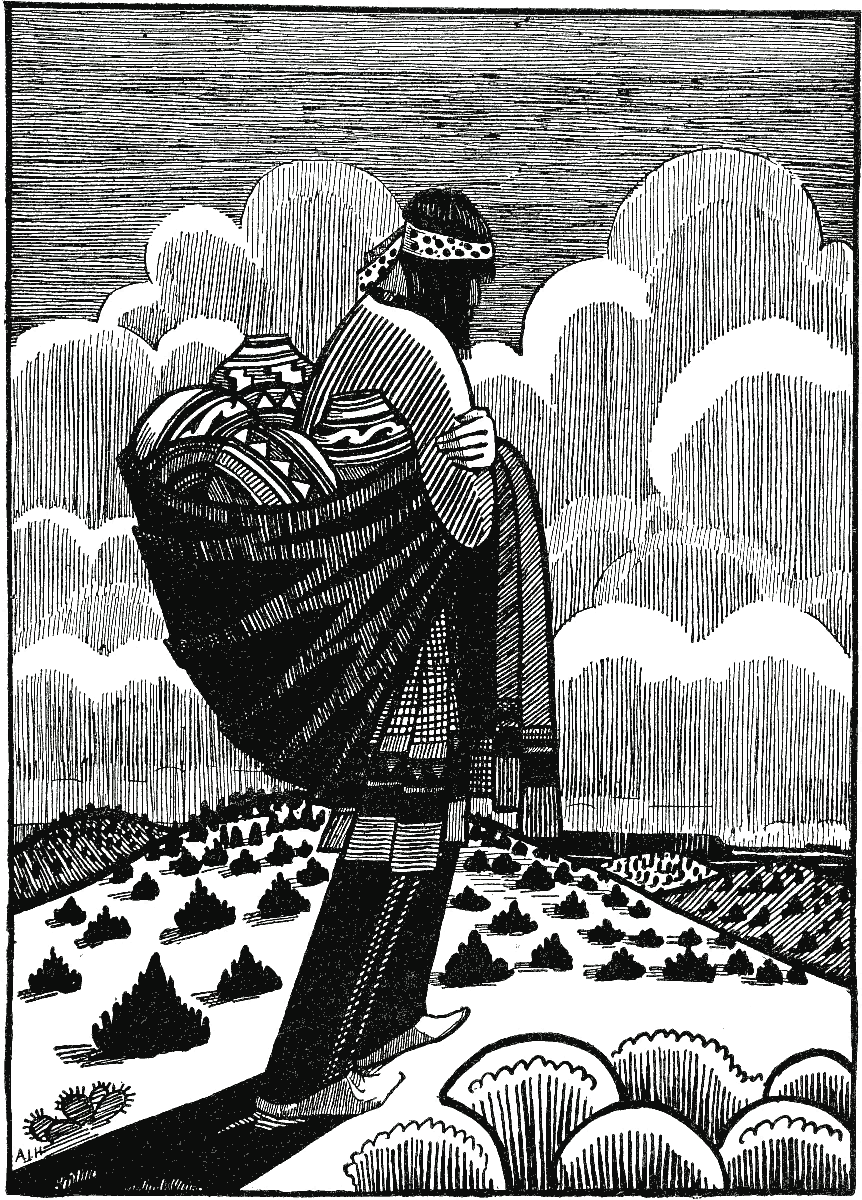
His step was soundless and he seemed A phantom in the land.
THE POTTERY PEDDLER
I saw him with his pack of wares, Spoil of an ancient craft,—— His body supple as the bow After the true-sped shaft: I liked the weave of banded wool That girt him at the thighs; I liked the glint of gaudy things That filled me with surmise: The abalone at his ears, His beaded turquoise string; The kerchief round his glossy hair—— Red on a blackbird’s wing: I liked the silver where its hue Shone on his earth-brown skin, And, oh, his patient eyes I liked, All smouldering within. I saw him loping up the road Made by the white man’s hand: His step was soundless, and he seemed A phantom in the land. I saw him on a white man’s street—— And, lo, the street was gone A century of centuries While still mine eyes looked on! And I beheld him, lithe and proud, Chief upon plain and hill,—— The eagle was his panoply, The mountain lion his kill: About him thronged his earth-brown kin, Rhythmic with the drum,—— I saw their gleaming feathers And their bright musicians come: I saw them with their patterned robes, Their glint of gaudy things, Their greens, their reds, their silver whites, Their dangles and their rings: A century of centuries While still mine eyes looked on: An Indian—and the white man’s street Ten thousand years agone!
The Dead Pueblo—I But yesterday its people passed Into their silence and their night, Leaving their broken walls to glow Encrimsoned by the shafted light.
THE DEAD PUEBLO
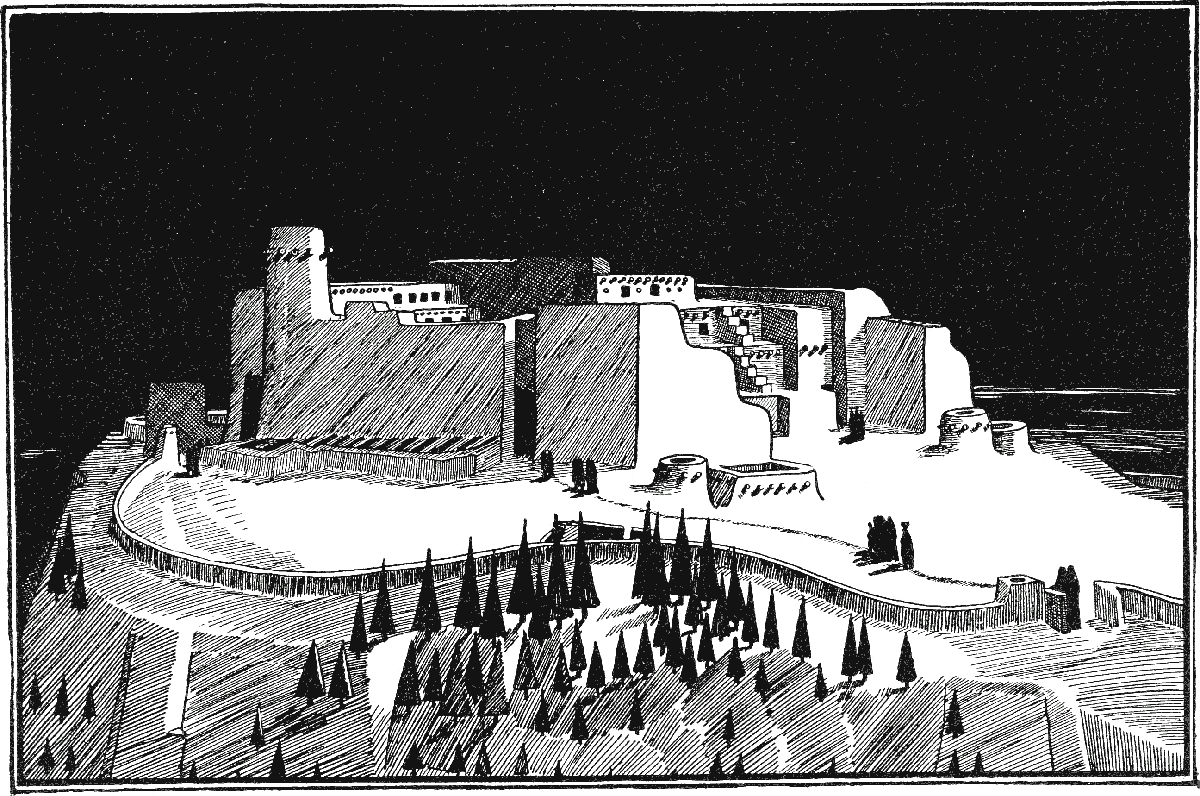
In 1838 the dozen or so of Indians, who comprised at that time the fading population of Pecos, abandoned their ancient pueblo and took refuge with their kinfolk of Jemez from the unceasing Comanche raids, which for more than a century had been diminishing the tribe. This closed a period of continuous occupation estimated by archaeologists at more than fifteen hundred years, during which the pueblo had become the most powerful in the Rio Grande region. A veritable fortress on its final site,—for it had been removed to the mesa top from an earlier location across the arroyo,—it is believed that Pecos had been founded as a result of the growing attacks of the wild tribes of the Plains and Desert upon the scattered farming communities of the fertile valleys and uplands of the vicinity. For many centuries and through many shifts of the local culture (by no means primitive when Pecos was founded) the community grew in strength—an eastern outpost of the Pueblo civilization. When in 1540 Coronado entered New Mexico in quest of the “seven cities of Cibola,” the people of Cicuyé (a Tewa name by which Pecos became known to the Spaniards) sent a delegation with presents, offering their friendship. Hernando de Alvarado was despatched to the town, where, says the chronicler Castañeda, “the people came out with signs of joy, and brought them into the town with drums and pipes and something like flutes, of which they had a great many; they made many presents of cloth and turquoises, of which there are quantities in that region; and the Spaniards enjoyed themselves for several days.” Of the village Castañeda says: “The houses are all alike, four stories high. One can go over the top of the whole village without there being a street to hinder. There are corridors going all around it at the first two stories, by which one can go around the whole village.... The people of this village boast that no one has been able to conquer them and that they can conquer whatever villages they wish.” It was at Pecos that the Spaniards found the Plains Indian “El Turco,” who told of the wonderful Quivera and lured them on into the expedition toward the Missouri River. When finally Coronado returned to Mexico, Friar Luis, a lay brother, remained at Pecos, one of the two first missionaries of the region. Castañeda writes: “Nothing more has been heard about him; but before the army left Tiguex some men who went to take him a number of sheep met him as he was on his way to visit some other villages.... He felt very hopeful that he was liked at the village [Pecos] and that his teaching would bear fruit, although he complained that the old men were falling away from him. I, for my part, believe that they finally killed him.” Later the Franciscans built at Pecos one of their largest establishments, now a massive ruin.
THE DEAD PUEBLO
I
A valley with its ancient hills Deep-founded in earth’s adamant And crested dark with driven cloud, Like warrior’s trophies blown aslant: With zenith-high a riven space, Whence royal from his azured zones The golden sun strikes sheer where lie The dead pueblo’s fallen stones: A ruin upon the mesa top Above the scarred arroyo’s sands, Its ochres crimsoned by the glow, Mid rock-strewn solitudes it stands: Where citadelled as now with light Its ramparts stood a thousand years, The valley’s strong Acropolis Against the gathering murk of fears: When Caesars held imperial sway Its dusky warriors manned their wall; Round council-fires its chieftains sate When Roland fell at Roncevalles: What time the looms of Flanders wove, Its women spun their fleecy thread; They fashioned earthen burial jars While wailing mere mourned Arthur dead: The dancers gathered to its feasts The while Columbus sailed the seas; At Coronado curious gazed Its children from their mothers’ knees: And there where now is grass-grown nave, Walls summer-breached and winter-rent, To pray before a Christian saint Came many a dark-hued penitent: But yesterday its people passed Into their silence and their night, Leaving their broken walls to glow Encrimsoned by the shafted light: Leaving their valley’s purpled hills To gather glamours and to brood, Scornful of man and his phantom years, In vast and patient solitude.
II
In the days of the Sires of the People Came the First-remembered of Men Forth from the wombs of mothering Night, To seek their Sign and to find their Light, And to hew them homes mid the virgin loams, Then, as ever again. Out of the mists of the past they marched, Children of Earth and of Sky,—— The red-soil land was theirs to claim, The hill-born torrent their flood to tame, And avalanche-thrown was the quarry-stone For their houses builded high. They gathered them where the valleys smiled, They gathered them, tribe and clan,—— They laid their walls through the sunny days; They broke their fields and they tilled their maize, And they sang them airs and chanted them prayers That come with the joy of man. Till up from the glowing desert, And up from the wandering plain, The greased and painted warriors crept With sudden whoop on them that slept—— Like wolves in bands from the famished lands,—— And they left a bloody stain. They ravaged the peaceful farmsteads, They shattered and scattered the folk, And they filled the land with a deathly spell, Where Apache stealth and Comanche yell And the treacherous blow of the Navaho Their nightly terrors woke. Till the chieftains counselled in sorrow Mid the sound of women’s woe, And they swore to build them a fortress-keep, And to hold their lands, and to sow and reap Where Sacred Earth had given them birth, Whatso might be their foe! And they set the rocks of their citadel On the mesa’s granite crest, And their terraces rose till the barren space Became a nation’s gathering place, And the red light shone from the stubborn stone Where the People dwelt at rest. And a new Age dawned and their troubled Morn Passed into the splendid Day; And they sang from their roofs when their work was done High-chanted hymns to the Fathering Sun; And their bows were strong and the arrow’s prong Kept the carrion tribes at bay.
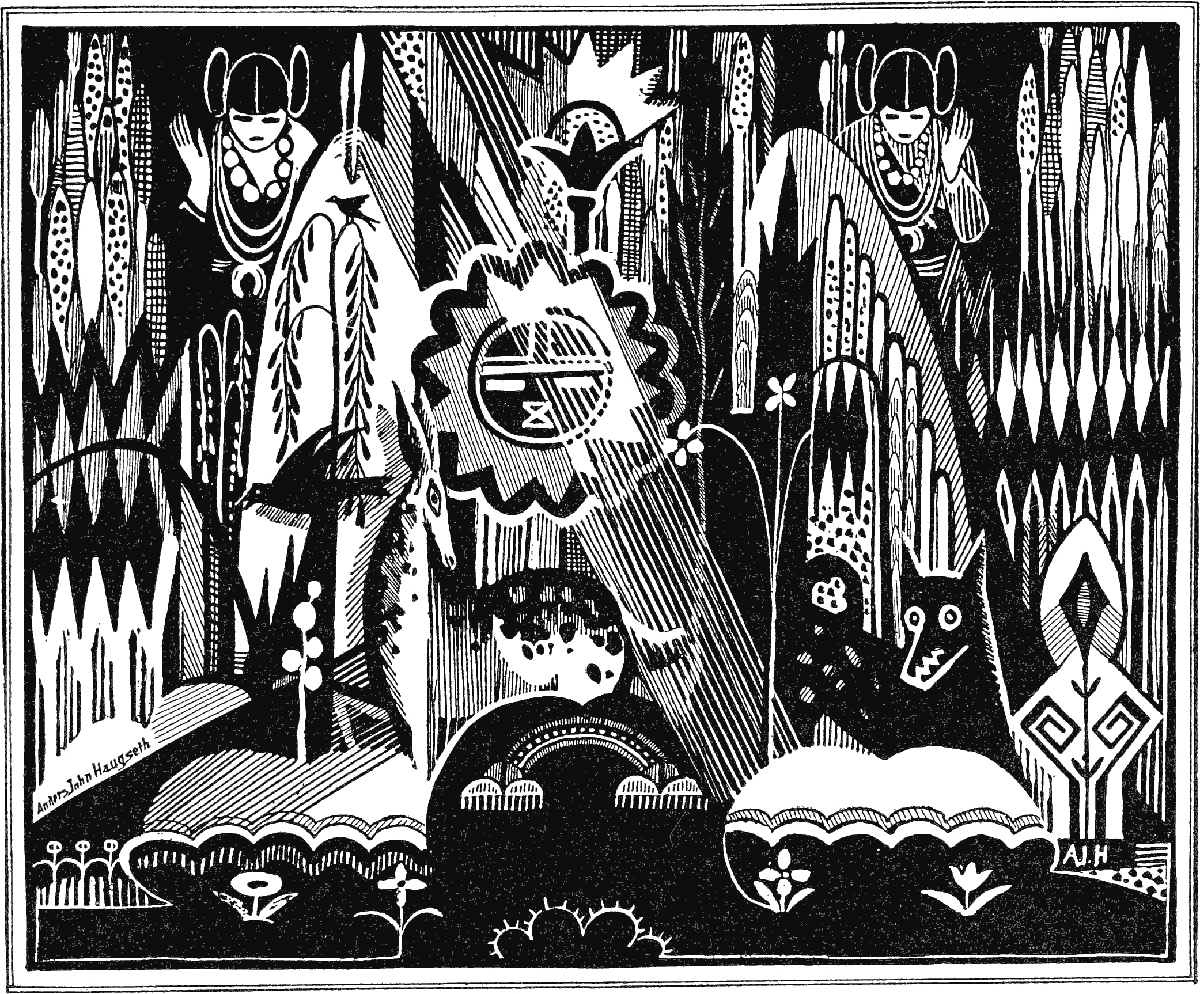
The Dead Pueblo—II With their cornfields and their beanfields, With their vines of squash and pumpkin, With their sunflowers and tobacco, Dwelt the olden folk of Pecos.
III
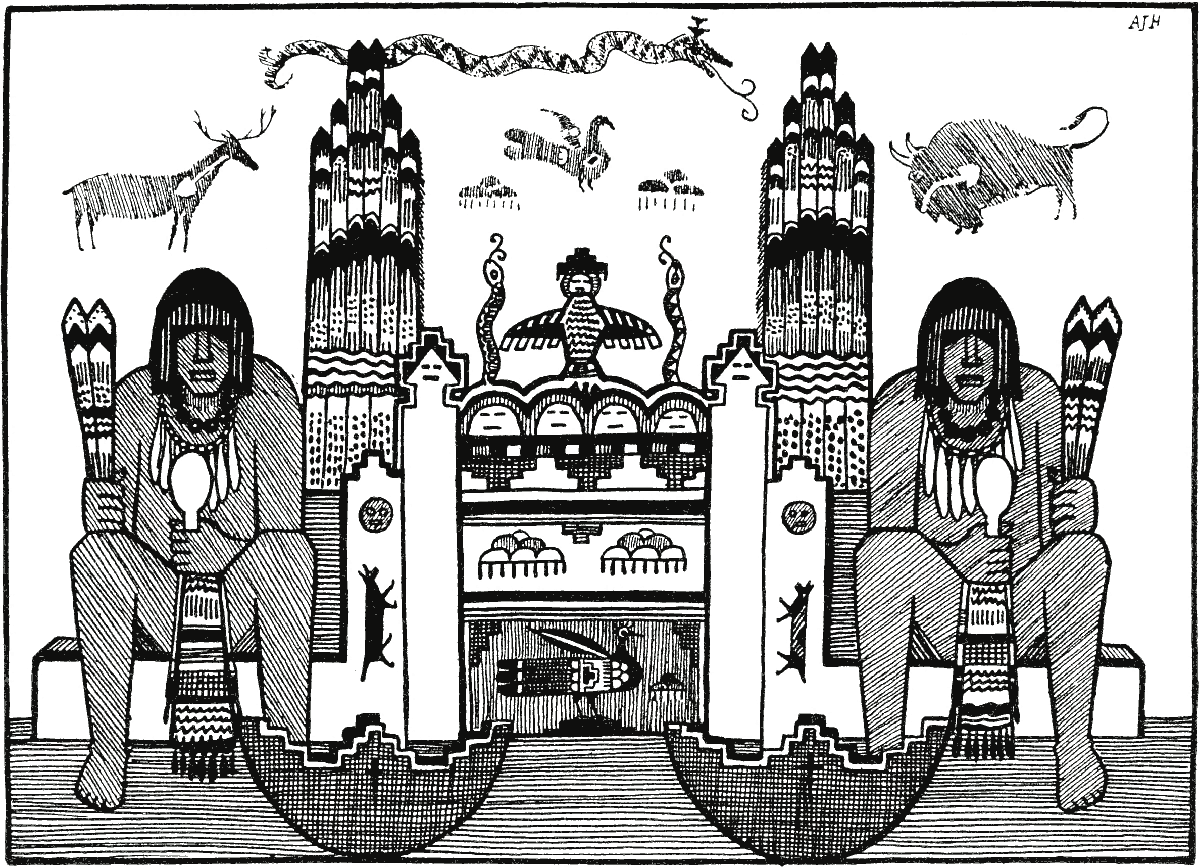
Time was kindly with this people In the ancient Vale of Pecos, In their citadel enseated High above the scarred arroyo, High upon the brunting mesa. There within the storeyed houses Built about their dancing plaza, Walled against the foeman’s onslaught, Walled and towered and ever watchful, Safe and happy dwelt the people: With their cornfields round about them In the pleasant watered valleys, Fair with corn of many colors Sacred to the Guardian Mothers—— White of Morn and blue of Zenith, Yellow for the burning Sunset, Speckled for the cloudy Northland: Earth and Sky have many colors, So the corn has colors many Sacred to the Guardian Mothers: With their cornfields and their beanfields, With their vines of squash and pumpkin, With their sunflowers and tobacco, Dwelt the olden folk of Pecos Rich and happy in their valley: And the fires upon their hearth-stones Glowed at dawn and glowed at twilight, And the wavering smoke ascended Quiet into quiet heavens—— Till the city seemed reflected In the vaporous blue of noonday, In the gleaming stars of night-time: And the women at their grinding Sang the Song of Fruitful Pollen; And the maidens at their spinning Sang the Breath-song of the Cotton; And they wove their baskets singing, Singing modelled earthen vessels, Painted brown and black and yellow With the symbols of the Cloud-Folk, Of the Mist-Folk and the Rain-Folk, And the sudden zig-zag Lightning—— And they left the life-line broken For the spirit of the vessel That it might not be imprisoned In the moulded clay forever: And the menfolk in the cornfields Sang the Song of Winter Breaking, Sang the Springtime and the Seeding, Sang the Tasseling and Summer, Sang the Fruitfulness of Harvest, And the Life that stirs in all things: And within their sacred Kivas, Where the Priests and Elders gathered Round their Totems and their Altars, Underneath the painted symbol Of the Plumed and Crested Serpent, There they sang their Spirit Ancients And the deeds of mighty Heroes, Of the Brothers armed with sunbeams Where they slew the hateful monsters When the Primal People wandered And the World was in its making: And within the sacred Kivas Said the prayers their sires had taught them, That the tribe might live forever Fathered by the Shining Heaven, Mothered on Earth’s fruitful bosom, With the Winds forever breathing Fourfold Life from out the Quarters Of the fourfold World man dwells in: And the men and women gathered, And the young men and the maidens, And the children and the strangers, When above the Kivas flaunted Banners brilliant with bright feathers Telling of the coming feast-day With the dancing and the chanting And the altars set with prayer-plumes, Where the grave-faced Priests and Elders Smoked before the sacred emblems Of the Powers that watched the nation: In the ancient Vale of Pecos, In its days of peace and plenty, When the people lived securely In their citadel enseated High above the scarred arroyo, High upon their granite mesa.
The Dead Pueblo—III And within their sacred Kivas, Where the Priests and chieftains gathered, Painted with the Serpent Symbol, With their totems and their altars, Sang the days of Spirit Ancients.
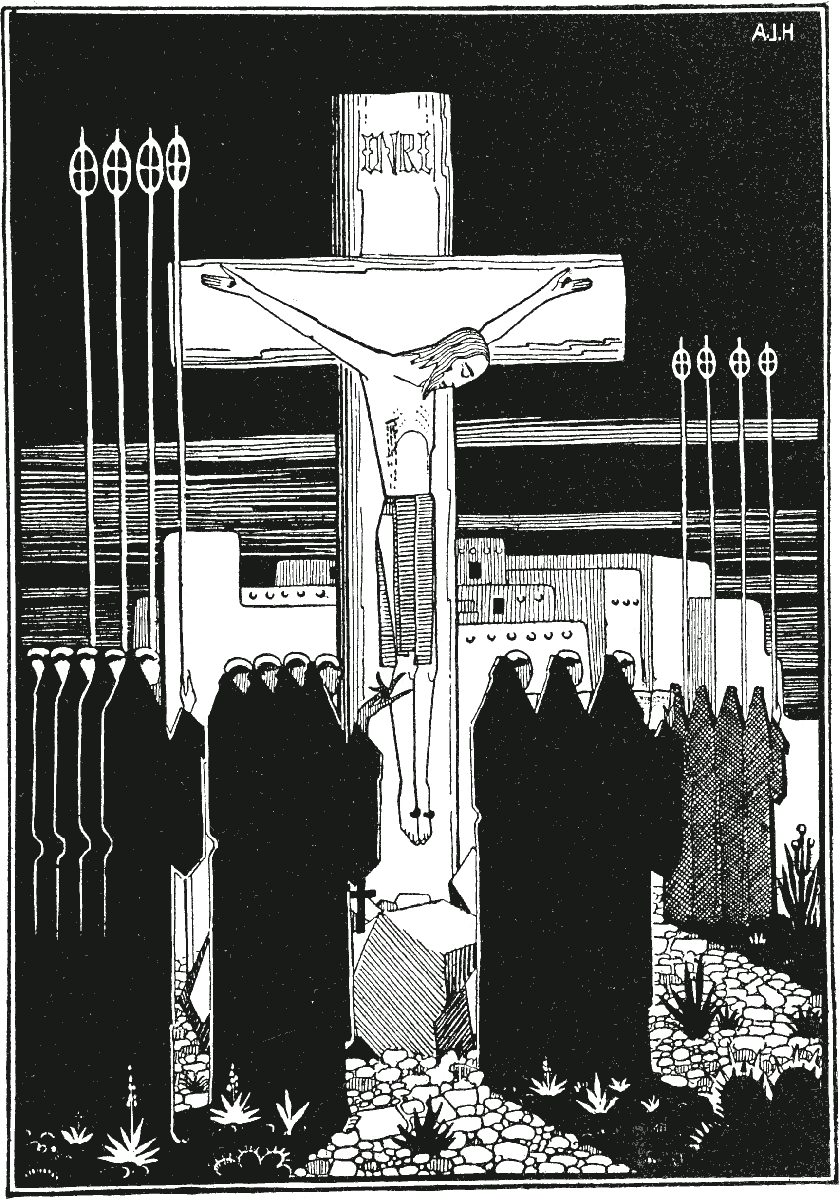
The Dead Pueblo—IV The Cross of Christus crucified, With thorn-pressed brow and piercéd side, And body wounded sore.
IV
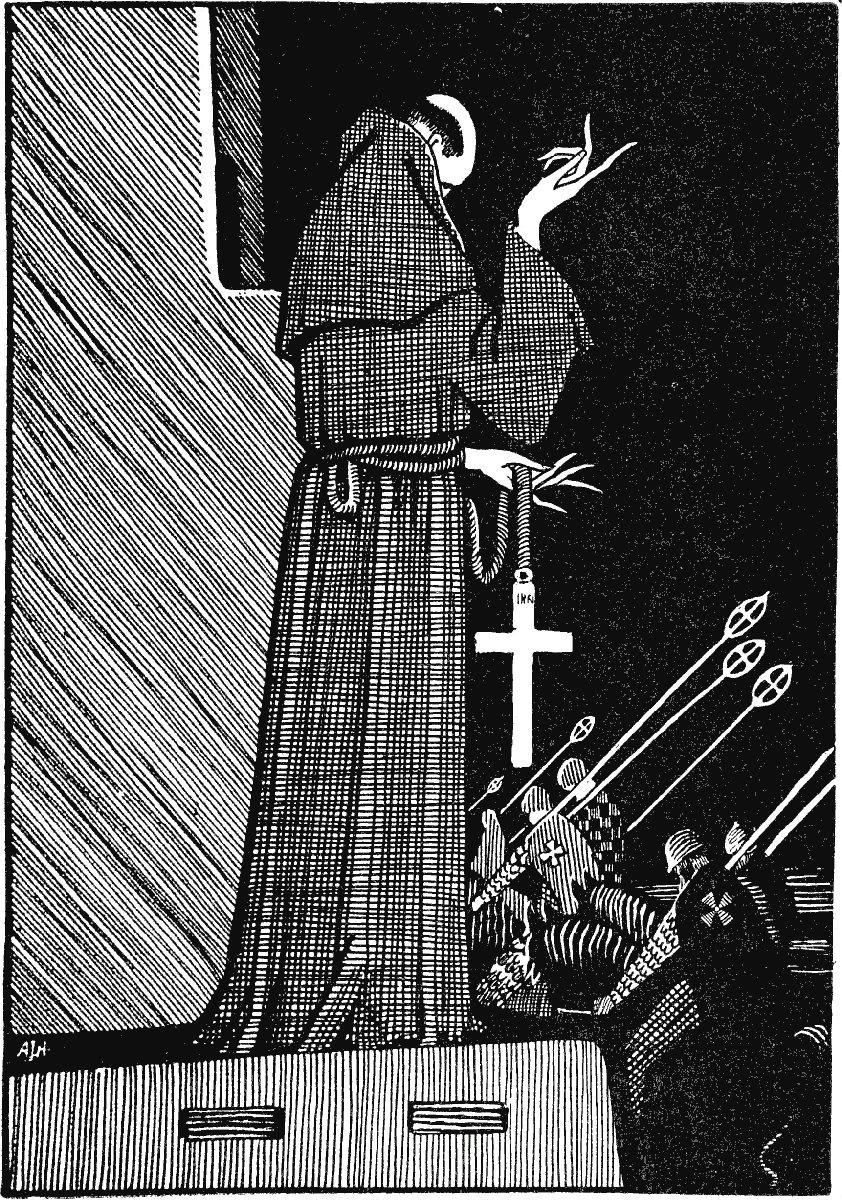
Blessed is the martyr’s crown And valiant were they who wore In Francis’ name the corded gown And to the heathen bore The Cross of Christus crucified, With thorn-pressed brow and piercéd side And body wounded sore: Like valiant soldiers they did come To preach their Gospel mild And find them sweetest martyrdom Within an heathen wild—— St. Francis’ men, who turned to kiss The Crucifix, and met their bliss, And on their murderers smiled. Bruit had come to the Pecos folk Of warrior-men from Heaven, Who strid strange beasts and in thunders spoke And armed them with red levin—— Who bannered their hosts with new gods and dread And shook the land with a terrible tread Where they searched for the Cities Seven: And the Priests and the Elders wafted high The smoke of their questioning prayer, And they asked of Earth and they asked of the Sky And they asked of the Lords of the Air—— And the signs breathed peace, and they were content, And unto the strangers their captains they sent With gifts and with covenants fair. For why should they fear the stranger’s face When the Powers whom their sires had known Had boded them well from the Sacred Place With its ancient divining stone? Why should men fear who through perilous past By their strong gods warded were mighty at last Into a nation grown? So with flute and with drum and with gala cheer Forth they thronged them to greet The steeled and glittering Cavalier And the Friar with way-worn feet—— And the men of Spain found pleasant rest, And the ovens glowed, and each grateful guest Warm-scented the odors sweet: Oh, the men of Spain in Pecos town Were welcomed with joyous array, Whose folk little dreamed as the dusk closed down That their Sun had ended that day—— That an Age of the Red Man’s World was past, And down from their altars his gods were cast To silently vanish away! Oh, who could the bitterness and the blood Of their lurid morrow know? Where the aged shaman sat grim with his brood Of the Spirits of long ago, And the lonely friar with his lifted sign Stood watching the riders in drifting line Pass out to the morning glow: And who should rue his martyr’s crown To the valiant soul who wore In Francis’ name the corded gown And to the heathen bore The Cross of Christus crucified, With thorn-pressed brow and piercéd side And body wounded sore? In after years they came again In corded robe and cowl, The army of St. Francis’ men, With book and adz and trowel—— And they builded their church and their masses said, And they pastored the living and prayed for the dead, And succored them many a soul: And the folk of the ancient citadel To Christian rites were born, And they harkened to a Christian bell, And they prayed to Christ each morn—— And sometimes in the fading day Their olden altars, in decay, With plumes they did adorn.
The Dead Pueblo—V And the lonely friar with his lifted sign Stood watching the riders in drifting line Pass out to the morning glow.
V
Still do the valley’s ancient hills, Oblivious of man’s passing years, Renew their bloom with the summer sun And gloam with gray cloud-fallen tears: Above their purple crests still climb The storm’s dark streamers ’thwart the heaven—— Like ghosts of old marauders come Bright-arrowed with the jagged levin: And still upon the mesa top The dead pueblo’s ruined walls Flare back defiance where the light In crimson splendor o’er them falls: About the plaza strewn with shards Like phantom footsteps fitful go The phantom winds and idly shift The downs of thistles to and fro: And sway the purple huaco’s spires, And bend the sunflower’s yellow head O’er wild verbenas lavender And Indian paintbrush saffron-red: And ruffle faint the placid pool That gathers on the kiva’s floor To mirror still the cloudy forms Pictured upon its walls of yore: While in the chambers long untrod The broken vigas and the clay Imprinted with the builder’s hand Yet crumble in their slow decay: And underneath the mounded stones That mark the ancient wall and keep, With gaud and trinket nigh their bones, Do they that builded sleep their sleep: There, warded by the broken church And tumulus that bears the Rood, Rememberless the ruins lie, Dead, mid the valley’s solitude: Above them, with his pinions spread Majestic in his noiseless flight, The Eagle wheels; then soars him far To vanish in the western night.