Chapter XIII · THROUGH LANGUOROUS LANDS OF THE SUNNY SOUTH.
Reading edition
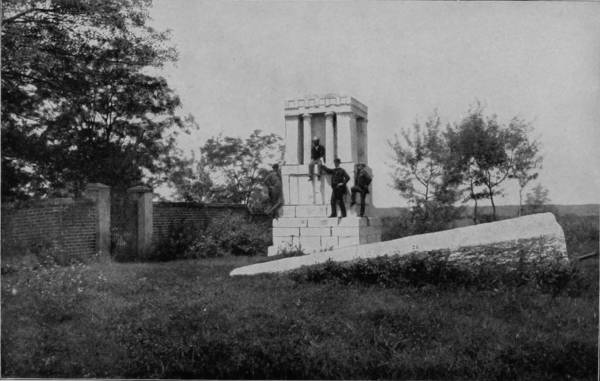
TOMB OVER THE GRAVE OF WASHINGTON’S MOTHER, AT FREDERICKSBURG, VIRGINIA.

New York City possesses many attractions for the cosmopolitan, but not for the artist, who prefers nature’s solitudes to the artificial glamor and noisy hum of a large city; hence our stay in that city was only for such time as it required to make preparations for extending our pictorial journey through summer lands of the southeast. Instead of carrying our original plans into immediate execution, however, it was decided to visit the battle-field of Gettysburg, which our artist coming up through Virginia and Pennsylvania did not find it convenient to include in his journey. The town of Gettysburg has a population of some 3,500 souls, and is the capital of Adams county, Pennsylvania, the center of a blooming and bounteously-producing agricultural district. Our route to reach the place was by way of the Pennsylvania Railroad to Hanover, and thence by the Western Maryland Railroad, a distance of 250 miles from New York. The landscape thereabout is undulating, occasionally rising to hills of considerable size; but scenically there is nothing particularly attractive, aside from the beautiful farms and truck-gardens that clothe the knolls with prodigal harvests. Historically, the place is imperishably famous, for here was fought, on the 1st, 2d and 3d of July, 1863, the bloodiest and hottest-contested battle of the civil war. From every eminence this dreadful field, though it now smiles with plenty, still presents memorials of that ever-memorable conflict. There is Cemetery Hill, the old grave-place of the town, where thousands slept before the awakening alarms of cannon and musket enveloped the scene in battle-smoke. Here it was that the Union forces, under General Meade, pitched their quarters, because it commanded a view of the adjacent country. One mile towards the west is Seminary Ridge, the spot chosen by the Confederates, under General Lee, 450as their vantage-point and headquarters. Now sweep the horizon and mark the places where the battle waxed fiercest; where the dead lay thickest and the thunder of conflict was loudest. There is Willoughby Run, where the battle began and where Buford’s cavalry was hurled upon the steel of Hill, and for two hours withstood the hell of ball and bayonet until flesh could endure no more. There is Round Top, another eminence where the Union lines reformed, with the left wing thrown around the ridges to Cemetery Hill. There is where Longstreet struck Sickles with such fearless resolution, and a whole day was spent in a contention for Great and Little Round Top, without advantage to either side, but with frightful losses to both. Now on Cemetery Hill the eyes of the world must rest, for here it was, on the third day, that such fighting was done as Greek nor Roman ever knew. After a lull at midday, two hundred brazen throats were opened with boom and screaming shells; the air became filled with smoke, and the earth was choked with dead, until there came a lull, out of which broke a column three miles long, whose gray uniforms soon proclaimed the advance of General Pickett leading his army in a desperate resolve to storm the Union position. No charge ever made was more terrible, no repulse was ever more fatal. Americans, whatever be their sympathies, whatever their prejudices, may feel proud of the heroism displayed by both armies on that day of carnage around Cemetery Hill. It was a courage that glorifies America.
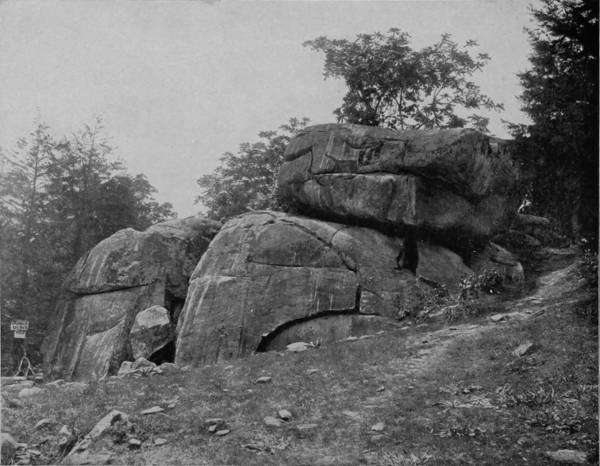
THE DEVIL’S DEN, BATTLE-FIELD OF GETTYSBURG
451
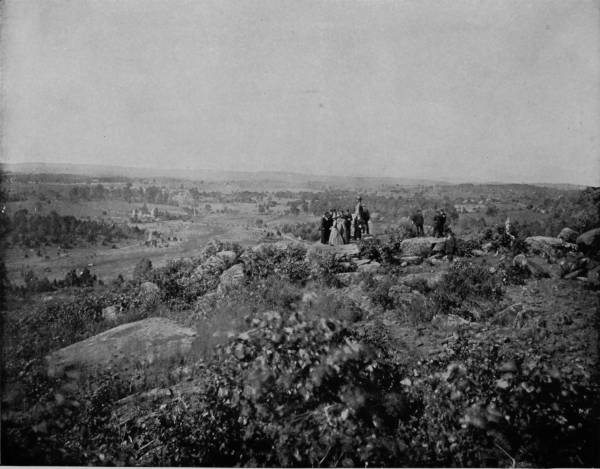
ROUND TOP, OVERLOOKING THE BATTLEFIELD OF GETTYSBURG.—The battle that was fought at Gettysburg on the first, second and third of July, 1863, has been justly classed as one of the great battles of the world. It was the final turning-point in the war between the North and the South, and each side, on this field, displayed a heroism that will forever shed a light of glory upon the courage and fortitude of Americans as soldiers. Fifty-four thousand of our countrymen gave up their lives at Gettysburg. They were distinguished by uniforms of blue and gray then; now they are clothed with robes that are woven without color. Let the head be uncovered and the eye moist with tears as we stand upon the ground made sacred by their blood.
452
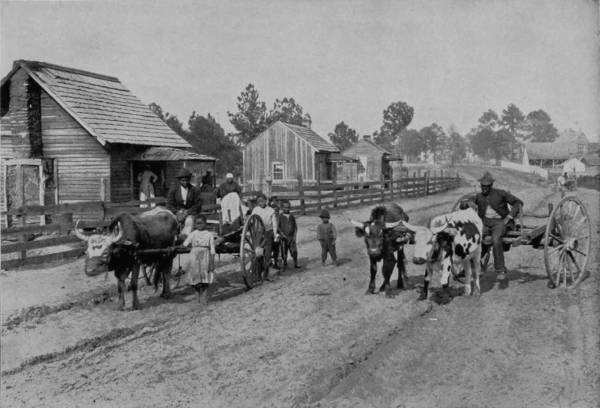
A VILLAGE SCENE OF HAPPY CONTENT IN VIRGINIA.
The 54,000 souls that laid down their arms and answered roll-call the morning of July 4th on the parade-grounds of paradise, were our countrymen. They were distinguished by uniforms of blue and gray then; they are invested with robes now that are woven without color. Let the trumpets blare, and the drums be beaten, but let it be on Memorial Day, as salutes of remembrance for the heroes who died within the gates of Cemetery Hill, at Round Top, the Stone Fence, Culp’s Hill, Seminary Ridge, Willoughby Run and Benner’s Hill.
Gettysburg is of itself a monument to human courage, but its field of blood has been made a national cemetery of seventeen acres, which was dedicated with imposing ceremonies on November 19, 1863, at which President Lincoln made the greatest address ever delivered on American soil, “With malice toward none, with charity for all.” A soldiers’ monument was erected in 1868, which is sixty feet high, surmounted by a marble figure of Liberty, and occupies a crown of the hill, where it is a conspicuous object for miles, and arranged in semi-circles about the base are the graves of nearly three thousand of the unidentified victims of the dreadful conflict.
“Thus sleep the braves who sank to rest,
By all their Country’s wishes blest.”
453
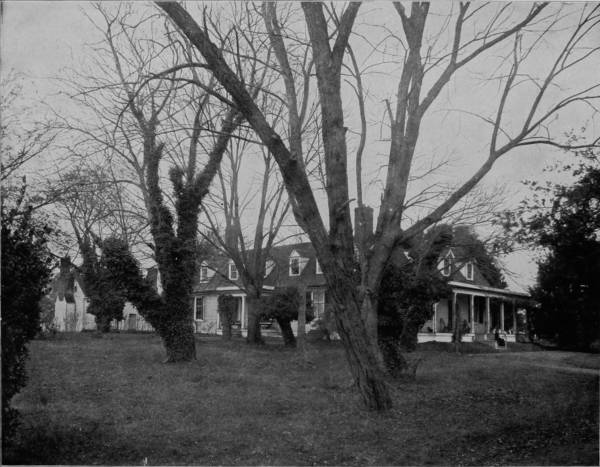
AN OLD COLONIAL HOUSE AT APPOMATTOX, VIRGINIA.—This picturesque old mansion, built while Virginia was still a colony of the mother-country, stands yet as a landmark of an earlier civilization and a social era that has passed away. The wealthy pioneer who planned it took as his model some still older mansion of the merry England from which he had emigrated, and thus sought to transplant in the wilds of America a memorial of some loved spot in his native country. Its halls are now filled with the ghostly recollections of the past, for even the mighty events which took place in this immediate vicinity in April, 1865, seem almost like ancient history, so rapidly does time speed away on the wings of steam and electricity.
454
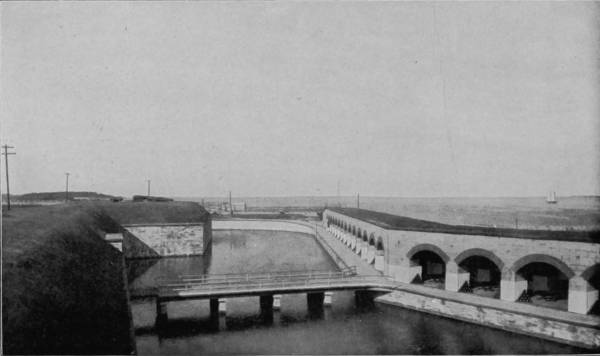
FORTRESS MONROE, VIRGINIA.
From Gettysburg our route was southwest to Washington, and thence by way of Fredericksburg to Appomattox. From Washington the Richmond, Fredericksburg and Potomac Railroad runs through a sterile section, unrelieved by either picturesque scenery or smiling field, so that a part of it has long been known as the Wilderness, famous, however, as the scene of many great battles in 1863-4, many traces of which are still to be seen from the car windows of passing trains. Fredericksburg is distinguished also as the vicinity in which Washington was born, and where he spent the greater part of his youth. Here it was also that Washington’s mother lived for a long time, and died in 1789. A monument erected in 1883, in the suburbs of the town, marks the place of her sepulture. Twelve miles beyond Fredericksburg is the battle-ground of Spottsylvania Court House, where Stonewall Jackson received his death wound, May 2, 1863. Indeed, the region for fifty miles thereabout is still scarred by the strokes of contending armies delivered thirty years ago, and cemeteries in which repose the heroic dead of both Union and Confederate are numerous, marked by many monuments to attest the appreciation of the living for the sacrifices which were endured in those dreadful years of the sixties. But if the country is somewhat barren, and gruesome with reminders of fratricidal strife, it is not entirely destitute of the phases that lend cheerfulness to life. Here is essentially the land of happy negroes, where poverty abounds with joy, for absence of responsibility is contentment of mind with the colored race. At the depot there is always a swarm of pickaninnies eager to scramble for pennies thrown to the crowd, and the most comical scenes imaginable occur at these tussles, for the little darkies themselves, in an array of all sizes and shades of black and brown, a company of tatterdemalions that would put Punch and Judy to rout, are ludicrous enough to make a goat laugh. The street-scenes of villages near-by, as well as in the suburbs of Fredericksburg, are equally whimsical, presenting, as they often do, human nature in its most grotesque aspect. Horses are rarely used by negroes for draught purposes; mules more frequently; but bulls, cows and yearling calves are the chief dependence, and carts the popular style of conveyance with these happy-go-lucky people. There is no need for haste, and the loads are never large, hence a yoke of cattle are as handy as a span of horses, and preferable because slow movement allows more sleep on the way. The sun makes the tobacco grow, and the rain makes music on the cabin-roof; so rain or shine the darkey’s heart is always light and the future is hidden from him by a veil of present delight. Such sights teach the value of content, even if they do offend ambition, and in them the philosopher’s stone has its hiding-place.
455
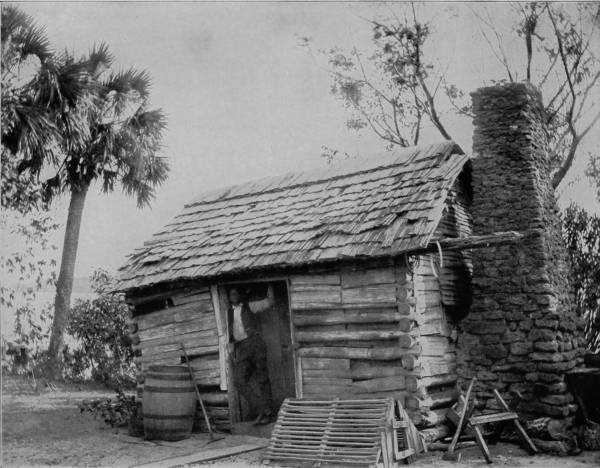
AN OLD CABIN HOME IN GEORGIA.—The old log cabin is a familiar sight in Georgia, as well as other parts of the South. Often it is vine-wreathed, showing signs of great antiquity, with roof of clapboards, upon which the rain patters like the long-roll beat of the snare drum. Homely, battered by time, and affording few comforts, yet in such cabins greatness has often had its birth, nor scorned such humble nativity. How many men of high estate lie down in the drapery of fine linen and, when night has folded the earth in her sable arms, think of the old cabin home in Georgia; of the long-time ago; of the bubbling spring in the hollow and the gourd that hung by it; of the grape-vine swing, and the cows mooing in the pasture; of father and mother, and the graves on the hillside. And there is a sigh from the heart for these pleasures of a past that have departed forever.
456
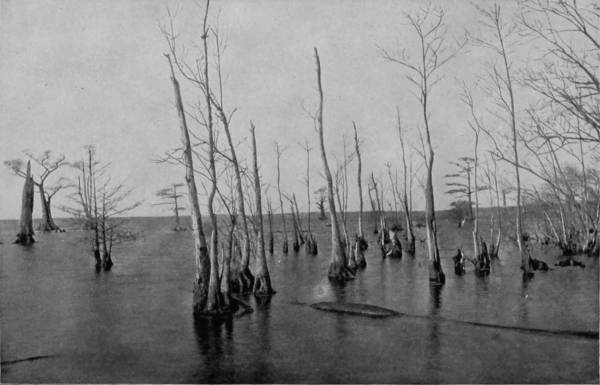
DRUMMOND’S LAKE, IN GREAT DISMAL SWAMP, VIRGINIA.
From Fredericksburg our route was northwest to Appomattox and thence east by way of Richmond to Fortress Monroe, on the peninsula. We were a little disappointed to find the site of the culminating event of the war destitute of any special feature of interest of either a natural or artificial character. The scene of surrender is not even marked by a monument, and the country thereabout is a pale and somber stretch of poorly-cultivated lands. Yet there are exceptions; for occasionally the monotony of cabin and broken fence is relieved by prolific tobacco-fields, pretty towns, and inviting manors adorned with colonial houses that still preserve their old-time air of comfort and Southern hospitality. Virginia well deserves the title of the Dominion State, not only because she is the mother of Presidents, but because she is also distinguished as the native state of many of the greatest men and women born on American soil. “To be a Virginian, is to be a gentleman,” has passed into an adage; and the country is proud of her for a hundred reasons, which reference to history will explain. If her soil is not the most fertile, yet her legacy is the richest, for she gave to the world such men as Washington, Madison, Jefferson, Randolph, Clay, Lee and a thousand others whose names and deeds are alike imperishable. Fortress Monroe is reached by the Chesapeake and Ohio Railroad, over which route we traveled from Appomattox. It is located at the point of a peninsula, formed by the Fork and James Rivers, which projects into Chesapeake Bay where it joins the Atlantic. The situation is particularly favorable for a Government fortress, and its natural and commanding advantages have been fully utilized, for it is the largest and strongest fortification in America. Hampton Roads separates the point of the peninsula from the opposite land. This body of water is about five miles wide and forms the outlet of James River. It was in the Roads that the most famous of modern naval battles, between the Monitor and the Merrimac (Virginia), took place, March 9, 1862. Two miles below Fortress Monroe is Old Point Comfort, a very popular resort and the seat of the National Soldiers’ Home. Newport News is nine miles above the Fortress, on Hampton Roads; and Yorktown, the place of Cornwallis’ surrender to Washington, October 19, 1781, is twenty-five miles north, on York River, both places possessing great historic interest for events of which they were the scene during the Revolutionary war.
457
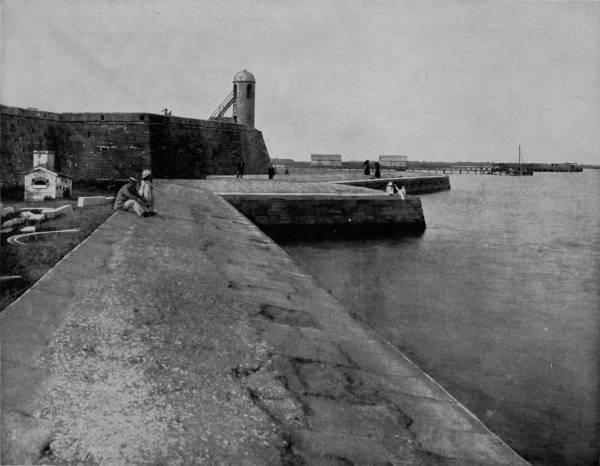
OLD FORT AND SEA WALL AT ST. AUGUSTINE, FLORIDA.—This old fort possesses a peculiar interest for Americans, being the oldest historic fortification of our country. Its construction was begun by Menendez de Aviles, a Spaniard, in 1565, but it was not completed until two centuries later. It was then called Fort San Marco, but with a ruthless disregard of historic associations characteristic of our people, it has been changed to Fort Marion, without in the least adding to the lustre of the renown of the great Revolutionary patriot of the South. The walls of the fort are composed of a conglomerate called coquina, which is formed of shells and sand brought from the island of Anastasia. Originally soft and pliable as plaster, it becomes almost of granitic hardness by exposure, affording a safe protection against the primitive artillery of that period.
458
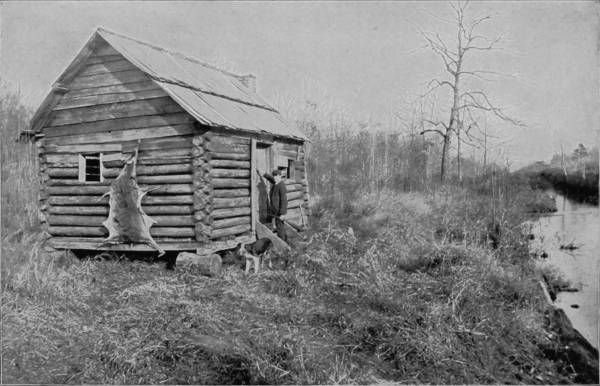
A HUNTER’S CABIN ON THE CANAL, DISMAL SWAMP.
Crossing Hampton Roads by steamer to Norfolk, we proceeded southward by the Norfolk Southern Railroad, through a region known as the Dismal Swamp, famous alike in fact and fiction. The term has been indelibly affixed to two extensive stretches of morass, the larger of which lies between the James River on the north and Albemarle Sound on the south, thus covering a part of Virginia and North Carolina, having a length of about forty miles and a breadth of twenty-five miles. Little Dismal Swamp is wholly within North Carolina, in the peninsula between Albemarle Sound and Pimlico Sound, and while occupying considerably less than one-third as much area as Great Dismal, is probably better known to readers because of the tragedies which have been enacted within its dark and gloomy districts. Speaking generally, the swamps are composed of a spongy, vegetable soil, but without any mixture of earth, which supports a dense growth of aquatic plants, brush-wood and timber. Sir Charles Lyell, the distinguished geologist, was first to bring to notice the curious fact that the surface of the swamp is actually twelve feet higher in many places than the surrounding country, so that its drainage is outward, except where a few small streams flow in from the west side. The center of Great Dismal is occupied by Drummond’s Lake, an oval basin six miles long and three wide, with perpendicular banks and fifteen feet depth of water. In and around this lake is a veritable paradise for hunters, for its waters abound with fish and wild fowl, and the adjacent woods are the favorite haunts of deer, bears, wild-cats, coons and swamp-rabbits. The region, inexpressibly dreary as it is, contributes largely to commerce by furnishing immense supplies of timber. To facilitate transportation the Great Swamp is intersected by canals, the two largest being those which connect the Elizabeth and Pasquotank Rivers, and Elizabeth River with Carrituck Sound.
Some queer little cabins are built along these water-ways, a few being occupied by timber cutters, but generally they are the temporary abodes of hunters who find shooting and trapping both pleasurable and profitable, and who work at logging out of game season. Little Dismal Swamp, though smaller than its more northern neighbor, is very much more dense with brush-wood, and decidedly more forbidding, because its gloomy depths rarely echo with the voice of man, or the sound of the woodman’s ax. Fifty years ago it was the refuge of runaway negroes, and a dangerous place for a white man to be seen, because the blacks who hid in its thick coverts were usually of the most desperate character, who would not hesitate at crime. One of the best-remembered, because the most tragic, negro insurrections that ever occurred in Virginia was headed by a Samsonian black named Nat Turner. Under his leadership more than a hundred armed negroes rose against their masters and massacred a score of men, women and children. When a sufficient force of whites was mustered to oppose them, the negroes fled to Little Dismal Swamp, where, after great length of time, they were starved into surrender. Nat Turner, however, was last to submit to his pursuers, and committed so many crimes, while the search for him continued, that his very name became a terror; but he was at last captured through betrayal by a negro whom he trusted, and after due trial was convicted and hanged.
459
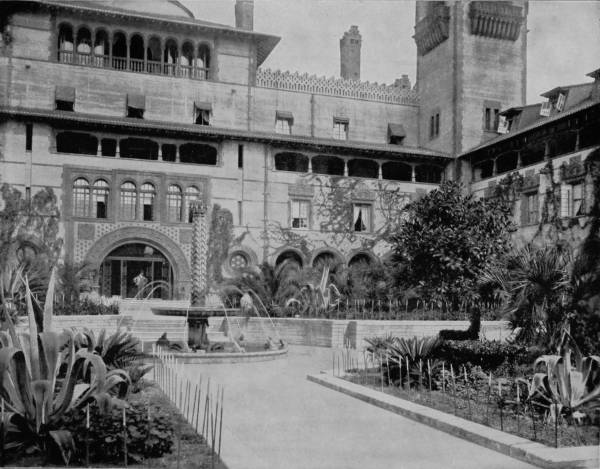
PONCE DE LEON HOTEL, ST. AUGUSTINE, FLORIDA.—This photograph represents the court of the hotel, around which the walls extend in the form of a hollow square. The hotel itself is a revival of the richest examples of Moorish architecture. It is old Spain of the golden reign of Ibn-l-Ahmar transported to American shores. With its lavish adornment, picturesque style and exquisite grounds, in which every known tropical plant is made to add its beauty and shed its fragrance, while flowing fountains cool the summer air, the Ponce de Leon is not only a reminder of the great palace of Spain in the time of Columbus, but it is also one of the best representatives of modern convenience, comfort and artistic beauty of architecture and construction.
460
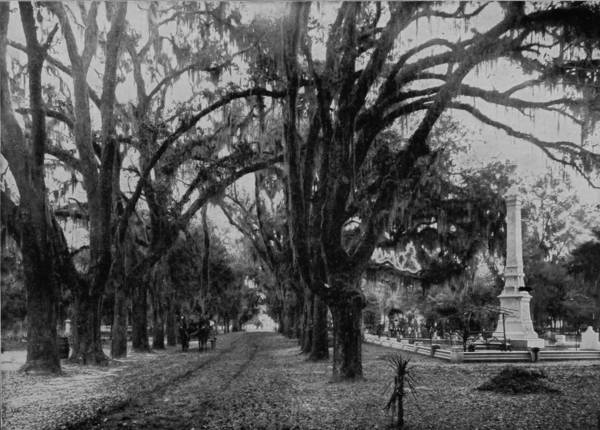
BONAVENTURE CEMETERY, SAVANNAH, GEORGIA.
Our next halting place on the flight southward was Savannah, the Gate City, as it is the Queen City of the South. Next to Atlanta in commercial importance, Savannah is easily first of all sunny metropoli in the superb beauty of its situation and the park grandeur of its surroundings. Here it was that General Oglethorpe founded his Georgia colony early in 1733; and the flourishing city, from which the first ocean steamer that ever attempted to cross the Atlantic sailed, and its rank as the second cotton port of the United States, are striking proofs of his foresight and excellent discrimination.
The city is situated on a bold bluff overlooking the Savannah River, along which it extends in a curved front for a distance of three miles, affording excellent wharfage. The streets are all very broad and magnificently shaded, while parks containing one to three acres occur at all the principal intersections, charmingly laid out and beautified with flowers, which grow in that warm climate in the richest profusion. Flower gardens constitute one of the most characteristic features of the place, for a majority of the residences are surrounded by ample grounds that are abloom with flowering plants throughout the year. This is the borderland of southern evergreens, where the stately oak is festooned with pearl-gray mosses, and the orange and the magnolia fill the air with delicious perfumes. Along the streets, too, are rows of flowering oleanders, pomegranates, palmettos, bananas, laurels, bays and sweet crape-myrtles. But of all the beauties about Savannah none rival the charms of Bonaventure Cemetery, four miles from the city, on Warsaw River, and reached by a shell road that is equal to any drive-way in the world. Every grave is a flower-bed, and the long avenues canopied with moss-garlanded oaks present a picture Arcadian in its loveliness, and suggestive of those flowery glades through which immortals might delight to wander.
461
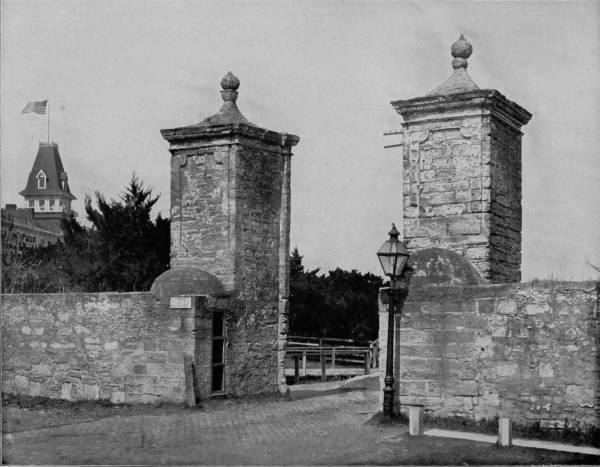
OLD CITY GATES, ST. AUGUSTINE, FLORIDA.—As St. Augustine is the oldest town in America, having been founded by the Spaniards in 1565, it is quite natural that we should find here many relics of the past mingled with the bright and better features of modern life. The old city was surrounded by a wall as security against attacks from the outside, and of this wall the gates, so beautifully photographed on this page, are about the only remaining relics. It is one of the links connecting the present with the earliest events of discovery in our country—a link rusty with the blood of conquest and martyrdom. Here it was that Spanish cruelty and French retaliation were carried to the most barbaric extreme, and cruelty is always in need of strong walls to protect it from the enemies it creates and nourishes.
462
A HOME IN THE MOUNTAINS OF GEORGIA.
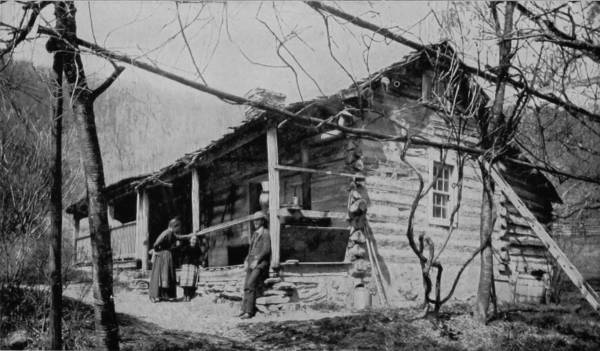
The country district about Savannah is somewhat similar in appearance to that of Western North Carolina, except that its mountains are not nearly so high. The soil, however, is practically the same, as are the social conditions; and hence the constant reminder of that section which we have already described. The old log-cabin is a familiar sight in Georgia, often vine-wreathed, and showing signs of great antiquity, with roofs of clap-board, upon which the rain patters like the long-roll beat of a snare-drum. The picture which we present is typical of this class, and an example as well of rural simplicity. Homely, battered by time, and affording few comforts, yet in such cabins greatness has often had its birth, nor scorned such humble nativity. How many men of high estate lie down in the drapery of fine linen and, when night has folded the earth in her sable arms, think of the old cabin home in Georgia; of the long time ago; of the bubbling spring in the hollow and the gourd that hung by it; of the grape-vine swing, and the cows mooing in the pasture; of father and mother, and the graves on the hillside. And there is a sigh from the heart. The old time was the flush of life’s morning; it is growing evening now, and the shadows are creeping up the slopes. Soon the present will be the “old times” to our children. How many men who have achieved greatness would exchange their possessions and positions for youth and the old cabin home as they see it now in their dreams! Many, yes, very many.
Inseparable, almost, from the log-house of the Southern poor, is the cabin home of the negro, because the two are separated by such a thin line of distinction that only critical inspection can prevent them from assimilating in the minds of those unfamiliar with Southern life. There is the same stone-chimney and clap-board roof, but the colored man’s cabin is a single room, and the front is porchless. More hasty construction is also noted, for the logs are laid like a turkey-pen, and clap-boards are used again, not for weather-boarding, but as a substitute for batten. Windows are not needed, through which to exchange civilities with the season, for there are holes and crannies to let smoke out, and plenty of accidental entrances for the warm summer air to get in. It is thus at small effort and no care the worst weather is kept out, and contentedness reigns within.
463
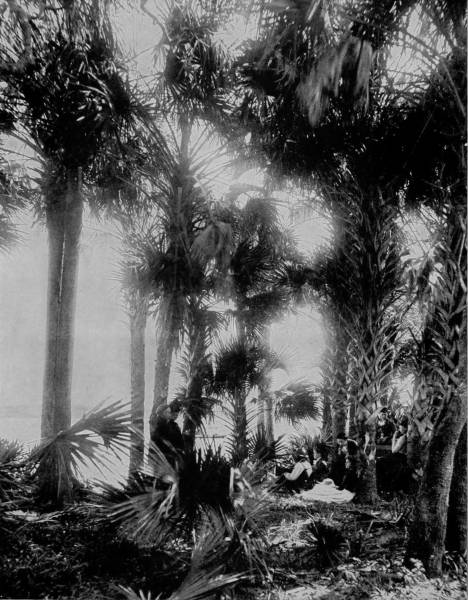
AMONG THE PALMETTOS ON THE BANKS OF HALIFAX RIVER, FLORIDA.—This is a typical Southern scene, and one of the most delightful to human senses that could be imagined. It is so perfectly in accord with nature that in imagination we can hear the bursting of the buds as they grow beneath the fructifying influences of the Southern sun, and feel the soft, hazy atmosphere as it gently rolls in from the cooling waters of the sea, and floods the intervening spaces of the moss-covered trees. In the Garden of Eden there must have been many bowers such as this, where Adam and Eve whispered the first vows of devotion and human love.
464
THE HEAD OF HALIFAX RIVER, ABOVE ORMOND.
Through Georgia and into the land of orange groves we sped, stopping a day at Jacksonville, and then hurried on to San Augustine, the oldest town in America (founded by the Spanish in 1565), and possibly the most interesting. It is a link which connects the present with the earliest events of discovery in our country—a link rusty with the blood of conquest and martyrdom. Here it was that Spanish cruelty and French retaliation were carried to the most barbaric extreme, and the enslavement of native Indians began. Passing through the first ordeals of settlement, a century later it was bitterly afflicted by raids of Indians and the plundering of pirates, so that its growth was prevented, and not until the British surrendered possession to the United States in 1821, did the place show any indications of permanency, or that it would attain to any importance beyond what it had before reached as a very small village.
St. Augustine is located on a narrow peninsula formed by the Matanzas and San Sebastian Rivers, and is separated from the ocean by Anastasia Island. From a place of little consequence, in the last few years it has become distinguished as the most popular winter resort in the South. Several things have conspired to bring about this change, chief of which, however, was the enterprises of Mr. H. M. Flagler, who, recognizing its favorable location, resolved to convert the town from a listless, sleeping, poverty-stricken village into such an Eden of loveliness as the arts of man can create. In accomplishing this object he spent $6,000,000, and the improvements are of such a character as may well satisfy his ambition. The Ponce de Leon Hotel is a revival of the richest examples of Moorish architecture. It is old Spain of the golden reign of Ibn-l-Ahmar transported to American shores. And strange coincidence it is, that the year in which Columbus set sail on his first western voyage in quest of eastern lands, the year of the Moorish Expulsion, the beautiful Alhambra, most magnificent building that ever graced the earth, was given over to vandalism and spoliation. The Ponce de Leon, with its lavish adornment, picturesque style and exquisite grounds, in which every known tropical plant is made to add its beauty and shed its fragrance, while fountains cool the summer air, is a reminder of the great palace of Grenada, and the chivalry of Spain in the time of Columbus.
465
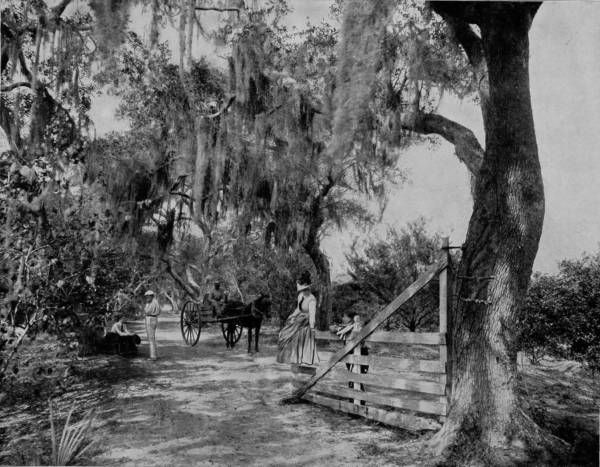
AVENUE OF MOSS-COVERED OAKS, NEAR ORMOND, FLORIDA.—Laying aside the question as to whether the command to work, that was imposed upon our first parents, was a curse or a blessing, it is easy to conceive that one reared among such scenery as this, where there are but few wants which the spontaneous growth of nature does not supply, would naturally regard hard labor as the greatest curse that could be pronounced against mankind. Here, side by side and of their own volition, grow the orange, the pomegranate, the fig, the melon, and nearly all the other fruits and vegetables necessary for the support of physical existence, while life is made delightful with the blossom and odor of thousands of bright-hued and ever-blossoming flowers. Here let us rest and dream, and think of work only when the flaming sword of necessity drives us forth to exertion.
466
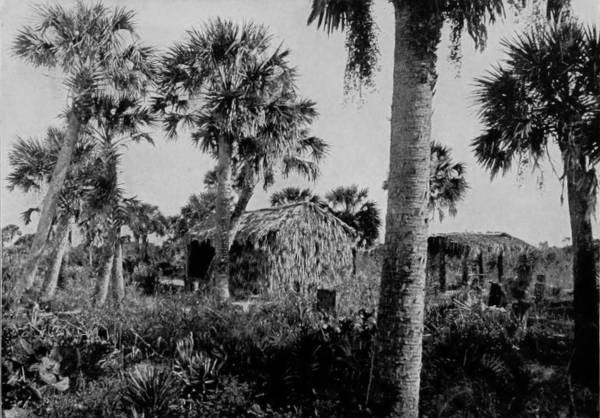
PALMETTO HUTS NEAR TITUSVILLE, FLORIDA.
But the interest to St. Augustine visitors is not confined to the Ponce de Leon, glorious as it is, joined though it be to its almost equally superb annexes, the Cordova and Alcazar, for the city is filled with the relics of an olden time, and associations that are almost painful to recall. Along its water-front extends a sea wall one mile in length and ten feet broad, built of coquina and coped with granite, forming an incomparable promenade between the old Franciscan monastery, now used as a barracks, and the ancient fort of San Marco, now known as Fort Marion. Though not the most formidable, these antique fortifications rank all others of this country in interest. Their construction was begun by Menendez de Aviles in 1565, at the time of the founding, but were not completed until two centuries later, all of the work being performed by enslaved Indians. The fortifications cover about four acres, and the walls are of coquina, a conglomerate of shells and sand brought from Anastasia Island, which, soft when dug, hardens by exposure. The fort is a splendid example of the best military architecture of the time, being in the shape of a trapezium, surrounded by a wide and deep moat, and with walls twenty-one feet high, sharp bastions at the corners, thick casemates, and subterranean passages and vaults which might serve equally for refuge ports or dungeons. That some of these were used for the latter purpose is proved by the fact that in one of the least accessible dungeon-rooms, the entrance to which was accidentally found, two skeletons chained to the wall were discovered. What a story of suffering these might tell if they could speak!
In the earlier centuries a wall extended across the peninsula, which protected the city from attack on the north side, but nothing now remains of this defence except the old city gates, at the head of St. George street. These are massive square towers fifteen feet high, pierced with loop-holes, and at the base of each is a sentry-box, which the guards occupied when on duty.
Near the center of the business part of the city is the old slave-market, adjoining which is the Plaza de la Constitucion, containing a monument erected in 1812, commemorative of the Spanish Liberal Constitution, while another monument stands in front of the old Market, which was erected in 1879, in honor of the Confederate dead.
Besides being a great winter resort, St. Augustine is a place of some commercial importance, its largest industry being the manufacture of palmetto hats, while in the convents a fine quality of lace goods is made, by girls and the nuns in charge.
467
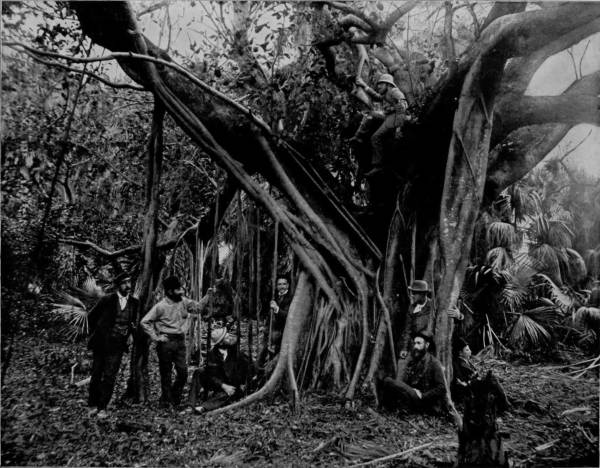
RUBBER OR BANYAN TREE, ON BANANA RIVER, FLORIDA.—We are now among the wonders of the semi-tropics and the paradisaic delights of a marvelous sun-browned land, where the mocking bird opens the matin competition in the college of vernal hymns, and the palmettos are vocal with the softly stirring breeze. The landscape is a dreamy haze of incomparable loveliness, where a feast of flowers is perpetually spread, and the voice of peris may be heard down under the green waters of a murmuring sea. The ocean is so near that the music of its rolling beach comes like a gentle lullaby through the clustering branches of the scented trees, bringing the hush of the still small voice that reminds us of the presence of Deity.
468
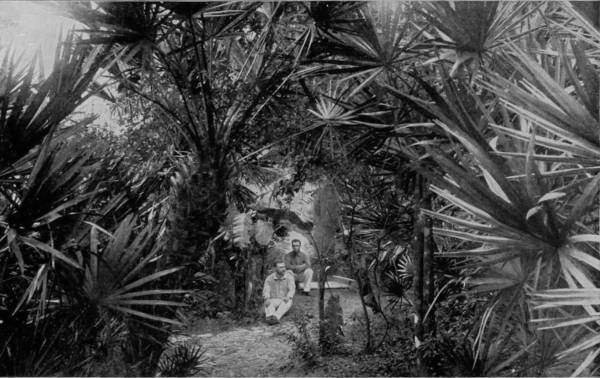
IN THE DEEP PALMETTO SOLITUDES ALONG INDIAN RIVER.
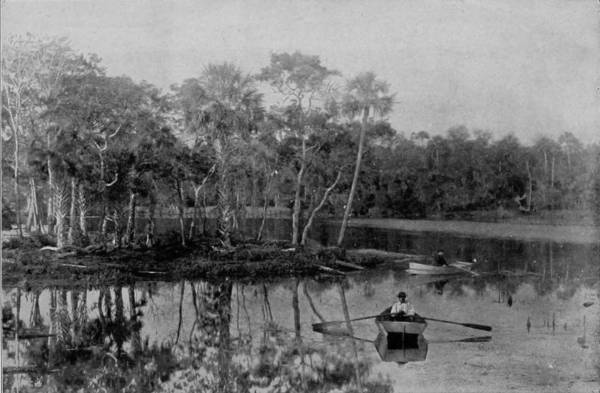
It is about seventy-five miles from St. Augustine to Ormond by the Jacksonville, Tampa and Key West Railroad, one of the branches of the Plant System, whose terminus is Daytona, five miles below Ormond. Indeed, nearly every road in Florida is the property of the Plant company, which has proven a factor of incalculable benefit to the State, and has reaped correspondingly great reward. Ormond is located on the head of Halifax River, which is a part of the Indian River Lagoon, connected by the Mosquito Haul-Over, or canal. We are now in the sub-tropics, and among the paradisiac delights of a marvelous sun-browned land, where the mocking-bird opens the matin competition in the college of vernal hymns, and the palmettos are vocal with the softly stirring breeze. The landscape is a dreamy haze of incomparable loveliness, where a feast of flowers is perpetually spread, and the voice of peris may be heard down under the green waters of a murmuring sea. Only a thin stretch of golden beach lies between the mainland, on which Ormond is located, and the ocean, so near that the billows are distinctly heard beating against the shore. Along this water-front of lagoon and sea are gleaming sands so hard that step nor wheel make any impression, and so inviting that nymphs might make it a playground. West of the village is a typical hummock of tropical growths, penetrated by a glade that is embowered and sweetly shaded by massive oaks gracefully festooned with pearl-gray mosses, and palmettos that flaunt their tangled, rustling branches before the beaming sun. Hereabout, too, are groves rich-laden with fruits as golden as those that were plucked by Hercules in the garden of Hesperides; where the orange and the banana bend beneath the weight of their own deliciousness, and pour out their honey to the bees in rich extravagance.
At Ormond boat was taken for a trip down Indian River, a journey which all the speech of adjective and imagery cannot justly describe. Indian River and Halifax River are not streams, but shallow lagoons, strips of the ocean enclosed by narrow tongues of sandy beach, severed by occasional inlets through which the billows break tumultuously. Its extreme length, for the two are now joined by a canal, is about two hundred miles, and though rarely more than three feet deep, and in places less, the lagoon is navigated by a line of stern-wheel boats, which, in winter-time, are crowded with excursionists, notwithstanding their sleeping accommodations are confined almost entirely to cots in the cabins. One line runs to Titusville, and there connects with another, which carries passengers as far south as Jupiter, the southern limit of the river. In the last year (1892) a railroad has been built from Titusville to Rockledge, and is being pushed southward, so that in another year or two the trip to Jupiter may be made by rail. But the boat journey, though beset by some harassments, consequent upon narrow passages and low water, will lose little of its popularity, because it will always remain one of the most delightful that can be taken. The connection between Halifax and Indian Rivers is by means of a canal that requires constant dredging, and through which it is difficult to pass with boat when the wind is blowing hard; while at times it is so choked with sand that the boats have to be literally dragged through by means of hawser and capstan. New Smyrna is a town of some importance, as is Titusville, but besides these, the landings are of no consequence as trading-places, consisting of never more than one or two stores and as many houses. This sparseness of population increases the interest of travelers on the river, for the charm of primeval beauty and attractiveness thus remains.
469
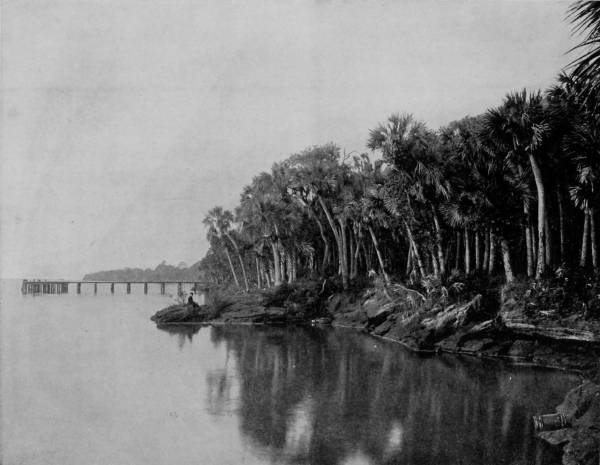
ROCKLEDGE, ON INDIAN RIVER, FLORIDA.—Rockledge is a resort of great popularity, but of no commercial importance, for it does not contain a single store. For beauty it is almost unrivaled, being richly adorned by nature and lavishly ornamented by the arts of man. The large cabbage palmettos that grow up wildly along the coquina banks were suffered to remain, and between them avenues were laid out and covered with shells, so that from the river there is a long prospect of gleaming walks ramifying a shore of brilliant green. Here also the orange grows to its most delicious perfection, likewise the lemon, banana and grape fruit; and such a breeze of perfume greets the incoming passenger as paradise itself might exhale.
470
SPOUTING ROCK, NEAR JUPITER.
As a rule the banks are covered with spiney-palmetto, which is almost as difficult to eradicate as Canada thistle, and hence few attempts are made to reclaim the land, as the cost of clearing exceeds the value. But at occasional intervals the banks are diversified with orange groves, and bananas are also raised to some extent, but the chief industry is fishing, for the river abounds with sheephead, pompano, mullet, cavalli, and green turtles. Rockledge is a resort of great popularity, but of no commercial importance, for it does not contain a single store. For beauty, however, it is almost unrivalled, being richly adorned by nature and lavishly beautified by the arts of man. The large cabbage palmettos that grow up wildly along its coquina banks were suffered to remain, and between them avenues were laid out and covered with shells, so that from the river there is a lovely prospect of gleaming walks ramifying a shore of brilliant green. Here also the orange grows in its most delicious perfection, likewise the lemon, banana, and grape fruit; and such a breeze of perfume greets the incoming passenger as paradise itself might exhale.
471
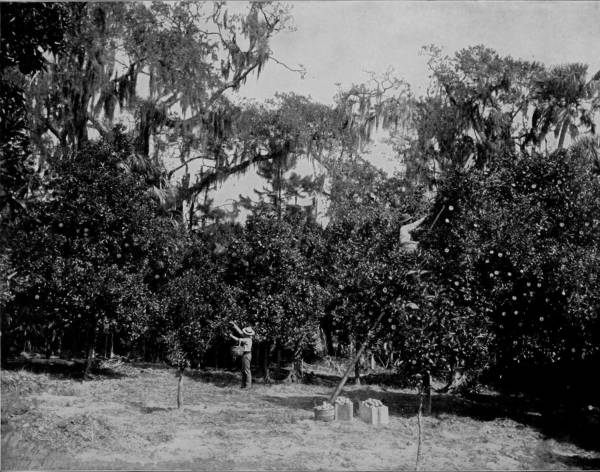
ORANGE GROVE AT ROCKLEDGE, INDIAN RIVER, FLORIDA.—A trip down Indian River is a journey that all the speech of imagery and adjective cannot justly describe. It is here that the orange reaches its best perfection, and on every hand are groves laden with the yellow fruit, while the more modest banana bush bends beneath the weight of its own deliciousness, and pours out its honey to the bees in rich extravagance. Nature is so luxurious in her productions that she supports nearly all the plants and trees and flowers belonging to this delightful climate, so that within the limits of an orange orchard may be found nearly everything that grows in the semi-tropics.
472
LAKE OKEECHOBEE, FLORIDA.
The river at Rockledge is nearly six miles wide and furnishes the finest sea for sailing, for the salt-air is present, and the dangers of heavy billows are absent. Across this expanse lies a broad strip of land which is divided by another lagoon called Banana River, along which is a charming vista of wood that has been named by some admirer Fairyland. This strip of forest-growth is beautiful enough to justify the name, and wandering through groves of oranges, palms, magnolias and paw-paws, on shell-walks of snowy whiteness, fancy pictures a troop of dryads picnicking among the trees, and drinking nectar from flaming begonia flowers that sprinkle the woods with scarlet. At the lower end of Fairyland is a natural park in which gnarled oaks spread their giant shadows over a lawn of grasses, and on the margin is a grove of pine-apples, the fragrance of which almost stifles the odor from the orange-blossoms. A single cottage is the only habitation in this poetic retreat, before the door of which are lofty paw-paws waving their feathery crests, and a gigantic rubber, or banyan tree, whose branches woo the soil and have taken root therein. Only one other specimen of this remarkable tree, of equal size, is found in the United States, and it, too, is a native of Florida, being one of the chief curiosities of Key West. There are other species that exhibit a disposition to fix the points of their drooping branches in the ground, but it is peculiar to the banyan to send out shoots from its main stems, which, instead of growing upward, point straight down, and even before reaching the ground the ends put out root-tendrils, which strike into the soil and firmly attach themselves as soon as they reach the earth. As the boat proceeds southward from Rockledge the way grows in interest, for we soon reach what may be called “the region of water-fowls.” Ducks, coots, water-hens, absolutely cover the river’s surface, while pelicans increase in number until we reach Pelican Island, where they swarm by thousands. The rising of water-fowl before the boat is a wondrous sight, and the beating of their wings on the water produces a sound like a heavy fall of hail on a dry clap-board roof; there are positively millions, and the commotion which they create is almost pandemonium. Another remarkable sight which we witnessed was a school of porpoises that had strayed into the lagoon (for they are not commonly found there) which, being frightened by the boat, made a retreat across the river in such precipitation that the shallow water was beaten into foam, leaving a streak of white behind them that marked their course some time after.
473
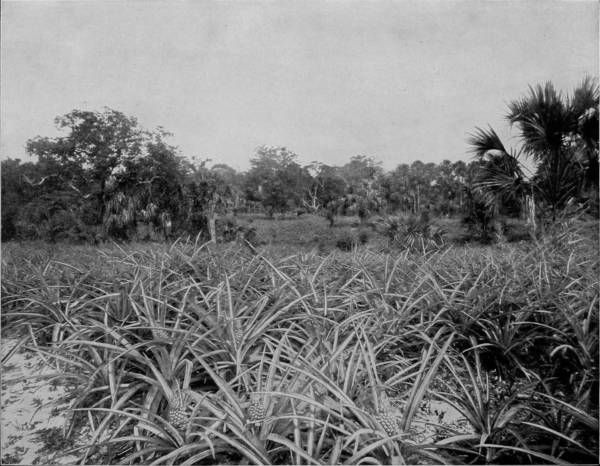
A PINEAPPLE GROVE ON INDIAN RIVER, FLORIDA.—A pineapple grove is one of the most enjoyable places in the world. The broad green blades of the plants, the golden reddish yellow fruit, and the pleasant odor that fills the air form a combination of the most delightful character. No one can fully appreciate the delicious flavor of the pineapple until he has plucked it ripe from the plant and eaten it on the spot. The fruit that goes to market is cut when only half ripe, and thus loses the best part of its flavor, and is spongy and tough in comparison with that which is allowed to mature before being gathered.
474
A CAMP OF CONSUMPTIVES, NEAR LAKE WORTH, FLORIDA.
The character of the shore vegetation also changed, the spiney-palmetto giving place to mangroves that grow so thickly a man might almost walk on their tops. In these deep forests wild game is abundant, including deer, bear, panthers and ’coons; and on our journey we saw a ’coon that had so little fear it scarcely moved even when the boat brushed the limb upon which it sat. When night falls upon these solemnly somber deep woods a sense of dread steals on the traveler, though he be in a gay crowd on a good steamboat. The river narrows for nearly ten miles through the mangrove thickets, and during this interval the banks are within reach from both sides. The passage is tortuous, too, and the boat requires slow and careful handling, frequently the bow striking one bank and the stern the other, while the electric bull’s-eye light penetrates and flashes like a Druid’s fire dance in the tangled copse where many slimy and uncanny things have their haunts. An alligator’s grunt, a loon’s cry, a frog’s hoarse croak, and a snake-bird’s piping are some of the sounds that animate the solitudes, and cracking branches betray the proximity of some wild beast whose eyes are like lanterns in the darkness.
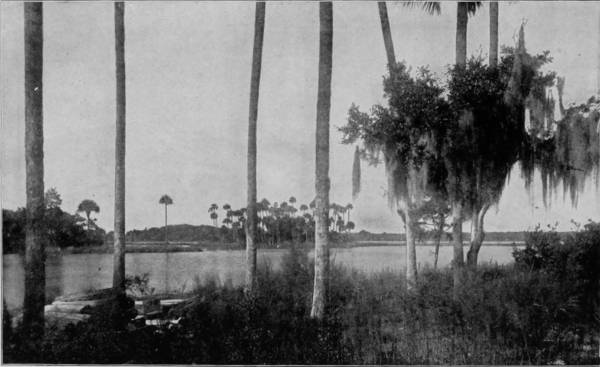
After hours of patient working, Jupiter Narrows are passed and the boat speeds on, her iron hull often grinding on the oyster-beds, and long waves breaking over the shallows. Eden is then reached, and the odor of the pine-apple is perceptible in the air. A stop is made to allow passengers to go on shore and visit the pine-apple grove near-by, where that excellent fruit is cultivated successfully by a gentleman who first lost a fortune in the experiment. A mile below Eden St. Lucie Sound and River extend several miles inland towards Lake Okeechobee, twenty-five miles distant. It is proposed to connect the lake with this river by means of a canal, and thus drain the swamps and everglades of Southern Florida. Another shorter canal on the west would connect the lake with Caloosahat River, and thus two outlets would be afforded, which would speedily accomplish the purpose of the company that has undertaken the enterprise.
475
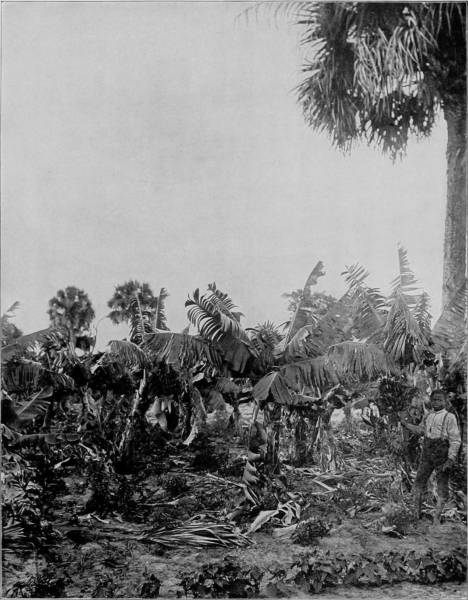
A BANANA GROVE IN FLORIDA.—The banana plant is one of the most beautiful growths that can be imagined. Its broad, luxuriant leaves are of a bright green color, changing to maroon and orange as the season advances and the fruit begins to ripen. The latter, when it reaches the delicious yellow stage of full maturity, does its part in helping to dress the field in the most beautiful livery of nature, presenting a scene of gold, green and maroon surpassing the powers of pen or pencil to depict or portray. The Spaniards, from a fancied resemblance of the transverse section to a cross, supposed the banana to have been the forbidden fruit, and that Adam saw in eating it the mystery of redemption by the cross.
476
THE ONE-OX SHAY IN FLORIDA.
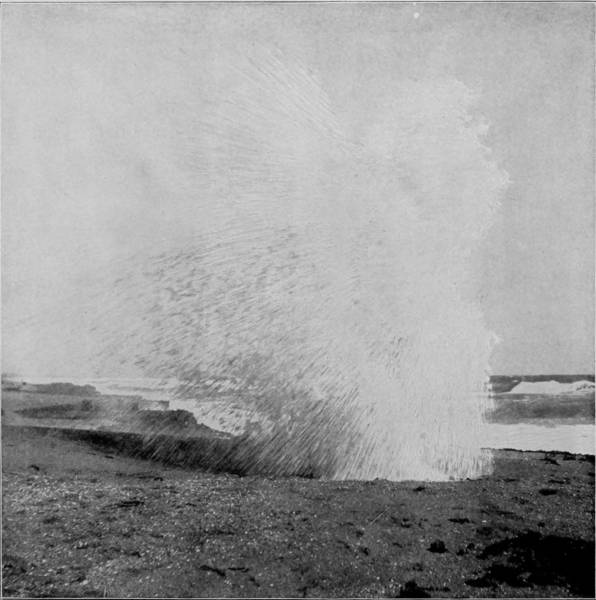
Twenty-five miles below Eden is Jupiter, the southern termination of Indian River, a little town that derives its importance from the Government light-house which stands before the inlet to warn vessels off the dangerous reefs outside. The surroundings, however, are very delightful, especially the beach, which is strewn with the prettiest ocean-shells that ever a pensive person gathered, including an occasional pearly nautilus, a perfect one of which we had the good fortune to find. Near-by is the Spouting Rock, a coquina formation that rises into a bank and which has been hollowed at the base by incessant dashing of the billows. Into this grotto the waves plunge with such force that they drive out through an opening in the top of the rock like a colossal fountain, and are scattered by the winds into a shower of rainbows. A narrow-gauge railroad runs south from Jupiter, a distance of eight miles, to Juno, its terminus on Lake Worth, where tourists take a steam launch for Palm Beach and are then in the land of the cocoanut. The voice of eloquence grows coarse when it attempts to paint the beauties of this o’er fair summer-land; a land where warm zephyrs stir the hazy air with breath of perpetual bloom, and sensuous perfumes fan the cheeks of languorous day. In this Arcadian spot of beauty, where the air is passionate as a lover, wooing and kissing the flowers, tossing and embracing the fronds of the cocoa-trees, there is a joy like retrospection; a communion with the rapturous soul of nature; a commingling with the creatures of our sweetest fancy; a balmy, delicious sense of gratification that lulls and etherealizes; that bridges the gulf between the real and the ideal; that builds substantial castles in clouds of gold, and makes everything a slave to our desires. The banks are pictures of beauty, the gardens are beds of perennial delight. Lake Worth is separated from the ocean by a strip of land less than half a mile wide, and this narrow tongue of what was once bare sand has been converted into a stretch of tropical exuberance. For a distance of four miles there is an unbroken glade of cocoanut-trees, while nearer to the sea-shore are banana groves, and trees bending to the ground with guavas, sapodillas, oranges, lemons and other tropical fruits. At intervals there are gardens full-bearing in February with beans, peas, tomatoes, and along the walks are flower-beds that flame with color and lade the atmosphere with nature’s incense. To walk through such a grove of fruitful delight is to fill the heart with ecstasy.
477
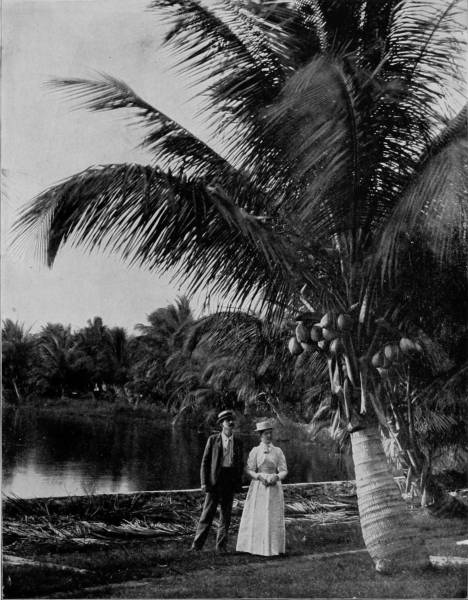
A COCOANUT GROVE ON THE BANKS OF LAKE WORTH, FLORIDA.—There are but few of the wants and conveniences of mankind to which the cocoanut palm does not contribute something. Without exception it is the most useful tree in existence. It attains a height of sixty to one hundred feet, and a diameter of one to two feet; while it is resplendently crowned with numerous feather-like leaves from eighteen to twenty feet long. The flowers come in clusters, and at first have a beautiful milk-white appearance, which, however, soon changes to a yellowish color. They are beautiful for their varied combinations and great number rather than from any individual grace. Each tree will produce from eighty to one hundred nuts per year.
478
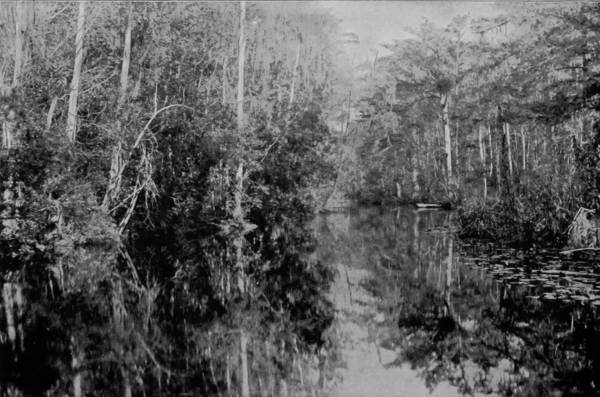
SCENE ON THE OKLAWAHA RIVER, FLORIDA.
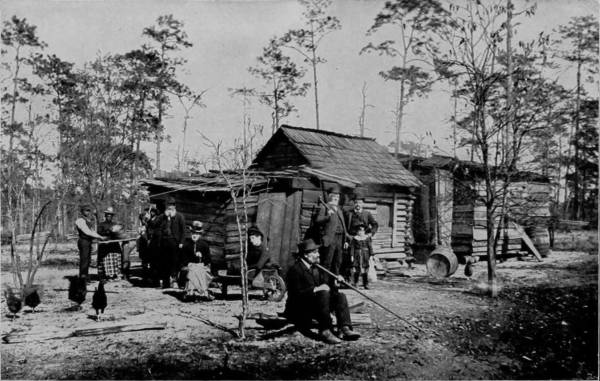
The air of this southern region is not only languorous but, in the piney districts particularly, is balsamic, and hence thousands of consumptives go to Florida for relief which they cannot find elsewhere. The Everglades are not what they were formerly pictured to be before exploration revealed that instead of impenetrable swamps they are sections of very thickly timbered lands, whose only drawback are spiney-palmettos, which render travel through them very laborious. But at several places I saw parties of consumptives encamped not far from Indian River, and also in the vicinity of Lake Worth, where they spent their time in hunting and fishing, and claimed great benefits from the exercise as well as from the restoratives contained in the air.
Returning from our trip down Indian River, we left the steamboat at Titusville and took train for Enterprise, at which point we embarked on boat for a run down the St. John’s River as far as Palatka. The journey was very different from that on Indian River, yet the sensation of pleasure was not wanting, for the stream, though the largest in Florida, is, nevertheless, characteristic, sluggish, rather shallow and margined with a thick growth of timber and brush-wood. The landings, while more important than those on Indian River, are generally small villages whose principal population are negroes. The industries in Florida are not varied as in other States, but consist mainly of fruit growing, fishing and phosphate digging. Manufacturing there is none, practically, and the people derive their largest revenue from tourists, who pay as much for oranges, cocoanuts and pineapples at the places where they are grown as is charged for the fruit in our Northern cities. Yet there are signs of rapid growth in Florida, and the State has a bright future, for it is settling up at a marvelous pace, and with an excellent class of immigrants.
479
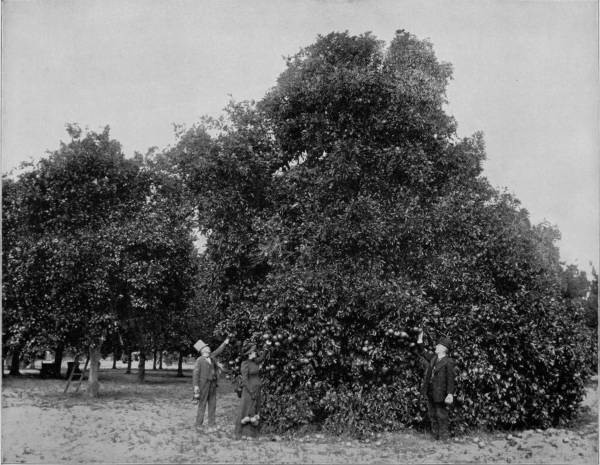
AN ORANGE GROVE NEAR PALATKA, FLORIDA.—A full-grown orange tree, loaded to the ground with its yellow, ripe, luscious fruit, is a delightful object to gaze upon. Oranges do not drop from the trees of their own accord as soon as they are matured, like most other fruits, but they hang by the stem until they are plucked off, and it is said that the longer they remain the sweeter and juicier do they become. Experience seems to prove the truth of this theory, for we have never eaten oranges elsewhere so deliciously sweet as when we took them from the tree with our own hands and ate them on the spot. Owing to the peculiarity of the fruit it is no uncommon thing to see ripe oranges on a tree that is in full bloom for another crop.
480
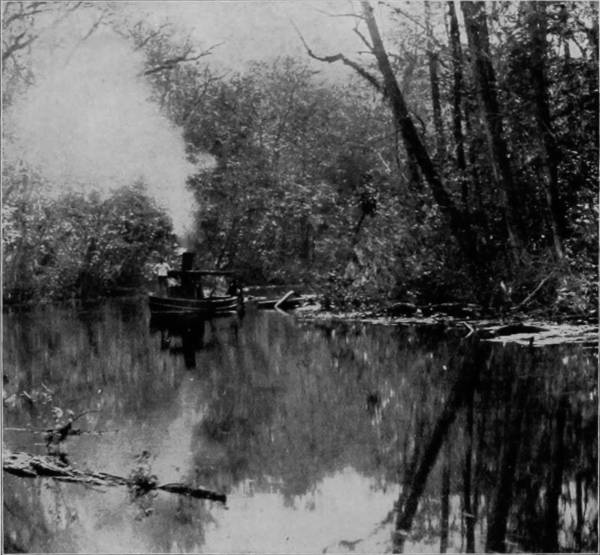
EXCURSION LAUNCH ON THE RUN, FLORIDA.
About Palatka are many very fine orange groves, and the city is in a flourishing condition, largely through the business of fruit growing. In writing of the St. John’s River Mr. Edward King says, with truth well told: “The banks are low and flat, but bordered with a wealth of foliage to be seen nowhere else upon this continent. One passes for hundreds of miles through a grand forest of cypresses robed in moss and mistletoe; of palms towering gracefully far above the surrounding trees; of palmettos whose rich trunks gleam in the sun; of swamp, white and black ash, of magnolia, water-oak, poplar and plane trees; and where the hummocks rise a few feet above the water level, the sweet-bay, the olive, cotton-tree, juniper, red-cedar, sweet-gum, and live-oak shoot up their splendid stems; while among the shrubbery and inferior growths one may note the azalea, the sumach, sensitive plant, agave, poppy, mallow, and the nettle. The fox-grape clambers along the branches, and the woodbine and bignonia escalade the haughtiest forest monarch. When the steamer nears the shore, one can see far through the tangled thickets the gleaming water, out of which rise thousands of cypress knees, looking exactly like so many champagne bottles set into the current to cool. The heron and the crane saucily watch the shadow which the approaching boat throws near their retreat. The wary monster-turtle gazes for an instant, with his black head cocked knowingly on one side, then disappears with a gentle slide and splash. An alligator grins familiarly as a dozen revolvers are pointed at him over the boat’s side, sullenly winks with his tail, and vanishes, as the bullets meant for his tough hide skim harmlessly over the ripples left above him. For its whole length the river affords glimpses of perfect beauty. It is not grandeur which one finds on the banks of the great stream; it is nature run riot. The very irregularity is delightful, the decay is charming, the solitude is picturesque.”
I may add to Mr. King’s description the regrettable fact that the animate scenes which he pictured are no longer to be witnessed on the St. John’s River. The persecution of alligators by travelers on the steamers has resulted in the practical extermination of those curious creatures in that stream. They are now protected by a State law, but it came too late; where alligators were plentiful five years ago they are now a curiosity, though in some parts of Florida, where travel is not heavy, their number is not yet diminished, but every year they are becoming scarcer, and in a little while they will no doubt be extinct. Not only are alligators persecuted for the mere sport of killing, but thousands are annually destroyed by professional hunters for their hides, which make an excellent leather. The taxidermist also finds his business increased by the sale of stuffed specimens to visitors from the North, while great numbers of the young are caught and sold to the lovers of curious things for pets, all of which contribute to their rapid diminution, and their total extinction is therefore a matter of only a short while.
481
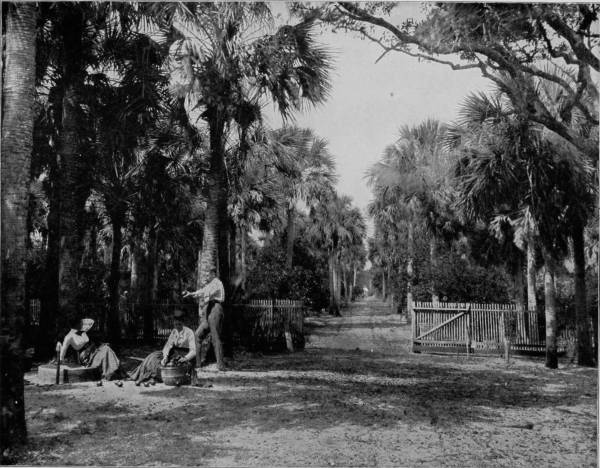
A PALMETTO GLADE NEAR PALATKA, FLORIDA.—The palmetto is intimately associated with the history of the South, having on several occasions been adopted as the national tree and emblazoned on the flags. It has also done good service on many occasions as material for forts and breastworks, the tough and spongy nature of the wood being well suited for such a purpose. No wonder, therefore, that it is regarded with a certain degree of love and veneration by the people who live within the limits of its growth. As a forest tree, or for the ornamentation of lawns, nothing could be more beautiful, as may be inferred from its elegant appearance in the photograph before us.
482
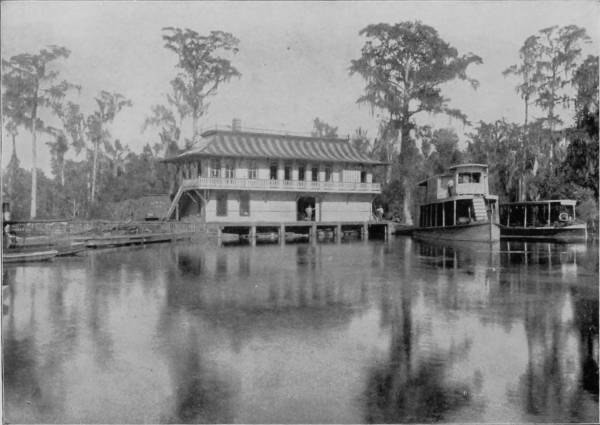
SILVER SPRING AND OCKLAWAHA STEAMBOAT.
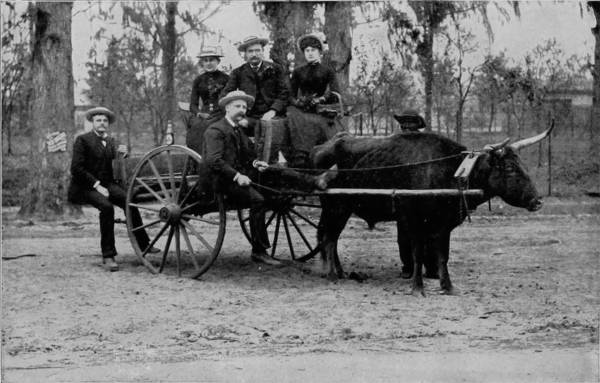
Palatka is a pretty town of 3,500 inhabitants, and situated in the heart of the orange belt. Besides its picturesque surroundings and importance as a shipping point, it is healthfully located on high ground and in the midst of a piney region noted for the blandness of its climate. Florida has been transformed within the past very few years by the Plant railways from a state of comparatively sandy desolation, without roads through its dense growths, into a country of great advantages and thriftiness. Fruit trees have supplanted the coverts of palmetto, and there is health and prosperity abounding everywhere. The “Florida Cracker,” as her languid, backwoods, one-gallus type of slovenly, slow humanity is called, has not yet wholly disappeared, but the transition to more industrious and cultured citizenship is going on, and it is particularly apparent about Palatka. The old-time conveyance of an ox in shafts hitched to a cart of uncertain age is not quite obsolete, but it survives more as a relic than as a thing of every-day service; and people who visit Florida on a winter trip, people in fine linen who are able to fare sumptuously, are more given to using the ox-cart, than are the permanent inhabitants. In the mountain districts of Colorado tourists ride burros; in Florida they affect a preference for the harnessed ox. It is the influence of locality that diversifies custom. Another curiosity in Florida, peculiar alike to Cuba and the tropics generally, is the palmetto hut, an unsubstantial structure roofed and “weather-boarded” with palmetto leaves, but which furnishes protection from the sun and rain. These huts are usually built to serve as temporary abodes for orange-pickers, and are therefore usually within or near the groves. Throughout Florida it is the custom to sell the orange crop on the trees, the purchasers being fruit dealers from the North. These dealers employ trained pickers, who work throughout the season, going from one grove to another, until the gathering is completed; usually they provide their own supplies, likewise their shelter, and the palmetto hut serves them both well and economically. When the fleas become so thick as to crowd the occupants, they burn the hut and build another. It is the cheapest way yet discovered of getting rid of these elusive pests.
483
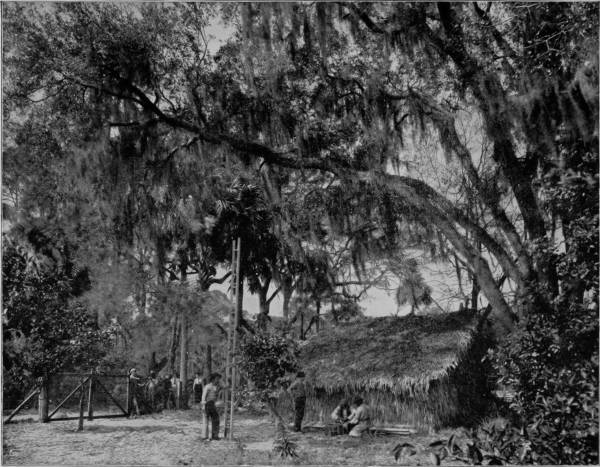
HOME OF THE ORANGE-PICKERS IN FLORIDA.—A curiosity peculiar to Florida, and the tropics generally, is the palmetto hut, an unsubstantial structure roofed and “weather-boarded” with palmetto leaves, but furnishing ample protection from sun and rain. These huts are usually built to serve as temporary abodes for orange-pickers, and are therefore generally within or near the groves. It is the custom to sell the orange crop on the trees, the purchasers being usually fruit dealers from the North. These dealers employ trained pickers, who work throughout the season, going from one grove to another until the gathering is completed. These pickers generally provide their own supplies, likewise their shelter, and the palmetto hut serves them both well and economically.
484
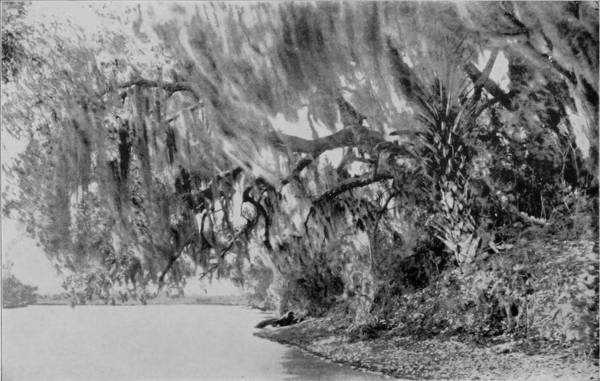
SCENE ON THE SUWANEE RIVER.
At Palatka we took boat for an excursion up the Ocklawaha River to Silver Spring and Ocala, the head of navigation on that stream. Of our many trips in the East, West and South, this proved to be the most unique, the most wonderful, the most sensationally picturesque. Ocklawaha River is at once a lagoon, a narrow lake, and a swamp, but at no place does it have the appearance of a flowing stream, for the current is scarcely perceptible. The shore-line is indicated by a profuse growth of water-vegetation and cypress knees, while at places the river is so narrow that lofty trees interlace their branches above the low smoke-stack of the boat. And what a boat! It is well adapted to the trade, and to that end is unlike any other steamer that ever sat in the water, a thing of indescribable shape, an object of surprise and curiosity. On this queer craft fifty people may ride in comfort during the day, while attention is attracted by the alligators, cranes, loons and snake-birds along the shore, but the night must be spent in vain regrets and fighting mosquitoes. No chance to get lonesome on this trip; there is too much to see in day-time and too much to do at night. But it is a novelty, an experience, a sensation worth more than the discomforts that must be endured. Along the Ocklawaha alligators are still plentiful, because shooting is not allowed from the boat, and there is no other way to approach them within gun-shot distance. The lazy monsters may be seen sunning their corrugated backs on nearly every log, and in their company huge water-snakes are often found, associated with big and little snapping-turtles, the three species forming a congenial but most repulsive family of reptilian cousinship. The water being half-stagnant is black with a vegetable dissolution, and yet so transparent that the bottom may at times be seen. But if the creatures that haunt the river are offensive, the sight is compensated by the wonder which they excite; while the dense woods that margin the shore are resonant with the carol of birds and jewelled with their brilliant plumage.
The trip is remarkably interesting, but the greatest charm that attaches to the stream is found when the boat reaches Silver Spring, the most exquisite pool that was ever rippled by dip of oar or skimmed by lap-wing. Tradition tells us that this is the marvelous rejuvenating spring of which Ponce de Leon heard fabulous tales which lured him to the dark interior of Indian-infested Florida. If his eyes ever gazed into its crystalline depths surely he must have believed that his quest for the magic fountain had been rewarded. The clearness of the water may be likened to the air itself, for at its greatest depth of eighty feet objects on the bottom may be clearly and distinctly seen, likewise the fissure through which the water pours up like a veritable fountain. A peculiarity of the spring is the prismatic colors which are reflected from any white or shiny object thrown into it. To test this curious fact I cast in a piece of broken crockery and watched with keenest interest the fragment as it sank in a zigzag motion to the bottom. No rainbow was ever so brilliant as the colors which flashed up from this piece of saucer, nor did ever jewel gleam with more scintillant beauty.
485
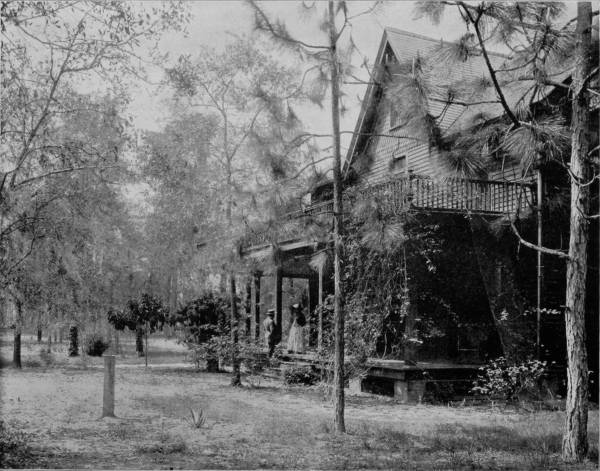
A HOME IN THE SHADES OF SOUTHERN PINES.—If Ponce de Leon and his doughty Spaniards had remained in Florida and built them homes like this, under the shades of the health-giving pines, instead of wading through swamps and morasses in quest of the fountain of youth, they might, and probably would, have lived to be hale and hearty old men. Abodes like this, in the balmy air of the Sunny South, are fountains of life within themselves, where, free from worry and the necessity of making a living, one has but little to do aside from living and growing and being happy. Such homes, with contentment, are more worthy of being sought after than the wealth of a thousand Crœsuses.
486
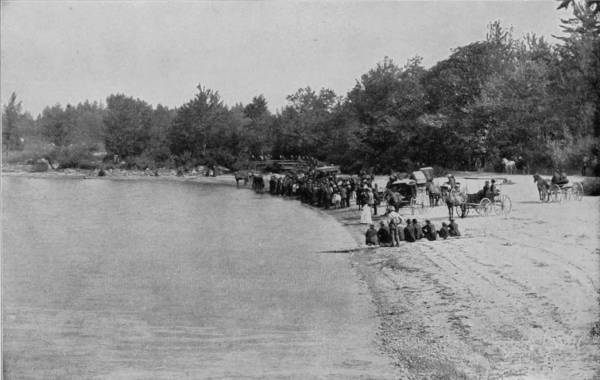
A BAPTIZING ON THE SUWANEE RIVER.
The flow from Silver Spring is so great that a deep river one hundred feet wide is formed, which, after a course of nine miles, joins the Ocklawaha. This stream is called the Run, and a little launch, or tug, plies over this short course, carrying visitors on an excursion which, if brief, is incomparably delightful. Five miles from Silver Spring is Ocala, on the Florida Southern Railroad, to which point we proceeded, and thence north and west by the Savannah, Florida and Western, and the Florida Central and Peninsular railroads to New Orleans. Ocala is on the border or north limit of the hummock lands, and thereafter the journey was through pine-barrens which are so infested with dwarf palmetto that it appears to be an impossible labor to clear it away. This is the home of the deer and likewise of the rattlesnake, very monsters of the latter being more plentiful than game; but north of Gainesville the country presents a change for the better, being much higher and undulating, with hills that are 300 or 400 feet above the ocean level, and the soil is exceedingly fertile. The vegetation, too, loses its tropical character, orange groves disappear, and fields of tobacco and cotton occupy the landscape.
At High Springs we crossed the Santa River, a tributary of the Suwanee; at New Bradford we touched the banks of that historic river, and at Ellaville crossed the stream and halted there a day to pay to it the tribute of a respect aroused in every American heart by Foster’s mournful pastorale, “The Old Folks at Home.” Who has not heard “Way down upon the Suwanee River”? and who hearing the song has not tried to picture the desolate plantation and the dreary heart that went up and down the solitudes of the deserted cotton-field sighing for the old massa and missus, who will never call for Pompey again? In a small boat we rowed down the river, which was as still as death, and almost as motionless. The faint sound of a saw-mill at Ellaville was the only thing that gave reminder of our proximity to civilization; and when at length even this link was broken by distance, it seemed as if all creation had gone into mourning. The spell, while mournful, was yet dreamily charming, and instinctively, under the influence of such lonesome isolation, we sang with the fullness of appreciation, “The Old Folks at Home.” Never before had song such sweetness, never had one so much of sadness, to me; and when the last note died away there was a feeling of oppression in the silence that ensued. The old song brought up visions to which 487we were unused: a fallow-field where once was bounty; a large white mansion with its long porch fallen in decay; a magnolia-tree with a mocking-bird’s deserted nest ready to fall from its dead branches; two grave-stones, green with moss, in the pasture, and an old darkey bowed in prayer. The Suwanee has its source in Okefenokee Swamps, Georgia, and after running its course of nearly three hundred miles, empties into the Gulf of Mexico, just above Cedar Key. At some places the river has considerable width, but never sufficient depth to permit of navigation by any craft of considerable size. Its banks are occasionally high, as at Ellaville, but generally they are flat and overhung by oaks thickly festooned with moss. The current is sluggish and the water seldom clear, carrying as it does a thick vegetable solution. The stream is neither beautiful nor romantic, save as it acquires the reputation for being both through the song that has made it as famous as our largest rivers.
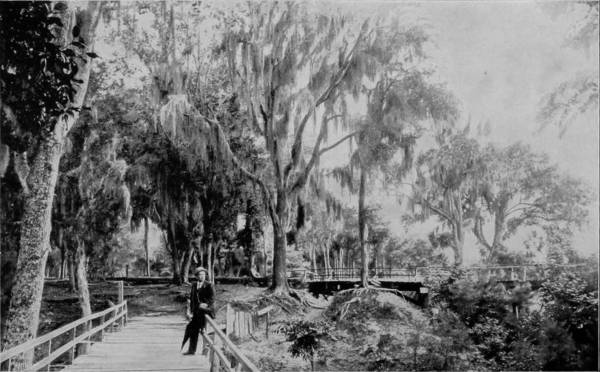
A SECTION OF BIENVILLE PARK, MOBILE, ALABAMA.
The country about Ellaville is fairly well settled, though the place itself hardly ranks as a hamlet. We arrived on Saturday, and as no trains run on Sunday we were compelled to remain over, and attended church in the forenoon and witnessed a baptizing later in the day. The administration of the ceremony proved to be a great event in the unruffled lives of the people, and many came long distances to witness the immersion of four candidates, three women and a man. The sight of a baptizing, while common enough, possessed for us unusual interest because the place was Suwanee River, and having the consent of the officiating minister, we took a photograph of the crowd on shore, a heavy cloud overcasting the sun immediately after, so that a picture could not be made of the baptizing. From Ellaville our journey was continued westward through Tallahassee and on to Mobile, where a short stop was made, and thence to New Orleans. Mobile is not only one of the oldest towns in the South, but is among the earliest settlements in America, the exact date of its founding being in dispute. The place is known to have been the original seat of the French colonization in the Southwest as early as 1702, but its growth was so slow that the Colonial Government was transferred to New Orleans in 1723, and with the change, the little importance which it had acquired became lost, nor was it again recovered until the place became a rendezvous for corsairs under the infamous Lafitte, from 1810 to 1815. Its greatest prosperity, however, dates since the civil war, though some 488years preceding that troublous period Mobile had become a considerable port, her chief shipments being cotton, coal, lumber and naval stores.
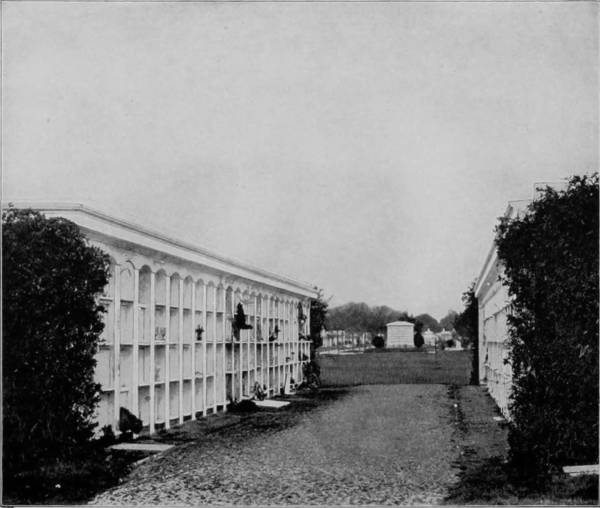
AVENUE OF TOMBS IN WASHINGTON CEMETERY, NEW ORLEANS.
The entrance to Mobile Bay is commanded by Forts Morgan and Gaines, which are thirty miles below the city, and on the east side of Tensas River are the ruins of Spanish Fort and Fort Blakely, all of which played an important part in the defence of the city when it was attacked by Admiral Farragut, in August, 1864. One of the most desperate battles that was fought during the war took place in the harbor, when Farragut ran the blockade with a squadron of ten powerful men-of-war headed by his flagship, the Hartford, and encountered the Confederate fleet inside. One of the Union ships ran onto a torpedo and was instantly blown into fragments, but the other vessels met with little opposition until at the moment when Farragut thought the battle won, he saw with surprise the dark body of a strange vessel flying the Confederate flag and bearing down upon him at great speed, evidently intent upon ramming and sinking his ship. The Hartford, by a piece of good luck and skilful handling, managed to avoid the intended blow, and then followed an engagement that has few parallels in fierceness. The strange gun-boat proved to be the Tennessee, one of the most powerful and destructive that the Confederate Government had sent into service. The Union iron-clads closed around their black and terrible antagonist and battered her with their heavy prows of steel until the unequal contest was ended by her surrender. Forts Gaines and Morgan were also captured, but Spanish Fort and Fort Blakely still defended the city, which resisted all efforts at its reduction until April 12, 1865, three days after the surrender of Lee.
Mobile has grown greatly since the war, and now has a population of nearly 35,000. It is situated on a sandy plain that rises into high and very graceful hills. Notwithstanding the barren shore as nature made it, the arts of man have supplied the deficiency of soil and made of the streets bowers of lovely shade, so charming that much of the city’s fame is due to the noble trees that arch all its streets. Bienville Park is one of the prettiest spots in southern lands, noted far and near alike for its massive live-oaks, magnificent magnolias, and handsome fountain, a place swathed in delicious airs and luxurious with the richest and most beautiful vegetation.
489
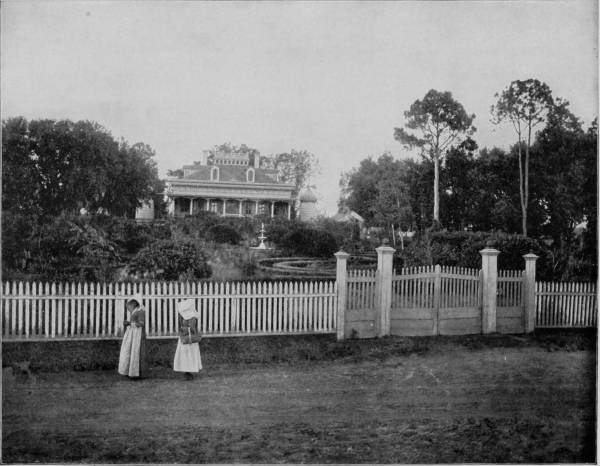
A PLANTATION HOME IN MISSISSIPPI.—This is one of the few old-time Southern mansions that survived the shock of war and still remain as landmarks of the golden age of the South country, when the wealthy planters owned armies of slaves and entertained with a hospitality even more than princely. As a rule these mansions have fallen into decay, even where they were not wholly or partially destroyed, for when the master and his sons left their bones to bleach upon some distant battle-field, the light of the home went out, and the weaker members of the household, reduced in many instances to pinching poverty, sadly but bravely took up the battle of life in less favored localities. But prosperity promises once more to smile upon the South, and the old mansions are being rebuilt, but the old faces are no more seen beneath their roofs.
490Westward from Mobile the route was by the Louisville and Nashville Railroad along the Gulf border of Mississippi, through some of the loveliest intervales that vision ever wandered over. The air is warm without debilitating sultriness, for the Gulf of Mexico tempers the atmosphere with refreshing humidity, and a constant breeze shakes the perfume out of flowering shrub and tree. Many beautiful places are passed on the run of one hundred and forty miles from Mobile to New Orleans, some of which are more or less noted as winter resorts, such as Ocean Springs, Biloxi, Beauvoir, Pass Christian, and Bay St. Louis. Beauvoir has a place in history as being the residence of Jefferson Davis for several years after the war, and where he died. The way is beautified also by many palatial homes and well-cultivated plantations that attest the thrift and prosperity of farmers of the New South.
Between Pass Christian and Bay St. Louis the road crosses an inlet of St. Louis Bay on a steel trestle, and a few miles further west passes over Pearl River and enters Louisiana. The land is level, and cut up by innumerable bayous, and after crossing the narrow outlet of Lake Pontchartrain, called Pigolet’s, the road runs along a tongue of sea marsh for a few miles, then plunges into a dismal swamp, where the alligator’s bellow and the cormorant’s cry are the only sounds that disturb its stillness, save when a train goes growling by. “The sea marsh is dotted with many lakes, where green vegetable rafts of lotus leaves and lily pods turn slowly with the tide or float lazily about, blown by the breath of a salt breeze sweeping in from the Gulf. But in the ghostly gloom of the swamp, the forest trees are like an assemblage of monstrosities, great gnarled trunks and knotted arms of moss-draped oaks, clutching at the fan-shaped fronds of palmettos, while the mixture of crooked bodies and twisted leaf-stems of the latonia appear as if they were the bodies and outstretched arms of horned goblins appealing for release.”
New Orleans is a very old city, settled by the French in 1718. Like other settlements of these early times, it has passed through many evil vicissitudes and been in turn a possession of France, Spain, and the United States. A singular thing in connection with the city is the fact that it is built upon ground that is considerably lower than the surface of the Mississippi during high water, and that it has no more substantial foundation than an alluvium deposit which has been going on for centuries, constantly extending into the Gulf, the point of outlet of the Mississippi. To prevent overflowing, the city is protected by a dyke, or levee, which is fifteen feet wide and fourteen feet high. This earth-wall follows the river’s crescent winding a distance of ten miles, while another extends across the rear to protect the city from Lake Pontchartrain. To secure a firm foundation for some of the large buildings, cotton-bales have been used on which to build, as piling is of no service. But that this character of basis is no disadvantage is proven by the fact that New Orleans is noted for its mammoth edifices, public, church and commercial, which give no sign of insecurity. The place is essentially cosmopolitan, for in no other city is the population more mixed, nearly every street being occupied by a different nationality. Commercially it is next to New York as an export city, and easily holds the honor of the leading cotton port of the country, from which one-fourth of the world’s supply is floated. She is likewise a city of many charms and great historic interest. Within the city proper occurred a terrible scene following the rebellion of 1763, when France ceded the place to Spain, while at its southern outskirts is the battle-field on which Jackson won his glorious victory over the British under Packenham, January 8, 1815. The city passed through another storm of shot and shell in 1862, when Farragut compelled its capitulation after a terrible bombardment. But these scars have long since healed, and New Orleans, despite plagues and wars, has held her position as Queen City of the South and one of the great metropoli of America, with a population now of 250,000, which is rapidly increasing. While New Orleans is famous for the romance with which her history is invested, for her immense importance as an export city, and also for the beauty of her parks and magnificence of her private residences, the curiosity of strangers is no less attracted by her cemeteries, which are unlike those of any others in the world. In earlier times it was the custom there to bury the dead in shallow graves, but this practice was finally abandoned for the more sacred and sanitary one of enclosing the bodies in tombs above the ground, and then hermetically sealing up the mortuary cell. This became a necessity because of the nature of the soil, where water is reached at a depth of two feet below the surface. Some of these tombs are mausoleums made of stone or iron and of beautiful architectural designs, but the more common form of disposition of the dead is in a wall pierced by cells large enough to contain a coffin, one above the other, to a height of seven or eight feet. There are thirty-three such cemeteries in New Orleans, in one of which (Greenwood) is a monument to the Confederate dead; and in another, the National, at Chalmette, the Union dead are similarly honored.
491
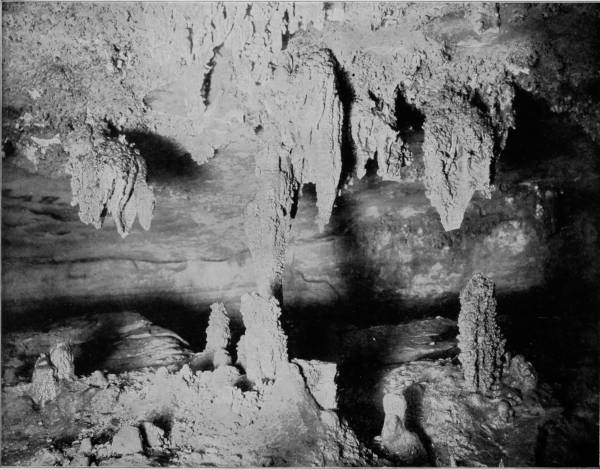
FAIRY GROTTO, MAMMOTH CAVE.—There is a remarkable absence of stalactitic formations in Mammoth Cave, Fairy Grotto and the Maelstrom being the only points where they are found in any quantity. But on the other hand, it contains an unexampled wealth of crystals of endless variety and incomparable beauty. There are halls canopied with fleecy clouds, or studded with mimic snowballs, and others displaying various grotesque resemblances on the walls and ceilings. Two avenues, each a mile long, are adorned by myriads of gypsum rosettes and curiously twisted crystals, called “oulopholites,” or cave-flowers, which are unfolded by pressure like a sheaf of wheat forced through a tight binding. This charming embellishment of clusters and garlands is frequently seen curling outward, like roses, composing petrified bouquets that cover the snowy arches.
492Having completed our work in New Orleans, and a tour of the Southeast, or at least that portion which is noted for its semi-tropical characteristics and great picturesqueness, we took train on the Louisville and Nashville Railroad for Mammoth Cave, to make an inspection and photographic tour of that world-wonderful natural curiosity. To reach the Cave our route was northeast through Birmingham, Nashville, and thence to Glasgow Junction, at which point connection is made with a little spur of the Louisville and Nashville Road, which runs directly to the Cave, a distance of twelve miles from the Junction. Mammoth Cave is in the eastern part of Edmondson county, Kentucky, eighty-five miles south of Louisville, and its entrance is in a forest ravine nearly two hundred feet above Green River, where the banks are very steep and high. It is said to have been discovered in 1809 by a hunter named Hutchins, while pursuing a wounded bear that had taken refuge in a wide crevice that led directly into a broad chamber of the Cave. The history of this discovery is not sufficiently definite to enable us to know which one of the two points of entrance was thus accidentally found. The present opening used is in the ravine mentioned, but the original mouth is believed to have been the aperture that is nearly a quarter of a mile above, and leads into what is known as Dixon’s Cave, a disconnected branch of Mammoth Cavern.
Luray Caverns are lighted by electricity, so that photographing its many chambers and beautiful stalactitic formations is easily accomplished; but though Mammoth Cave is the largest and best known of the world’s great subterranean recesses, and visited by about 6,000 persons annually, no provision has been made for lighting, beyond the crude method of guides who carry torches and candles. To photograph its dark rivers, avenues, configurations, and strange sculpturings many attempts have been made by the aid of magnesium lights, but without satisfactory results until Mr. Ben. Hains, of New Albany, Indiana, made special and most careful preparations to do the work which had so often failed in the hands of others. Several weeks were spent in the cave testing the powerful artificial lights which he had provided, and by dint of perseverance he was at last rewarded by the most perfect results. To this enterprising gentleman we are indebted for the use of the photographs from which our reproductions are made.
Mammoth Cave first came into notice and importance about the year 1812, when it was discovered that the cave contained vast beds of niter, sufficient, as was stated at the time, to supply the whole population of the globe with saltpeter. Gratz and Williams were the owners, and established a very large industry in collecting the nitrous earth by means of ox-carts and shipping it to Philadelphia, where it was used in manufacturing the gun-powder that enabled us to triumph over England a second time. The region is essentially cavernous, as Professor Shaler estimates that in this carboniferous limestone district of Kentucky “there are at least 100,000 miles of open caverns,” but very few of the five hundred caves and grottoes of Edmondson county contain nitrous earth. On the other hand, there have been very few evidences of prehistoric occupancy discovered in Mammoth Cave, while in Salt Cave, its neighbor, and almost a rival in size, archæologic remains, such as fire-places, burnt torches, sandals, and moccasin-prints are numerous; and in Short Cave, also near-by, the mummified bodies of several small animals and a few human remains have been found. White Cave is half a mile from the Mammoth Cave entrance, and the two may be connected, though the communication has not been discovered. But there is a decided difference in the formations that characterize the two. White Cave is in some respects similar to Luray Caverns in its exquisitely charming variety of stalactites. In the first chamber, “Little Bat Room,” as it is called, we find many lovely creations and a few objects of great interest to paleontologists. In the second room is a piece of stalactitic drapery, which has been very appropriately called the “Frozen Cascade.” “Humboldt’s Pillar” and “Bishop’s Dome” are other wonderful examples of the effects of slowly percolating water bearing lime in solution. In this same cave, some seventy years ago, were found huge fossil bones, of the megalonyx, or giant sloth, bear, bison, and stag, and scattered among these animal remains were a few human bones.
But while the adjacent caves each possess an interest peculiar to themselves, Mammoth Cave must continue to remain the most remarkable cavern in our country, not only for its size, but likewise for the marvels which exploration of its labyrinthine avenues has revealed. To Professor H. C. Hovey’s admirable and scientific description of the Cave I acknowledge my indebtedness for a larger part of the information here imparted, from which, also, liberal extracts are made, though without quotation credit.
493
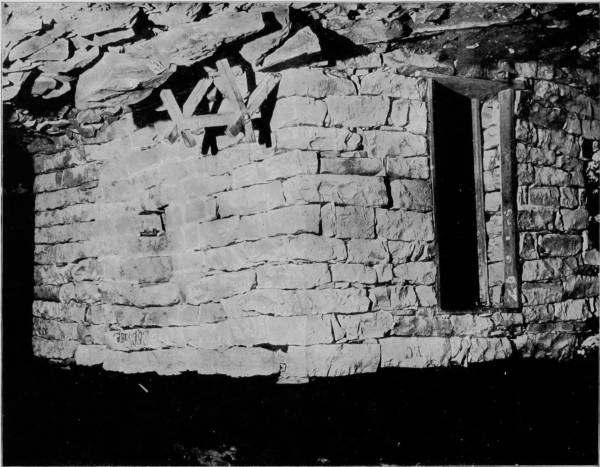
OLD STONE HOUSE, MAMMOTH CAVE.—The dry atmospheric condition of the galleries of Mammoth Cave led to a belief some forty years ago that a continuous residence within these dark precincts for a definite period would be beneficial to consumptives. The experiment was therefore made by building a number of stone houses or huts at a point about a mile within the cave, in which a colony of invalids took up their abodes and lived in deep seclusion until it was demonstrated by the death of several of the sufferers that they derived no benefit from the surroundings. Relics of two of these stone huts still remain, but they exist now only as curiosities, no one having spent a night in either of them for many years.
494The entrance to Mammoth Cave is arched by a rock-span of seventy feet, thence leading by an easy descent down a winding flight of stone steps to a narrow passage through which the air rushes outward with great force in summer and is drawn inward with corresponding violence during the winter, a phenomenon due to the inequality of temperature between the air inside and out of the Cave, for the temperature of the Cave is uniformly 54° Fahrenheit at all times. The atmosphere being thus constantly agitated, is kept constantly pure, for while the lower levels are moist, being no doubt connected with Green River, the upper avenues and galleries are always dry; conditions which were one time thought to be particularly favorable to consumptives, as well as to those suffering from other wasting diseases. The experiment was therefore made, some forty years ago, of building thirteen stone houses at a point one mile within the Cave, in which a number of invalids took up their domicile and lived there in deep seclusion until it was demonstrated that whatever might be the salubrity of the atmosphere, consumptives derived no benefit from it, a number dying in the Cave. Relics of two of these stone huts still remain, but they exist now only as curiosities, no one having spent a night in one of them for many years.
The main cave is from 40 to 300 feet wide and from 35 to 125 feet high, divided into a great number of rooms and winding avenues, the extent of which has not yet been determined, for exploration of the Cave is far from being complete. Some of the best known rooms are, first, the Rotunda, in which are ruins of the old saltpeter works, and where the skeletons of two men were found several years ago. Beyond this is the Star Chamber, where the protrusion of white crystals through a coating of black oxide of manganese creates an optical illusion of great beauty. Another department is called the Chief City, a chamber of nearly two acres space, with a vaulted roof 125 feet high. The floor is bestrewn with rocks, among which have been found charred torches of cone, and a few other evidences of prehistoric occupancy. There are also shown some mummified bodies, preserved by their inhumation in nitrous earth, utensils, ornaments, braided sandals, and other relics, but all of these were found in Salt and Short Caves, near-by, and removed to Mammoth Cave for exhibition. The main cave ends four miles from the entrance, but is joined to other spacious chambers by winding passages leading to different levels, so that while the cavern area is perhaps less than ten miles, the total length of the avenues is supposed to be 150 miles.
The chief places of interest are found along two main lines of the explored portions, from which side excursions may be made. The “short route” may be covered in about four hours, but it requires nine hours to traverse what is known as the “long route.” Audubon Avenue is the first leadway, interesting for the swarms of bats that hang in huge clusters from the ceiling, but it is not until Gothic Avenue is reached that stalactites and stalagmites are met with. This passage leads into the Chapel, at the end of which is a beautiful double dome and cascade; thence we pass into the Throne-Room, with its royal formations of surprising splendors, which compel visitors to stop, and elicit exclamations of wonder and admiration. The Bridal Altar is almost equally grand, with its frosted pillars of pearl-white, and the convolutions of their magnificent pediments that may be likened to clouds in the sky of cave. Indeed, these vertical shafts or petrified columns are among the most surprising features of cave scenery. They are not confined to the Bridal Altar, however, for they pierce through all levels, from the uppermost galleries to the lowest floors, and even find lodgment in the sink-holes.
A block of stone that is forty feet long by twenty feet wide is called the Giant’s Coffin, and when viewed from a certain angle the resemblance to a funeral casket is so great that even if attention were not called to it, visitors would hardly fail to be a little shocked by the sight. There is a narrow passage-way around the coffin, which followed leads to a large vault called Gorin’s Dome, in which there are six pits varying in depth from 65 to 220 feet; truly, awful pits to fall into. Notwithstanding the treacherous character of the floor, Gorin’s Dome is one of the finest chambers in the Cave, for it is charmingly festooned and pillared with stalactitic formations. Mammoth Dome, which is at the termination of Sparks Avenue, is probably more interesting, because besides having its walls draped with a marvelous tapestry, the great wonder of the room is immensely increased and beautified by a cataract, which falls from a height of 250 feet and fills the apartment with its musical splashings. The Egyptian Temple, which is a continuation of the Mammoth Dome, contains six massive columns, two of which are quite perfect and eighty feet high by twenty-five feet in diameter. Lucy’s Dome, which is three hundred feet high, is the loftiest of these monster shafts, the equal of which cannot be found in any known cave in the world.
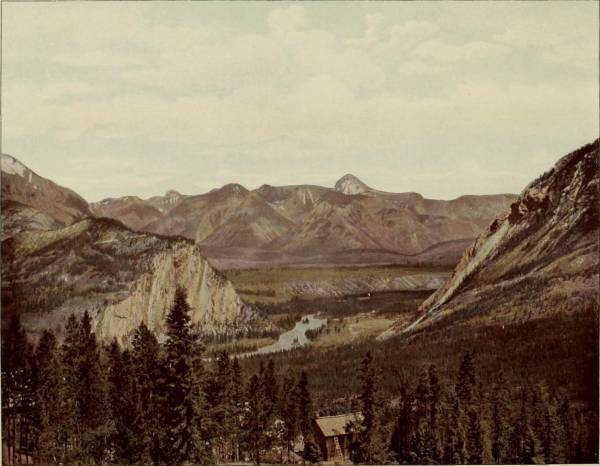
BEAUTIFUL BOW VALLEY.—One of the peculiarly attractive and picturesquely exquisite portions of British America is mountain-begirted Bow Valley, 500 miles east of Vancouver, along the Canadian Pacific Railway line. The region is wondrously diversified and marvelously beautiful, holding within its compass not only a valley of paradisaic charms, but also mountains of startling grandeur, with crystalline lakes reposing on their bosoms, range breaking beyond range, snowy crests gleaming with sunlight splendors, forests tinted with softest hues, streams that murmur and cascades that roar, while the valley is aflame with the richest colorings of daisies, buttercups, bluebells, heather, wild pinks, anemones, and brianthus, a symphony of beauty, a colossal bouquet decorating the marriage-bed of nature.
495
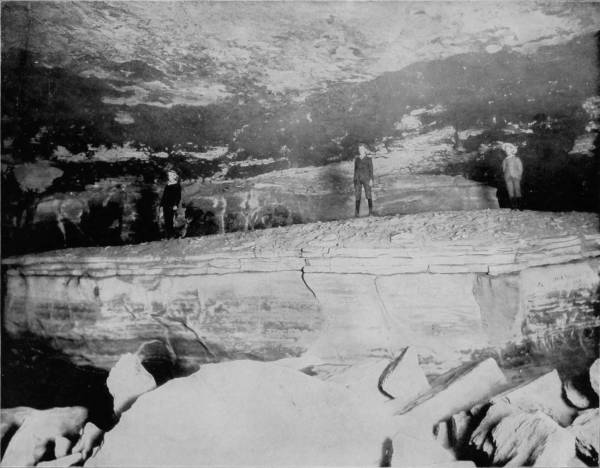
GIANT’S COFFIN, MAMMOTH CAVE, KENTUCKY.—This remarkable and weird curiosity is composed of a huge block of stone forty feet long by twenty wide, and when viewed from a certain angle the resemblance to a funeral casket is so great that, even if attention were not called to it, visitors would hardly fail to be a little shocked by the uncanny sight. Standing within its presence it is almost impossible to divest one’s self of the belief that he is gazing upon the last resting-place of some tremendous giant, the guardian genius, perhaps, of this lugubrious subterranean abode; and it is with a sigh of relief that we pass on to more inspiring and splendid scenery.
496The Maelstrom, in Croghan’s Hall, is one of the deepest and most awful-appearing pits yet discovered, and until 1859 no one had ever ventured to explore its dark recesses. It is at a remote point in the Cave and seldom visited, because the way is beset with obstacles, while the sight is neither reassuring nor compensating. A son of George D. Prentice, however, braved the dangers of the pit by permitting some of his friends to lower him 190 feet by a rope to the bottom, but his experience was of little value, because he found nothing of interest to reward him for the trouble. Some pretty stalactites are near this pit, and also in Fairy Grotto, but in the deeper recesses there is a remarkable absence of these formations. Indeed, considering the character and extent of Mammoth Cave, its poverty of stalactitic ornamentation is surprising. On the other hand, it contains an unexampled wealth of crystals of endless variety and incomparable beauty. Besides the sparkling vault of the Star Chamber, which is 300 feet long and 80 feet high, there are halls canopied by fleecy clouds, or studded by mimic snow-balls, and others displaying various grotesque resemblances on the walls and ceilings. Cleveland’s Cabinet, and Marion’s Avenue, each a mile long, are adorned by myriads of gypsum rosettes and curiously twisted crystals called “oulopholites.” These cave-flowers are unfolded by pressure, like a sheaf of wheat forced through a tight binding. This charming embellishment of clusters and garlands is frequently seen curling outward, like roses, composing petrified bouquets that cover the snowy arches.
This curious feature is even more marked by the stalactites in Mary’s Vineyard, where they appear in the form of an aggregation of spherical prominences, resembling clusters of grapes. Other chambers are drifted with snowy crystals of sulphate of magnesia, and the ceilings are so thickly covered with their efflorescence that a sharp concussion of the air will cause them to fall like flakes in a snow-storm.
Many small rooms and tortuous paths, where danger lies, are avoided as much as possible; but even on the regular routes through the Cave some disagreeable experiences are inevitable, while about the deep pits peril is always present. The one now known as the Bottomless Pit was for many years a barrier to all further exploration, and until a substantial wooden bridge was built across it. Long before the shaft had been cut as deep as now, the water flowed away by a channel gradually contracting until at a point called The Fat Man’s Misery the walls were only eighteen inches apart. The rocky sides are beautifully marked with waves and ripples, as if running water had been suddenly petrified. This winding-way conducts to River Hall, beyond which lie the crystalline gardens that have been described. It was formerly believed that if this narrow passage were closed, escape would be impossible; but a few years ago a tortuous fissure called the Cork-Screw was discovered, by means of which a good climber ascending a few hundred feet finally lands 1,000 yards from the mouth of the Cave, and cuts off nearly two miles.
The waters, entering through numerous domes and pits, and falling, during the rainy season, in cascades of great volume, are finally collected in River Hall, where they form several extensive lakes, or rivers, whose connection with Green River is known to be in two deep springs appearing under arches on its margin. Whenever there is a freshet in Green River the streams in the cave are joined in a continuous body of water, the rise sometimes being as much as sixty feet above the low-water mark. The subsidence within is less rapid than the rise; and the streams are impassable during a greater part of the year. They are usually navigable from May to October, and furnish exceedingly interesting as well as novel features of cave scenery. The largest body of water is called the Dead Sea, embraced within a basin formed by cliffs sixty feet high, above which a path has been made which leads to a stairway and thence to the River Styx, a body of water that is four hundred feet long and forty feet wide. Lake Lethe is the next water-basin, enclosed by walls ninety feet high, below which is a path that conducts to a pontoon at the neck of the lake. Thence a beach of the finest yellow sand extends for 500 yards to Echo River, the largest of all, being nearly one mile long, from 20 to 200 feet broad, and varying in depth from 10 to 40 feet. Two or three boats are placed on this Lethean or Stygian stream, in which visitors are taken from one end of the river to the other, and the trip is of such novelty that the remembrance of it is imperishable. To see the boats approaching, in the weird light of flickering torches, is like a vision of a spectral crew, funereal, sepulchral and almost horrific. The arch overhead is symmetrical but irregular in height, and is famous for its musical reverberations—not a distinct echo, for the repetitions are so rapid that they merge and become a prolongation of sound that continues for nearly half a minute. The long vault has a certain key-note of its own, which, when sounded, produces harmonies of almost incredible depth and sweetness.
497
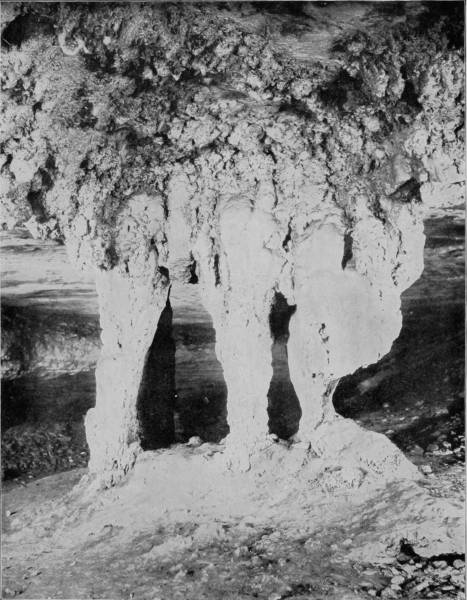
THE BRIDAL ALTAR, MAMMOTH CAVE.—The Bridal Altar is one of the most magnificent spectacles of Mammoth Cave, with its frosted pillars of pearl-white and the convolutions of their magnificent pediments that may be likened to clouds in the sky of the cave. These vertical shafts or petrified columns are among the most surprising and beautiful features of cave scenery, and when brilliantly lighted they present a scene of splendor surpassing the utmost stretch of the imagination. Let us not, therefore, wonder that this is a favorite resort for young married people, who come hither in the rosy blush of their wedding dawn to plight the faith that makes them one for time and eternity.
498In these Plutonian regions of perpetual night, where vegetation is only imaged by petrified efflorescence, many creatures find a congenial abode, and become so accustomed to this dark habitat that they cannot live elsewhere. Of the twenty-eight different species here found, the most remarkable are a blind and wingless grasshopper with extremely long antennae; a blind and colorless cray-fish, and a blind fish which grows to the length of six inches. These fish possess the additional curiosity of being viviparous, or producing their young in a living state, instead of by eggs. Occasionally other fish are caught in the running streams of the Cave which are identical with species common in Green River, thus proving the subterranean connection that exists between that river and the Cave streams.
The strongly marked divergence of these blind creatures from those found on the outside led Agassiz to believe that they were specially created for the limits within which they dwell; but the opinion now generally held is that they are modifications of allied species existing in the sunlight, and that their peculiarities are to be accounted for on the principles of evolution—the process of change being accelerated, or retarded, by their migration from the outer world to a region of silence and perpetual darkness.
Having concluded our examination of Mammoth Cave, we departed by the Louisville and Nashville Railroad for Louisville, at which city train was taken on the St. Louis Air Line for Wyandotte Cave, which was to be our last objective point in completing our extensive photographic tour of America. This very remarkable Cave, though not so generally known as Luray or Mammoth, is about ten miles south of the Louisville and St. Louis Air Line, in Crawford county, Indiana, and is only five miles from the Ohio River. We reached the Cave by way of Milltown, thence to Corydon, and from that point by private conveyance a distance of eleven miles. Entrance to the Cave is by way of a large opening in a hillside, the aperture being about six feet high and twenty feet wide, through which there is always a strong circulation of air like that noted at the mouth of Mammoth Cave, while the temperature is likewise uniformly 54° Fahrenheit. A short avenue leads into a chamber known as Fanueil Hall, whose dimensions are 200 feet long, 50 feet wide and 25 feet high; thence the route conducts through Twilight Hall into Columbian Arch, which resembles a railroad tunnel, so symmetrical is the excavation. Washington Avenue is next entered, which, followed, brings the visitor to Banditti Hall, where the ceiling rises to an immense height, and the walls are jagged, as is the floor, with protruding rocks, so that this chamber is both forbidding in appearance and difficult to traverse. At this point the main gallery branches, one avenue leading to what is known as the Old Cave, and the other conducting by a longer route to more interesting apartments than those before passed. Through a narrow crevice the visitor gains a room called the Bats’ Lodge, and beyond this is Rugged Mountain, which is in the center of a circular room, where Epsom salts of sparkling purity and vast quantities of gypsum in efflorescent beauty cover the arched vault. Seen under torch-light the effect is indescribably magnificent, and is the first striking intimation which the visitor receives of the extraordinary grandeur to which he will be presently introduced. Following the long route we cross a lovely sand-deposit known as the Plain, but find an abrupt termination of this level walk and are compelled to climb the rock-bestrewn Hill of Difficulty, then squeeze through a small passage-way from which we find present relief by emerging into Wallace’s Grand Dome, one of the most magnificent chambers, as well as the largest, in the Cave, being 245 feet high and 300 feet in diameter. In the center is Monument Mountain, a tremendous stalagmite formation above which is an immense dome beflowered with curling leaves of gypsum that bear a wondrous likeness to the foliage of the acanthus. At the apex of the mountain is a stalagmite one hundred and twenty feet in circumference, which has been broken by some force into three columns, which, viewed from the base, admirably counterfeit three monuments, or ghosts clad in robes of gleaming whiteness, from which fact the chamber takes its name. Visitors are usually treated to a superbly grand sight while examining the splendors of this hall, for the guide disposes his company about the base of the mountain, and ascending to the summit he extinguishes his torch in order to bring the visitors under the influence of dense darkness for a few moments. Suddenly the peak is lighted up with a dazzling splendor, as the guide touches off green, blue, red and orange lights, bathing the chamber in a sea of flaming beauty and bejewelling its lofty arch until Aladdin’s Cave of our imagination is reproduced.